Nehmen Sie Kontakt mit Wanhui Company auf


Aktualisiert Juli 2026 Bewertet vom Wanhui Verpackungsteam.
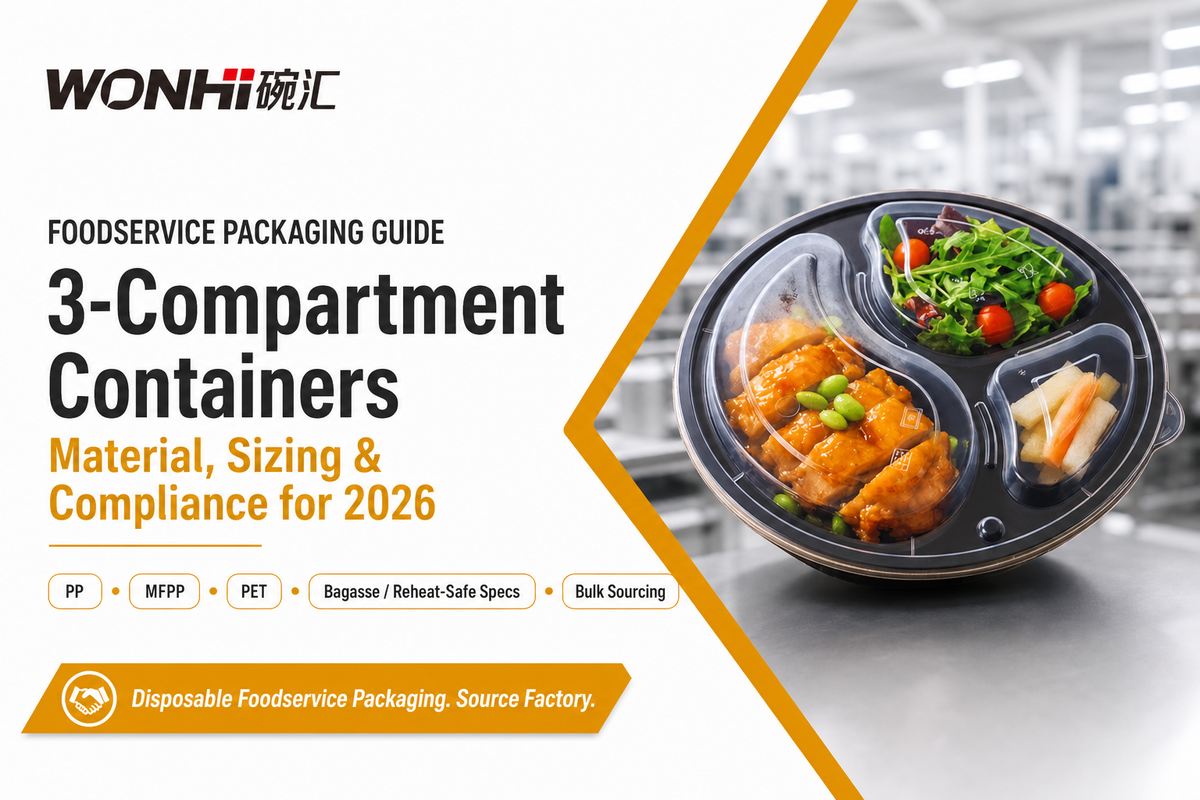
3 Fachbehälter sind einschalige Gastronomieschalen mit drei Innenbrunnen, die einen heißen Eintopf von zwei Seiten oder ein Dessert getrennt halten, und für US-amerikanische Lebensmitteldienstleistungen außerhalb des Geschäftsbereichs sind sie die Formatbetreiber, nach denen Sauce-Bleed, Portionierung und Präsentation greifen Alles ist wichtig auf einmal. Dieser Leitfaden ist für den Käufer geschrieben, nicht für den Browser: Welches Material überlebt Ihren Wiedererwärmungszyklus tatsächlich, wie viele Fächer Ihr Menü wirklich benötigt, warum Soße zwischen den Vertiefungen wandert und wie Sie Ihren nächsten Großauftrag im Rahmen des Schaums und der PFAS-Regeln legal halten jetzt rollen in den Bundesstaaten.
Die kurze Antwort: Ein 3-Fach-Behälter ist ein einteiliges, aufklappbares oder mit Schnappdeckel versehenes Tablett mit drei Innenräumen, in dem sich eine komplette Mahlzeit befindet. Typischerweise ein großer Einlassbrunnen plus kleinere Seitenvertiefungen. Für die Heißlieferung werden mit Polypropylen (PP) oder Mineral gefüllte PP (MFPP) mit belüftetem, umlaufsicherndem Deckel verwendet; Reservieren Sie klares PET für den Kaltservice und behandeln Sie “kompostierbar”als zertifizierte Spezifikation und nicht als Etikett.
Schnelle Spezifikationen: 3-Fach-Foodservice-Container
| Gemeinsame Fußabdrücke | 8×8 in und 9×9 in Scharnier (Quadrat); 9×6 in rechteckiger |
| Typische Brunnenspaltung | ~850 ml Entree + 350 ml + 350 ml Seiten |
| Warmfuttermaterial | PP (#5) / mit Mineralien gefülltes PP (MFPP) |
| Kaltgut | Klares PET (#1) |
| Mikrowellenbewertung (PP/MFPP) | Kurze Nacherwärmung auf ~120°C / 250°F |
| Kofferpackungen | 100 –150 Sätze/Fall typisch |
Was ein 3-Fach-Container eigentlich ist (und wenn das Format gewinnt)
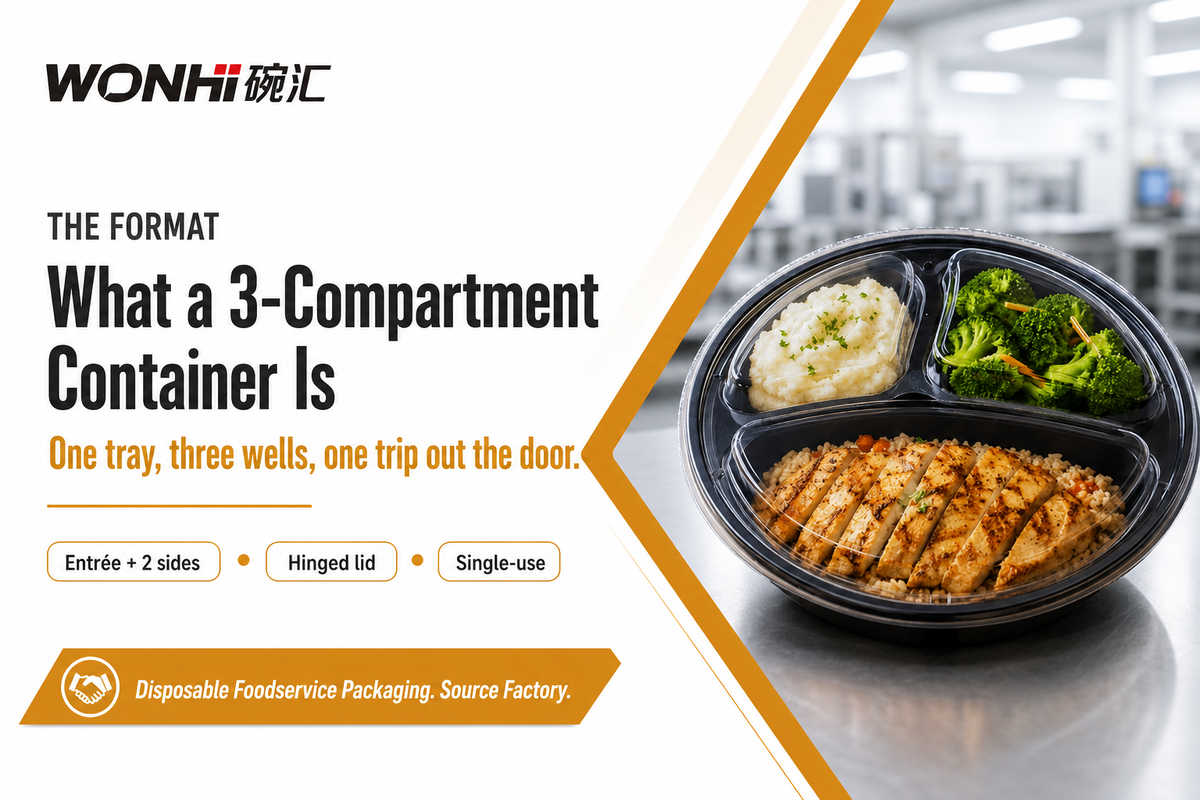
Ein 3-Fach-Behälter ist ein einzelnes Scharnier- oder Schnappdeckel-Tablett mit drei versiegelten Innenbrunnen, die für eine vollständige Mahlzeit dimensioniert sind. „A-line, ein heißer Behälter, der von zwei kalten oder frechen Seiten getrennt gehalten wird. Diese Harze sind gemäß der FDA-Regel für Lebensmittelkontakt geeignet Olefinpolymere (21 CFR 177,1520), was die Sicherheitsgrundlage für PP- und PET-Lebensmittelservice-Tabletts ist, keine Temperaturbewertung.
Dieses Format gewinnt, wenn Ihre Speisekarte eine natürliche dreiteilige Struktur hat und die Saucenmigration den ersten Eindruck des Kunden beeinträchtigt. “Kombinationsmahlzeiten, Mittagessen in der Schule und in der Cafeteria, Essensvorbereitungslieferung und Catering-Teller.”Er ersetzt die Gewohnheit „eine Tasse pro Artikel plus eigener Deckel” durch eine einzige Artikelnummer, die die Arbeit im Pick-Pack reduziert und die Anzahl der Einzelstücke in Ihrem Lagerregal verkleinert.
Es Verlieren Wenn das Menü ein einzelner Artikel mit hohem Volumen ist: Trennwände fressen nutzbares Volumen, sodass eine Burrito-Schale oder eine Flügelreihenfolge in einem 1- oder 2-Fach normalerweise besser ist Mehlzubereitungsbehälter. Praktiker, die diese Tabletts testen, bemerken das Gleiche wiederholt: Käufer geben die Fachanzahl zu hoch an und beschweren sich dann, dass sie “nur Platz verlieren”“ Wanhui kodiert das Format direkt in seine SKU-Nummern. In der Praxis lautet eine 883 als ”8-Zoll, 3-Fach“ und eine 993 als ”9-Zoll, 3-Fach”, die gleiche Logik, die Großhandelskataloge verwenden. In der Praxis hat eine Taqueria mit 400 Lieferaufträgen pro Tag ihre Nasseingänge in Einwegbehälter mit 3 Fächern verschoben und gemischte Beschwerden scharf geschnitten. Das bedeutet, dass die Lebensmittelbehälter auf einem Untertassenregal mit 3-Geräten verteilt werden können.
💡 Schlüssel zum Mitnehmen: Wählen Sie 3 Fächer, wenn das Menü eintritt plus plus ist, und nicht standardmäßig ein. Zwei Fächer ist nur dann von Vorteil, wenn das Essen tatsächlich getrennt werden muss.
Wie viele Fächer brauchen Sie eigentlich? die Compartment-Count-to-Menu-Matrix
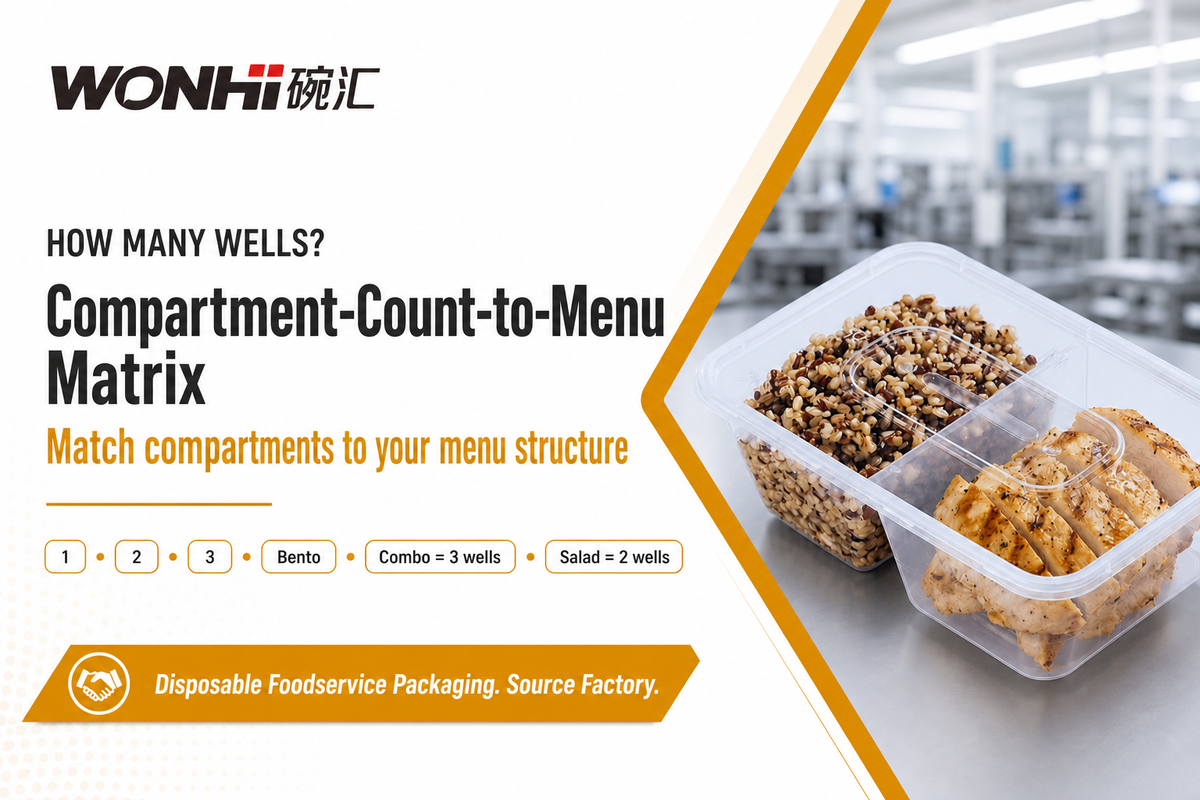
Die Compartment-Count-to-Menu-Matrix ordnet die Menüstruktur der Fachanzahl zu, sodass Sie nach dem Essen angeben, nicht nach dem, was Ihr letzter Händler zufällig vorrätig hat. Ordnen Sie die Anzahl der Artikel an, die physisch voneinander getrennt bleiben müssen; Alles andere ist verschwendetes Werkzeug und verlorenes Volumen.
| Menüstruktur | Graf | Warum |
|---|---|---|
| Suppe, Ein-Protein-Schüssel, Dessert | 1 | Ein Essen, keine Trennung erforderlich; Trennwände kosten nur Volumen |
| Reis + Eiweiß, Salat + Dressing | 2 | Eine Nass-/eine Trockenpaarung; wird oft mit einer Versiegelung pro Vertiefung geliefert |
| Combo-Mahlzeit: Entree + 2 Seiten | 3 | Der Klassiker Fit + Deckel SKU ersetzt drei Tassen |
| Schul-/Cafeteria-Tablettmahlzeit | 3 | Portionskontrollierte Komponenten, auf der Leitung wieder aufwärmbar |
| Essenszubereitung (makrospurig) | 3 | Protein-/Kohlenhydrat-/Veg-Split-Reads als Portionskontrolle |
| Überzogenes Essen im Bento-Stil | 3–4 | Visuelle Vielfalt; siehe die Anleitung zum Bento-Box-Format |
| Verkostungs-/Probenehmerplatte | 5+ | Viele kleine Portionen; Spezialwerkzeuge |
| Großvolumiger Einzelartikel (Flügel, Pommes, Burrito-Schüssel) | 1 | Trennwände blockieren das Volumen, das die Lebensmittel benötigen |
Gut aufgespaltene und SKU-Logik, die auf den Spezifikationen der Wanhui-Produktionslinie basiert; Menüanpassungsmuster werden mit Diskussionen über Lebensmitteleinkäufer abgeglichen.
💡 Schlüssel zum Mitnehmen: Durch die Standardisierung auf einem Fach für ein Menü mit mehr als zwei Speisen werden drei Tassendeckel-SKUs in eine zusammengefasst, was einer echten Beschaffungsersparnis von 3 Produktlinien, einem Einzelpalettenversand und einfacheren Küchenstationen entspricht.
Materialauswahl: PP, MFPP, PET, Bagasse und Schaum im Vergleich
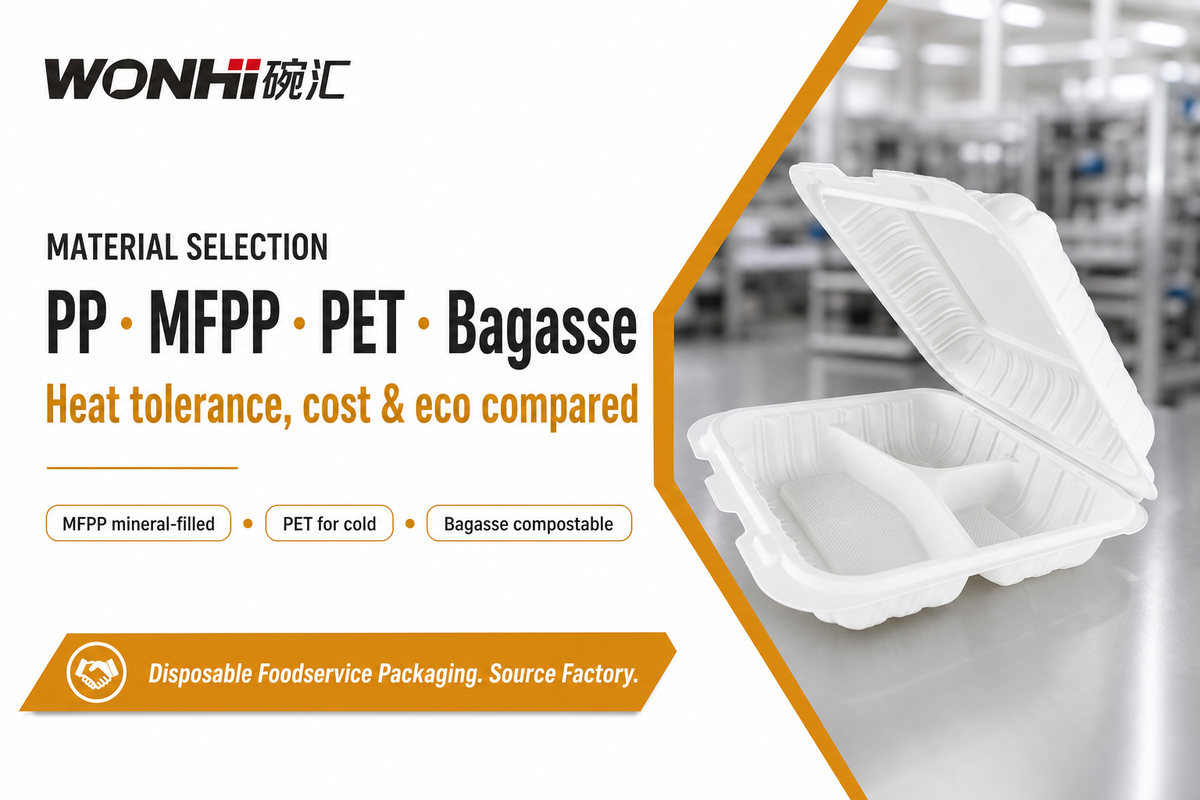
Material entscheidet alles nachgeschaltete – Hitzetoleranz, Mikrowellensicherheit, Klarheit, Recyclingfähigkeit und ob der Behälter in Ihrem Bundesstaat überhaupt legal ist.
Falsch verstehen und die Box schmilzt entweder auf der Aufwärmphase oder fällt durch eine kommunale Schaumstoffregel. So vergleichen sich die fünf Foodservice-Familien tatsächlich.
| Material | Service-temp | Mikrowelle | Am besten für |
|---|---|---|---|
| Polypropylen (PP #5) | Kontinuierlich ~80 – 100°C; Kurzer Ausbruch ~120°C/250°F | Ja (Lüftungsdeckel) | Heißes Take-out, Reisschalen, Lieferung |
| Mineralgefülltes PP (MFPP) | ~110°C/230°F, steifer | Ja | Premium-Scharniert, Schaumstoffersatz |
| PET (#1) | Weich macht ~70 – 75°C (amorph) | Nein | Kalte Salate, Sushi, Feinkostladen, Display |
| Bagasse (Formfaser) | Behandelt warme Speisen gut (~200°C+) | Ja | Kompostierte Veranstaltungsorte (falls zertifiziert) |
| EPS-Schaum | ~70°C; wird schnell weich | Nein | Gesetzlich festgelegt werden (siehe Compliance) |
PP-Serviceproben MatWeb Polypropylen Daten; PET-Erweichung durch Glasübergangsmessung. FDA 21 CFR 177.1520 Richtet die Sicherheit des Lebensmittelkontakts und nicht die Temperatur.
Zwei praktische Notizen, die Spec-Blätter verbergen. Erstens kostet PP pro Volumeneinheit etwa 1/3 bis 1/5 so viel wie PET, auf Gewichtsbasis und auch in Bezug auf Dollar-Kosten pro Gramm Harz. „Auch das ist der Grund, warum praktisch alle US-Küchenpreise bei Temperatur auf PP basieren. Zweitens ersetzt mineralisch gefülltes PP den inerten 30-40%-Füllstoff für Polymer und fügt die Steifigkeit hinzu, die einen Klappdeckel und einen Trennwand schützt, weshalb sich Schaumaustauschlinien anlehnen MFPP-Schwenkbehälter Statt ungefüllte PP.
Die Materialauswahl zeigt sich in den Reklamationsraten, nicht in den Spec-Blättern. Eine Burrito-Bowl-Geisterküche mit dünnen Schaumstoff-Clamshells kämpfte mit ständigen Rückrufen mit verzogenem Deckel und Queso-Spill, bis sie auf schwarzes PP mit umlaufenden Verschlussdeckeln umstellte; Die Beschwerden gingen stark zurück, da die Verpackungskosten pro Bestellung um etwa $0,15 stiegen. Die Bediener wiederholen die Lektion unverblümt: Kaufen Sie das richtige Material für die Hitze, nicht die günstigste Box im Regal.
“Wir haben vierzehn MFPP-Füllverhältnisse über die Linien 883 und 993 getestet, bevor wir uns für die aktuelle Formulierung entschieden haben, es ist die einzige Mischung, die nach 90-sekündiger Mikrowellenwiedererwärmung Form hält, ohne die 3-Kompartiment-Teiler zu verziehen”
Wird es die Mikrowelle überleben? Die Foodservice-Wärme-Temperaturleiter
Sind 3-Fach-Behälter mikrowellengeeignet?
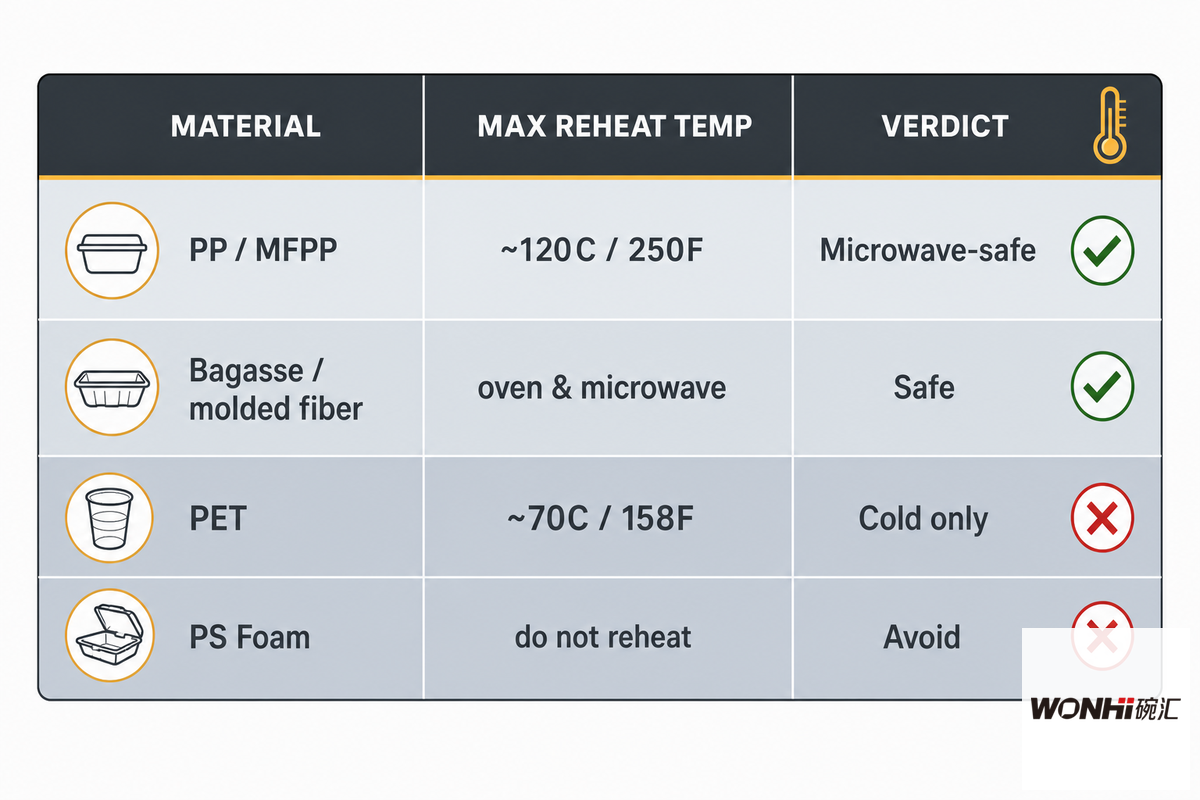
PP und mineralisch gefüllte PP 3-Fach-Behälter funktionieren gut mit kurzen mikrowellensicheren Wiedererwärmungen, bis etwa 120 C/250 F; klares, ungefülltes PET ist es nicht, denn es beginnt nahe 70-75 C zu erweichen, unterhalb der Temperatur von gerade plattierter Suppe oder Reis Bei der Auswahl eines Artikels zum Wiedererwärmen, halten Sie einfach Die Foodservice-Wärme-Temperaturleiter Im Hinterkopf: Richten Sie die Materialbewertung an die tatsächliche Spitzentemperatur Ihres Lebensmittels aus und lassen Sie dann einen Puffer.
- ✔~200°C+ Bagasse-Formfaser- und Dual-Ofen-CPET-Schalen: Dampftisch- und Konvektionsservice.
- ✔~110 – 120°C / 230 250°F PP und MFPP: heiße Suppe, Reisschüsseln, Mikrowellen-Aufwärmgerät Hier lebt Takeout.
- ✔~70 –75°C PET-Decke: nur kalt und umgebungsorientiert; Verzieht sich unter Heißfüllung, niemals in die Mikrowelle.
- ✔~60 –70°C EPS-Schaumboden: wird schnell weicher und wird komplett verboten.
Arbeitsbeispiel: Eine mit ~95°C plattierte Schüssel mit Reis und Curry liegt über dem ~70°C-Erweichungspunkt von PET, aber bequem unter der PP-Kurzbruchbewertung von ~120°C. Sie geben also schwarzes PP oder MF an, nicht klar PET. Die Klarheit ist nichts wert, sobald sich das Tablett verformt und der Kunde einen heruntergefallenen Deckel fotografiert.
Betreiber bestätigen ein Scheitern durch Kundenfeedback, da Kunden anrufen, um zu melden, dass sich dünner Kunststoff unter heißem Essen sichtbar verzieht (was sofort auf ein potenzielles Auslaugungsrisiko hinweist) oder um ihnen mitzuteilen, dass ihre Mehlpräparate ihre Plastikdeckel nicht in die Mikrowelle stellen (was sie verzerrt). und stattdessen von Hand waschen. PP nimmt auch den Frost-zu-Mikrowellen-Schaukel, den die Lieferung von Mahlzeiten vorbereitet, und bleibt geschmeidig im Gefrierschrank und sicher unter einer Nacherwärmung. Die Materialbewertung ist jedoch nur die Hälfte der sicheren Nacherwärmung: USDA-Leitlinien zur Lebensmittelsicherheit Fordert außerdem das Entlüften, Rühren oder Drehen, um die Reste gleichmäßig zu erhitzen, eine Stehzeit zu haben und auf 165°F/74°C aufzuwärmen. Wenn das Wiedererwärmen im Behälter für Ihr Menü wichtig ist, legen Sie die mikrowellengeeigneten Artikelnummern auf Ihre PP/MFPP-Leitungen und beschriften Sie sie deutlich.
Warum Sauce zwischen den Fächern blutet: Die Cross-Compartment-Bleed-Regel
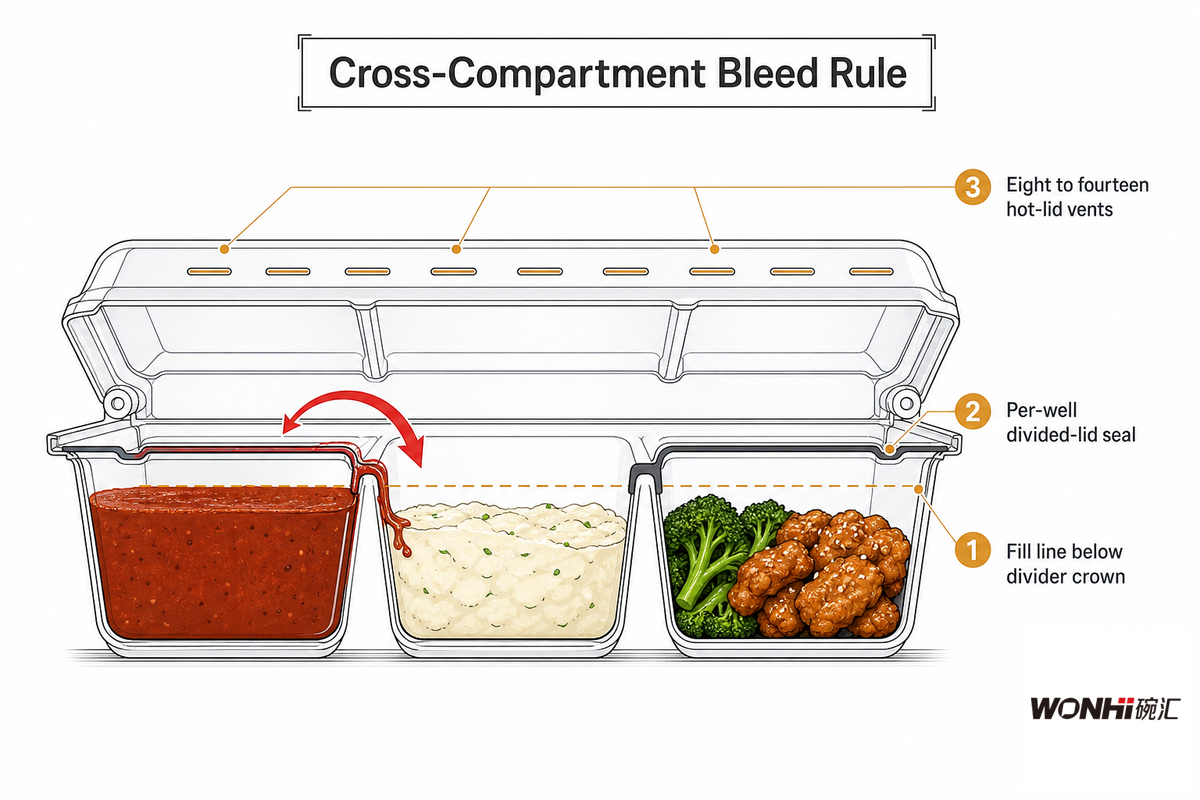
Cross-Fachment-Bleed-One-Dressing oder Soße, die von einem Brunnen in den nächsten wandert – ist die Hauptbeschwerde bei geteilten Behältern, und es ist weit mehr ein Deckel-Dichtung-Problem als ein Teiler-Höhe-Problem. Die meisten 3-Fach-SKUs versenden einen Deckel, der den Umkarton abdichtet, aber nicht jeden Innenraum gut, sodass eine Neigung im Lieferbeutel Flüssigkeit über die Trennwände laufen lässt.
Wie ein Essens-Prepper es ausdrückte, “dichtet der Deckel die Fächer nicht voneinander ab, so dass mein Hummus über alles andere hinauslief”
Die Kreuzfach-Entlüftungsregel: Füllen Sie sie bis unter die Trennhöhe, verwenden Sie einen geteilten Deckel, der die Innenbrunnen unabhängig abdichtet, und entlüften Sie Deckel an Warmfuttergegenständen.
Technische Anmerkung: Durch das Überdichten eines heißen Behälters kommt es zu Undichtigkeiten Schlimmer, Nicht besser. Eingeschlossener Dampf baut Dampfdruck auf, der Reibungsschlösser mit einer Lasche aufwirft. Einzellaschen, die für den Griff nach dem Kaltgreifen entwickelt wurden, sind nach dem Auftreffen der Wärmeausdehnung. Vent ist der allgemeine Fix: USDA-Leitlinien zur Lebensmittelsicherheit Es geht darum, den Deckel zu lösen oder zu entlüften, damit Dampf entweichen kann, anstatt Druck aufzubauen. Ein Patent für Lebensmittelbehälter (Ankerverpackung, US20100320210A1() offenbart 14 Lüftungsschlitze auf der Oberseite als ihr optimales, die auf der Deckeloberseite und nicht auf den Seiten platziert werden, um einen toten Luft-Effekt zu vermeiden. Ein nützlicher technischer Referenzpunkt und kein universeller Leistungsschwellenwert. Für warme, frittierte oder Reisgerichte ist ein belüfteter Deckel der Mehr Auslaufsichere Wahl; Reservieren Sie nicht belüftete Perimeterschlösser für Suppen und Saucen.
Wenn die Sendung stimmt, können wir uns auf eine weitere Hälfte konzentrieren, die die Fertigungskonsistenz ausmacht. Billiges geteiltes PP wird oft mit unförmigen Deckeln geliefert, die sich nicht direkt aus der Box schließen lassen – ein Käufer hatte zehn Behälter und “keines schließt”” Auf der 993-Linie von Wanhui ist der Entre-Brunnen 38 mm tief und die Seitenbrunnen sind 32 mm groß, wobei die Wand 0,55-0,65 mm auf der Linie gemessen wurde, sodass der Teiler langlebig bleibt und seine Form durch eine erneute Erwärmung beibehält, anstatt sich in den benachbarten Brunnen zu entspannen.
Größenbestimmung nach Operationstyp: Der Spec-Selektor vom Operationstyp
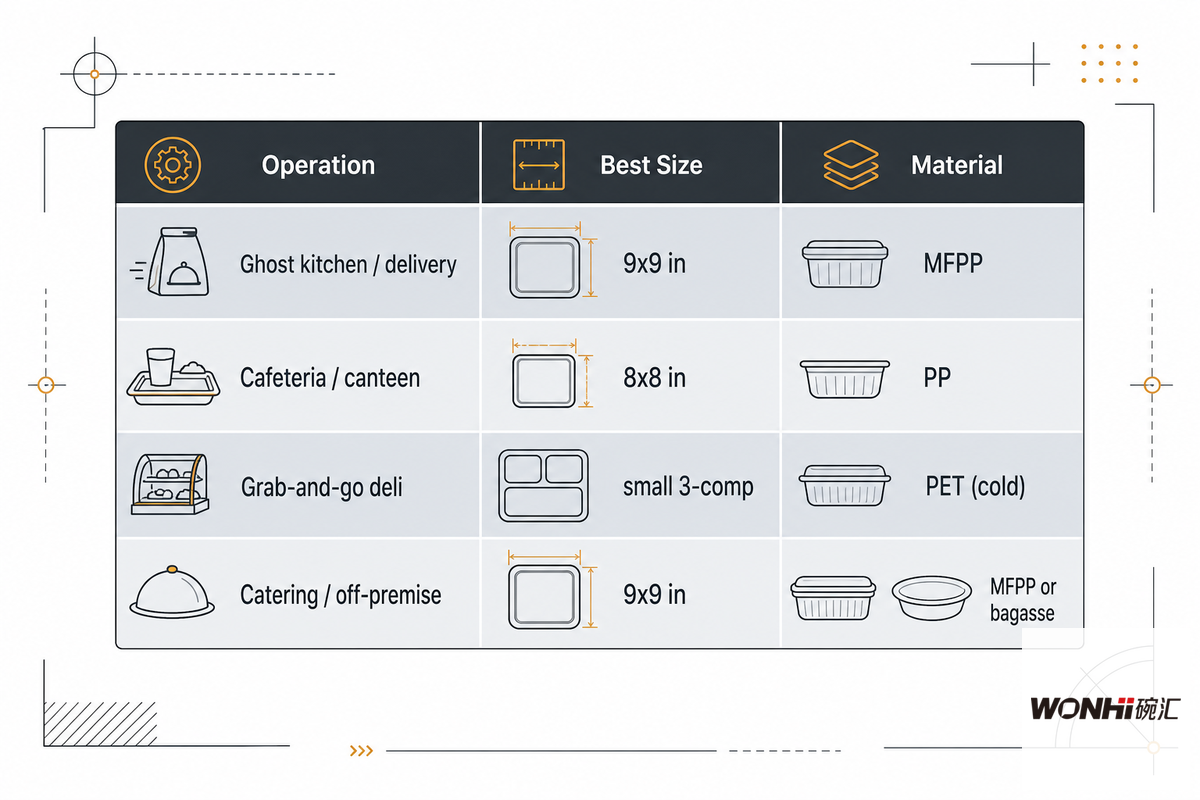
Der Operation-Type Spec Selector liest sich in der Materialtabelle anders herum – beginnen Sie mit dem, was Sie ausführen, und er gibt Ihnen die Anzahl, das Material, den Platzbedarf und das eine Compliance-Flag, das Sie nicht überspringen können. Es ist für die fünf Off-Premise-Operationen konzipiert, bei denen 3-Fach-Tabletts in Volumen gekauft werden.
| Operation | Material | Fußabdruck | Aufpassen auf |
|---|---|---|---|
| Geisterküche (Warmlieferung) | Schwarzes PP / MFPP | 9×9 in | Belüfteter Perimeterverschlussdeckel; überlebt 30 –60 Minuten Beutelzeit |
| Schule / Krankenhauskantine | MFPP | 8×8 in | Reifungsbewertung; Portionskonsistenz |
| Catering / Veranstaltungen | MFPP oder Bagasse | 9×9 in | Stapelhöhe; Veranstaltungsortkompostauftrag |
| Essenszustellung | PP (gefrierschranksicher) | 8×8 in | Gefrierschrank + Mikrowelle mit doppeltem Zoll; Manipulationssiegel |
| Einzelhandel mit Grab-and-Go | Klares PET | 9×6 in | Nur Kühlkette; Klarheit verkauft das Essen |
Fußabdrücke spiegeln die gängigen Wanhui-Werkzeuge mit 3 Fächern wider; Kapazität mit dem abstimmen Fachmaterialentscheider.
Ganz gleich, ob die Bediener sie Mitnahmebehälter oder 3-Fach-Mahlzeitenvorbereitungsbehälter mit Deckel nennen, das geteilte Format ist so konzipiert, dass das Portionieren über eine Schicht hinweg einfach ist. Praktische Details spielen auch noch eine Rolle: Ein geräumiges, aber leichtes Tablett, das sich fest stapelt, leicht zu reinigen ist, wenn es einen Wiederverwendungszyklus sieht, und hilft den Mitarbeitern, Portionen konsistent zu messen, was eine geschäftige Linie bequem hält.
Wiederverwendbar vs. Einweg (und warum “Kauf einfach Glas” ist nicht die Antwort für Betreiber)
In welchem Behälter können Lebensmittel am gesündesten aufbewahrt werden?
Für den direkten Lebensmittelkontakt ist die sicherste Einwegauswahl BPA-freies Polypropylen in Lebensmittelqualität (PP #5) für warme Lebensmittel oder PET für kalte Lebensmittel, beide unter geklärt FDA 21 CFR 177.1520; PP in Lebensmittelqualität ist von Natur aus BPA-frei, da es aus Propylen polymerisiert ist und kein Bisphenol-A enthält.
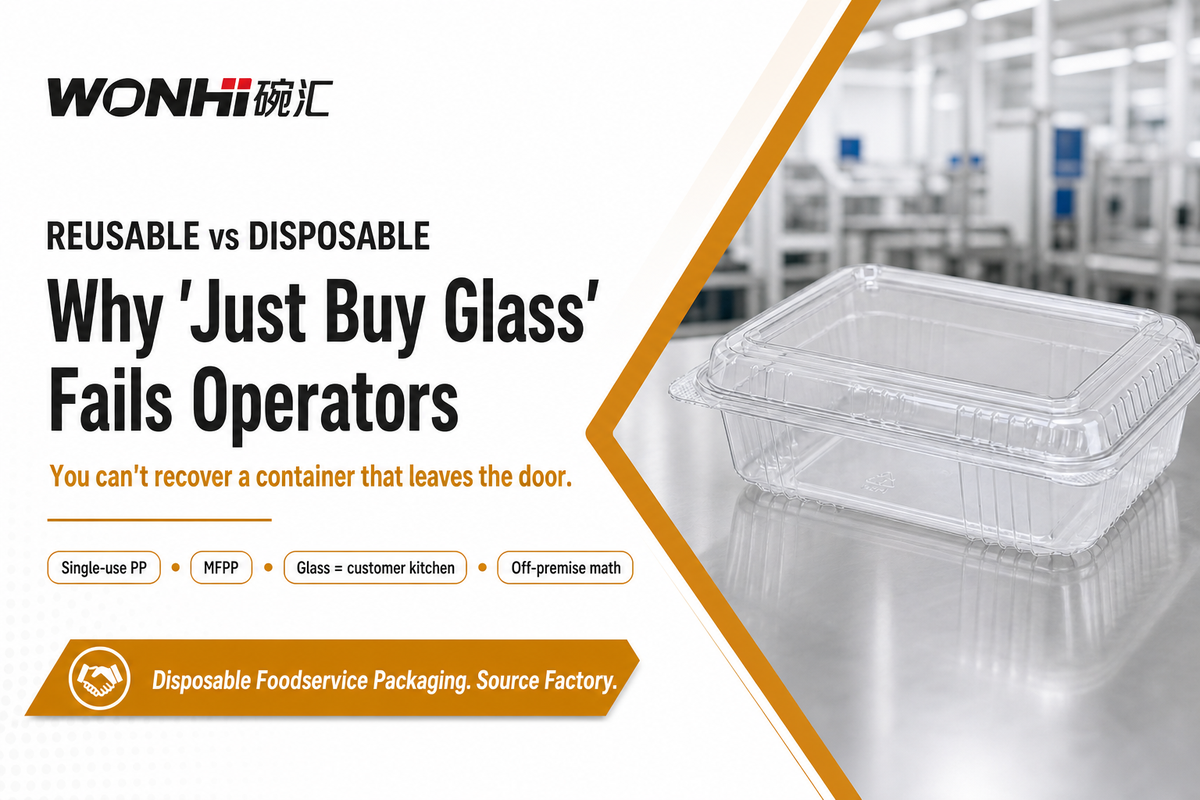
Glas und Edelstahl eignen sich gut für die persönliche Wiederverwendung, beantworten jedoch eine andere Frage als die eines Gastronomiebetreibers. Ein Restaurant, das Lebensmittel an die Tür weitergibt, kann einen wiederverwendbaren Behälter nicht wiederherstellen, daher ist PP/MFPP zum einmaligen Gebrauch, das aufwärmt und eine Versiegelung aufrechterhält, die praktische “gesunde” Option; Glas und Stahl gehören in die Küche des Kunden, nicht in die Liefertasche.
Einweg-PP/MFPP gewinnt, wenn
- Essen verlässt Ihre Räumlichkeiten und kommt nicht wieder
- Der Durchsatz ist hoch und der Arbeitsaufwand zum Waschen ist knapp
- Sie benötigen mikrowellengeeignet, gefriergeeignet und zu geringen Stückkosten stapelbar
Mehrwegglas/Stahl gewinnt, wenn
- Ein geschlossenes Regelkreis- oder Dine-in-Programm stellt den Behälter wieder her
- Der Endverbraucher ist ein Verbraucher, der zu Hause Mahlzeiten zubereitet
- Eine langfristige Wiedererwärmung ohne Verformung ist wichtiger als die Stückkosten
Hausmahlzeit-Preppers, die nach wiederverwendbaren Mahlzeiten-Prep-Behältern oder 3-Fach-Glasbehältern greifen, lösen ein anderes Problem; Diese stapelbaren Sets halten die Lebensmittel im Kühlschrank über eine Woche organisiert, während ein Foodservice-Tablett für einen Ausflug vor die Tür optimiert. Wir stellen Einweg-Lebensmittelservice-Behälter her, nicht aus Glas oder Stahl. Deshalb sagen wir Ihnen ganz offen: Wenn Ihr Betrieb in einem echten Wiederverwendungskreislauf funktionieren kann, ist ein Glas-Set möglicherweise besser für diesen Volumenabschnitt. Für alles, was die Tür verlässt, geben Sie den Einweg per Anwendungsfall an und zahlen Sie keine Prämie für eine Funktion, die der Kanal nicht verwenden kann.
Compliance und Lieferanteneinstellung: Schaumverbote, PFAS und FDA-Lebensmittelkontakt
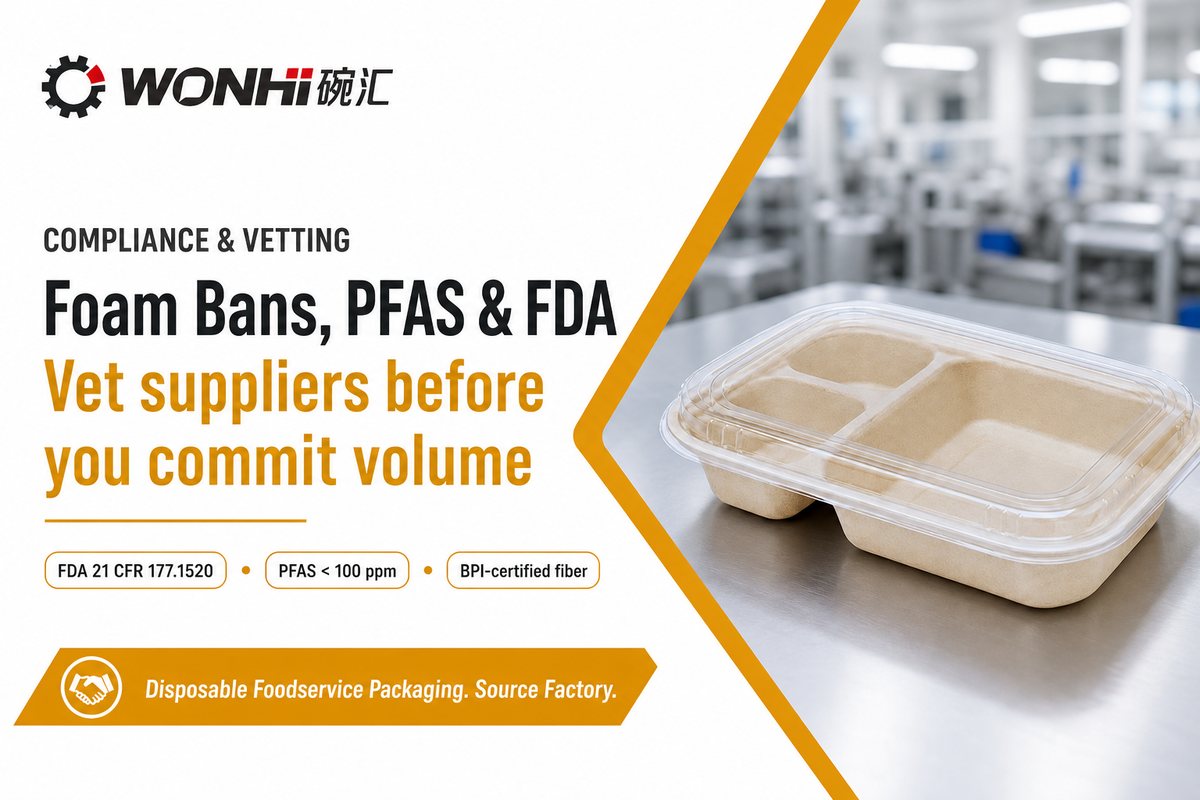
Dies ist der Abschnitt, den die Produktseiten weglassen, und wo eine fehlerhafte Bestellung zum rechtlichen Problem wird Drei Faktoren bestimmen, ob Ihr 3-Fach-Behälter sicher zu kaufen ist: die Schaumvorschriften in Ihrem Bundesstaat, der PFAS-Status von allem “kompostierbar” und die Lebensmittelkontaktdokumentation, die Ihr Lieferant tatsächlich bereitstellen kann.
Schaumverbote sind mittlerweile eine Kaufbeschränkung
Lebensmittel aus Schaumstoff aus expandiertem Polystyrol (EPS) werden in immer mehr Bundesstaaten gesetzlich eingeführt. Zuerst im Jahr 2019 in Maine, gefolgt von NJ, NY, MD, OR, WA, VT, CO, RI und DE. Kalifornien ist der schärfste Fall Fall: unterSB 54, 1 Jan 2025, EPS Foodservice Ware musste eine 251 TP3 T Recyclingrate nachweisen Es versagte, dass Standard, so dass Verkauf, Import, und Vertrieb nach Kalifornien jetzt verboten ist, und die Beratung des Generalstaatsanwalts Zitiert Strafen bis zu $50.000 pro Tag, pro Verstoß Der regulierte “Produzent” kann über den Hersteller hinaus zu einigen Importeuren und Händlern reichen, obwohl CalRecycle Ausnahmen für kleine Unternehmen und den Verkauf von legal erworbenen Lagerbeständen anmerkt, so dass die Beschaffung konformer PP, MFPP, PET oder Bagasse statt Schaum ist jetzt Teil der Überprüfung selbst Bestätigen Sie Ihr eigenes Ansehen, anstatt es anzunehmen. SB 543 (OR) trat ebenfalls im selben Monat in Kraft.
“Compostable” ist nicht gleich PFAS-frei
Pflanzenfaser- und Bagasseverpackungen enthielten in der Vergangenheit einige der höchsten PFAS-Konzentrationen “für immer chemisch”aller Lebensmittelverpackungen, da es keine natürliche Fettbarriere gibt. Daher beschichteten die Hersteller sie, um eine solche zu schaffen. Etiketten bedeuten nichts, Zertifizierungen tun dies. Suchen Sie nach einer BPI-Zertifizierung. Seit dem 1. Januar 2020 sind dafür insgesamt maximal 100 ppm organisches Fluor erforderlich, und eine unterzeichnete Erklärung, die bescheinigt, dass keine absichtlich zugesetzten fluorierten Chemikalien verwendet wurden. Suchen Sie auch nach dem zugrunde liegenden Wert ASTM D6400 / D6868 Standards für Kompostierbarkeit Viele unabhängig geprüfte Verpackungen, die als kompostierbar vermarktet werden, überschreiten die 100-ppm-Fluormarke; fordern einen Laborbericht, kein Logo.
⚠️ Checkliste zur Lieferantenüberprüfung: Fordern Sie (1) eine FDA 21 CFR 177.1520-Materialerklärung, (2) eine Konformitätserklärung, die mit der Bestellung versandt wird, (3) unabhängige Migrationstestberichte und für Öko-Linien, (4) aktuell BPI-Zertifizierung Mit dem Fluor Sourcing Veteranen es unverblümt: “Lebensmittel sicher in China ist nicht immer Lebensmittel sicher” fordert Batch-spezifische Dokumentation statt eine generische “Lebensmittelqualität” Anspruch Wanhui versendet eine Erklärung der Einhaltung und Migrationstestberichte mit jeder Bestellung aus seiner auditierbaren Anlage in Linyi, Shandong.
Großeinkauf: Vertriebspartner Markup vs. Factory-Direct
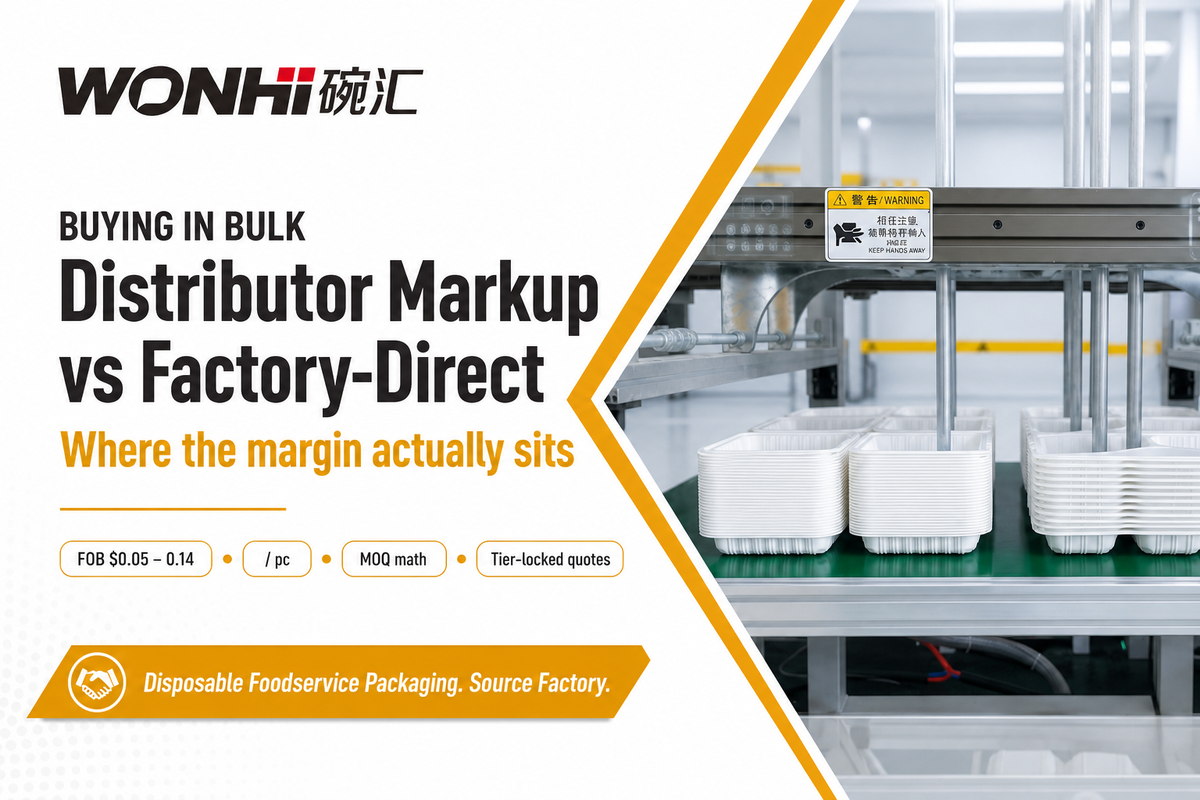
Die wahre Kostenherausforderung ist nicht der Aufkleberpreis, sondern wie viele Schichten Marge zwischen der Form und Ihrem Lagerraum liegen. Aufklappbare 3-Fach-Tabletts laufen etwa $0,05-$0,14 pro Stück ab Werk FOB, während vergleichbare 9-Fertig9-Tabletts bei US-Händlern üblicherweise mit $0,18-$0,59 pro Stück angegeben werden, abhängig von Größe und Material. Dieser drei- bis zehnfache Spread ist Verteilermarge, Fracht und Lagerung, kein Unterschied im Container.
Das soll nicht heißen, dass Direktbeschaffung automatisch ein Geldsparer ist Es handelt die Verteilermarge für Seefracht, Einfuhrzoll und eine Mindestbestellmenge, also, wenn Sie kein Großabnehmer sind, die Zahlen nicht zugunsten von direkt gehen, bis Sie eine Volumenschwelle erreicht Schlüsselfaktoren Ihres Landpreises:
Was bewegt Ihre angelandeten Kosten
- MaterialfamilieInjektion PP ist die Basislinie; Bagasse und In-Mold-Kennzeichnung erhöhen die Kosten.
- VolumenstufeSowohl der Stückpreis als auch die Fracht pro Einheit sinken stark mit der Fallzahl.
- AnpassungBeim Logodruck wird ein einmaliges Setup hinzugefügt; ein Maßform Fügt Werkzeug und einen 4-Wochen-Vorsprung hinzu.
- ZielSeefracht und der Importzollstapel, Zeile für Zeile notiert, so dass sich nichts in einem gebündelten “Lieferpreis” verbirgt”
Es ist bereits heute wahr: viele Betreiber 3 Fach Lebensmittelbehälter im Großhandel über die großen Distributoren 3 Restaurant Depot, Sysco, US Foods, Webstaurant – ob für einen Ketten-Rollout oder eine einzelne Fall von 3 Fach Essensvorbereitungsbehälter, und einige sogar China-direct Sourcing suchen, um die Hersteller-zu-Distributor-Marge auszuziehenHüten Sie sich, dass die Preisprämie für die Vermeidung von Direktversand immer auf “der anderen” Ende-Überprüfung „nicht Preis“bestätigen Sie Volumen konsolidieren, um ein MOQ zu löschen, ab Werk direkt an Lebensmittelbehälter im Großhandel Vertriebshändler-Aktien schlagen kann; unterhalb dieser Zeile, ein Vertriebshändler kann einfacher sein Fragen Sie jeden Lieferanten für ein stufengesperrtes, aufgeschlüsseltes Angebot, bevor Sie wechseln.
Was sich im Jahr 2026 ändert: Schaumverbote, PFAS-Regeln und Formatskonsolidierung
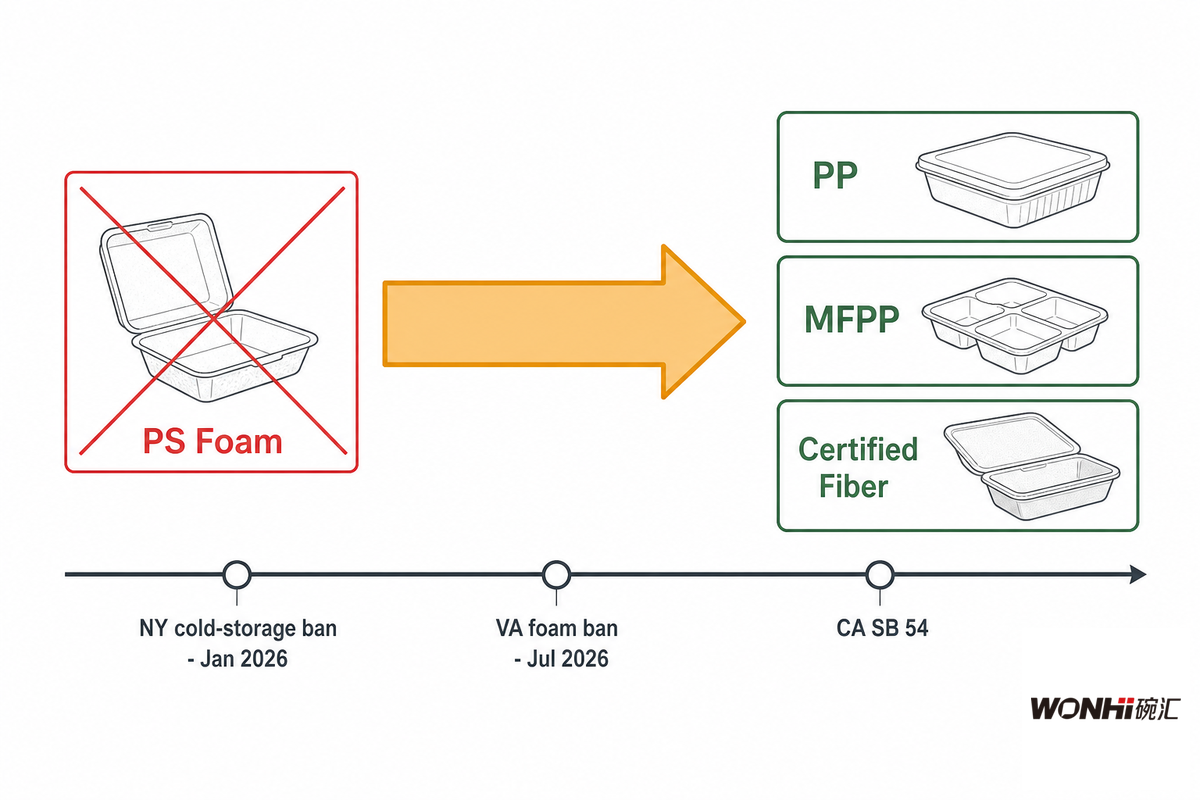
“Planen”nicht „Aufträge für 2026”, indem Sie sich ein Marktwachstumstabelle ansehen. „Ihre Kaufentscheidungen für das kommende Jahr werden durch Vorschriften bestimmt, nicht durch die Ausweitung des Essens außerhalb des Geschäftsgeländes. Die Verbote von Polystyrol nehmen zu: Seit 2025 haben mindestens neun Bundesstaaten beschlossen, expandiertes Polystyrol zu verbieten. Virginia verbietet Schaum am 1. Juli 2026 in allen Lebensmittelverkäufern und New York hat sein Verbot am 1. Januar 2026 auf Kühllagerbehälter ausgeweitet.
Der bundesstaatliche “Farewell to Foam Act” wurde im selben Jahr wieder eingeführt, und das alles läuft auf eine notwendige, unvermeidbare Abkehr vom Schaum hin zu PP, MFPP, und zertifizierten Faseralternativen hinaus.
PFAS-Chemikalien stellen den zweiten Aspekt dar: Mehr als 350 PFAS-bezogene Gesetzentwürfe wurden im Jahr 2025 in 39 Bundesstaaten durch die Gesetzgebungspipeline gebracht, und Kaliforniens AB 1201 (mit Wirkung vom 30. Juni 2027) wird neu definieren, was als wirklich “kompostierbar”akzeptiert wird“. Lieferanten werden gezwungen, jedes ”kompostierbare” Produkt als organischen Input einzustufen, wodurch eine breite Palette von Kunststoffalternativen effektiv verboten wird. Zusätzlich zum Druck stimmte das USDA im Jahr 2026 gegen die Aufnahme synthetischer kompostierbar-plastischer Rohstoffe in staatlich anerkannte Kompoststandards. Fügen Sie erweiterte Herstellergebühren hinzu, die jetzt in sieben Bundesstaaten umgesetzt werden, um weniger teuer zu werden und härter zu können.
Für unvorbereitete Käufer ist das Risiko real. Ein Betreiber aus Virginia prognostizierte öffentlich etwa $115.000 mehr pro Jahr allein auf To-Go-Verpackungen nach dem Abschalten des Schaums, die eigene Schätzung eines einzelnen Betreibers, aber ein konkretes Beispiel für den Kostenschock, den ein später Wechsel mit sich bringt. Für Ihren Einkauf im Jahr 2026 ist es jetzt an der Zeit, die Einhaltung in Form von PP/MFPP für heiße Anwendungen und zertifizierte Fasern sicherzustellen, wo eine lokale Kompostierungsinfrastruktur vorhanden ist, um das verantwortungsvolle Ende der Lebensdauer zu unterstützen, und wo die lokale Organiksammlung dies akzeptiert, was bedeutungsvolle Kürzungen bedeutet Deponie Methan, Die Faserauswahl verdient dort also ihren Aufschlag. Anstatt sich zu fangen, sichern Sie sich jetzt das konforme Material und planen Sie Ihre Bestellung nach regulatorischen Meilensteinen und nicht nach einer Prognose für das Marktwachstum.
Häufig gestellte Fragen
F: Welche Größe hat ein 3-Fach-Container?
Antwort anzeigen
Dominante Foodservice-Größen sind 88-Zoll- und 9-×9-Zoll-Quadratscharniere mit Scharnier, plus einer rechteckigen Option von 9 ̄NF6 Zoll. Eine typische 9-Fertig9-Spaltung in eine 850-ml-Einstiegsmulde und zwei 350-ml-Seitenmulden, ungefähr eine Gesamtkapazität von 32 48 oz. Die Fachtiefe des Fächers beträgt üblicherweise etwa 38 mm für die Eingabeschacht und 3032 mm für die Seiten. Kleinere Lunchbox-Formate fallen bei einzelnen Seiten- oder Snack-Portionen auf etwa 6 (Cater-Kaliber bis zu 250 mm. Da die äußere Anordnung durch die Form von SkU nicht genau von der Form festgelegt ist, bestätigen Sie sich die Größe von Ihrem Fußabmessungen nicht genau auf einen guten Wert festlegen.
F: Sind 3-Fach-Behälter spülmaschinenfest und wiederverwendbar?
Antwort anzeigen
PP- und MFPP-Behälter halten nur wenigen Zyklen durch kommerzielle Geschirrspüler stand, bevor sie ihre Versiegelung verlieren. Sie können daher ein oder zwei Mal wiederverwendet werden, waren aber nie als mehr als eine Einweg-Lebensmitteldienstleistung gedacht. PET kann überhaupt nicht in einer Spülmaschine verwendet werden, während PLA und Pappe nur einmal verwendet werden sollten. Wenn die Mehrfachverwendung wirklich das Ziel ist, sollte Glas das Material sein; Foodservice PP wurde für den Durchfluss- und nicht für den Unendlichkeitsgebrauch entwickelt.
F: Warum kommen einige 3-Fach-Container mit gleich großen Vertiefungen an, wenn das Foto einen großen und zwei kleine zeigt?
Antwort anzeigen
Das Fachlayout wird durch den Formhohlraum festgelegt und variiert je nach Artikelnummer; Einige 3-Fachwerkzeuge sind ein großes plus zwei kleine, andere sind drei gleiche Vertiefungen. Katalogfotos sind keine zuverlässige Anleitung, und Käufer berichten regelmäßig, dass sie nach der Bestellung aus einem Bild, das eine ungleiche Aufteilung impliziert, ein Tablett mit gleichem Vertiefungswert erhalten haben Überprüfen Sie die Tabelle mit den Fächerkörnungsmaßen auf dem Spezifikationsblatt und fordern Sie ein physisches Muster an, bevor Sie eine Fallreihenfolge standardisieren.
F: Wo kann ich 3-Fach-Container in großen Mengen kaufen?
Antwort anzeigen
Sie können bei Ihrem Broadline-Händler oder direkt ab Werk kaufen, wenn Ihr Volumen die Mindestmenge übersteigt, und dann auf einem festgelegten Preis bestehen, um die gesamten angelandeten Kosten zu bewerten.
F: Ist Schaum (Styropor) für den 3-Fächer-Takeout noch legal?
Antwort anzeigen
Nicht in einer wachsenden Gerichtsbarkeiten EPS Lebensmittel ist verboten oder eingeschränkt in einem Dutzend-plus Staaten von Kalifornien (ein de facto Verbot gemäß SB 54), New York, Maine, Maryland, New Jersey, Oregon, und Washington, und, ab 1. Juli 2026, ganz Virginia Starre PP, MFPP, PET, und Bagasse sind kein Schaum und bleiben legal, weshalb konforme Betreiber auf diese Materialien umsteigen Bestätigen Sie immer Ihre lokale Regel, bevor Sie bestellen.
F: Was ist eine Tupperware mit 3 Fächern?
Antwort anzeigen
“Tupperware” ist eine Verbraucher wiederverwendbare Marke; in der Gastronomie das Äquivalent ist ein Einweg-PP-Tablett mit 3 Fächern oder MFPP mit geteiltem Deckel Die Funktion ist die gleiche „Eine von zwei Seiten“eingeweitete Funktion, aber Foodservice kauft einzeln verwendbares, lebensmittelgerechtes PP pro Gehäuse und nicht ein wiederverwendbares Haushaltsset.
Warum wir das geschrieben haben
Wanhui betreibt 86 hauseigene Linien zur Herstellung von PP-, MFPP-, PET- und Bagasse-Lebensmittelservicebehältern, darunter 3-Fächer-Bleche mit 883 und 993. Die Spezifikationen, Vertiefungen und das Materialverhalten in diesem Leitfaden stammen aus unseren eigenen Produktionslinienaufzeichnungen und der FDA, EPA, CalRecycle, BPI und oben zitierten Patentquellen, nicht aus einem Katalog. Vom Wanhui-Verpackungsteam überprüft.
Referenzen und Quellen
- 21 CFR 177.1520, Olefinpolymere (Lebensmittelkontakt)Elektronischer Code der Bundesvorschriften der USA
- Daten zu Kompostierung und Verschwendung von LebensmittelnUS-Umweltschutzbehörde
- Quantifizierung der Methanemissionen aus deponierten LebensmittelabfällenUS-EPA (2023)
- SB 54 Verpackungs-EPR-/EPS-BestimmungenCalRecycle
- SB 54 Beratung zur Durchsetzung des SchaumverbotsBüro des Generalstaatsanwalts in Kalifornien
- Verbot von Polystyrolschaum (SB 543)Oregon DEQ
- Fluorierte Chemikalien / 100 ppm GesamtfluorstandardInstitut für biologisch abbaubare Produkte
- ASTM D6400 / D6868 kompostierbare ProdukteUS-Kompostierungsrat
- Lebensmittelbehälter mit verbesserter Belüftung (US20100320210A1)Ankerverpackung, Patentliteratur
- Neue Kompostierungszugriffsdaten (2025)Koalition für nachhaltige Verpackungen
- Sicheres Kochen im MikrowellenofenUSDA-Dienst für Lebensmittelsicherheit und -inspektion
Verwandte Artikel
- Essensvorbereitungsbehälter, Formate und Größen für Vorbereitungsprogramme
- Bento Boxes, der Cousin im geteilten Format für überzogene Mahlzeiten
- Essenstabletts, Servier- und Catering-Tablettführer
- Kompostierbare Clamshell-Behälter, zertifizierte Faseroptionen
- Großhandel mit Lebensmittelbehältern, Leitfaden zur Massenbeschaffung