Nehmen Sie Kontakt mit Wanhui Company auf


Ein beispielhafter praktischer Leitfaden für die volumetrische Beschaffung von Restaurants, Feinkostläden, Imbisswagen, Caterern und Liefermarken.
Einkauf Lebensmittelbehälter im Großhandel Es mag einfach erscheinen, aber es kann das Gegenteil beweisen, wenn Ihre erste Palette ankommt und die Deckel sich nicht schließen, wenn Suppenlecks bei 200° F liegen oder wenn ein staatlicher Inspektor Ihre Schaumstoffmuscheln anzeigt. Dieser Leitfaden zeigt, wie Sie das geeignete Material auswählen, Formate und Größe, Überprüfung der Einhaltung der Lebensmittelqualität, Lesen von Nachhaltigkeitsansprüchen und wie Sie einen Großeinkauf durchführen, einschließlich der Vorschriften von 2026, die ändern, was Sie kaufen können. Wenn Sie zuerst bestellen und später recherchieren möchten, sehen Sie sich unsere an Lebensmittelbehälter im Großhandel Katalog; wenn Sie eine fundierte Entscheidung treffen wollen, lesen Sie weiter.
Schnelle Spezifikationen: Lebensmittelbehälter im Großhandel auf einen Blick
| Übliche Materialien | PP (#5), PET (#1), PS-Schaum (#6), Bagasse/Formfaser, Kraftpapier, Aluminium, PLA |
| Übliche Größen | Delikatessenbecher 8 / 16 / 32 oz; Muscheln 1-Zoll-Fach; Tabletts, Schüsseln, Suppenbecher |
| Mikrowellensichere Option | Polypropylen (PP) °F ~250 (12°C); PET und Schaum sind nicht |
| Referenz in Lebensmittelqualität | FDA 21 CFR 177 (PP §177.1520, PET §177.1630) |
| Typische Großhandels-MOQ | Lagerartikel: 1 – Gehäuse; Sonderdruck/Zollform: höher, werkzeugabhängig |
| Wachposten 2026 | Staatliche EPS-Schaumverbote, staatliche + bundesstaatliche PFAS-Grenzwerte, EPR-Programme |
Lebensmittelbehälter im Großhandel auf einen Blick: Kategorien und Käuferprioritäten
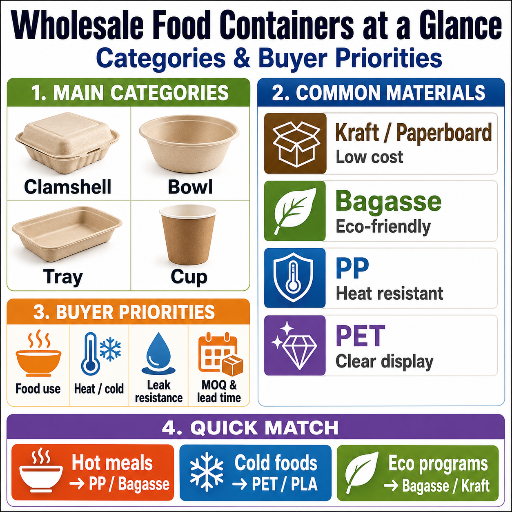
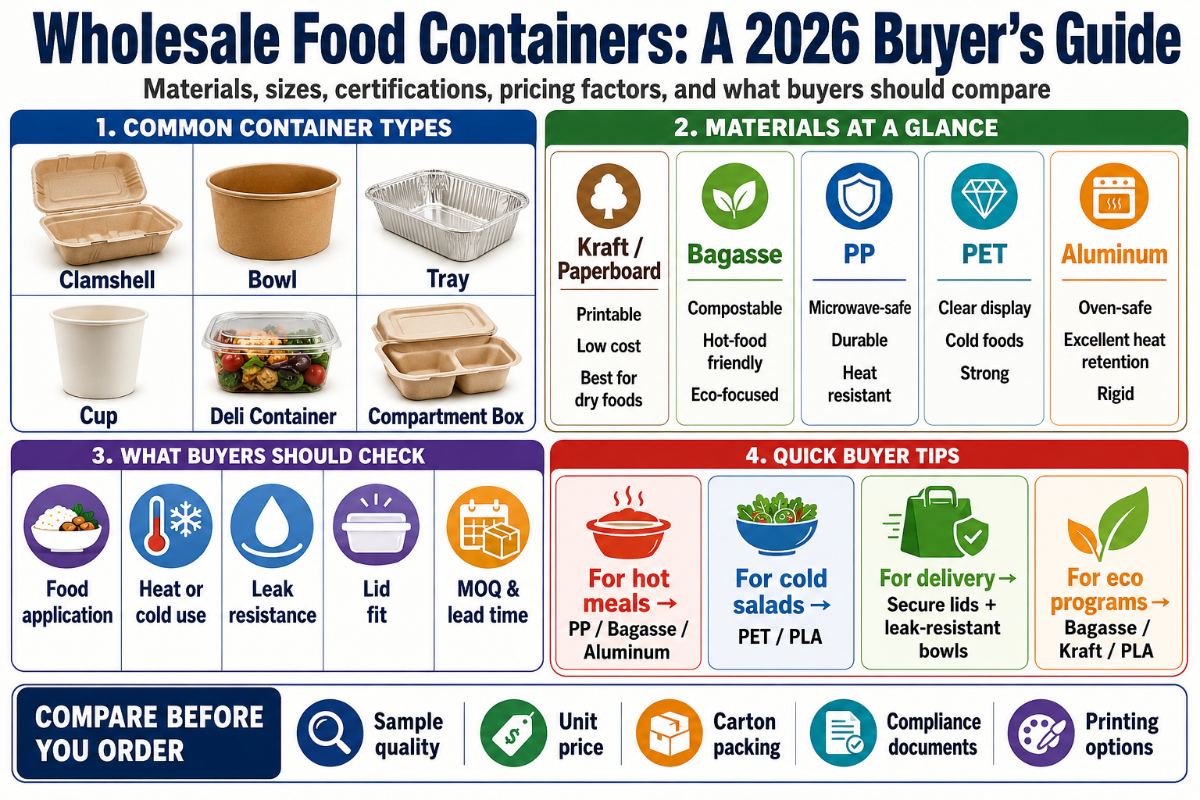
“Großhandels-Lebensmittelbehälter” ist ein Oberbegriff, der alle Einwegbehälter umfasst, die ein Gastronomiebetrieb in loser Schüttung beschafft, um zubereitete Lebensmittel (Deli-Becher, Klappmuscheln, Take-out-Behälter, To-Go-Boxen, Tabletts, Schüsseln, Suppenbecher und Catering-Boxen zu halten, zu transportieren oder in den Einzelhandel zu bringen Sie sind ein Einwegersatz für wiederverwendbare, spülmaschinengeführte Lebensmittel und werden aufgrund ihrer Bequemlichkeit und Sauberkeit während des Großaufkommens ausgewählt Diese Kategorie umfasst zahlreiche Materialien und weit gefächerte Größen, und genau dort verfangen sich Großabnehmer: Was für eine Umgebung wie die Salatbar funktioniert, funktioniert, funktioniert möglicherweise nicht für eine andere, wie eine heiße Curry-Linie.
Bei Hunderten von Großaufträgen gibt es vier Dinge, die den Erfolg eines Containerprogramms bestimmen: Material (Übersteht es die Temperatur, das Fett und die Säure des Lebensmittels?), Format und Größe (passt es zum Gericht und zum Regal?), Einhaltung der Lebensmittelsicherheit (ist es FDA-Konformität für Lebensmittelkontakt Unter 21 CFR Teil 177 und in Ihrem Bundesstaat legal?), und Gesamtkosten (nicht nur Preis pro Stück, sondern auch Lecks, Rücksendungen und Entsorgung) Im Folgenden wird jede Priorität im Detail behandelt, zusammen mit der Art und Weise, wie der Kauf selbst ausgeführt wird.
💡 Schlüssel zum Mitnehmen
Wenn man sich die vier Prioritäten anschaut, sollte man es als eine Sequenz und nicht als Menü sehen Material beschränkt Format, Format beschränkt Größe, und alle Compliance kann alles außer Kraft setzen Preis ist der letzte Filter, nicht der erste.
Behältermaterialien im Vergleich: PP, PET, PS-Schaum, Bagasse, Kraft und Aluminium
Material ist die erste Entscheidung, da es die physikalischen Grenzen von allem anderen, was folgt, vor Ihrem Vergleich, setzen Sie Ihren Fokus: ein Behälter ist nur “Lebensmittel-Qualität” für die Bedingungen, zu denen es zugelassen und konstruiert ist Ein Lebensmittel-Kontakt-Polymer ist unter der Zuständigkeit der US-amerikanischen FDA-Lebensmitteldienst, und die Vorschriften dafür finden Sie hier 21 CFR Teil 177 und Polypropylen ist da §177.1520 und PET steht unter §177.1630. Das sind Zusammensetzungsstandards und die Zulassung und Zulassung sind an bestimmte Verwendungsbedingungen gebunden, PET ist z.B. ein Material, das grundsätzlich kaltseitig ist: Foodservice verwendet es praktisch in einem Temperaturbereich von 120°F (49°C) Also, “FDA zugelassen” auf einem spec-Blatt zu haben, bedeutet ohne vorgesehene Einsatzbedingungen nicht viel.
Die nützlichste Wahl besteht darin, die Lebensmittel abzubilden Zustand „Saueres, saures und mikrowellenbeheiztes Material.“auf heiße, o. heiße, gefrorene und mikrowellenbeheizte Lebensmittel auf jeweils unterschiedliche Weise.
| Nahrungszustand | Best-fit-material | Vermeiden | Warum |
|---|---|---|---|
| Heiße Speisen, Mikrowellen-Erwärmung | Polypropylen (PP) | PET, PS-Schaum | PP fasst ca. 250°F (121°C); Es ist der einzige gängige Einwegkunststoff, der für die Wiedererwärmung in der Mikrowelle ausgelegt ist |
| Kalt-/Klaranzeige (Salate, Schnittobst) | PET (rPET) | PP für Klarheit | PET bleibt glasklar und starr kalt, verzieht sich jedoch über ~120 140°F (49 – 60 °C) |
| Heiße Suppe / frech, leckageanfällig | PP rund + Schnappdeckel oder gefütterter Papiersuppenbecher | Ungefüttertes Papier, PET | PE-beschichtete Papierauskleidungen weichen bei heißen Fülltemperaturen. Field berichtet von Lecks in der Nähe von Siedetemperaturen (~95°C/203°) |
| Fettig / gebraten | Kraft mit fettbeständigem Futter, Bagasse | Normale Pappe | Fett dringt durch ungefütterte Fasern; Bagasse widersteht Öl ohne Kunststofffolie |
| Ofen / Aufwärmen am Veranstaltungsort | Bagasse (Formfaser), Aluminium | Alle Kunststoffe, PLA | Bagasse verträgt hohe Hitze; Aluminium läuft von ca. 20° F bis 400° F (jedoch nicht in der Mikrowelle) |
| Gefrier-/Gefrierlager | PP, Aluminium, Bagasse | Sprödes PET im Tiefkühlzustand | PP und Ballaststoffe bleiben kalt; PET kann bei sehr kaltem Zustand beim Aufprall reißen |
| Saure (Tomate, Zitrusfrüchte, Vinaigrette) | PP, linierte Faser | Blankes Aluminium | Säure reagiert mit unbeschichtetem Aluminium; PP ist chemisch stabil |
| Kompostierbares Programm erforderlich | Zertifizierte Bagasse-/PLA-ausgekleidete Faser | “Biodabbaubarer” Kunststoff | Nur zertifizierte Kompostierbare (siehe H2-6) sind vertretbar; “biologisch abbaubar” ist weitgehend unreguliert |
| Langstreckenlieferung, Stapelung | PP mit Verschlussdeckel | Schaumstoff, dünnes PET | Schnappfelgen, die den Beuteltaumel mechanisch verriegeln; Belüftete Deckel geben Dampf ab |
Technische Anmerkung
PP hat eine Temperaturtoleranz von etwa 250°F (121°C) und einen Schmelzpunkt von 320°F (160°C); der praktische Grenzwert liegt gemäß den Referenzen des Lebensmitteldienstes bei etwa 120°F (49°C) und ist nicht mikrowellengeeignet (21 CFR 177.1630 definiert die Zusammensetzung, keine Temperatureinstufung); PS-Schaum erweicht bei etwa 75°C (167°F); PLA verformt sich über 40-60°C und sackt in einem heißen Auto; Bagasse Backofen und Mikrowellenhitze. Wenn Sie sich nicht sicher sind, halten Sie einer heißen, die Probe mit einer PP-Fill-Line-Line zu dienen.
Für einen Vergleich der drei Harze, die die meisten Käufer in Betracht ziehen, ist unser PP vs. PET vs. Bagasse-Materialselektor Passt diese Anleitungszeilen an Ihr spezifisches Menü an.
Die 6 Foodservice-Containerfamilien (und welche Lebensmittel sie passen)
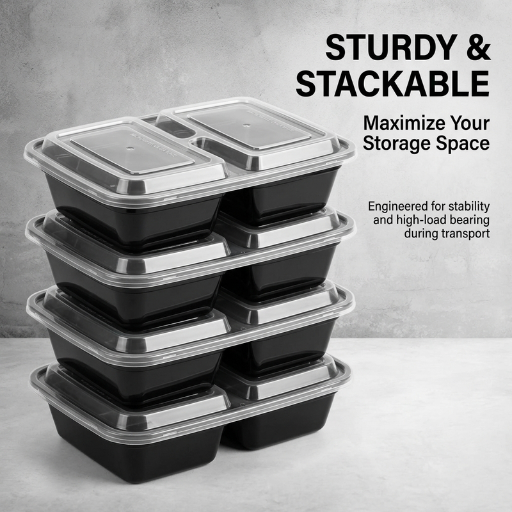
Nach dem Setzen der Materialien orientiert sich die Form des Behälterdesigns an der Schüssel Die meisten Einweg-Lebensmittelbehälter werden in sechs Familien eingeteilt. Diese Familien- und Lebensmittelpaarung mildert die beiden häufigsten Probleme: zertrümmerte Präsentation und Verschütten während des Transports.
| Familie | Am besten für | Typische Materialien | Größenspanne |
|---|---|---|---|
| Deli-Becher (rund, mit Deckel) | Suppen, Saucen, Beilagen, Fertigzutaten | PP, HAUSTIER | 8, 16, 32 Unzen |
| Klappmuscheln | Eintritte, Burger, Sandwiches, Salate | PP, Bagasse, PS-Schaum (sofern legal) | 1 Abteil |
| To-Go & Boxen im chinesischen Stil | Nudeln, Reis, gemischte warme Gerichte | Kraftpappe, PP | 16 64 oz |
| Tabletts und Platten | Catering, Fleisch/Produkt, Bäckerei | Formfaser, PET, Aluminium | Klein bis vollwertig |
| Schüsseln & Suppenbecher | Kornschalen, Suppen, Salate | PP, liniertes Papier, Bagasse | 12 –48 oz |
| Catering & Mehrportionsboxen | Gruppenbestellungen, Essensausrüstungen | Kraft, Wellpappe | Halb-/vollpfanne |
Standardisierung erfolgt typischerweise bei 2-3 Familien für die Handhabbarkeit von Artikeln und Nachbestellungen Eine lieferlastige Küche kann PP-Clamshells für Vorspeisen, PP-Deli-Becher für Seiten und Saucen sowie gefütterte Papierschalen für Suppen verwenden und dann Spezialformate wie z Bento-boxen und Einweg-Suppenbehälter Wie es das Menü erfordert.
Leitfaden zur Behältergröße: Passende oz-Kapazität zu Teilen
Stille kostspielige Größenfehler können extrem expansiv sein Wenn Behälter zu klein sind, zerdrücken sie Leck und Lebensmittel Zu groß, und dann zahlen Sie für Material und Fracht und lassen Portionen knapp aussehen Deli-Cup-Standardgrößen sind das Rückgrat der meisten Programme.
Was sind die Standardgrößen für Feinkostbehälter?
Der Großteil der Einweg-Lebensmitteldienstleistungsbranche verfügt über eine nahezu universelle Deli-Cup-Leiter: 8 oz, 16 oz und 32 oz, wobei 12 oz und 24 oz-Becher als übliche In-Betweens-Becher gelten. Sein großer Vorteil ist, dass ein Deckeldurchmesser über mehrere verschiedene Becherhöhen passt. Das bedeutet, dass Sie sich für die 8, 16 und 32 oz einen einzigen Deckel-SKU teilen können, der sowohl Ihren Deckelbestand schneidet als auch die “falschen Deckel”-Fehler reduziert, die eine Verpackungslinie verlangsamen Stellen Sie sicher, dass die Tasse mit der Portion übereinstimmt: Dressings und Supsuppen und Sups in 2, Supsuppen in 16 oz.
| Kapazität | Best-fit-nutzung | Anmerkungen |
|---|---|---|
| 8 oz | Dressings, Dips, Soßen, kleine Seiten | Höchste Anzahl pro Fall; teilt Deckel mit 12/16 oz |
| 16 Unzen | Einzelsuppe, Getreideseite, Salat | Die Größe des Arbeitstiers für die meisten Menüs |
| 24 Unzen | Salat im gesamten Gebäude, große Beilage, Smoothie | Brücken 16 und 32 oz |
| 32 oz | Familiensuppe, Massenpräparat, Poke Bowl | Überprüfen Sie die Tiefkühltiefe/Regaltiefe, bevor Sie die Standardisierung durchführen |
Überprüfen Sie vor dem Sichern einer Größenmatrix die Zahlen anhand Ihrer Gehäusepackungen und der Regaltiefe mithilfe von a Behältergröße und Produktlinienwähler Damit die Kartons in Ihre Aufbewahrung passen.
Lebensmittelqualität und Lebensmittelsicherheit: Was Sie vor dem Kauf überprüfen müssen
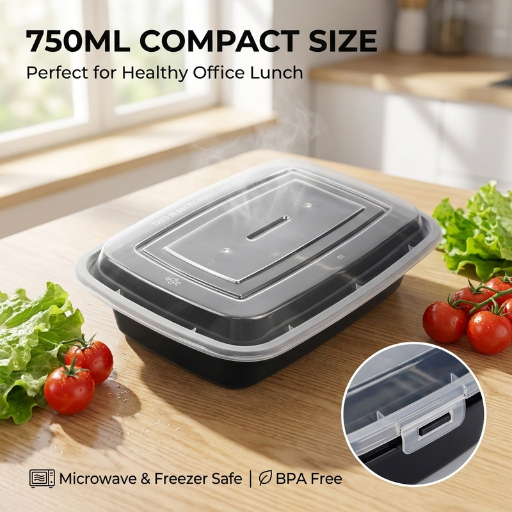
Sie sollten “Food-grade” – Behauptungen überprüfen, nicht annehmen, insbesondere bei größeren Bestellungen Die FDA’s 21 CFR Teile 174 178 Ermöglicht die Verwendung bestimmter Materialien für Lebensmittelkontaktanwendungen, aber das spezifische Material, die Art des Lebensmittels und die Verwendungstemperatur sind alles Faktoren, die die Konformität bestimmen. Allein die Angabe, dass etwas “FDA-zugelassen”ist, ist nicht dasselbe wie die Bereitstellung einer Dokumentation für die Einhaltung von Vorschriften für Ihre Anwendung.
Was ist der Unterschied zwischen PP – und PET-Behältern?
Die beiden Kunststoffe, die Sie am meisten vergleichen werden, sind PP (Polypropylen, Harzcode #5) und PET (Polyethylenterephthalat, #1). PP ist opak bis durchscheinend und hitzeverträglich, flexibel und nur für die übliche Einweg-Mikrowellenwiedererwärmung aus Kunststoff geeignet (auf ~250°F/121°C). PET ist starr, glasklar und für die Kaltanzeige geeignet, verzieht sich jedoch bei schwacher Hitze, wobei Foodservice-Referenzen einen praktischen Grenzwert von etwa 120°F (49°C) angeben, der es kalt macht – und kein wieder aufwärmendes Material. Die einfachste Regel: Wenn der Kunde es in die Mikrowelle stellt, versenden Sie mikrowellengeeignetes PP; Wenn es sich um einen hochwertig aussehenden kalten Artikel handelt, versenden Sie PET. PP ist auch die haltbarere Wahl für die Zubereitung und wiederholte Handhabung von Lebensmitteln, während die Klarheit des Displays PET geschätzt macht.
Bevor die Massen-PO ausgestellt wird, fordern Sie die folgenden vier Dokumente von Ihrem Lieferanten an und führen Sie Ihre eigene Überprüfung durch:
- Eine FDA-Lebensmittelkontakterklärung, in der der spezifische 21-CFR-Abschnitt für das jeweilige Harz erwähnt wird (z. B. §177.1520 für PP).
- Nutzungsbedingungengrenzen: Temperatur und Lebensmitteltypbereich das Material ist für . nicht nur “Mikrowellengeeignet” auf dem Deckel bewertet.
- ✔ Status des recycelten Inhalts: Im Allgemeinen unterliegt recyceltes (PCR) Harz für Lebensmittel nach dem Verbraucher einer Einzelfallprüfung durch die FDA. Spezifische Freigaben mit prozessspezifischem Kontakt. Eine CFR-Zitat aus Frischharz deckt keine recycelte Charge ab.
- Eine PFAS-freie Erklärung für alle Fasern oder beschichteten Produkte (dies wird in mehreren Bundesstaaten zu einer festen gesetzlichen Anforderung, siehe Ausblick 2026).
Forumsköche warnen immer wieder davor, dass der ‘Mikrowellen-sichere’ Stempel einfach bedeutet, dass der Behälter nicht schmilzt. Aktuelle Tests gewährleisten keine Nullmigration. Aktuelle Tests zeigen, dass PP- und PS-Behälter Mikroplastikpartikel in großen Mengen abwerfen, wenn sie in der Mikrowelle erhitzt werden. So viele Küchen transportieren Lebensmittel unabhängig vom Stempel auf einen Teller zum Wiedererwärmen. Für Behälter ein verifiziertes Hersteller von Kunststoffbehältern in Lebensmittelqualität Probleme haben sollten, dies zu beweisen.
Nachhaltige Optionen: kompostierbar vs. biologisch abbaubar vs. recycelbar
Nachhaltigkeit ist dort am meisten verwirrt, wo Kunden ein echtes rechtliches Risiko darstellen. Die drei Begriffe sind nicht synonym.
| Anspruch | Was es bedeuten sollte | Wie zu überprüfen | Fangen |
|---|---|---|---|
| Kompostierbar | Zerlegt sich in einem kommerziellen Komposter in CO2, Wasser, Biomasse | BPI-Zertifizierung nach ASTM D6400 (Kunststoff), D6868 (beschichtet) oder D8410 (Faser) | Braucht Zugang zur industriellen Kompostierung; selten selbstkompostierbar |
| Biologisch abbaubar | (Loosely) bricht schließlich zusammen | Kein universeller Standard | Weitgehend unreguliert behandeln als rote Flagge ohne eine Bescheinigung |
| Recycelbar | Akzeptiert und in lokalen Streams wiederaufbereitet | Harzcode + lokale Programmannahme | Lebensmittelrückstände und Kleinteile disqualifizieren sich in der Praxis häufig |
Zertifizierte Kompostierbare haben echte Standards: zu sein BPI zertifiziert, 84 Tagen muss ein Artikel etwa 901TP3 T Zerfall erreichen und PFAS-Beschränkungen (in Kraft seit 2020) erfüllen, für Verbraucher ist der einfache Maßstab dieser “6. Grad”, wenn er nicht nach einem ASTM-Standard zertifiziert ist, ist der Anspruch „eco“unhaltbar.
Sind kompostierbare Behälter eigentlich besser?
Nicht automatisch und dies erscheint die Gegenintestierung, die die meisten Käufer verpassen Ein kompostierbarer Behälter liefert seinen Umweltnutzen nur, wenn er tatsächlich eine Anlage erreicht, die ihn akzeptiert Ohne diesen Zugang, zwei. Erstens ist ein kompostierbarer Gegenstand, der in Recycling geworfen wird, ein Schadstoff: ein kompostierbarer Becher kann bewirken, dass ein ganzer Ballen aus recycelbarem Kunststoff, der sonst wertvoll ist, auf die Deponie gelangt. Zweitens werden in der sauerstoffarmen Umgebung einer Deponie die Kompostierstoffe unrein abgebaut und Methan erzeugt, das die UN-Umweltprogramm Über einen Zeitraum von 20 Jahren als über 80-mal potenter als CO2 bezeichnet wird In dieser Situation kann eine kompostierbare Gabel eine Größer Klimabelastung als eine herkömmliche Kunststoffbelastung.
“Kompostierbare Verpackungen liefern ihren Umweltnutzen nur dann, wenn sie tatsächlich eine Kompostierungsanlage erreichen, die sie ohne Zugang akzeptiert, dass sie sich wie ein Schadstoff beim Recycling oder eine Methanquelle auf Deponien verhält.”
Es gibt auch eine Marketing-Law-Ebene, die Käufer vergessen: US FTC Grüne Leitfäden (16 CFR Teil 260) Kompetente, zuverlässige Nachweise für Umweltaussagen wie “kompostierbar” oder “recycelbar” auf Ihrer Verpackung verlangen, müssen belegt, nicht nur geltend gemacht werden Ein ASTM/BPI-Zertifikat bestätigt den technischen Anspruch eines Unternehmens, aber das ist keine ausreichende Bedingung, um alle Anforderungen an Marketing-Substantiation zu erfüllen Fazit: Zertifizierte Materialien verwenden und Begründen Sie Ihre Ansprüche auf der Packung. Unsere Kompostierbarkeitszertifizierungsdecoder Veranschaulicht, welche Zertifizierungen für die Materialien relevant sind, während die mehr Umweltfreundliche Lebensmittelverpackungen Zertifiziertes Sortiment zeigt die Möglichkeiten.
So kaufen Sie Großhandel: MOQs, Preisstufen, Kundenspezifisches Drucken und Importieren
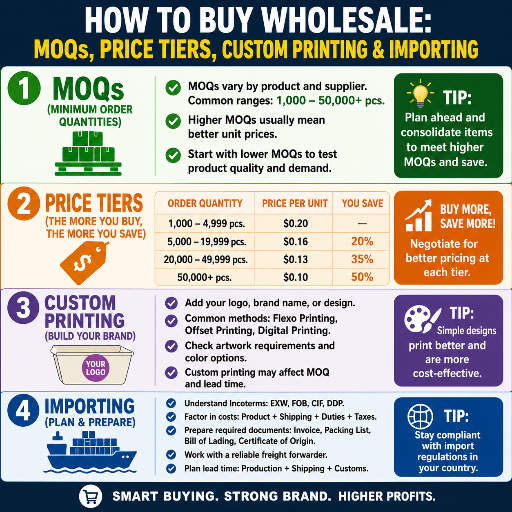
Kaufen ist ein eigenständiges Recht Der häufigste Fehler von Großkäufern, der sich auf die Einzelkosten konzentriert, besteht darin, dass Behälter von geringer Qualität zu Lecks führen, zuzüglich Rückerstattungs-, Entsorgungs- oder Compliance-Kosten, die etwaige Einsparungen bei weitem übersteigen können. Versuchen Sie es mit einer strukturierten Scorecard (keine Preisliste).
Die Bulk Container Sourcing Scorecard
- Lebensmittelqualität: Können sie auf Anfrage eine 21-CFR-Quellenangabe, Nutzungsbedingungen und eine PFAS-freie Erklärung vorlegen?
- MOQ-passung Wenn die Mindestbestellmenge Ihrer Abbrandrate entspricht, oder lagern Sie am Ende den Lagerbestand eines Jahres?
- Preis in Ihrem tatsächlichen Volumen – geben Sie ein Angebot für die Stufe an, die Sie tatsächlich kaufen, nicht für den Hauptpreis.
- Lieferzeit und Zuverlässigkeit „Fracht + Fracht; Fordern Sie einen tatsächlichen Zeitrahmen an, nicht den besten Fall.
- Benutzerdefinierte Fähigkeit „Und was ist die Möglichkeit, Ihr Logo zu drucken und individuelle Formen zu schneiden?
- Compliance-abdeckung (sind ihre Materialien auf die Verbote eingegangen, die in Ihren Vertriebsstaaten (und Exportmärkten) gelten?
Bei MOQ und Anpassung spaltete sich die Wirtschaft in zwei Wege. Lagerartikel Schiff in niedrigen Mindestmengen (oft einige Fälle), decken ein breites Spektrum an Auswahl und schnellem Versand sowie Anzugtests und kleinere Operationen ab. Maßgedrucktes oder maßgefertigtes Formen Programme haben höhere Mindestlogo- und Etikettenplatten plus feste Setup-Kosten, aber sie reduzieren die Stückkosten bei höherer Menge und setzen Ihre Marke auf jede Bestellung. Durch den Betrieb von 20 Thermoformleitungen, 6 Blattextrusionslinien und 60 Spritzgusslinien mit einer Gesamtkapazität von mehr als 1 Million Einheiten pro Tag haben wir festgestellt, dass Käufer dazu neigen, Tests zu unterschätzen, bevor sie einen großen benutzerdefinierten Lauf durchführen; Durch die Bestellung von Mustern Ihrer tatsächlichen Menüpunkte werden die teuersten Fehler verhindert. Bewerten Sie Optionen mithilfe unserer Großhandel Lebensmittelbehälter Lieferant Tools, oder erkunden Maßgeschneiderte Lebensmittelverpackungen Optionen für Markenläufe.
⚠️ Importüberwachung
Wenn Sie Aluminiumbehälter, Tabletts oder Deckel importieren, sollten Sie Handelsbehelfe in Betracht ziehen: Seit 2025 gibt es in den USA Antidumping- und Ausgleichszollanordnungen gegen bestimmte Einwegbehälter aus Aluminium aus China. Diese Zölle werden zu Ihrem Stückpreis und Ihrer Fracht addiert. Überprüfen Sie also die angelandeten Kosten nicht nur das FOB-Angebot, bevor Sie sich für importiertes Aluminium entscheiden.
Passen Sie ein Containerprogramm an Ihren Betrieb an
Der richtige Behältermix hängt davon ab, wie das Essen aus Ihrer Küche austritt. Ein paar Betriebsprofile:
Geisterküchen oder Liefermarke hängen von der Integrität des Transports ab Unsere oberste Priorität wird ab sofort bei PP-Muscheln mit Verschluss, belüfteten Deckeln und PP-Deli-Bechern für jede Soße sein Jede Soße, die aus dem Becher im Beutel entweicht, führt zu einer Rückerstattung und einer Ein-Stern-Rezension. Halten Sie standardmäßig zwei Muschelschalengrößen und ein Deckelsystem ein, um die Leitung schnell zu halten.
Ein Foodtruck ist auf Schnelligkeit und eine geringe Lagerfläche angewiesen. Einnisten von Feinkostbechern und eine einzelne Muschel, die den größten Teil der Speisekarte abdeckt, besiegen ein breites SKU-Sortiment; Kubische Lagerung ist der limitierende Faktor, daher sind die Gehäusemaße genauso wichtig wie der Preis. Stock-and-Go Mehlzubereitungsbehälter Link hier dienen oft der doppelten Pflicht für den LKW-Service.
A Kantine in einem Krankenhaus oder einer Schule Behandelt Themen wie Wärmespeicherung, Allergentrennung und Einhaltung der Beschaffungsvorschriften. Ihre Fachschalen halten verschiedene Artikel getrennt, PP ermöglicht die Wiedererwärmung und zertifizierte Materialien erfüllen die Einkaufsanforderungen von Institutionen, bei denen Compliance/Dokumentation Vorrang vor dem niedrigsten Preis hat.
Betrieb → Containerprogramm (Schnellkarte)
| Lieferung / Geisterküche | PP-Verriegelungsmuscheln + PP-Saucenbecher; belüftete Deckel |
| Lebensmittelwagen | Nistende Feinkostbecher + eine vielseitige Muschel; Mindcase-Würfel |
| Verpflegung | Halb-/Vollschalenschalen + Kraft-Catering-Boxen |
| Krankenhaus / Schulkantine | PP-Fachschalen; zertifizierte Materialien + vollständige Dokumente |
Ausblick 2026: Schaumverbote, PFAS-Regeln und die Umstellung auf Fasern
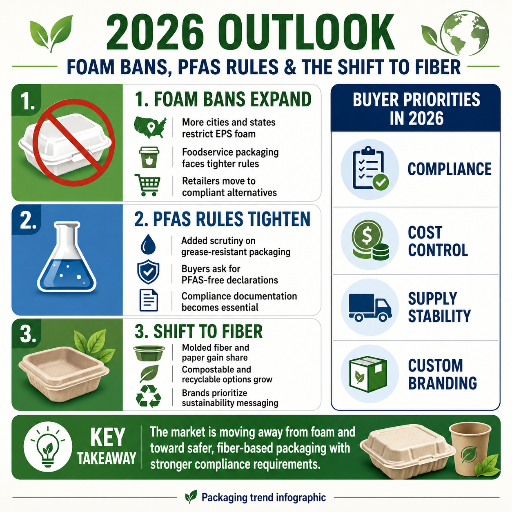
Vorschriften werden der sich am schnellsten ändernde Aspekt Ihres Unternehmens sein, und 2026 wird ein entscheidendes Jahr sein. Wenn Sie planen, im Jahr 2026 Einkäufe zu tätigen, sollten Sie die Einhaltung als Teil Ihrer Beschaffungsspezifikationen und nicht als nachträglichen Gedanken betrachten.
Verbote von Polystyrol (Schaum) breiten sich aus. Zu den Staaten mit EPS-Lebensmittelserviceverboten gehören mittlerweile Kalifornien, New York, New Jersey, Maine, Maryland, Vermont, Washington, Rhode Island und Delaware. New York hat EPS-Lebensmittelservice-Container im Jahr 2022 verboten und lt NYSDEC , 1, ab 1. Januar 2026 gilt dies auch für Kühlhaus-EPS (Kühler, Eisladen).Das EPS-Lebensmittelserviceverbot von Virginia wird bis 2025 umgesetzt.2026, basierend auf dem Anbietertyp. Überprüfen Sie daher, wie hoch der aktuelle Zeitpunkt des Inkrafttretens Ihres Betriebs ist, anstatt davon auszugehen, dass es eine einzige Frist geben wird.
Für Fasern gelten nun PFAS-Grenzwerte. Die PFAS-Regel von Maine für pflanzliche Lebensmittelverpackungen tritt am 25. Mai 2026 in Kraft (mit Ausnahme von Herstellern mit weniger als 1 TP4T1 Milliarde Umsatz) und die kalifornische AB 1200 hat PFAS (oder insgesamt 100 ppm organisches Fluor) in pflanzlichen Lebensmitteln verboten. Faserverpackungen seit 2023 und das umfassendere Lebensmittelverpackungsverbot von New Jersey wird im Jahr 2028 in Kraft sein, und im Jahr 2025 wird Illinois sein PFAS-Reduktionsgesetz (Public Act 104-0231) mit Angabe der Gültigkeitsdaten der Lebensmittelkonform, die in den Verkaufsterminen vorgesehen sind, die von UPost enthalten sind.
Die Umstellung auf Fasern erfolgt strukturell und nicht saisonal. Der US-Einwegmarkt für Lebensmittelverpackungen wird voraussichtlich von etwa 1 4T14,9 Milliarden (2024) auf 1 4T23 Milliarden TP bis 2030 (etwa 7,51 TP3 T CAGR) wachsen, und Schnellverarbeitungsketten ersetzen Kunststoffmuscheln durch geformte Fasern und Pappe. Die unterstützende Technologie sind PFAS-freie wasserbasierte Barrierebeschichtungen unter Verwendung von Ton, Calciumcarbonat, Stärke, Chitosan oder Bio-Polyester-Dispersionen (die, als Lebensmitteltechnik Berichten zufolge geben Sie Ballaststoffen nun die Anforderungen an Fett- und Feuchtigkeitsbeständigkeit. Aktion für Käufer 2026: Wenn Sie in mehrere Bundesstaaten verkaufen oder exportieren, stellen Sie neue Programme standardmäßig in zertifizierte, PFAS-freie Fasern oder PP um und führen Sie einen dokumentierten Compliance-Trail; Die Schaum-Ban-Compliance-Finder Karten, welche Ihrer Staaten den Schaum bereits einschränken.
Die Schaum-zu-Faser-Schalter-Kostenkurve
Der Wechsel von Schaum zu zertifizierter Faser erhöht in der Regel kurzfristig die Stückkosten, verringert sich jedoch, sobald Sie das Preis-Compliance-Risiko (Geldstrafen, erzwungene Rückkäufe, wenn ein Verbot auftritt), den Markenwert und den konsequenten Rückgang des Faserpreises bei steigendem Volumen an Betreibern, die wechseln, erhöhen Vorher Die Frist ihres Staates umgeht die Prämie aus Panikkäufen, die beim gleichzeitigen Wechsel aller auftreten.
Häufig gestellte Fragen
Sind Lebensmittelbehälter im Großhandel mikrowellen- und gefriergeeignet
Antwort anzeigen
Es hängt vom Harz ab. Polypropylen (PP, #5) ist sowohl mikrowellensicher (bis etwa 250°F/121°C) als auch gefrierschranksicher, weshalb es sich um die Standardeinstellung für aufwärmbare Mahlzeiten handelt. PET (#1) ist gefrierverträglich für Kühlkörper, jedoch nicht mikrowellenfest, zerrissen und kann sich über etwa 120140°F zersetzen. Bestätigen Sie immer, dass das spezifische Produkt für beide bewertet ist, und achten Sie auf ein gedrucktes mikrowellensicheres Symbol für PP-Artikel.
Sind Auslaufbehälter auslaufsicher?
Antwort anzeigen
Nur von der Konstruktion aus Echte Leckfestigkeit kommt von einem Schnappdeckel, der mechanisch am Behälterrand verriegelt, nicht von dickerem Material Für Suppen und freches Geschirr wählen Sie runde PP-Deli-Becher mit Schnappdeckel oder gefütterte Papiersuppenbecher; vermeiden Sie ungefütterte Pappe, deren PE-Liner in der Nähe von 95°C (203°F) versagen kann.Zur Lieferung helfen auch belüftete Deckel, indem sie Dampfdruck abgeben, der sonst Flüssigkeit herausdrücken würde.
Was ist das typische MOQ für Lebensmittelgroßhandelsbehälter?
Antwort anzeigen
Bei Lagerartikeln (unbedruckt) sind die Mindestwerte oft nur wenige Fälle, was sie ideal zum Testen macht. Maßgedruckte oder individuell geformte Programme enthalten höhere Mindestwerte, da Logo-Platten und -Werkzeuge feste Einrichtungskosten haben, die sich nur über größere Mengen amortisieren. Fragen Sie jeden Lieferanten nach dem MOQ auf der genauen SKU- und Druckebene, die Sie benötigen, und fordern Sie Muster an, bevor Sie sich auf einen großen individuellen Lauf festlegen.
Kommen Deckel mit oder werden sie separat verkauft?
Antwort anzeigen
Normalerweise separat. Tassen, Schüsseln und Tabletts verkaufen Körper in separaten Fällen. Die meisten Feinkostgeschäfte bestätigen also, dass Sie beide bestellen.
Sind Schaumstoffbehälter (Styropor) verboten?
Antwort anzeigen
In einer wachsenden Zahl von US-Bundesstaaten, ja. Expanded Polystyrol (EPS) Foodservice-Behälter sind in Staaten wie Kalifornien, New York, New Jersey, Maine, Maryland, Vermont, Washington, Rhode Island und Delaware verboten, und weitere führen schrittweise Beschränkungen durch, bis 20252026. Da die Regeln und Wirksamkeitsdaten je nach Bundesstaat und manchmal je nach Stadt unterschiedlich sind, überprüfen Sie Ihre spezifischen Verkaufsgerichtsbarkeiten, bevor Sie Schaum neu bestellen, und verfügen über eine qualifizierte Faser- oder PP-Alternative, damit ein Verbot nicht zu Strang Ihre Lagerbestände führt.
Kann man chinesische Take-out-Boxen in die Mikrowelle stellen?
Antwort anzeigen
Nicht, wenn sie einen Metallgriff oder eine Folienauskleidung haben. Entfernen Sie diese zuerst. Normale Pappkartons können Lebensmittel kurz erwärmen, sind aber nicht für anhaltende Hitze ausgelegt; Übertragen Sie sie in einen mikrowellengeeigneten PP-Behälter oder eine Platte zum Wiedererwärmen.
Wie lange dauert die Lieferung von Schüttgutcontainern und die Vorlaufzeit?
Antwort anzeigen
Lagerartikel versenden am schnellsten innerhalb von Tagen im Inland. Individuell bedruckte Bestellungen fügen Zeit für die Korrektur und Druckeinrichtung hinzu, und kundenspezifische Formen fügen Werkzeugvorlaufzeit oben hinzu. Bauen Sie bei importierten Bestellungen Seefracht und Zollabfertigung ein Fragen Sie immer nach dem realistischen Produktions-plus-Frachtfenster statt nach der Best-Case-Nummer und bestellen Sie einen Lagerpuffer, um die Lücke bei Ihrem ersten kundenspezifischen Lauf zu schließen.
Suchen Sie nach lebensmittelgerechten Behältern in großen Mengen oder mit individuell bedrucktem Logo?
Über diesen Leitfaden
Dieser Leitfaden wurde vom Verpackungsteam von Wonhi (Shandong Wanhui Environmental Protection Technology Co., Ltd.) erstellt und überprüft, einem 20-jährigen Hersteller von Einweg-Mahlzeitenboxen, -schalen und -Bedienungsbehältern, die nach Europa, Amerika und in den Nahen Osten exportieren, Asien-Pazifik und Südamerika. Wir haben die unten aufgeführten öffentlichen Quellen für Materialtemperaturbereiche, FDA-Zitate, Zertifizierungsstandards und regulatorische Daten für 2026 herangezogen; Überprüfen Sie vor dem Kauf die tatsächlichen Daten Ihres Gerichtsstands, da diese sich häufig ändern.
Referenzen und Quellen
- 21 CFR Teil 177 Indirekte Lebensmittelzusatzstoffe: Polymere „Electronic Code of
- 21FR 17.1520 7. Cfin-Polymere (Polypropylen) & Arzneimittelverwaltung
- Recycelte Kunststoffe in Lebensmittelverpackungen & Arzneimittelverwaltung
- Kommerzielle Kompostierbarkeitszertifizierung (ASTM D6400/D6868/D8410) Institut
- Grüne Leitfäden, 16 CFR Teil 260 ÅR. Federal Trade Commission
- Verbots von expandiertem Polystyrolschaum Ministerium für Umweltschutz des Staates York
- Verpackungsgesetze treten im Jahr 2026 in Kraft Paketieren
- Nachhaltige Barrierebeschichtungen ersetzen PFAS Lebensmitteltechnik
- Fakten über Methan Umwelt
Verwandte Ressourcen
- Einweg-Lebensmittelbehälter Produktpalette über Mehlkästen, Schüsseln und Tabletts
- Kompostierbare Muschelbehälter Optionen im Glasfaserformat mit Zertifizierung
- Benutzerdefinierte Takeout-Boxen „VERPACKUNG, Logo-gedruckt
- 3-fach-container Essen und Kantinenanteil Trennungen
- Lebensmittelbehälter im Großhandel Katalog und Angebotsanfrage