Póngase en contacto con la empresa Wanhui


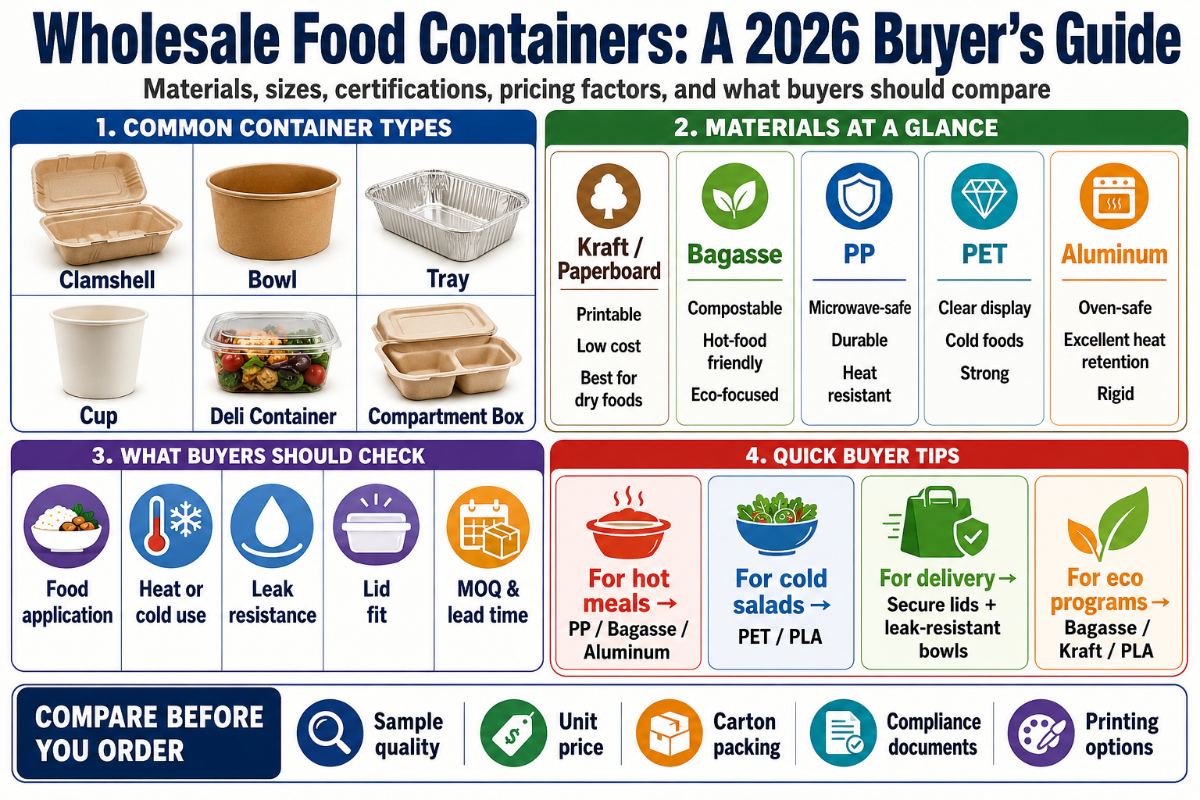
Un ejemplo de guía práctica para el abastecimiento volumétrico de restaurantes, delicatessen, camiones de comida, empresas de catering y marcas de entrega a domicilio.
Compras envases de alimentos al por mayor puede parecer fácil, pero puede demostrar lo contrario cuando llega su primera paleta y las tapas no se cierran, cuando las fugas de sopa están a 200°F o cuando un inspector estatal señala sus conchas de espuma. Esta guía muestra cómo elegir el material, los formatos y el tamaño apropiados, la verificación del cumplimiento de la calidad de los alimentos, la lectura de afirmaciones de sostenibilidad y cómo realizar una compra al por mayor, incluidas las regulaciones de 2026 que cambian lo que puede comprar. Si desea realizar un pedido primero e investigar más tarde, consulte nuestro envases de alimentos al por mayor catálogo; Si quieres poder tomar una decisión informada, continúa leyendo.
Especificaciones rápidas: envases de alimentos al por mayor de un vistazo
| Materiales comunes | PP (#5), PET (#1), espuma PS (#6), bagazo/fibra moldeada, papel kraft, aluminio, PLA |
| Tamaños comunes | Tazas de delicatessen 8 / 16 / 32 oz; conchas 1-3 compartimentos; bandejas, tazones, tazas de sopa |
| Opción segura para microondas | Polipropileno (PP) « tolera ~250°F (121°C); El PET y la espuma no lo son |
| Referencia de calidad alimentaria | FDA 21 CFR 177 (PP §177.1520, PET §177.1630) |
| Moq típico al por mayor | Artículos en stock: 1-5 cajas; impreso/molde personalizado: superior, dependiente de herramientas |
| Vigilancias 2026 | Prohibiciones estatales de espuma EPS, límites PFAS estatales + federales, programas EPR |
Contenedores de alimentos al por mayor de un vistazo: categorías y prioridades del comprador
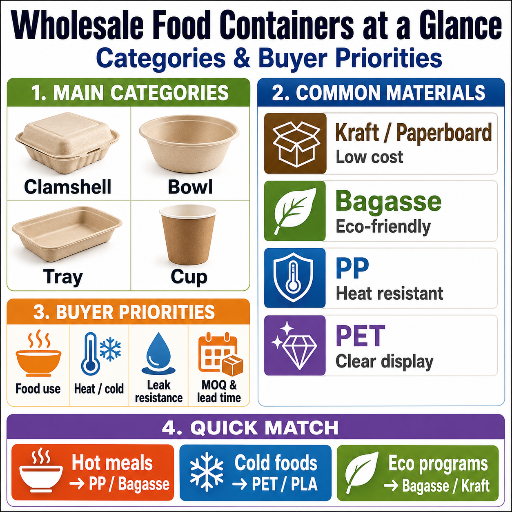
“contenedores de alimentos al por mayor” es un término genérico que cubre todos los contenedores desechables que una operación de servicio de alimentos adquiere a granel para contener, transportar o vender alimentos preparados al por menor ‘tazas de delicatessen, conchas con bisagras, contenedores para llevar, cajas para llevar, bandejas, tazones, tazas de sopa y cajas de catering. Son un sustituto de un solo uso de los alimentos reutilizables reciclados en lavavajillas y se seleccionan por su comodidad y limpieza durante un servicio de gran volumen. Esta categoría incluye numerosos materiales y tamaños muy diversos, que es precisamente donde los compradores a granel se enredan: lo que funciona para un entorno, como la barra de ensaladas, puede no funcionar para otro, como una línea de curry caliente.
En cientos de pedidos al por mayor, hay cuatro cosas que determinan el éxito de un programa de contenedores: material (¿sobrevive a la temperatura, la grasa y el ácido de los alimentos?), formato y tamaño (¿se ajusta al plato y al estante?), cumplimiento de la seguridad alimentaria (es Cumple con los requisitos de contacto con alimentos de la FDA según 21 CFR Parte 177 y legal en su estado?), y costo total (no sólo precio por pieza, sino también fugas, devoluciones y enajenaciones). A continuación, se trata en detalle cada prioridad, junto con cómo ejecutar la compra en sí.
💡 Conclusión clave
Al observar las cuatro prioridades, debe verse como una secuencia y no como un menú. El material limita el formato, el formato limita el tamaño y todo cumplimiento puede anularlo todo. El precio es el último filtro, no el primero.
Materiales de los contenedores comparados: PP, PET, espuma PS, bagazo, kraft y aluminio
El material es la primera decisión ya que establece los límites físicos de todo lo demás que sigue. Antes de hacer su comparación, concéntrese en: un contenedor es sólo de “grado alimentario” para las condiciones en las que está autorizado y diseñado. Un polímero en contacto con alimentos está bajo la jurisdicción del servicio de alimentos de la FDA de EE. UU., y las regulaciones al respecto se pueden encontrar aquí 21 CFR Parte 177 y el polipropileno está aquí §177.1520 y el PET está bajo §177.1630. Estos son estándares de composición y la aprobación y autorización están ligadas a condiciones de uso específicas. Por ejemplo, el PET es un material fundamentalmente frío: el servicio de alimentos lo utiliza prácticamente en un rango de temperatura de 120°F (49°C). Por lo tanto, tener “aprobado por la FDA” en una hoja de especificaciones no significa mucho sin las condiciones de uso proporcionadas.
La forma más útil de elegir es mapear los alimentos condición ^ no es su nombre « para un material. Los alimentos calientes, aceitosos, ácidos, congelados y recalentados por microondas enfatizan cada envase de diferentes maneras.
| Estado alimentario | Material de mejor ajuste | Evitar | Por qué |
|---|---|---|---|
| Comida caliente, recalentamiento por microondas | Polipropileno (PP) | PET, PS espuma | PP contiene ~250°F (121°C); es el único plástico desechable común clasificado para recalentamiento por microondas |
| Exhibición fría/clara (ensaladas, fruta cortada) | PET (rPET) | PP para mayor claridad | El PET permanece frío, rígido y transparente como el vidrio, pero se deforma por encima de ~120-140°F (49-60°C) |
| Sopa caliente / picante, propensa a goteras | PP redondo + tapa a presión o taza de sopa de papel forrado | Papel sin forro, PET | Los revestimientos de papel recubiertos de PE se ablandan a temperaturas de llenado en caliente « Los informes de campo citan fugas cercanas a la ebullición (~95°C/203°F) |
| Graso/frito | Kraft con forro resistente a la grasa, bagazo | Cartón liso | La grasa atraviesa la fibra sin forro; El bagazo resiste el aceite sin película plástica |
| Horno/recalentar en el lugar | Bagazo (fibra moldeada), aluminio | Todos los plásticos, PLA | El bagazo tolera altas temperaturas; el aluminio corre entre ~-20°F y 400°F (pero no en microondas) |
| Almacenamiento congelado/congelador | PP, aluminio, bagazo | Pet quebradizo en congelación profunda | El PP y la fibra se mantienen duros en frío; El PET puede agrietarse bajo el impacto cuando hace mucho frío |
| Ácido (tomate, cítricos, vinagreta) | PP, fibra forrada | Aluminio desnudo | El ácido reacciona con el aluminio sin recubrimiento; El PP es químicamente estable |
| Se requiere programa compostable | Bagazo certificado/fibra revestida de PLA | “Plástico ”biodegradable” | Sólo los compostables certificados (ver H2-6) son defendibles; “biodegradable” está en gran medida no regulado |
| Entrega a larga distancia, apilamiento | PP con tapa con cierre | Espuma, PET fina | Las llantas a presión que se bloquean mecánicamente sobreviven a la caída de la bolsa; Las tapas ventiladas liberan vapor |
📐 Nota de ingeniería
El PP tiene una tolerancia de temperatura de aproximadamente 250°F (121°C) y un punto de fusión de 320°F (160°C); el límite práctico es de alrededor de 120°F (49°C) según las referencias del servicio de alimentos, no apto para microondas (21 CFR 177.1630 define la composición, no una clasificación de temperatura); La espuma PS se ablanda a aproximadamente 75°C (167°F); El PLA se deforma por encima de 40-60°C y se desploma en un automóvil caliente; el bagazo resiste el calor del horno y del microondas. Si no está seguro de una línea de llenado en caliente, use PP y confirme con una muestra a su temperatura de servicio real.
Para una comparación lado a lado de las tres resinas que la mayoría de los compradores consideran, nuestro Selector de material PP vs PET vs bagazo personaliza estas líneas guía para su menú específico.
Las 6 familias de contenedores de Foodservice (y qué alimentos encajan)
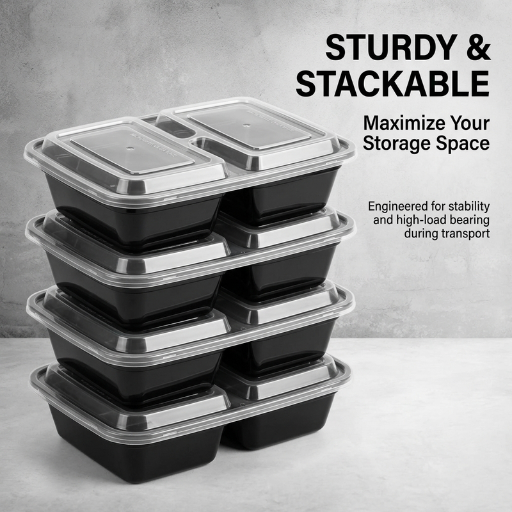
Una vez establecidos los materiales, la forma del diseño del recipiente se basa en el plato. La mayoría de los envases de alimentos desechables se clasifican en seis familias. Esta familia y maridaje mitiga los dos problemas más frecuentes: presentación destrozada y derrames durante el transporte.
| Familia | Mejor para | Materiales típicos | Tamaño de lapso |
|---|---|---|---|
| Tazas de delicatessen (redondas, con tapa) | Sopas, salsas, acompañamientos, ingredientes preparados | PP, MASCOTA | 8, 16, 32 oz |
| Conchas con bisagras | Platos, hamburguesas, sándwiches, ensaladas | PP, bagazo, espuma PS (cuando sea legal) | 1-3 compartimentos |
| Cajas para llevar y estilo chino | Fideos, arroz, platos calientes mixtos | Cartón Kraft, PP | 16-64 oz |
| Bandejas y platos | Catering, carne/productos agrícolas, panadería | Fibra moldeada, PET, aluminio | Pequeño a grande |
| Cuencos y tazas de sopa | Cuencos de cereales, sopas, ensaladas | PP, papel forrado, bagazo | 12-48 oz |
| Cajas de catering y multiporciones | Pedidos grupales, kits de comida | Kraft, corrugado | Pan half/full |
La estandarización generalmente ocurre en 2 o 3 familias para la manejabilidad de SKU y reordenamientos. Una cocina con muchas entregas puede usar bivalvas de PP para platos principales, tazas de delicatessen de PP para acompañamientos y salsas, y tazones de papel forrados para sopas, y luego usar formatos especiales como cajas bento y envases de sopa desechables como lo requiere el menú.
Guía de tamaño de contenedores: capacidad de oz coincidente con las porciones
Los errores de tamaño silenciosamente costosos pueden ser extremadamente amplios. Si los contenedores son demasiado pequeños, aplastan las fugas y la comida. Demasiado grande, y luego estás pagando por los materiales y el flete y haciendo que las porciones parezcan escasas. Los tamaños estándar de taza de delicatessen son la columna vertebral de la mayoría de los programas.
¿cuáles son los tamaños estándar de contenedores de delicatessen?
La mayor parte de la industria de servicios de alimentos desechables tiene una escalera de delicatessen casi universal: 8 oz, 16 oz y 32 oz, con tazas de 12 oz y 24 oz como intermediarios comunes. Su gran ventaja es que el diámetro de una tapa se ajusta a varias alturas de taza diferentes. Eso significa que para los de 8, 16 y 32 oz puede compartir un SKU de tapa única, lo que corta su inventario de tapa y reduce los errores de “tapa incorrecta” que ralentizan una línea de empaque. Asegúrese de que la taza coincida con la porción: los apósitos y los costados cuestan 8 oz, las sopas individuales y los costados de grano cuestan 16 oz, mientras que las sopas familiares y la preparación a granel cuestan 32 oz.
| Capacidad | Uso que mejor se adapta | Notas |
|---|---|---|
| 8 oz | Apósitos, salsas, salsas, guarniciones | Recuento más alto por caso; comparte tapa con 12/16 oz |
| 16 oz | Sopa individual, guarnición de cereales, ensalada | El tamaño del caballo de batalla para la mayoría de los menús |
| 24 oz | Ensalada de entrada, lado grande, batido | Puentes 16 y 32 oz |
| 32 oz | Sopa familiar, preparación a granel, poke bowl | Verifique la profundidad del congelador/estante antes de estandarizar |
Antes de asegurar una matriz de tamaño, verifique los números con los paquetes de su caja y la profundidad del estante usando un selector de tamaño de contenedor y línea de producto para que las cajas quepan en su almacenamiento.
Grado alimenticio y seguridad alimentaria: qué verificar antes de comprar
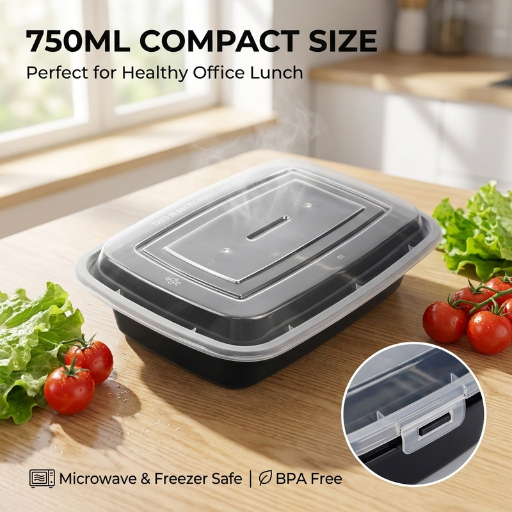
Debe verificar, no asumir, afirmaciones de “grado alimentario”, especialmente para pedidos más grandes. La FDA 21 CFR Partes 174-178 permite el uso de ciertos materiales para aplicaciones en contacto con alimentos, pero el material específico, el tipo de alimento y la temperatura de uso son factores que determinan el cumplimiento. Simplemente afirmar que algo está “aprobado por la FDA” no es lo mismo que proporcionar documentación para el cumplimiento tu aplicación.
¿cuál es la diferencia entre contenedores de PP y PET?
Los dos plásticos que más compararás serán el PP (polipropileno, código de resina #5) y el PET (tereftalato de polietileno, #1). El PP es opaco a translúcido, flexible y tolerante al calor, el único plástico desechable común apto para recalentamiento por microondas (hasta ~250°F/121°C). El PET es rígido, transparente como el vidrio y adecuado para visualización en frío, pero se deforma a bajo calor, y las referencias al servicio de alimentos citan un límite práctico de alrededor de 120°F (49°C), lo que lo convierte en un material frío y no recalentado. La regla más fácil: si el cliente lo utiliza en el microondas, envíe PP para microondas; Si es un artículo frío de aspecto premium, envíe PET. El PP también es la opción más duradera para la preparación de alimentos y la manipulación repetida, mientras que la claridad de la pantalla hace que el PET sea apreciado.
Antes de emitir la orden de compra masiva, solicite los siguientes cuatro documentos a su proveedor y realice su propia revisión:
- ✔ Una declaración de contacto con alimentos de la FDA que menciona la sección específica de 21 CFR para la resina en particular (por ejemplo, §177.1520 para PP).
- Límites de condiciones de uso: la temperatura y el rango de tipo de alimento para el que está clasificado el material ⎯ no solo “seguro para microondas” en la tapa.
- ✔ Estado del contenido reciclado: Generalmente, la resina reciclada posconsumo (PCR) para contacto con alimentos está sujeta a revisión caso por caso por parte de la FDA con autorizaciones específicas del proceso. Una citación CFR de resina virgen no cubre un lote reciclado.
- Una declaración sin PFAS para cualquier producto de fibra o recubierto (esto se está convirtiendo en un requisito legal estricto en varios estados «ver las perspectivas para 2026).
Los chefs del foro advierten continuamente que el sello ‘apto para microondas’ simplemente significa que el recipiente no se derretirá, lo que no garantiza una migración cero. Pruebas recientes muestran que los contenedores de PP y PS arrojan partículas de microplástico en grandes cantidades cuando se cocinan en el microondas, por lo que muchas cocinas trasladan los alimentos a un plato para recalentarlos independientemente del sello. Para contenedores, un verificado fabricante de envases de plástico de calidad alimentaria no debería tener problemas para demostrarlo.
Opciones Sostenibles: Compostable vs Biodegradable vs Reciclable
La sostenibilidad es donde los clientes se confunden más « y donde las afirmaciones vagas plantean un riesgo legal genuino. Los tres términos no son sinónimos.
| Reclamar | Lo que debería significar | Cómo verificar | Captura |
|---|---|---|---|
| Compostable | Se descompone en un compostador comercial en CO2, agua y biomasa | Certificación BPI según ASTM D6400 (plásticos), D6868 (recubierto) o D8410 (fibra) | Necesita acceso al compostaje industrial; rara vez es compostable en casa |
| Biodegradable | (Loosely) finalmente se derrumba | Sin estándar universal | En gran medida no regulado “tratar como una bandera roja sin un certificado |
| Reciclable | Aceptado y reprocesado en arroyos locales | Código de resina + aceptación del programa local | Los residuos de alimentos y las piezas pequeñas suelen descalificarse en la práctica |
Los compostables certificados tienen estándares reales: ser Certificado BPI, un artículo debe alcanzar aproximadamente la desintegración 90% en 84 días y cumplir con las restricciones PFAS (en vigor desde 2020). Para los consumidores, el criterio fácil es este ñanero si no está certificado según un estándar ASTM, el reclamo “eco” es indefendible.
¿son realmente mejores los contenedores compostables?
No automáticamente « y esta es la parte contraintuitiva que la mayoría de los compradores pasan por alto. Un contenedor compostable sólo ofrece su beneficio medioambiental si realmente llega a una instalación que lo acepta. Sin ese acceso, aparecen dos problemas. Primero, un artículo compostable arrojado en reciclaje es un contaminante: una taza compostable puede provocar que se envíe al vertedero un fardo entero de plástico reciclable que de otro modo sería valioso. En segundo lugar, en un entorno de falta de oxígeno, los compostables se descomponen de forma sucia, lo que crea metano, que Programa de las Naciones Unidas para el Medio Ambiente se describe como más de 80 veces más potente que el CO2 en un período de 20 años. En esa situación, una bifurcación compostable puede ser una más grande carga climática que una convencional de plástico.
“El embalaje compostable sólo ofrece su beneficio medioambiental cuando llega a una instalación de compostaje que lo acepta ”sin ese acceso se comporta como un contaminante en el reciclaje o como una fuente de metano en un vertedero”
También hay una capa de ley de marketing que los compradores olvidan: la FTC de EE. UU Guías verdes (16 CFR Parte 260) se debe fundamentar, no simplemente afirmar, una evidencia competente y confiable de afirmaciones ambientales como “compostable” o “reciclable” en su embalaje. Un certificado ASTM/BPI confirma el reclamo técnico de una entidad, pero esa no es una condición suficiente para satisfacer todos los requisitos de fundamentación de marketing. En pocas palabras: utilice materiales certificados y fundamente sus reclamos en el paquete. Nuestro decodificador de certificación de compostabilidad ilustra qué certificaciones son relevantes para los materiales, mientras que más envases de alimentos ecológicos la gama certificada muestra las opciones.
Cómo comprar al por mayor: MOQ, niveles de precios, impresión e importación personalizadas
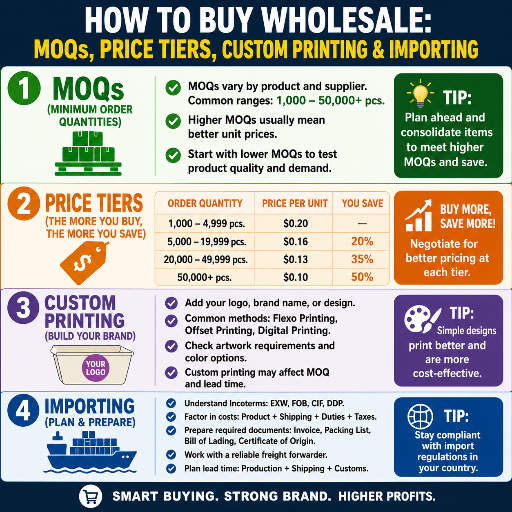
Comprar es una habilidad en sí misma. El error más común de los compradores a granel es centrarse únicamente en el costo unitario: los contenedores de baja calidad provocan fugas, además de costos de reembolso, eliminación o cumplimiento que pueden superar con creces cualquier ahorro. Intente utilizar un cuadro de mando estructurado (no una lista de precios).
El cuadro de mando de abastecimiento de contenedores a granel
- Documentación de calidad alimentaria: ¿pueden proporcionar una citación de 21 CFR, condiciones de uso y una declaración libre de PFAS previa solicitud?
- Ajuste MOQ «¿los pedidos mínimos se alinean con su tasa de consumo o terminará almacenando un año de inventario?
- Precios a su volumen real ‘proporcione una cotización para el nivel que realmente está comprando, no el precio principal.
- Plazo de entrega y confiabilidad «producción + flete; Solicite un plazo real, no el mejor de los casos.
- Capacidad personalizada «¿Pueden imprimir su logotipo y cortar moldes personalizados, y cuál es la recuperación de las herramientas?
- Cobertura de cumplimiento «¿sus materiales abordan las prohibiciones que se aplican en sus estados de ventas (y mercados de exportación)?
En cuanto a la MOQ y la personalización, la economía se dividió en dos caminos. Artículos en stock se envía en mínimos bajos (a menudo en algunos casos), cubre una amplia gama de selección y envío rápido, y se adapta a pruebas y operaciones más pequeñas. Impreso o moldeado a medida los programas tienen mínimos más altos porque las placas de logotipos y etiquetas, además de las herramientas, conllevan costos de configuración fijos, pero reducen el costo unitario en mayor cantidad y ponen su marca en cada pedido. Operando 20 líneas de termoformado, 6 líneas de extrusión de láminas y 60 líneas de moldeo por inyección con una capacidad total de más de 1 millón de unidades por día, hemos descubierto que los compradores tienden a subestimar las pruebas antes de realizar una gran ejecución personalizada; Solicitar muestras de los elementos reales del menú evitará los errores más costosos. Evalúe las opciones utilizando nuestro proveedor mayorista de envases de alimentos herramientas o explorar envases de alimentos personalizados opciones para ejecuciones de marca.
⚠️ Importando vigilancia
Si importa contenedores, bandejas o tapas de aluminio, considere soluciones comerciales: desde 2025, EE. UU. ha recibido órdenes de derechos antidumping y compensatorios contra ciertos contenedores de aluminio desechables de China. Estos derechos se sumarán al precio unitario y al flete, así que verifique el costo de aterrizaje, no solo la cotización FOB, antes de decidirse por el aluminio importado.
Adaptar un programa de contenedores a su operación
La mezcla adecuada del recipiente dependerá de cómo salga la comida de la cocina. Algunos perfiles operativos:
Las cocinas fantasma o la marca de entrega dependen de la integridad del tránsito. Nuestra principal prioridad a partir de ahora serán las conchas de PP con cierre, tapas ventiladas y tazas de delicatessen de PP para cada salsa. Cualquier salsa que se escape de la taza en la bolsa generará un reembolso y una revisión de una estrella. Mantenga los tamaños estándar de dos conchas de almejas y un sistema de tapa para mantener la línea rápida.
Un camión de comida depende de la rapidez y de un pequeño espacio de almacenamiento. Anidar tazas de delicatessen y una sola cubierta que cubre la mayor parte del menú vence a una amplia variedad de SKU; El almacenamiento cúbico es el factor limitante, por lo que las dimensiones de la caja son tan importantes como el precio. Stock-and-go envases de preparación de comidas link aquí suele cumplir una doble función para el servicio de camiones.
A comedor en un hospital o escuela aborda cuestiones como la retención de calor, la segregación de alérgenos y el cumplimiento de las adquisiciones. Sus bandejas de compartimentos mantienen diferentes artículos separados, el PP permite recalentar y los materiales certificados cumplen con los requisitos de compra de las instituciones, donde se prioriza el cumplimiento/documentación sobre el precio más bajo.
Operación → Programa de Contenedores (mapa rápido)
| Entrega/cocina fantasma | Almejas con bloqueo de PP + tazas de salsa de PP; tapas ventiladas |
| Camión de comida | Tazas de delicatessen anidadas + una concha versátil; cubo de mindcase |
| Catering | Bandejas de media/campana + cajas de catering kraft |
| Hospital/comedor escolar | Bandejas de compartimentos de PP; materiales certificados + documentos completos |
Perspectivas para 2026: prohibiciones de espuma, reglas PFAS y cambio a la fibra
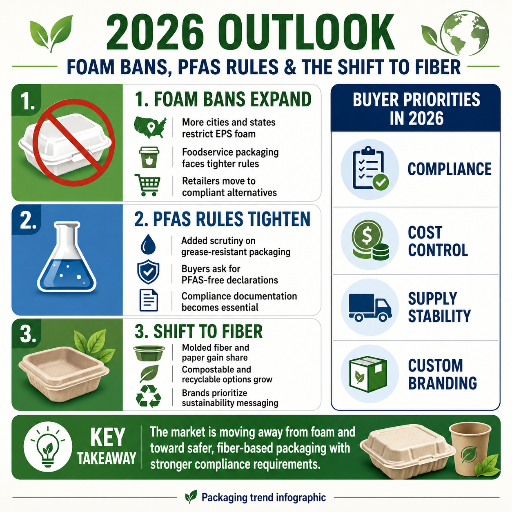
Las regulaciones serán el aspecto que cambiará más rápidamente en relación con su negocio y 2026 será un año crucial. Si planea realizar compras en 2026, debe considerar el cumplimiento como parte de sus especificaciones de abastecimiento, en lugar de una idea de último momento.
Las prohibiciones del poliestireno (espuma) se están extendiendo. Los estados con prohibiciones de servicios de alimentos de EPS ahora incluyen California, Nueva York, Nueva Jersey, Maine, Maryland, Vermont, Washington, Rhode Island y Delaware. Nueva York prohibió los contenedores de servicios de alimentos de EPS en 2022, y según NYSDEC , a partir del 1 de enero de 2026, esto también se aplicará a los EPS de almacenamiento en frío (refrigeradores, hieleras). La prohibición del servicio de alimentos EPS de Virginia se implementará entre 2025 y 2026, según el tipo de proveedor, así que verifique cuál es la fecha de vigencia actual para su operación en lugar de asumir que habrá una fecha límite única.
Los límites del PFAS ahora se aplican a la fibra. La regla PFAS de Maine sobre envases de alimentos de fibra vegetal entra en vigor el 25 de mayo de 2026 (excluyendo a los fabricantes con menos de $1 mil millones en ingresos) y la AB 1200 de California ha prohibido el PFAS (o ≥100 ppm de flúor orgánico total) en envases de alimentos de fibra vegetal desde 2023 y la prohibición más amplia de PFAS para envases de alimentos de Nueva Jersey entrará en vigor en 2028, y en 2025 Illinois habrá ampliado su Ley de Reducción de PFAS (Ley Pública 104-0231) para incluir envases de alimentos, con otras disposiciones y plazos de cumplimiento que entrarán en vigor en los próximos años. Debido a las diferentes fechas y alcance por estado, es aconsejable confirmar en lugar de asumir la fecha de vigencia para cada uno de sus estados de ventas. La FDA ha declarado que los agentes antigrasas PFAS ya no se venderán en el mercado estadounidense a partir de 2024, y las autorizaciones pertinentes expirarán a principios de 2025, lo que indica que incluso los estados no prohibidos están viendo diseñado el PFAS.
El cambio hacia la fibra es estructural, no estacional. Se prevé que el mercado estadounidense de envases de alimentos desechables crezca de aproximadamente $14,9 mil millones (2024) a $23 mil millones para 2030 (alrededor de 7,5% CAGR), y las cadenas de servicio rápido están reemplazando las almejas de plástico con fibra moldeada y cartón. La tecnología habilitadora son los recubrimientos de barrera a base de agua sin PFAS, que utilizan dispersiones de arcilla, carbonato de calcio, almidón, quitosano o biopoliéster, que, como Ingeniería de Alimentos informes, ahora le brinde a la fibra las necesidades de comida para llevar caliente resistente a la grasa y la humedad. Acción para los compradores de 2026: si vende en varios estados o exporta, default nuevos programas a fibra o PP certificado y libre de PFAS y mantiene un seguimiento de cumplimiento documentado; el buscador de cumplimiento de prohibición de espuma mapas que de tus estados ya restringen la espuma.
La curva de costos del interruptor de espuma a fibra
El cambio de espuma a fibra certificada generalmente aumenta los costos unitarios en el corto plazo, pero disminuye una vez que se aumenta el riesgo de cumplimiento del precio (multas, recompras forzosas si se produce una prohibición), el valor de la marca y la disminución constante en el precio de la fibra a medida que aumenta el volumen. Operadores que cambian antes la fecha límite de su estado evita la prima de las compras de pánico que ocurren cuando todos cambian al mismo tiempo.
Preguntas frecuentes
¿son seguros los contenedores de alimentos al por mayor para microondas y congeladores?
Ver respuesta
Depende de la resina. El polipropileno (PP, #5) es apto para microondas (hasta aproximadamente 250°F/121°C) y apto para congeladores, por lo que es el valor predeterminado para comidas recalentables. El PET (#1) es tolerante al congelador para artículos fríos, pero no apto para microondas « se deforma y puede degradarse por encima de aproximadamente 120-140°F. Confirme siempre que el producto específico esté clasificado para ambos y busque un símbolo impreso a prueba de microondas en artículos PP.
¿los contenedores para llevar son a prueba de fugas?
Ver respuesta
Sólo por diseño. La verdadera resistencia a las fugas proviene de una tapa a presión que se bloquea mecánicamente al borde del recipiente, no de un material más grueso. Para sopas y platos picantes, elija tazas redondas de delicatessen de PP con tapas a presión o tazas de sopa de papel forradas; Evite el cartón sin forro, cuyo revestimiento de PE puede fallar cerca de 95°C (203°F). Para la entrega, las tapas ventiladas también ayudan liberando la presión del vapor que de otro modo expulsaría el líquido.
¿cuál es el MOQ típico para envases de alimentos al por mayor?
Ver respuesta
Para artículos en stock (sin imprimir), los mínimos suelen ser tan bajos como unos pocos estuches, lo que los hace ideales para realizar pruebas. Los programas impresos o moldeados personalizados tienen mínimos más altos porque las placas de logotipo y las herramientas tienen costos de configuración fijos que solo se amortizan en volúmenes mayores. Pregunte a cada proveedor por el MOQ en el SKU exacto y el nivel de impresión que necesita, y solicite muestras antes de comprometerse con una gran ejecución personalizada.
¿Las tapas vienen incluidas o se venden por separado?
Ver respuesta
Generalmente por separado. La mayoría de las tazas, tazones y bandejas de delicatessen venden cuerpos y tapas en estuches separados, así que confirma que estás pidiendo ambos.
¿están prohibidos los contenedores de espuma (espuma poliestireno) para llevar?
Ver respuesta
En un número creciente de estados de EE. UU., sí. Los contenedores de servicios de alimentos de poliestireno expandido (EPS) están prohibidos en estados como California, Nueva York, Nueva Jersey, Maine, Maryland, Vermont, Washington, Rhode Island y Delaware, y más están introduciendo restricciones gradualmente hasta 2025-2026. Porque las reglas y las fechas de vigencia difieren según el estado « y a veces según la ciudad “consulte sus jurisdicciones de ventas específicas antes de reordenar espuma y tenga calificada una alternativa de fibra o PP para que la prohibición no deje varado su inventario.
¿Puedes poner cajas chinas para llevar en el microondas?
Ver respuesta
No si tienen un mango de metal o cualquier forro de aluminio, quítelos primero. Las cajas de cartón lisas pueden calentar brevemente los alimentos, pero no están diseñadas para un calor sostenido; Transfiera a un recipiente de PP apto para microondas o a un plato para recalentar.
¿cuánto tiempo lleva la entrega y el plazo de entrega de contenedores a gran
Ver respuesta
Los artículos en stock se envían más rápido a menudo en días a nivel nacional. Los pedidos impresos personalizados añaden tiempo para la prueba y la configuración de impresión, y los moldes personalizados añaden tiempo de entrega de herramientas además. Para pedidos importados, incluya el transporte marítimo y el despacho de aduanas. Siempre solicite la ventana realista de producción más carga en lugar del número del mejor de los casos, y solicite un colchón de existencias para cubrir el vacío en su primera ejecución personalizada.
¿busca envases de calidad alimentaria a granel, lisos o impresos a medida con su logotipo?
Acerca de esta guía
Esta guía fue preparada y revisada por el equipo de embalaje de Wonhi (Shandong Wanhui Environmental Protection Technology Co., Ltd.), un fabricante de 20 años de cajas de comida desechables, tazones y contenedores para servicios de alimentos que exporta a Europa, América, Medio Oriente, Asia-Pacífico y América del Sur. Nos basamos en las fuentes públicas a continuación para conocer los rangos de temperatura de los materiales, las citas de la FDA, los estándares de certificación y las fechas reglamentarias de 2026; Verifique las fechas de vigencia estatales de sus jurisdicciones antes de comprarlas, ya que cambian con frecuencia.
Referencias y fuentes
- 21 CFR Parte 177 « Aditivos alimentarios indirectos: polímeros « Código electrónico de regulaciones federales de EE. UU
- 21 CFR 177.1520 « Polímeros de olefina (polipropileno) « Administrația de Alimente și Drugării SUA
- Plásticos Reciclados en Envases de Alimentos « Administrația de Alimente și Drugării SUA
- Certificación de Compostabilidad Comercial (ASTM D6400/D6868/D8410) « Instituto de Productos Biodegradables
- Guías verdes, 16 CFR Parte 260 «Comisión Federal de Comercio de Estados Unidos
- Prohibición ampliada de la espuma de poliestireno «Departamento de Conservación Ambiental del Estado de Nueva York
- Las leyes de embalaje entrarán en vigor en 2026 « Bucea de empaquetare
- Los revestimientos de barrera sostenibles reemplazan a los PFAS «Ingeniería de Alimentos
- Datos sobre el metano « Programul de Mediu ONU
Recursos relacionados
- Contenedores de alimentos desechables « gama completa de productos en cajas de comida, tazones y bandejas
- Contenedores tipo almeja compostables « Opciones de formato articulado con certificación en fibra
- Cajas de comida para llevar personalizadas «packaging con marca y logotipo impreso
- Contenedores de 3 compartimentos « Separaciones de porciones de comida y comedor
- Contenedores de alimentos al por mayor « solicitud de catálogo y cotización masiva