Póngase en contacto con la empresa Wanhui


Actualizado en julio de 2026. Revisado por el equipo de embalaje de Wanhui.
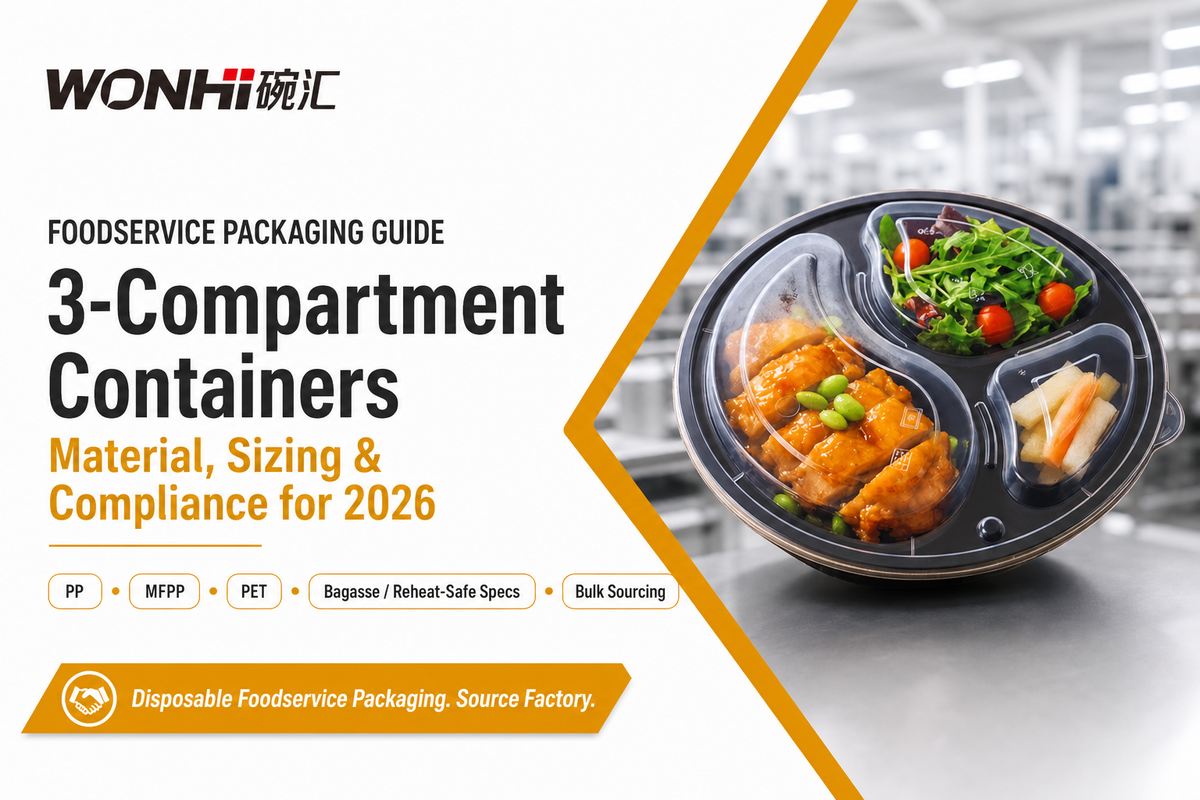
Los contenedores de 3 compartimentos son bandejas de servicio de alimentos de una sola carcasa con tres pozos interiores que mantienen una entrada caliente separada de dos lados o de un postre, y para el servicio de alimentos fuera de las instalaciones de EE. UU., son el formato al que los operadores buscan cada vez que sangran, reparten y presentan la salsa. todo importa a la vez. Esta guía está escrita para el comprador, no para el navegador: qué material realmente sobrevive a su ciclo de recalentamiento, cuántos compartimentos necesita realmente su menú, por qué la salsa migra entre pozos y cómo mantener legal su próximo pedido al por mayor según las reglas de espuma y PFAS que ahora se extienden por todo el país. estados.
La respuesta corta: Un recipiente de 3 compartimentos es una bandeja de servicio de alimentos de una sola pieza con bisagras o tapa a presión con tres pozos interiores que contienen una comida completa, normalmente un pozo de entrada grande más dos pozos laterales más pequeños. Para entrega en caliente, especifique polipropileno (PP) o PP relleno de minerales (MFPP) con una tapa ventilada con cierre perimetral; reserve PET transparente para servicio en frío y trate “compostable” como una especificación certificada, no como una etiqueta.
Especificaciones rápidas: Contenedores de servicio de alimentos de 3 compartimentos
| Huellas comunes | 8×8 pulg. y 9×9 pulg. articulados (cuadrados); 9×6 en rectangular |
| Típico bien dividido | ~850 ml entrada + 350 ml + 350 ml lados |
| Material de comida caliente | PP (#5) / PP relleno de minerales (MFPP) |
| Material de servicio en frío | Pet transparente (#1) |
| Clasificación de microondas (PP/MFPP) | Recalentamiento de ráfaga corta a ~120°C / 250°F |
| Paquetes de estuches | 100-150 juegos/caso típico |
Qué es realmente un contenedor de 3 compartimentos (y cuándo gana el formato)
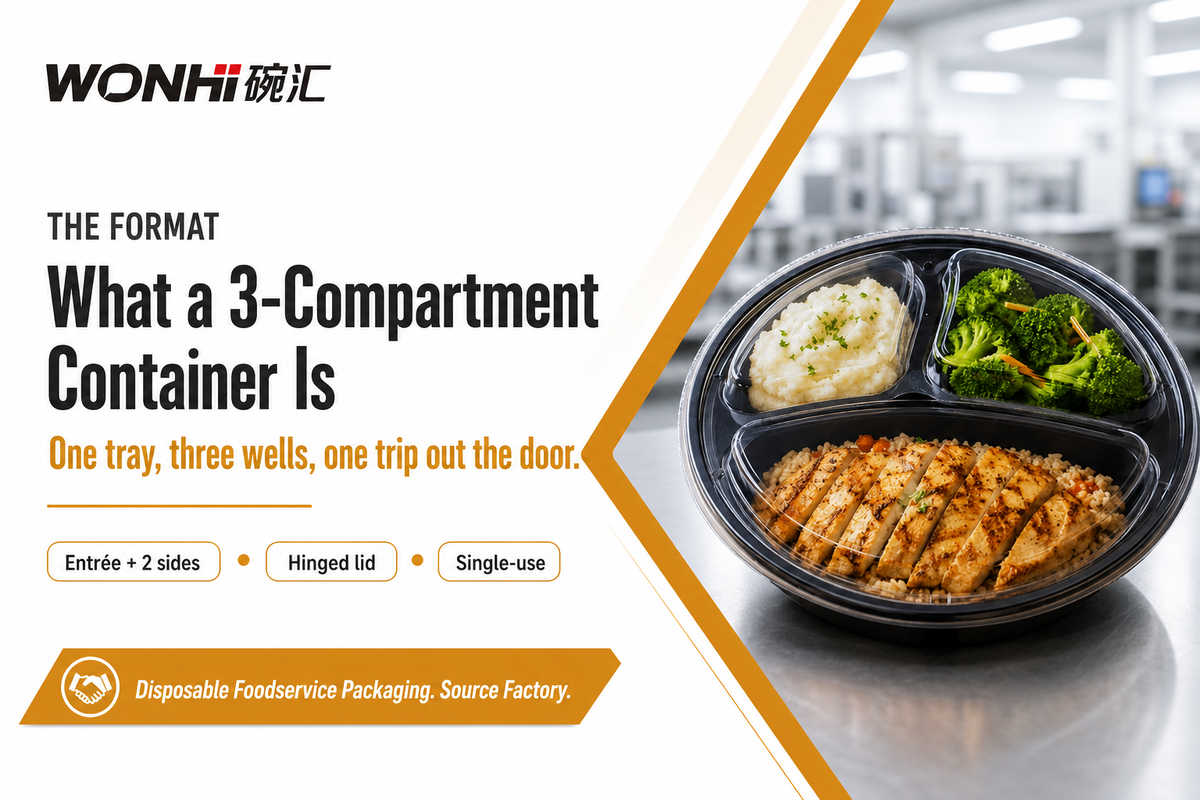
Un recipiente de 3 compartimentos es una bandeja con una sola bisagra o tapa a presión con tres pozos interiores sellados del tamaño adecuado para una comida completa. Un plato principal caliente se mantiene separado de dos lados fríos o picantes. Esas resinas son de grado de contacto con los alimentos según la regla de la FDA polímeros de olefinas (21 CFR 177.1520), que es la base de seguridad para las bandejas de servicio de alimentos de PP y PET, no una clasificación de temperatura.
Este formato gana cuando su menú tiene una estructura natural de tres partes y la migración de la salsa perjudica la primera impresión del cliente “combinación de comidas, servicio de almuerzo en la escuela y cafetería, entrega de preparación de comidas y platos de catering. Reemplaza el hábito de ”una taza por artículo más su propia tapa” con un solo SKU, lo que reduce la mano de obra del paquete de recogida y reduce la cantidad de artículos en línea en el estante de su almacén.
Eso pierde cuando el menú es un solo elemento de gran volumen: los divisores comen volumen utilizable, por lo que un cuenco de burrito o un pedido de alas suele ser mejor en un compartimento de 1 o 2 envase de preparación de comidas. Los profesionales que prueban estas bandejas notan lo mismo repetidamente: los compradores sobreespecifican el recuento de compartimentos y luego se quejan de que “simplemente están perdiendo espacio”. Wanhui codifica el formato directamente en sus números SKU “un 883 dice ”8 pulgadas, 3 compartimentos“ y un 993 como ”9 pulgadas, 3 compartimentos”, la misma lógica que utilizan los catálogos mayoristas. En la práctica, una taquería que ejecuta 400 pedidos de entrega al día movió sus entradas húmedas a contenedores desechables de 3 compartimentos y cortó bruscamente las quejas de fugas mixtas. Ese es el concreto que se entrega en contenedores de alimentos de 3 compartimentos en un menú atrevido, y por qué los operadores pagan por contenedores de 3 compartimentos con tapas que realmente sellan en lugar de los contenedores de 3 compartimentos más baratos para llevar que puedes comprar en el estante. Ese mismo formato dividido también aparece como loncheras de consumo y juegos de almacenamiento de alimentos, pero un contenedor de alimentos de plástico para servicio de alimentos está diseñado para un ciclo de un solo uso más caliente y rápido que una caja de sobras del hogar.
💡 Conclusión clave: Elija 3 compartimentos cuando el menú sea entrée-plus-two, no por defecto « el divisor sólo es una ventaja cuando la comida realmente necesita separarse.
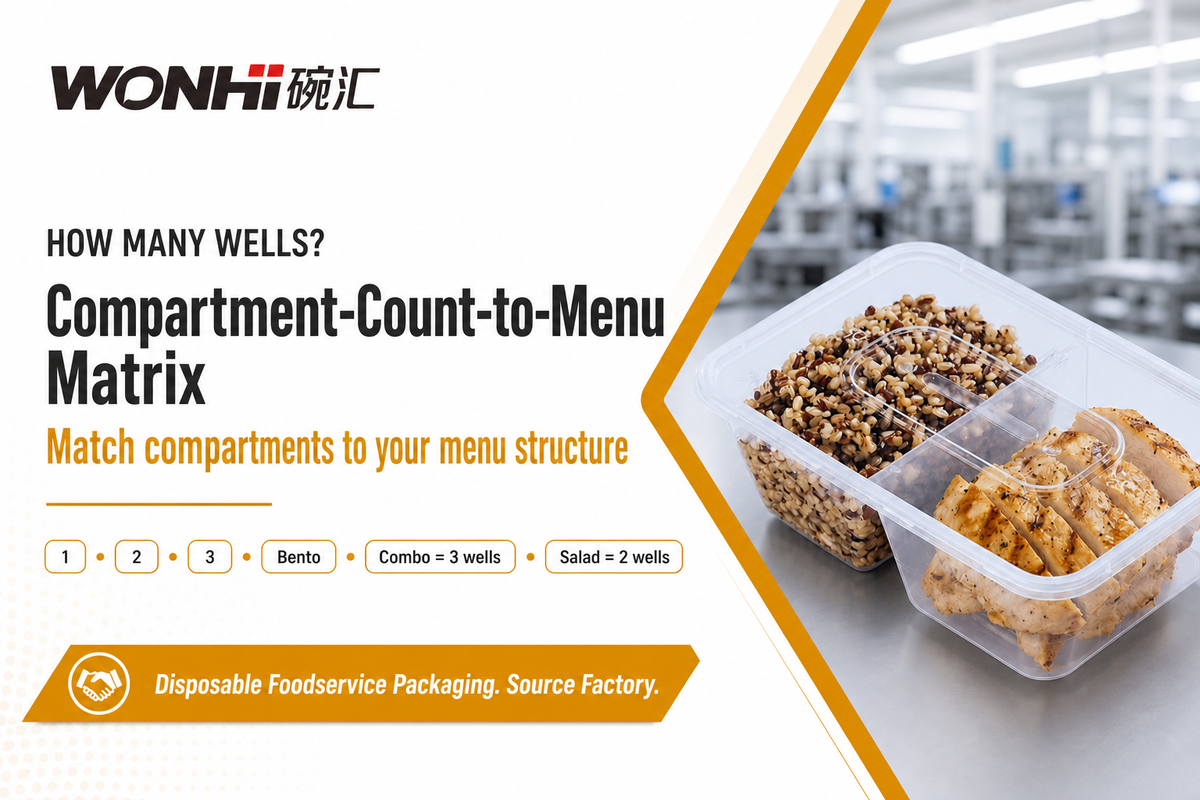
La matriz de recuento de compartimentos al menú asigna la estructura del menú al recuento de compartimentos para que usted especifique por la comida, no por lo que sea que haya tenido su último distribuidor en stock. Haga coincidir el recuento con la cantidad de artículos que deben permanecer físicamente separados; todo lo demás son herramientas desperdiciadas y volumen perdido.
| Estructura del menú | Contar | Por qué |
|---|---|---|
| Sopa, tazón monoproteico, postre | 1 | Un alimento, no se necesita separación; Los divisores sólo cuestan volumen |
| Arroz + proteína, ensalada + aderezo | 2 | Un maridaje húmedo/uno seco; A menudo se envía con un sello por pocillo |
| Comida combinada: entrada + 2 caras | 3 | El ajuste clásico « un SKU reemplaza tres tazas + tapas |
| Comida en bandeja de escuela/cafetería | 3 | Componentes controlados por porciones, recalentables en línea |
| Entrega de preparación de comidas (macro-track) | 3 | La división de proteína/carb/vegetal se lee como control de porciones |
| Harina chapada estilo bento | 3–4 | Variedad visual; ver el guía de formato de caja Bento |
| Plato de degustación/muestreador | 5+ | Muchas porciones pequeñas; herramientas especiales |
| Artículo único de gran volumen (alas, papas fritas, tazón de burrito) | 1 | Los divisores bloquean el volumen que necesitan los alimentos |
Lógica SKU y bien dividida extraída de las especificaciones de la línea de producción de Wanhui; Los patrones de ajuste del menú se cotejan con las discusiones de los compradores de servicios de alimentos.
💡 Conclusión clave: La estandarización en un menú de 3 compartimentos para una entrada más dos colapsa tres SKU de taza y tapa en uno, que es donde la adquisición real salva vidas: menos artículos de línea, envío de una sola paleta, estaciones de cocina más simples.
Selección de materiales: PP, MFPP, PET, Bagazo y Espuma Comparados
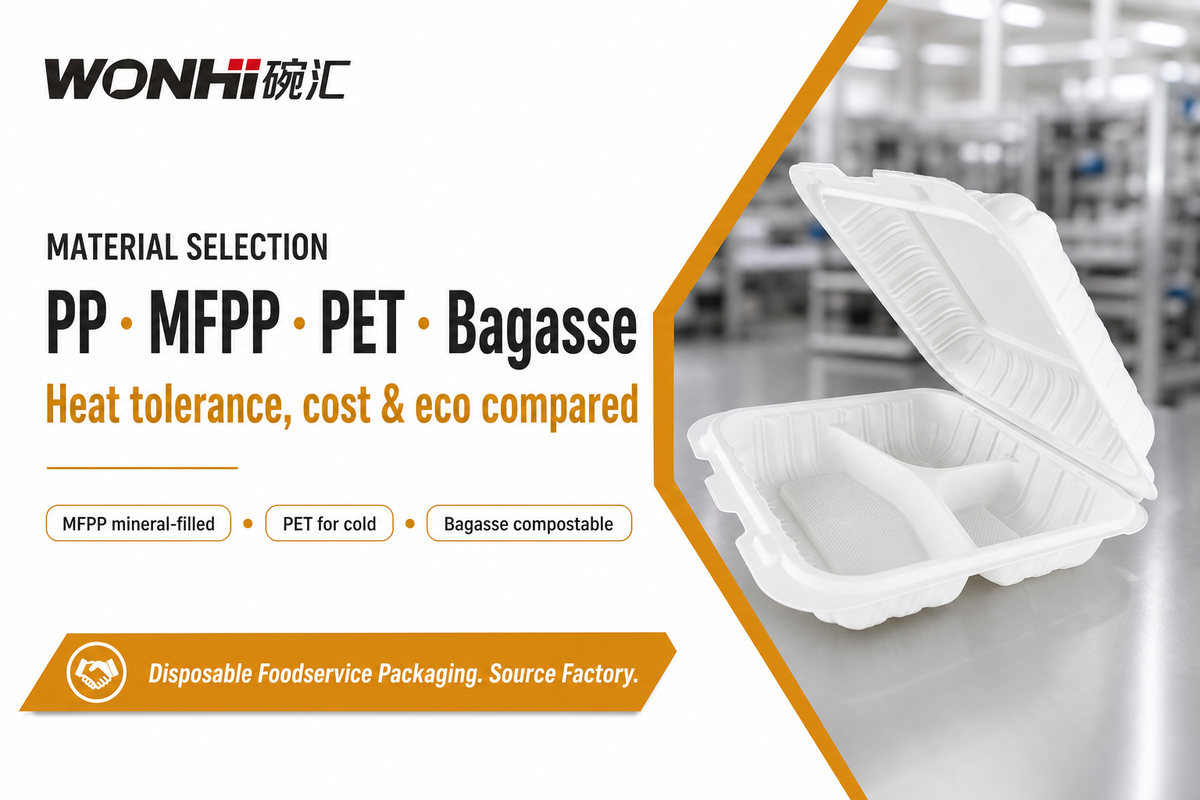
El material decide todo lo relacionado con la tolerancia al calor, la seguridad de los microondas, la claridad, la reciclabilidad y si el contenedor es legal en su estado.
Si se equivoca, la caja se derrite al recalentar o no cumple con la regla municipal de espuma. Así es como se comparan las cinco familias de servicios de alimentos.
| Material | Temperatura de servicio | Microondas | Mejor para |
|---|---|---|---|
| Polipropileno (PP #5) | Continuo ~80-100°C; ráfaga corta ~120°C/250°F | Sí (tapa de ventilación) | Comida caliente para llevar, tazones de arroz, entrega a domicilio |
| Pp relleno de minerales (MFPP) | ~110°C/230°F, mai străgător | Sí | Reemplazo de espuma con bisagras de primera calidad |
| PET (#1) | Suaviza ~70-75°C (amorfo) | No | Ensaladas frías, sushi, delicatessen, display |
| Bagazo (fibra moldeada) | Maneja bien los alimentos calientes (~200°C+) | Sí | Lugares exigidos por compost (si están certificados) |
| Espuma EPS | ~70°C; se suaviza rápidamente | No | Ser legislado (ver cumplimiento) |
Temperaturas de servicio de PP por Datos de polipropileno MatWeb; Ablandamiento de PET a partir de la medición de la transición vítrea. FDA 21 CFR 177.1520 rige la seguridad en contacto con los alimentos, no la temperatura.
Dos notas útiles que ocultan las hojas de especificaciones. En primer lugar, el PP cuesta entre 1/3 y 1/5 de la cantidad por unidad de volumen que el PET, por peso y también en términos de costo en dólares por gramo de resina. Esta es la razón por la que prácticamente todos los alimentos de cocina estadounidenses a temperatura dependen del PP. En segundo lugar, el PP relleno de minerales sustituye el polímero por una carga inerte 30-40%, lo que añade la rigidez que protege una tapa con bisagras y un divisor, razón por la que se apoyan las líneas de reemplazo de espuma Contenedores con bisagras MFPP en lugar de PP sin llenar.
La elección del material aparece en las tasas de quejas, no en las hojas de especificaciones. Una cocina fantasma con forma de burrito que utilizaba finas conchas de espuma luchó contra constantes devoluciones de llamada de tapa deformada y queso derramado hasta que cambió a PP negro con tapas con bloqueo perimetral; Las quejas disminuyeron drásticamente por un aumento en el costo del embalaje de aproximadamente $0,15 por pedido. Los operadores repiten la lección sin rodeos: compre el material adecuado para el calor, no la caja más barata del estante.
“Probamos catorce relaciones de relleno de MFPP en las líneas 883 y 993 antes de decidirnos por la formulación actual; es la única mezcla que mantiene la forma después de recalentar el microondas durante 90 segundos sin deformar los divisores de 3 compartimentos”
¿sobrevivirá al microondas? La escalera de temperatura y recalentamiento del servicio de alimentos
¿son seguros los contenedores de 3 compartimentos para microondas?
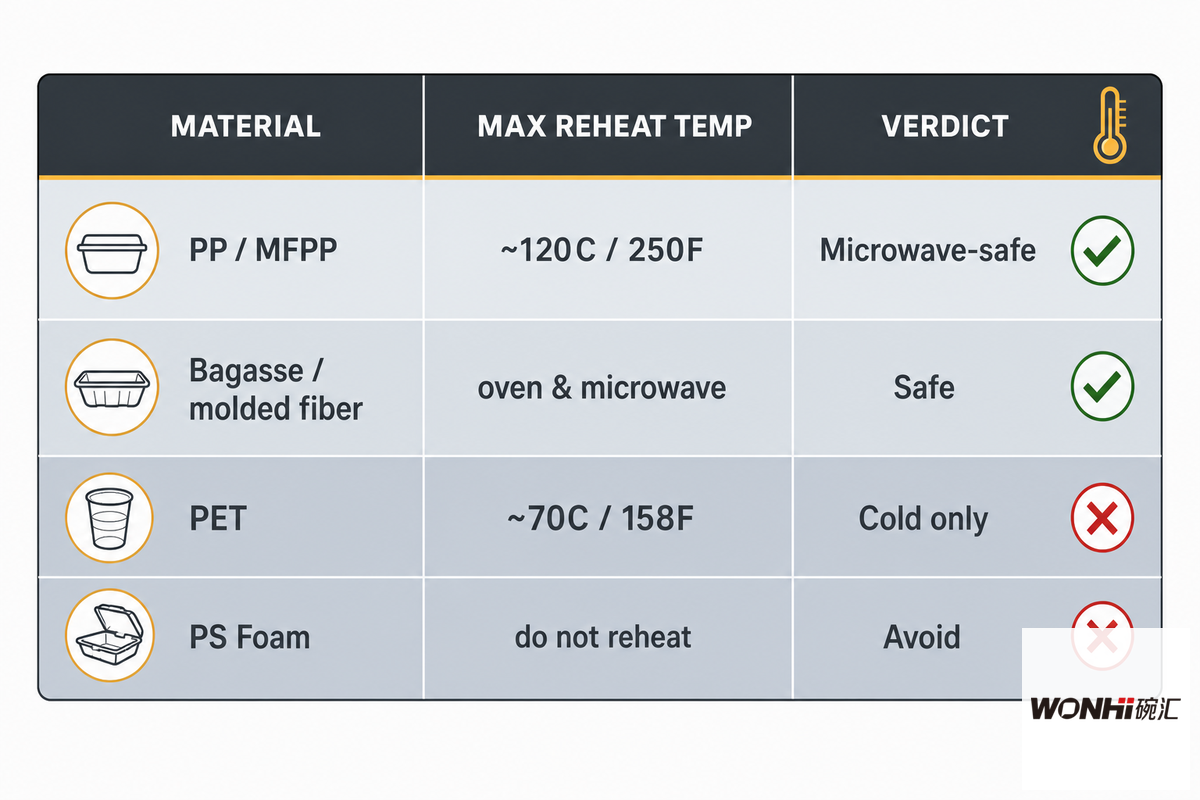
Los recipientes de PP y PP de 3 compartimentos llenos de minerales funcionan bien con recalentamientos cortos aptos para microondas, de hasta aproximadamente 120 °C/250 °F; El PET claro y sin llenar no lo es, porque comienza a ablandarse cerca de 70-75 °C, por debajo de la temperatura de la sopa o el arroz recién chapados. Al seleccionar un artículo para recalentar, simplemente consérvelo la escalera de temperatura y recalentamiento del servicio de alimentos en mente: haga coincidir la clasificación del material con la temperatura máxima real de su alimento y luego deje un amortiguador.
- ✔~200°C+ bandejas CPET de fibra moldeada de bagazo y doble horno: mesa de vapor y servicio de convección.
- ✔~110-120°C / 230-250°F PP y MFPP: sopa caliente, tazones de arroz, recalentamiento en microondas. Aquí es donde vive la comida para llevar.
- ✔~70-75°C Techo de PET: frío y ambiente únicamente; se deforma bajo relleno caliente, nunca en el microondas.
- ✔~60-70°C Suelo de espuma EPS: se ablanda rápidamente y está prohibido por completo.
📐 Ejemplo trabajado: Un recipiente de arroz y curry chapado a ~95°C se encuentra por encima del punto de reblandecimiento de ~70°C del PET, pero cómodamente por debajo de la clasificación de ráfaga corta de ~120°C del PP. Entonces, especifique PP o MFPP negro, PET no claro: la claridad no vale nada una vez que la bandeja se deforma y el cliente fotografía una tapa caída.
Los operadores confirman el fracaso a través de los comentarios de los clientes, ya que los clientes llaman para informar que el plástico delgado se deforma visiblemente bajo los alimentos calientes (lo que indica inmediatamente un posible riesgo de sanguijuelas) o para decirles que sus preparadores de comidas no colocarán sus tapas de plástico en el microondas (lo que los distorsiona), y en su lugar lávelos a mano. PP también toma el swing de congelación a microondas que exige la entrega de preparación de comidas, manteniéndose flexible en el congelador y seguro bajo un recalentamiento. Sin embargo, la clasificación del material es solo la mitad del recalentamiento seguro: Guía de seguridad alimentaria del USDA también requiere ventilación, agitación o rotación para un calentamiento uniforme, un tiempo de reposo y recalentamiento de las sobras a 165°F/74°C. Si el recalentamiento en el contenedor es importante para su menú, coloque los SKU aptos para microondas en sus líneas PP/MFPP y etiquételos claramente.
Por qué la salsa sangra entre compartimentos: la regla del sangrado entre compartimentos
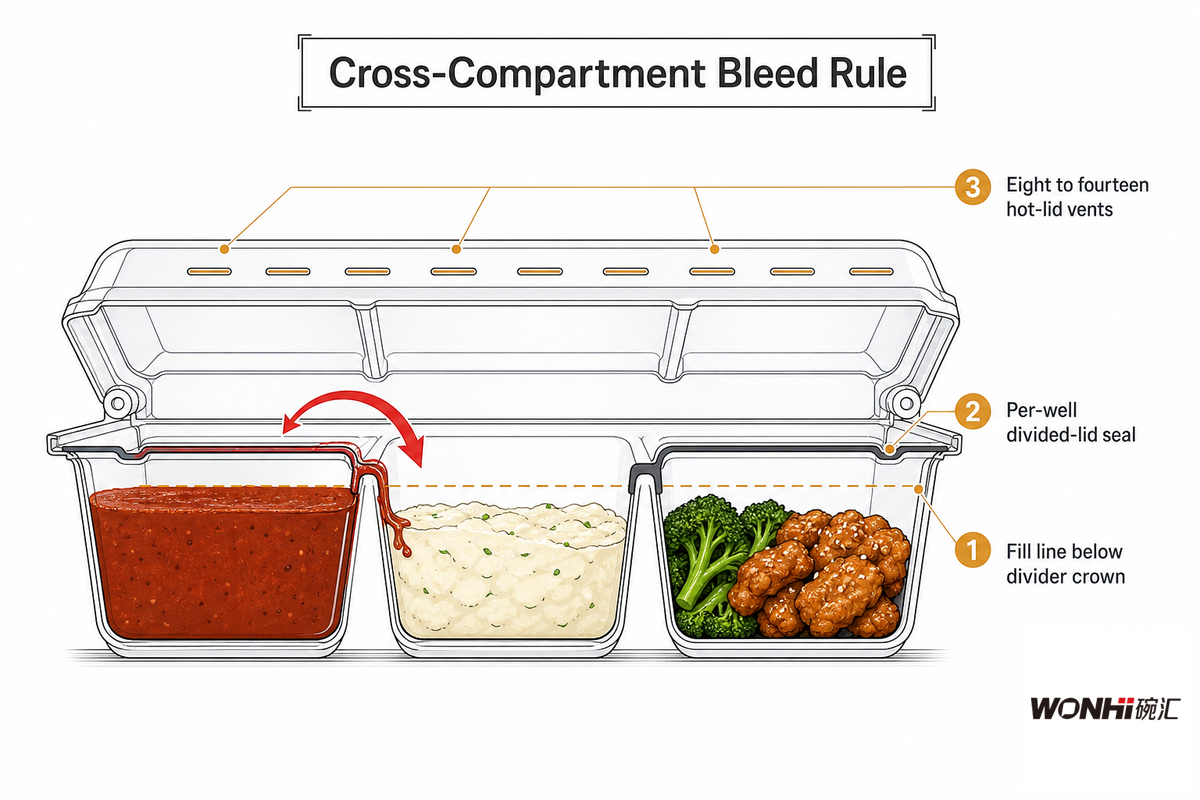
El aderezo o salsa de purga ‘con compartimento cruzado que migra de un pozo al siguiente ‘es la principal queja en recipientes divididos, y es un problema de cierre de tapa mucho más que de altura del divisor. La mayoría de los SKU de 3 compartimentos envían una tapa que sella bien la caja exterior pero no cada interior, por lo que una inclinación en la bolsa de entrega permite que el líquido pase por encima de los divisores.
Como dijo un preparador de comidas, “la tapa no sella los compartimentos entre sí, por lo que mi hummus se filtró sobre todo lo demás”
La regla de purga entre compartimentos: llene hasta por debajo de la altura del divisor, use una tapa dividida que selle los pozos interiores de forma independiente y las tapas de ventilación en los alimentos calientes.
📐 Nota de ingeniería: Sellar demasiado un recipiente caliente produce fugas peor, no mejor. El vapor atrapado genera una presión de vapor que activa cerraduras de fricción de una sola pestaña « tapas diseñadas para agarrarse y ponerse en frío « una vez que llega la expansión térmica. La ventilación es la solución general: Guía de seguridad alimentaria del USDA es aflojar o ventilar la tapa para que pueda escapar el vapor en lugar de generar presión. Una patente de contenedor de alimentos (Anchor Packaging, US20100320210A1) describe de 8 a 14 respiraderos en la superficie superior como su óptimo probado, colocados en la parte superior de la tapa en lugar de en los lados para evitar un efecto de aire muerto, un punto de referencia de ingeniería útil, no un umbral de rendimiento universal. Para platos calientes, fritos o con arroz, una tapa ventilada es la más opción a prueba de fugas; Reserve cerraduras perimetrales sin ventilación para sopas y salsas.
Si el envío es correcto, podemos centrarnos en otra mitad que es la consistencia de fabricación. El PP dividido barato a menudo viene con tapas deformes que no se cierran directamente de la caja: un comprador tenía diez contenedores y “ninguno cierra.” En la línea 993 de Wanhui, el pozo de entrada tiene 38 mm de profundidad y los pozos laterales tienen 32 mm, con una pared de 0,55 a 0,65 mm medida en la línea para que el divisor siga siendo duradero y mantenga su forma mediante un recalentamiento en lugar de relajarse en el pozo vecino.
Dimensionamiento por tipo de operación: El selector de especificaciones de tipo de operación
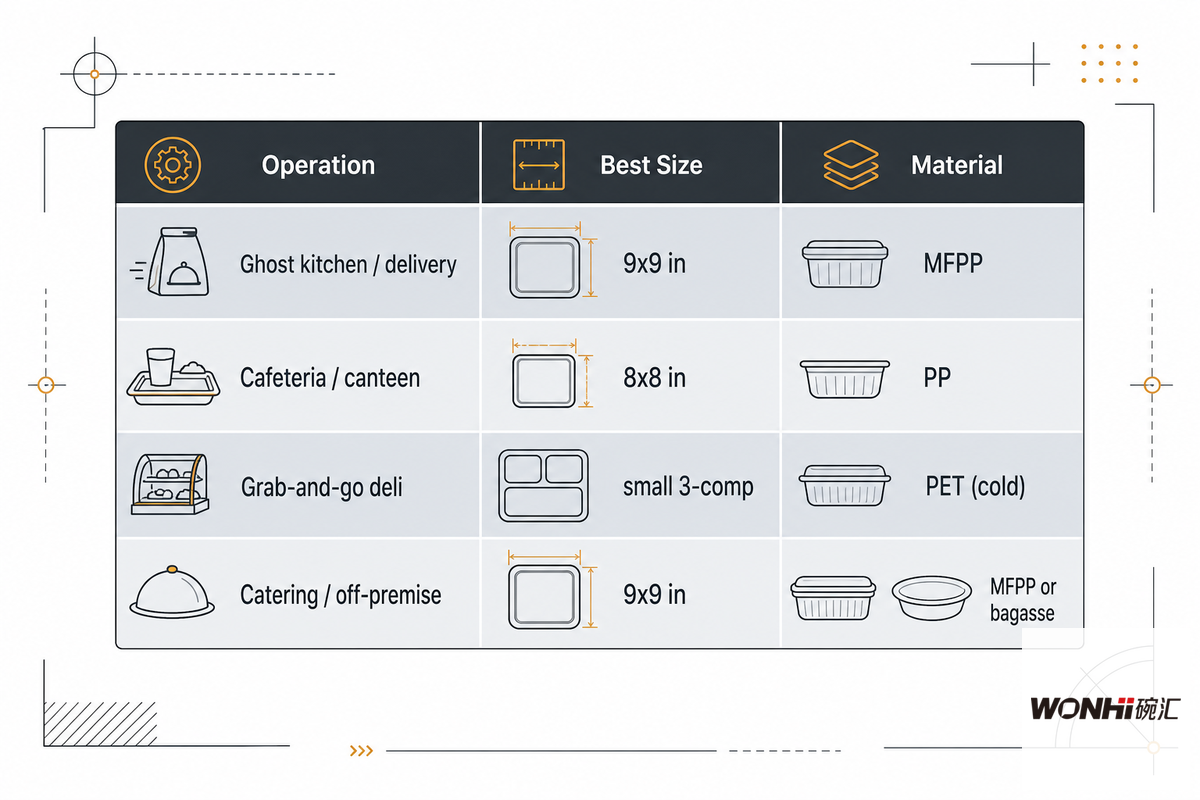
El selector de especificaciones de tipo de operación lee al revés de la tabla de materiales: comience con lo que ejecuta y le brindará el recuento, el material, la huella y el indicador de cumplimiento que no puede omitir. Está diseñado para las cinco operaciones fuera de las instalaciones que compran bandejas de 3 compartimentos en volumen.
| Operación | Material | Huella | Estar atento a |
|---|---|---|---|
| Cocina fantasma (entrega en caliente) | Pp/mfpp negro | 9×9 pulg | Tapa con cierre perimetral ventilada; sobrevive a 30-60 minutos de tiempo de bolsa |
| Comedor escolar/hospitalario | MFP | 8×8 pulg | Calificación de recalentamiento en línea; consistencia de la porción |
| Catering/eventos | MFPP sau bagază | 9×9 pulg | Altura de la pila; mandato de compostaje del lugar |
| Entrega previa a la comida | PP (a prueba de congeladores) | 8×8 pulg | Congelador + microondas de doble función; sello de manipulación |
| Grabar y seguir al por menor | Mascota CLARA | 9×6 pulg | Sólo cadena de frío; la claridad vende la comida |
Las huellas reflejan las herramientas comunes de 3 compartimentos de Wanhui; igualar la capacidad con el decisor de material del compartimento.
Ya sea que los operadores los llamen contenedores para llevar o contenedores de preparación de comidas de 3 compartimentos con tapa, el formato dividido está diseñado para facilitar el reparto en un turno. Los detalles prácticos también importan: una bandeja espaciosa pero liviana que se apila herméticamente, es fácil de limpiar si se ve un ciclo de reutilización y ayuda al personal a medir porciones consistentemente es lo que mantiene conveniente una línea ocupada.
Reutilizable versus desechable (y por qué “simplemente compre vidrio” no es la respuesta para los operadores)
¿Cuál es el envase más saludable para almacenar alimentos?
Para el contacto directo con alimentos, la opción desechable más segura es el polipropileno de calidad alimentaria sin BPA (PP #5) para alimentos calientes o PET para frío, ambos aclarados FDA 21 CFR 177.1520; El PP de calidad alimentaria está inherentemente libre de BPA porque está polimerizado a partir de propileno y no contiene bisfenol-A.
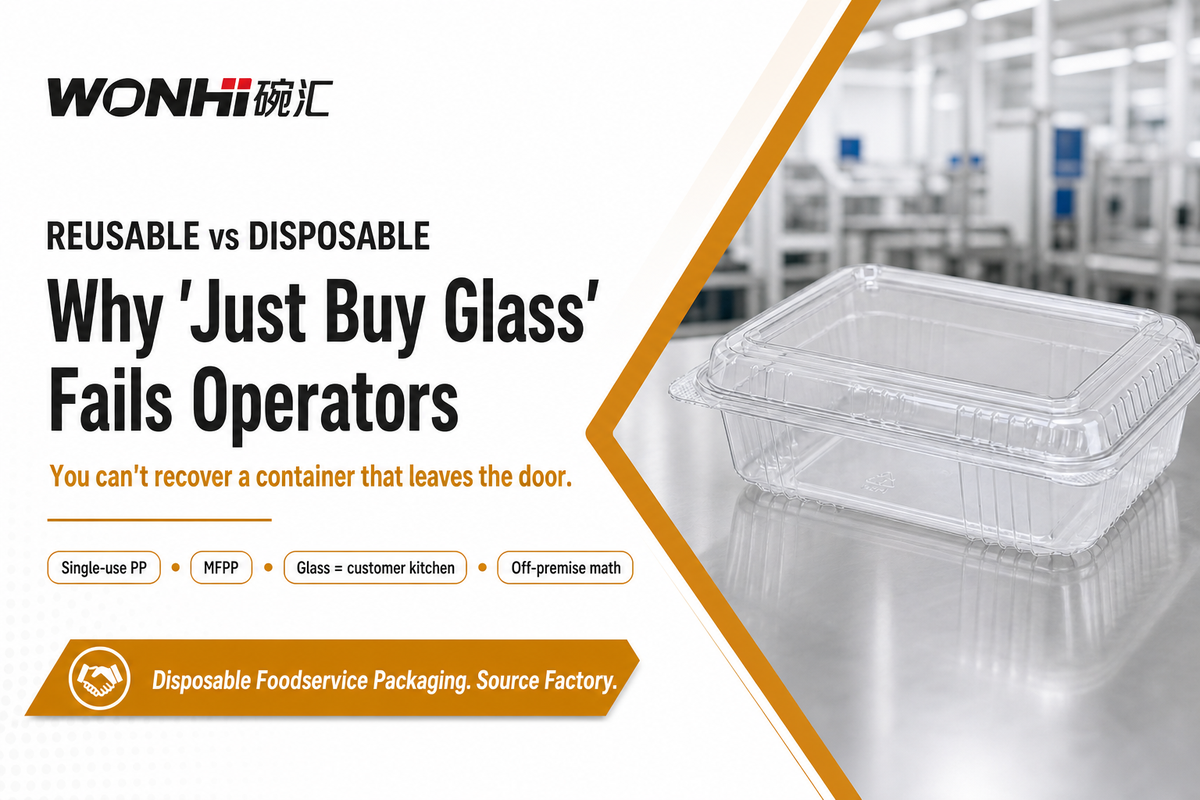
El vidrio y el acero inoxidable funcionan bien para su reutilización personal, pero responden a una pregunta diferente a la de un operador de servicio de alimentos. Un restaurante que sale comida por la puerta no puede recuperar un recipiente reutilizable, por lo que el PP/MFPP de un solo uso que recalienta y mantiene un sello es la opción práctica “saludable”; El vidrio y el acero pertenecen a la cocina del cliente, no a la bolsa de entrega.
✔ PP/MFPP desechable gana cuando
- La comida sale de tus instalaciones y no vuelve
- El rendimiento es alto y la mano de obra para lavar es escasa
- Necesita apto para microondas, congelador y apilable a bajo costo unitario
⚠ El vidrio/acero reutilizable gana cuando
- Un programa de circuito cerrado o de cena recupera el contenedor
- El usuario final es un consumidor que prepara comidas en casa
- El recalentamiento a largo plazo sin deformación importa más que el costo unitario
Los preparadores de comidas caseros que buscan recipientes reutilizables para preparar comidas o recipientes de vidrio de 3 compartimentos están resolviendo un problema diferente; Esos juegos apilables mantienen los alimentos organizados en el refrigerador durante una semana, mientras que una bandeja de servicio de alimentos se optimiza para un solo viaje por la puerta. Fabricamos recipientes desechables para el servicio de alimentos, no de vidrio ni de acero, por lo que le diremos con franqueza: si su operación puede funcionar en un circuito de reutilización real, un juego de vidrio puede ser mejor para ese segmento de volumen. Para todo lo que sale de la puerta, especifique desechable por caso de uso y deje de pagar una prima por una característica que el canal no puede usar.
Cumplimiento y verificación de proveedores: prohibiciones de espuma, PFAS y contacto con alimentos de la FDA
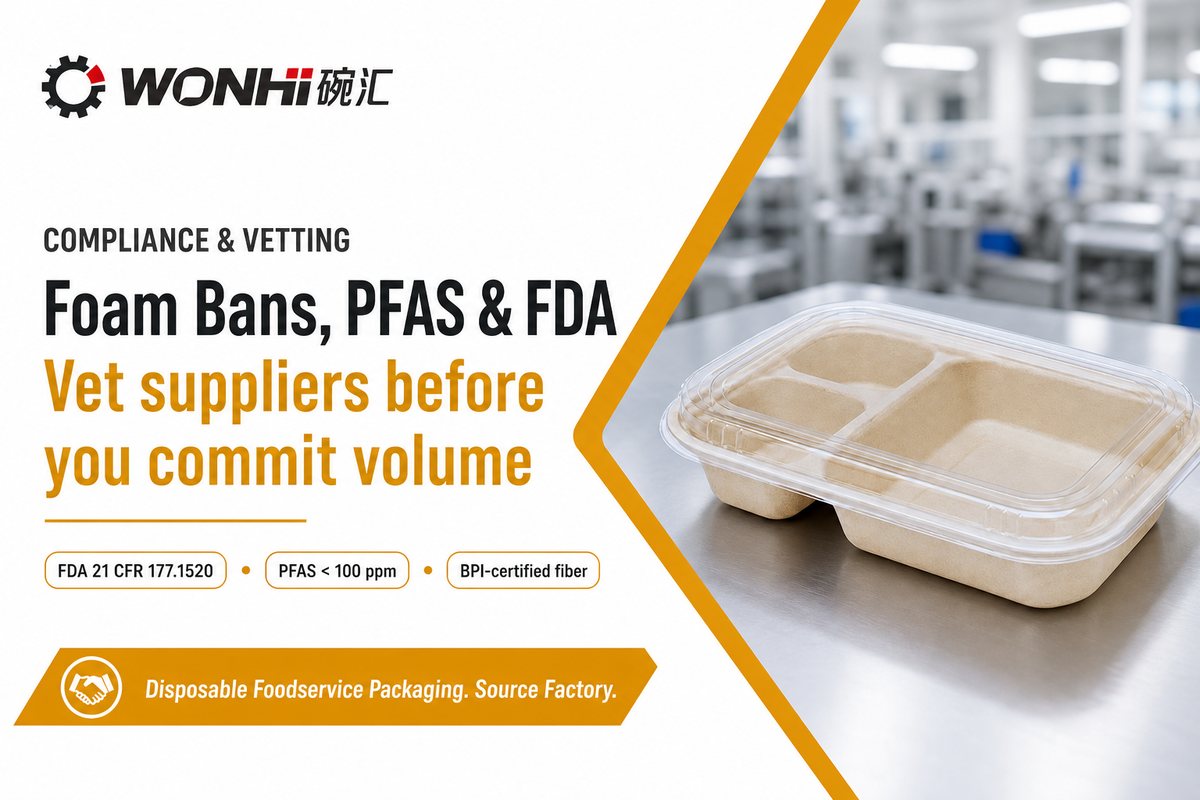
Esta es la sección que omiten las páginas del producto y donde un pedido defectuoso se convierte en un problema legal. Tres factores determinan si su contenedor de 3 compartimentos es seguro de comprar: las regulaciones de espuma en su estado, el estado PFAS de cualquier cosa “compostable” y la documentación de contacto con alimentos que su proveedor realmente puede proporcionar.
Las prohibiciones de espuma son ahora una limitación para la compra
Los productos de servicios de alimentos con espuma de poliestireno expandido (EPS) están legislados en un número cada vez mayor de estados (Maine primero en 2019, seguido de Nueva Jersey, Nueva York, MD, OR, WA, VT, CO, RI y DE). California es el caso más agudo: bajoSB 54, los productos de servicio de alimentos de EPS tuvieron que demostrar una tasa de reciclaje de 25% antes del 1 de enero de 2025. No cumplió con ese estándar, por lo que la venta, importación y distribución en California ahora está prohibida, y el Asesoramiento del Fiscal General cita sanciones de hasta $50.000 por día, por infracción. El “productor” regulado puede ir más allá del fabricante a algunos importadores y distribuidores, aunque CalRecycle señala exenciones para pequeñas empresas y la venta directa de acciones adquiridas legalmente, por lo que ahora es parte de la investigación de antecedentes obtener PP, MFPP, PET o bagazo que cumplan con las normas. Confirme su propia posición en lugar de asumirla. SB 543 (OR) también entró en vigor este mismo mes.
“Compostable” no es lo mismo que libre de PFAS
Históricamente, los envases de fibra vegetal y bagazo tenían algunas de las concentraciones más altas de PFAS “químicos para siempre” de cualquier envase de alimentos, ya que no existe una barrera natural contra la grasa, por lo que los fabricantes los recubrieron para crear una. Las etiquetas no significan nada, las certificaciones sí. Busque la certificación BPI, desde el 1 de enero de 2020, esto requiere un máximo de 100 ppm de flúor orgánico total y una declaración firmada que certifique que no se han utilizado productos químicos fluorados agregados intencionalmente. Busque también el subyacente ASTM D6400/D6868 estándares de compostabilidad. Muchos envases probados de forma independiente comercializados como compostables superan la marca de flúor de 100 ppm; Exige un informe de laboratorio, no un logotipo.
⚠️ Lista de verificación de investigación de proveedores: solicite (1) una declaración de material FDA 21 CFR 177.1520, (2) una Declaración de cumplimiento enviada con el pedido, (3) informes de pruebas de migración independientes y líneas ecológicas, (4) actuales Certificación BPI con el resultado de la prueba de flúor. Los veteranos del abastecimiento lo expresaron sin rodeos: “los alimentos seguros en China no siempre son seguros” “exige documentación específica para cada lote en lugar de una afirmación genérica de ”calidad alimentaria”. Wanhui envía una Declaración de Cumplimiento e informes de pruebas de migración con cada pedido de su planta auditable en Linyi, Shandong.
Compra al por mayor: marcado del distribuidor frente a Factory-Direct
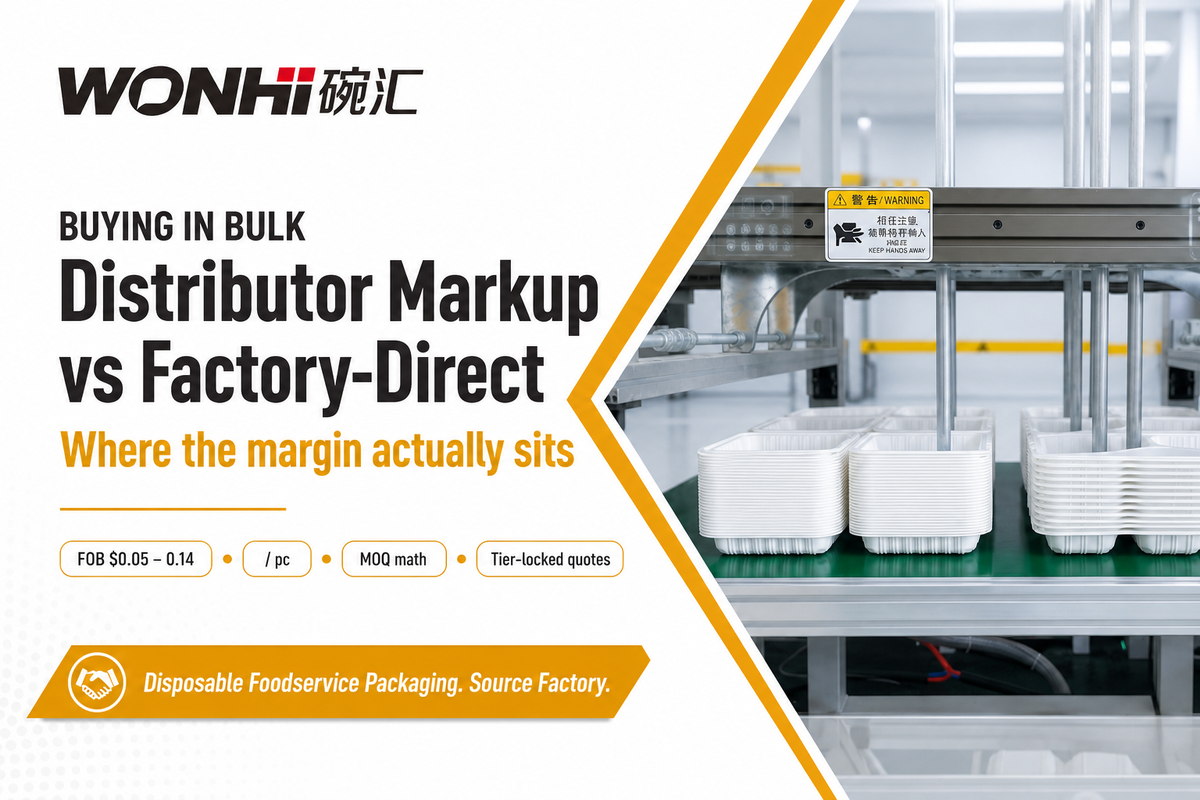
El verdadero desafío del costo no es el precio de etiqueta, sino cuántas capas de margen se encuentran entre el molde y su almacén. Las bandejas con bisagras de 3 compartimentos funcionan aproximadamente $0.05-$0.14 por pieza ex-factory FOB, mientras que las bandejas comparables 9×9 en los distribuidores de EE. UU. se citan comúnmente en $0.18-$0.59 por pieza dependiendo del tamaño y el material. Ese diferencial de tres a diez veces es el margen del distribuidor, el flete y el almacenamiento, no una diferencia en el contenedor.
Eso no quiere decir que el abastecimiento directo ahorre dinero automáticamente. Cambia el margen del distribuidor por transporte marítimo, derechos de importación y una orden de compra mínima, por lo que, a menos que sea un comprador importante, las cifras no cambian a favor de ir directamente hasta que alcanza un umbral de volumen. Impulsores clave de su precio neto:
Lo que mueve el costo de su tierra
- Familia materialla inyección de PP es la base; El bagazo y el etiquetado en molde añaden costo.
- Nivel de volumenel precio por pieza y el flete por unidad caen drásticamente con el recuento de casos.
- Personalizaciónla impresión de logotipos agrega una configuración única; a molde personalizado agrega herramientas y una ventaja de 4-6 semanas.
- Destinoel transporte marítimo y la pila de derechos de importación, cotizados línea por línea, por lo que nada se esconde en un “precio de entrega” incluido”
Ya es cierto hoy en día: muchos operadores valoran al por mayor contenedores de alimentos de 3 compartimentos entre los principales distribuidores “Restaurant Depot, Sysco, US Foods, Webstaurant -ya sea para un lanzamiento en cadena o para un solo caso de contenedores de preparación de comidas de 3 compartimentos, y algunos incluso buscan China -abastecimiento directo para eliminar el margen de fabricante a distribuidor. Tenga en cuenta que el precio superior por evitar el envío directo siempre estará en el extremo ”del otro” ‘verificación ‘no precio. Si consolida el volumen para borrar un MOQ, directamente de fábrica envases de alimentos al por mayor puede superar las acciones del distribuidor; Por debajo de esa línea, un distribuidor puede ser más sencillo. Solicite a cualquier proveedor una cotización detallada y bloqueada por niveles antes de cambiar.
Qué está cambiando en 2026: prohibiciones de espuma, reglas PFAS y consolidación de formato
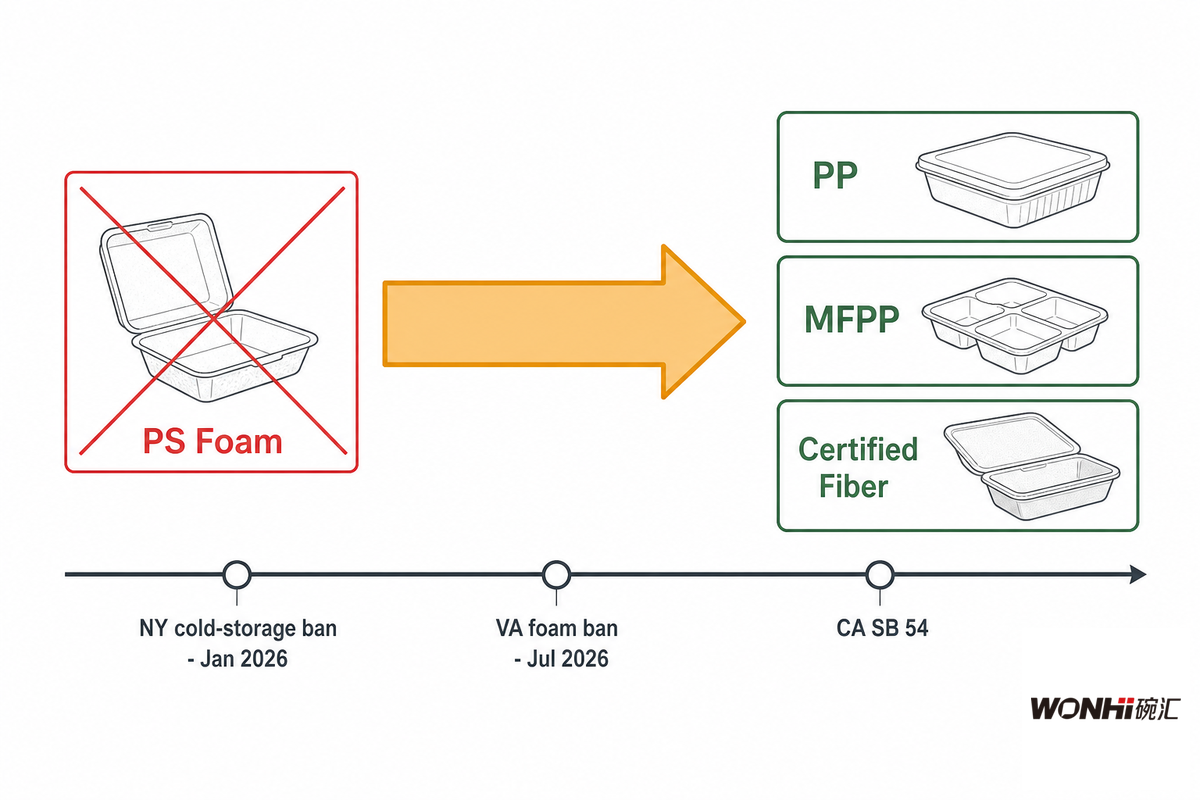
No “planifique” pedidos para 2026 mirando un gráfico de crecimiento del mercado (sus decisiones de compra para el próximo año estarán dictadas por regulaciones, no por la expansión de las comidas fuera de las instalaciones). Las prohibiciones de poliestireno están proliferando: desde 2025, al menos nueve estados han tomado medidas para prohibir el poliestireno expandido, Virginia prohíbe la espuma en todos los vendedores de alimentos el 1 de julio de 2026 y Nueva York extendió su prohibición a los contenedores de almacenamiento en frío el 1 de enero de 2026.
La “Ley de Adiós a la Espuma” federal se reintrodujo el mismo año y todo equivale a un giro necesario e inevitable desde la espuma hacia PP, MFPP y alternativas de fibra certificadas.
Los productos químicos PFAS presentan el segundo frente: más de 350 proyectos de ley relacionados con PFAS pasaron por la cartera legislativa en 39 estados en 2025, y el AB 1201 de California (en vigor el 30 de junio de 2027) redefinirá lo que se acepta como verdaderamente “compostable” (obligando a los proveedores a clasificar cualquier producto “compostable” como insumo orgánico, prohibiendo así efectivamente una amplia gama de alternativas plásticas. Además de la presión, el USDA votó en 2026 en contra de la inclusión de materias primas sintéticas de plástico compostable en estándares de compost aprobados a nivel federal. Agregue tarifas ampliadas de responsabilidad al productor que ahora se implementan en siete estados, y estos formatos más difíciles de reciclar en realidad se vuelven más costosos (no menos) de manejar.
Para compradores no preparados, el riesgo es real. Un operador de Virginia proyectó públicamente aproximadamente $115.000 más por año solo en envases para llevar después de apagar la espuma, una estimación propia de un solo operador, pero una ilustración concreta del shock de costos invita a un cambio tardío. Para su compra en 2026, ahora es el momento de garantizar el cumplimiento en forma de PP/MFPP para aplicaciones calientes y fibra certificada donde existe infraestructura de compostaje local para respaldar su final de vida útil responsable, y donde la colección de productos orgánicos locales sí lo acepta, el compostaje se corta significativamente metano de vertedero, por lo que la elección de la fibra gana su prima allí. En lugar de quedar atrapado, asegure el material compatible ahora y planifique su pedido en torno a hitos regulatorios, no a un pronóstico de crecimiento del mercado.
Preguntas frecuentes
P: ¿Qué tamaño tiene un contenedor de 3 compartimentos?
Ver respuesta
Los tamaños dominantes de servicio de alimentos son bandejas con bisagras cuadradas de 8 × 8 pulgadas y 9 × 9 pulgadas, además de una opción rectangular de 9 × 6 pulgadas. Un típico 9×9 se divide en aproximadamente un pozo de entrada de 850 ml y dos pozos laterales de 350 ml, aproximadamente una capacidad total de 32-48 oz. La profundidad del compartimento suele ser cercana a los 38 mm para el pozo de entrada y de 30-32 mm para los lados. Los formatos de lonchera más pequeños bajan a aproximadamente 6 × 6 pulgadas para lados individuales o porciones de refrigerios, mientras que los calibres de catering aumentan hasta 250 mm. Debido a que la distribución interior está fijada por el molde y difiere según el SKU, confirme las dimensiones exactas del pozo (no solo la huella exterior) con respecto al tamaño de sus porciones antes de comprometerse con un estuche.
P: ¿Los recipientes de 3 compartimentos son aptos para lavavajillas y reutilizables?
Ver respuesta
Los contenedores de PP y MFPP solo soportan unos pocos ciclos en lavavajillas comerciales antes de perder su sello, por lo que pueden reutilizarse una o dos veces, pero nunca tuvieron la intención de ser más que un servicio de alimentos desechable. El PET no se puede utilizar en absoluto en un lavavajillas, mientras que el PLA y el cartón sólo deben utilizarse una vez. Si el objetivo es realmente el uso múltiple, el vidrio debería ser el material; Foodservice PP fue diseñado para un uso fluido en lugar de infinito.
P: ¿Por qué llegan algunos contenedores de 3 compartimentos con pozos del mismo tamaño cuando la foto muestra uno grande y dos pequeños?
Ver respuesta
La disposición de los compartimentos está fijada por la cavidad del molde y varía según SKU; algunas herramientas de 3 compartimentos son una grande más dos pequeñas, otras son tres pozos iguales. Las fotografías del catálogo no son una guía confiable y los compradores informan periódicamente que reciben una bandeja de igual pozo después de realizar el pedido a partir de una imagen que implicaba una división desigual. Verifique la tabla de dimensiones del compartimento en la hoja de especificaciones y solicite una muestra física antes de estandarizar el pedido de un caso.
P: ¿Dónde puedo comprar contenedores de 3 compartimentos al por mayor?
Ver respuesta
Puede comprar a su distribuidor de línea ancha o directamente desde la fábrica si su volumen excede la cantidad mínima y luego insistir en un precio fijo detallado para evaluar el costo total de aterrizaje.
P: ¿Sigue siendo legal la espuma (Styrofoam) para comida para llevar de 3 compartimentos?
Ver respuesta
No en un número creciente de jurisdicciones. La espuma para el servicio de alimentos EPS está prohibida o restringida en más de una docena de estados, incluidos California (una prohibición de facto según la SB 54), Nueva York, Maine, Maryland, Nueva Jersey, Oregón y Washington y, a partir del 1 de julio de 2026, todo Virginia. El PP rígido, el MFPP, el PET y el bagazo no son espuma y siguen siendo legales, razón por la cual los operadores que cumplen con las normas cambian a esos materiales. Confirme siempre su regla local antes de realizar el pedido.
P: ¿Qué es un Tupperware de 3 compartimentos?
Ver respuesta
“Tupperware” es una marca reutilizable para el consumidor; en foodservice el equivalente es una bandeja desechable de PP o MFPP de 3 compartimentos con tapa dividida. La función es la misma “separar una entrada por dos lados ^ pero foodservice compra PP de un solo uso y de calidad alimentaria por caja en lugar de un juego doméstico reutilizable.
Por qué escribimos esto
Wanhui opera 86 líneas internas que producen contenedores de servicio de alimentos de PP, MFPP, PET y bagazo, incluidas bandejas 883 y 993 de 3 compartimentos. Las especificaciones, la profundidad de los pozos y el comportamiento de los materiales en esta guía provienen de nuestros propios registros de líneas de producción y de las fuentes de patentes, FDA, EPA, CalRecycle, BPI y citadas anteriormente, no de un catálogo. Revisado por el equipo de embalaje de Wanhui.
Referencias y fuentes
- 21 CFR 177.1520, Polímeros de olefinas (contacto con alimentos)código electrónico de regulaciones federales de EE. UU
- Datos de compostaje y desperdicio de alimentosAgencia de Protección Ambiental de EE. UU
- Cuantificación de las emisiones de metano de los residuos de alimentos depositados en vertederosEPA de EE. UU. (2023)
- SB 54 Embalaje Disposiciones EPR/EPSCalRecycle
- Aviso de aplicación de la prohibición de espuma SB 54Oficina del Fiscal General de California
- Prohibición de la espuma de poliestireno (SB 543)Oregón DEQ
- Productos químicos fluorados / 100 ppm de flúor total estándarInstituto de Productos Biodegradables
- Productos compostables ASTM D6400 / D6868Consejo de Compostaje de EE. UU
- Recipiente de comida con ventilación mejorada (US20100320210A1)Embalaje de anclaje, literatura de patentes
- Nuevos datos de acceso al compostaje (2025)Coalición de Embalaje Sostenible
- Cocinar de forma segura en el horno microondasServicio de Inspección y Seguridad Alimentaria del USDA
Artículos relacionados
- Contenedores de preparación de comidas, formatos y tamaños para programas de preparación
- Bento Boxes, el primo de formato dividido para comidas chapadas
- Guía de bandejas de comida, bandejas para servir y catering
- Contenedores tipo almeja compostables, opciones de fibra certificada
- Contenedores de alimentos al por mayor, guía de adquisiciones al por mayor