Entre em contato com Wanhui Company


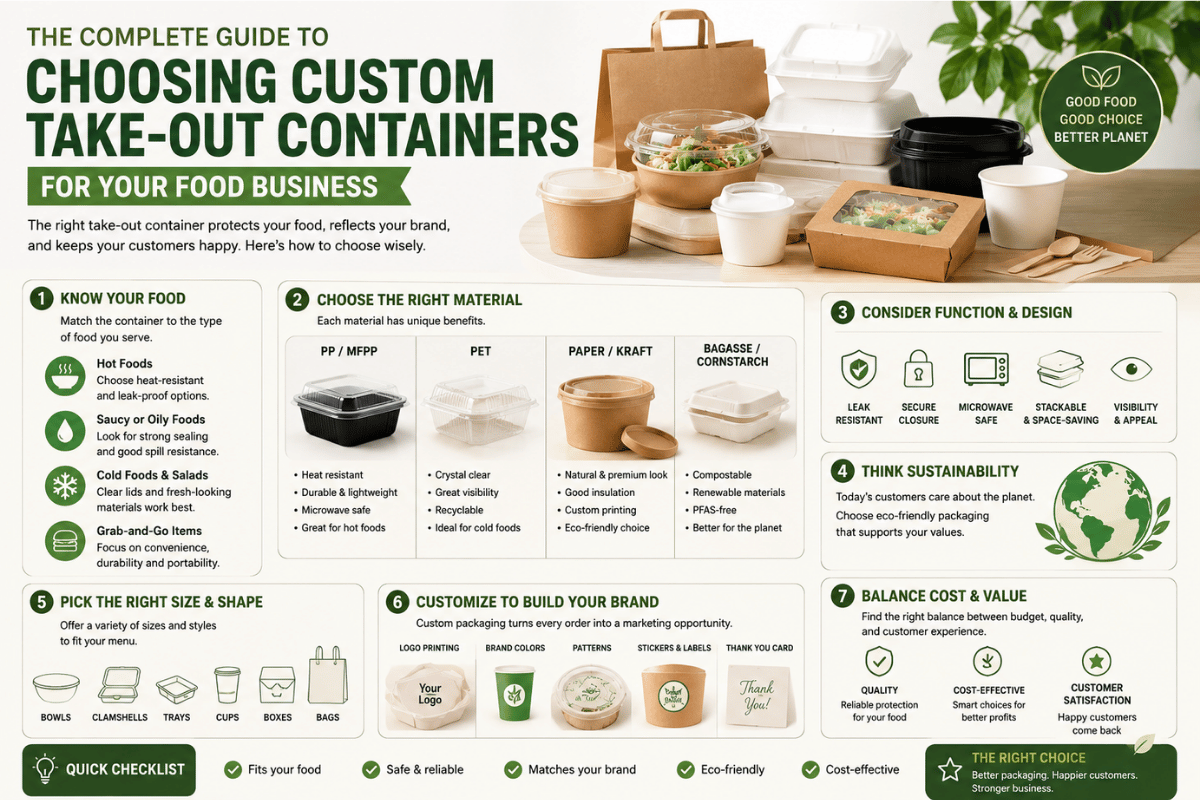
Caixas personalizadas para viagem, tigelas, bandejas e conchas construídas de acordo com o tamanho específico de uma marca de alimentos, cor e recipientes impressos de uma marca do que comprados como estoque simples. Escolher bem é mais difícil do que parece. Um único pedido aborda segurança alimentar, desempenho de micro-ondas, controle de vazamentos, regras de reciclagem e uma quantidade mínima de pedidos que pode chegar a dezenas de milhares. Este guia analisa todas as decisões na ordem em que você realmente o atende, sem nenhuma proposta do fornecedor anexada.
Já sabe o que quer e só precisa de um fabricante? salte adiante para contêineres personalizados para viagem construídos de acordo com as especificações. Ainda pesando materiais, tamanhos e custo? comece aqui.
Referência rápida: Visão geral dos materiais do contêiner para retirada
| Material | Limite de calor típico | Microondas | Vazamento/graxa | Fim da Vida |
|---|---|---|---|---|
| PP (polipropileno) | ~120°C/250°F | Sim | Alto | Reciclável #5 (correio limitado) |
| PET/rPET | ~70°C/158°F | Não | Alto | Reciclável #1 (amplamente aceito) |
| Bagaço (fibra de cana) | ~95100 °C (205 °F) | Sim (explosões curtas) | Médio | Comercialmente compostável |
| Papel Kraft + forro | ~85°C/185°F | Limitado | Médio | Reciclável/compostável por forro |
| Espuma/EPS | Isolando, teto baixo | Não | Médio | Não reciclável; proibido em muitas áreas |
| Alumínio | Forno seguro | Não | Alto | Amplamente reciclável |
As temperaturas máximas listadas são médias e sujeitas a variações com base na espessura da parede e no pacote de aditivos específico Consulte sempre uma folha de dados do fornecedor específica para o item escolhido.
O que são contêineres personalizados para retirada (e quando a personalização compensa)?
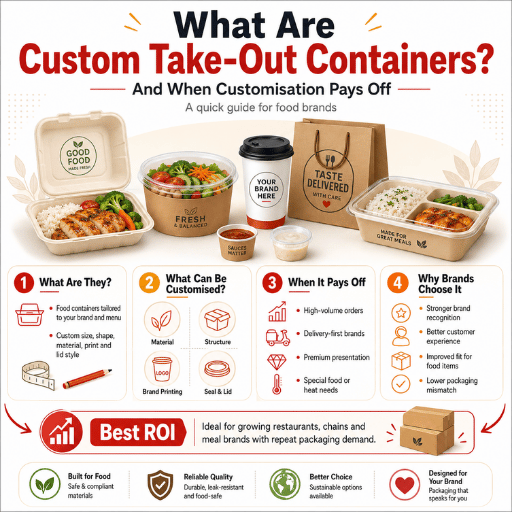
Um recipiente para viagem personalizado – uma caixa de comida, tigela, bandeja ou concha criada para sua marca de alimentos com base em suas especificações exatas, em vez de ser selecionada a partir de itens padrão pré-fabricados.
O costume pode significar duas coisas distintas, e confundir uma com a outra pode ser um erro caro para um comprador pela primeira vez.
Impresso sob medida é um recipiente pré-projetado e pré-fermentado com sua marca aplicada através da impressão Seu formulário já está estabelecido; seus gastos cobrem apenas a impressão. Custom-moulded é um design de recipiente original fabricado a partir de uma ferramenta especializada (um molde) usinado para sua forma precisa.
Imprimir uma forma existente é em grande parte um trabalho de semanas; encomendar um molde é um processo de ferramentas industriais que dura meses e um investimento muito maior. Para a maioria das marcas de serviços de alimentação, a rota impressa é suficiente.
Qual é o propósito da personalização?
A única função dos recipientes padrão é segurar os alimentos Um recipiente de marca continua a servir mesmo depois de sair da cozinha, sentado na mesa do cliente de entrega, sendo fotografado ou sendo reutilizado em casa – tudo publicidade não compensada para sua marca É uma despesa que uma concha genérica não poderia gerar.
Esse benefício ocorre às custas do compromisso de longo prazo, pois você se torna obrigado a atender aos requisitos mínimos de pedidos e a suportar prazos de entrega mais longos Consequentemente, a personalização é econômica, uma vez que sua demanda suporta consistentemente uma tiragem antes de ajustes futuros em seu conceito de serviço de alimentação.
💡 Regra do polegar de equilíbrio
Se uma tiragem completa de impressão personalizada não for consumida dentro de aproximadamente 9-12 meses, opte por personalizar apenas a impressão Reconfigurar um molde que não se encaixa mais no seu negócio – ou descartar a impressão parcialmente usada à medida que seu conceito de serviço de alimentação evolui – anula efetivamente o investimento feito em seu item personalizado.
Takeaway chave: Decida sempre entre custom-printing e custom-moldagem antes de solicitar uma cotação.
Essas duas rotas diferem em custo, cronograma e risco, e a impressão personalizada geralmente é a melhor escolha.
Materiais de contêiner para retirada comparados: PP, PET, papel, bagaço, espuma e alumínio
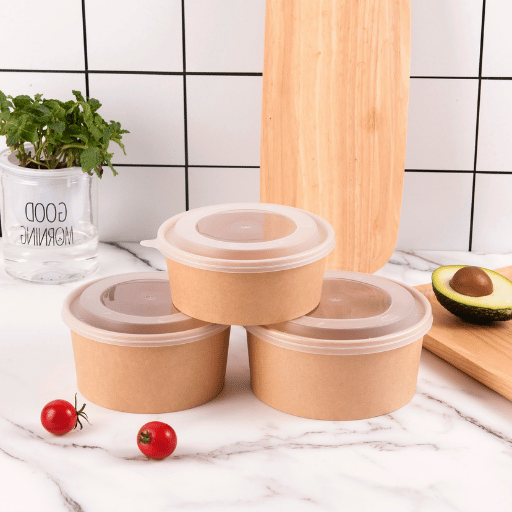
A escolha do material do take-out dita tudo o mais & ness; tolerância ao calor, compatibilidade do forno, resistência ao derramamento, custo geral, e comercialização Abaixo olhamos como os materiais comuns do recipiente do take-out realmente se comportam.
O polipropileno (PP) é o cavalo de batalha do take-out de comida quente Ele permanece estável até 120 °C, por isso é verdadeiramente seguro para microondas, resistente a óleo e graxa (por que as caixas de refeição para viagem e os recipientes de sopa são principalmente PP. PET e rPET reciclado são de vidro transparente e rígido, adequado para alimentos frios, como saladas e frutas cortadas, mas amolecem a cerca de 70 °C e não podem ser colocados em microondas O bagaço (polpa de cana) pode ser moldado em bandejas compostáveis firmes e conchas que funcionam em geladeira e pulsos curtos de microondas, mas é passível de amolecer devido ao contato prolongado com alimentos úmidos e oleosos As caixas de papel Kraft (Kraft) são principalmente caixas de papelão dobradas e pizza (dependem de um revestimento de PE ou PLA, que decide a resistência à graxa e se a caixa pode ser reciclada ou composta.
O poliestireno expandido (espuma) isola barato, mas não pode ser colocado no micro-ondas, é quase não reciclável e foi proibido para uso em catering por um número crescente de autoridades, detalhadas na seção sobre regulamentação abaixo As bandejas de alumínio podem suportar temperaturas de forno que derreteriam a maior parte do plástico e reciclariam facilmente, mas impedem que as micro-ondas funcionem e são mais caras.
Os recipientes para retirada de plástico ou papel são melhores?
Nem o vencedor absoluto ambos falham de maneiras diferentes Os plásticos (PP) contêm fluidos e reaquecem prontamente, mas, enquanto reciclável em papel, a maioria dos recipientes de plástico para levar não estão na prática O papel e as fibras são geralmente vistos como tendo melhor credibilidade ambiental e são compostáveis onde existem instalações, mas muitas vezes são mais pobres em reter líquido ou óleo e uma caixa de papel forrada pode realmente ser mais difícil de reciclar do que um recipiente de PP limpo Talvez mais precisamente, a aparência limpa de alguns materiais à base de plantas é estragada pelo vazamento, e uma caixa de papel que falha no trânsito não é uma boa jogada de RP A resposta está em entender ambos, e escolher a retirada certa para sua comida específica, e as condições locais de reciclagem.
Onde PP vence
- Pratos quentes, atrevidos ou sopa
- Os clientes de alimentos farão microondas
- Selos estanques e confiáveis à prova de vazamentos
- Menor custo unitário em volume
9 Onde Fibra/Kraft vence
- Mercados com proibições de espuma ou plástico
- Marcas que vendem uma história visível e ecológica
- Alimentos secos e quentes (não líquidos de imersão prolongada)
- Acesso à compostagem comercial
Se você não tem certeza de qual resina se adapta ao seu menu, um estruturado seletor de material do recipiente para viagem restringe o tipo de alimento da lista restrita por tipo de alimento e, para linhas vegetais, o contêineres compostáveis para viagem a gama mostra quais formatos de fibra estão disponíveis.
Ponto chave: Escolha sempre a resina antes do formato de retirada (PP) para alimentos quentes que são quentes, molhados ou serão colocados no micro-ondas, PET para itens frios e estética limpa, e bagaço ou papel kraft quando a proibição e a compostabilidade são fatores-chave.
Como combinar o recipiente com a comida (quente, fria, sopa, frita, salada)
Uma das rotas mais rápidas para um cliente infeliz é usar um único recipiente para um menu inteiro Os alimentos falham de diferentes maneiras (fugas de sopa), alimentos fritos ficam encharcados, salada murcha, então o recipiente certo é uma chamada de comida por comida Use a matriz abaixo como ponto de partida.
| Tipo de alimento | Risco Principal | Contentor Recomendado |
|---|---|---|
| Sopa, curry, rede elétrica atrevida | Vazamentos, pressão do calor | Tigela PP com tampa de encaixe em junta |
| Comida frita (batatas fritas, tempura) | Vapor → sonolência | Caixa kraft ventilada ou bandeja perfurada |
| Salada, tigelas frias, frutas cortadas | Wilting, exibição ruim | PET transparente/tigela de rPET |
| Rede quente, arroz + acompanhamentos | Mistura, reaquecimento | Almofada articulada PP ou bandeja de 3 compartimentos |
| Pizza, pães achatados | Vapor preso, trituração | Caixas de pizza kraft onduladas com aberturas |
| Catering/multi-porção | Derramamento, empilhamento | Grandes bandejas PP ou alumínio com tampas de travamento |
Dois modos de falha merecem atenção especial, porque eles se sentam atrás da maioria das reclamações de takeout: condensação e textura perdida Quando um recipiente de comida quente é selado, o vapor preso condensa na parte inferior da tampa e goteja de volta para o alimento Crisp, itens empanados sofrem mais Para manter o alimento frito crocante você precisa de uma tampa que respira uma tampa perfurada ou uma caixa kraft que respira (respira) mesmo que isso corra contra o instinto para selar tudo apertado.
Uma loja pho movendo-se para a entrega aprendeu isso da maneira mais difícil Ele embalou caldo em conchas rasas destinadas a pratos de arroz seco, com snap lids nunca classificados para selar líquido e cerca de uma entrega em oito chegou ao cliente com caldo solto no saco Mudando a linha de sopa para tigelas PP profundas com tampas de encaixe de junta, mantendo as conchas para pratos secos, terminou as reclamações de vazamento A lição é contundente: os líquidos precisam de um recipiente projetado para líquidos, não a caixa mais próxima na prateleira.
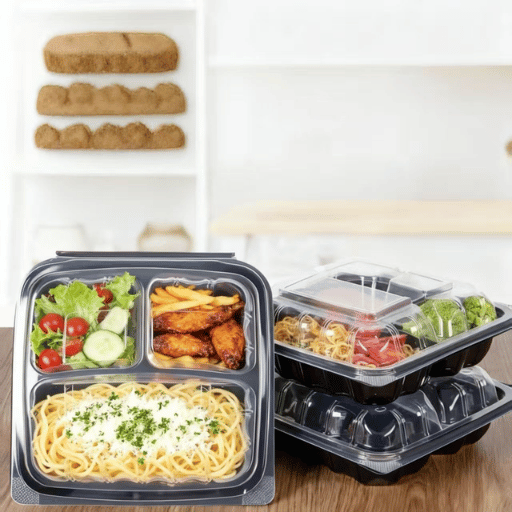
Para refeições de compartimento, Recipientes de 3 compartimentos evite que um cano principal e dois lados se sangrem, enquanto o catering a granel é melhor servido com robustez bandejas alimentos dimensionado para porções compartilhadas.
Lição principal: Cada item do menu precisa ser categorizado com base em sua probabilidade de causar problemas, e combinado com um recipiente Todos os líquidos terão tampas seladas, todos os alimentos fritos terão aberturas, todos os alimentos frios terão uma visão clara.
Tamanhos e capacidade do contêiner para retirada: um guia prático de dimensionamento
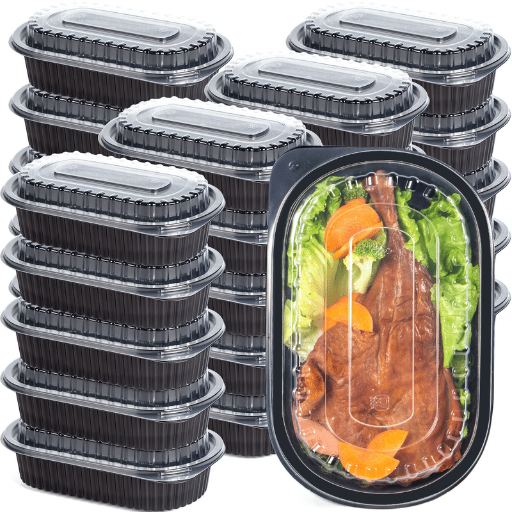
Embora a capacidade nas folhas de especificações seja frequentemente listada por volume (onça fluida ou ml) nos pedidos de contêineres, esse número não conta a história completa.
Para evitar que os alimentos vazem e garantir o assento adequado da tampa, você deve sempre preencher até 75-80 por cento do volume de trabalho Tome suas decisões de pedido em torno deste número de trabalho, não do seu valor de catálogo.
| Nível de tamanho | Capacidade | Uso Típico |
|---|---|---|
| Pequeno | 8122 (2 oz 350 ml) | Lados, molhos, molhos, sobremesas |
| Médio | 16 660 (5 onças) (750 ml) | Rede única, saladas, tigelas de arroz |
| Grande | 288880 (80 onças 100 ml) | Maiúsculas e moletons, pratos de macarrão, combos |
| Família/catering | 48 oz 100 oz+ (14000 ml) | Porções compartilhadas, bandejas de festa |
A menos que seu cardápio precise de tamanhos especializados para pratos incomuns, três ou quatro tamanhos normalmente são suficientes.
Para economizar dinheiro e simplificar o gerenciamento de estoque, a seleção de uma família de contêineres que permita a reutilização de tamanhos de tampa em 2 ou 3 contêineres deve ser priorizada, tendo apenas um tamanho para vários formatos de contêiner, a equipe pode cometer menos erros ao escolher tampas no calor do momento, e você diminuirá o custo geral por item.
Nota de Engenharia
Não especifique a capacidade máxima ao fazer seus pedidos.
Se um recipiente rotulado como “32 oz” estiver cheio demais, ele fará com que sua tampa se expanda ou a vedação dobre; um recipiente classificado para uma porção de trabalho de 24-26 oz viajaria de forma confiável Ao informar um fabricante sobre o tamanho certo, o detalhe que mais importa é o peso do prato, não o número de catálogo.
Lição chave: Faça a encomenda fácil e eficaz na redução de custos dimensionando 3 a 4 recipientes para lidar com níveis de enchimento 75-801TP3 T, e se possível, use tamanhos comuns da tampa.
Os contêineres para retirada são seguros para microondas e recicláveis? A resposta honesta

Quer a embalagem de um recipiente possa ou não ser feita legalmente de boa fé, depende completamente da resina usada e, infelizmente, o símbolo de reciclagem no fundo não pode ajudá-lo a tomar nenhuma das decisões.
Você pode levar recipientes de plástico para microondas?
Se é legalmente permitido ou um ponto de marketing respeitável adicionar texto de reivindicação a uma tampa ou caixa de recipiente é inteiramente ditado pelo conteúdo de resina do plástico Apenas um tipo de plástico comumente usado, PP (polipropileno), é seguro para microondas a 120 C; daí por que refeições reaquecíveis geralmente vêm em caixas de alimentos PP PET pode curvar-se tão baixo quanto 70 C, e qualquer coisa em espuma pode ser uma bagunça derretida.
A resina, em vez de marcações genéricas, é o indicador final: Se o seu recipiente estiver marcado com “5 PP,” e você tiver documentação do fornecedor indicando que o item é seguro para microondas, então ele pode ser comercializado com segurança como tal Caso contrário, seria pouco aconselhável fazer essa afirmação em sua caixa de alimentos.
Os contêineres para retirada podem ser reciclados em casa?
Muito menos frequentemente do que as pessoas percebem O código de resina estampado em um recipiente apenas identifica o conteúdo, não se os programadores locais aceitariam De acordo com o Agência de Proteção Ambiental dos EUA, apenas cerca de 8,71TP3 T de plástico foi reciclado nos Estados Unidos em 2018 2018 e até mesmo garrafas PET conseguiram apenas 29,1%.
Então a dura realidade de servir embalagens aos seus clientes é que o seu recipiente (feito de resina “reciclável”) provavelmente está indo para o aterro Mais óbvio?
Recipiente de plástico preto para levar porque os classificadores ópticos não conseguem ver preto contra uma correia transportadora escura, essas coisas sempre caem no lixo, apesar de sua resina (#5 PP) ser realmente reciclável (por RecycleSmart Massachusetts, por exemplo.) Apenas #1 PET e #2 HDPE são reciclados em qualquer nível significativo.
⚠️ Importante: Reciclável em Teoria ^ Reciclado na Prática
Não imprima “recyclable” em um recipiente sem primeiro garantir que a resina, a cor e o formato sejam aceitos pelos processos de reciclagem nos locais onde seus clientes operam Quaisquer alegações de reciclagem sem tal verificação representam um risco de lavagem verde Se você estiver buscando uma história justificável de fim de vida, a resposta pode ser um recipiente PET claro e não preto ou uma caixa comercial de fibra compostável.
Se o seu modelo pode apoiá-lo, a resposta mais forte para ambas as perguntas é sair totalmente dos descartáveis Formatos duráveis e seguros para máquinas de lavar louça, como recipientes reutilizáveis para preparação de refeições altere a equação para serviços de refeições por assinatura e refeições em campus fechado.
Resumindo: A segurança do microondas passa pelo tipo de resina (PP sim, PET não).Reciclar a aceitação local desse material, não pelo rótulo ‘não deixe que o seu fim de vida mensagens aplicar para o plástico preto!
Segurança e Conformidade Alimentar: O que realmente significa “Food-Grade”
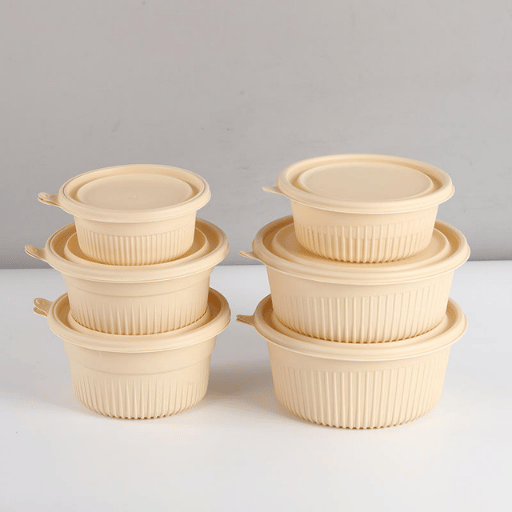
“Food Grade” é uma palavra de marketing sem sentido ‘s e não uma designação exigida pela lei e é sua obrigação garantir que qualquer componente que toque em seu alimento tenha essa designação para seu mercado específico.
Nos EUA, a FDA supervisiona os materiais plásticos em contato com alimentos em seção 21 CFR Parte 177 do seu regulamento, 177.1520 refere-se especificamente aos polímeros de olefinas (olefin polymers) onde a classe em que o polietileno e o polipropileno na grande maioria dos recipientes para levar para fora caem Compostos mais recentes usam o sistema Food Contact Notification da FDA Na UE Regulamento (UE) n.o 10/2011 descreve plásticos de qualidade alimentar com substâncias e níveis máximos de migração – este é um sub-regulamento, sob regra-quadro que não torna elementos transferíveis que representem uma ameaça à saúde dos alimentos – enquanto, na China, o GB 4806.7 especifica regras para o contacto com alimentos propriedades dos plásticos.
Uma alegação de ‘qualidade alimentar não tem sentido sem a papelada para apoiá-la O comprador nunca deve deixar a fábrica sem uma cópia do relatório de teste de migração e uma declaração de conformidade relativa à resina exata e ao corante usado não é um certificado genérico de fábrica O pigmento e o aditivo que os testes de migração são realizados para evitar.
Antes de autorizar qualquer pedido personalizado de contêiner para viagem, pergunte e segure:
- ✔
Uma declaração de conformidade que cita o regulamento aplicável ao seu mercado (FDA 21 CFR, EU 10/2011, ou GB 4806.7) - ✔
Um relatório de teste de migração/extração emitido por um laboratório credenciado para a resina e corante especificados. - ✔
Confirmação de que o recipiente é fabricado com resina virgem de qualidade alimentar (em vez de reafiação reciclada inespecífica que pode ser inadequada para contato direto com alimentos).
Se a caixa contiver uma reivindicação compostável, solicite a referência de certificação por trás dela como independente verificador compostável da conformidade ajuda a confirmar que uma caixa de fibra atende a um padrão aceito.
Principais conclusões: Trate o “food-grade” como uma reivindicação para verificar Obtenha uma declaração de conformidade e um relatório de teste de migração vinculado à sua resina e corante exatos em arquivo antes do início da produção.
O que Custam os Recipientes de Retirada Personalizados (E o Que Impulsiona o Preço)
Não há um preço único para um recipiente de take-out personalizado O custo total é o preço por recipiente multiplicado por volume, mais cada outra peça de embalagem Pelo menos seis fatores movem esse preço por unidade, e conhecê-los mantém um orçamento honesto e mostra onde uma cotação é acolchoada.
Material
Fibra e rPET geralmente custam mais por unidade do que PP virgem
Volume pedido
O preço unitário cai acentuadamente à medida que a quantidade passa de cada nível MOQ
Imprimir cores
Cada cor adicional pode adicionar uma placa e uma carga de configuração
A primeira grande divisão: seu orçamento é para impressão personalizada ou para um contêiner moldado sob medida?
Para imprimir um contêiner sob medida, os custos de configuração para impressão e um MO (Q) moderado – normalmente uma faixa de milhares a dezenas de milhares de cada design de impressão exclusivo – são incorridos. Em contraste, a criação de um molde personalizado tem ferramentas e custos de configuração de uma escala substancialmente diferente (e porque esses custos de ferramentas são pagos antecipadamente e amortizados em cada caixa, os MOQs do molde são significativamente mais altos, apropriados apenas para grandes volumes, demanda consistente ou uma forma única que de outra forma seria inalcançável.
Esqueça o preço unitário, é sobre o custo por pedido servido Basta adicionar o preço de cada componente, ou seja, cada recipiente, tampa, saco e inserção, e você obtém o custo de embalagem por pedido Um recipiente com um preço de dois centavos mais alto pode de fato ser muito mais barato se esses 2 centavos extras evitarem que uma entrega danificada se extravie e um reembolso caro.
Ao analisar os pedidos feitos através de fábricas no exterior, considere o ‘custo desembarcado’ (sua cotação mais todos os direitos de envio, importação e quaisquer taxas de importador) e, nos Estados a partir de 2025, o fator nas taxas de embalagem nos estados que adotam a responsabilidade estendida do produtor, discutido na próxima seção.
Uma cozinha na nuvem executando três marcas virtuais atingiu a parede MOQ diretamente Cada marca queria sua própria concha impressa, ainda que nenhuma poderia consumir uma tiragem separada dentro de um ano A correção era um recipiente neutro compartilhado, com identidade de marca movida para uma manga impressa e um adesivo uma embalagem SKU em um volume que ganhou uma quebra de preço real A MOQ e estimador de lead-time e a calculadora de custo total de propriedade de cinco anos torne essa compensação concreta antes de se comprometer.
Key Takeaway: Construa o orçamento total em torno do custo por pedido atendido e do ‘custo desembarcado’, em vez do custo unitário do contêiner.
Se as quantidades exigidas do pedido forem muito baixas para um molde sob medida, imprima seu design em um recipiente padrão, luve-o ou adicione um adesivo.
Projetando embalagens personalizadas que constroem sua marca

A impressão, o elemento ‘premium’ de qualquer recipiente personalizado, deve entregar valor.
Que boa impressão de embalagens é reproduzir desenhos limpos em uma superfície desajeitadamente curva, em velocidade e em uma linha de produção.
Os métodos de impressão diferem com cada recipiente: Flexo é adequado para papel kraft e caixas, bom para sólidos de baixo custo Para a melhor definição, Offset é frequentemente usado para mangas impressas e caixas dobráveis Para gráficos impressos em caixas kraft, que durarão, estamos oferecendo rotulagem no molde: um filme impresso será integrado em um recipiente de plástico no processo de moldagem.
Alternativamente você poderia considerar o método de impressão direta que coloca a arte diretamente em uma parede ou tampa de plástico Ambos os métodos de impressão apresentarão diferentes limites de cor e custos, e você pode melhor servir sua obra de arte nesse cenário.
Para uma embalagem recente de rebranding de cadeia de saladas, um logotipo projetado para telas foi enviado, composto de gradientes finos e letras cinza pálido Em uma superfície kraft acidentada as cores estriadas, e as letras quase desapareceram A impressão teria custado semanas e outra configuração.
os logotipos de embalagens exigem o envio de uma versão plana e de alto contraste com cores distintas antes que os pedidos sejam aceitos.
💡 Dica profissional: o resumo do design da embalagem
Antes de aprovar amostras de arte: apresente ao fabricante uma arte vetorial original, definições exatas de cores pontuais, o desenho contra um solo plano e as margens de manutenção claras para cada face do recipiente.
Projete dentro de uma faixa de uma ou duas cores para manter a impressão econômica; uma imagem colorida vibrante irá manchar na velocidade de produção.
Algumas dicas de design servirão bem a qualquer produto: certifique-se de que o logotipo imprima bem em seu tamanho atual; nunca cultive designs de uma borda a outra; garanta que seu recipiente seja facilmente reconhecido – uma forma icônica ou uma faixa distinta de cores sólidas funciona melhor.
Trate a obra de arte como engenharia de embalagens, não como uma reflexão tardia gráfica.
Resumindo: seja realista quanto às restrições de cores; fornecer arte plana com logotipo de alto contraste com cores pontuais definidas; e obtenha aprovação em amostras de produtos antes de um grande trabalho de impressão.
Como obter um fabricante confiável de contêineres para retirada
Onde você adquire faz toda a diferença para a qualidade, pontualidade e resolução para problemas Ajuda a diferenciar entre o fabricante e o revendedor ou agente.
Se você está apenas buscando algum logotipo adicionado a uma linha de produtos (alguns trabalhos de impressão precisam de tão pouca atenção que você receberá o que procura de qualquer pessoa) você pode usar um revendedor que vende contêineres de estoque e aplica seu logotipo; estes geralmente carregam uma marcação de preço e dão pouca influência sobre o próprio recipiente Mas se você precisar de um tamanho específico ou de um formato feito sob medida, um plástico específico certificado por contato com alimentos, documentação específica ou recurso quando algo der errado, você precisa ir até a fonte de um fabricante.
A maioria dos compradores comete apenas alguns erros de compra, e a rotina de verificação rápida abaixo evita cada um deles:
- ✔
Sempre peça amostras primeiro. Teste o ajuste, vazamento, comportamento de micro-ondas e qualidade de impressão com sua comida real antes de se comprometer com uma corrida completa. - ✔
Confirme o MOQ e o prazo de entrega por escrito & período de configuração de impressão, que os compradores subestimam rotineiramente. - ✔
Peça os documentos de segurança alimentar antecipadamente (declaração de conformidade, relatório de migração) A relutância aqui é uma bandeira vermelha. - ✔
Esclareça quem é o dono do molde se você comissionar ferramentas e quais são os termos de reordenação. - ✔
Verifique a capacidade de produção em relação ao seu crescimento 0 fornecedor que não consegue escalar força uma nova fonte no meio da temporada.
Se uma cotação for significativamente menor do que todas as outras propostas de preços, esse preço é um sinal de alerta, não uma pechincha; certifique-se de que eles estejam usando materiais de espessura apropriados, plásticos de qualidade alimentar aceitáveis e documentação adequada Pese o preço em relação às credenciais e à experiência de exportação de um fabricante: um que já tenha enviado recipientes personalizados para viagem em seu mercado entenderá suas realidades de conformidade e frete Você pode obter uma noção do histórico de um fabricante a partir de seu fundo empresa página.
Aprendizados importantes: primeiro, experimente, para permitir que seu cliente se comprometa, obtenha o MOQ, o prazo de entrega e os documentos de conformidade por escrito e desconte um orçamento suspeitamente baixo e tome isso como um aviso do naufrágio do navio.
Perspectivas da Indústria 2026: Proibições de Espuma, Leis EPR e Mudança para Fibra
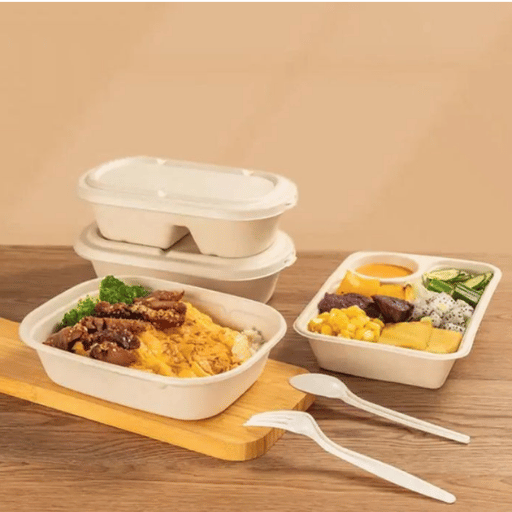
O terreno regulatório nas embalagens para viagem está mudando mais rapidamente do que há pelo menos uma década. Examinamos três turnos que orientarão a estratégia de fornecimento até 2026 e além.
A espuma está sendo legislada Itens expandidos de serviços alimentícios de poliestireno são proibidos em uma lista de jurisdições em rápido crescimento. Do estado de Washington Departamento de Ecologia recipientes, pratos, tigelas, conchas, bandejas e copos de espuma proibidos a partir de junho de 2024; A proibição de recipientes de espuma para alimentos no Colorado entrou em vigor em 1o de janeiro de 2024; e somente a Califórnia tem 131 leis locais de poliestireno, por Californianos contra o desperdício. Se a espuma ainda estiver na mistura da embalagem para viagem, planeje sua substituição agora, em vez de embaralhar quando seu estado agir.
A responsabilidade estendida do produtor (EPR) muda quem paga No final de 20, sete estados dos EUA 25 Maine, Oregon, Colorado, Minnesota, Maryland e Washington promulgaram leis EPR de embalagem que transferem o custo de descarte de embalagem para “produtores,” um termo que agora muitas vezes chega ao proprietário da marca Como a Guia de conformidade EPR 2025 estabelece, o programa do Oregon começou a ser aplicado em 1o de julho de 2025 e o prazo de conformidade da Califórnia é 1o de janeiro de 2027. O efeito prático: formatos difíceis de reciclar podem acarretar taxas mais altas do que os recicláveis ou compostáveis, portanto a escolha do material está se tornando uma decisão de custo direto, não apenas ambiental.
A demanda está se movendo em direção à fibra Globalmente, o mercado de embalagens de serviços alimentícios deverá crescer de US$ 110,29 bilhões em 2025 para US$ 188,39 bilhões até 2035, e os formatos compostáveis e de fibra são a parte que mais cresce nele. O movimento concreto para qualquer marca que faça um pedido de embalagem de 2026 é projetar a linha para que o material possa mudar, favorecendo as famílias de contêineres que existem tanto em uma versão de plástico quanto em uma versão de fibra, de modo que uma mudança regulatória não force uma reformulação completa. A recipientes biodegradáveis para alimentos a categoria é um lugar útil para avaliar quais formatos de fibra já podem estar.
Principais conclusões: Trate a espuma como um material de pôr do sol, orce para taxas de EPR em estados regulamentados e escolha famílias de contêineres que possam alternar entre plástico e fibra sem reequipar.
Perguntas frequentes
Q: Que é a quantidade mínima da ordem para recipientes personalizados para viagem?
Ver Resposta
Isso depende se você deseja imprimir sob medida ou molde personalizado Para impressão personalizada uma forma de recipiente que já existe, o preço geralmente entra em um volume de vários milhares a dezenas de milhares de unidades por design Ao usar um molde personalizado geralmente requer muitos volumes maiores, pois você distribui o custo de ferramentas por cada unidade produzida Sempre confirme o MOQ para seu recipiente específico e imprima o trabalho por escrito.
Q: Quanto tempo leva para produzir recipientes personalizados para levar para fora?
Ver Resposta
Para impressões personalizadas para um recipiente existente, os tempos de produção seriam de algumas semanas após a instalação aprovada da arte e da impressão. Se você precisar de um molde personalizado completamente novo, o prazo de entrega da produção será muito maior, pois o molde precisa ser usinado e executado. A aprovação da amostragem e da arte vem antes disso, então leve em consideração esse tempo também!
Q: Qual é a diferença entre recipientes impressos sob medida e moldados sob medida?
Ver Resposta
Impresso personalizado significa um recipiente pronto para uso e pronto para uso com seu logotipo aplicado (menos caro, menor quantidade, mais rápido Moldado personalizado significa um formato de recipiente inteiro feito com uma ferramenta cortada apenas para você (mais caro, mais longo) maior MOQ; geralmente só vale a pena quando você não consegue encontrar nenhum formato de estoque para funcionar Muitas marcas de serviços de alimentação optarão por impressos personalizados.
P: Os recipientes compostáveis para viagem valem o custo extra?
Ver Resposta
Vale a pena se o seu mercado tem proibições de espuma ou restrições de embalagens plásticas, se sua base de clientes tem acesso comercial de compostagem, ou se demonstrar suas credenciais ambientais em sua marca é importante para o marketing da marca Menos valioso se você não tiver uma infraestrutura de compostagem comercial local, ou se sua comida estiver molhada e oleosa o suficiente para que o desempenho da fibra se deteriore E uma vez que as taxas de EPR se tornem comuns, a dificuldade em reciclar plástico pode em breve torná-lo uma opção mais barata, independentemente.
P: Os contêineres para viagem podem entrar no freezer?
Ver Resposta
Os recipientes PP têm excelente tolerância ao freezer, tornando-os populares para pacotes de preparação de refeições recipientes feitos com fibra de bagaço também toleram o congelamento com a maioria dos tipos de alimentos PET pode se tornar frágil em temperaturas de sub-congelamento e pode rachar sob estresse, particularmente se manuseado aproximadamente Informe seu fornecedor no início do processo de design se este será um uso primário.
Q: Preciso de recipientes diferentes para alimentos quentes e frios?
Ver Resposta
Normalmente sim. A comida quente geralmente precisa de material estável ao calor e, idealmente, micro-ondas, como PP, às vezes com ranhuras de ventilação para evitar o acúmulo de vapor que leva à comida encharcada. A comida fria, por sua vez, é melhor exibida em PET transparente, que permanece firme na temperatura da geladeira, mas se torna um tanto frágil à medida que esfria. Para esses fins, uma pequena série de dois ou três tipos de recipientes geralmente servirá melhor, em vez de tentar construir um que faça tudo.
Q: Que informação um fabricante precisa de citar minha ordem?
Ver Resposta
As informações mínimas essenciais: seu tipo de alimento e temperatura de serviço, tamanho da porção de serviço de trabalho, contagem de unidades desejada, material preferido (ou orientação de solicitação), se você precisa de impressão personalizada e número de cores necessárias, seu país de destino e regulamentos/impostos relevantes, e a data de entrega desejada Um resumo mais claro produz estimativas de preços mais comparáveis e úteis.
Pronto para especificar seus contêineres de retirada personalizados?
A Wanhui produz PP de qualidade alimentar, fibra e recipientes reutilizáveis para viagem, apresentando desenvolvimento interno de moldes e impressão de logotipo personalizado para a indústria de serviços de alimentação em todo o mundo.
Sobre Este Guia
Este guia foi escrito para ajudar os operadores de serviços de alimentação fazer escolhas de contêiner take-out sem. As leis regulatórias de espuma de venda excessiva, as leis de EPR dos EUA e os padrões de contato com alimentos da UE são extraídas das principais fontes governamentais e de padrões citadas abaixo, e as faixas de temperatura do material são dadas como valores típicos da indústria que variam com o design da peça É publicado pela Wanhui, fabricante de contêineres para viagem de qualidade alimentar, e revisado pela equipe de embalagem da Wanhui quanto à precisão técnica.
Referências e fontes
- Plásticos: Dados Específicos de Materiais Ônibus. Agência de Proteção Ambiental
- Proibição expandida de poliestireno 0 Departamento de Ecologia do Estado de Washington
- 21 CFR Parte 177 Aditivos Alimentares Indiretos: Polímeros (eCFR)
- Regulamento (UE) n.o 10/2011 relativo a materiais e artigos plásticos destinados a contactar alimentos &Lex, União Europeia
- Meus contêineres para viagem são todos lixo? •CleSmart Massachusetts
- Ordenanças locais de poliestireno da Califórnia Ços californianos contra o desperdício
- O Guia 2025 para Conformidade Embalagem EPR – Rosa de LLP
- Dimensionamento do mercado de embalagens de serviços alimentícios Embalagem de 100 metros
Artigos Relacionados
- Recipientes personalizados para retirada 3a impressão de logotipo-tamanhos diretos, materiais e
- Embalagem Alimentos Personalizados range de embalagem personalizada completa
- Recipientes Alimentares Descartáveis – recipientes, tigelas e compartimentos
- Embalagem de alimentos ecológica formatos compostáveis e biodegradáveis
- Entre em contato com a equipe Wanhui 0 s, cotações e conselhos espec