Get in touch with Wanhui Company


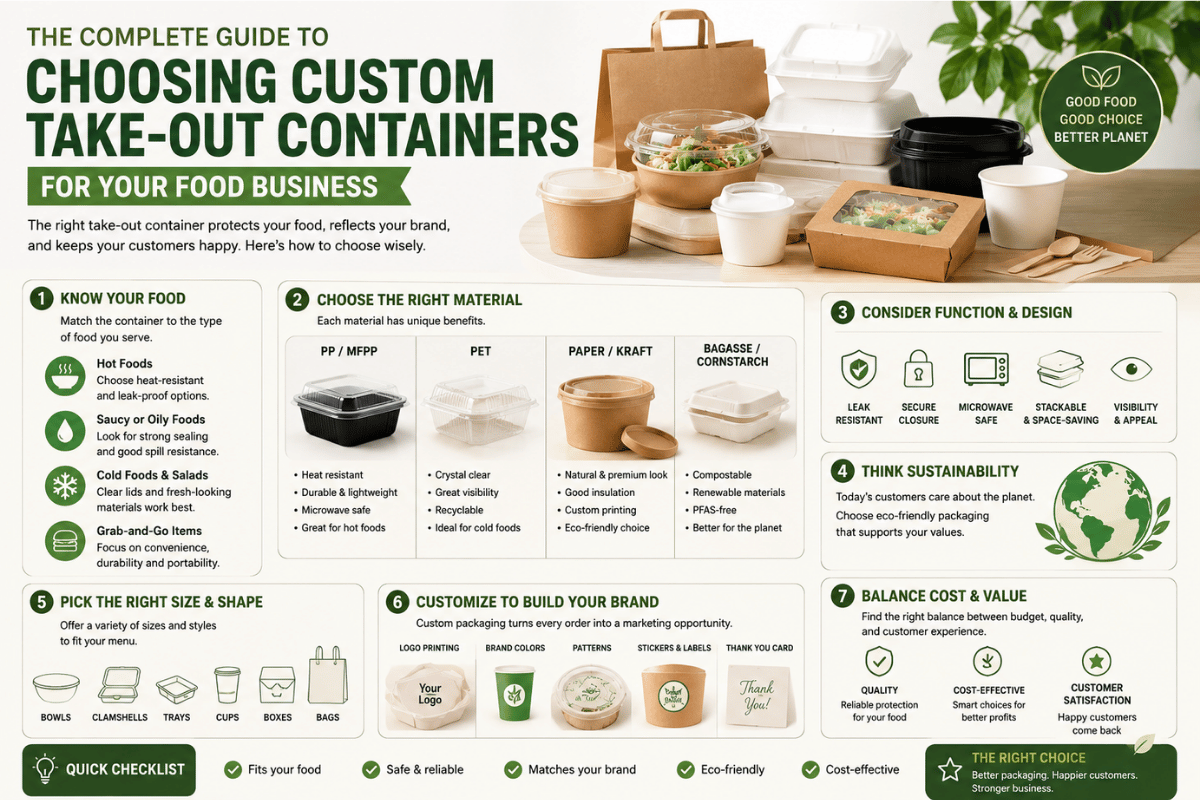
Custom take-out containers are food-grade boxes, bowls, trays and clamshells built to a food brand’s own spec — size, material, colour and printed logo — rather than bought as plain stock. Choosing them well is harder than it looks. A single order touches food safety, microwave performance, leak control, recycling rules, and a minimum order quantity that can climb into the tens of thousands. This guide walks through every decision in the order you actually meet it, with no vendor pitch attached.
Already know what you want and just need a manufacturer? Skip ahead to custom take-out containers built to spec. Still weighing up materials, sizes and cost? Start here.
Quick Reference: Take-Out Container Materials at a Glance
| Material | Typical Heat Limit | Microwave | Leak / Grease | End of Life |
|---|---|---|---|---|
| PP (polypropylene) | ~120°C / 250°F | Yes | High | Recyclable #5 (limited curbside) |
| PET / rPET | ~70°C / 158°F | No | High | Recyclable #1 (widely accepted) |
| Bagasse (sugarcane fibre) | ~95–100°C / 205°F | Yes (short bursts) | Medium | Commercially compostable |
| Kraft paper + lining | ~85°C / 185°F | Limited | Medium | Recyclable / compostable by lining |
| Foam / EPS | Insulating, low ceiling | No | Medium | Not recyclable; banned in many areas |
| Aluminium | Oven-safe | No | High | Widely recyclable |
Maximum temperatures listed are average and subject to variations based on wall thickness and the specific additive package. Always consult a supplier data sheet specific to your chosen item.
What Are Custom Take-Out Containers (And When Customisation Pays Off)?
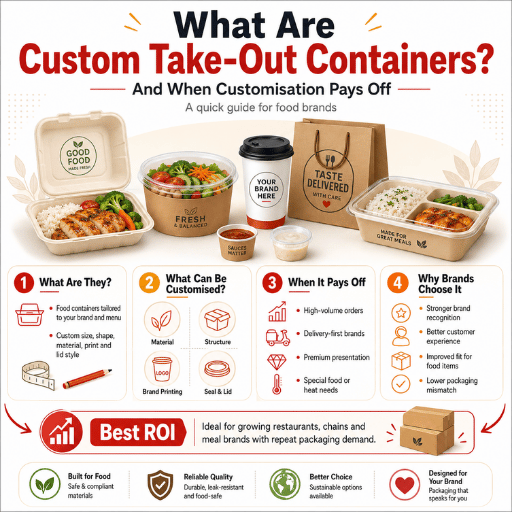
A custom take-out container-a food box, bowl, tray, or clamshell created for your food brand based on your exact specifications rather than being selected from pre-manufactured standard items.
Custom can mean two distinct things, and mistaking one for the other can be a costly error for a first-time purchaser.
Custom-printed is a pre-designed and pre-tooled container with your brand applied through printing. Its form is already established; your spend covers only the printing. Custom-moulded is an original container design fabricated from a specialised tool — a mould — machined for your precise shape.
Printing an existing shape is largely a job of weeks; commissioning a mould is an industrial tooling process that runs into months and a far higher investment. For most foodservice brands, the printed route is enough.
What’s the purpose of customization?
Standard containers’ sole function is to hold food. A branded container continues to serve even after leaving the kitchen, sitting on the delivery client’s desk, being photographed, or being reused at home-all uncompensated advertising for your brand. It is an expense that a generic clamshell could not generate.
This benefit comes at the expense of long-term commitment, as you become obligated to meet minimum order requirements and bear longer lead times. Consequently, customization is cost-effective once your demand consistently supports a print run before future adjustments to your food service concept.
💡 Break-Even Rule of Thumb
If a full run of custom printing won’t be consumed within approximately 9-12 months, opt for customizing only the printing. Reconfiguring a mould that no longer fits your business-or discarding partially used printing as your food service concept evolves-effectively nullifies the investment made in your customized item.
Key takeaway: Always decide between custom-printing and custom-moulding before requesting a quotation.
Those two routes differ in cost, timeline and risk, and custom-printing is usually the better choice.
Take-Out Container Materials Compared: PP, PET, Paper, Bagasse, Foam and Aluminium
The choice of material dictates everything else – including heat tolerance, oven compatibility for your customers, spill resistance, overall cost, and marketability compliance. Below we look at how common take-out container materials actually behave.
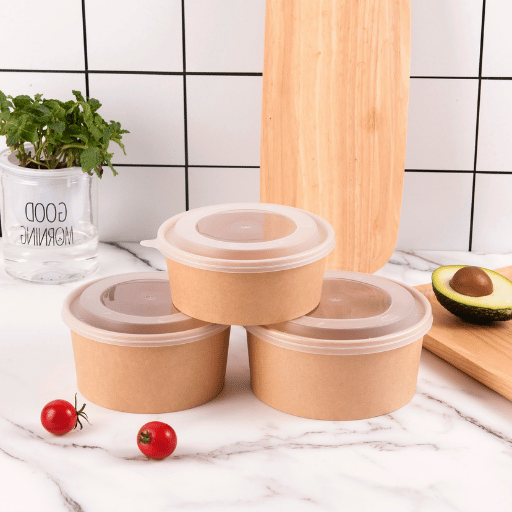
Polypropylene (PP) is the workhorse of hot-food take-out. It stays stable up to 120°C, so it is truly microwave safe, and oil and grease resistant – why takeaway meal boxes and soup containers are mostly PP. PET and recycled rPET are glass clear and rigid, suitable for cold foods such as salads and cut fruit, but soften at around 70°C and cannot be put into a microwave. Bagasse (sugarcane pulp) can be moulded into firm compostable trays and clamshells that work in fridge and short microwave pulses, but is liable to soften from prolonged contact with wet, oily foods. Kraft paper boxes — the classic folded take-out carton and pizza boxes — depend on a PE or PLA lining, which decides grease resistance and whether the box can be recycled or composted.
Expanded polystyrene (foam) insulates cheaply but cannot be microwaved, is almost unrecyclable and has been banned for catering use by an increasing number of authorities, detailed in the section on regulation below. Aluminium trays can withstand oven temperatures that would melt most plastic and recycle easily, but prevent microwaves from working and are more expensive.
Are Plastic or Paper Take-Out Containers Better?
Neither is the outright winner — both fail in different ways. Plastics (PP) contain fluids and reheat readily, but, while recyclable on paper, most plastic take-out containers aren’t in practice. Paper and fibres are usually viewed as having better environmental cred and are compostable where facilities exist, but they are often poorer at holding liquid or oil and a lined paper box may actually be more difficult to recycle than a clean PP container. Perhaps more to the point, the clean look and feel of some plant-based materials is spoilt by leakage, and a paper box that fails in transit is not a good PR move. The answer lies in understanding both, and picking the right take-out for your specific food, and local recycling conditions.
✔ Where PP Wins
- Hot, saucy or soupy dishes
- Food customers will microwave
- Tight, reliable leak-proof seals
- Lowest unit cost at volume
⚠ Where Fibre / Kraft Wins
- Markets with foam or plastic bans
- Brands selling a visible eco-friendly story
- Dry, warm food (not long-soak liquids)
- Access to commercial composting
If you are not sure which resin suits your menu, a structured take-out container material selector narrows the shortlist food type by food type, and for plant-based lines the compostable to-go containers range shows which fibre formats are available.
Key point: Always choose the resin before the take-out shape – PP for hot foods that are hot, wet, or will be microwaved, PET for cold items and clean aesthetics, and bagasse or kraft paper when ban and compostability are key factors.
How to Match the Container to Your Food (Hot, Cold, Soup, Fried, Salad)
One of the quickest routes to an unhappy customer is using a single container for an entire menu. Foods fail in different ways — soup leaks, fried food turns soggy, salad wilts — so the right container is a food-by-food call. Use the matrix below as a starting point.
| Food Type | Main Risk | Recommended Container |
|---|---|---|
| Soup, curry, saucy mains | Leaks, pressure from heat | PP bowl with gasket-fit snap lid |
| Fried food (fries, tempura) | Steam → sogginess | Vented kraft box or perforated tray |
| Salad, cold bowls, cut fruit | Wilting, poor display | Clear PET / rPET bowl |
| Hot mains, rice + sides | Mixing, reheating | PP hinged clamshell or 3-compartment tray |
| Pizza, flatbreads | Trapped steam, crushing | Corrugated kraft pizza boxes with vents |
| Catering / multi-portion | Spillage, stacking | Large PP or aluminium trays with locking lids |
Two failure modes deserve special attention, because they sit behind most takeout complaints: condensation and lost texture. When a hot food container is sealed shut, trapped steam condenses on the underside of the lid and drips back onto the food. Crisp, breaded items suffer most. To keep fried food crisp you need a lid that vents — a perforated lid or a kraft box that breathes — even though that runs against the instinct to seal everything tight.
A pho shop moving into delivery learned this the hard way. It packed broth in shallow clamshells meant for dry rice dishes, with snap lids never rated to seal liquid — and roughly one delivery in eight reached the customer with broth loose in the bag. Switching the soup line to deep PP bowls with gasket-fit lids, while keeping the clamshells for dry dishes, ended the leak complaints. The lesson is blunt: liquids need a container engineered for liquids, not the nearest box on the shelf.
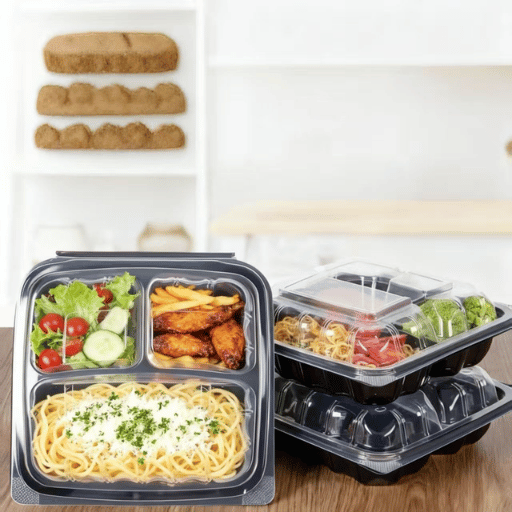
For compartment meals, 3-compartment containers keep a main and two sides from bleeding into each other, while bulk catering is better served by sturdy food trays sized for shared portions.
Main lesson: Each menu item needs to be categorized based on its likelihood of causing issues, and matched with a container. All liquids will get sealed lids, all fried food will get vents, all cold foods will get a clear view.
Take-Out Container Sizes and Capacity: A Practical Sizing Guide
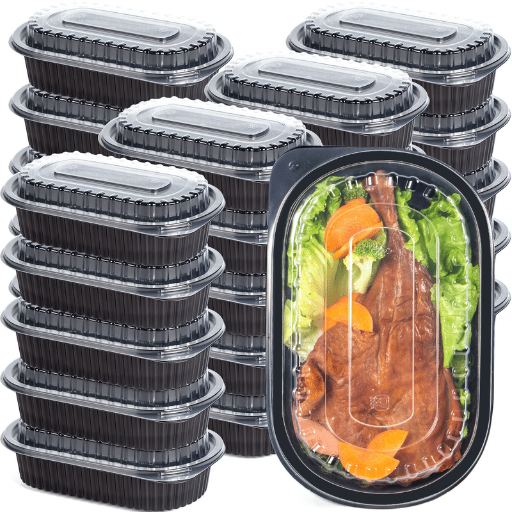
While capacity on spec sheets is often listed by volume (fluid oz or ml) on container orders, this figure does not tell the full story.
To prevent foods from leaking and ensure proper lid seating, you should always fill to 75-80 percent working volume. Make your ordering decisions around this working number, not its catalog value.
| Size Tier | Capacity | Typical Use |
|---|---|---|
| Small | 8–12 oz (250–350 ml) | Sides, sauces, dips, desserts |
| Medium | 16–26 oz (500–750 ml) | Single mains, salads, rice bowls |
| Large | 28–38 oz (800–1100 ml) | Hearty mains, noodle dishes, combos |
| Family / catering | 48 oz–100 oz+ (1400–3000 ml) | Shared portions, party trays |
Unless your menu needs specialised sizes for unusual dishes, three or four sizes are normally sufficient.
To save money and simplify inventory management, selecting a container family that allows for the reuse of lid sizes across 2 or 3 containers should be prioritized. By having just one size for multiple container formats, staffing can make fewer mistakes when choosing lids in the heat of the moment, and you’ll lower the overall cost per item.
📐 Engineering Note
Do not specify the maximum capacity when placing your orders.
If a container labeled as “32 oz” is over-filled, it will cause its lid to expand or the seal to bend; a container rated for a 24-26 oz working portion would travel reliably. When briefing a manufacturer on the right size, the detail that matters most is the weight of the dish, not its catalogue number.
Key lesson: Make ordering easy and cost-effective by sizing 3 to 4 containers to handle 75-80% fill levels, and if possible, use common lid sizes.
Are Take-Out Containers Microwave-Safe and Recyclable? The Honest Answer

Whether or not a claim on the packaging for a container can be made either legally or in good faith, are completely dependent on the resin used – and unfortunately, the recycling symbol on the bottom cannot help you make either decision.
Can You Microwave Plastic Take-Out Containers?
Whether it is legally permissible or a reputable marketing point to add claim text to a container lid or box is entirely dictated by the plastic’s resin content. Only one commonly used type of plastic, PP (polypropylene), is safe to microwave to 120C; hence why reheatable meals usually come in PP food boxes. PET may bow out as low as 70C, and anything in foam may be a melted mess.
The resin, rather than generic markings, is the ultimate indicator: If your container is marked with “5 PP,” and you have documentation from the supplier indicating that the item is safe to microwave, then it can safely be marketed as such. Otherwise, it would be ill advised to make this claim on your food box.
Can Take-Out Containers Be Recycled at Home?
Much less frequently than people realize. The resin code stamped on a container just identifies the contents, not whether local programmers would accept it. According to the U.S. Environmental Protection Agency, only about 8.7% of plastic was recycled in the United States in 2018 — and even PET bottles managed just 29.1%.
So the harsh reality of serving packaging to your customers is that their container (made of “recyclable” resin) is probably heading for the landfill. Most obvious?
Black plastic take-out container. Because optical sorters can’t see black against a dark conveyor belt, these things always land in the trash, despite their (#5 PP) resin being actually recyclable (per RecycleSmart Massachusetts, for instance.) Only #1 PET & #2 HDPE recycle at any significant level.
⚠️ Important: Recyclable in Theory ≠ Recycled in Practice
Do not print “recyclable” on a container without first ensuring that the resin, color and format are accepted by recycling processes in those locations where your customers operate. Any recycling claims without such vetting pose a greenwashing risk. If you are seeking a justifiable end-of-life story, the answer could be a clear, non-black PET container, or a commercial compostable fiber box.
If your model can support it, the strongest answer to both questions is to step outside disposables entirely. Durable, dishwasher-safe formats such as reusable meal-prep containers change the equation for subscription meal services and closed-loop campus dining.
Bottom line: Microwave safety goes by resin type (PP yes, PET no). Recyclability by local acceptance of that material, not by the label – don’t let your end of life messaging apply to black plastic!
Food Safety and Compliance: What “Food-Grade” Really Means
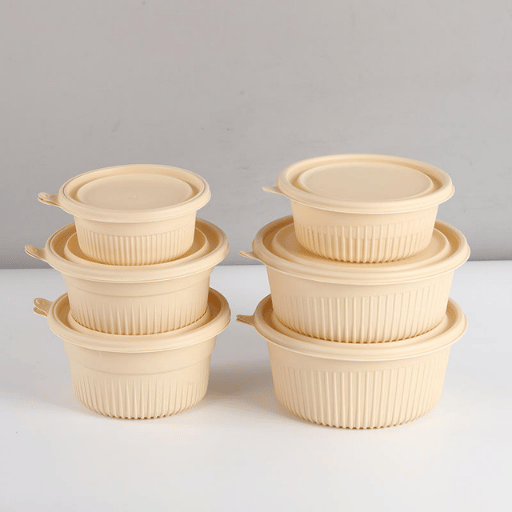
“Food Grade” is not some meaningless marketing word – it’s a designation required by law and it’s your obligation to ensure any component that touches your food has that designation for your particular market.
In the US, the FDA has oversight of plastic food-contact materials in section 21 CFR Part 177 of its regulation, where 177.1520 relates specifically to olefin polymers — the class into which the polyethylene and polypropylene in the great majority of take-out containers fall. More recent compounds use FDA’s Food Contact Notification system. In the EU Regulation (EU) No 10/2011 describes food-grade plastics with substances and maximum migration levels-this one is a sub-regulation, under framework rule which makes no transferable elements that pose a health threat to foodstuffs-while, in China, GB 4806.7 specifies rules for the food-contacting properties of plastics.
A ‘food-grade’ claim is meaningless without the paperwork to back it up. The buyer should never leave the factory without a copy of the migration test report and a declaration of conformity relating to the exact resin and colourant used – not a generic factory certificate. It is the pigment and additive which migration testing is carried out to prevent.
Before you authorize any custom take-out container order ask and hang onto:
- ✔
A declaration of compliance that cites the regulation applicable to your market (FDA 21 CFR, EU 10/2011, or GB 4806.7) - ✔
A migration / extraction test report issued by an accredited laboratory for the specified resin and colorant. - ✔
Confirmation that the container is manufactured using virgin food grade resin (rather than unspecific recycled regrind that might be inappropriate for direct food contact).
If the box carries a compostable claim, ask for the certification reference behind it — an independent compostable compliance checker helps confirm a fibre box meets an accepted standard.
Key takeaway: Treat “food-grade” as a claim to verify. Get a declaration of compliance and a migration test report tied to your exact resin and colourant on file before production starts.
What Custom Take-Out Containers Cost (And What Drives the Price)
There is no single price for a custom take-out container. Total cost is the price per container multiplied by volume, plus every other piece of packaging. At least six factors move that per-unit price, and knowing them keeps a budget honest and shows where a quote is padded.
Material
Fibre and rPET usually cost more per unit than virgin PP
Order volume
Unit price falls sharply as quantity rises past each MOQ tier
Print colours
Each additional colour can add a plate and setup charge
The first major split: is your budget for custom print or for a custom-moulded container?
To custom-print a container, the setup costs for printing and a moderate MO(Q) -typically a range in thousands to tens-of-thousands of each unique print design- are incurred. In contrast, creating a custom mould has tooling and setup costs of a substantially different scale – and because these tooling costs are paid upfront and amortised across each box, mould MOQs are significantly higher, only appropriate for large volumes, consistent demand, or an otherwise unobtainable unique shape.
Forget the unit price, it’s about the cost per order served. Just add the price of each component, i.e. each container, lid, bag and insert, and you get the per-order packaging cost. A container with a price tag two cents higher can in fact be much cheaper if that extra 2 cents prevents a damaged delivery from going astray and a costly refund.
When looking at orders placed through overseas factories, consider the ‘landed cost’ (your quote plus all shipping, import duties and any importer fees) and, in the States from 2025 onwards, factor in packaging fees in states adopting extended producer responsibility, discussed in the next section.
A cloud kitchen running three virtual brands hit the MOQ wall directly. Each brand wanted its own printed clamshell, yet none could consume a separate print run within a year. The fix was a shared neutral container, with brand identity moved to a printed sleeve and a sticker — one packaging SKU at a volume that earned a real price break. A MOQ and lead-time estimator and a five-year total cost of ownership calculator make that trade-off concrete before you commit.
Key Takeaway: Build the total budget around cost per order served and the ‘landed cost’, rather than the container unit cost.
If your required order quantities are too low for a bespoke mould, print your design onto a standard container, sleeve it or add a sticker.
Designing Custom Packaging That Builds Your Brand

The printing, the ‘premium’ element of any custom container, should deliver value.
What good packaging printing does it’s reproduce clean designs onto an awkwardly curved surface, at speed, and on a production line.
Print methods differ with each container: Flexo is suitable for kraft paper and boxes, good for low-cost solids. For the best definition, Offset is often used for printed sleeves and folding cartons. For graphics printed on kraft boxes, which will last, we are offering in-mould labelling: a printed film will be integrated into a plastic container in the molding process.
Alternatively you could consider the direct printing method that places artwork directly on a plastic wall or lid. Both printing methods will feature different color limits and costs, and you can best serve your artwork in that setting.
For a recent salad chain rebranding packaging, a logo designed for screens was submitted, comprised of thin gradients and pale gray lettering. On a bumpy kraft surface the colors striated, and the lettering nearly disappeared. Printing would have cost weeks and another setup.
packaging logos require the submission of an flat, high-contrast version with distinct spot colors before orders are accepted.
💡 Pro Tip: The Packaging Design Brief
Before approving artwork samples: present the manufacturer with an original vector artwork, exact spot-color definitions, the design against a flat ground, and the keep-clear margins for each face of the container.
Design within a single- or two-colour range to keep printing economical; a vibrant full-colour image will smear at production speed.
Some design tips will serve any product well: make certain the logo prints well at its current size; never crowd designs from one edge of a face to another; ensure your container is easily recognized-an iconic shape or distinctive solid color band works best.
Treat the artwork as packaging engineering, not a graphics afterthought.
In short: be realistic about colour constraints; supply flat, high-contrast logo artwork with defined spot colours; and get it approved on product samples before a large printing job.
How to Source a Reliable Take-Out Container Manufacturer
Where you procure makes all the difference to quality, timeliness, and resolution to problems. It helps to differentiate between the manufacturer and the reseller or agent.
If you’re merely seeking some logo added to a product line (some print jobs need so little attention that you’ll receive what you seek from anyone) you can use a reseller that sells stock containers and applies your logo; these generally carry a price mark-up and give you little sway over the container itself. But if you need a particular size or a custom-made shape, a specific food-contact-certified plastic, specific documentation, or recourse when something goes wrong, you need to go to the source — a manufacturer.
Most buyers make only a handful of purchasing errors, and the quick vetting routine below prevents each one:
- ✔
Always order samples first. Test fit, leak, microwave behaviour and print quality with your real food before committing to a full run. - ✔
Confirm the MOQ and lead time in writing — including printing setup time, which buyers routinely underestimate. - ✔
Ask for the food-safety documents up front (declaration of compliance, migration report) — reluctance here is a red flag. - ✔
Clarify who owns the mould if you commission tooling, and what the re-order terms are. - ✔
Check production capacity against your growth — a supplier that cannot scale forces a re-source mid-season.
If one quotation is significantly lower than all of the other price proposals, that price is a warning signal, not a bargain; be sure they are using appropriate thickness materials, acceptable food grade plastics, and proper documentation. Weigh price against a manufacturer’s credentials and export experience: one that has already shipped custom take-out containers into your market will understand its compliance and freight realities. You can get a sense of a manufacturer’s track record from its company background page.
Important learnings: Sample first, to let your customer commit, get the MOQ, leadtime and compliance papers in writing and discount a suspiciously low quote and take it as a warning of the ship sinking.
Industry Outlook 2026: Foam Bans, EPR Laws and the Shift to Fibre
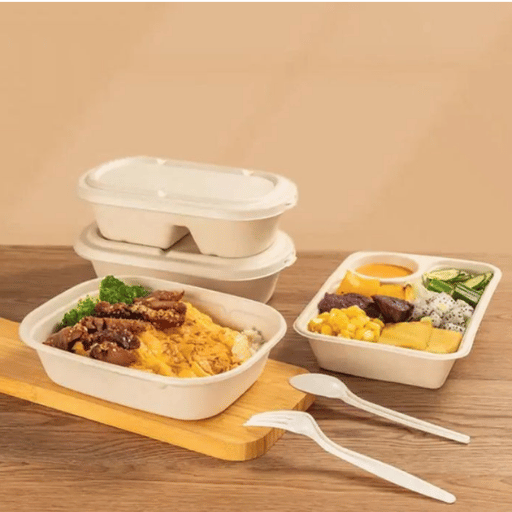
The regulatory terrain in take-out packaging is changing faster than it has done in at least a decade. We examine three shifts which will guide sourcing strategy through 2026 and beyond.
Foam is being legislated out. Expanded polystyrene foodservice items are banned in a fast-growing list of jurisdictions. Washington State’s Department of Ecology banned foam containers, plates, bowls, clamshells, trays and cups effective June 2024; Colorado’s foam food-container ban took effect on 1 January 2024; and California alone has 131 local polystyrene ordinances, per Californians Against Waste. If foam is still in your takeout packaging mix, plan its replacement now rather than scrambling when your state acts.
Extended producer responsibility (EPR) changes who pays. By late 2025, seven US states — Maine, Oregon, Colorado, California, Minnesota, Maryland and Washington — had enacted packaging EPR laws that shift the cost of packaging disposal onto “producers,” a term that now often reaches the brand owner. As a 2025 EPR compliance guide sets out, Oregon’s program began enforcement on 1 July 2025 and California’s compliance deadline is 1 January 2027. The practical effect: hard-to-recycle formats may carry higher fees than recyclable or compostable ones, so material choice is becoming a direct cost decision, not only an environmental one.
Demand is moving toward fibre. Globally, the food service packaging market is projected to grow from USD 110.29 billion in 2025 to USD 188.39 billion by 2035, and compostable and fibre formats are the fastest-growing part of it. The concrete move for any brand placing a 2026 packaging order is to design the lineup so material can shift — favour container families that exist in both a plastic and a fibre version, so a regulatory change does not force a full re-tool. The biodegradable food containers category is a useful place to benchmark which fibre formats can already stand in.
Key takeaway: Treat foam as a sunsetting material, budget for EPR fees in regulated states, and choose container families that can switch between plastic and fibre without re-tooling.
Frequently Asked Questions
Q: What is the minimum order quantity for custom take-out containers?
View Answer
This depends on whether you want to custom print or custom mould. For custom printing a container shape that already exists, the price usually kicks in at a volume of several thousand to tens of thousands of units per design. When using a custom mould it generally requires a lot of larger volumes, as you spread the tooling cost across each unit produced. Always confirm the MOQ for your specific container and print job in writing.
Q: How long does it take to produce custom take-out containers?
View Answer
For custom prints to an existing container shape production times would be within a few weeks of approved artwork and printing setup. If you need a completely new custom mould then your production lead time will be much longer as the mould has to be machined and run off. Sampling and artwork approval comes before that, so factor in this time too!
Q: What is the difference between custom-printed and custom-moulded containers?
View Answer
Custom printed means an off-the-shelf, ready-made container with your logo applied – less expensive, lower quantity, faster. Custom molded means a whole new container shape made with a tool cut only for you – significantly more expensive, longer lead time and higher MOQ; usually only worth while when you can’t find any stock shapes to work. Many foodservice brands will opt for custom printed.
Q: Are compostable take-out containers worth the extra cost?
View Answer
Worth it if your market has foam bans or plastic packaging restrictions, if your customer base has commercial composting access, or if demonstrating your environmental credentials in your brand is important for brand marketing. Less valuable if you lack a local commercial composting infrastructure, or if your food is wet and oily enough that fiber performance deteriorates. And once EPR fees become common place, the difficulty in recycling plastic may soon make it a cheaper option regardless.
Q: Can take-out containers go in the freezer?
View Answer
PP containers have excellent freezer tolerance, making them popular for meal prep packages. containers made with fiber from bagasse also tolerate freezing with most food types. PET may become brittle in sub-freezing temperatures and could crack under stress, particularly if handled roughly. Inform your supplier early in the design process if this will be a primary use.
Q: Do I need different containers for hot and cold food?
View Answer
Typically yes. Hot food usually needs heat-stable, and ideally microwaveable material such as PP, sometimes with vent slots to avoid steam buildup that leads to soggy food. Cold food, meanwhile is best displayed in clear PET, which stays firm at refrigerator temperature, but becomes somewhat brittle as it chills. For those purposes, a small series of two or three container types will often serve best rather than trying to build one that does it all.
Q: What information does a manufacturer need to quote my order?
View Answer
The minimum essential information: your food type and serving temp, your working serving portion size, desired unit count, preferred material (or request guidance), whether you require custom printing and number of colours needed, your destination country and relevant regulations/taxes, and your desired delivery date. A clearer brief produces more comparable, more useful price estimates.
Ready to Spec Your Custom Take-Out Containers?
Wanhui produces food-grade PP, fibre, and reusable take-out containers, featuring in-house mould development and custom logo printing for the food service industry worldwide.
About This Guide
This guide was written to help foodservice operators make take-out container choices without being oversold. The regulatory points — foam bans, EPR laws, US and EU food-contact standards — are drawn from the primary government and standards sources cited below, and material temperature ranges are given as typical industry values that vary with part design. It is published by Wanhui, a food-grade take-out container manufacturer, and reviewed by the Wanhui packaging team for technical accuracy.
References & Sources
- Plastics: Material-Specific Data — U.S. Environmental Protection Agency
- Expanded Polystyrene Ban — Washington State Department of Ecology
- 21 CFR Part 177 — Indirect Food Additives: Polymers — U.S. Food and Drug Administration (eCFR)
- Regulation (EU) No 10/2011 on plastic materials and articles intended to contact food — EUR-Lex, European Union
- Are My Take-Out Containers All Trash? — RecycleSmart Massachusetts
- California Local Polystyrene Ordinances — Californians Against Waste
- The 2025 Guide to EPR Packaging Compliance — Proskauer Rose LLP
- Food Service Packaging Market Sizing — Towards Packaging
Related Articles
- Custom Take-Out Containers — factory-direct sizes, materials and logo printing
- Custom Food Packaging — the full custom packaging range
- Disposable Food Containers — trays, bowls and compartment containers
- Eco-Friendly Food Packaging — compostable and biodegradable formats
- Contact the Wanhui team — samples, quotes and spec advice