Get in touch with Wanhui Company

ISO 22000 & 9001 Certified Quality
Plastic Container Manufacturer
Plastic Food Container Manufacturer with 20-Year Production Expertise
20 years dedicated to food-grade takeaway boxes, bowls and clamshell packaging. 86 production lines, over 1 million pieces daily, and export to five continents – specifically designed to the needs of restaurant chains, food-delivery services, hospital and school canteen systems, or retail meal preparation brands.
Request a Custom Quote
0
Product Families
0
Production Lines
ISO
22000 & 9001
Certified Quality
0
Continents Exported
From Catering Bottleneck to Reliable Supply — How Wanhui Solves B2B Packaging Procurement
Three recurring frustrations in foodservice packaging procurement:
-
Supply variability
– the small workshops of lead time for production and delay schedule into the pack season. -
Quality drift between lots
—wall thickness, lid-fit tolerance, and weld-line integrity is inconsistent due to operation being carried out by several (uncoordinated) sub-contractors. -
Customization gaps
–if the buyer requires branded IML containers or other customed compartments, the order goes to the much more expensive Asia supplier.
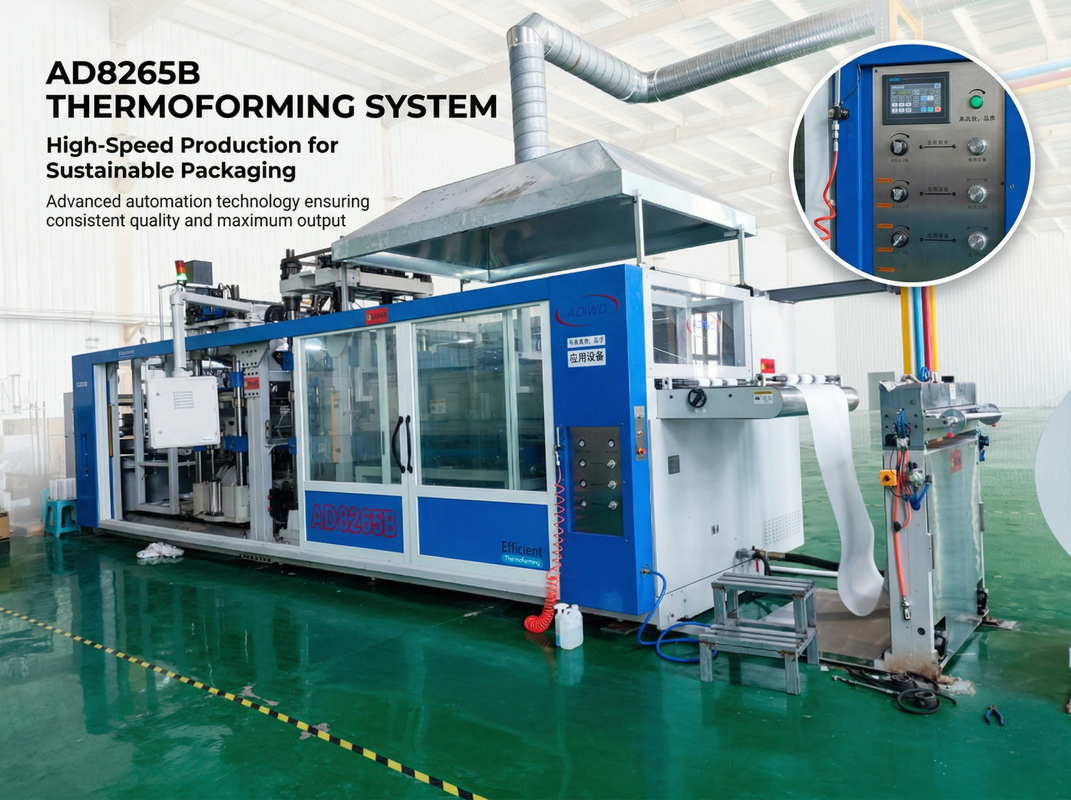
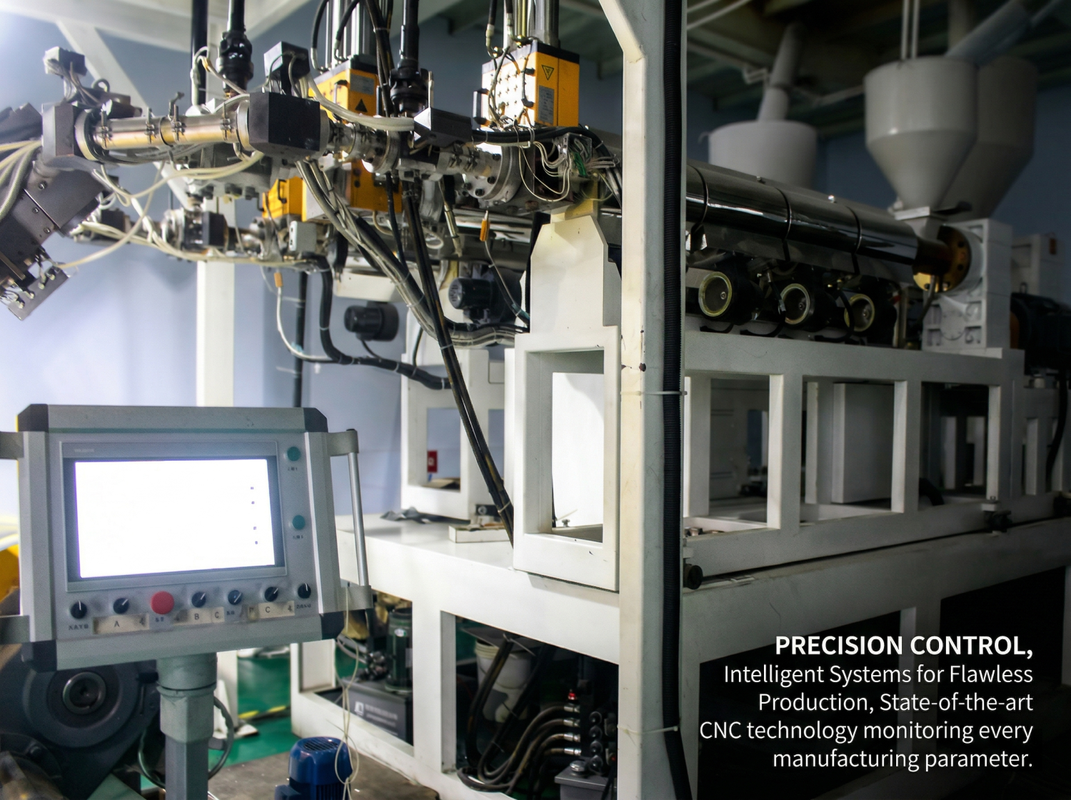
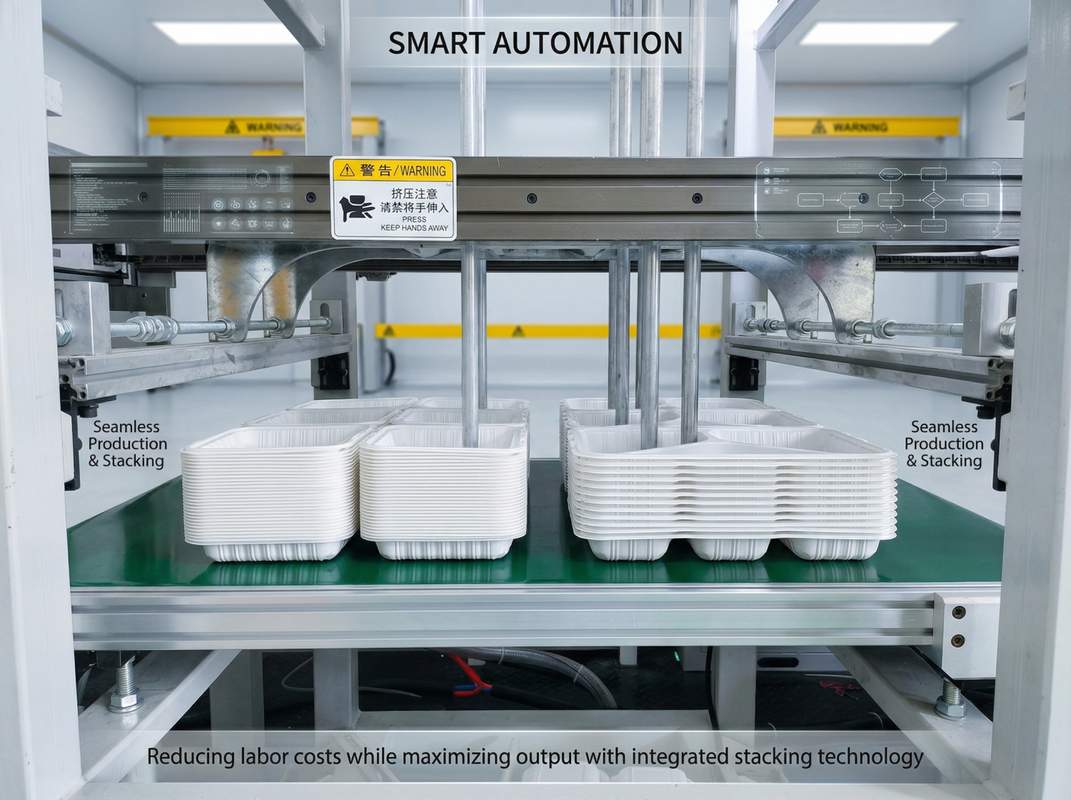
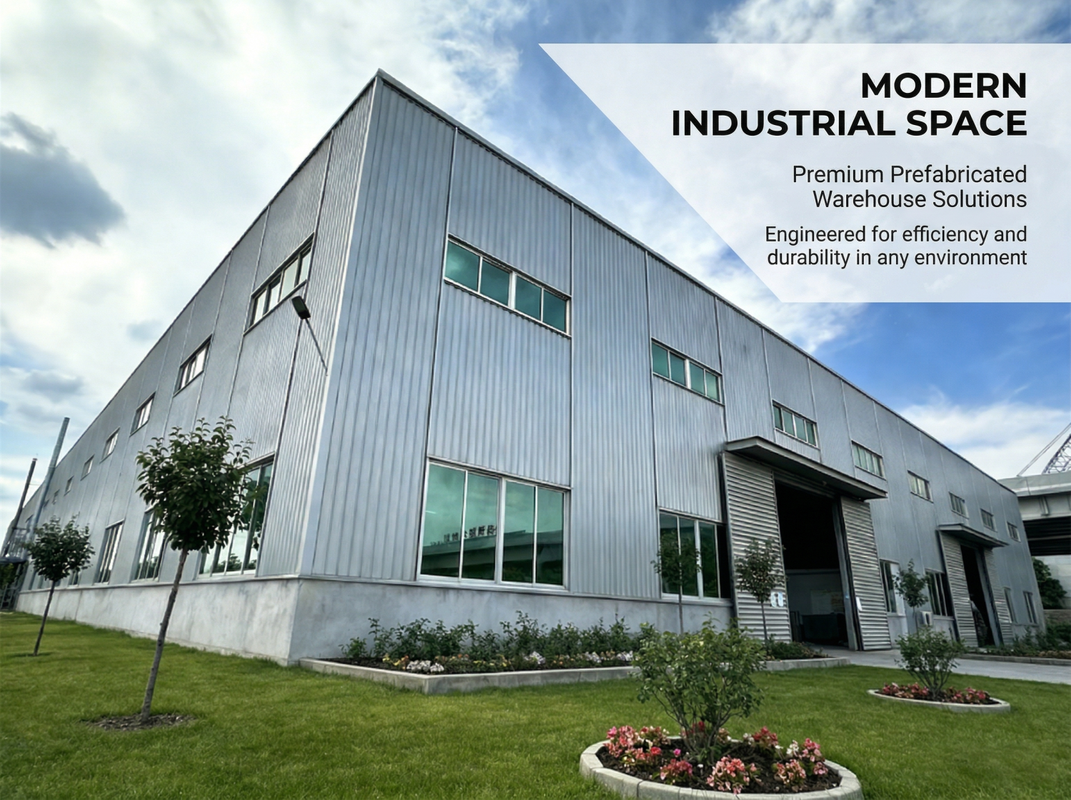
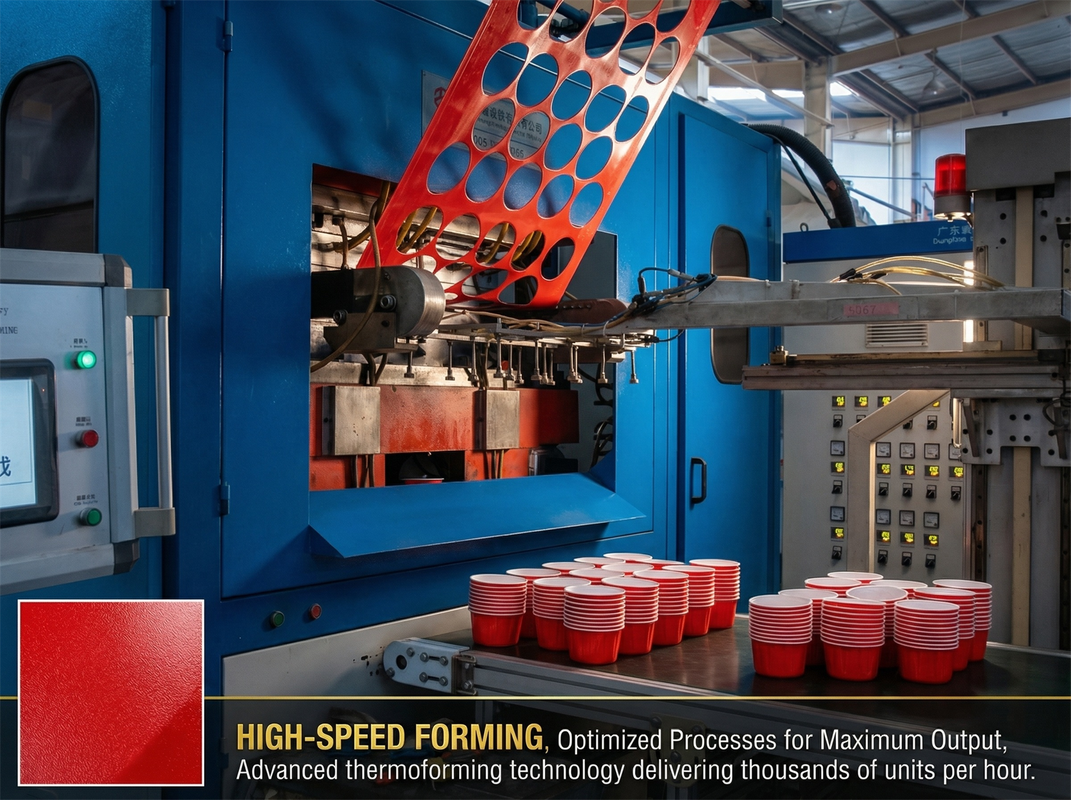
Wanhui solves those friction points by running an end-to-end vertically integrated food packaging chain — sheet extrusion, thermoforming, injection molding, and IML printing all under one industrial park in Lanshan District, Linyi City, Shandong.
Technical Engineering Brief
A plastic food container in the commercial world is actually a highly engineered polymer component capable of withstanding a specific thermal envelope…
Five Product Families for Every Foodservice Scenario — Find Your Match
Wanhui offers five disposable plastic food container families. A family is designed for one of five other combinations of the following factors: acceptable temperature of served food, emphasis on food appearance, emphasis on environmental sustainability and brand logic sophistication. A Wanhui Family Grid is provided in the following page; a corresponding Decision Matrix can be found below.
High-End Thermoformed PP Containers
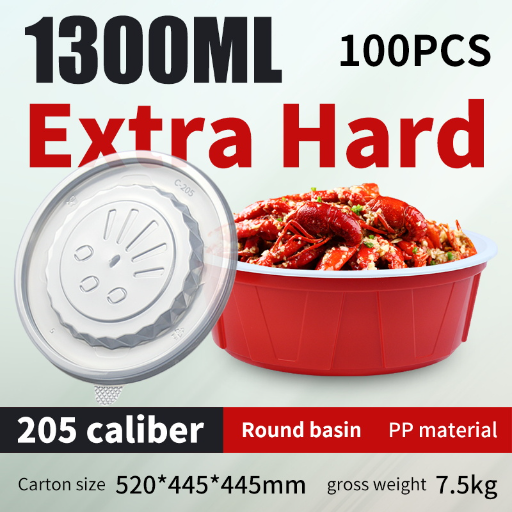
High quality Food grade polypropylene bowls and blister-pack containers with reinforced V shaped ribbing for crush resistance. Cat-ear easy open lid tabs and U shaped steam-vent geometry maintain food texture during delivery.
White Round Bowls 300–1750 ml, three caliber series (120 / 150 / 180 mm)
Red & White Blister-Pack 280–3000 ml, V-ribbed reinforced
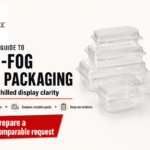
Clear Anti-Fog Bowls Blue lid, 120 / 150 / 180 mm series
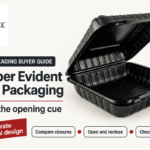
MFPP Hinged-Lid Containers
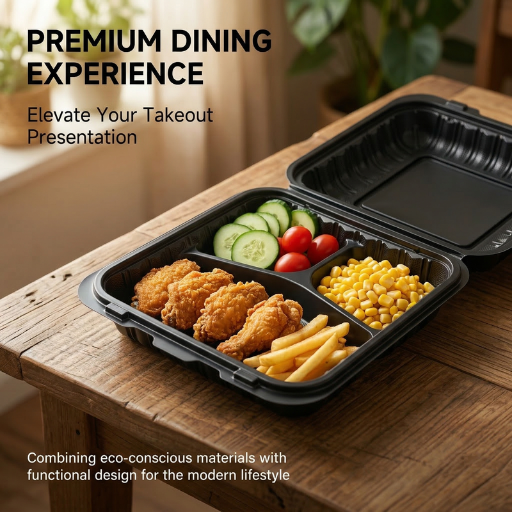
One-part mineral-filled polypropylene (PP) clamshells. The integrated hinge eliminates the risk of losing a separate lid; the mineral additive provides enhanced heat resistance and additional stiffness for structural integrity as compared to regular PP material – Dart Container has published a material guide which indicates that mineral-filled PP can support up to 40% natural mineral loading and is appropriate for hot and cold food applications.
Sizes 6×6 / 8×8 / 9×6 / 9×9 inch
Volumes & Finishes 700 / 750 / 900 / 1000 ml | Black or white

Disposable PP Plastic Containers
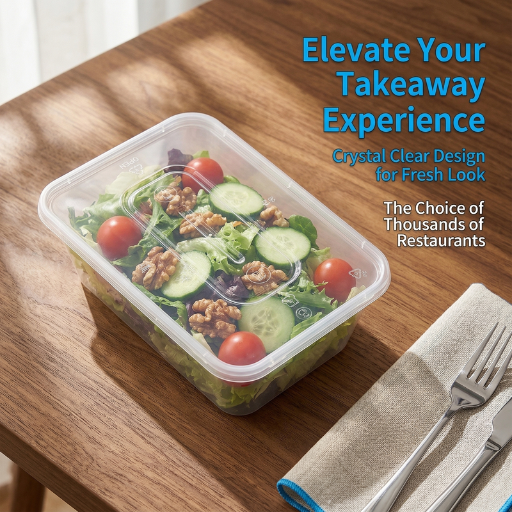
Cost competitive transparent and black PP containers for high-volume single-use applications – fast-food delivery, salad bars, supermarket ready-to-eat. These disposables stack reliably for store-shelf display, are leak-proof for transit, and microwave safe to ~120 C (the published upper working temperature for polypropylene type 5).
Geometry Round, rectangular, square
Lid Options Snap-on, hinge, anti-fog clear
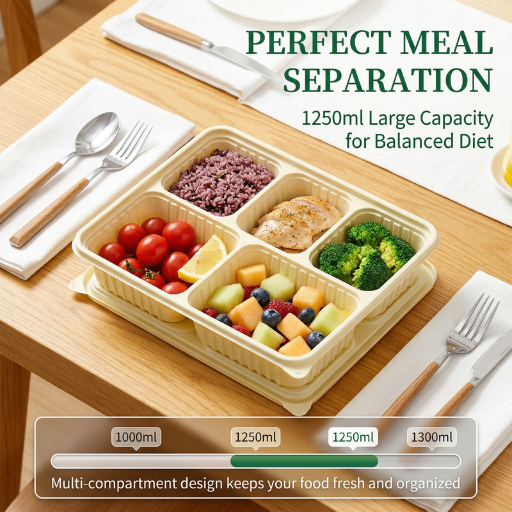
Biodegradable Cornstarch Containers
PLA / cornstarch-based formulations for brands with sustainable sourcing commitments. Plant-based feedstock, BPA-free, designed to breakdown in industrial composting conditions (see FAQ below for honest discussion of what “compost able” really takes).
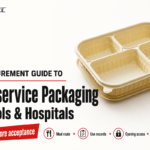
Best Fit Hospital / school canteens, environmentally-conscious restaurant brands
Compliance Retail brands with BPI or EN 13432 sourcing needs
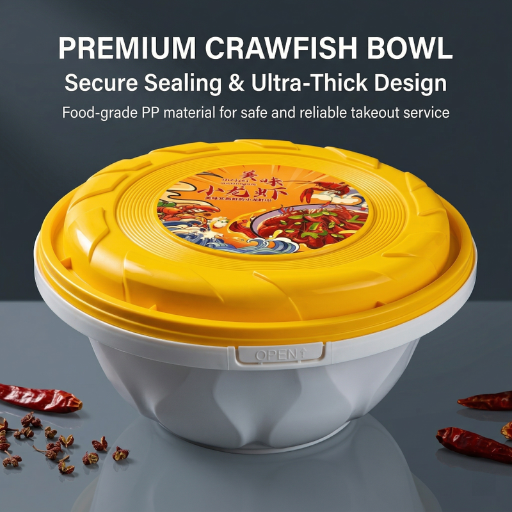
In-Mold-Labeling (IML) Custom-Branded
Wanhui’s premium tier. IML process fuses a full-color graphic film into the container wall during the injection cycle – the resulting print is scratch-proof, peel-proof, and integral to the part itself. Custom mold development is available for proprietary shapes.
Use Cases Retail-ready frozen-meal packaging, premium meal-prep brands
Target Market Private-label foodservice lines, branded delivery for restaurant chains
Decision Matrix — Match Product Family to Procurement Scenario
| Procurement Scenario | Recommended Family | Typical Size Range | Key Feature That Decides It |
|---|---|---|---|
| Hot-food delivery (curry, stir-fry, fried rice) | MFPP Hinged-Lid (Family 2) | 700–1000 ml | Higher heat tolerance + leak-resistant hinge geometry |
| Cold display / salad bar / supermarket ready-to-eat | Clear Anti-Fog (Family 1) or Disposable PP (Family 3) | 300–1500 ml | High transparency for content visibility |
| Premium retail meal-prep with brand identity | IML Custom-Branded (Family 5) | Custom mold | Embedded scratch-proof full-color print |
| Hospital / school canteen with sustainability KPI | Cornstarch Biodegradable (Family 4) | Standard plate / bowl sizes | Plant-based feedstock + industrial-compostable |
| Restaurant chain bulk daily packaging | High-End Thermoformed PP (Family 1) | 280–3000 ml | V-ribbed structural strength + cat-ear easy-open |
| Sauce / dip / condiment portions | Sauce Cup Range (Accessory) | 25–100 ml (1–4 oz) | Hinged-lid or separate-lid, microwave-safe PP |
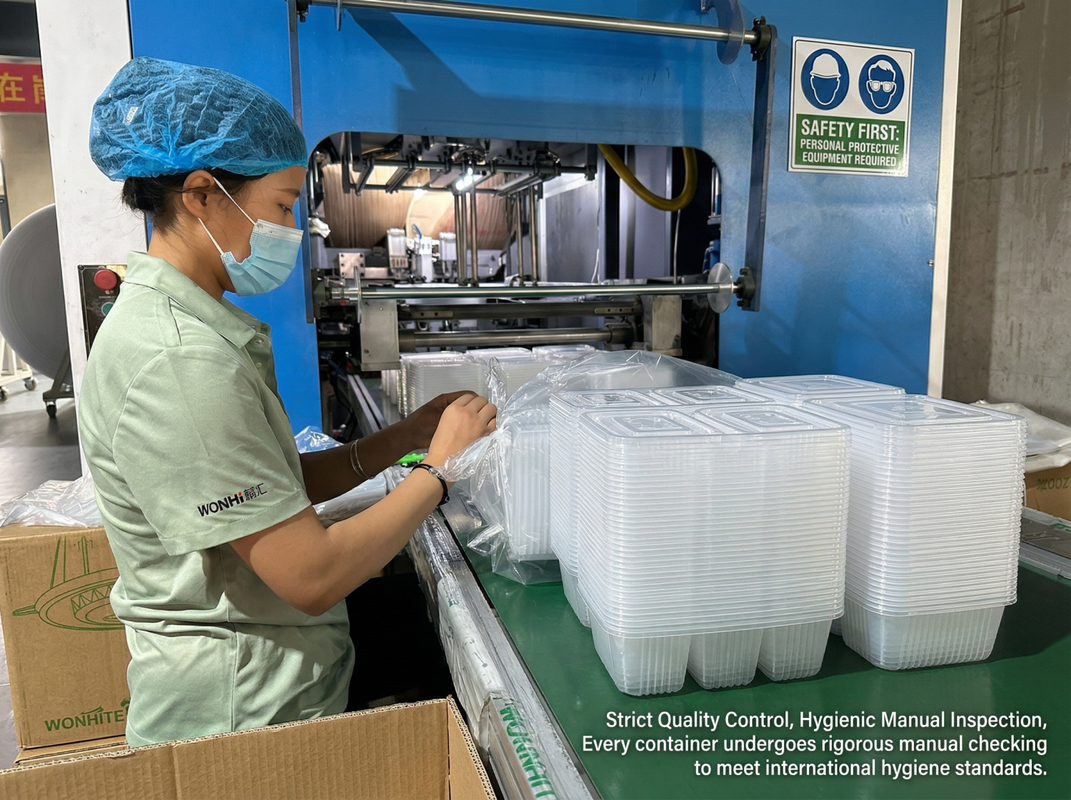
We do not ask buyers to take quality on trust. Every shipment leaves with a batch traceability ID, a pre-shipment AQL inspection report, and the option for an independent third-party inspection by SGS, Intertek, or TÜV Rheinland – the only Chinese-issued certifications that meaningfully translate to a US or EU buyers audit. If a supplier is reluctant to allow that, then frankly the relationship is not worth the risk.
PP, MFPP, PET, or Cornstarch — Which Material Wins Your Use Case?
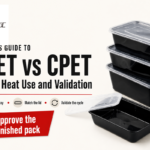
The single most common procurement mistake in food container sourcing is to choose a material solely based on price then discover it does not perform within the thermal or chemical limits of the actual end-use. This table compares the four polymer chemistries that Wanhui makes – in terms of working temperature ranges, presentation features, and end of life pathways that drive the real decisions.
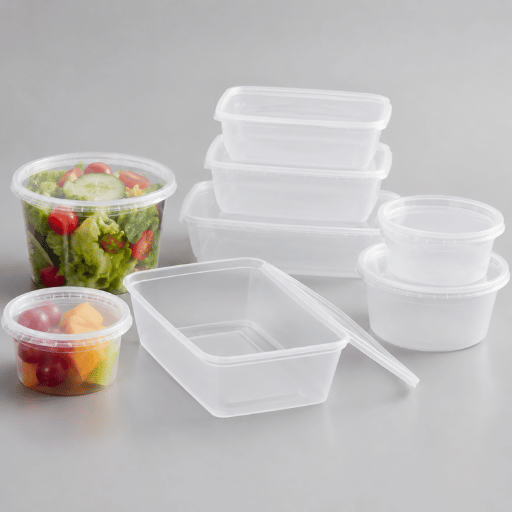
PP(Polypropylene,Resin #5)
- Working Temperature −20 °C to 120 °C
- Transparency Translucent or opaque
- Cost Tier Standard
- Best Fit Application Hot-food delivery, microwave reheating, freezer storage
- End-of-Life Recyclable as #5 stream
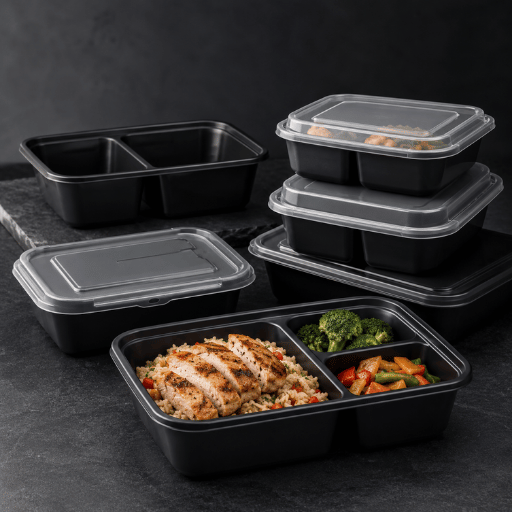
MFPP (Mineral-Filled PP)
- Working Temperature −20 °C to ~130 °C
- Transparency Opaque (mineral content)
- Cost Tier Standard / Premium
- Best Fit Application Hinged-lid hot takeout, premium delivery clamshells
- End-of-Life Still recyclable as #5; reduces petroleum resin by up to 40%
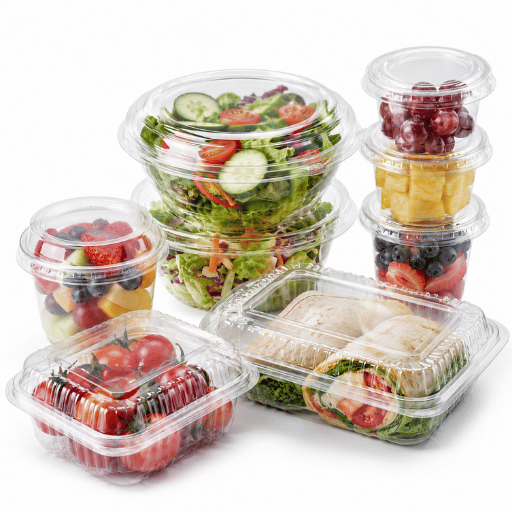
PET (Polyethylene Terephthalate)
- Working Temperature −40 °C to ~70 °C
- Transparency Crystal clear
- Cost Tier Premium (transparent)
- Best Fit Application Cold display, anti-fog cold packaging, salad / fruit visibility
- End-of-Life Recyclable as #1 stream (most established)

PLA / Cornstarch
- Working Temperature −5 °C to ~50 °C (heat-sensitive)
- Transparency Translucent
- Cost Tier Premium (eco)
- Best Fit Application Eco-conscious brands, cold or room-temperature applications
- End-of-Life Industrial composting required — see FAQ Q6
Thermal & Chemical Limits
A subtle but important distinction: heat over 60 C (140 F) dramatically increases additive migration into the package contents (~18-34%), especially in acidic applications like tomato sauce or citrus juice. This is why a “food-safe” label by itself is inadequate – the working temperature of the container needs to correspond directly with the food’s actual temperature. PP is the workhorse of hot foods because its semi-crystal line structure remains dimensionally stable through many rounds of microwave heating; HDPE, on the other hand, softens quickly over 90 C and is not microwave-safe, although it is rated for cold food contact.
The PLA Composting Reality
Cornstarch / PLA deserves a separate honesty note. The material is genuinely plant-based and BPI-certifiable for industrial composting, but a peer-reviewed study published in Polymers on industrial composting found that a 1 mm-thick PLA-based rigid container left 97.2% of its mass intact after three weeks in a real industrial composting plant, compared with 68.9% under controlled lab conditions. In other words: “compostable” is real, but it requires actual industrial composting infrastructure and the correct thermophilic phase at 58 °C — not a backyard compost bin and not a landfill. We surface that detail here so you can route the material to brands and markets where the infrastructure exists.
Procurement & Shelf Life
Two further procurement considerations on the material side. First, shelf life: the polymer chemistry shapes how long packaged food stays fresh — PP and MFPP deliver an oxygen and moisture barrier suitable for hot and cold short-cycle foodservice, while PET’s transparency comes at the cost of a slightly higher gas-transmission rate that matters mainly for long-storage retail. Second, weight and end-of-life: all four families are lightweight relative to glass or rigid metal, which lowers freight cost per pallet; PP, MFPP and PET enter standard plastic packaging recycling streams (#5 PP, #1 PET), and although a disposable food container is single-use by design, PP-family parts are often reusable for an additional cycle of food storage when consumers choose to keep them. PLA / cornstarch follows a different end-of-life path — industrial composting — and should be sourced where the receiving infrastructure can process it without contaminating mechanical recycling. These are routine considerations for environmentally conscious foodservice operators, and the right plastic food container manufacturer should be able to discuss them without sales-deck hedging.
Customers Worldwide — From Restaurant Chains to Hospital Canteens
Wanhui’s containers are supplied to foodservice operators throughout Europe, the Americas, the Middle East, the Asia Pacific, and South America—five continents of disparate regulation and taste preference, and of widely varying freight and handling conditions. The illustration below illustrates which combinations of product family and type of foodservice operation are actually served:
Industry / Operation Type
Primary Product Family
Why That Match
Industry / Operation Type
Restaurant chains & cloud kitchens
Primary Product Family
MFPP Hinged-Lid (Family 2) + High-End PP (Family 1)
Why That Match
Hinge geometry tolerates frequent open-close, V-ribbed wall withstands stacked delivery without crack propagation
Industry / Operation Type
Food-delivery aggregators & meal-prep services
Primary Product Family
MFPP Hinged-Lid (Family 2)
Why That Match
Leak resistance is non-negotiable; one-piece hinge eliminates lid-loss in dispatch
Industry / Operation Type
Hospital & school canteens
Primary Product Family
Cornstarch Biodegradable (Family 4) + Disposable PP (Family 3)
Why That Match
Sustainability tenders favor compostable; PP covers high-throughput tray service
Industry / Operation Type
Retail brand meal-prep (frozen / chilled)
Primary Product Family
IML Custom-Branded (Family 5) + High-End PP (Family 1)
Why That Match
IML print is the only label option that survives freezer + microwave cycling without peel
Industry / Operation Type
Supermarket ready-to-eat & deli
Primary Product Family
Clear Anti-Fog Bowls (Family 1) + Disposable PP (Family 3)
Why That Match
Crystal-clear lid visibility drives impulse purchase
Industry / Operation Type
Catering & private events
Primary Product Family
Sauce Cup Range + High-End PP (Family 1)
Why That Match
Mixed-volume portion control; clear lid for visual presentation
Industry / Operation Type
Beverage industry (sauce/condiments)
Primary Product Family
Sauce Cups + IML branded lids
Why That Match
Cross-sells with beverage SKUs; branded lid drives recognition at point of sale
Certified Quality — ISO 22000, Food Production License, and Patented Designs
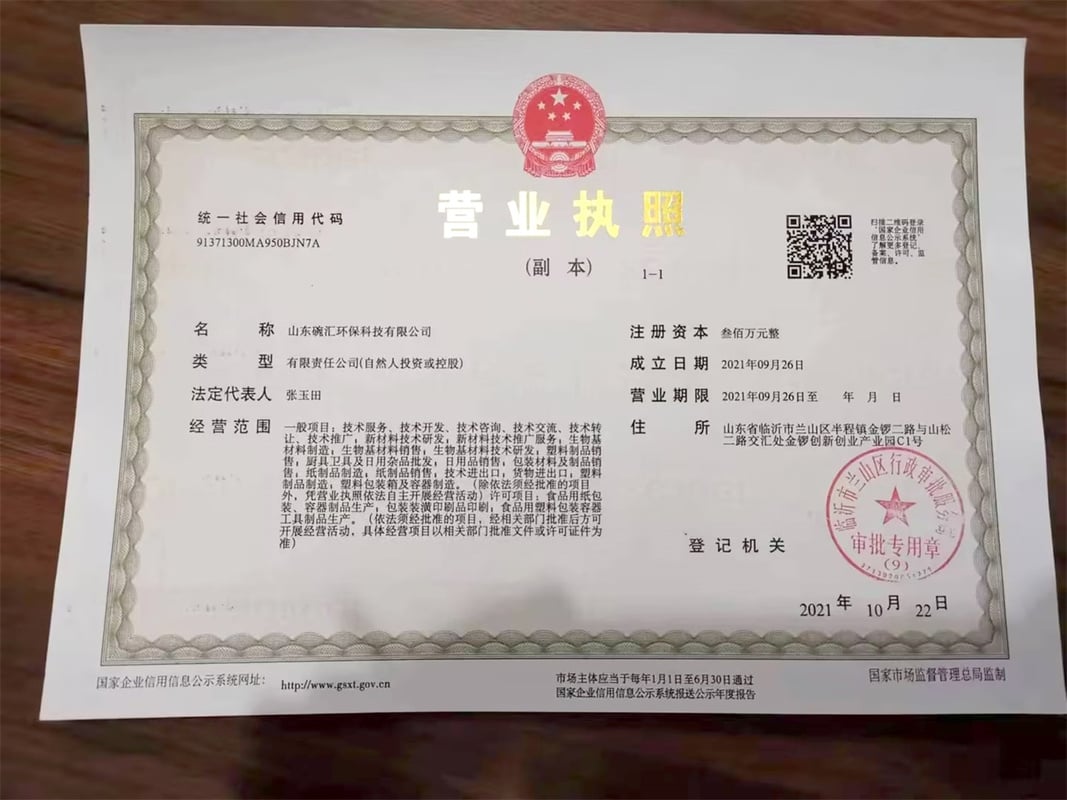
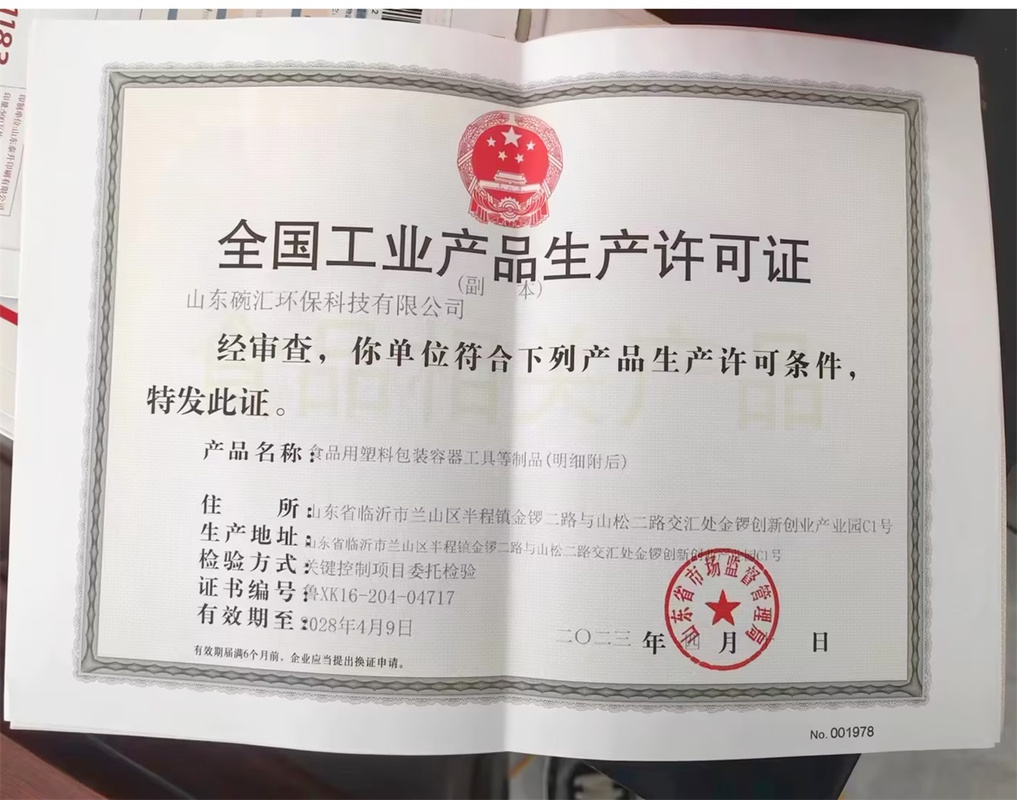
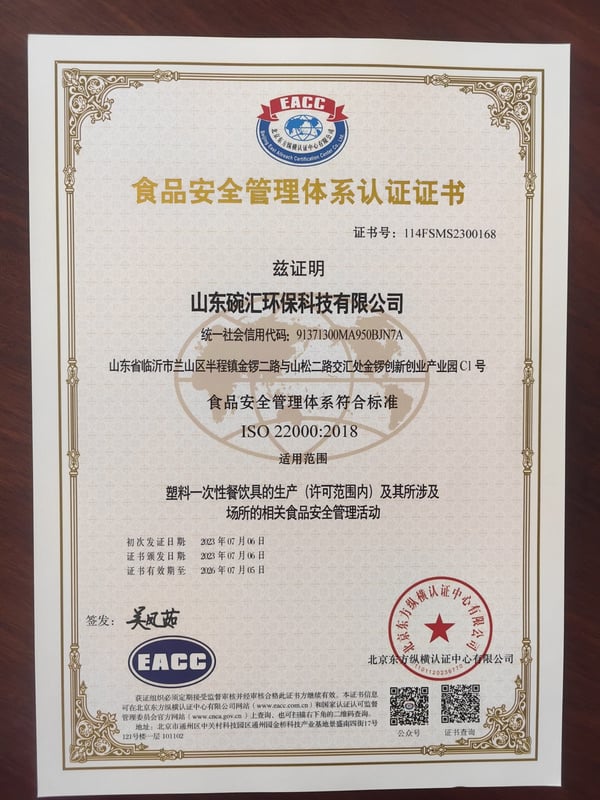
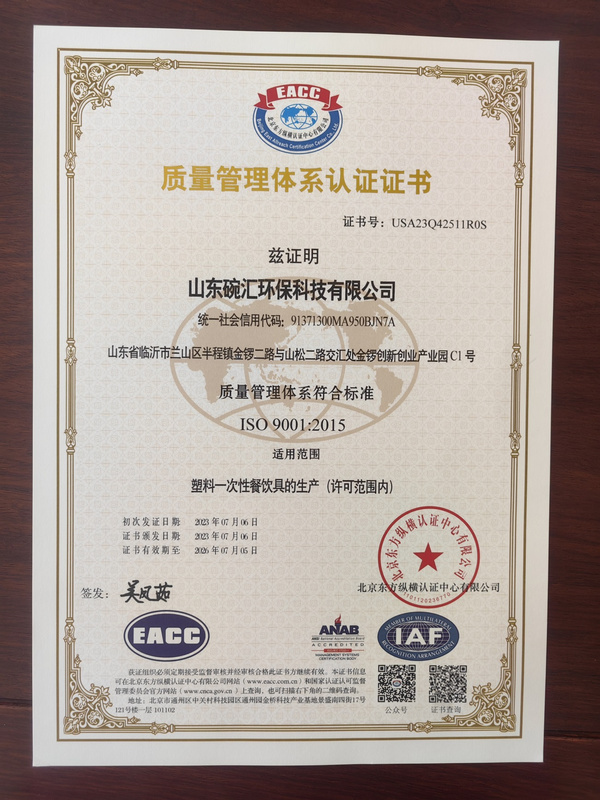
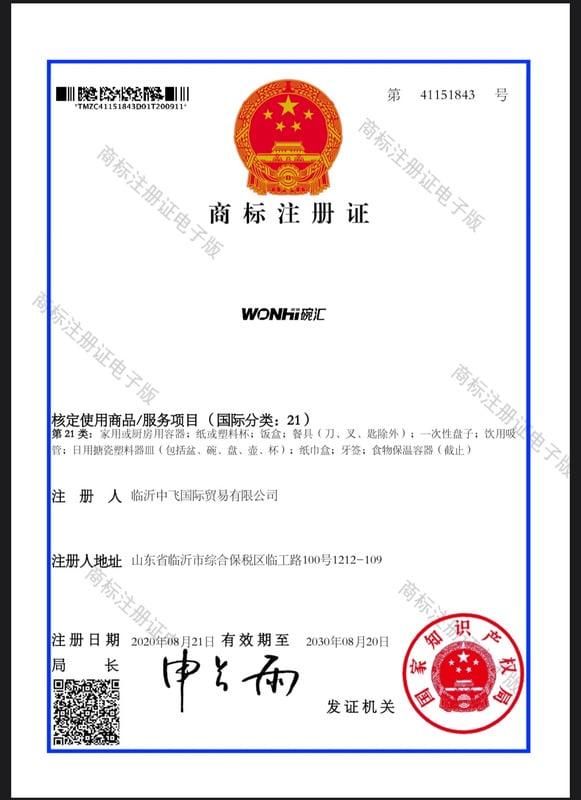
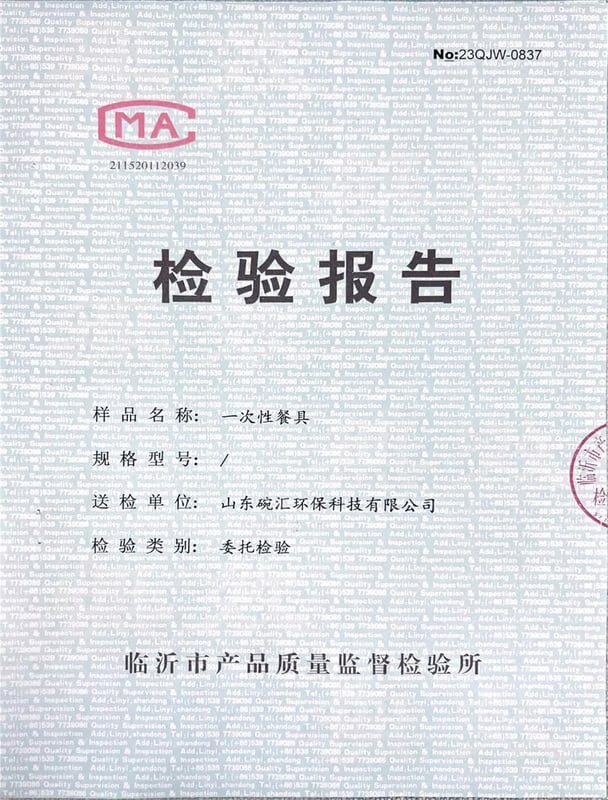
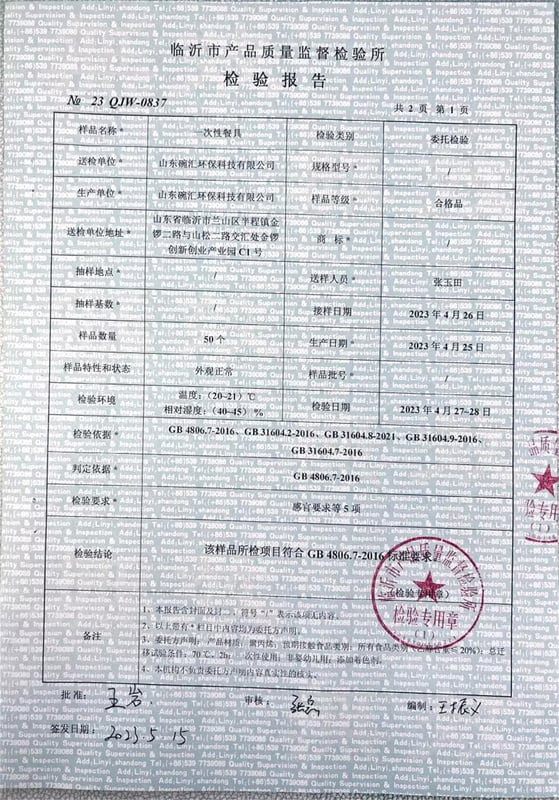
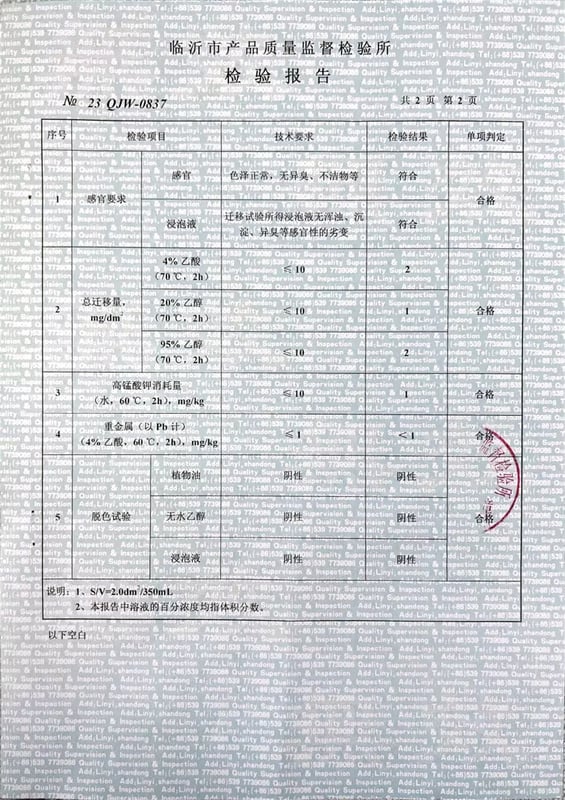
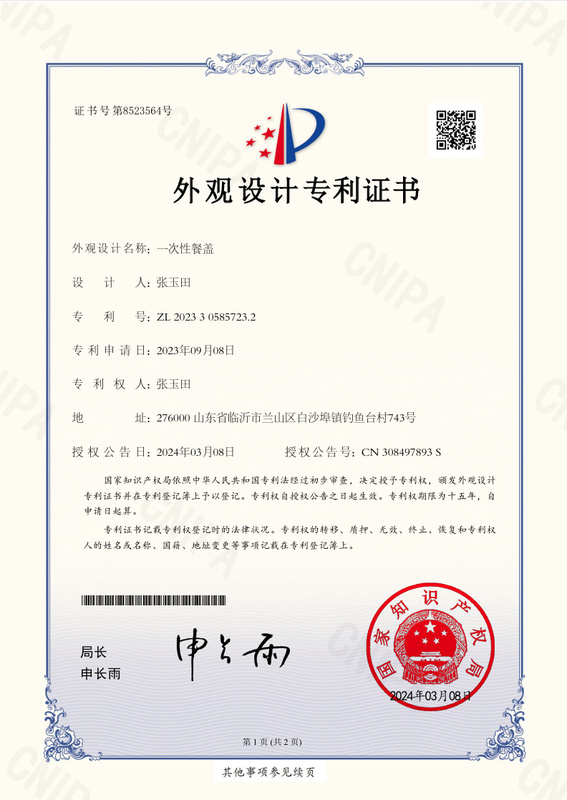
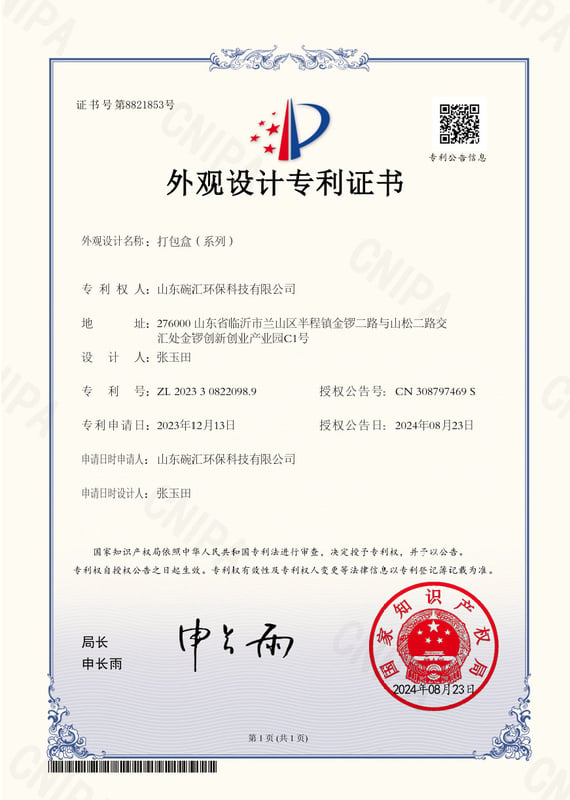
Test reports and ‘certificate verifiability’ are always rated more important than brochure logos. The Chinese food packaging buyers are now routinely recommended to check that the certificate holder name and applicant name correspond to a valid business license of the supplier, also to request the original PDF of the report, issued by agency and check the agency’s portal with their report number (not the printed QR code).
Wanhui keeps in our files a few certifications under the company name on our business license. The original PDFs can be found in the RFQ packet upon request:
For US and EU purchasers: any third-party test report we provide will come from one of the internationally-accredited third-party independent China labs of SGS, Intertek or TV Rheinland. Labs not affiliated to an international accreditation will not pass, and are not issued. Pre-shipment test and inspection by V-Trust or SGS can be added at any contract, with sampling plan AQL agreed prior to production.
ISO 22000:2018
Food Safety Management System — HACCP, PRPs (ISO 22002-4 for packaging), traceability
ISO 9001
Quality Management System — process control, supplier audit, calibration discipline
Food Production License
PRC national food contact materials production permit
Business License
Shandong AIC registered, export rights in scope
Patent — Takeout Box
Patented structural geometry for crush resistance
Patent — Lid Design
Patented sealing-lid mechanism for leak prevention
Registered Trademark
Wanhui brand protected for the foodservice container category
Procurement Made Simple — Pricing Factors, Lead Time and Custom Mold Development
Honest first: a quoted “we have stock, ship in 7 days” is a most poisonous phrase in international food packaging sourcing. Genuine B2B lead time from a real manufacturer is nearly never 7 days, and once it’s “almost too good to be true” it usually means the buyer’s rejected inventory or a deposit grab. Here’s how Wanhui defines real lead time, what influences cost, and how custom tooling is done.
Pricing Factors Framework
Unit price of a custom order for our food container has these dimensions as a starting point. We lay them out so that a procurement team can quickly put together a costing model (parallel to our own) and request a formal quotation.
| Pricing Factor | How It Moves the Quote |
|---|---|
| Product family | Standard thermoformed PP is the cost baseline. MFPP carries a mineral-filler premium. IML adds film and printing-plate cost. Cornstarch carries a feedstock premium driven by PLA resin price. |
| Container size and wall thickness | Larger volumes and thicker walls consume more resin per unit; this is the dominant variable for high-volume orders. |
| Lid configuration | Snap-on, separate, hinged, anti-fog — each has a distinct tooling and material profile. |
| Custom print & mold | Custom logo printing requires dedicated plates and Pantone ink mixing; the setup cost is the same whether you run 10,000 or 1,000,000 units, which is why volume matters disproportionately on branded orders. |
| Order volume | True factory MOQ for custom-tooled food containers typically sits in the 50,000–100,000-piece range. Suppliers offering “5,000-piece MOQ” on custom items are usually traders aggregating leftover stock. |
| Destination & freight | Ocean freight from a Chinese port to a US or EU warehouse typically runs 25–35 days; rates fluctuate by lane and season. |
For your particular application, request a detailed quotation and our sales team will return a per-piece price, tooling amortization, packing dimensions and freight assumption broken out as separate line items.
Why Direct-to-Factory Sourcing Outperforms Trader-Aggregated Supply
Wanhui’s ROI argument is performance-driven rather than promised in a single percentage figure. Three durable advantages from operating a vertically integrated production base of 86 lines:
1. Lot-to-lot performance consistency
in wall thickness, lid-fit tolerance and weld-line density managed inside a single polysource F/E shop, not across multiple subcontractors.
2. Production capacity headroom
– our daily processing volume (up to one million pouches) lets us offer true scheduling latitude for peak seasonpouch counts without exposure to second- and third-tier unknown workshops.
3. Branded-packaging unit economics
– In-mold-labeling (IML) and custom print plate development costs amortize meaningfully better at output volumes our proven factory can sustain, which is where the real cost advantage on branded retail orders is.
Total-cost comparisons are volume/type/destination-dependent- requesting a detailed quote against your current vendor is the only way to speak to true direct-factory economics.
Interactive Manufacturing & Procurement Tools
Container Material Selector — Find Your Match
Answer three questions about your application. We recommend the right product family with the material rationale behind the choice.
Launch Tool
Custom Mold Payback Estimator — Stock vs Custom Tooling
Estimate when a custom mold investment crosses the break-even line versus running a stock-shape order with surface printing.
Calculate ROI
High-Performance Plastic Container Solutions
Plastic Container 1

Plastic Container 2
Plastic Container 3
Plastic Container 4
Plastic Container 5
Plastic Container 6
Plastic Container 7

Plastic Container 8
Plastic Container 9

Plastic Container 10
Frequently Asked Questions
Both products are polypropylene. MFPP (mineral-filled polypropylene) adds up to 40% natural mineral additive, generally calcium carbonate, to the raw resin during production. Result: a more rigid, thermally stable plastic that consumes materially less petroleum base per cell. Specifically for hot-food delivery we see better stacking weight under load and less melting influence from hot fill through, for cold foods PET based resin exhibits higher clarity with an anti-fog lid additive, without sacrificing cost.
Our PP and MFPP families are microwave-safe across the working temperature range of polypropylene type 5, which the published industry data places at roughly −20 °C to 120 °C (−4 °F to 248 °F). They are also freezer-rated within that range. PET-based products (the clear cold-display family) are not designed for microwave use — PET softens above approximately 70 °C and is purpose-built for cold and ambient applications.
Custom-tooled or custom-printed food container minor order quantity (MOQ) generally begins at 50,000 pieces per SKU, scaling with number of print colors and number of compartments in the mold cavities. Smaller orders are generally obtained from traders strengthening surplus stock; not from fully integrated production facilities. Request a quote for your specific brand volume and SKU count, however, and we will confirm a MOQ on your product.
Absolutely. Letter-of-design / full-CNC tooling requests are routine. From bare aluminum 2-D CNC work to 15-20 day lead-time for full production molds. Under project terms, the mold remains your property; tooling costs are separate from individual piece pricing. We can also create a custom IML film design for placement directly into the wall of the mold in the injection cycle.
Hot foods- especially delivery of saucy or greasy property- we recommend MFPP hinged-lid clamshel; thanks to higher heat tolerance, built-in leak resistance and capacity to support stacked transport, we also list a thermally stable temperature range much higher than PET based. For cold case display, fried and raw salmon and similar, PET wins on clarity (with anti-fog additive). PP is translucent but less clear and less costly.
Yes, but it has to be under industrial composting conditions – that though is an important caveat of honesty. PLA / cornstarch containers do need a commercial composting facility operating in the thermophilic phase at ca 58 C to decompose within the 90-day window that BPI certification pays for or within the 180-day window of ASTM D6400. They will not likely decompose in a backyard compost bin – we can’t even guarantee they will when resorted in commercial compost. For markets and operators who do have access to industrial composting infrastructure (many of the European markets, the growing US municipal systems, and an increasing number of hospital and school canteens) they do deliver a genuine road-to-citizen. For those who do not have that infrastructure, a recyclable PP container may be the more honest 21st Century sustainability choice.
Yes. They are exported to operators in Europe, the Americas, the Middle East, the Asia-Pacific zone and South America. Ocean Freight from our Shandong production base to most US and EU destination ports takes 25-35 days depending on route. We are happy to quote at FOB or CIF and suggest pre-shipment inspection by SGS, Intertek or V-Trust will be necessary with the contract structure.
Any certification referenced can be cross-checked against the name on our business license (the legal name). We deliver the original PDF that contains the report number issued by the certifying agency, the report number is then cross cross checked against the confirm image provided on the IAO public portal. For US and EU-based importers, the third-party testing reports we produce are from internationally accredited labs working in China – V-Trust, SGS or Intertek – because those are the certs most likely to come through an inward audit of a downstream importer. If any agent refuses to produce an original PDF, calling the certification a “trade secret”, that’s a red flag in procurement we would not ignore.