
Get in touch with Wanhui Company


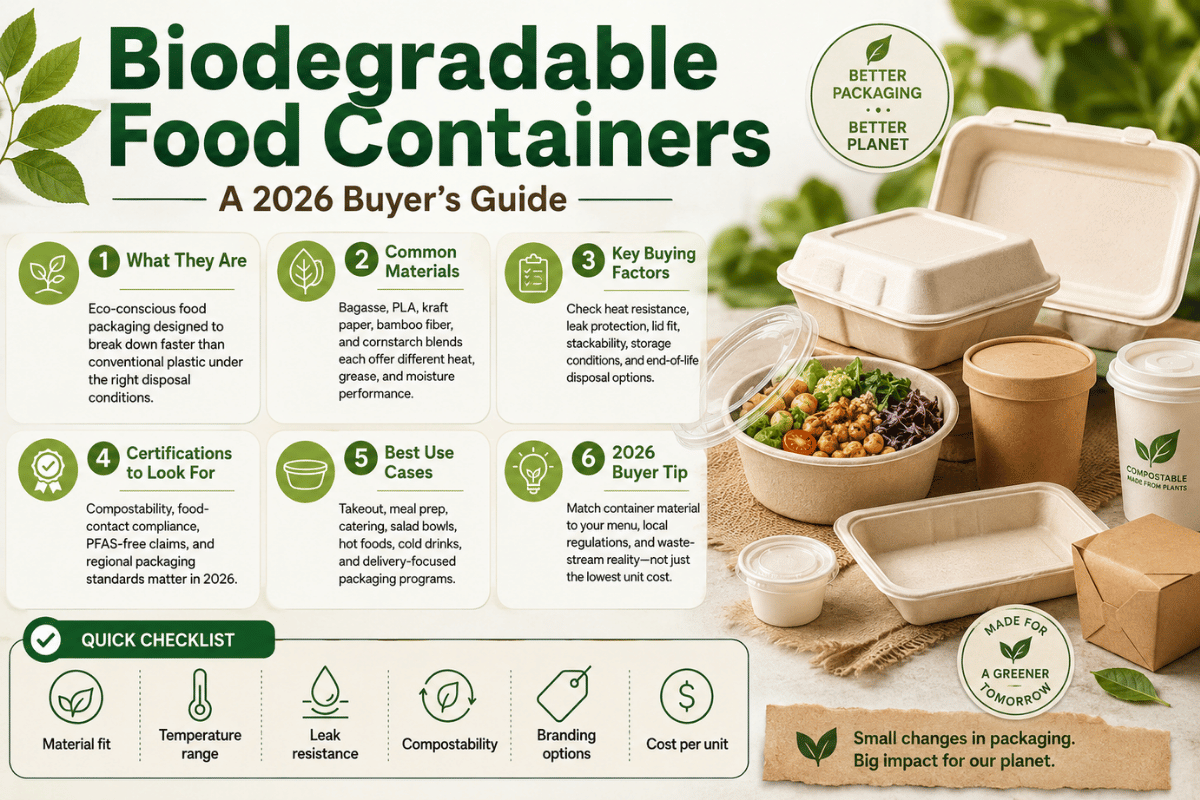
Updated June 2026 · A foodservice buyer’s guide
Biodegradable food containers abound on packaging labels in 2026, but the word “biodegradable” alone tells you almost nothing about how a container performs with a hot meal or its ultimate fate post-meal. The reality is almost everything biodegrades sooner or later. Biodegradable food containers are single-use food packaging made from plant-based, bio-based materials — bagasse, molded fiber, or biodegradable plastics like PLA — that microbes can break down into water, CO2, and biomass. The real questions for a restaurant, café, or food delivery brand are much narrower: is it certified compostable, will your food survive inside it, and can your customers actually dispose of it the way the label implies? This guide answers those questions with the standards, temperatures, decomposition timelines, and certification checks that most product pages omit.
If you’re looking for a business procurement rather than simply browsing, jump to the biodegradable food containers range, or read more for the framework.
Quick Specs: Biodegradable Food Containers at a Glance
| Common materials | Bagasse (sugarcane fiber), molded fiber, PLA, CPLA, PHA, kraft paper, paperboard |
| Heat tolerance | Bagasse up to ~120 °C; PLA softens around 50–55 °C |
| Compostable standards | ASTM D6400 (plastics), ASTM D6868 (coated fiber items), EN 13432 |
| Certification mark | BPI (commercial), TÜV OK compost (home/industrial) |
| Break-down time | ~90–180 days in industrial composting; far longer in a landfill |
What “Biodegradable Food Containers” Actually Means (and What It Doesn’t)
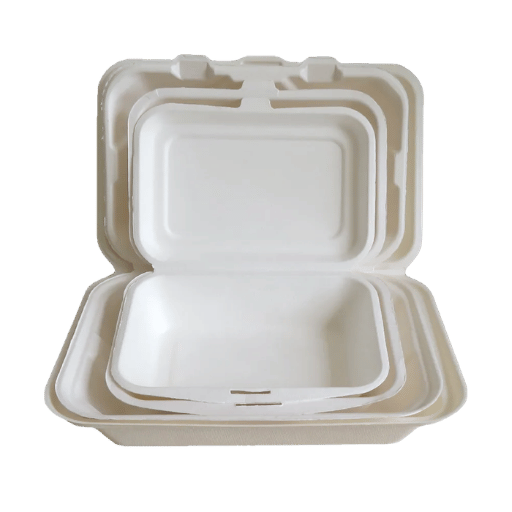
A biodegradable food container is one whose material can be broken down by microorganisms into water, carbon dioxide, and biomass. The problem is in what the term omits: there’s no required time limit or finite end-environment. A traditional plastic fork will biodegrade in several centuries, meaning by definition calling something “biodegradable” can both true and useless. This very fact is why the term seem to be a magnet for vague marketing.
This poses a challenge for purchasing as “biodegradable” is neither a performance specification nor a disposal directive. For environmentally sustainable consumers and the foodservice companies that serve them, reducing plastic waste first comes through using officially certified options, but superior packaging options need sustainable practice supported by evidence, not slogans. When you compare packaging options for takeout, move beyond the headline phrase to two tangible qualities: a compostability standard the item is tested against, and the disposal environment it actually requires. The rest of this guide is focused around those two qualities. Demand for biodegradable food packaging, compostable packaging, and other eco-friendly, environmentally friendly packaging is rising as environmentally conscious consumers weigh the environmental impact of traditional packaging. Replacing plastic or styrofoam containers and ordinary plastic containers with biodegradable packaging cuts a brand’s impact on the environment — but only when the packaging choices are backed by real standards, not slogans.
Think about a small Portland taco truck owner who decided to switch off foam to a box stamped “100% biodegradable,” expecting a green win. The box carried no certification identifier and no standard number – so in accordance with FTC guidance the label was in effect completely meaningless, and the city’s hauler sent it to landfill together with the rest. That disconnect between the label and the result is the issue this guide closes. The US FTC’s Green Guides treat such unsubstantiated claims as misleading for exactly this reason.
⚠️ Common misconception
“biodegradable” and “plant-based” don’t automatically imply “great for the earth.” A bio-based material that final ends up within a landfill, where the amount of oxygen available is indeed negligible, may not significantly decompose for a strong period of time sitting down neatly beside the single-use plastics it had been completely used to replace.
Biodegradable vs Compostable: The Difference That Decides Everything
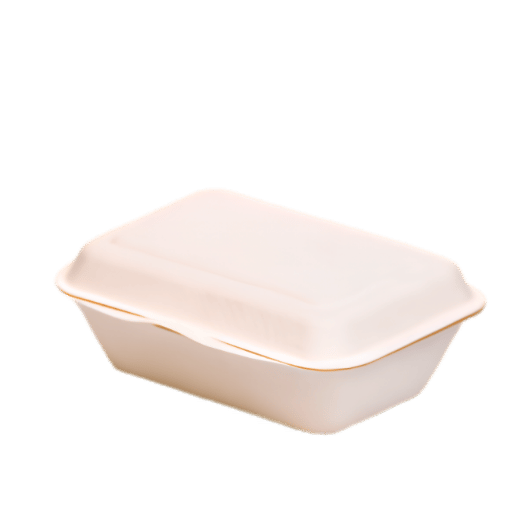
If you take away one message from this guide, let it be this. Biodegradable means a material may break down eventually — no timeline, no defined result. Compostable is the stricter, testable claim: ASTM D6400 or EN 13432 require about 90% biodegradation within 180 days, physical disintegration within roughly 12 weeks, and a safe compost that supports plant growth under defined composting conditions. Compostable is a subset of biodegradable that adds a clock, a result, and a test.
| Claim | Time limit? | Standard / test | End result |
|---|---|---|---|
| Biodegradable | None defined | No required standard | Unspecified |
| Compostable | ~180 days | ASTM D6400 / D6868 / EN 13432 | Non-toxic compost |
| Oxo-degradable | None reliable | None (FTC-flagged) | Plastic fragments |
| Recyclable | N/A | Depends on local stream | New material feedstock |
Standard definitions per ASTM D6400 / EN 13432; “oxo-degradable” caution per US FTC Green Guides.
The U.S. Federal Trade Commission’s “Green Guides” consider unsubstantiated “degradable” or “biodegradable” claims on products that usually go into landfills deceptive on those items, since a landfill isn’t likely to degrade the product within one year of disposal. To boil it down, “compostable” is the claim worth paying a premium for, and “biodegradable” by itself is the claim worth scrutinizing.
And from a practical point of view for a buyer, the threat is real: specifying a product because of its “biodegradable” designation could cause the product to be disqualified by a sustainability audit, because-simply put-it’s unregulated because nobody has yet determined how to measure the word, unlike ASTM D6400 and a BPI mark. In practice, the costliest mistake is treating the two as the same: a buyer who specifies “biodegradable” for a 90-day compost program can fail the audit, because the unregulated claim guarantees nothing. The US FTC Green Guides treat unqualified landfill-bound claims as deceptive for this reason.
How to Spot a Greenwashed Claim: The 4-Signal Greenwash Filter
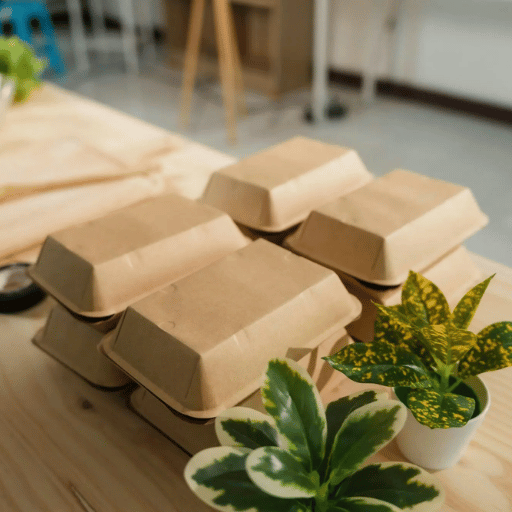
Given biodegradable’s lax regulation, a practical remedy is a short testing process. Simply put your container (or any supplier’s spec sheet) through these four filters prior to trusting theeco claim. A well-verified compostable container passes all four – a greensashed product typically doesn’t clear two.
- ✔ Signal 1 — Certification mark. Look for BPI, TÜV OK compost (home or industrial), or a Seedling logo. A logo ties the SKU to third-party lab testing, not the marketing department.
- ✔ Signal 2 — Standard number. A legitimate claim names ASTM D6400, ASTM D6868 (for coated paper and fiber items), or EN 13432. No number, no proof.
- ✔ Signal 3 — Disposal pathway stated. Does it say “industrial composting” or “home compostable”? Under FTC 16 CFR 260.7, a compostable claim should be qualified when composting facilities are not available to a substantial majority of buyers.
- ✔ Signal 4 — PFAS verification. Ask for a “no intentionally added PFAS” statement. BPI certification, for example, requires no intentionally added fluorinated chemicals plus total organic fluorine below 100 ppm.
“A major reason certified compostables fail to break down in the field is look-alike contamination, products that look compostable but aren’t. Certification and clear labeling are what let composters tell the difference.”
Biodegradable Products Institute (BPI), on compostability certification
A tiny caveat to that: “PFAS-free” is a must have, but that’s far from the full story of the chemical contents that can interact with your food. Scientists mapping the full alphabet of food-contact chemicals identified many that are capable of migration from food packaging, and in case you’re making a lot of it, the safest option is to request your vendor’s complete food-contact compliance documents, not just proof of PFAS elimination.
What They’re Made From: Bagasse, Molded Fiber, PLA, CPLA, PHA & Paperboard
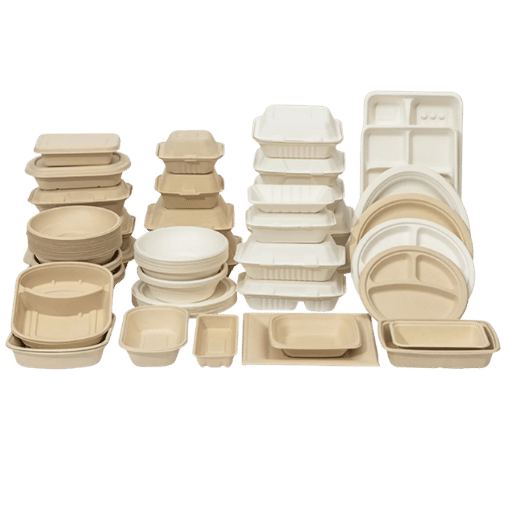
The vast majority of biodegradable food containers are based on one of a few bio-based polymers. The biggest factor is that the finalized product-with all its coating, liner, and binder-dictates compostability, thermal performance, and PFAS content-not the specific plant fiber or bio polymer used for the main part.
For instance, a bagasse bowl lined with a plastic film is a very different product from an uncoated bagasse bowl, and hence why products like ASTM D6868 treat coated paper and fiber end-items distinct from simple plastics. Where operators and buyers tend to go wrong is believing the plant fiber name on the label – usually it’s the coating that causes different types of bagasse bowls to compost differently, therefore, check the product certificate (BPI / ASTM D6868) on the individual SKU. Independent material data, such as peer-reviewed biocomposite research, confirms that coatings and fiber treatment drive thermal and compostability behavior more than the base material name.
| Material type | Source | Heat / grease | Composting pathway |
|---|---|---|---|
| Bagasse | Sugarcane fiber by-product | Excellent (to ~120 °C), grease-OK | Industrial; often home-compostable uncoated |
| Molded fiber (mixed pulp) | Recycled paper / plant pulp | Good; coating-dependent | Industrial; home varies |
| PLA (polylactic acid) | Corn-based / plant sugars | Poor — softens around 50–55 °C | Industrial only (140 °F+) |
| CPLA (crystallized PLA) | Heat-treated PLA | Better heat (hot lids/cutlery) | Industrial; harder to compost |
| PHA | Microbial fermentation | Good, flexible | Industrial & marine-degradable |
| PBAT / PBS blends | Bio + fossil hybrid polymer | Flexible films/liners | Industrial; used as fiber coating |
| Bamboo fiber | Bamboo pulp | Good heat; sturdy | Industrial; often home-compostable |
| Kraft paper | Wood pulp | Dry/ambient only uncoated | Compostable if uncoated |
| Coated paperboard | Paperboard + bio-coating | Good with PLA/PHA/aqueous coat | Depends on coating (ASTM D6868) |
| Wheat straw / palm leaf | Agricultural residue | Good; rustic finish | Often home-compostable |
Material behaviors collated from peer-reviewed data on biocomposites, along with standards set by ASTM and EN (note coatings and certification scope will vary between different SKUs).
What are biodegradable food containers made from?
In the restaurant market (and largely the food service industry), products generally fall into two families: the agricultural-fiber family (bagasse, molded fiber, bamboo fiber, and kraft paper) and the bioplastics family (PLA, CPLA, and PHA). Fiber tends to be cheaper and more heat-tolerant, while bioplastics suit cold or clear packaging.
Although established brands like World Centric were instrumental in the popularization of plant fiber and bioplastic-based packaging options, the same issues remain pertinent regarding the disposal and waste streams of any supplier using plastics. The agricultural-fiber items – bagasse trays, paper food containers, deli containers, pizza boxes, clamshells – tend to be less expensive and hold up better to high heat, whereas bioplastics are suited where clear windows are key, such as cold salad bowls and some clear deli containers. neither category is universally ‘better; the right choice is highly dependent on the dish, heat load, and local waste management infrastructure.
Heat, Grease & Liquid Performance: The 3-Load Container Match
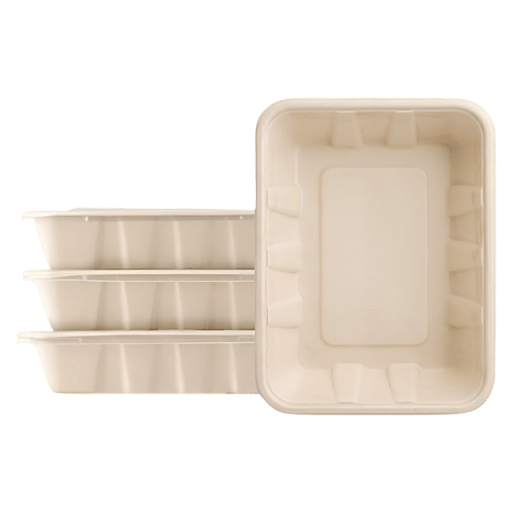
The quickest path to selecting the right product is to rate your dish across three dimensions- heat load, grease resistance, and liquid capacity – and match those properties with material’s capacities, such as whether its high thermal stability outweighs its cost effectiveness. The supposed “premium” nature of many bioplastics breaks down where heat and moisture come in- while PLA may look modern and sleek, it wilts rapidly under warm or hot conditions. PLA-hot food reviews are often marred with soft, pliable lids and one account I read of a ramen spill could only be described as a “soup-splosion.” Bagasse, in contrast, a much cheaper waste product, doesn’t falter when faced with boiling soup and it’s even safe to place in a microwave- an attribute supported by studies on thermal improvement via fiber reinforcement which indicates that such plant-derived inclusions far outperform PLA in resisting heat.
Suppose there’s a small Japanese eatery that regularly dispatches two hundred containers filled with soup every evening. Whereas bowls made of PLA warp and fog as the liquid cool and even soft lids start to sag after coming into contact with a ninety degree temperature range, bagasse can comfortably take in the identical liquid without breaking a sweat- a result confirmed by peer-reviewed research on fiber-reinforced biocomposites, which shows plant fiber reinforces material against heat far better than neat PLA.
✔ Best for hot & greasy loads
- Bagasse / molded fiber (hot soup, fried foods, hot entrées)
- Coated paperboard take-out boxes (grease-resistant)
- PHA-lined fiber for hot-fill
⚠ Cold / dry loads only
- PLA clear containers (salads, cold deli, cold drinks)
- Uncoated kraft paper (dry baked goods)
- Plain paper food containers without a liner
📐 Engineering Note
Aim to select a material which can accommodate your food item’s maximum serving or reheating temperature, with a reasonable degree of allowance or safety margin. With a maximum heat-deflection range of roughly fifty °Celsius (just over 100°F), anything warmer than a steaming broth or a quick spin through a microwave will likely distort the material; conversely, bagasse maintains structural integrity even at approximately 120°C. As a general principle: if it’s hot and oily, or intended for reheating, choose bagasse or a fiber with a PHA liner – don’t go with PLA plain. To improve airflow, a vented lid will greatly reduce the condensation which can otherwise turn the contents of your fibre container soggy – a very common complaint from food service operators.
How Long Until It’s Gone? The Decomposition Reality Timeline
“How long to break down?” is the question every label avoid, because the honest answer is “it depends where it goes.” One and the same BPI certified compostable container can break down in months or sit for years in a landfill. This is the single biggest communication breakdown about biodegradable food containers. As in, most production kitchens will assume that their compostable cups just… vanish, since landfill is so good at stalling decomposition that 90-day lab result turns to years.
| Environment | Bagasse / fiber | PLA |
|---|---|---|
| Industrial composting | ~60–90 days | ~90–180 days (140 °F+) |
| Home compost bin | ~90–180 days (uncoated) | Will not break down |
| Landfill | Very slow (low oxygen) | Years; effectively inert |
Time frames are typical ranges that are dependent upon condition; PLA needs industrial composting and will NOT break down in a home bin or the landfill.
Two practical takeaways. Number one, PLA is industrial-compostable Only – it requires sustained thermophilic heat that a backyard compost bin just doesn’t provide, so a compostable PLA cup in a home bin or the landfill performs as well as plastic. Number two, even excellent materials require access: If your customer doesn’t have curbside organics collection and you don’t have a local commercial composter facility nearby, you must make a qualified claim. That’s why the FTC 16 CFR 260.7 specifically requests that compostable claims be qualified when appropriate access facilities are unavailable to the majority of the customers, and it’s also why not all commercial composters readily accept bio-plastics and bagasse.
For a rural diner in a county with no curbside organics collection program, this is an open and shut case; regardless of the packaging material used, any truly “compostable,” ‘BPI-certified’ item is still going to go to the landfill where it can do little else but perform exactly like the plastic that previously served the same purpose. That operator would have much more business acumen in offering either qualified packaging with a recyclable or alternative reduced-material item to the customer, as opposed to placing a compostable badge on a package about which the customer can do nothing. As the US EPA notes, food-related organics make up a significant share of landfilled material, largely because collection access is uneven.
Container Formats: Clamshells, Bowls, Trays, Boxes & Cups
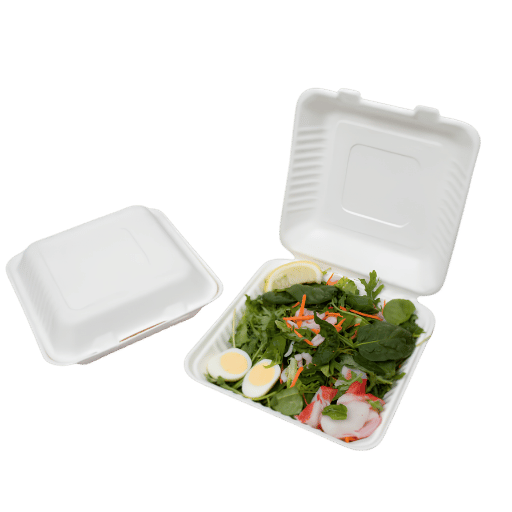
Format once again comes down to matching menu items. There are a handful of core shapes for biodegradable take out containers; find one that securely seals, includes the venting required to avoid condensation on hot food and fits well with the logistics of your kitchen storage and food delivery system. Format also represents an additional cost consideration as the oversized tray has a considerable impact not only on material spend but on bin space; over and above that added cost factor, that will manifest in tangible ways over thousands of covers each week for high volume establishments. In practice, the biggest format risk is over-sizing: pairing a deep clamshell with a shallow salad can waste 30% of your material and bin space, because you end up paying for fiber and disposal you never use.
| Format | Best for |
|---|---|
| Compostable clamshells | Burgers, sandwiches, single entrées |
| Bowls & trays | Salads, rice/grain bowls, hot entrées |
| Deli containers | Soups, sides, food storage containers |
| Take-out boxes / to-go boxes | Noodles, dry meals, leftovers |
| Cups & pizza boxes | Cold drinks; pizza and flatbreads |
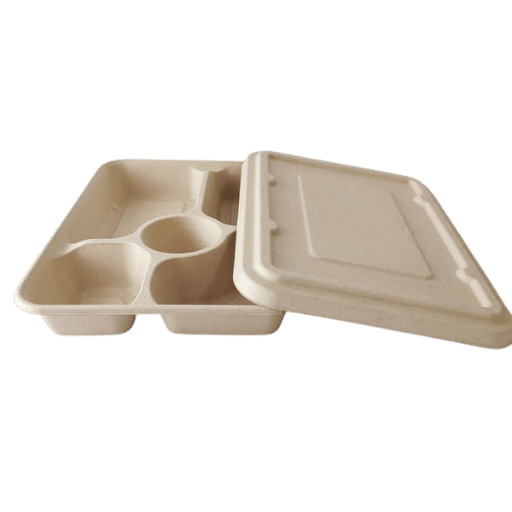
Fiber and PLA/PHA containers are emerging as leaders among commercial foodservice trays, as reported by Packaging World. Multi-compartment trays separate hot food from cold food, providing space for the sauce or liquid components and helping to maintain the crispiness of fries and sides. Ventilated lids keep hot food warm and crisp, while clear PLA lids for fiber trays have a sleek design that’s perfect for displaying refrigerated foods like deli meats and salads. Whether you call them compostable takeout containers, compostable take out containers, or compostable to go containers, the format names overlap — bowls, trays, clamshells, go boxes for food, and cups all replace disposable food packaging. Matching your eco-friendly food packaging starts with considering hot versus cold, food type, moisture content, and grease load.
Regulations Driving the Switch: Foam Bans, PFAS Limits & What’s Next
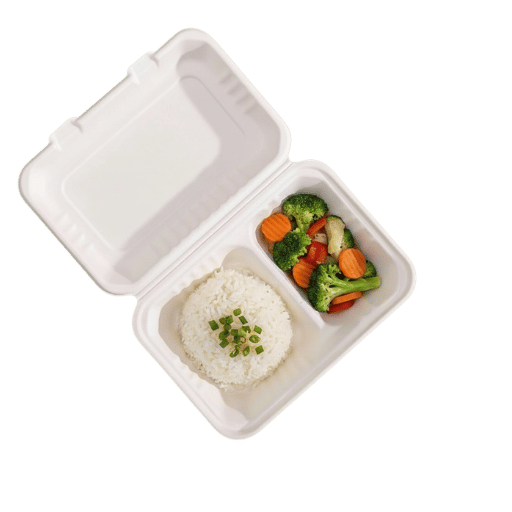
Switching away from plastic and styrofoam is increasingly a compliance necessity, not a marketing option – and the regulatory picture shifted meaningfully in 2024-2026. The driving force behind buyer decisions, rather than market-size hyping, is a cocktail of new and changing rules for what one can legally buy, sell and consume. The compliance risk is quite real, particularly in a multi-state environment where what’s legal in one state is potentially noncompliant elsewhere – as state, rather than federal, rules increasingly shape PFAS and EPR regulations. See the US FDA PFAS phase-out and California CalRecycle (SB 54) for the current rules.
- FDA PFAS phase-out (2024). The FDA successfully obtained a market phase-out for PFAS that has been used in food packaging as a grease-proofing agent and is no longer being marketed for the US food packaging market. Many Food Contact Notifications that were previously active became ineffective on January 6, 2025 (and the shift to no-added-PFAS documentation continues). Note: This is a phase-out, not a ban, so spec to “no added PFAS” as opposed to relying solely on absence of proof.
- California AB 1200. Imposed a statutory ban on intentionally added PFAS in plant-fiber based food packaging and introduced a total organic fluorine threshold – a hard standard that the FDA phase-out simply isn’t.
- California SB 54 (EPR). Producers were required to register by June 1, 2026; there were a reporting deadline of May 31, 2026 for source reduction plans and supply chain reporting. Full compliance is phased-in beginning in January 2027.
For any sourcing manager, the path forward is direct: Prior to placing your next purchase order, ensure that the supplier has provided documents for “no-added-PFAS” and “compostability certification”, and review the compliance calendar for the states in which you’re shipping. The demand for PFAS-free fiber and certified compostable packaging is driven precisely by these regulatory shifts. While market reports often suggest the size of the US foodservice Packagingmarket is multi-billion-dollars, and growing by mid-single digits, it’s an incidental, and not driving figure – the governing signal is the regulations.
Sourcing Biodegradable Containers for Your Business
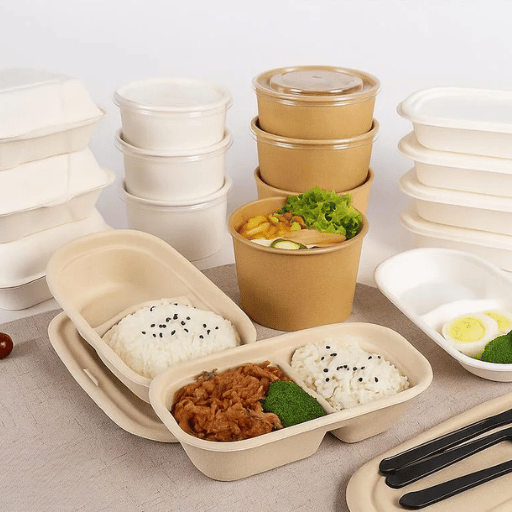
Purchasingfora foodservice business differs from purchasing a 50-pack for the retail consumer. While cost, certification paper work and custom printing will play roles, all of those take a back seat to what one can actually legally buy and use. Fiber options will generally be more cost-effective than most other alternatives, with many bagasse options running a modest premium over conventional styrofoam, and the cost gap closing significantly with increasing volumes; the cost premium on PLA will be slightly higher. However, what may appear a wide gap on a per-unit basis is far less consequential across an entire pallet. Across the restaurant supplies trade and the wider packaging sector, both businesses and consumers now expect alternatives to plastic containers.
When considering any manufacturer, insist on five things: documentation of their compostability certification (BPI / ASTM D6400 / D6868 / EN 13432), documentation of Food-Contact compliance and no-added-PFAS status, details regarding minimum order quantities and price break opportunities, custom molding and logo imprinting capabilities and reasonable production lead-time guarantees.
A source-factory perspective
We’re manufacturers with a capacity that exceeds 1M units/day through our 86 production lines (20 thermoforming, 6 sheet extrusion, and 60 injection molding). We produce over 30 tons of sheet material per day, and our biodegradable line covers bagasse, PLA, and PLA-lined fiber. Our products carry BPI, ASTM D6400, EN 13432, FDA 21 CFR, LFGB, and ISO 9001 certification. In our experience, customers that do not encounter problems ask for the cert pack and the sample run first for their custom mold – before they pay for the mold, and when costs are minimal to adjust any heat/grease resistance or lid-fit issues.
Explore Biodegradable Food Containers →
Not ready to commit? Request free samples or a custom-print spec sheet to test performance and sustainability with your own menu items first.
Frequently Asked Questions
Q: What containers are biodegradable?
View Answer
Containers made from bio-based materials biodegrade, including bagasse (sugarcane fiber), molded fiber, kraft paper and paperboard, bamboo fiber, and bioplastics such as PLA, CPLA, and PHA. However, “biodegradable” alone has no time limit, so for foodservice use look specifically for certified compostable containers that name ASTM D6400, ASTM D6868, or EN 13432 — those have been tested to break down within a defined timeframe. Treat the standard number, not the word biodegradable, as the signal worth trusting.
Q: Which is better, biodegradable or compostable?
View Answer
Compostable is the stronger, more useful claim. “Biodegradable” only promises that a material breaks down eventually, with no fixed time limit — which is why the FTC treats unqualified biodegradable claims for landfill-bound items as deceptive. “Compostable” is testable: under ASTM D6400 or EN 13432 the item must reach about 90% biodegradation within 180 days and leave non-toxic compost. For a business, certified compostable packaging is the safer specification — the only claim a composter can act on.
Q: Are biodegradable food containers safe for hot foods and liquids?
View Answer
It depends entirely on the material. Bagasse and molded fiber handle hot foods well, tolerating temperatures up to roughly 120 °C and staying leak resistant with soup and oily dishes, and they are generally microwave-safe. PLA is the opposite: it softens around 50–55 °C, so it warps with hot soup, hot-fill, or reheating and should be reserved for cold salads and drinks. For hot menus, specify bagasse, coated paperboard, or PHA-lined fiber, and confirm the rated fill temperature.
Q: How long do biodegradable food containers take to decompose?
View Answer
In an industrial composting facility, certified compostable containers typically break down in about 90–180 days, and uncoated bagasse can break down in roughly 60–90 days. In a landfill, low oxygen means decomposition nearly stalls, and PLA will not break down outside industrial composting.
Q: Can biodegradable food containers be recycled?
View Answer
Usually no — compostable and biodegradable food containers belong in organics or composting streams, not recycling, where they act as contamination. The right waste disposal route is industrial or home composting where the environmental conditions exist; otherwise they end up in landfill where they behave like plastic.
Q: What are biodegradable food containers made from?
View Answer
Mainly agricultural fibers (bagasse, molded fiber, bamboo fiber, kraft paper) and bioplastics (corn-based PLA, CPLA, PHA). The coating or lining on the finished item matters as much as the base fiber for compostability and heat performance. These biodegradable materials and sustainable packaging options each suit different foods, so match the material to your menu rather than the marketing. Fiber like bagasse and bamboo is cheaper and more heat-tolerant; PLA and PHA bioplastics suit cold or clear packaging.
Q: Are biodegradable containers more expensive than plastic?
View Answer
Slightly, but the gap is narrowing. Bagasse carries only a modest premium over conventional plastic, and PLA costs a little more. For most foodservice businesses, that premium over plastic packaging is offset by compliance gains and brand value.
About This Analysis
This guide combines published standards (ASTM D6400/D6868, EN 13432), US FTC and FDA guidance, and peer-reviewed material data with our own manufacturing experience producing bagasse, PLA, and PLA-lined fiber food containers across 86 production lines. Heat, decomposition, and cost figures are typical ranges that vary by coating, certification scope, and disposal environment. Reviewed by the Shandong Wanhui Environmental Protection Technology Co., Ltd. technical team.
References & Sources
- Environmental Claims: Summary of the Green GuidesUS Federal Trade Commission
- 16 CFR 260.7, Compostable ClaimsCornell Legal Information Institute / FTC
- Market Phase-Out of Grease-Proofing Substances Containing PFASUS FDA
- Properties of PLA and bagasse-reinforced biocomposites — NCBI / PMC
- Commercial Compostability CertificationBiodegradable Products Institute (BPI)
- Paperboard packaging for foodservice sustainabilityPackaging Digest
Related Articles
- Biodegradable food containersshop bagasse, PLA & fiber options
- Compostable clamshell containerscertified bagasse & PLA clamshells
- Eco-friendly food packagingthe full sustainable range
- Custom food packaging — logo printing & custom molds