Get in touch with Wanhui Company


Updated July 2026 · A sourcing guide for foodservice buyers · Reviewed by the Shandong Wanhui technical team.
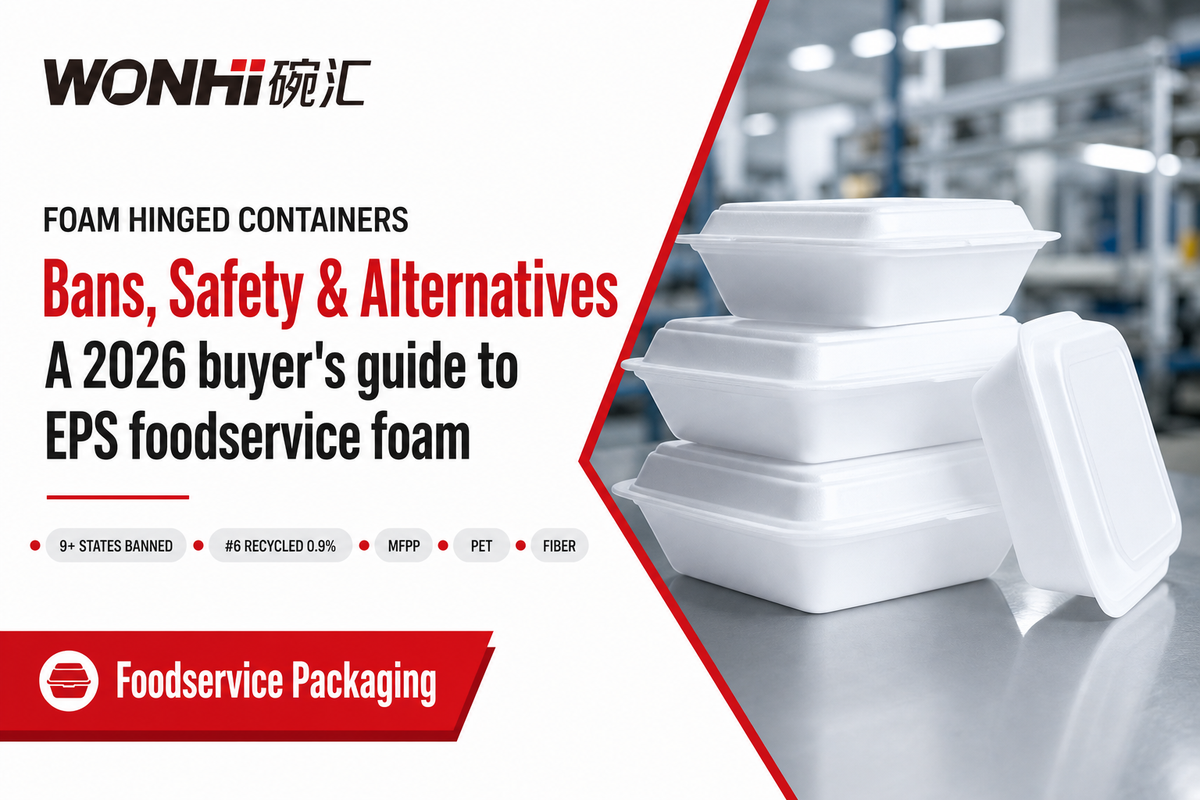
Foam hinged containers are single-piece clamshell takeout boxes molded from expanded or extruded polystyrene (EPS/XPS) foam, with the lid and base joined by an integrated living hinge. They’re the cheapest, lightest, best-insulating disposable takeout box a kitchen can buy, and, in a growing list of places, illegal to sell. Most buyers still shop them on price alone. This guide covers the three things that actually decide whether foam is the right call: where it’s banned, whether it’s safe, and what to switch to when it isn’t.
The short answer. Foam hinged containers hold serving temperature better than any comparably priced package, and polystyrene is an FDA-authorized food-contact material under 21 CFR 177.1640. But at least nine U.S. states plus Washington, D.C. now ban expanded polystyrene foodservice foam, the material is recycled at under 1%, and it is not a reheating package. Buy it where it is legal and short-haul insulation is the whole job; plan a compliant alternative everywhere else.
Key takeaways
- Foam foodservice bans aren’t new, Washington, D.C. banned them on January 1, 2016, and Maryland and Vermont followed on July 1, 2020.
- There’s no U.S. federal ban. The Farewell to Foam Act (H.R. 1918) was introduced in March 2025 with a proposed 2028 start date, but it isn’t law.
- The #6 chasing-arrows symbol is a resin ID code, not a recycling promise: EPA data puts foam-container recycling near 0.9%, and only 4 of 375 U.S. sorting facilities accept it.
- Polystyrene is FDA-authorized for food contact, but styrene migration climbs with heat and fat, foam is a transport-and-hold package, not a microwave or long-term-storage one.
Quick Specs: Foam Hinged Containers
| Material | Expanded / extruded polystyrene foam (EPS / XPS), resin code #6 |
| Insulation | R-3.6 to R-4.2 per inch at 75°F (ASTM C578 / C518) |
| Service temperature | Long-term 167°F (75°C); intermittent 180°F (82°C); not microwave-safe |
| Common formats | 1 / 2 / 3-compartment, sandwich, hot dog, hoagie; vented or non-vented lid |
| Legal status | Banned for foodservice in 9+ U.S. states and D.C.; legal elsewhere — confirm your market |
What Foam Hinged Containers Actually Are (Styrofoam, EPS, XPS & the #6 Code)
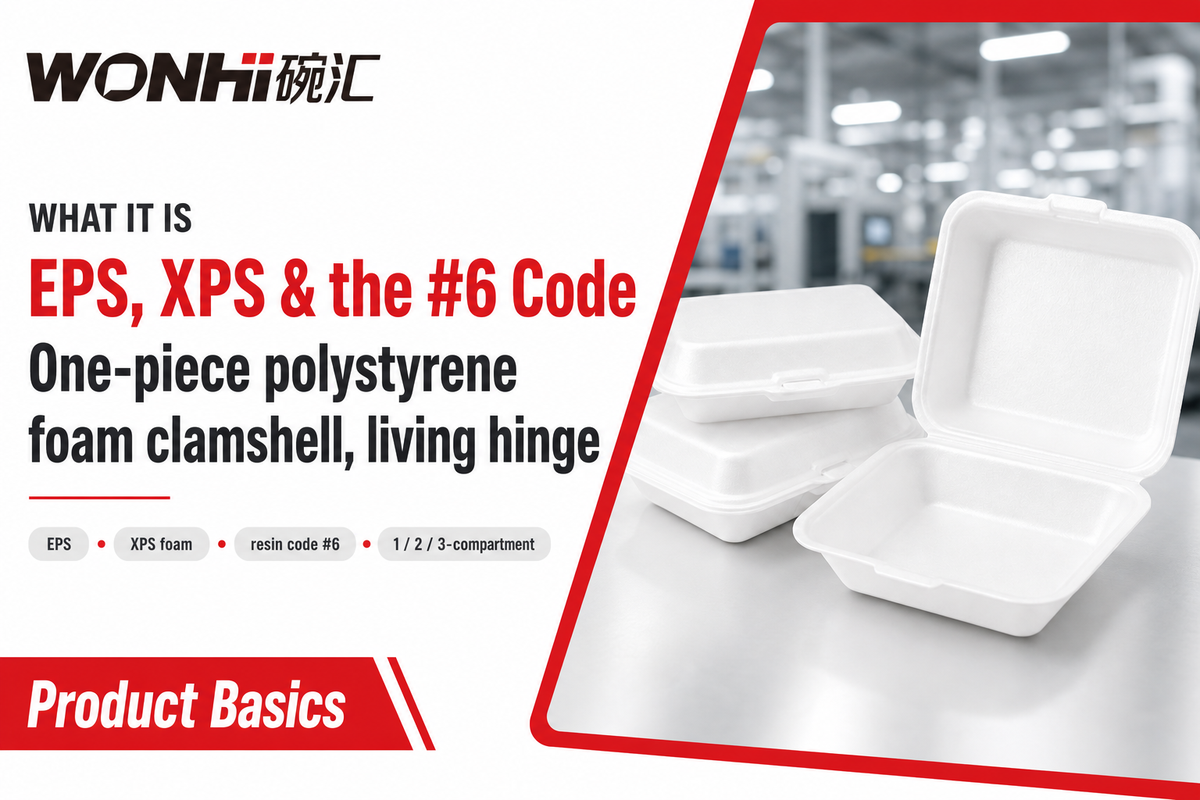
A foam hinged container is a disposable takeout box formed from a single piece of closed-cell polystyrene foam, with the base and lid joined by a molded hinge. Because the lid can’t be lost or mismatched, a foam clamshell closes in one motion and moves faster across a pack line than a two-part tub.
In the trade these go by carryout or take-out containers, and the largest U.S. foam brand, Dart, popularized the perforated hinge (its “Performer”) that lets the lid detach as a second plate. The resin itself — polystyrene — is authorized for food contact under FDA 21 CFR 177.1640, the same rule that governs its clear #6 cousins. A secure closure — and, on XPS foam sandwich boxes, a smoother finish — is what separates a clamshell that protects food from one that merely holds it. Stock colors are usually white or black, and the one-piece design’s real draw is convenience: it is sturdy enough for a heavy, saucy meal, with no separate lid to chase. Material is where most confusion starts, so precision pays off.
⚠️ Common mistake: “Styrofoam” is not the technical name
“Styrofoam” is a Dow trademark for extruded polystyrene building insulation. The blue foam board is Styrofoam; your takeout clamshell is not. Foodservice foam is expanded polystyrene (EPS) or, for some sandwich boxes, extruded polystyrene (XPS) — both carry resin identification code #6. Getting the name right matters at the procurement stage, because bans and spec sheets are written around “expanded polystyrene,” not “Styrofoam.”
Three polystyrene forms show up in disposable foodservice, and buyers meet all of them under the single word “foam.” The table below sorts the material and the container formats so you can read a spec sheet or a ban statute without guessing.
| Item | What it is | Typical use / note |
|---|---|---|
| EPS | Expanded polystyrene (fused beads) | Most foam clamshells, cups, trays |
| XPS | Extruded polystyrene (continuous cell) | Smoother sandwich / hinged lid boxes |
| GPPS | General-purpose (solid, non-foamed) polystyrene | Clear #6 lids — usually exempt from foam bans |
| Sandwich / burger box | 5–6 in, 1 compartment | Tab-lock hinge |
| Single hot entree | 8–9 in, 1 compartment | Secure-lock hinge |
| 3-compartment combo | 9–9.5 in, 3 compartments | Keeps a hot protein from bleeding into cold sides |
| Hot dog container | 7 in, 1 compartment | Tab-lock hinge |
| Hoagie / sub box | 9–13 in, 1 compartment | All-purpose hinge |
| Vented lid | Perforated or channeled top | Releases steam from fried / saucy food |
| Non-vented lid | Sealed top | Keeps cold, crisp or dry items intact |
💡 Takeaway: When a ban statute or a supplier quote says “expanded polystyrene,” it means EPS/XPS foam, the clamshell in question. Clear, solid #6 lids are a different material and usually sit outside the same rules. To match a format to your menu, our foam hinged containers page lists the full footprint range.
How Foam Insulates, and the Temperature Limit That Ends the Story
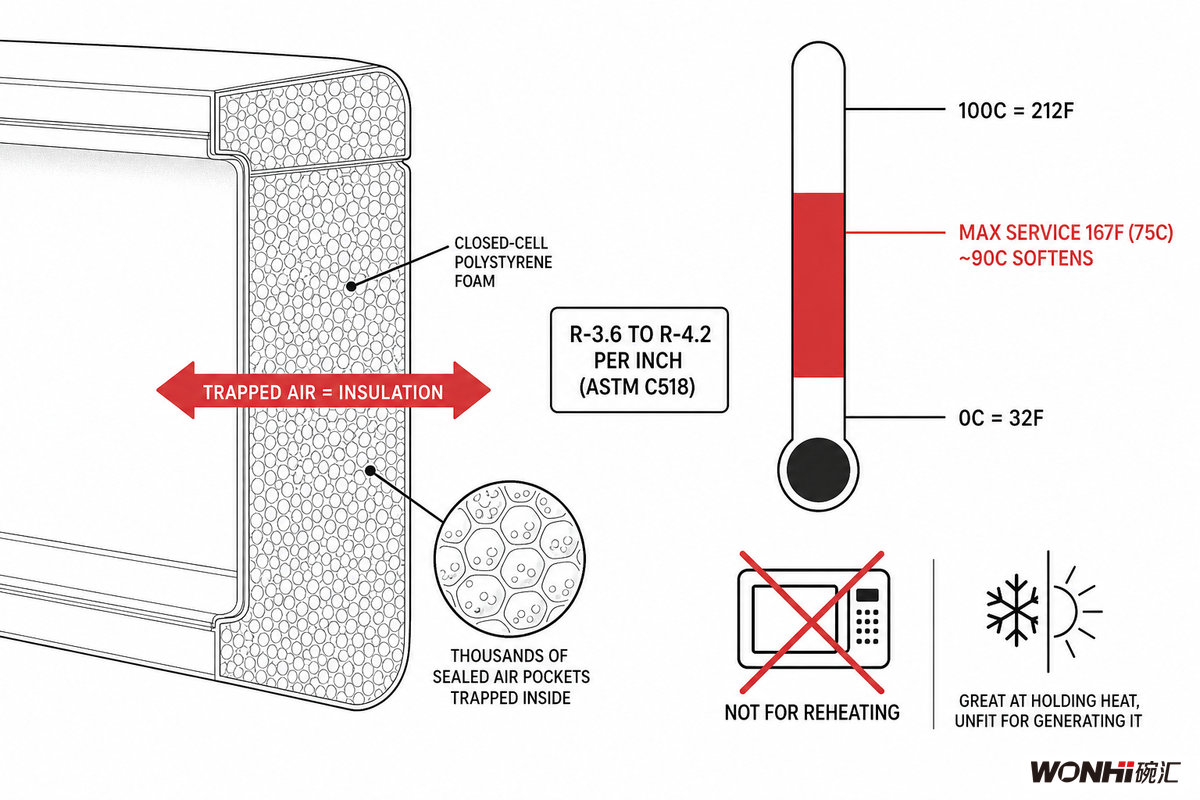
Foam holds a hot lunch hot for a structural reason, not a marketing one: polystyrene traps thousands of sealed air pockets, and still air is an effective low-cost insulator. That gives EPS a thermal resistance of roughly R-3.6 to R-4.2 per inch at 75°F, measured by the ASTM C518 heat-flow test, the same physics behind building insulation board.
Against a 0.020-inch paperboard wall with almost no mass, that insulating layer is why foam clamshells keep food closer to serving temperature through a 20-to-40-minute delivery. In a carryout or delivery run that insulation works on both hot and cold foods — it holds a hot entree hot and a chilled deli side cold — which is the whole reason operators reached for foam to move take-out food hot from the pass line to the customer.
📐 Engineering Note — where the physics stops
Polystyrene has a glass-transition temperature of about 90–100°C, and the ASTM C578 standard rates the material for a maximum service temperature of only 167°F (75°C) long-term, 180°F (82°C) intermittent. Fresh coffee or soup runs hotter than that, and a microwave pushes it well past. In lab migration testing, foam samples heated toward 100°C physically shrank and melted. So the insulation that makes foam good at holding heat is the same reason it fails at generating or reheating it: foam is a transport-and-hold package, full stop.
That single limit, great at holding temperature, unfit for reheating, drives most of what follows, from the safety question to the choice of a replacement material.
Are Foam Food Containers Safe? Styrene, Hot Food & Microplastics
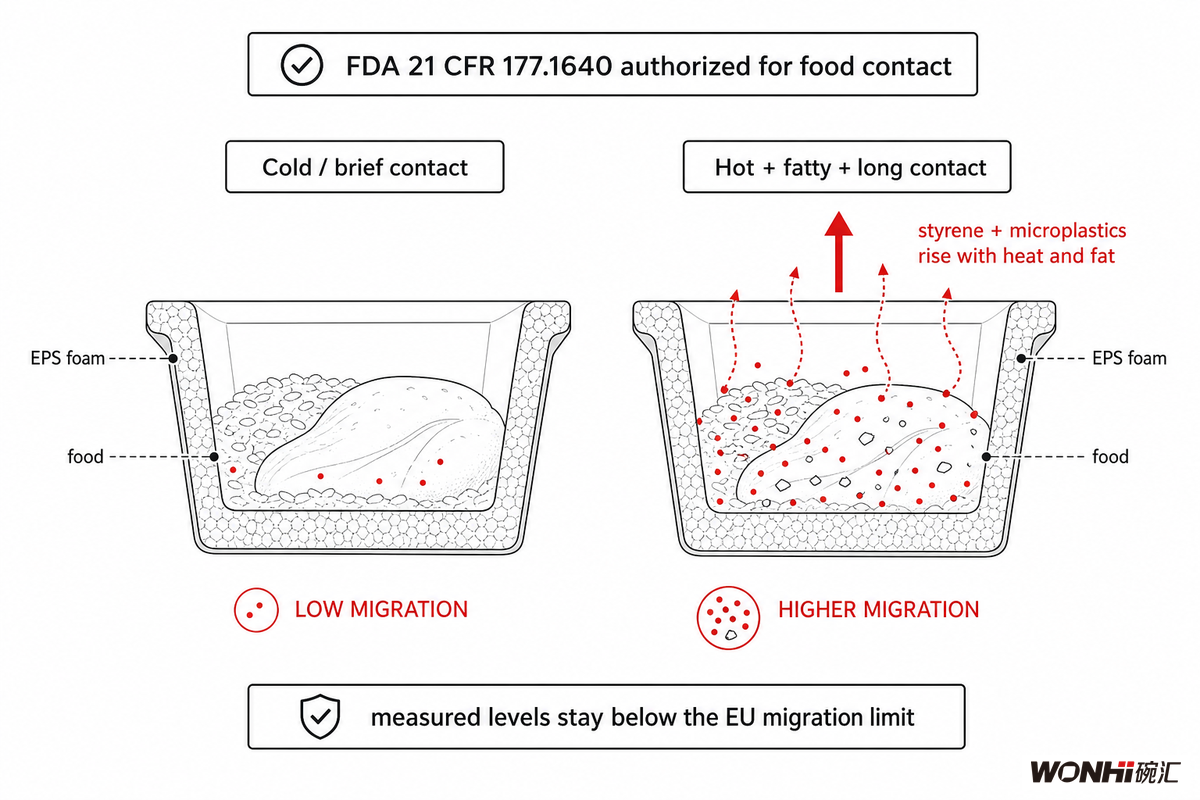
Foam food containers are authorized for food contact and, in normal use, leach styrene at levels well below regulatory limits, but the honest answer has caveats that depend on heat and fat. Polystyrene is cleared under FDA 21 CFR 177.1640, which caps residual styrene monomer at 1% by weight (0.5% for fatty foods). That nuance sits in two places: the monomer itself, and what happens when you heat the box.
Styrene, the building block of polystyrene, is listed by the U.S. National Toxicology Program as “reasonably anticipated to be a human carcinogen” (12th Report on Carcinogens, 2011), and in 2019 the International Agency for Research on Cancer upgraded it from Group 2B to Group 2A, “probably carcinogenic to humans.” That classification is about the monomer, not a verdict on a single takeout meal, but it’s why the migration conditions matter.
Can you microwave foam takeout containers?
No. Microwaving foam is the one use that turns a compliant package into a problem. In a peer-reviewed study of styrene migration published in Foods (2021), fat content and high temperature both significantly increased how much styrene moved into food simulants; a disposable XPS foam plate reached 6.42 µg/mL of styrene in a 95% fatty simulant at 70°C, far above a polystyrene cup.
Even so, every measured level stayed well below the EU’s overall migration limit for food-contact plastics under Regulation 10/2011. One practical rule falls straight out of the data: keep fatty, acidic, and very hot food out of long, hot contact with foam, and never reheat in the box, transfer to a #5 polypropylene or ceramic dish.
Do foam containers release microplastics?
Foam does shed microplastic fragments, and heat accelerates it. That same 2021 study found that 70°C combined with fatty or alcoholic contact “produced the most microplastics,” with EPS trays releasing particles in the 50-to-100-micron range. This is the more defensible health concern than acute toxicity from a single meal: cumulative microplastic exposure and the fact that foam breaks into fragments rather than dissolving.
For freezing or storing fatty leftovers long-term, glass or rigid polypropylene is the lower-migration choice; foam earns its place in short-haul transport, not the freezer.
⚠️ Common mistake: “FDA-authorized” does not mean “safe to microwave”
Food-contact authorization certifies the material for its intended use — holding and transporting food at ordinary temperatures. It does not clear foam for reheating, oven use, or holding near-boiling liquids. Menu signage and staff training should say so plainly.
Where Foam Hinged Containers Are Banned in 2026
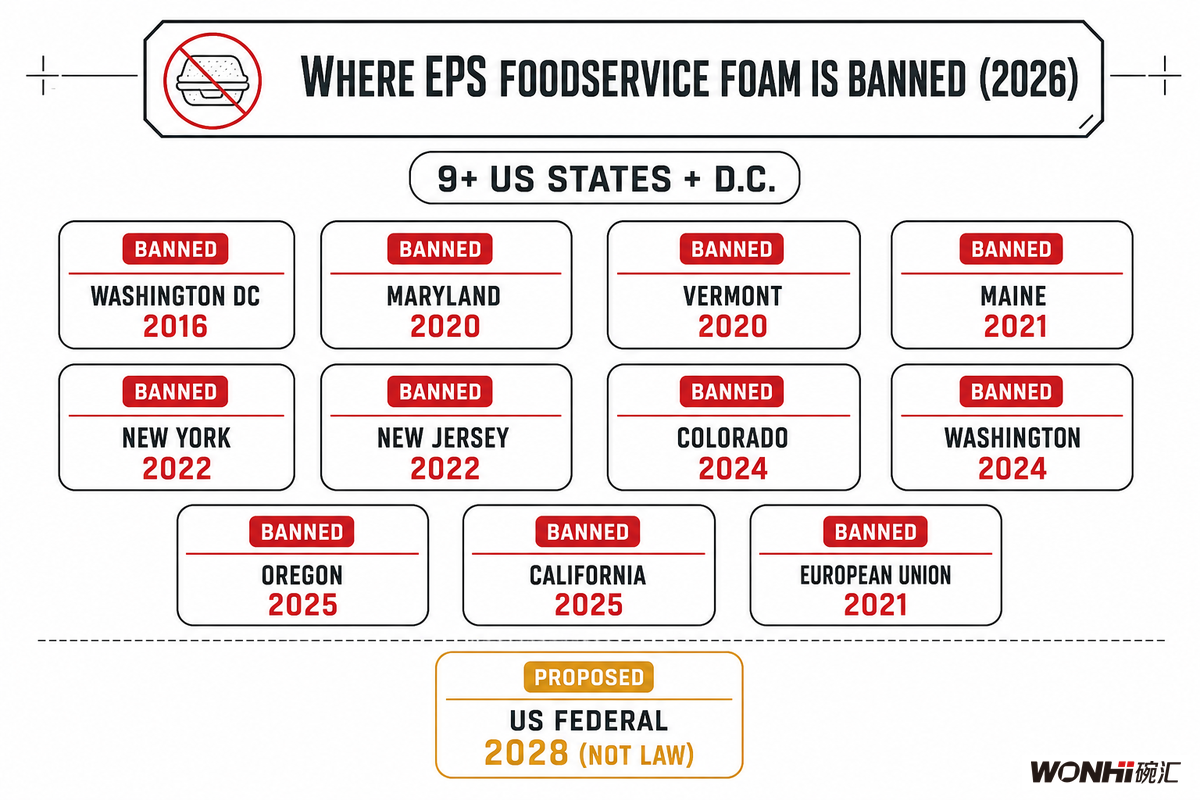
Foam hinged containers are banned for foodservice in at least nine U.S. states plus Washington, D.C., across the European Union, and the list is still growing, but there’s no nationwide U.S. ban. Foam regulation is the quietest part of a sourcing decision and the one that most often surprises a buyer after the order ships.
Below, the enacted rules sit in one place, each confirmed against the state’s own regulator — from California’s CalRecycle to New York’s DEC — so you can check a destination market before you commit a carton.
| Jurisdiction | Effective | Scope & penalty (foodservice foam) |
|---|---|---|
| Washington, D.C. | Jan 1, 2016 | First U.S. jurisdiction; foam foodservice ware |
| Maryland | Jul 1, 2020 | First state ban in effect; up to $250 after a cure period |
| Vermont | Jul 1, 2020 | EPS foodservice (S.113) |
| Maine | Jul 1, 2021 | EPS foodservice; no sell-through of old stock |
| New York | Jan 1, 2022 | Statute names “hinged clamshell”; $250 / $500 / $1,000; cold-storage foam adds Jan 1, 2026 |
| New Jersey | May 4, 2022 | EPS foodservice (S864) |
| Colorado | Jan 1, 2024 | Foam containers and cups (HB21-1162) |
| Washington (state) | Jun 2024 | Foam containers/clamshells; $250 first / $1,000 repeat |
| Oregon | Jan 1, 2025 | Foam foodservice (SB 543) |
| California | Jan 1, 2025 | SB 54; foam blocked unless it hits a 25% recycling rate (it has not) |
| European Union | Jul 3, 2021 | EPS food & beverage containers (Directive 2019/904) |
| United States (federal) | Jan 1, 2028 (proposed) | Farewell to Foam Act (H.R. 1918) — introduced, not law |
Sources: state and D.C. environmental regulators, the European Commission, and Congress.gov; see References. Trade trackers count 11–12 states as additional bans take effect.
3 Triggers Behind Every Foam Ban
Read the statutes side by side and every foam ban traces to one of three legal mechanisms. Knowing which one applies tells you how hard the rule is and whether a workaround exists.
- Statewide statute. A direct sale-and-distribution ban (Maryland, Vermont, Maine, New York, New Jersey, Colorado, Washington, Oregon). No sell-through in most cases, existing stock can’t be run down after the date.
- Municipal ordinance. A city or district rule, sometimes carved out of a state law (Washington, D.C. in 2016; New York City’s own ban predates the state’s). A statewide picture can hide a stricter local one.
- Recycling-rate performance standard. California’s SB 54 sets a different trap for foam: expanded polystyrene food service ware must demonstrate a 25% recycling rate to stay on the market. Because EPS hasn’t met that rate, it can’t be sold or distributed in California as of January 1, 2025. Watch this model, a performance standard bans by outcome rather than by name.
“The regulation is the part of the sourcing decision buyers under estimate. We run foam, mineral-filled polypropylene, and fiber on the same floor, so our first question to an overseas customer is not size or price, it is which states and countries the order ships to. Get that wrong and a compliant-looking quote becomes unsellable inventory.”
Wanhui Production Team, Thermoforming Workshop
💡 Takeaway: Confirm the rule for every destination market before you place a volume order. Where foam is legal you can still buy it; where it isn’t, you need a named alternative ready. One quick way to check a market is our foam ban compliance checker.
Can You Actually Recycle Foam Containers? The #6 Reality
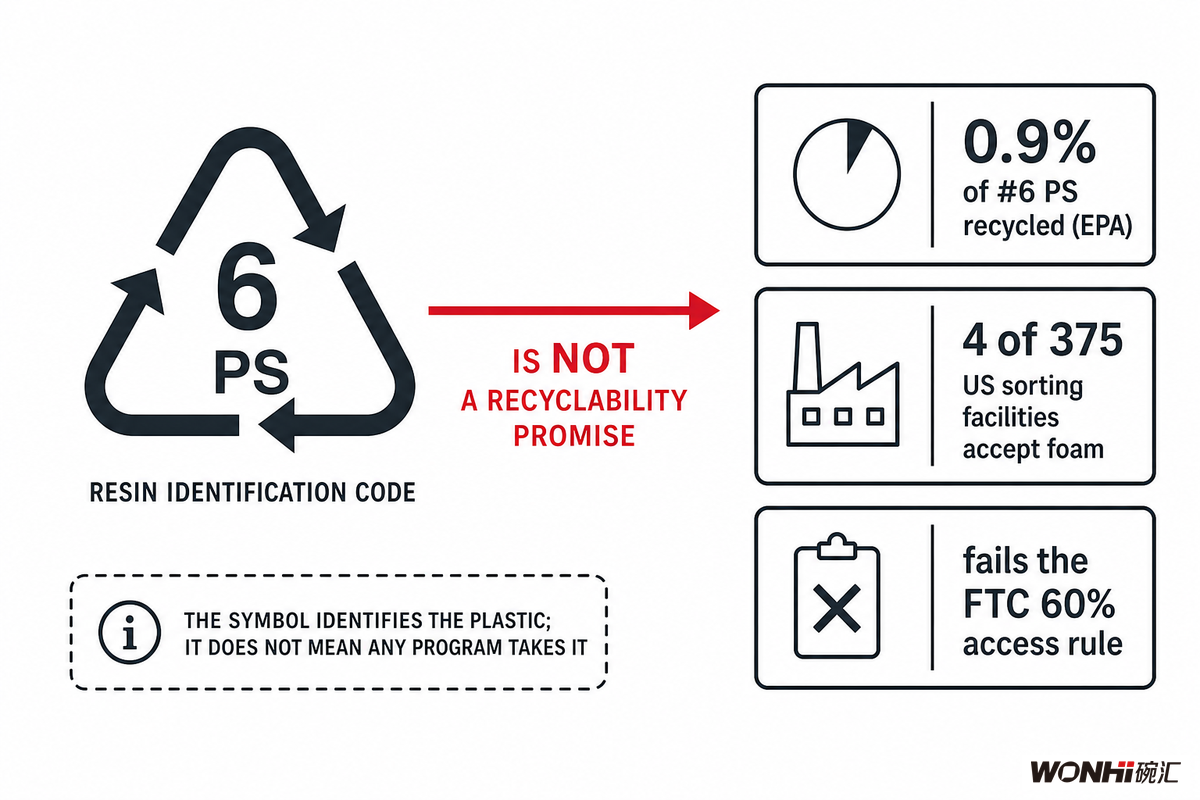
In practice, no, foam foodservice containers are almost never recycled, whatever the #6 symbol on the base implies. U.S. EPA figures for 2018 show about 80,000 tons of polystyrene foodservice containers generated with only a “negligible” amount, under 5,000 tons, recycled; across all #6 polystyrene, EPA data put the recycled share near 0.9%. A separate 2022 industry survey of 375 U.S. material recovery facilities found only four accept foam foodservice at all. That gap is mundane to explain: foam is bulky, low-value, and, as EPA researchers put it, “often contaminated by the food it contained.”
⚠️ Common mistake: the chasing-arrows #6 is not a recycling promise
That resin identification code is a material label, not a guarantee that any program accepts the item. The FTC Green Guides say a “recyclable” claim requires access for at least 60% of the population — a bar foam misses by a wide margin — and California’s SB 343 now restricts printing the symbol on packaging that is not genuinely recyclable. Treat a #6 stamp as identification only.
What actually drives the bans isn’t a single meal, it’s persistence. Expanded polystyrene isn’t biodegradable; researchers estimate a minimum lifespan of roughly 500 years in the environment, where it fragments into the microplastics discussed above rather than breaking down. That combination, near-zero recovery plus centuries of persistence, is the honest reason lawmakers reach for a ban rather than a recycling mandate.
💡 Takeaway: Don’t build a sustainability claim on foam’s recyclability. If diversion from landfill is a buyer requirement, the realistic paths are a widely recycled rigid resin or a certified compostable format, covered next.
What Replaces Foam, the Switch Decision by Driver
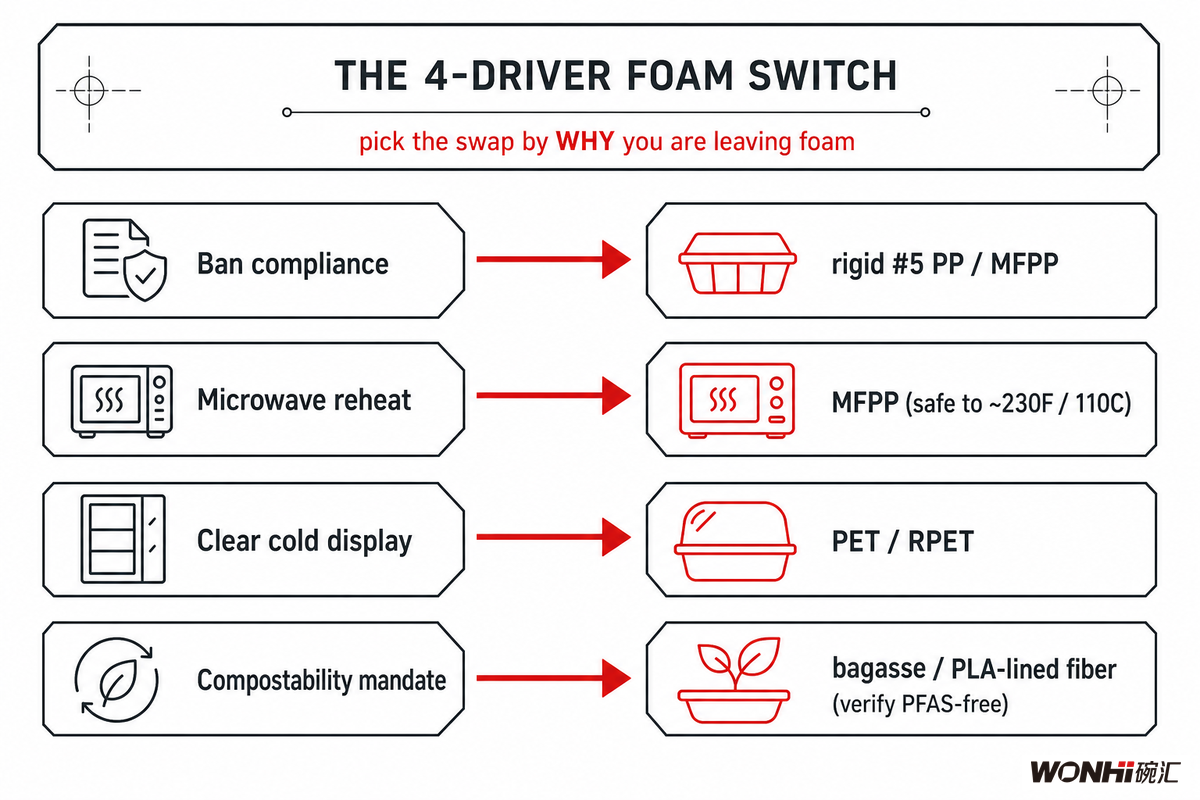
There’s no single “best” replacement for foam, the right swap depends on why you’re switching. A ban forces a different answer than a microwave requirement or a compostability mandate. Rather than compare every material against every other, match your driver to a material and move on. Wanhui runs all of these lines, so this is a routing decision, not a sales pitch for one house resin.
4-Driver Foam Switch: Match the Reason to the Material
| Your driver | Best-fit material | Why |
|---|---|---|
| Ban compliance | Rigid #5 PP or mineral-filled PP (MFPP) | Rigid polypropylene is the named-compliant alternative in most foam-ban statutes |
| Microwave / hot reheat | MFPP | Microwave-safe to about 230°F (110°C); mineral filler adds rigidity and heat resistance |
| Clear cold display | PET / RPET | Crystal clarity for merchandising; wider recycling access than foam; cold-only |
| Compostability mandate | Bagasse / PLA-lined fiber | Certifiable to ASTM D6400/D6868 — but verify it is PFAS-free (see note) |
📐 Engineering Note — the fiber caveat
Molded fiber is not automatically the clean choice. In February 2024, the FDA completed a market phase-out of PFAS grease-proofing substances, and independent testing has found some molded-fiber foodware among the highest in PFAS. A genuinely sustainable swap is the one matched honestly to your waste stream and confirmed PFAS-free, not the one with the greenest label.
Each swap trades some thing: MFPP and PP cost more per unit than foam and are opaque; PET is brittle when frozen; fiber carries the PFAS question. For a hot, reheatable menu the strongest all-round replacement is microwave-safe MFPP hinged containers; for cold display, clear plastic hinged containers; and for a compostability requirement, compostable clamshell containers.
When Foam Hinged Containers Still Make Sense
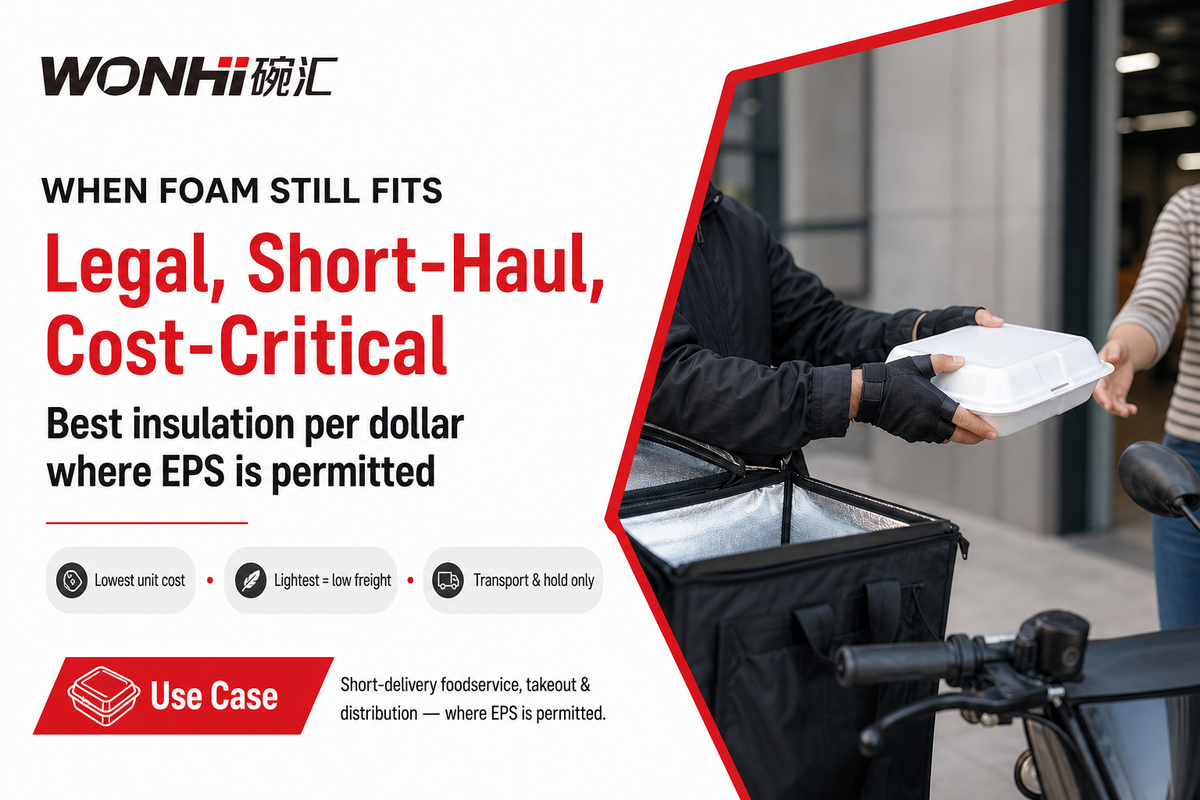
Foam isn’t obsolete everywhere, and pretending otherwise does buyers no favors. Where it’s legal and short-haul insulation is the whole job, foam still wins on the three numbers a high-volume operation feels daily: it’s the lowest-cost takeout material, the lightest (which cuts freight per thousand units), and the best insulator per dollar.
That high insulation cuts both ways — it holds food hot or cold — and foam’s light weight keeps shipping cost per thousand low, while a secure lid guards against a spill in the delivery bag. A rice-bowl-and-protein combo driven 20 minutes across a warm-climate market where foam is permitted is a textbook fit.
✔ Foam still fits when
- The destination market permits EPS foodservice
- The job is transport and heat retention, not reheating
- Unit cost and freight weight are the binding constraints
⚠ Switch away when
- You ship into a banned state, D.C., or the EU
- Customers reheat in the box
- A buyer or brand requires recyclable or compostable packaging
📐 Procurement tip from the floor
Ask any foam supplier for the wall gauge and carton count, not just the price. Look-alike containers can ship 10–20% lighter on foam content, and that thin wall is exactly what crushes lids and cracks hinges in transit. An accurate spec sheet is the cheapest insurance a foam order can carry.
Foam remains a popular budget choice for short-haul carryout where it is legal — and where rules like the EU’s Single-Use Plastics Directive do not apply — and any credible supplier should openly offer a wall-gauge spec so you can compare like for like. If foam is the right call for your market, our bulk foam hinged containers ship from a factory running 20 thermoforming and 60 injection lines, and when a market flips, the same site makes the compliant swap, so you change product without changing supplier.
The Regulatory Outlook: Where Foam Rules Are Heading
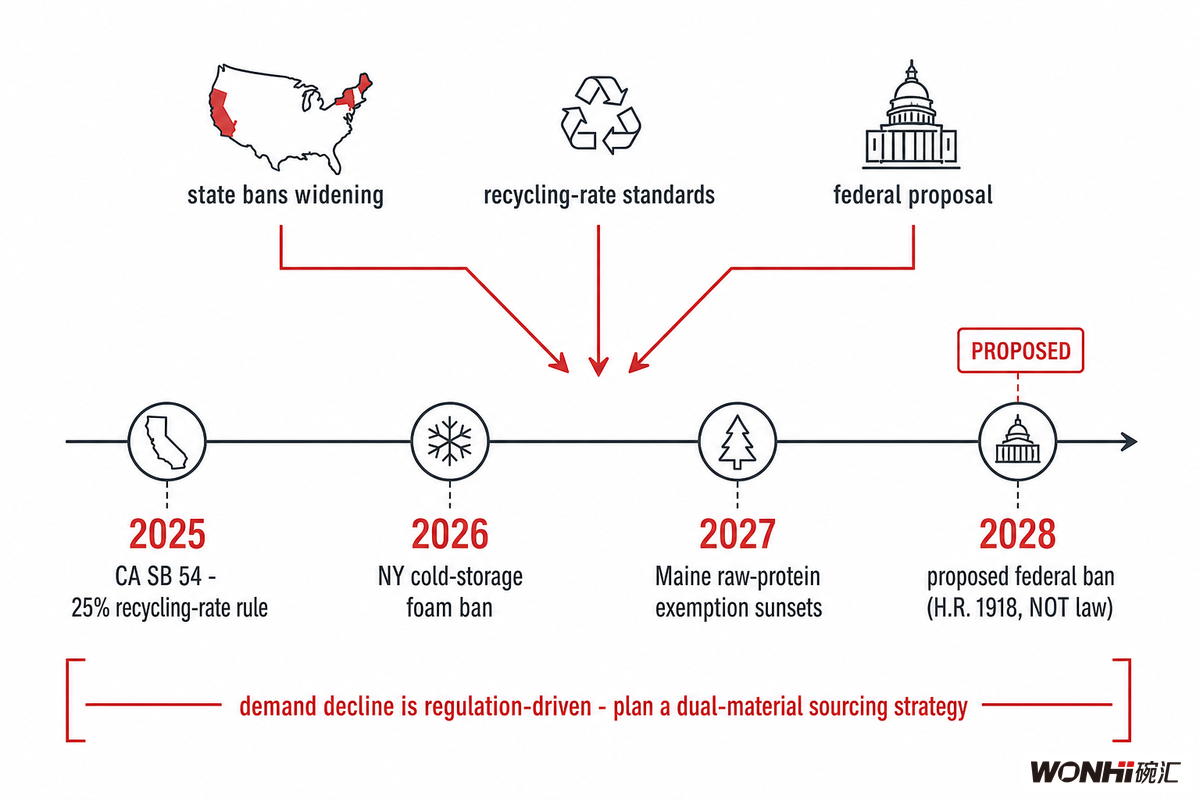
The decline of foam foodservice is regulation-driven, not preference-driven, and that distinction should shape how a buyer sources it. Search demand for foam takeout terms is down 16% to 21% year over year, but the cause isn’t shoppers falling out of love with foam; it’s the ban pipeline widening and recycling-rate standards taking hold. Planning around today’s map alone is a mistake, because the map is designed to keep moving.
Three dated signals define the next few years. At the federal level, the Farewell to Foam Act (H.R. 1918, introduced by Rep. Lloyd Doggett in March 2025, with a companion Senate bill, S.897) proposes a nationwide ban on foam foodservice ware, loose fill, and coolers beginning January 1, 2028. It was referred to committee and hasn’t passed either chamber, so it isn’t law and the 2028 date is contingent on enactment. At the state level, California’s SB 54 recycling-rate standard took effect January 1, 2025, and New York’s cold-storage foam ban begins January 1, 2026, extending an existing foodservice ban to coolers and ice chests. Maine’s temporary raw-protein exemption is set to sunset July 1, 2027. Every dated signal points the same way.
For a buyer, the action item is a dual-material sourcing plan: keep foam where it’s legal and cost-critical, but qualify a compliant alternative, MFPP for hot menus, PET for cold display, fiber where compostability is mandated, before the next ban date lands in a market you serve. Sourcing from a manufacturer that runs foam and its alternatives on one floor turns a regulatory shift from a supplier hunt into a product change.
Frequently Asked Questions
Q: What are foam food containers called?
View Answer
In the trade they are foam hinged containers, foam hinged lid containers, foam clamshells, or foam takeout containers. “Styrofoam” is a genericized brand name, not the technical term — the actual material is expanded or extruded polystyrene (EPS or XPS), which carries resin identification code #6. Ban statutes and spec sheets use “expanded polystyrene,” so that is the phrase to search when you are checking rules or comparing quotes.
Q: Is polystyrene the same thing as Styrofoam?
View Answer
Not exactly. Polystyrene is the polymer; “Styrofoam” is a Dow trademark for a specific extruded polystyrene used in building insulation, and it is used generically in everyday speech. A foam takeout clamshell is expanded or extruded polystyrene foam, resin code #6 — correctly called EPS or XPS foam, not “Styrofoam.” That distinction matters because regulations and material data sheets are written around “polystyrene” and “expanded polystyrene,” never the brand name.
Q: What are the best containers to freeze food and avoid microplastics?
View Answer
For long-term freezing of fatty or acidic food, glass or rigid polypropylene (#5) are the lower-migration choices. Foam and thin films shed more microplastic fragments under temperature swings and fatty contact, and migration studies show heat and fat both raise the amount released. Foam hinged containers are engineered for short-haul transport and holding, not for freezing or long-term storage — use them for the trip, then transfer leftovers to glass or a rigid tub.
Q: Are foam takeout containers microwave-safe?
View Answer
No. Polystyrene foam carries resin code #6 and softens near 90°C, so a microwave warps it and drives up styrene migration. Transfer food to a #5 polypropylene or ceramic dish before reheating.
Q: How long does a foam container take to break down?
View Answer
Expanded polystyrene is not biodegradable; researchers estimate a minimum lifespan of about 500 years in the environment, where it fragments rather than decomposing. That persistence is a core reason for the bans.
Q: Where can I still buy foam hinged containers legally?
View Answer
Foam hinged containers remain legal and common across many U.S. states, the Middle East, parts of Asia-Pacific, and South America — anywhere without an expanded-polystyrene foodservice ban. Because the map changes, confirm the rule for each destination market before ordering; a foam ban compliance checker or a supplier that also makes compliant alternatives keeps a single order from becoming stranded inventory.
Sourcing foam, or planning the switch? Send your sizes, volumes, and destination markets, and Wanhui’s specialists will match the compliant container to your menu.
Why We Wrote This Guide
Wanhui has manufactured disposable foodservice packaging for 20 years and runs expanded polystyrene, mineral-filled polypropylene, and molded-fiber lines under one roof. Because we make foam and its alternatives, we’ve no stake in overselling either, the ban dates, migration figures, and recycling rates here are drawn from government regulators and peer-reviewed research, cited below, so a buyer can verify every number before deciding whether foam belongs in their supply chain.
References & Sources
- 21 CFR 177.1640, Polystyrene and rubber-modified polystyreneU.S. FDA / eCFR
- Report on Carcinogens Profile: StyreneU.S. National Toxicology Program
- Styrene Monomer and Poly(Styrene) Fragment Migration into Food SimulantsFoods, 2021 (NIH/PMC)
- Facts and Figures about Materials, Waste and RecyclingU.S. EPA
- Green Guides (environmental marketing claims)U.S. Federal Trade Commission
- Expanded Polystyrene Food Service Ware Requirements (SB 54)CalRecycle
- Polystyrene Foam BanNew York State Dept. of Environmental Conservation
- Polystyrene Food Service Products BanMaryland Dept. of the Environment
- Expanded Polystyrene BanWashington State Dept. of Ecology
- Single-Use Plastics Directive (EU) 2019/904European Commission
- H.R. 1918, Farewell to Foam Act of 2025U.S. Congress
- Market Phase-Out of PFAS Grease-Proofing SubstancesU.S. FDA
Related Articles
- Hinged lid containers: MFPP vs plastic vs foamhow the three clamshell materials compare by the numbers
- Compostable clamshell containerswhen fiber and PLA are the right foam replacement
- Biodegradable food containers: a buyer’s guidesorting real eco-claims from labels
- Hinged container material-fit selectormatch heat, oil resistance, and compliance to a material