Get in touch with Wanhui Company


Updated July 2026 · A foodservice buyer’s guide.
Eco-friendly food boxes are single-use foodservice containers built for a lower environmental footprint than plastic or foam – but “eco-friendly” is an umbrella term, not a specification. It covers four very different routes: compostable, recyclable, reusable, and source-reduced packaging. Each behaves differently once your customer is done with the meal, and the box that looks greenest on the shelf isn’t always the one that does the least harm in your city’s waste stream. This guide gives foodservice buyers a way to choose the right eco route for a real menu, a real budget, and – the part most product pages skip – the disposal reality where your food actually ends up.
Answer-first: Eco-friendly food boxes are disposable food packaging designed for a smaller environmental impact than conventional plastic or expanded polystyrene foam. The four routes are compostable (bagasse, PLA), recyclable (PP, rPET, kraft/paperboard), reusable (deposit-return), and source-reduced (lighter, right-sized). The genuinely greener choice depends on which route your local waste system can actually process.
Key takeaways (before you buy)
- Compostable isn’t automatically the greenest option: the U.S. EPA reports only about 5% of wasted food is composted, and wasted food drives 58% of landfill methane – so a compostable box with nowhere to compost can perform worse than a recyclable one.
- “eco-friendly” is a spectrum of four routes; match the route to your local waste infrastructure, not to the label.
- The right material can match foam on hot food – bagasse handles heat to roughly 120C, while PLA softens near 50C.
- Expect an eco premium of anywhere from about 10-20% (fiber) to 2-3x (some formats); it pays off through compliance, brand value, and fewer leak complaints.
Quick Specs: Eco-Friendly Food Boxes at a Glance
| Eco routes | 4 — compostable, recyclable, reusable, source-reduced |
| Bagasse heat ceiling | up to ~120 °C / 248 °F (hot mains, microwave) |
| PLA softening point | ~50 °C / 122 °F (cold foods only) |
| Compostable standard | ASTM D6400 / D6868 — ~90% biodegradation in 180 days |
| US food-waste composted | ~5% (EPA); food = 24.1% of landfill waste |
| Landfill methane from food | 58% of landfill methane (EPA) |
| Foam-ban states (US) | 12+ (CA SB 54 target: 100% recyclable/compostable by 2032) |
| Typical eco premium | ~10-20% (fiber) up to 2-3x (some formats) |
| Vented lid optimum | 8–14 top-surface vents for hot food |
What Makes a Food Box “Eco-Friendly” (and What Doesn’t)
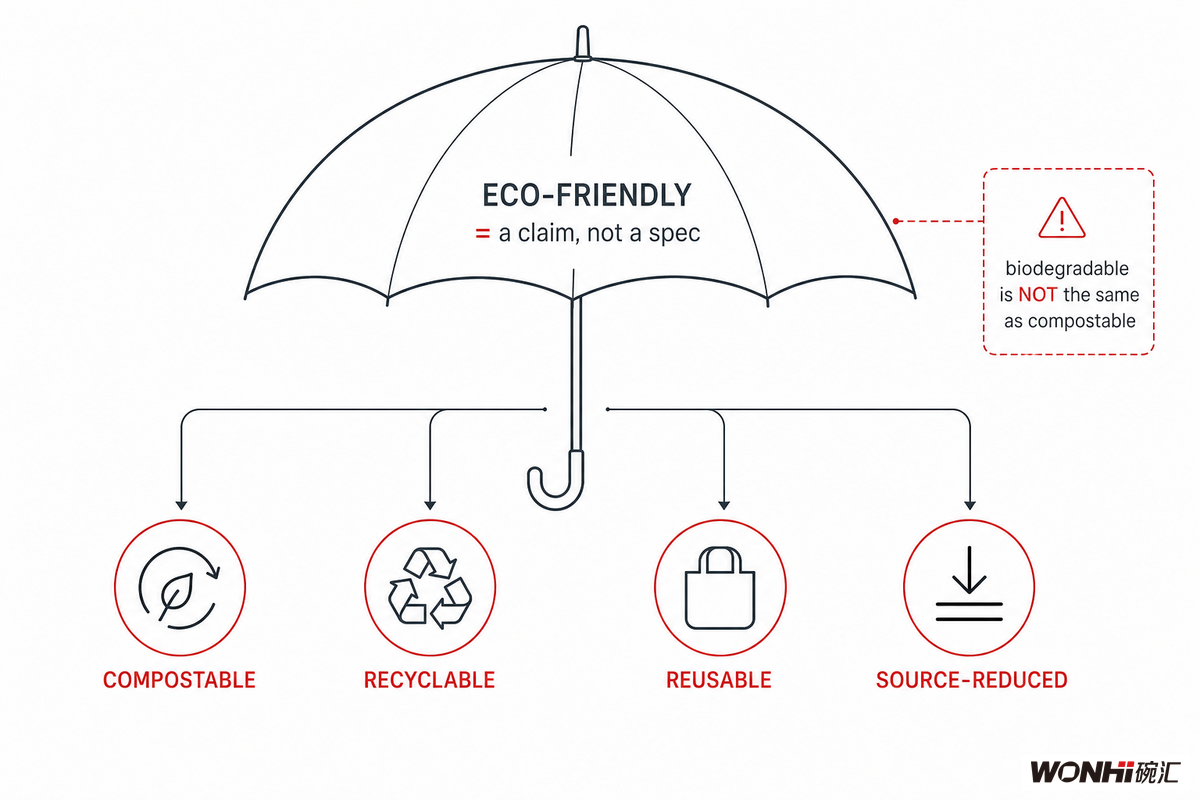
An eco-friendly food box is any disposable food container designed to reduce environmental harm compared with conventional plastic or foam – usually by being made from renewable, plant-based materials or recycled content, and by being compostable or recyclable at end of life. Put plainly, eco-friendly packaging is defined by what it’s made from and where it can go afterward, not by the word printed on the label.
The trouble is that “eco-friendly” is a marketing claim, not a tested standard. On its own it tells you almost nothing about how the box performs with a hot meal or where it belongs after the meal.
This is where most buyers slip. “eco-friendly,” “biodegradable,” and “compostable” get used as if they mean the same thing, and they do not. Biodegradable only promises a material breaks down eventually, with no fixed timeline – even conventional plastic technically qualifies. Certified compostable is the stricter, testable subset: under standards like ASTM D6400 a box must reach about 90% biodegradation within 180 days in a commercial composting facility. (For the full material-by-material breakdown of biodegradable versus compostable, see our companion biodegradable food containers buyer’s guide.)
So the useful question is never “is this box eco-friendly?” It’s “which eco route is it, and can my customers dispose of it that way?” Answer that, and the rest of this guide – the four routes, the infrastructure test, the switch from foam, the real cost – falls into place. A café that switches to a box stamped “100% biodegradable” — with no standard number and no local composter — has changed its packaging cost, not its footprint. So when buyers ask us for the best eco-friendly food boxes, our honest first answer is a question back: which route, and can your customers dispose of it that way? Treat the green sticker as the start of due diligence, not the end of it.
The 4-Route Eco Box Framework: Compostable, Recyclable, Reusable, Reduced
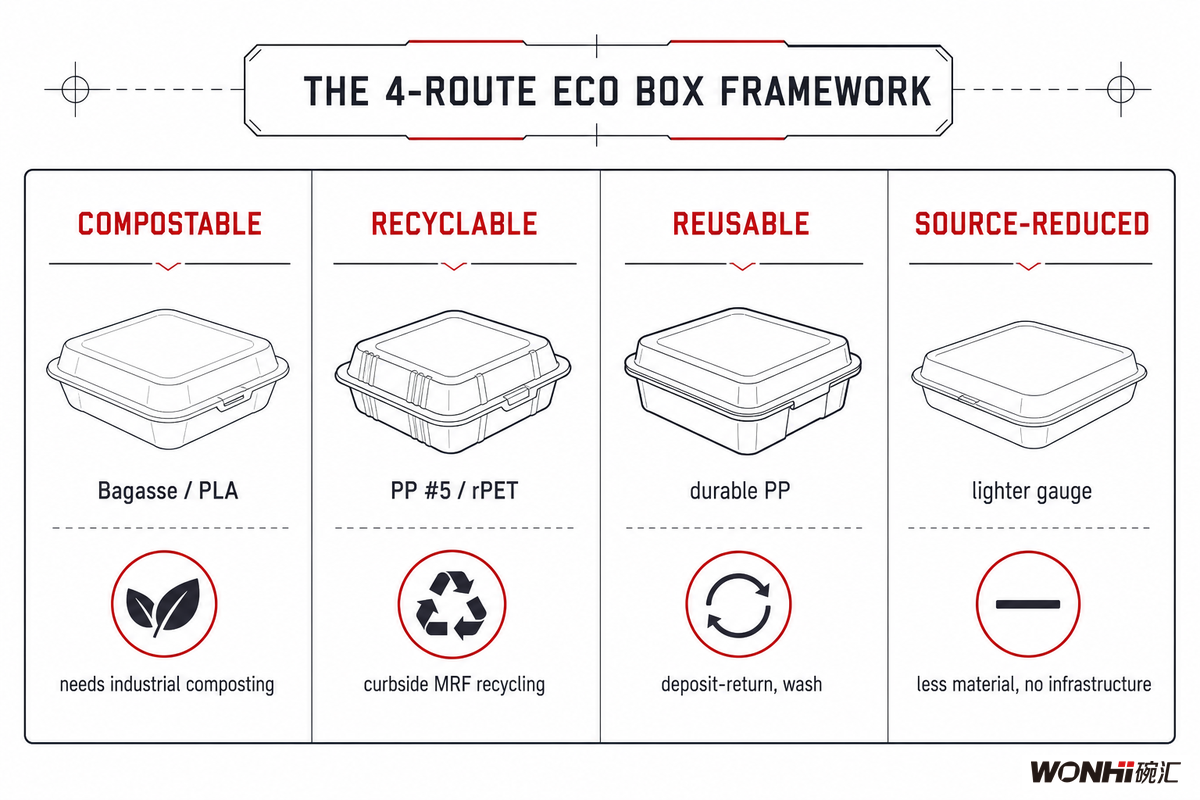
Each food box that hits the market from eco-friendly fits into one of four routes. If you’re in a hurry, simply stating the route name is the quickest way to grasp a container’s real trade-offs, as each route requires a different waste treatment path to realize its benefit. We call it the 4-Route Eco Box Framework, and we use it as a lens throughout this guide.
| Decision dimension by eco route type | Compostable | Recyclable | Reusable | Source-Reduced |
|---|---|---|---|---|
| Example materials | Bagasse, PLA/CPLA, molded fiber, wheat straw | PP (#5), rPET, kraft/paperboard | Durable PP, stainless steel | Lighter-gauge PP, right-sized fiber |
| End-of-life route | Industrial (or some home) composting | Curbside/MRF recycling stream | Wash and reuse (deposit-return) | Less material to any bin |
| Infrastructure needed | Commercial composting facility access | Working recovery for that resin | Return logistics + wash hub | None — benefit is built in |
| Best food / use | Hot mains (bagasse), cold salads (PLA) | Hot delivery, microwave reheat | Campus, stadium, closed loops | High-volume QSR staples |
| Relative unit cost | Mid to upper | Low to mid | High up front, low per use | Lowest |
| PFAS risk | Historically high in coated fiber — demand PFAS-free | Low (rigid resins) | Low | Low |
| Home-compostable? | Some uncoated fiber only; PLA no | No | N/A | N/A |
| Recyclable in curbside? | No — contaminates recycling | Yes, where the resin is accepted | N/A | Depends on material |
| Foam-ban compliant? | Yes | Yes | Yes | Yes (not foam) |
| What a “green win” requires | Customer actually composts it | Customer actually recycles it | Container comes back and is reused | Nothing extra — automatic |
Route behaviors compiled from EPA waste guidance, ASTM composting standards, and material data; certification scope varies by individual SKU.
Take particular care to read the bottom row of the table, as it’s the entire point of the framework: for three of the four routes, their environmental benefit is only realized if one particular thing occurs after your customer has finished their meal. A compostable container, for example, needs composting access to perform well. A recyclable container, for example, needs a functioning recycling stream for its specific plastic. A reusable container must, for example, return to your restaurant. Only source reduction will yield its benefit regardless of what your customer does, which is an insight that completely rearranges the foodservice buyer’s approach, as demonstrated in the section below. For a facility handling sorted PP or PET containers, plastic recycling systems from Kitech are a processing-equipment reference; acceptance, collection and the intended recycled-material use still require separate confirmation.
The materials behind these routes are worth naming. Bagasse is made from sugarcane; PLA (polylactic acid) is corn-based; molded fiber is often made from recycled materials, and some boxes are made from bamboo or made from plant-based materials. Rigid recyclable packaging replaces plastic food containers with food-safe, BPA-free resin. In short, plant-based packaging made from renewable resources, recycled-content packaging materials, and reusable options each answer the same question — where the food containers made for your menu will end up.
Which Eco Box Is Actually Greener? Match It to Your Local Waste System

The “greenest” food box is the one that your local waste management system is capable of handling. In order for a certified compostable container to truly compost, the collection of organic waste must occur-at either an industrial facility or curbside-yet access remains the biggest problem stopping the container from realizing its full potential.
By EPA data, only about 5% of the food that went to waste in the U.S. in 2019 (66.2 million tons) was actually composted. Curbside collection for organics is still not universal, and in areas that lack this capability, a compostable box ends up in a landfill, behaving identically to the plastic it’s replacing.
In fact, it may be worse. When organic material breaks down in a landfill, it generates methane-the EPA says wasted food accounts for 58% of this landfill methane. In contrast, a rigid recyclable polypropylene box inertly occupying the same space in the landfill will produce zero emissions. This is the counterintuitive “secret” of green packaging that won’t appear on most product pages: compostable isn’t inherently the most “green” option. Where composting facilities don’t exist, a recyclable box will often deliver the lower real environmental impact. The Biodegradable Products Institute concurs, as does the Sustainable Packaging Coalition, which views the decision as dependent on existing infrastructure.
This principle needs two important disclaimers to avoid becoming its own oversimplification. First, while disposal is one consideration, the life cycle impacts-such as the “up-stream” manufacturing-for some compostable foodware can be worse than for its plastic and paper alternatives (according to the Oregon Department of Environmental Quality’s influential analysis, for example), which is why preventing food waste and using correctly-sized containers trump simply substituting them for packaging. Second, just being made of “recyclable resin” doesn’t mean it’s “actually recycled”; the box must actually be acceptable to the recovery facility by its plastic, color and form, and be clean enough to be processed. Make the choice to fit the route, then make sure the infrastructure matches the route.
The Waste-Stream Fit Rule
Choose the eco-route supported by your customers’ waste infrastructure, and then select the specific material within that route:
- In markets with curbside or contracted commercial composting, use compostable (bagasse for hot, PLA for cold) and clearly mark the disposal instructions on the box.
- In markets with no composting but high recycling rates for rigid plastics, select recyclable polypropylene or rPET – it’s microwavable, durable, and genuinely recycled.
- If both options perform poorly (rural, no organics collection, poor recovery rates), consider source reduction or reusable alternatives (with deposit-return programs) and limit eco claims to only those that are well-supported.
A real-world example to illustrate the principle. A quick-service restaurant with 20 locations in a metropolitan area that offers curbside organic waste pickup would be an ideal candidate for certified compostable bagasse. The containers would be diverted from landfill, the eco claim would be valid, and the product would comply with the foam ban. However, the same chain in a rural county with no composting facility and no organic waste pickup would end up sending the “greener” compostable boxes to the same landfill as everything else, missing the environmental benefit that an inert plastic container would provide. The product remains the same, but the outcome depends entirely on the waste infrastructure, not the packaging. According to sustainability professionals, the “compostable” product isn’t always the best option; its suitability depends on local compostability.
“We tested cornstarch, bagasse, and PLA samples against five real customer menus before we recommended a split-sourcing plan. Cornstarch carried the cold deli line, bagasse carried the hot mains, microwavable polypropylene took the delivery soup, and clear PLA kept the salad case looking premium. One material, and one eco route, is rarely the right answer for an entire menu.”
Switching From Foam or Plastic to Eco Boxes: A Practical Playbook
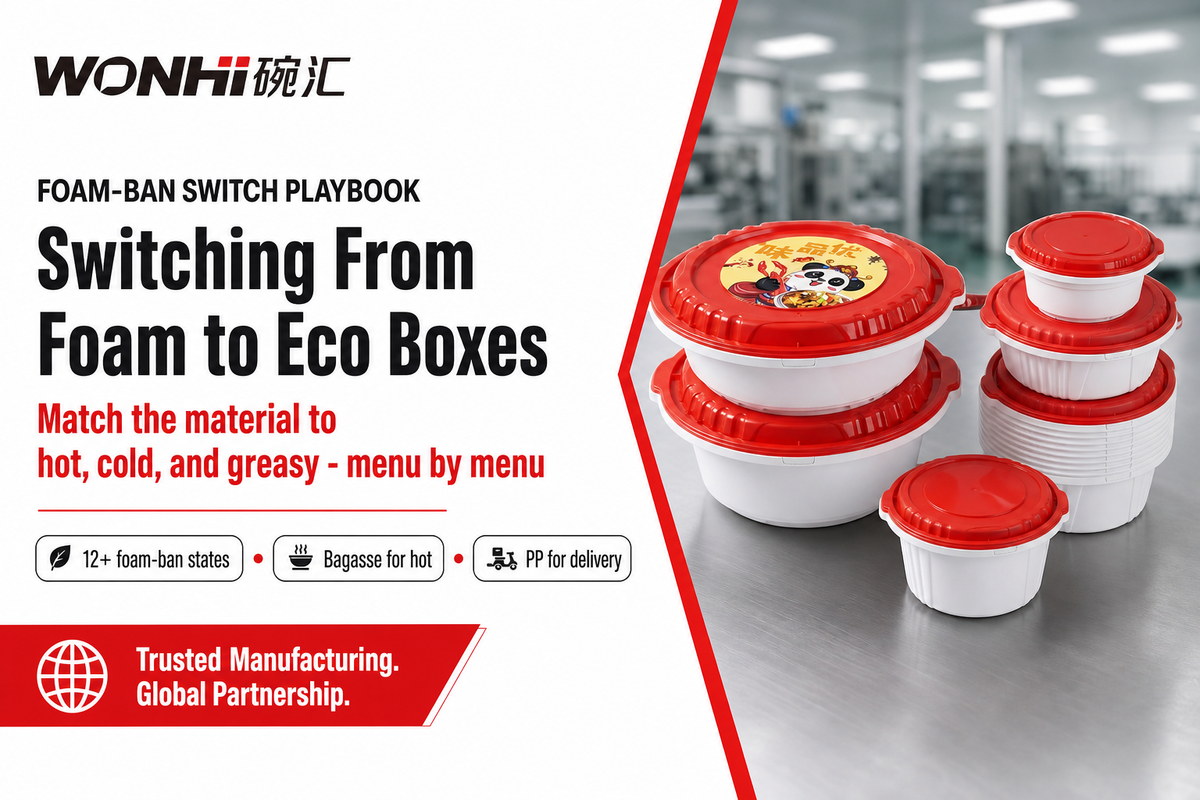
If a foam ban mandates a switch, it’s not as daunting as it appears – provided the transition is made menu by menu, not as an automatic reflex. Foam packaging, particularly polystyrene (styrofoam), is now banned in over a dozen U.S. states, including California, New York, Washington, Oregon, and Maine. In California, SB 54 has hastened the transition toward packaging single-use materials such as recyclable and compostable. Fortunately, operators concerned about performance will find that an appropriate eco-friendly material can match foam in terms of function while surpassing it in brand impact.
Are eco-friendly food boxes as sturdy as foam?
For the majority of menu items, yes – assuming you match the material to the thermal and grease requirements. Bagasse (sugarcane fiber) effectively contains hot food and soup up to about 104°C (220°F), resists grease without PFAS, and provides performance similar to foam in heat retention while being more durable under a delivery bag.
Microwavable polypropylene is suitable for reheated dishes with sauce and offers a secure closure to prevent leaks. The issue isn’t that “eco materials are weak,” but rather selecting a cold-food material like standard PLA for a hot-food application. Both cornstarch and PLA soften at around 50°C, making them suitable for cold salads and grab-and-go items, but not for hot soups.
The “switch map” approach ensures simplicity. Hot soups, curries and rice bowls transition to bagasse or microwavable polypro with a vented, leak-resistant lid; cold salads, deli and grab-and-go go to clear PLA or recyclable rPET so contents remain visible; and dry goods like sandwiches, baked goods and fries go to kraft paperboard or uncoated fiber-the most budget-friendly eco switch of them all. For example, one ghost-kitchen operator with a queso-centric menu dramatically reduced “warped lid” and spill reports by switching from a flimsy foam clamshell to a rigid box with a lid that locks into the perimeter-eco and anti-complaint upgrades merged into a single choice. Every move off plastic or styrofoam containers is also a chance to cut single-use plastic elsewhere — plastic straws, plastic food wrap, and other take-out extras — so the whole to-go order is better than plastic and helps reduce plastic and your carbon footprint, with more of the packaging reused or recycled.
📐 Engineering Note
Don’t pack a hot box totally airtight, as the steam will get trapped inside the box, cause pressure and possibly pop up the lid, and then steam will drip down onto the food, making it soggy. Some of the food-container patent applications show that somewhere in the 8- to 14 range for top surface vent is ideal for venting steam while keeping moisture on the food. Vented lids are better for avoiding leaks and are great for hot food and fried items as you don’t have to remove the lid to heat the food in a microwave.
Matching Eco Boxes to Your Menu: Formats, Heat & Lids

After you’ve chosen the eco option, format is a match: estimate each dish’s temperature, greasiness, and liquidity then pick the corresponding lid shape and container form factor. Use the chart below to match eco-friendly food boxes with lids to the foods on your menu. For the grease and heat-resistance temperatures behind each material — including biodegradable food containers with lids — see our materials guide.
You can find ordering information including case counts and dimensions in the eco-friendly food boxes catalog. The same match applies to paper food containers, compostable food containers, and compostable take-out containers, plus to-go boxes, hot cups, compostable bags, and food storage lunch boxes: rate paper food and fiber to the load, and confirm the lid and base snap tight. Even glass food jars follow the rule, so reviewing your full selection of eco-friendly packaging — the eco-friendly packaging options above — is part of choosing eco-friendly for each menu line.
| Format | Best for | Lid to specify |
|---|---|---|
| Clamshell / hinged box | Burgers, sandwiches, single hot entrées | Same-body hinged (no mismatched lids) |
| Bowl | Rice/grain bowls, salads, soups | Snap-on or press-fit for liquids |
| Tray | Multi-compartment meals, catering | Clear PLA lid for cold display |
| To-go box (folded) | Noodles, dry mains, leftovers | Integrated fold-lock |
| Cup with lid | Soups, sauces, cold drinks | Press-fit, tamper-evident optional |
| Pizza / flatbread box | Pizza, flatbreads, bakery | Kraft board, vented corners |
For any compostable format, check the SKU for an ASTM D6868 compost-labeling mark (valid for coated paper and fiber products). Two common compostable format pitfalls lead to wasted expense. Over-sizing – a deep clamshell for a shallow salad – results in buying material and taking up bin space you will never need.
Another mistake: treating lids as an accessory, rather than the final piece of the packaging system. A shallow, poorly sealed lid that leaks over a liquid-filled delivery container does not constitute a closed package, and requires you to coordinate lid type -snap-on or press-fit – with food-carry, not base-fit, alone. For both hot deliveries and microwavable reheating, our microwavable recyclable polypropylene hinged-lid formats are listed on our MFPP hinged-lid containers page.
For rigid recyclable products, consult our disposable PP and PET food containers pages.
The Real Cost of Eco-Friendly Food Boxes (and When the Premium Pays Off)
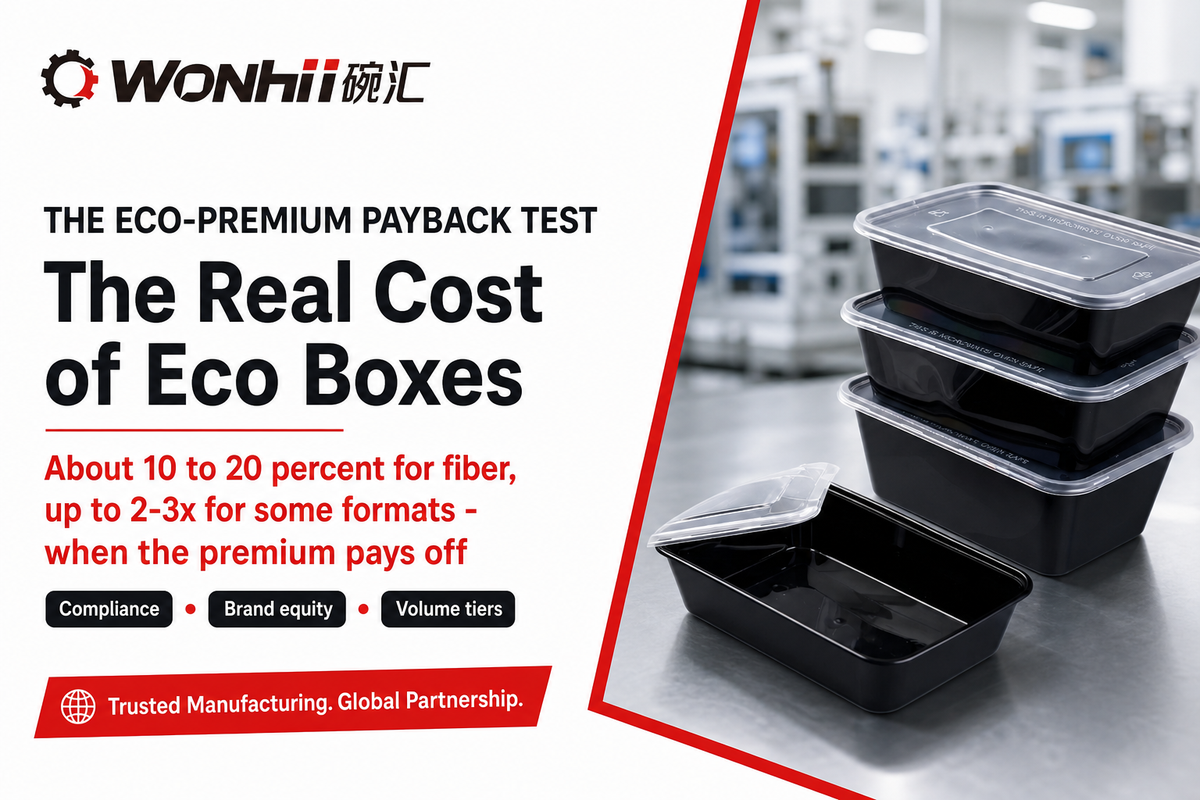
These eco-friendly boxes generally aren’t cheaper than their foam and plastic counterparts, and the honesty of that spread is all over the map. Food industry research firm Technomic said, according to US Foods, that some earth-friendly packaging “may cost two or three times as much as standard foam, paper and plastic.” At the gentler end of the spectrum, those going to fiber reported premiums closer to 10% or 20%. There’s a real gap on the per-unit spreadsheet — until you buy at wholesale volumes — and the value proposition changes for restaurants and small businesses once you factor in what that premium buys.
Four levers determine your landed cost: the family of food-contact material you choose (kraft and bagasse are cheaper than PLA), your order volume class (per-item cost drops rapidly as scale increases), customization (logo printing or a custom mold adds a single time cost), and freight. Instead of arguing the sticker price, decide if the premium pays out on what matters to you. For eco-conscious brands sourcing restaurant supplies, an eco-friendly alternative bought at wholesale prices closes most of the gap — sustainable food packaging and eco-friendly food containers are now standard packaging options, not premiums.
The Eco-Premium Payback Test — does the extra cost earn its keep?
- Avoided compliance cost. A state foam ban that leaves your inventory stranded costs more than a packaging premium. If you ship into a state with a ban, eco costs you nothing but money to stay compliant.
- Brand premium. Many operators find customers notice and appreciate eco packaging; the added expense can be hidden in menu prices without anyone noticing.
- Spill losses. A box designed to match your food product (vented lid, correct seal) reduces spill and leak complaints – cost avoidance that a cheap box won’t provide.
- Class size compression. The higher your minimum order class, the lower your per-item premium; ensure you get every class category included on your quote, not just the website.
One honest limitation precludes this turning into a sales pitch: if you don’t process or have access to composting recycled facilities, don’t pay a compostable premium for something that can’t be achieved. If that’s your reality, consider instead a recyclable box where recovery is possible, or source reduction – and a qualified statement rather than a green message that your customer can do nothing about.
How to Verify an “Eco-Friendly” Claim Is Real (3 Fast Checks)

Run these three fast checks per SKU to catch most greenwashed food box claims. They take a minute per SKU and most greenwash can be spotted this way.
- An endorsement mark. Confirm BPI (North America) or TÜV OK compost (EU/home). A logo identifies the SKU to third-party test results, not marketing claims.
- A standard number. A valid compostable claim includes ASTM D6400, ASTM D6868 (coated fiber), or EN 13432. Without a number, you have no proof – “biodegradable” with no standard is a scam the FTC Green Guides warns consumers about.
- A composting pathway claim plus “no added PFAS”. The label must say “industrial compostable” or “recyclable #5”, and food-grade fiber must display a no-intentionally-added-PFAS claim. Use “no added PFAS” as a warning indicator but not the definition – read the full food-contact compliance proof, since inks, coatings and other food-contact items aren’t covered by PFAS standards.
If you want the full greenwash-detection toolkit – the four-signal test, the certification lookup, and the PFAS statement – our biodegradable food containers guide covers it completely. The bottom line: trust the number, not the adjective.
What’s Changing: Eco Food Box Rules Through 2027 (Industry Outlook)

The one and only power behind the durability of eco-friendly food boxes is the rule book for foodservice buyers – and the rules get tighter for years to come. That’s what will drive purchasing. Compliance — not market hype — is the load-bearing driver here, so the smart move for a foodservice buyer is to plan purchasing around the regulatory calendar rather than the market forecast.
The extended producer responsibility (EPR) laws for California’s Senate Bill 54 were finalized in 2026, with requirements that single-use packaging and food service ware sold in the state will need to be 100% recyclable or compostable, with producer obligations phasing in through 2027 and material targets set for 2032. More than a dozen states have also prohibited foam products. A distributor that missed California’s SB 54 producer-registration window, for instance, found its inventory non-compliant the day the rule took effect — the compliance calendar, not the market forecast, is what belongs on your purchasing timeline.
The U.S. Food and Drug Administration (FDA) stated in Feb. 2024 that grease-proofing materials like PFAS were no longer sold in U.S. food packaging. In Jan. 2025, the FDA revoked 35 Food Contact Notifications. With California’s AB 1200 banning intentional PFAS in plant-based food packaging – and in many other materials too, over total-fluorine thresholds – there are significant, measurable benefits to specifying a “no added PFAS” designation and ensuring a certified recyclable or compostable route — a step that reduces the risk of ban states becoming prohibitive places to do business.
Although analysts are quick to describe the eco-packaging category as growing, eco-friendly materials are still less than 1% of the total U.S. disposables market, worth approximately $20 billion, according to estimates by Technomic. Treat this figure as interesting, but remember that your next purchase order must comply with the ban calendars in your shipping markets, not market-size trends.
Frequently Asked Questions
Q: What is the greenest food packaging?
View Answer
The best and greenest option will be what your customers’ waste stream will actually accommodate. A compostable box is only environmentally beneficial if it ends up in a commercial composting facility – a process used to deal with only about 5% of all waste food, according to the EPA. For customers who don’t have composting, a recyclable polypropylene box has the lower environmental impact because a compostable box thrown in the landfill creates greenhouse gas. Consider how the material aligns with existing waste disposal infrastructure.
Q: Are disposable takeout containers recyclable?
View Answer
It really depends on the material and your stream. Rigid #5 polypropylene boxes and PET are recyclable if accepted by your local MRF – as long as there’s little food waste in them, which could otherwise contaminate a whole batch. Conversely, compostable items can’t be recyclable or they’ll be contaminants in recycling; they belong in organics/composting. Uncoated kraft and paperboard are considered recyclable.
Q: How do I dispose of compostable to-go containers?
View Answer
To-go products are meant for industrial/commercial or curbside organics streams where a facility can turn them into soil within 90-180 days. Most of these, like PLA-based to-go, need heat that’s unavailable in backyard bins. If you don’t have a local collection service and composting facility available for customers, then a certified compostable box still has no place to go besides a landfill, so clearly identify how to dispose of the packaging properly on the container itself.
Q: Are eco-friendly food boxes microwave and freezer safe?
View Answer
It depends on the material. Bagasse and microwavable polypropylene are microwave- and freezer-safe; plain PLA is neither and softens with heat. Check the SKU’s rated fill temperature.
Q: Are paper and kraft food containers compostable?
View Answer
Uncoated kraft and paperboard tend to be compostable and commonly home-compostable. However, a liner or coating shifts the landscape: a plastic-coated kraft may fail to compost or recycle cleanly. Scan each SKU for the ASTM D6868 standard for coated paper and fiber products, and be sure to identify if the coating is bio-based.
Q: Do eco-friendly food boxes cost more than plastic?
View Answer
Commonly yes, although the price range is broad and shrinking. Bagasse and kraft fiber products command a mild up-charge of 10-20% versus conventional plastic, while certain configurations can be two to three times more costly than traditional foam or plastic.
This premium is reduced with volume orders and frequently off-set by foam-ban compliance, brand value and less in leak related returns. Nevertheless, for rural operators without recycling or composting services available, a recyclable or source reduced option may be a more sensible choice than a compostable premium.
Whether you need eco friendly food boxes with lids for delivery, eco friendly food boxes wholesale for a chain rollout, or the best eco friendly food boxes for a small restaurant, Wanhui produces kraft, PLA, bagasse and recyclable polypropylene food boxes in every format previously listed – custom molded, with logo printing included. Share your menu and delivery route with our application engineers and receive a tiered split-sourcing proposal.
Our Perspective on the “Eco” Sticker
This guide reflects how we advise foodservice buyers who ask us for “the greenest box.” Our answer is rarely a single material, it’s a route matched to the customer’s waste infrastructure, tested against a real menu at the sample stage before any mold is cut. We build compostable bagasse and PLA lines alongside recyclable polypropylene because the honest recommendation changes with the ZIP code. Reviewed by the Shandong Wanhui Environmental Protection Technology Co., Ltd. technical team.
References & Sources
- Composting and Wasted Food Statistics — U.S. Environmental Protection Agency
- Market Phase-Out of Grease-Proofing Substances Containing PFAS — U.S. Food and Drug Administration
- SB 54: Plastic Pollution Prevention and Packaging Producer Responsibility — California Department of Resources Recycling and Recovery (CalRecycle)
- Food Packaging Containing PFAS (AB 1200) — California Department of Toxic Substances Control
- Compostable Product Labeling Requirements — Washington State Department of Ecology
- Environmental Claims: Summary of the Green Guides — U.S. Federal Trade Commission
- The Problem With Organics in Landfills / Compostability Standards — Biodegradable Products Institute
- A Guide to Eco-Friendly Takeout Containers — US Foods / Food Fanatics (Technomic data)