Get in touch with Wanhui Company


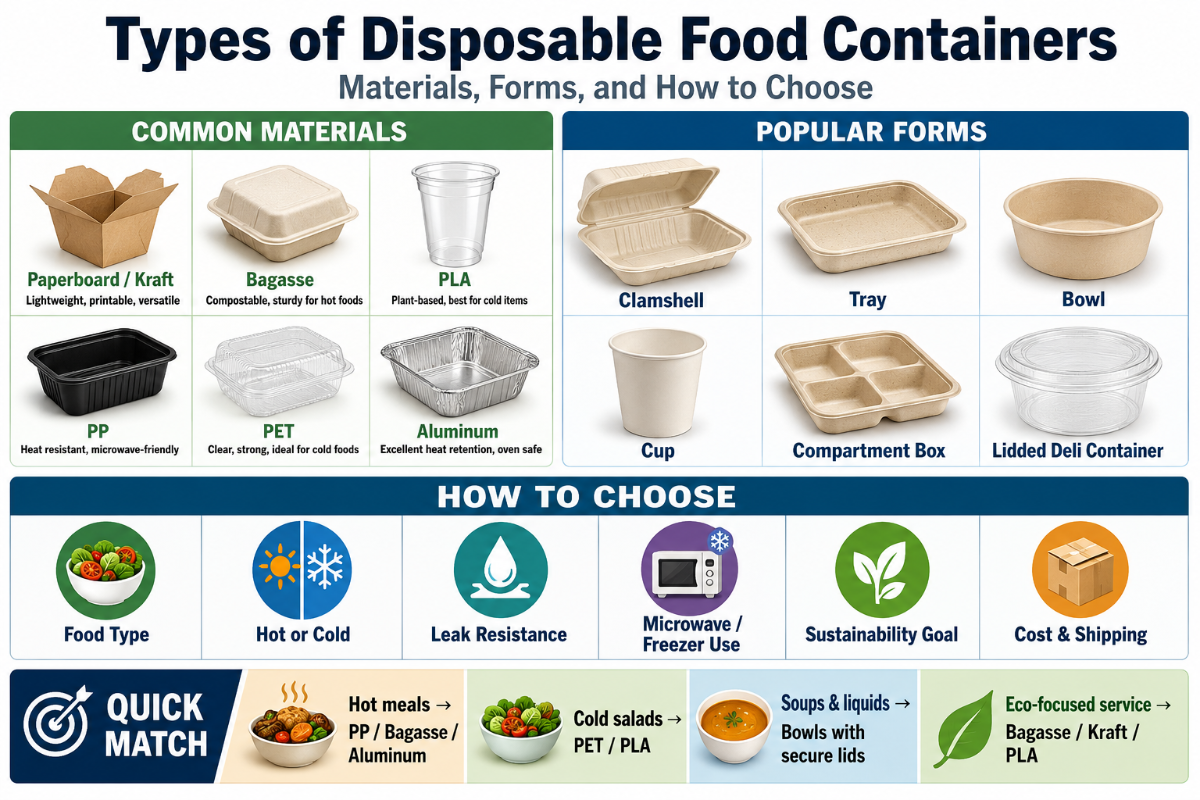
If you run a restaurant, a delivery kitchen, or a catering line, the types of disposable food containers you choose decide whether soup arrives sealed or spilled, whether a reheated lunch is safe or leaching, and whether your packaging passes the next single-use plastic law in your state. This guide breaks down every major container material and form factor, what each one is actually safe for, and how to match a container to the food going in it — without the marketing gloss.
It is an educational companion to our commercial range. If you are ready to source, see disposable food containers from Wonhi for wholesale and OEM options.
Disposable Container Cheat Sheet
| Material | Best for | Microwave | Recyclable / Compostable |
|---|---|---|---|
| PP (#5 plastic) | Hot, saucy, reheatable meals | Yes | Recyclable where #5 is accepted |
| APET (#1 plastic) | Cold salads, deli, clear display | No | Widely recyclable (#1) |
| Aluminum foil | Oven-reheat, hot greasy food | No | Recyclable (clean) |
| Paperboard / kraft | Dry-to-moist, take-out boxes | Depends on lining | Recyclable if uncoated |
| Molded fiber / bagasse | Hot foods, eco programs | Yes | Compostable (check PFAS-free) |
| EPS foam (#6) | Low-cost insulation (banned in 12 states) | No | Rarely recyclable |
Treat this as a starting point — the sections below add temperatures, resin codes, and a food-to-container selector.
What Are Disposable Food Containers?
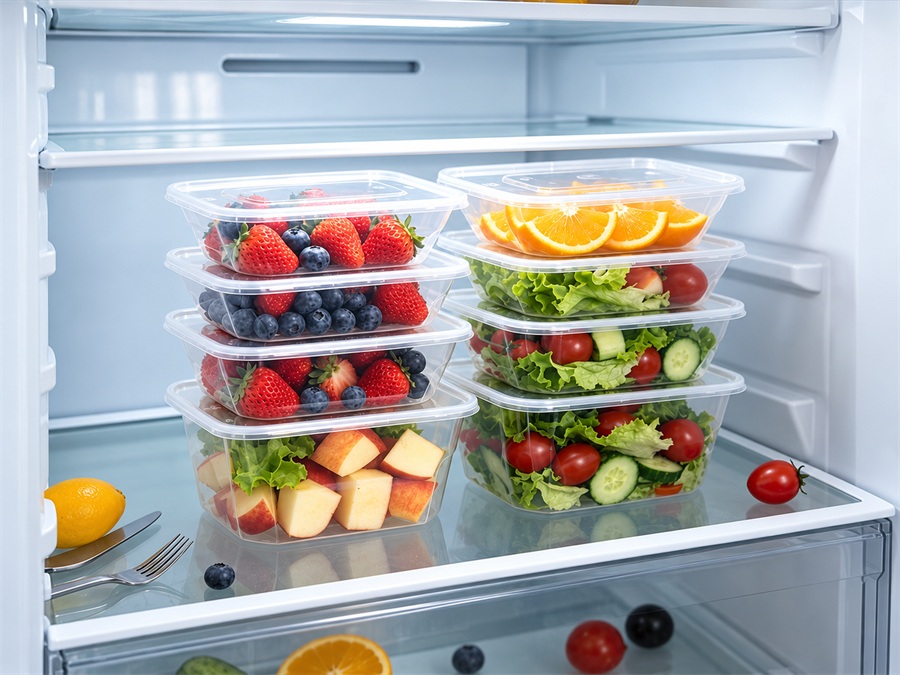
Disposable food containers are single-use vessels — boxes, bowls, trays, clamshells, cups, and to-go containers — built to hold prepared food for transport, takeout, delivery, or short-term service, then be recycled, composted, or thrown away. They are not the reusable, dishwasher-safe storage tubs you keep at home (the Tupperware-and-Pyrex category). That distinction matters: home storage containers are engineered for hundreds of wash cycles, while disposables are optimized for cost-per-unit, stacking, and a single trip from kitchen to customer.
This category is large and growing. Globally, the disposable food container market was valued near USD 49.2 billion in 2025 and is forecast to climb toward USD 88.7 billion by 2036, an annual growth rate around 5.5%, driven mostly by food delivery and tightening packaging regulation (FutureMarketInsights / IndexBox). The buyers are restaurants, ghost kitchens, caterers, grocery delis, and institutional canteens in hospitals and schools — each with different temperature, leak, and compliance needs. Because these are single-use items, end-of-life handling matters from the start: the U.S. EPA frames foodware choices around reduce-reuse-recycle before disposal, a thread that runs through the material and sustainability sections below.
Because “container” covers so much ground, the smartest way to learn the landscape is along two axes: the material it is made from (which governs heat, safety, and disposal) and the form factor (which governs fit, portion, and closure). The next two sections take each in turn.
Disposable Food Container Materials, Compared
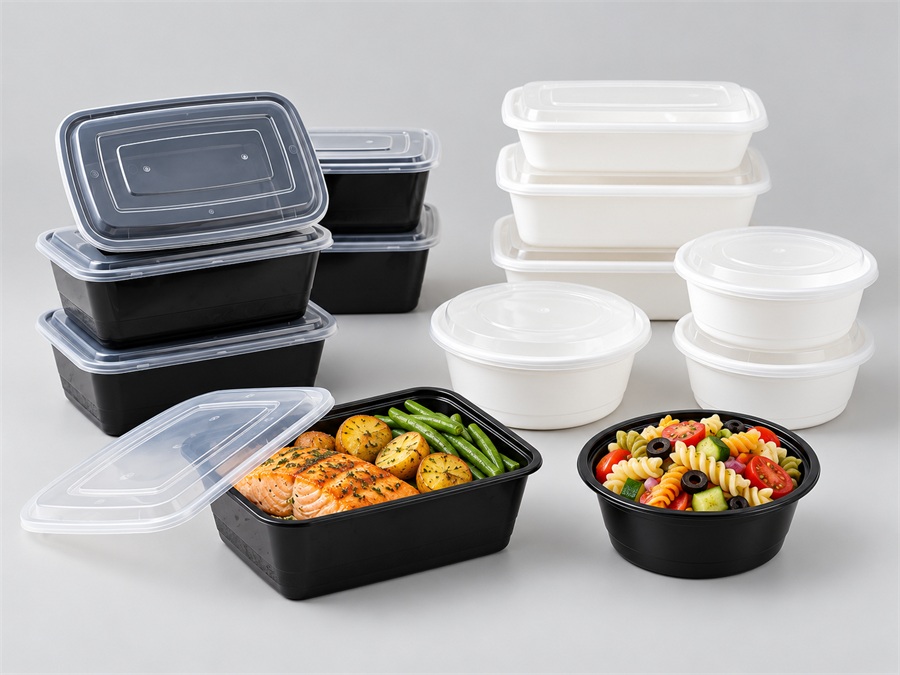
Material is the single most consequential choice, because it sets the temperature ceiling, the microwave and freezer behavior, the grease and moisture resistance, and how the container can be discarded. Below is an original synthesis we call the 5-Material Trade-Off Table — it merges published thermal limits with food-contact and disposal realities so you can compare families side by side rather than one product page at a time.
| Material (resin) | Hot-use ceiling | Microwave | Freezer | Oven | Grease / moisture | End-of-life | Best-fit food |
|---|---|---|---|---|---|---|---|
| PP — polypropylene (#5) | ~250–266°F | Yes | Yes | No | High | Recycle (#5) | Hot, saucy, reheatable |
| APET — amorphous PET (#1) | ~120°F (cold/cool) | No | Yes | No | High (water) | Recycle (#1) | Cold salads, deli, clear display |
| CPET — crystallized PET (#1) | to ~400°F | Yes | Yes | Yes | High | Recycle (#1) | Frozen-to-oven ready meals |
| PS / EPS foam (#6) | ~175°F | No | Yes | No | Medium | Rarely recycled; banned in 12 states | Low-cost hot drinks/soup (where legal) |
| Aluminum foil | to ~400°F (oven) | No | Yes | Yes | High | Recyclable (clean) | Oven-reheat, hot greasy, catering |
| Kraft paper (uncoated) | Warm, dry | Limited | No | No | Low | Recyclable / compostable | Dry items, pastries, sandwiches |
| Coated paperboard (PE/PLA) | Hot (lining-dependent) | Depends on lining | Yes | No | High | Coating limits recycling | Take-out boxes, noodle/rice |
| Molded fiber / bagasse | Hot; to ~400°F+ | Yes | Yes | Short reheats | High (if treated) | Compostable (verify PFAS-free) | Hot foods, eco-forward brands |
| PLA bioplastic (#7) | ~120°F | No | Yes | No | Medium | Industrial compost only | Cold drinks, cold deli (eco) |
| RPET — recycled PET (#1) | ~120°F (cold/cool) | No | Yes | No | High | Recycle (#1) | Cold salads with recycled content |
Temperatures are typical published ranges and vary by grade, wall thickness, fill time, and food fat/acidity. Treat them as guidance, then confirm against the supplier spec for your exact item.
Plastic: PP, PET (APET vs CPET), and PS
Plastic still accounts for roughly 38% of disposable container consumption in 2026, and for good reason: it resists moisture and survives the trip. Polypropylene (PP, resin #5) is the workhorse for hot food — it stays stable to roughly 250–266°F (about 121–130°C) and is microwave-safe because its semi-crystalline structure holds its shape near boiling-point fills, so a PP container handles a reheated curry or a hot soup that would warp a thinner plastic. Meal prep containers are most often PP for exactly this reason. .
PET is where most buyers oversimplify. Standard APET (amorphous, resin #1) is the clear plastic behind salad bowls and deli lids — crystal-clear and cold-only, not microwave-safe, and best kept under ~120°F (49°C). But CPET (crystallized PET) is a different animal: it is engineered for frozen-to-oven ready meals and tolerates oven heat to around 400°F (204°C). So “PET means cold only” is wrong — it depends on whether the tray is amorphous or crystallized. Polystyrene (PS, #6), including expanded foam, is cheap and insulating but is generally rated for lower heat (industry data puts the practical limit around 175°F / 79°C, grade-dependent). The U.S. National Toxicology Program lists styrene as “reasonably anticipated to be a human carcinogen,” and studies report that styrene migration into food rises with heat and fat content — one reason foam is now banned in many states (covered below).
Aluminum Foil
Aluminum trays are the choice when food needs real oven heat: at roughly 38–80 µm gauge they hold up to about 400°F (204°C), conduct heat evenly for reheating, and shrug off grease. Its limitation is the microwave — metal and microwaves do not mix — and the surface gets hot fast, so foil suits catering, baked entrees, and oven-finish items rather than handheld delivery.
Paper, Kraft, and Coated Paperboard
Paper-based containers span a wide range. Uncoated kraft (commonly 250–350 gsm for rigid boxes) is fine for dry or warm items (pastries, sandwiches) and recycles easily, but it wicks moisture. To carry wet or greasy food, paperboard is lined — historically with polyethylene (PE), increasingly with PLA. That lining is what makes a paper box hold a saucy noodle dish, but it is also what complicates recycling, since the coating must be separated. Food trays are commonly paperboard or molded fiber.
Molded Fiber and Bagasse (Sugarcane)
Molded fiber — most often bagasse, the fibrous residue left after sugarcane is pressed — has become the default “eco” material. It is sturdy across a wide temperature range (roughly -13°F to 428°F / -25°C to 220°C), handles hot food without warping, and is microwave-friendly for short reheats. It is genuinely compostable in the right system. But bagasse carries an important asterisk on chemical treatment that we cover in the safety section — do not assume “plant fiber” automatically means “clean.”
✔ Plastic strengths
- Best moisture and leak resistance
- PP microwaves; CPET ovens; APET shows food clearly
- Lowest cost per leak-proof unit
⚠️ Fiber / paper limits
- Needs a coating or treatment for wet/greasy food
- Compostable only where a facility accepts it
- Must be verified PFAS-free (see below)
Container Forms & Formats: Shapes, Sizes & Closures
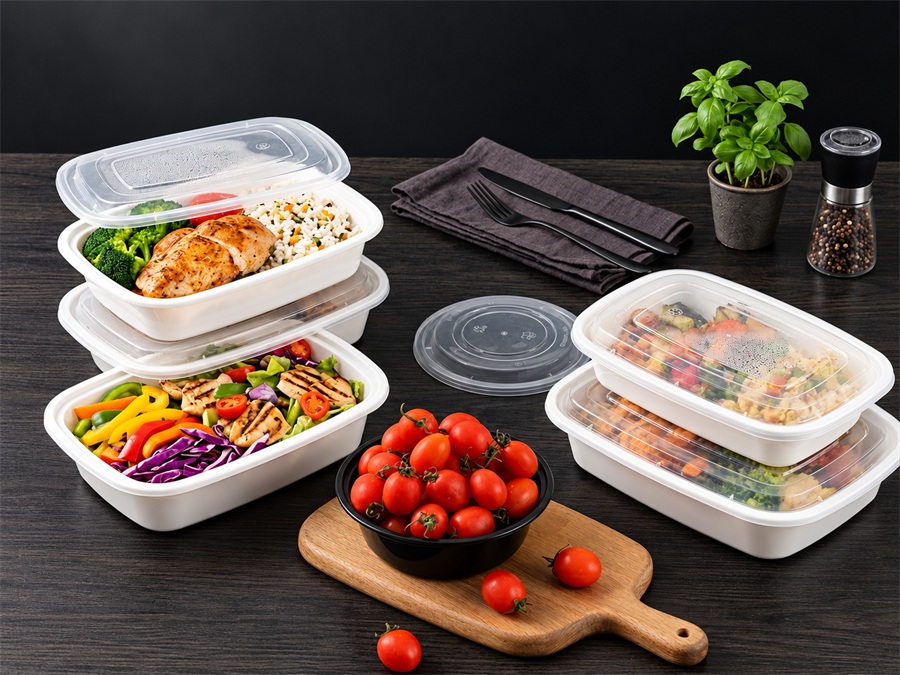
Once material is settled, form factor decides fit and function. The same PP resin becomes a deli cup, a hinged clamshell, or a three-section tray depending on the food and the service model. Here is how the common forms map to use and size.
| Form | Typical sizes | Best-fit food |
|---|---|---|
| Clamshell / hinged | 6″–9″ single & multi | Burgers, salads, full meals, bakery |
| Deli / round cup | 8, 16, 32 oz | Soups, sides, sauces, prep |
| Take-out box / carton | 26–64 oz | Noodles, rice, Chinese take-out |
| Tray / platter | 1–5 compartment | Plated meals, deli, catering |
| Bowl | 12–48 oz | Salads, poke, grain bowls, soup |
| 3-compartment | 28–40 oz | Meal-prep, plate lunches |
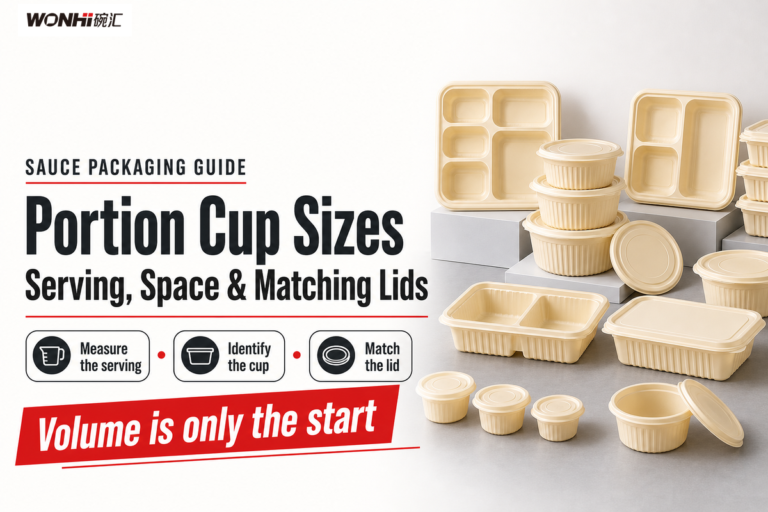
| Portion / soufflé cup | 0.75–5.5 oz | Dressings, dips, condiments |
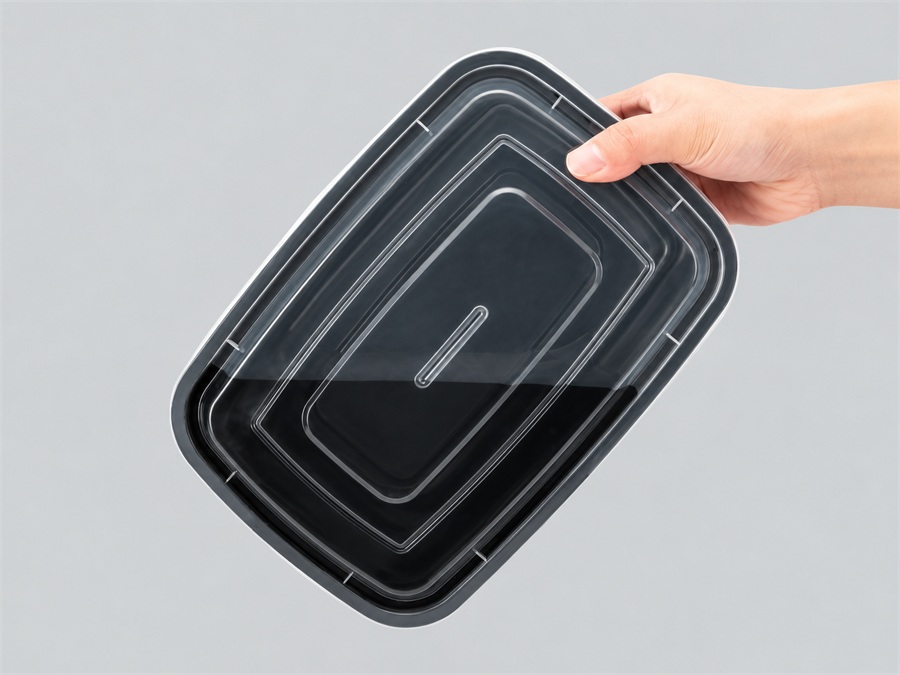
| Lids (flat / dome / vented) | Matched to base | Closure, stacking, venting steam |
What size deli container do I need?
Deli and round containers follow a near-universal size ladder — 8, 16, and 32 oz (roughly 240, 470, and 950 ml) are the volume workhorses, with 12 and 24 oz filling the gaps. An 8 oz cup suits sides, dressings, and small soups; 16 oz handles a single-serve soup or salad; 32 oz covers family sides, bulk prep, and large salads. Because lids are sized to a base diameter, sticking to one supplier’s diameter family lets a single lid fit several heights — a small detail that cuts your SKU count. Wonhi’s disposable soup containers and 3-compartment containers follow standard diameter families for this reason.
Closures are where deliveries are won or lost. Most disposable food containers with lids share a base-diameter family, so one container lid style covers several bases. A flat lid stacks tightly for transport; a dome lid clears a tall salad or a sandwich; a vented lid lets steam escape so hot fries do not go soggy. For anything liquid, a tight, tamper-evident lid is the deciding feature — far more than the bowl itself. Compartment trays and bento boxes keep wet and dry components separate so a salad’s dressing does not wilt the greens in transit.
“The container body almost never fails — the lid seal does. For delivery menus we tell buyers to qualify the lid-and-base pair as a system under a real transport shake, not to spec the bowl and the lid separately.”
Are Disposable Food Containers Safe? Resin Codes, BPA/BPS & PFAS
“Is this safe for hot food?” is the question buyers should ask most and ask least. The honest answer has three layers: the resin identity, the regulatory clearance, and the use conditions. Get those straight and most safety confusion disappears.
Are disposable plastic food containers safe?
Generally yes — when the right resin is used within its limits. In the United States, food-contact plastics must comply with FDA 21 CFR Part 177, which sets the specifications for polymers used in single- and repeated-use food-contact surfaces. Risk here is not “plastic” in the abstract; it is mismatching a resin to heat. Polystyrene foam leaches styrene into hot, fatty food; standard PET can release trace antimony when heated, which is why it is built for cold use. Match the resin to the temperature and the container does its job safely.
Resin Code Safety Map (#1–#7 for Food)
- Resin #1 (PET) is food-safe for single use; cold-leaning (APET) unless crystallized (CPET). Avoid prolonged heat in standard PET.
- Resin #2 (HDPE) is food-safe and stable; common in jugs and rigid tubs.
- Resin #4 (LDPE) is food-safe; used for flexible films, lids, and liners.
- Resin #5 (PP) is food-safe and the best mainstream hot/microwave choice.
- Resin #3 (PVC) — avoid for food because of plasticizer concerns.
- Resin #6 (PS) — avoid for hot or fatty food (styrene migration).
- Resin #7 (Other) is a mixed bag and may include polycarbonate or PLA; verify before use.
📐 Engineering Note
The resin number is a material identifier for recycling and quality control — not a food-safety or heat-safety stamp. ASTM, which administers the resin identification code, is explicit that it identifies resin content, not suitability for any given use. Food-contact safety comes from FDA 21 CFR 177 compliance plus the intended-use conditions: time, temperature, and how fatty or acidic the food is. A #5 cup is microwave-grade only if it was made and cleared for that use. Always read the supplier’s food-contact and temperature declaration rather than inferring safety from the triangle.
The PFAS Catch in “Compostable” Fiber
Here is the finding most guides miss. To make molded-fiber and paper bowls resist hot, greasy food, manufacturers have used PFAS — “forever chemicals.” Independent testing reported by Consumer Reports and peer-reviewed work in Environmental Science & Technology found that sugarcane-bagasse bowls carried some of the highest total organic fluorine levels of all samples — despite being marketed as biodegradable and compostable. PFAS do not break down and migrate more into warm food. In February 2024, the FDA announced that grease-proofing materials containing PFAS would no longer be used in new US food packaging, and the Biodegradable Products Institute began rejecting certification of compostable products containing intentionally added fluorine. Practically, an “eco” fiber container is only as clean as its PFAS-free certification — verify it, do not assume it.
State law is moving faster than many buyers realize. Washington restricts intentionally added PFAS in plant-fiber food packaging, and California’s AB 1200 bans plant-fiber food packaging that exceeds 100 ppm total organic fluorine. If you ship across state lines, your “compostable” line now has a chemical compliance dimension, not just a marketing one. For grades that meet food-contact requirements, our food-grade disposable containers are made to national hygiene and international food-safety certifications.
How to Choose the Right Container for Your Food
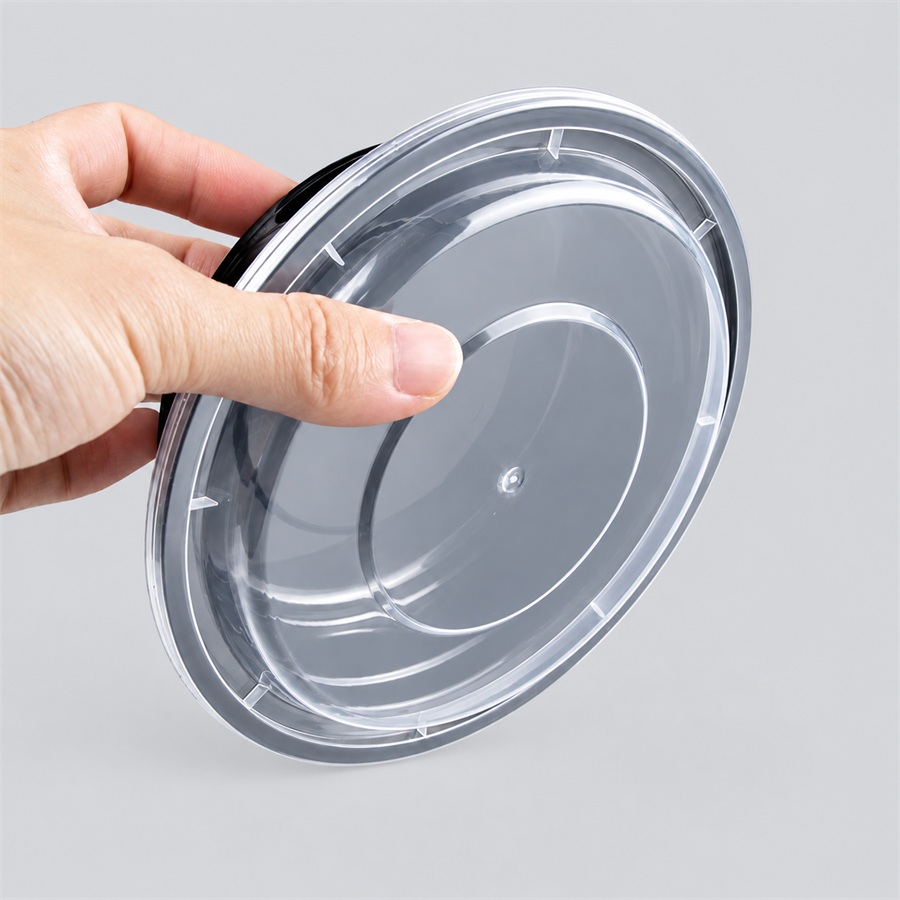
A faster way to choose is to start with the food’s state, not the catalog. A hot saucy curry, a cold salad, and a frozen-to-oven entrée want three different materials. Use this Hot / Wet / Greasy / Cold Container Selector as a decision shortcut.
The Hot / Wet / Greasy / Cold Container Selector
- Hot & saucy (curry, stew) → PP (#5) bowl with a tight, leak-proof lid, or treated molded fiber. Microwave-reheatable.
- Greasy / fried (wings, fries) → vented lid + grease-resistant board or PP; venting stops sogginess.
- Cold & crisp (salad, poke) → clear APET/RPET clamshell or bowl; keep dressing in a portion cup.
- Frozen-to-oven (ready meals) → CPET tray or aluminum; both take real oven heat.
- Soup / liquid → round PP deli container, tamper-evident lid; size up one step to leave headroom.
Wonhi’s commercial range maps to these uses, and for branded or custom-mold needs the custom take-out containers guide covers logo printing and tooling. Before you lock an order, avoid the field mistakes that show up most often in operator forums.
⚠️ 5 Common Selection Mistakes
- Putting a cold-rated APET or foam box in the microwave — it warps or leaches. Match the resin first.
- Specifying the bowl but not testing the lid seal under transport — the #1 source of delivery leaks.
- Undersizing to save a few cents, then overfilling — overfilled containers spill in the bag.
- Buying foam without checking your state ban deadline — then scrambling to re-source.
- Assuming “compostable” is automatically PFAS-free or locally compostable — verify both.
Compostable vs Biodegradable vs Recyclable
These three words get used interchangeably in marketing, but they mean very different things — and confusing them invites greenwashing claims that the FTC Green Guides treat as deceptive advertising. Here is the 3-Term Untangler.
| Term | What it actually means | The catch |
|---|---|---|
| Compostable | Certified to break down ≥90% in ~180 days under industrial composting (ASTM D6400 for plastics; D6868 for fiber/paper) | Needs an industrial facility — won’t break down in a landfill or backyard |
| Biodegradable | Will break down by microbial action; no single technical standard like D6400 | Regulated by the FTC Green Guides — an unqualified “biodegradable” claim must be substantiated to fully break down within ~1 year in customary disposal, or it risks being deceptive |
| Recyclable | Can be reprocessed into new material (PET #1, PP #5, clean aluminum) | Only if your local stream accepts that resin and it’s clean of food |
What is a better alternative to disposable containers?
For repeat-service settings — dine-in, offices, schools with a wash-and-return system — the US EPA places reusable foodware at the top of the hierarchy, ahead of any single-use option. Where reuse is not practical, the EPA’s guidance is blunt about disposables: buy certified-compostable foodware only when a local program actually accepts those product types, because many commercial composters reject compostable containers and they end up landfilled anyway. In other words, a BPI-certified compostable box only delivers its benefit if there is a facility to receive it. Match your sustainability claim to your local infrastructure, certify PFAS-free, and you avoid the gap between the label and the landfill.
The Disposable Food Container Industry in 2026 & Beyond
Two forces are reshaping the category, and both have firm dates attached. First, regulation: as of 2025, twelve states — Maryland, Maine, Vermont, New York, New Jersey, Colorado, Virginia, Washington, Oregon, Rhode Island, Delaware, and California — have enacted expanded polystyrene (EPS) foam bans, per Packaging Dive. New York’s foam ban widened to coolers and ice chests on January 1, 2026; Virginia’s expanded EPS ban reaches all food vendors by July 1, 2026; and a federal Farewell to Foam Act has been proposed. Foam is on a clear phase-out clock.
Second, materials: momentum is toward paperboard, molded fiber, and bagasse, alongside PFAS-free coatings built from cellulose nanomaterials rather than fluorochemistry. Plastic is not vanishing — it holds roughly 38% of consumption because nothing beats it for moisture and leak resistance — but the mix is diversifying, and container design is being optimized for delivery: stackable footprints and secure, leak-proof closures built for the shake of a courier bag.
💡 What to do about it
Diversify your material mix toward fiber and paperboard for items and regions where bans apply, but keep PP and PET for moisture-critical hot and wet foods where fiber underperforms. Track your state’s deadline, require PFAS-free certification on any fiber line, and confirm a local composting outlet before you market a container as compostable.
Frequently Asked Questions
Q: Are disposable food containers safe?
View Answer
Yes, when the resin matches the use. Food-contact plastics in the US must meet FDA 21 CFR Part 177, and the common food-safe resins are PET (#1), HDPE (#2), LDPE (#4), and PP (#5). The real risk is heat mismatch — using polystyrene foam (#6) for hot, fatty food, or microwaving a cold-rated PET tray. Choose PP for hot and microwave use, keep standard PET for cold, and follow the supplier’s food-contact and temperature declaration rather than guessing from the resin number.
Q: What are disposable food containers made of?
View Answer
Five material families cover almost everything: plastics (polypropylene #5 for hot food, PET #1 for cold, polystyrene #6 foam for cheap insulation), aluminum foil for oven use, paper and coated paperboard for take-out boxes, and molded fiber such as bagasse for compostable lines. Each has a different temperature ceiling, microwave and freezer behavior, and disposal path, which is why material is the first thing to settle when choosing a container.
Q: Which disposable food containers are microwave- and freezer-safe?
View Answer
Polypropylene (#5) is the mainstream microwave-and-freezer choice, stable to roughly 250–266°F. Molded fiber/bagasse and crystallized PET (CPET) also handle microwave and freezer, and CPET plus aluminum go in the oven. Standard amorphous PET (APET), polystyrene foam, and PLA are not microwave-safe — most tolerate the freezer but not heat. Always look for an explicit “microwave-safe” declaration, since it depends on the grade and wall thickness, not just the material name.
Q: What is the difference between compostable and biodegradable?
View Answer
Compostable is a certified standard (ASTM D6400/D6868) — roughly 90% breakdown in 180 days under industrial composting. Biodegradable has no required timescale and means little on its own.
Q: Are bagasse / sugarcane containers really better than plastic?
View Answer
They can be, with two conditions. Bagasse is renewable, handles hot food, and is compostable where a facility accepts it — a real advantage over foam. But independent testing has found some bagasse bowls carrying high PFAS (“forever chemical”) levels added for grease resistance, and as of 2024 the FDA and BPI have moved against intentionally added fluorine, with states like California (AB 1200) capping total organic fluorine at 100 ppm in plant-fiber packaging. So bagasse is better than plastic on renewability and end-of-life only when it is certified PFAS-free and there is local composting. Without those, plastic that gets recycled can be the more honest choice. Verify the certification, not the marketing.
Q: Are disposable food containers recyclable?
View Answer
Some are, if clean and accepted locally. PET (#1), PP (#5), and clean aluminum are recyclable in many programs; foam (#6) rarely is; and coated paperboard is hard to recycle because the lining must be separated. Food residue also disqualifies otherwise-recyclable items, so rinse-and-sort matters. Always check what your local stream actually accepts.
Q: How do I choose a container for hot, saucy, or greasy food?
View Answer
For hot and saucy, use a polypropylene (#5) bowl with a tight, leak-proof lid, or a treated molded-fiber container — both take heat and reheat in the microwave. For greasy or fried food, add a vented lid and a grease-resistant surface so steam escapes and the food stays crisp. Size up one step for liquids to leave headroom, and qualify the lid-and-base as a sealed system before committing to a delivery menu.
Sourcing disposable food containers at wholesale?
Wonhi (Shandong Wanhui) manufactures food-grade meal boxes, bowls, trays, and clamshells across PP and PET lines, with OEM logo printing and custom mold development for restaurants, delivery, and institutional canteens.
About This Guide
This guide was written by the team at Wonhi (Shandong Wanhui Environmental Protection Technology Co., Ltd.), a food packaging container manufacturer with 20 years in disposable meal boxes, bowls, and trays across PP and PET production lines. Temperature, resin, and regulatory points are sourced from FDA, NIH, university extension, ASTM/BPI, and 2024–2026 trade reporting, cited inline. Where a claim depends on grade or local rules, we say so rather than overstate it.
References & Sources
- 21 CFR Part 177 — Indirect Food Additives: Polymers — U.S. FDA / eCFR
- Plastic Resin Codes — National Institutes of Health (NIH), Office of Research Facilities
- Which Plastics Are Safe for Food Storage? — Utah State University Extension
- FDA Actions to End Sales of PFAS Used in US Food Packaging (Feb 2024) — U.S. FDA
- PFAS in Food Packaging: Migration, Toxicity, and Management — Environmental Science & Technology (ACS)
- Sustainable Management of Food — U.S. EPA
- BPI Certified Compostable (ASTM D6400 / D6868) — Biodegradable Products Institute
- Green Guides (environmental marketing claims) — U.S. Federal Trade Commission
- Dangerous PFAS Chemicals Are in Your Food Packaging — Consumer Reports
- State Packaging Laws Taking Effect in 2026 — Packaging Dive
Related Articles
- Disposable Food Containers — Wholesale & OEM Range — material lines, sizes, and how to order
- Custom Take-Out Containers Guide — logo printing and custom mold development
- Disposable Soup Containers — leak-proof round cups by size
- Food Trays — paperboard and fiber options
- 3-Compartment Containers — meal-prep and plate lunches