Entre em contato com Wanhui Company


Atualizado em julho de 2026.
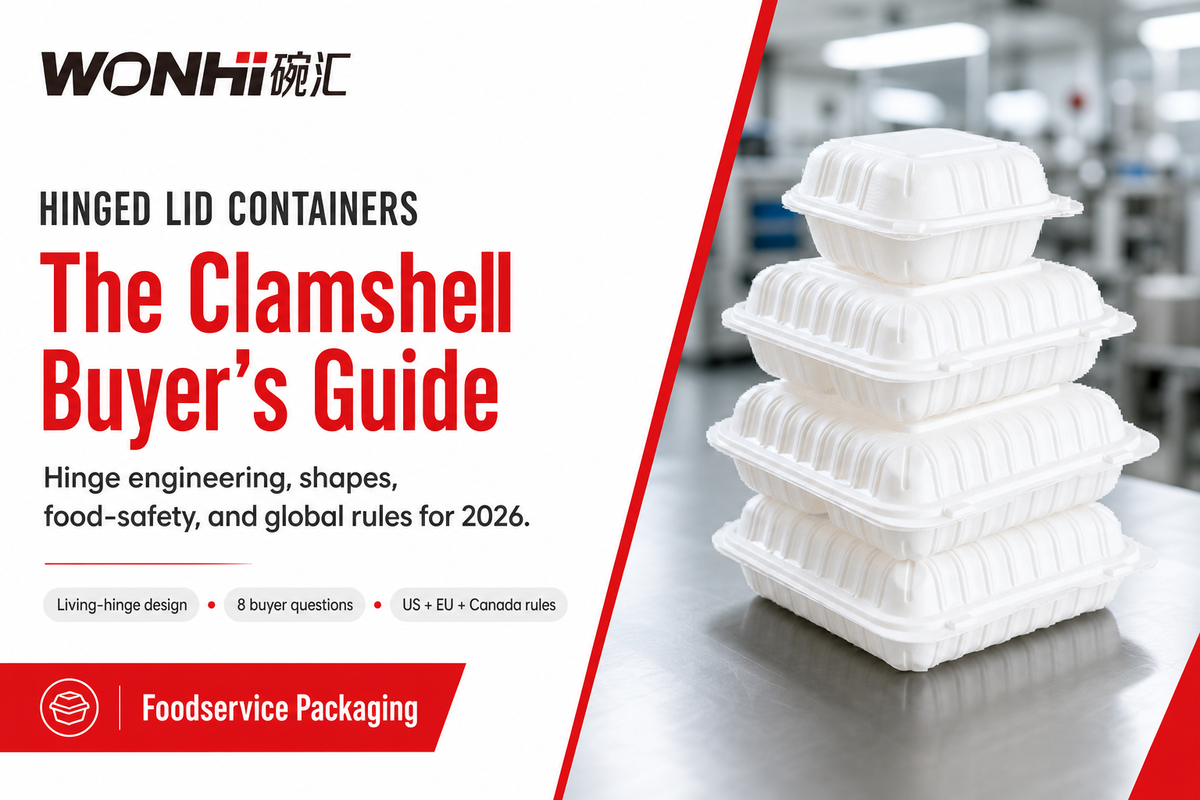
Pacotes de foodservice de uma peça com tampa articulada (geralmente chamados de recipientes com concha), onde uma única dobradiça viva moldada une a tampa e a base à parte, e eles são o formato padrão de comida rápida para viagem, entrega e catering Se a busca é por tampa articulada de plástico ou pelas versões de espuma abordadas separadamente abaixo, a própria Wanhui página de solução de recipientes com tampa articulada já decompõe qual material escolher: MFPP, PP transparente ou espuma. Este guia começa onde essa página para. Abrange as perguntas que um comprador faz após a escolha do material, como a dobradiça em si é projetada, quais formas existem além do retângulo padrão, quando a contagem de compartimentos é uma decisão de segurança alimentar e não uma preferência de tamanho, e o que muda quando um contêiner cruza uma borda.
Especificações rápidas
| Formato | Corpo inteiriço; tampa e base unidas por uma dobradiça viva integral |
| Materiais comuns | MFPP, PP transparente, PET/RPET, espuma EPS (regulada pelo estado em 12 estados dos EUA) |
| Faixa de capacidade | Aproximadamente 4 onças a 64+ onças, dependendo da família do molde |
| Opções compartimentos | 1, 2 ou 3 compartimentos |
| Empilhável /transporte | Sim, é plano para armazenamento, empilhável para transporte de paletes |
| À prova de vazamentos/microwavable | À prova de vazamentos quando fechado por linha de enchimento; microondas seguro em graus de polipropileno e MFPP de qualidade alimentar |
| Seleção material | Veja Wanhui Seletor de ajuste de material |
O que torna o contêiner “HLid com tampa reduzida é um design de dobradiça viva explicado
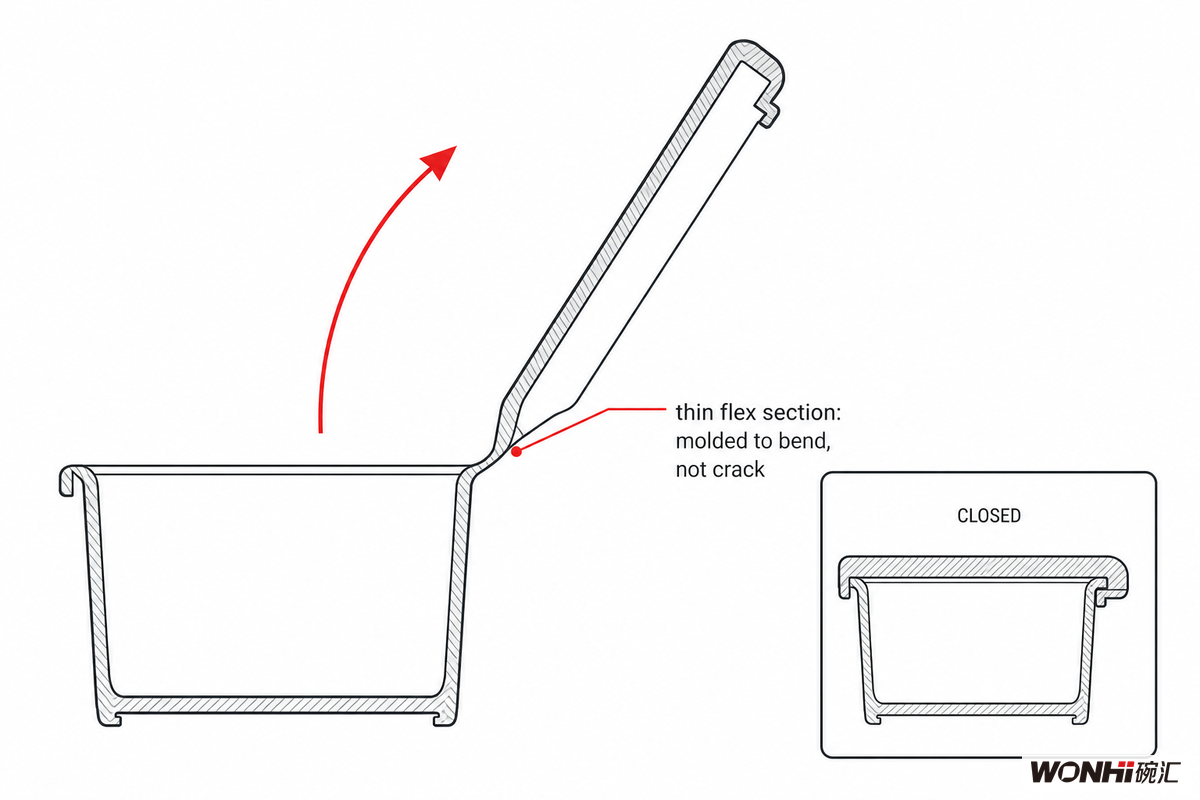
Uma peça moldada, isso é tudo o que há para um recipiente de tampa articulada Em vez de uma tampa, tampa, anel de encaixe ou faixa, há uma conexão curta e dobrável do mesmo plástico uma dobradiça viva (“living hinge”) para manter a tampa e a base juntas em polipropileno moldado por injeção, as estruturas de dobradiça tradicionais duram milhões de ciclos de abertura e fechamento, dizem os engenheiros do Universidade do Texas, porque a parte flexível é formada por calor ou moldada por injeção especificamente para dobrar em vez de rachar sob tensão.
At MIT, pesquisa sobre flexões articuladas também aponta PP e PE como os materiais dominantes para a sua elasticidade O próprio mecanismo básico está documentado em Patente dos EUA 7.685.676, que descreve a dobradiça viva como uma seção flexível projetada para tolerar tensões e compressões repetidas sem rachaduras Chame-a de Dobradiça de Perda Zero-Peça (às vezes chamada de design “attached-lid” ou “attached-hinged”): como a tampa nunca pode ser separada do corpo do recipiente, nenhuma tampa se perde na linha de embalagem, nenhum saco de retirada vazio acaba com uma tampa isolada rolando no fundo, e nenhum cliente precisará procurar através de uma gaveta bagunçada Em suma, não há nenhum argumento real de engenharia a ser feito em favor do design da tampa/cuba do corpo sobre uma autônoma: uma parte, em vez de duas, e uma parte que nunca pode se desviar. (Embora um recipiente delicatessen com tampa encaixada resolva um problema diferente, embora relacionado, para armazenamento – o recipiente articulado é projetado para uso único, funcionalidade próxima e, e, portanto, sua proliferação através da gaveta mais ampla de Wanhui gama de recipientes descartáveis para alimentos, no lugar de banheiras de plástico descartáveis soltas.)
Nem todos os projetos de dobradiças são estruturas contínuas, também A série de espuma da Dart Container, por exemplo, emprega uma dobradiça perfurada patenteada “Performer” composta por pequenas perfurações em vez de uma curvatura contínua, uma abordagem alternativa para abordar questões de durabilidade dentro do material de espuma de menor densidade Esta abordagem de dobradiça perfurada faz um compromisso entre a resistência à fadiga de uma dobradiça contínua e as melhores propriedades de flexão necessárias em um material de espuma que não possui a flexibilidade inerente da PP. Errar a geometria da dobradiça é um risco real, não cosmético: uma seção flexível moldada visivelmente muito fina corre o risco de rachar prematuramente bem antes da figura de milhões de ciclos citada acima, enquanto uma moldada muito grossa luta contra a mão do operador em cada abertura, porque todo o design vive dentro de uma janela de tolerância estreita entre “flexível o suficiente para abrir uma mão e ”durável o suficiente para sobreviver a uma rota de ferramentas própria da“ Wanhui mantém essa tolerância à espessura da dobradiça para uma precisão consistente em cada família de moldes, em geometria de vida de moldagem genérica, especificamente adaptada e com a experiência de moldagem PPF.
Formas articuladas especializadas e não padronizadas além da grade retangular
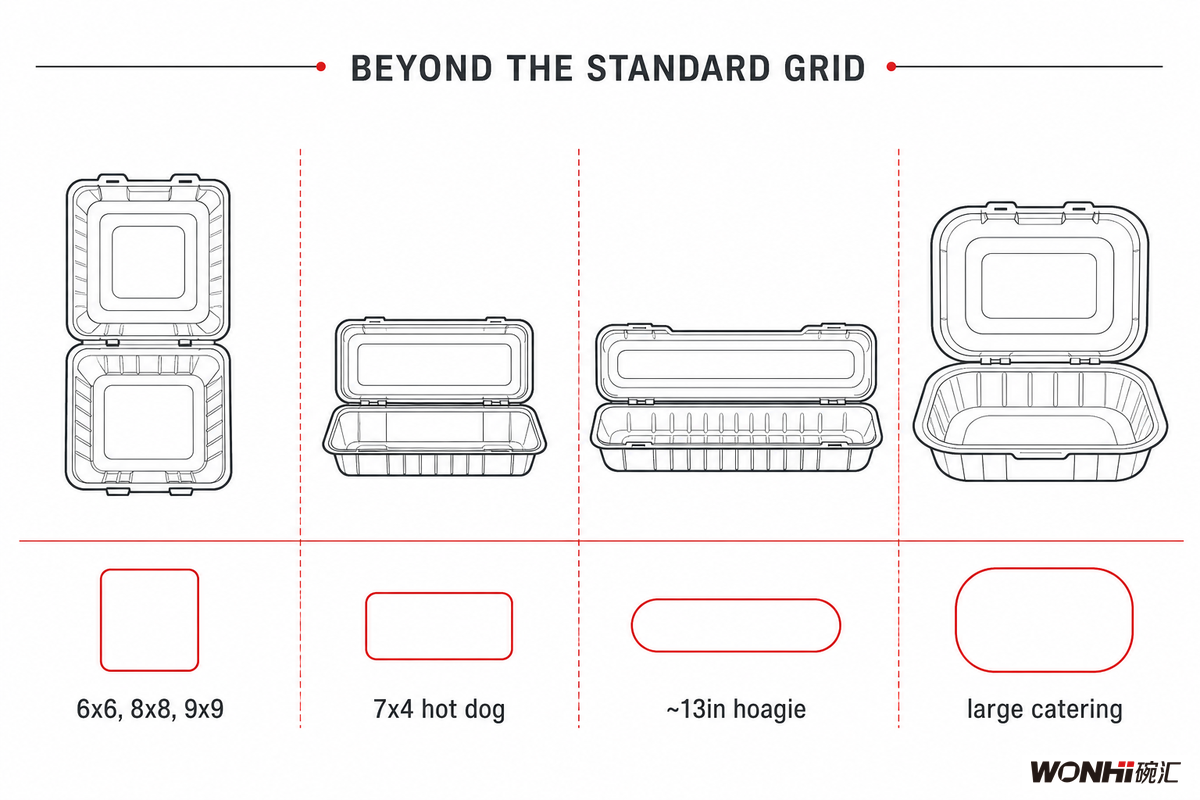
Embora as pessoas geralmente imaginem um recipiente quadrado ou quadrado (a grade padrão do próprio Wanhui roda 6×6, 8×8, 9×6 e 9×9 polegadas), o design da dobradiça não se limita a esses tamanhos Os fabricantes estabelecidos dos EUA também são capazes de fazer ferramentas para recipientes específicos para um item alimentar, não um tamanho de caixa genérico, por exemplo, um retângulo articulado de 7×4 polegadas, grandes recipientes de tampa articulada dimensionados para bandejas completas de catering e uma bandeja hoagie articulada de aproximadamente 13 polegadas para um cachorro-quente ou sub. Você não encontrará isso se digitar apenas o recipiente com dobradiça de “” em qualquer mecanismo de busca.
Na maioria das vezes, os compradores de produtos alimentícios obtêm um resultado melhor e mais prático especificando o produto (cachorro-quente, hoagie, sanduíche) e a forma da pegada alvo e o tamanho do saco de entrega ou da exibição do contador em que será colocado, não simplesmente citando dimensões de uma caixa em polegadas Nenhum cachorro-quente precisa de uma caixa 9×9 que seja ar 801TP3 T. Ele precisa de uma forma perfeitamente cortada em sua forma, e isso inclui um tamanho de bandeja de hoagie de plástico apropriadamente pequeno Isso otimiza o uso do material junto com o custo unitário, em uma ampla variedade de tamanhos 60 linhas de moldagem por injeção e Wanhui desenvolvimento de moldes interno pode produzir ferramentas personalizadas para esses requisitos personalizados e específicos de formato, juntamente com layouts quadrados e retangulares padrão, permitindo que uma rede de restaurantes dos EUA que atualmente compra recipientes quadrados de um fornecedor de plástico mude para quadrados do dia a dia e recipientes especiais para cachorro-quente ou bandeja de hoagies sem ter que passar por um segundo processo de qualificação do fornecedor.
Nota de Engenharia
Quando a dobradiça está no lado curto de um recipiente alongado (como o de um hoagie), o material precisa de uma seção flexível mais longa e estreita em comparação com a seção flexível mais curta e mais larga necessária para uma dobradiça em um recipiente quadrado com o mesma espessura de parede, a geometria da dobradiça deve ser dimensionada com o vão em que está fazendo a ponte, não apenas com o material.
Configuração do compartimento como decisão de segurança alimentar e apresentação
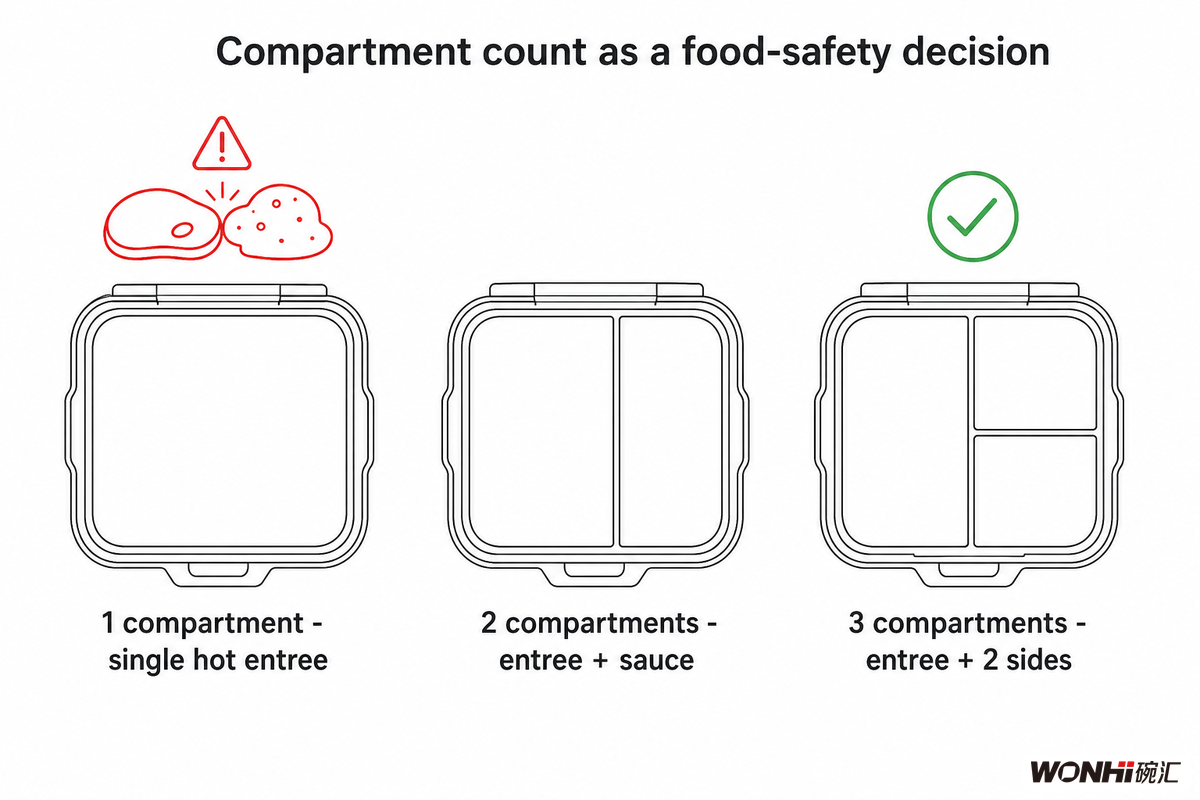
Contaminação cruzada, como definido pelo USDA, refere-se à transmissão de bactérias de um alimento ou superfície para outro através do contato quando os itens não estão fisicamente separados Em um recipiente articulado de compartimento único, a prevenção de tal contaminação depende inteiramente de como a equipe da cozinha embala a caixa Um item cru ou altamente úmido e um item pronto para consumo colocados um ao lado do outro não têm proteção contra a transmissão de bactérias em um design tão aberto; divisórias físicas podem fornecer essa proteção, que é o principal argumento para um recipiente multicompartimentado do ponto de vista da segurança alimentar, em vez de uma estética de revestimento de alimentos.
Há um argumento secundário para aquele para a segurança alimentar, no entanto, e isso é para apresentação Em um pedido entregue por um serviço de terceiros e mostrado na listagem do aplicativo, ou mesmo apenas em um prato apresentado para um evento atendido, ter alimentos tocando uns aos outros sugerem um trabalho de embalagem desagradável e desleixado, o que muitas vezes leva ao tipo de avaliações de uma estrela que se queixam de “tudo misturado.” Por alguns centavos, uma partição pode impedir que essa bagunça encharcada ocorra e, assim, salvar um cliente repetido potencialmente perdido.
Errar isso acarreta um risco real mensurável, não apenas estético: um único pedido de vários cursos mal embalado que aciona um reembolso ou uma revisão de uma estrela pode apagar a margem em vários pedidos corretamente embalados em um turno típico de 8 horas, porque a parede do compartimento faz o trabalho de separação de segurança alimentar, um cozinheiro de linha ocupado não consegue replicar manualmente de forma confiável na prática sob pressão de ordem e volume. As ferramentas do compartimento do próprio Wanhui, construídas com anos de experiência de produção interna de precisão, são projetadas para manter a separação da parede com uma tolerância consistente na grade de 3 cursos abaixo, em vez de depender de um molde genérico compartilhado entre famílias de contêineres não relacionadas.
| Curso /Emparelhamento de Alimentos | Compartimentos | Porquê |
|---|---|---|
| Entrada quente única, sem lados | 1 | Nenhum alimento de umidade mista para separar |
| Entrée + molho molhado ou molho | 2 | Evita que o molho mergulhe o item base em trânsito |
| Entrée + 2 lados distintos (por exemplo, arroz + vegetal) | 3 | Evita sangramento de sabor cruzado e transferência de umidade entre os lados |
| Placa para catering, estilo buffet | 3 | A separação física suporta o controle de contaminação cruzada descrito pelo USDA |
Essa ideia de particionamento por padrão também se estende além de um cenário de entrega de pedido único Um restaurante de tamanho médio que administra tanto take-out quanto catering, um serviço de assinatura de preparação de refeições domésticas ou qualquer empresa que atenda pedidos para um grande evento, todos naturalmente favorecem contêineres para viagem de três compartimentos como padrão, porque a partição funciona para segurança alimentar e apresentação, estejam eles embalando um almoço ou 200.
Limpe os contêineres articulados como uma ferramenta de merchandising, não apenas como embalagem
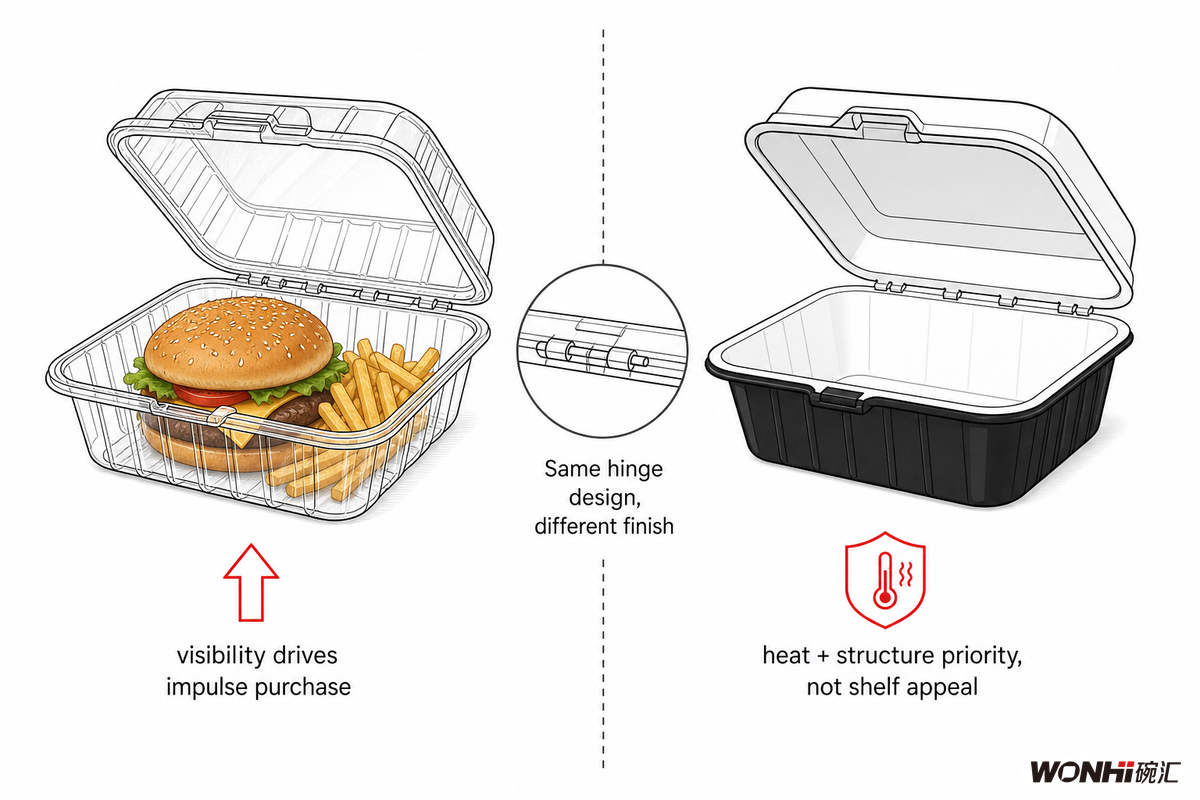
Em muitas padarias e delicatessens que armazenam e exibem sanduíches, saladas ou doces pré-embalados, por exemplo, a decisão de usar um recipiente de plástico transparente não é motivada pela segurança alimentar (já que seria igualmente seguro em um recipiente opaco). Em vez disso, o plástico transparente é selecionado porque um estudo sobre exibições de salgadinhos publicado na literatura do próprio National Institutes of Health descobriu que a visibilidade nos pontos de compra, como displays de caixa registradora ou apresentações de fim de corredor, pode influenciar diretamente as compras por impulso Os clientes tendem a comprar itens que podem ver prontamente Na verdade, opções de tampa de plástico transparente com tratamentos antiembaçantes são fabricados especificamente para melhorar a visibilidade do produto em displays de merchandising de alimentos frios“ porque, se a neblina obscurecer a visualização, todo o benefício da seleção de plástico transparente será anulado.
Esta é uma decisão de caso de uso, não uma atualização universal: embalagens transparentes trocam as propriedades de barreira à luz e umidade que protegem recheios sensíveis ao oxigênio ou sensíveis à luz, o que é uma das razões Gama de contentores articulados da própria Wanhui ainda executa preto e branco opaca MFPP como o padrão para entradas quentes, em vez de PP claro em toda a placa Escolha claro quando o produto precisa vender-se através da tampa; escolha opaco MFPP quando o trabalho está segurando calor e estrutura, não apelo prateleira.
Como o mesmo design de dobradiça de núcleo está subjacente a ambos, um balcão de padaria premium e um refrigerador econômico pode estocar a mesma pegada de concha 88 ou 99 em dois acabamentos diferentes sem requalificar um segundo formato de contêiner A decisão é finalizar, não formatar Os compradores que adquirem contêineres com tampas articuladas para uma barra de salada, um programa de contêineres para viagem ou uma caixa de delicatessen de supermercado estão realmente escolhendo um acabamento superficial na mesma concha moldada.
Escolher um acabamento para apelo de prateleira sozinho, apenas para descobrir a troca de barreira depois que um enchimento sensível à luz ou oxigênio perde frescor no início de um caso claro, é um erro que vale a pena evitar a lacuna entre “looks melhor na prateleira” e “holds up para a vida útil real do produto” é um risco real para qualquer coisa além de recheios secos ou estáveis em prateleira Como Wanhui executa PP claro e MFPP opaco nas mesmas 60 linhas de moldagem por injeção sob um sistema de produção certificado ISO 9001, um comprador OEM que obtém um programa misto de merchandising e hot-hold na prática qualifica um único fornecedor e família de moldes (a mesma pegada de 8×8 ou 9×9 usada acima) em vez de executar duas aprovações de fornecedores separadas para o que é, estruturalmente, um recipiente em dois acabamentos.
O plástico em um recipiente articulado é realmente seguro para alimentos?
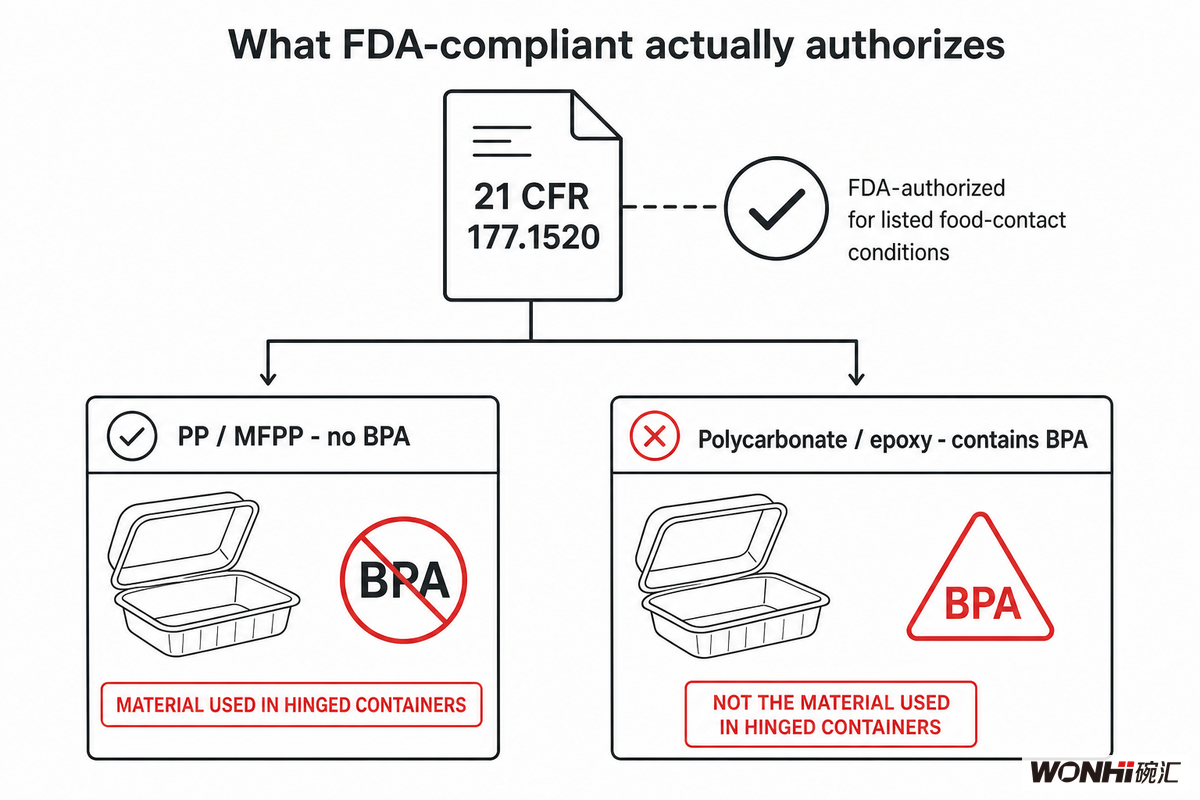
As resinas de polipropileno de qualidade alimentar são autorizado sob 21 CFR 177.1520 “ que a autorização é, não uma aprovação geral. Esse regulamento lista quais polímeros de alfinetes ”podem ser usados com segurança, sujeitos aos tipos e condições alimentares específicos nomeados na seção (licença não ilimitada) para qualquer alimento. A questão da devida diligência de um comprador é se a resina e o uso de um fornecedor se enquadram nessas condições nomeadas, e não apenas se o“ compatível com ”FDA aparece em uma folha de especificações.
Dois outros emblemas que aparecem ao lado de “FDA-compliant na maioria das folhas de especificações ” cofre para microondas (ou microfone FDA) e capturas à prova de vazamentos de lote são ganhos de forma diferente da autorização de resina é Microwave-safe e microwavable são reivindicações de desempenho sobre como a peça moldada específica se comporta sob calor, não uma garantia da família de resina; um recipiente PP de parede fina e um recipiente MFPP de parede espessa feito da mesma resina base pode avaliar de forma diferente O erro que os compradores cometem é tratar o“ em conformidade com o ”FDA como um emblema de passagem/falha única em vez de verificar se o tipo específico de alimento e a faixa de temperatura correspondem às condições reais autorizadas da resina (ou uma lacuna que acarreta risco real se um fornecedor substituir um lote de resina não verificado para atingir uma meta de preço. Como as linhas de polipropileno e MFPP de Wanhui são projetadas para manter a conformidade executada, qualificada sob 21 CFR 177.1520 e produzidas sob um certificado ISO 10000, cada um sistema de teste de resina de certificação de teste de conformidade real em conformidade com a mesma prática de teste de cada um sistema de teste de resina específica do mesmo padrão de teste de teste de teste de conformidade com a mesma função ISO 2000, em vez de uma aplicação de teste de teste de uma aplicação de teste de teste de conformidade com a mesma em conformidade com a mesma função específica do mesmo em conformidade com a mesma em conformidade com a mesma em conformidade com a mesma função do mesmo sistema de teste de uma aplicação de teste de uma função do mesmo em conformidade com a mesma em conformidade com a mesma em conformidade com a mesma em conformidade com a mesma função de teste de uma aplicação de teste de uma função do mesmo sistema de teste de uma função do OEM 200000000, um sistema de teste de teste de teste de teste de teste de uma função do mesmo em conformidade com a mesma em conformidade com a mesma em conformidade com a mesma em conformidade com a mesma em conformidade com a mesma em conformidade com a mesma em conformidade com a mesma em conformidade com a mesma em conformidade.
Leakproof reivindicação fechamento-ajuste, não uma reivindicação material (ainda resina) é totalmente food-afe e o recipiente pode pode vazar se a dobradiça e o aro não assentar mesmo que é exatamente o defeito a lista de verificação de recepção-inspeção abaixo é construída para pegar Os recipientes genuinamente seguros descansam em todos os três segurando de uma só vez: resina autorizada, uma classificação de microondas verificada para esse molde específico, e um fechamento que realmente senta.
Esse emblema “B-free” aparecendo em quase todas as listas de recipientes articulados de plástico merece uma segunda olhada. BPA é um produto químico usado em plásticos de policarbonato e resinas epóxi (não em polipropileno), uma distinção Explicador da própria Stanford Medicine sobre bisfenol A confirma independentemente do FDA. A própria posição atual da FDA é direto: a perspectiva atual da “FDA, baseada em sua avaliação de segurança mais recente, é que o BPA é seguro nos níveis atuais que ocorrem nos alimentos.” Imprimir “BPA-free” em um recipiente de PP é verdadeiro, e também é verdade para todos os outros recipientes de PP no mercado, porque o PP nunca foi uma resina de origem BPA.
Não sinaliza nada sobre o produto específico além de confirmar que é o material que todos já presumiram que era.
Por que os contêineres articulados vazam, deformam ou racham e como capturá-los ao receber
A própria linha de produção da Wanhui trata a fadiga da dobradiça e a falha no ajuste do fechamento como o defeito que uma lanchonete mais comumente percebe, uma base descentralizada de meio milímetro parece perfeitamente razoável em uma linha de fábrica e depois abre em uma sacola de entrega. Análise independente de falhas de engenharia de plásticos em conjuntos articulados descobre que as falhas na dobradiça em campo decorrem em grande parte da fadiga de baixo ciclo e da ruptura por fluência, tensão repetida no material em um ponto flexível que os projetistas originais nunca especificaram que ele poderia suportar, em vez de uma fratura gigante.
Muitos recipientes de alimentos articulados incluem selos invioláveis – uma pequena aba ou perfuração que rasga na primeira vez que a tampa é removida Isso é usado principalmente para entrega de terceiros ou coleta onde você deseja garantia de que o recipiente não foi previamente perturbado antes de o cliente pegá-lo O objetivo aqui é um trust, não um vazamento, então isso não é um substituto para um bom fechamento da tampa; mesmo um recipiente hermético selado vazará se a dobradiça não se encaixar corretamente nele.
Uma causa ainda mais simples do lado da cozinha mostra-se, porém, com o método de fechamento Um único cozinheiro em uma delicatessen articulada descrevendo as cristas moldadas em um recipiente resumiu a justificativa: “Eles sentam na metade inferior para que você não coloque o recipiente diretamente na condensação Estava seco, então está chorando.” Uma pequena mudança na orientação da embalagem pode ter um impacto descomunal nos volumes de reclamação do que muitos imaginam.
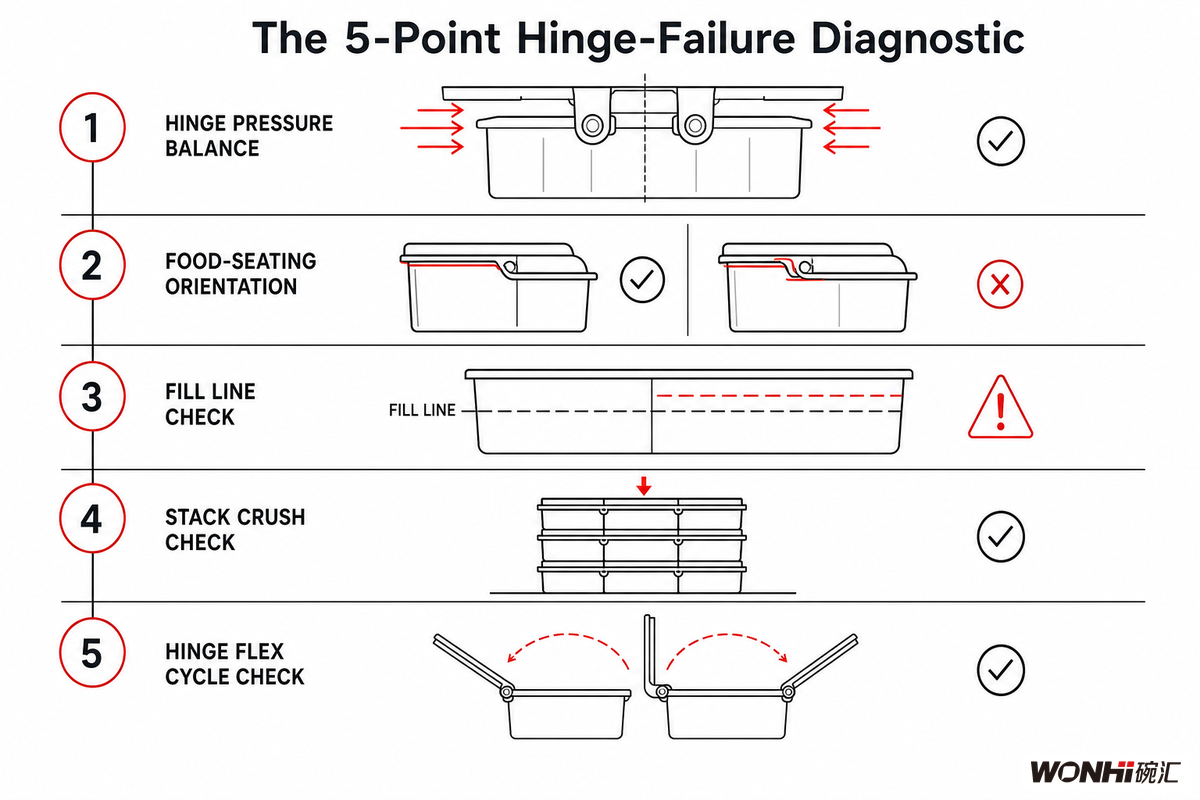
O diagnóstico de falha de dobradiça de 5 pontos listado abaixo foi projetado para ser usado na doca receptora, à medida que você examina uma remessa que já chegou, em vez de no chão de fábrica como parte de uma operação de controle de qualidade de produção. É igualmente aplicável a uma tampa articulada resistente a vazamentos classificada para alimentos quentes e frios, ou a uma caixa leve para sanduíches/saladas resfriadas; os 5 pontos de verificação concentram-se na mecânica de fechamento, e não na faixa de temperatura para a qual o recipiente foi especificado.
- ✔ Flex 5 dobradiças aleatórias através de um ciclo de fechamento aberto completo à mão. Se parecer apertado ou desenvolver uma linha de tensão branca, ele poderá sair antes mesmo que o consumidor final a veja.
- ✔ Certifique-se de que a tampa e a base se encontrem uniformemente sob a mesma pressão em toda a periferia. Um lado está fora de sintonia, o que contribui para o fechamento do “clamshell” que será aberto em qualquer lugar.
- ✔ Certifique-se de que as equipes de embalagem estejam acomodando os alimentos na metade correta com base na crista/ventilação moldada do recipiente, e não no lado mais rápido de embalar.
- ✔ Sinalize qualquer contêiner cheio acima de sua linha de enchimento. O preenchimento fará com que a dobradiça feche em uma carga que nunca foi planejada para o motivo mais comum de vazamentos durante o trânsito.
- ✔ Experimente a caixa empilhada para verificar a resistência ao esmagamento, antes que uma palete completa seja carregada em um caminhão quente ou em um refrigerador.
Além das proibições estaduais dos EUA, o quadro regulatório global para contêineres sem espuma
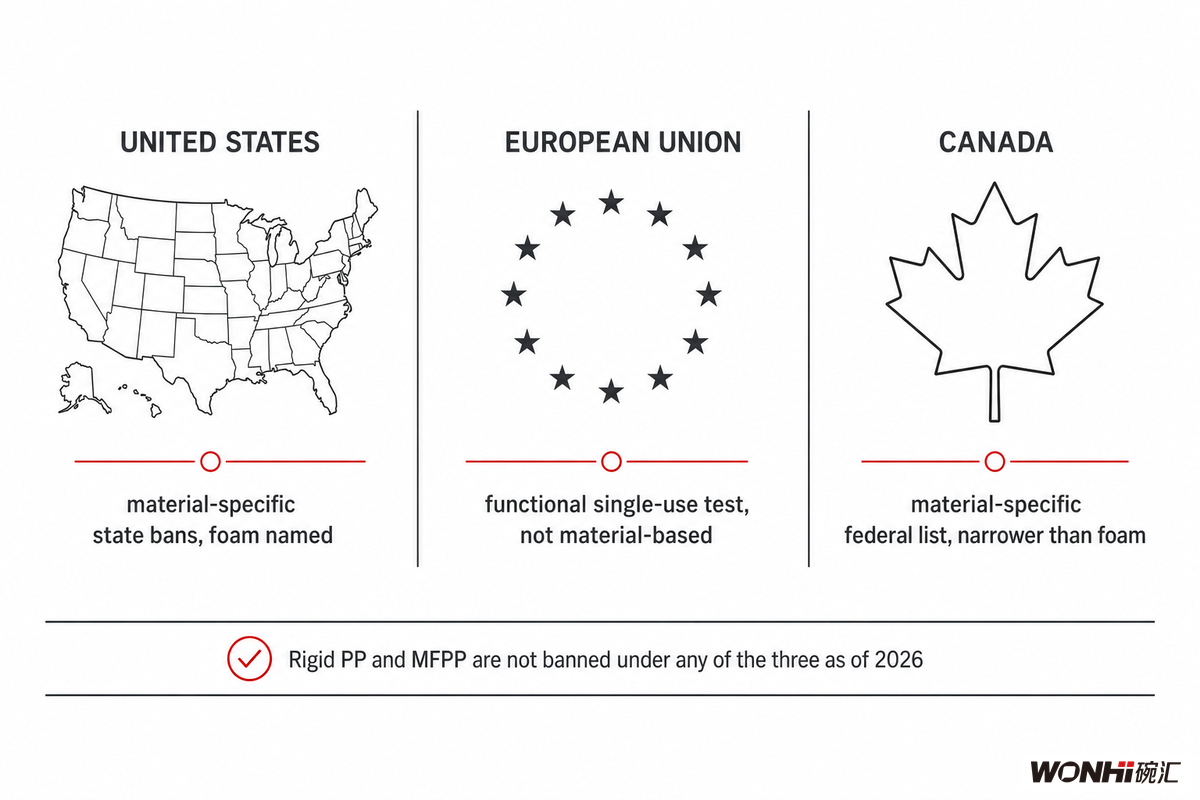
Próprio Wanhui a página de conformidade rastreia o mapa de proibição de serviços de alimentação de espuma dos EUA em 12 estados para recipientes de tampa articulada de espuma especificamente, mas isso é escopo para espuma sozinho, e é inteiramente um mapa centrado nos EUA Os compradores que compram para a Europa ou Canadá estão operando sob conjuntos totalmente diferentes de regulamentos que não são baseados em dobradiça em tudo.
A Europa aplica um teste funcional ao abrigo da sua Diretiva Plásticos de Utilização Única, em vez de uma proibição de materiais: um recipiente para alimentos é abrangido pela diretiva quando é concebido para utilização única, geralmente consumido diretamente do recipiente, e não requer preparação adicional, uma definição ampla o suficiente para incluir um recipiente articulado quente de PP rígido para fast food, bem como um recipiente de espuma. Além disso, o mais novo Regulamento (UE) 2025/40 (Regulamento sobre Embalagens e Resíduos de Embalagens) determina que, até 12 de fevereiro de 2028, os distribuidores de takeaway HORECA ofereçam aos clientes a possibilidade de encomendar e receber os seus alimentos prontos para consumo em embalagens reutilizáveis dentro de um sistema de reutilização Este prazo será aplicado quer o recipiente seja MFPP, PP ou PET.
A proibição dos EUA parece ser ecoada pelo canadense Regulamentos de proibição de plásticos de uso único ao destacar certos materiais, embora este seja mais estreito que o “foam”, restringindo apenas poliestireno expandido ou extrudado, PVC, plástico oxo-degradável ou plástico preto com negro de fumo como materiais proibidos para utensílios de serviços de alimentação Os recipientes articulados rígidos PP e MFPP não estão entre eles.
Um risco oculto para a Europa é assumir que o sign-off de conformidade de uma região viaja por toda parte: um contêiner liberado sob o teste funcional da Europa ainda pode tropeçar na lista específica de materiais do Canadá, e o erro comum é tratar uma aprovação única como um passe global compradores uma lacuna real quando uma remessa é mantida na alfândega enquanto a papelada correta é obtida após o fato Como a Wanhui exporta contêineres articulados para a Europa, Américas, Oriente Médio, Ásia-Pacífico e América do Sul sob um sistema de produção interno certificado ISO 9001 e FDA 21 CFR 177 construído em torno de 20 anos de experiência em conformidade com a exportação, um comprador OEM que fornece na prática pode solicitar documentação de conformidade específica do destino por produção, em vez de assumir que a papelada de uma região cobre uma remessa com destino a outra (o mesmo hábito de devida diligência que captura uma jurisdição de misma antes que um contêiner saia da fábrica.
O que realmente acontece com um recipiente articulado PP ou PET após o descarte
Relatório de reciclagem de PET de 2024 da NAPCOR coloca a taxa de reciclagem de garrafas PET dos EUA em 30,2% para 20241 abaixo do pico de 32,5TP3T de 2023, mas ainda acima da média de 29,5% da década anterior. As termoformas PET, às quais pertencem as conchas da família das resinas, contam uma história diferente: o mesmo relatório mostra que a recuperação específica da termoforma cresceu 521TP3 ano após ano, para 264 milhões de libras nos EUA e Canadá em 2024. O impulso real de uma base pequena, embora a procura do mercado pelo material recuperado tenha permanecido inconsistente.
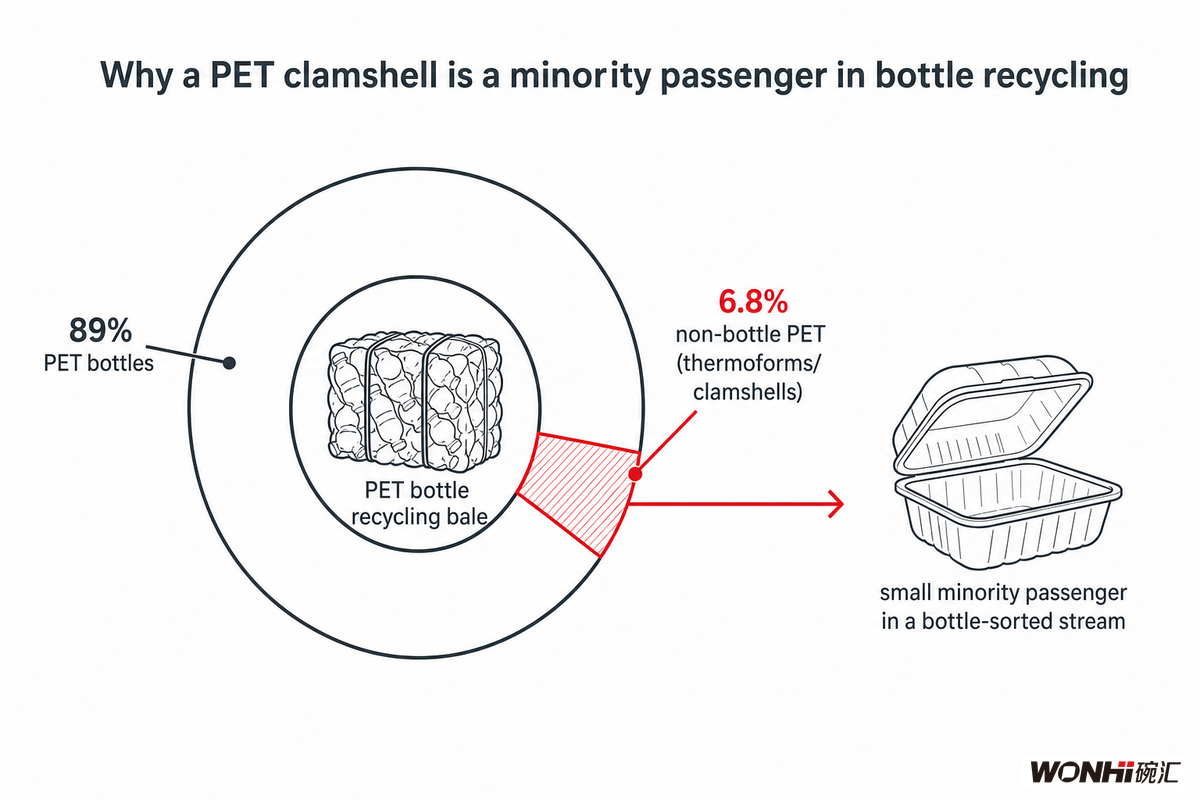
Pesquisa científica revisada por pares sobre os fluxos de reciclagem de plásticos nos EUA explica parte do porquê: um modelo de fluxo de materiais nesse mesmo estudo coloca um fardo PET típico em garrafas PET de 89,01TP3 T e PET sem garrafa de 6,81TP3 T, e a pureza do fardo de garrafa do mundo real é ainda maior em outros lugares no mesmo papel 91,1% para 99.3%, de acordo com os dados da DSM Environmental Services que cita De qualquer forma, a concha, sendo um pequeno passageiro minoritário em um processo de classificação fortemente inclinado para garrafas, não é rejeitada porque a resina é inerentemente não reciclável ‘é rejeitada por causa de como os fardos recebidos são compostos, embora essa composição esteja agora mudando à medida que a recuperação específica da termoforma aumenta.
No Canadá, os documentos oficiais de orientação assumem uma postura realista e não encorajadora: optar por uma resina mais reciclável como o PP aumenta o potencial de recuperação de valor, mas não garante resultados positivos no final da vida útil, e o recipiente rejeitado seria descartado independentemente do código de resina. Em termos mais simples para um comprador: a resina é apenas um componente de um resultado de fim de vida; como o contêiner é coletado, classificado e processado em um mercado final específico é a outra parte importante da história, e #5 ou #1 é apenas o ponto de partida.
Perspectivas da indústria, para onde se dirige o formato do contêiner articulado
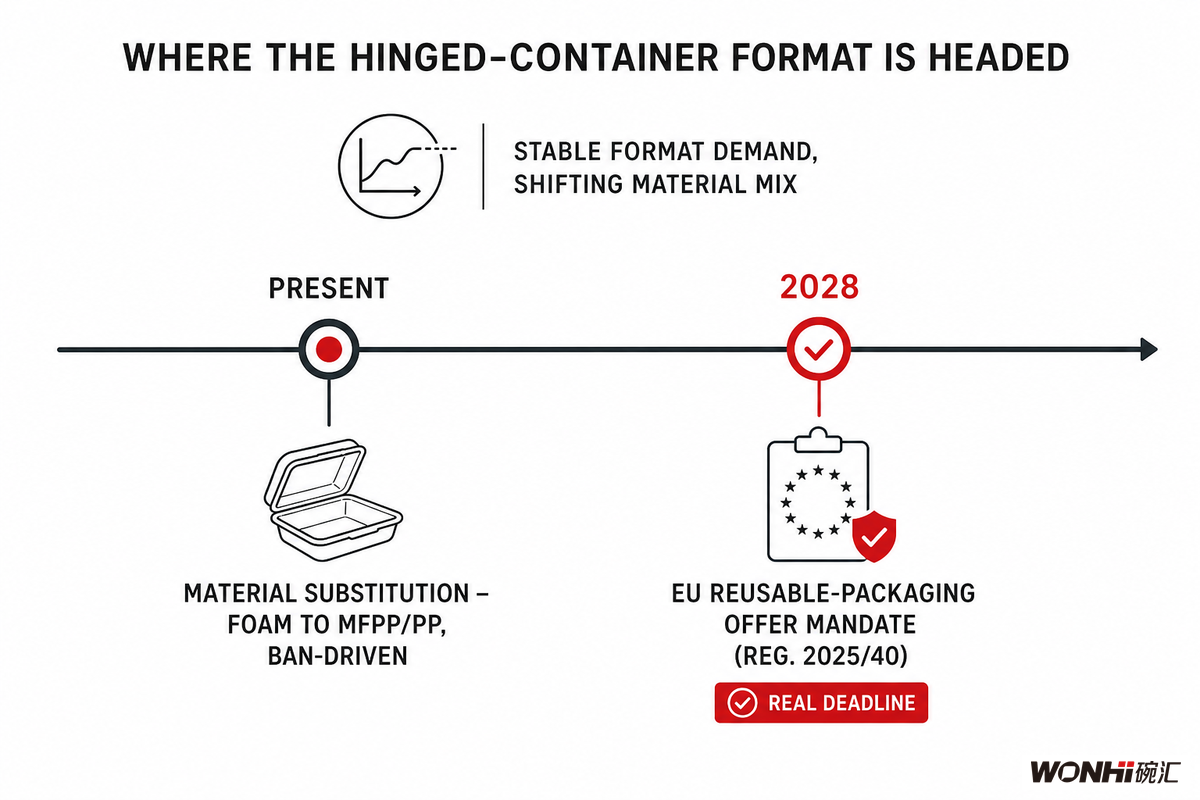
a demanda de pesquisa por categoria articulada/clamshell também não está realmente se expandindo; a busca agregada por contêineres “clamshell” não se moveu nos últimos meses Isso, observaria, é uma indicação de maturação da categoria, não de angústia. Na medida em que há movimento real, é no nível da subcategoria em dois níveis:
Primeiro é o material substituição que já está em progresso e é consequência da onda de proibição: a demanda de espuma está amolecendo, já que MFPP e PP claro tomam comida quente e reaquecem a partir de espuma devido a uma lista cada vez maior de estados onde o material não pode ser vendido para esses fins O movimento regulatório é a segunda frente vindo de uma direção inesperada para muitos como o Regulamento (UE) 2025/40’s 2028 oferta obrigatória para reusable-embalagem é material neutro, o que será tanto uma preocupação para qualquer PP rígido ou MFPP recipiente articulado como será para uma espuma um para qualquer operador de marketing na UE. Imprensa comercial cobrindo tendências de embalagens de serviços de alimentação em 2026 enquadra a mudança em torno da sustentabilidade e do valor, da conveniência e da sustentabilidade, não apenas da sustentabilidade, o que se alinha com o motivo pelo qual os pedidos estão sendo feitos na prática: a durabilidade vem em primeiro lugar, a reciclabilidade em segundo lugar.
Um item de ação prática: se a sua cadeia de abastecimento tocar no canal HORECA da UE, comece agora a definir o âmbito de uma oferta de embalagem reutilizável, em vez de esperar pelo prazo de 2028 para forçar uma pesquisa apressada de fornecedores e faça um loop fornecedor atacadista que já executam linhas multimateriais em vez de uma comprometida com uma única resina O preço está seguindo a mesma lógica de substituição: a espuma ainda mantém um preço por unidade mais baixo onde permanece legal, mas a vantagem do MFPP no desempenho de isolamento e reaquecimento fecha a lacuna de custo total uma vez que penalidades de proibição, reembolsos e avaliações de uma estrela de caixas de entrega encharcadas são contadas, o MFPP é o material projetado para substituir a vantagem de isolamento da espuma, menos a exposição à proibição da espuma.
“O ajuste da tampa é onde as conchas baratas falham, uma base que está a meio milímetro de distância parece boa na linha e aparece aberta na mala de entrega. Nós testamos amostras de fechamento em cada corrida porque esse é o defeito que uma lanchonete realmente vê.”
Equipe de Qualidade e Engenharia de Wanhui
A equipe por trás deste relatório
Este guia foi compilado pela Shandong Wanhui Environmental Protection Technology Co., Ltd., um fabricante de 20 anos que opera 20 linhas de termoformação, 6 linhas de extrusão de folhas e 60 linhas de moldagem por injeção em MFPP, PP, PET e espuma articulada- produção de contêineres. A estrutura de segurança alimentar do compartimento e a lista de verificação de inspeção de recebimento nesta peça baseiam-se em nossos próprios testes de ajuste de fechamento e ciclo de dobradiça do piso de produção, verificados de acordo com fontes regulatórias da FDA, USDA, UE e Canadá citadas abaixo.
Referências e fontes
- 21 CFR 177.1520 Inventário de Substâncias em Contato com Alimentos • Administração de Alimentos e Medicamentos
- Bisfenol A (BPA): Uso em Aplicação de Contato com Alimentos • Administração de Alimentos e Medicamentos
- Fatos sobre o bisfenol A – Medicina de Stanford
- Prevenir a contaminação cruzada Serviço de Segurança e Inspeção Alimentar da USDA
- Regulamento (UE) 2025/40, Embalagens e Resíduos de Embalagens 0 Jornal Oficial da União Europeia
- Regulamentos de proibição de plásticos descartáveis: Diretrizes Técnicas 0 e Mudança Climática Canadá
- Relatório de reciclagem PET de 2024 Associação Nacional de Recursos de Recipientes PET (NAPCOR)
- Reciclagem de Plásticos nos Estados Unidos: Fluxos de Materiais Plásticos (PMC) Institutos de Saúde
- A disponibilidade de snacks para alimentos exibe que podem desencadear compras por impulso (PMC) Institutos de Saúde
- Análise Experimental em uma Dobradiça Viva Fabricada Aditivamente Universidade do Texas
- US7685676B2, dobradiça viva Escritório de Patentes e Marcas Registradas (Google Patents)
Perguntas frequentes
P: O que é um recipiente com tampa articulada e como é diferente de uma cuba com tampa separada?
Ver Resposta
Um recipiente com tampa articulada (ou concha) é moldado por injeção em uma única peça com a tampa e a base conectadas por uma dobradiça viva em vez de uma tampa separada. Em contraste, uma cuba de delicatessen com tampa encaixável apresenta a tampa como uma peça totalmente separada que é facilmente extraviada, misturada com o recipiente errado ou trocada intencionalmente Esta construção de dobradiça de peça única prioriza a segurança garantida da tampa até a base, razão pela qual os recipientes de alimentos com tampa articulada são usados esmagadoramente para embalagem de retirada e entrega de uso único (a partir de sanduíches e caixas de retirada chinesas para bandejas de catering completas (em comparação com cuba plástica com tampas removíveis).
P: Os recipientes de plástico articulados são seguros para alimentos?
Ver Resposta
O polipropileno utilizado em recipientes articulados é Food and Drug Administration (FDA) compatível para contato com alimentos, conforme descrito em 21 CFR 177.1520, para os alimentos e condições de uso listados no mesmo “ não uma aprovação ampla e ilimitada para qualquer alimento a qualquer temperatura Esse termo de marketing onipresente sem BPA que acompanha essas listagens, embora factualmente preciso, é em grande parte sem sentido, pois o BPA é um produto químico usado em resinas de policarbonato/epóxi, não em polipropileno Os recipientes de PP nunca tiveram risco associado ao BPA.
P: Quantos compartimentos devo encomendar para catering versus entrega em árvore única?
Ver Resposta
Uma única entrada quente sem lado não precisa de parede de separação interna Um molho molhado ou molho requer separação para evitar a mistura com o item principal durante o transporte, e dois lados justificam a partição para maior clareza e controle da contaminação cruzada, conforme recomendado pelo USDA para buffets e serviços de catering Considere o tipo de curso e o teor de umidade, não apenas as dimensões gerais do recipiente.
Q: Que tamanhos e formas estão disponíveis além do retângulo padrão?
Ver Resposta
Além da grade quadrada/retangular padrão de caixas plásticas de 6×6 a 9×9 polegadas, os fabricantes também produzirão ferramentas dedicadas para embalagens plásticas de alimentos específicas para a forma, como um recipiente para cachorro-quente e sanduíche de aproximadamente 7×4 polegadas, ou um recipiente hoagie de 13 polegadas, geralmente disponível para pedidos em grandes quantidades Sempre consulte seu fornecedor por tipo de alimento e pegada, em vez de apenas por centímetros.
P: Quanto tempo os recipientes articulados normalmente duram antes que a dobradiça falhe?
Ver Resposta
A durabilidade da dobradiça raramente é um problema com recipientes de uso único, dado seu descarte imediato após uma viagem, ao contrário dos reutilizáveis articulados abertos inúmeras vezes Uma estatística mais pertinente é que as dobradiças vivas convencionais de polipropileno moldadas por injeção são normalmente projetadas para milhões de ciclos de fechamento aberto em aplicações reutilizáveis; consequentemente, uma falha de dobradiça na embalagem ou entrega é invariavelmente devido a um defeito ou excesso de enchimento, não exaustão do projeto A análise de falhas na montagem articulada indica que a fadiga de baixo ciclo e a ruptura por fluência em concentrações de tensão não projetadas na conta de peça para a maioria das falhas (em termos práticos, uma dobradiça que racha no primeiro fechamento foi preenchida demais, dimensionada inadequadamente ou danificada antes da embalagem Um teste de estresse manual de uma amostra (conforme o Diagnóstico de Falha de Dobradiça de 5 Pontos, descrito em outro lugar) detecta efetivamente esses problemas antes que eles impactem os clientes.
Q: São PP e PET contentores articulados reciclável?
Ver Resposta
Tecnicamente sim, a imagem está melhorando mais rápido do que a maioria dos compradores imagina: a reciclagem de garrafas PET nos EUA funcionou 30,2% em 2024 (NAPCOR), enquanto a recuperação térmica PET (a categoria de conchas) caiu em 52% ano após ano para 264 milhões por o mesmo relatório NAPCOR, embora ainda de uma base pequena contra as garrafas 89.01TP3 T/6.81TP3 T não-garrafa PET um modelo de fluxo de materiais coloca em um fardo típico (pureza do mundo real muitas vezes corre mais alto, 91.11TP3 T-99.31TP3 T por dados de Serviços Ambientais DSM).A escolha do material só marginalmente melhora as probabilidades; a aceitação pelo programa de coleta local ainda impulsiona o destino final.
P: As regulamentações fora dos EUA afetam qual material devo encomendar?
Ver Resposta
Sim. A diretiva de Plástico de Uso Único da UE define um teste funcional (consumido imediatamente, sem necessidade de preparação adicional e comido com recipiente) para o qual um recipiente quente de PP ou MFPP poderia ser tratado como uma espuma, enquanto o novo Regulamento (UE) 2025/40 exige um material neutro, embalagem reutilizável para o takeaway HORECA a partir de fevereiro de 2028. o Canadá tem um escopo menor (apenas espuma, PVC, plásticos oxo-degradáveis e black-carbon são proibidos), portanto, isso não se estende a PP e MFPP rígidos lá.
Artigos Relacionados
- Recipientes articulados MFPP Linha PP cheia de minerais da Wanhui para rede elétrica quente e reaquecida
- Recipientes articulados de plástico (P.P./PET) para saladas, e exposição do delicatessen
- Recipientes articulados de espuma: proibições, segurança e alternativas (2026) 2026 EUA. mapa de proibição de espuma e guia de decisão do switch-driver
- Seletor de tamanho de contêiner Ção de capacidade para o tamanho da sua porção
- Bandejas de comida: Bandejas de serviço descartáveis e Guia de bandejas de catering