Nehmen Sie Kontakt mit Wanhui Company auf


Aktualisiert im Juli 2026.
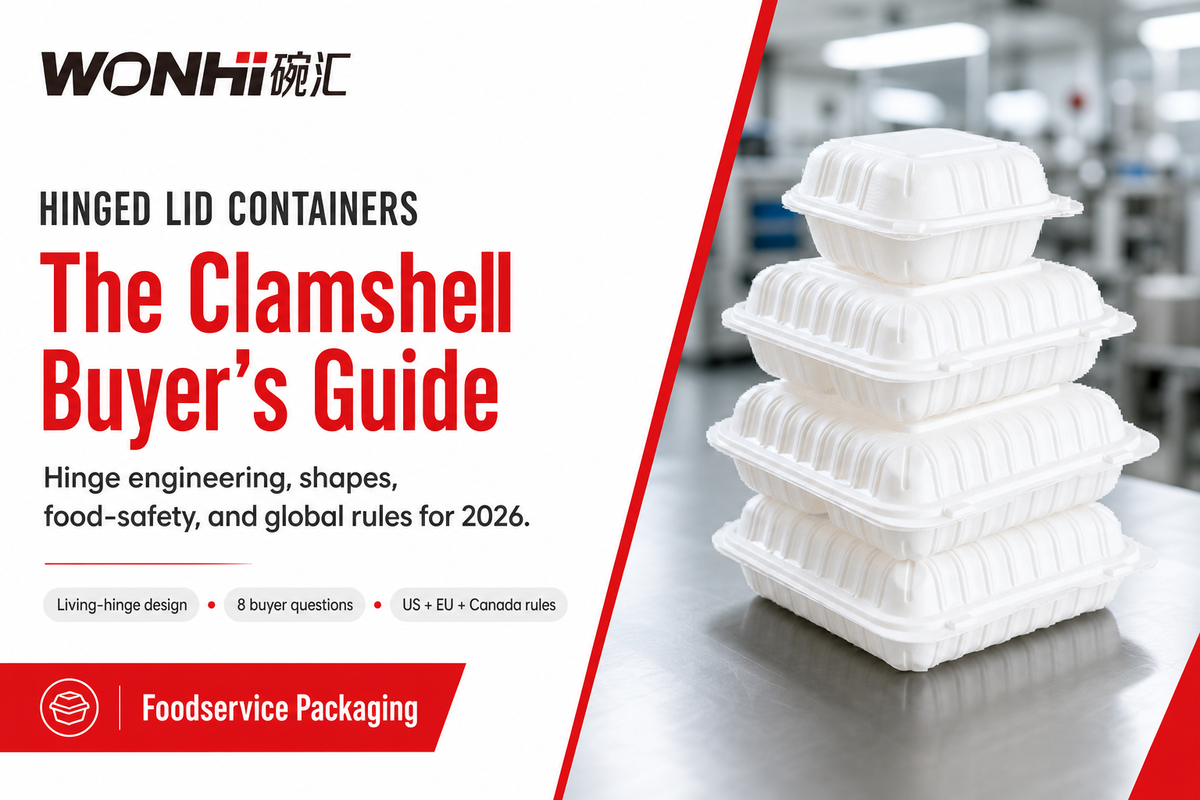
Behälter mit Klappdeckel sind einteilige Servicepakete, die oft als Muscheln bezeichnet werden und bei denen ein geformtes Wohnscharnier den Deckel und das Basisteil verbindet, und sie sind das Standardformat zum Mitnehmen für Fast Food, Lieferung und Catering. Ob die Suche ist für Behälter mit Klappdeckel aus Kunststoff oder die unten separat abgedeckten Schaumstoffversionen, Wanhuis eigene Seite mit Klappdeckelbehältern Lösung Zerlegt bereits, welches Material zu wählen ist: MFPP, klares PP oder Schaum. Diese Anleitung beginnt dort, wo diese Seite anhält. Sie behandelt die Fragen, die ein Käufer stellt, nachdem das Material ausgewählt wurde, wie das Scharnier selbst konstruiert ist, welche Formen über das Standardrechteck hinaus existieren, wenn eine Fachanzahl eine Entscheidung über die Lebensmittelsicherheit und keine Größenpräferenz ist und was sich ändert, sobald ein Behälter eine Grenze überschreitet.
Schnelle Spezifikationen
| Format | Einteiliger Körper; Deckel und Sockel sind durch ein integriertes Wohnscharnier verbunden |
| Übliche Materialien | MFPP, klares PP, PET/RPET, EPS-Schaum (staatlich reguliert in 12 US-Bundesstaaten) |
| Kapazitätsbereich | Ungefähr 4 oz bis 64+ oz, je nach Schimmelpilzfamilie |
| Abteilmöglichkeiten | 1, 2 oder 3-Fach |
| Stapelbar / Transport | Ja, flach für den Palettentransport |
| Undicht / mikrowellengeeignet | Undicht im geschlossenen Zustand pro Fülllinie; Mikrowellensicher in lebensmittelechtem Polypropylen und MFPP-Qualitäten |
| Materialauswahl | Siehe Wanhuis Material-Fit-Selektor |
Was macht den Container “Deckel” erklärt das Living-Hinge Design
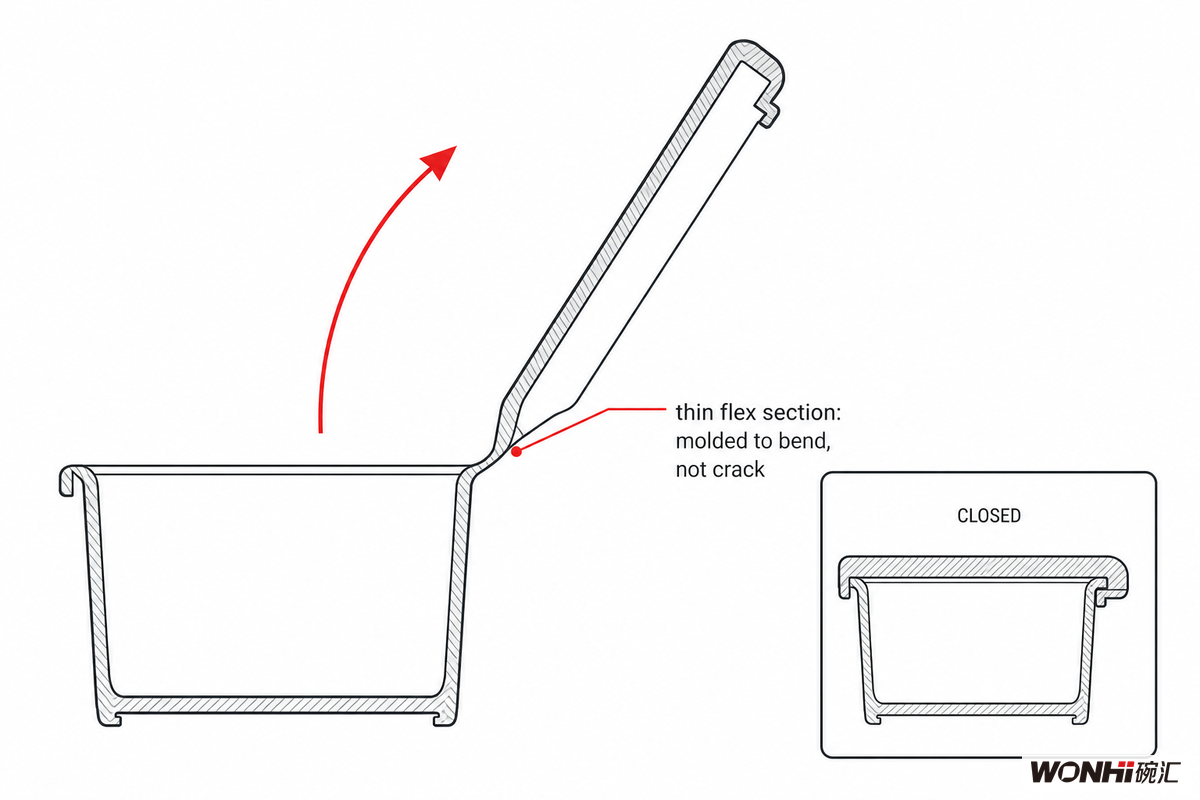
Ein Formteil, das ist alles an einem Klappdeckelbehälter Statt Deckel, Kappe, Schnappring oder Band gibt es eine kurze, biegbare Verbindung aus dem gleichen Kunststoff – ein lebendes Scharnier – um Deckel und Boden zusammen zu halten In Spritzguss-Polypropylen halten traditionelle Scharnierstrukturen Millionen von Offen-Schließ-Zyklen durch, sagen Ingenieure an der Universität von Texas, „, weil das flexible Teil entweder wärmegeformt oder speziell spritzgegossen wird, um sich zu biegen, anstatt unter Belastung zu reißen.
Bei MIT, Forschung zu Gelenkflexuren Weist auch auf PP und PE als dominierende Materialien für ihre Elastizität hin Der Grundmechanismus selbst ist dokumentiert in US-Patent 7.685.676, “, das das lebende Scharnier als einen biegsamen Abschnitt beschreibt, der so konstruiert ist, dass er wiederholte Spannungen und Kompression ohne Risse verträgt. Nennen Sie es das Zero-Piece-Loss-Scharnier (manchmal auch ”Ansteckdeckel“oder ”Ansteckklapp” genannt): Da sich der Deckel nie vom Behälterkörper lösen kann, gehen keine Deckel an der Verpackungslinie verloren, keine leeren Aussteckbeutel enden mit einem isolierten Deckel, der im Boden rollt, und keine Kunden müssen eine unordentliche Schublade durchsuchen. Kurz gesagt, es gibt kein wirkliches technisches Argument, das zugunsten des Deckel-/Körperrohrdesigns gegenüber einem eigenständigen Design vorgebracht werden könnte: ein Teil, wenn auch nur ein Teil, das nicht weggeht -Ton-Solus-Soling-s-s-sich-sich-s. Sortiment für Einweg-Lebensmittelbehälter, anstelle loser Einweg-Kunststoffwannen.)
Auch bei nicht allen Scharnierkonstruktionen handelt es sich um kontinuierliche Strukturen. Die Schaumstoffserie von Dart Container verwendet beispielsweise ein patentiertes perforiertes “Performer”-Scharnier, das aus kleinen Perforationen anstelle einer kontinuierlichen Biegung besteht, ein alternativer Ansatz zur Lösung von Haltbarkeitsproblemen innerhalb des Schaumstoffmaterials mit geringerer Dichte. Dieser Ansatz mit perforiertem Scharnier macht einen Kompromiss zwischen der Ermüdungsbeständigkeit eines Endlosscharniers und den besseren Biegeeigenschaften, die in einem Schaumstoffmaterial erforderlich sind, dem die inhärente Flexibilität von PP fehlt. Die Schwenkgeform ist ein echtes Risiko, das deutlich zu dünn geformt ist, bevor die oben genannte Millionen von Zyklen überleben. “Toleranz”und-Toleranz“, das sich zwischen jedem offenen, weil das Handwerkzeug-Therum-zu-zu-zu-zu-Thr-Thr-Thr-Thr-Thr-Thr-Thr-Thr-Thr-Thr-Thr-Thr-Thr-Thr-Thr-Throplastikoplastik.
Spezial- und nicht standardmäßige Scharnierformen jenseits des rechteckigen Gitters
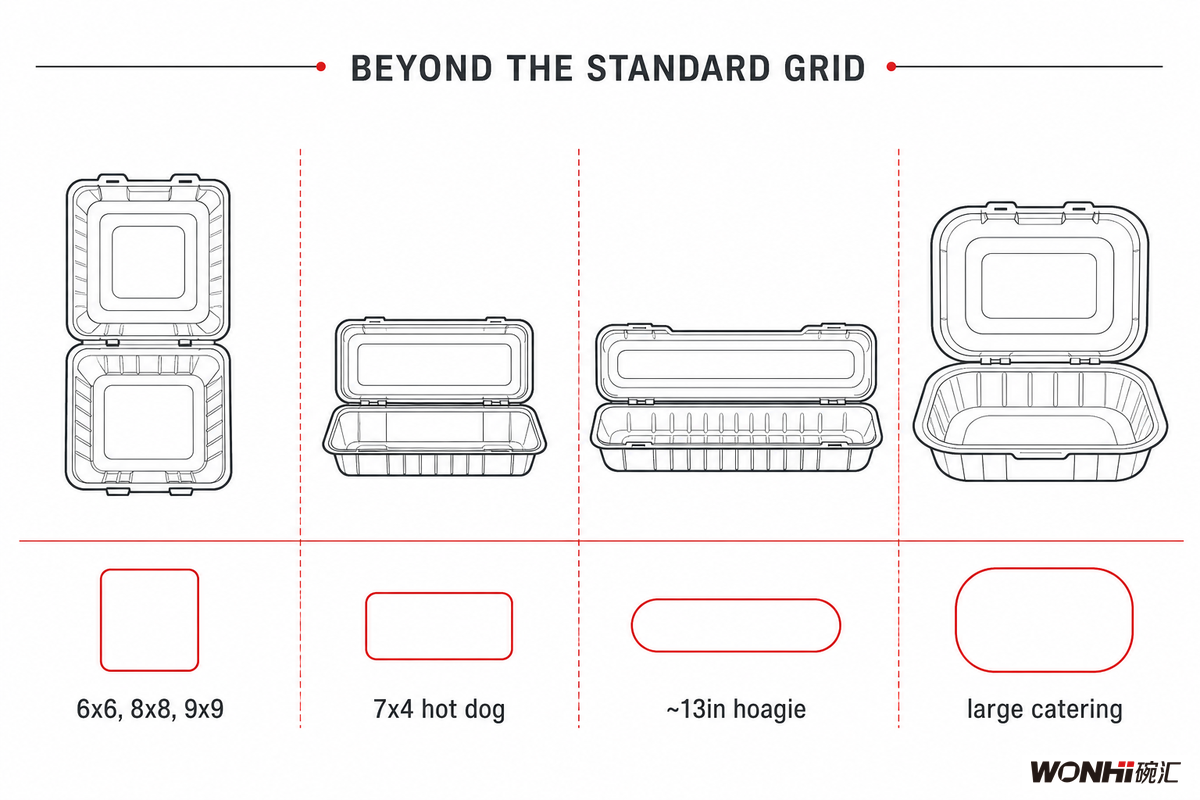
Obwohl sich die Leute üblicherweise einen kastenförmigen oder quadratischen Behälter vorstellen (Wanhuis eigenes Standardraster umfasst 6 ̄6, 8 ̄NF8, 9 ̄ff6 und 9 ̄NF cher), ist das Scharnierdesign nicht auf diese Größen beschränkt. Etablierte US-Hersteller sind auch in der Lage, Werkzeuge für Behälter herzustellen, die speziell auf ein Lebensmittel zugeschnitten sind, nicht auf eine generische Kartongröße, zum Beispiel ein 7 ¤4-Zoll-Rechteck mit Scharnier, große Behälter mit Klappdeckel, die für vollständige Catering-Tabletts dimensioniert sind, und ein etwa 13-Zoll-Scharnlaiblech für einen Hot Dog oder Sub. Sie werden diese nicht finden, wenn Sie einfach “Scharniere”in” in eine Suchmaschine eingeben.
Meistens erhalten Käufer von Lebensmitteln ein besseres, praktischeres Ergebnis, indem sie das Produkt (Hot Dog, Hoagie, Sandwich) und die Ziel-Fußabdruckform und -größe des Lieferbeutels oder der Thekenanzeige angeben, in die es platziert wird, nicht einfach durch Angabe der Abmessungen einer Box in Zoll Kein Hot Dog benötigt eine 9.E.R.F.9-Box mit 80% Luft. Sie benötigt eine Form, die perfekt in ihre Form geschnitten ist, und dazu gehört auch eine entsprechend kleine Kunststoff-Hoagie-Tray-Größe Dies optimiert die Materialnutzung zusammen mit den Stückkosten über eine große Vielfalt an Größen. Wanhuis 60 Spritzgusslinien und Eigene Formenentwicklung Kann maßgeschneiderte Werkzeuge für solche benutzerdefinierten, formspezifischen Anforderungen zusammen mit standardmäßigen quadratischen und rechteckigen Layouts herstellen, sodass eine Restaurantkette in den USA, die derzeit quadratische Behälter von einem Kunststoffanbieter kauft, sowohl auf alltägliche Plätze als auch auf spezielle Hot-Dog- oder Hoagie-Tray-Behälter umsteigen kann ohne einen zweiten Anbieterqualifikationsprozess durchlaufen zu müssen.
Technische Anmerkung
Wenn sich das Scharnier auf der kurzen Seite einer länglichen Behälterform befindet (wie bei einem Hoagie), benötigt das Material einen längeren, schmaleren Biegeabschnitt im Vergleich zu dem kürzeren, breiteren Biegeabschnitt, der für ein Scharnier an einem quadratischen Behälter erforderlich ist Bei gleicher Wandstärke muss die Scharniergeometrie mit der Spannweite, die sie überbrückt, skalieren, nicht nur mit dem Material.
Fachkonfiguration als Entscheidung für Lebensmittelsicherheit und Präsentation
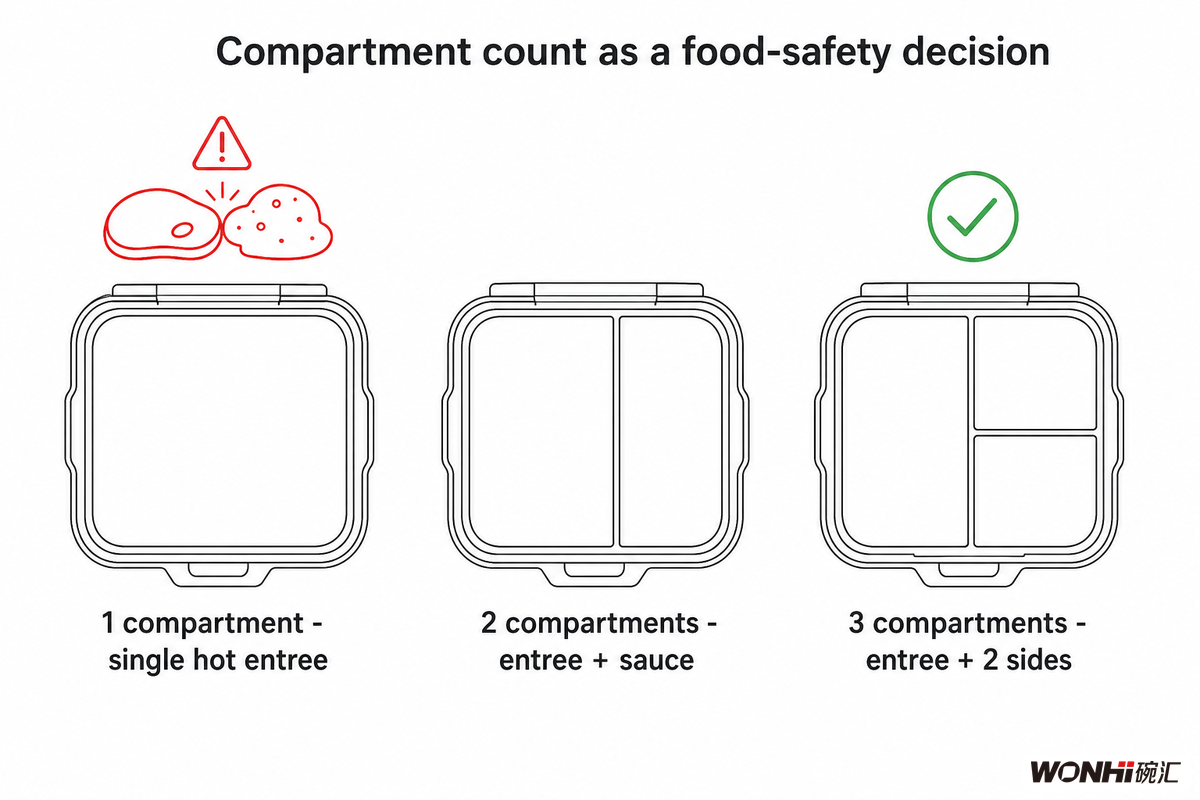
Kreuzkontamination, wie USDA definiert, bezieht sich auf die Übertragung von Bakterien von einem Lebensmittel oder einer Oberfläche auf eine andere durch Kontakt, wenn die Gegenstände nicht physisch getrennt sind In einem Klappbehälter mit einem Fach hängt die Verhinderung einer solchen Kontamination vollständig davon ab, wie das Küchenpersonal die Schachtel verpackt Ein roher oder stark feuchter Gegenstand und ein nebeneinander platzierter verzehrfertiger Gegenstand haben keinen Schutz vor der Übertragung von Bakterien in einer so offenen Bauweise; Physikalische Trennwände können diesen Schutz bieten, der aus Sicht der Lebensmittelsicherheit das Hauptargument für einen Behälter mit mehreren Fächern und nicht aus Sicht der Lebensmittelbeschichtung ist.
Es gibt jedoch ein sekundäres Argument für die Lebensmittelsicherheit, und zwar für die Präsentation. Bei einer Bestellung, die von einem Drittanbieter geliefert und im Angebot der App angezeigt wird, oder auch nur auf einer Platte, die für eine Catering-Veranstaltung präsentiert wird, deuten Lebensmittel, die sich berühren, auf einen unattraktiven, schlampigen Packjob hin, was oft zu Ein-Stern-Bewertungen führt, die sich über “alles vermischt”beschweren.” Für ein paar Cent kann eine Partition verhindern, dass dieses durchnässte Durcheinander auftritt, und so einen potenziell verlorenen Wiederholungskunden retten.
Dies falsch zu machen birgt ein echtes Risiko, das messbar und nicht nur ästhetisch ist: Eine einzelne falsch gepackte mehrgängige Bestellung, die eine Rückerstattung oder eine Ein-Sterne-Bewertung auslöst, kann die Marge bei mehreren korrekt gepackten Bestellungen in einer typischen 8-Stunden-Schicht löschen. Denn die Fachwand erledigt die Trennung zwischen Lebensmitteln und Sicherheit. Ein vielbeschäftigter Koch kann in der Praxis unter Auftragsvolumendruck nicht zuverlässig von Hand nachbilden. Wanhuis eigene Fachwerkzeuge, die mit jahrelanger präziser Produktionserfahrung im eigenen Haus gebaut wurden, sind so konstruiert, dass sie die Wandtrennung im 3-Gänge-Gitter unten auf eine gleichbleibende Toleranz halten, anstatt sich auf eine generische Form zu verlassen, die über unabhängige Containerfamilien hinweg gemeinsam genutzt wird.
| Kurs / Essenskopplung | Kompartimente | Warum |
|---|---|---|
| Single Hot Entreée, keine Seiten | 1 | Kein gemischtfeuchtigkeitshaltiges Lebensmittel zum Trennen |
| Verloren + feuchte Sauce oder Dressing | 2 | Hält die Soße davon ab, den Grundgegenstand während des Transports einzuweichen |
| Entree + 2 distinkte Seiten (z.B. Reis + Gemüse) | 3 | Verhindert geschmacksübergreifendes Entlüften und Feuchtigkeitstransfer zwischen den Seiten |
| Catering-Platte-up, Buffet-Stil | 3 | Die physikalische Trennung unterstützt die vom USDA beschriebene Kreuzkontaminationskontrolle |
Diese Idee der standardmäßigen Aufteilung geht auch über ein Einzelbestell-Lieferszenario hinaus. Ein mittelgroßes Restaurant, das sowohl zum Mitnehmen als auch zum Catering anbietet, ein Abonnementdienst für die Essensvorbereitung im Haushalt oder jedes Unternehmen, das Bestellungen für eine große Veranstaltung ausführt, bevorzugen natürlich alle Drei-Fach-Ausnahmebehälter als Standard, da die Trennwand für die Lebensmittelsicherheit und Präsentation funktioniert, unabhängig davon, ob sie ein Mittagessen oder 200 einpacken.
Klarflügelbehälter als Merchandising-Tool, nicht nur als Verpackung
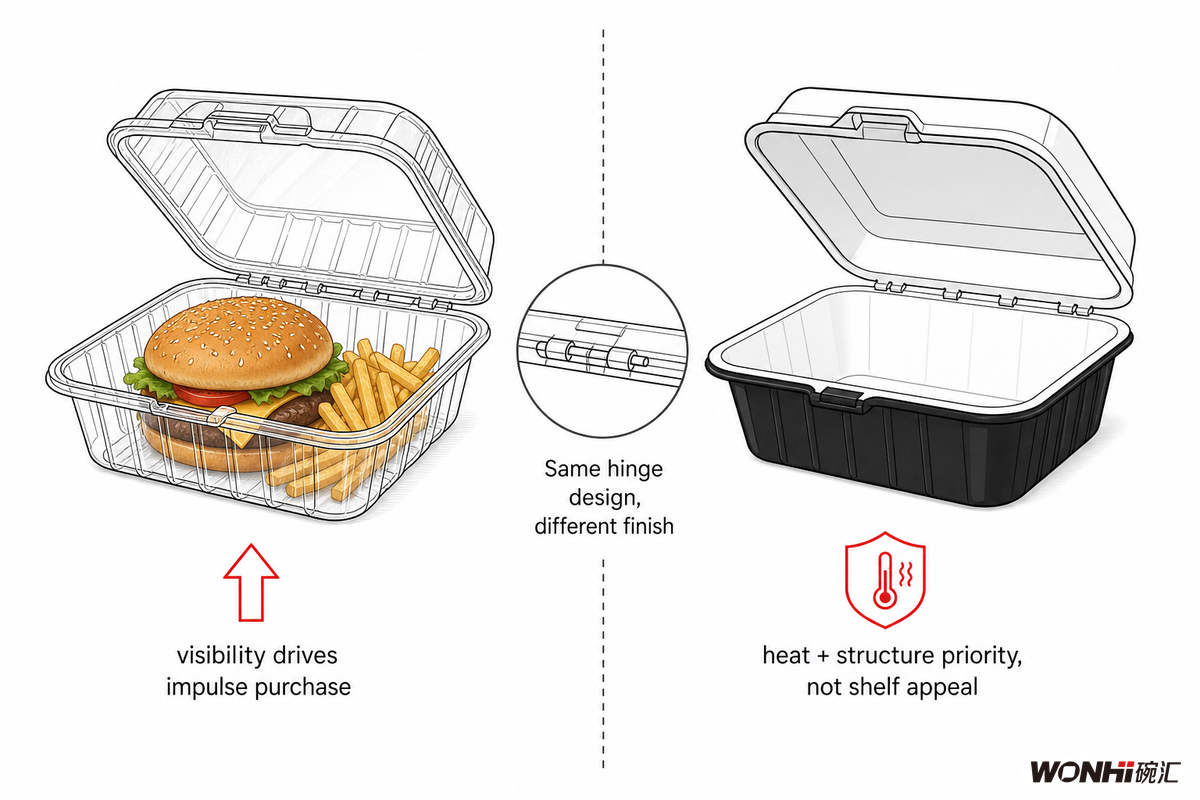
In vielen Bäckerei- und Feinkostkoffern, in denen beispielsweise vorverpackte Sandwiches, Salate oder Gebäck gelagert und ausgestellt werden, hängt die Entscheidung für die Verwendung eines durchsichtigen Kunststoffbehälters nicht von der Lebensmittelsicherheit ab (da er in einem undurchsichtigen Behälter genauso sicher wäre). Stattdessen wird der durchsichtige Kunststoff ausgewählt, weil Eine Studie über Snack-Food-Displays, die in der eigenen Literatur der National Institutes of Health veröffentlicht wurde Es wurde festgestellt, dass die Sichtbarkeit an Kaufpunkten, wie Kassenanzeigen oder Präsentationen am Ende des Ganges, einen direkten Einfluss auf Impulskäufe haben kann Kunden neigen dazu, Artikel zu kaufen, die sie leicht sehen können Tatsächlich, Durchsichtige Kunststoffdeckeloptionen mit Antibeschlagbehandlungen Speziell hergestellt werden, um “die Produktsichtbarkeit in Cold Food Merchandising Displays zu verbessern”, weil, wenn Nebel die Sicht verdeckt, der gesamte Vorteil der Auswahl von klarem Kunststoff zunichte gemacht wird.
Das ist eine Use-Case-Entscheidung, kein universelles Upgrade: Durchsichtige Verpackungen tauschen die licht – und feuchtigkeitsbarrierenden Eigenschaften weg, die sauerstoffempfindliche oder lichtempfindliche Füllungen schützen, was ein Grund ist Wanhuis eigenes Scharnierbehältersortiment Immer noch läuft schwarz-weiß undurchsichtiges MFPP als Standard für heiße Teilnehmer statt klares PP auf der ganzen Linie Wählen Sie klar, wenn das Produkt sich durch den Deckel verkaufen muss; Wählen Sie undurchsichtiges MFPP, wenn der Auftrag Wärme und Struktur hält, nicht Regalattraktivität.
Da beiden das gleiche Kernscharnierdesign zugrunde liegt, können eine Premium-Bäckerei-Theke und ein preisgünstiger Greif-und-Gang-Kühler die gleiche 8-Fertig-Fußabdruck oder 9-Fertigschale in zwei verschiedenen Ausführungen führen, ohne eine zweite Behälterform neu zu qualifizieren. – die Entscheidung ist Finish, nicht Format Käufer beschaffen Behälter mit aufklappbaren Deckeln für eine Salatbar zum Essen, ein To-Go-Container-Programm oder ein Lebensmittel-Ferienkoffer wählen wirklich eine Oberflächenbeschaffenheit auf derselben geformten Schale.
Die Auswahl eines Finishs allein für den Regaleinspruch, nur um den Barriere-Kompromiss zu entdecken, nachdem eine licht- oder sauerstoffempfindliche Füllung in einem klaren Fall früh an Frischigkeit verliert, ist ein Fehler, der es wert ist, vermieden zu werden. “Die Lücke zwischen ”im Regal besser aussehen“und ”hält an”. „Für die tatsächliche Haltbarkeit des Produkts ist ein echtes Risiko für alles, was über trockene oder haltbare Füllungen hinausgeht. Da Wanhui sowohl klares PP als auch undurchsichtiges MFPP über dieselben 60 Spritzgusslinien unter einem ISO 9001-zertifizierten Produktionssystem läuft, ist ein OEM-Käufer, der in der Praxis ein gemischtes Merchand- und Hot-Hot-Hot-Hold-Hold-Programm für Zulassungen verwendet wird ein einziger Lieferant und zwei verwendet.
Ist der Kunststoff in einem aufklappbaren Behälter tatsächlich lebensmittelecht?
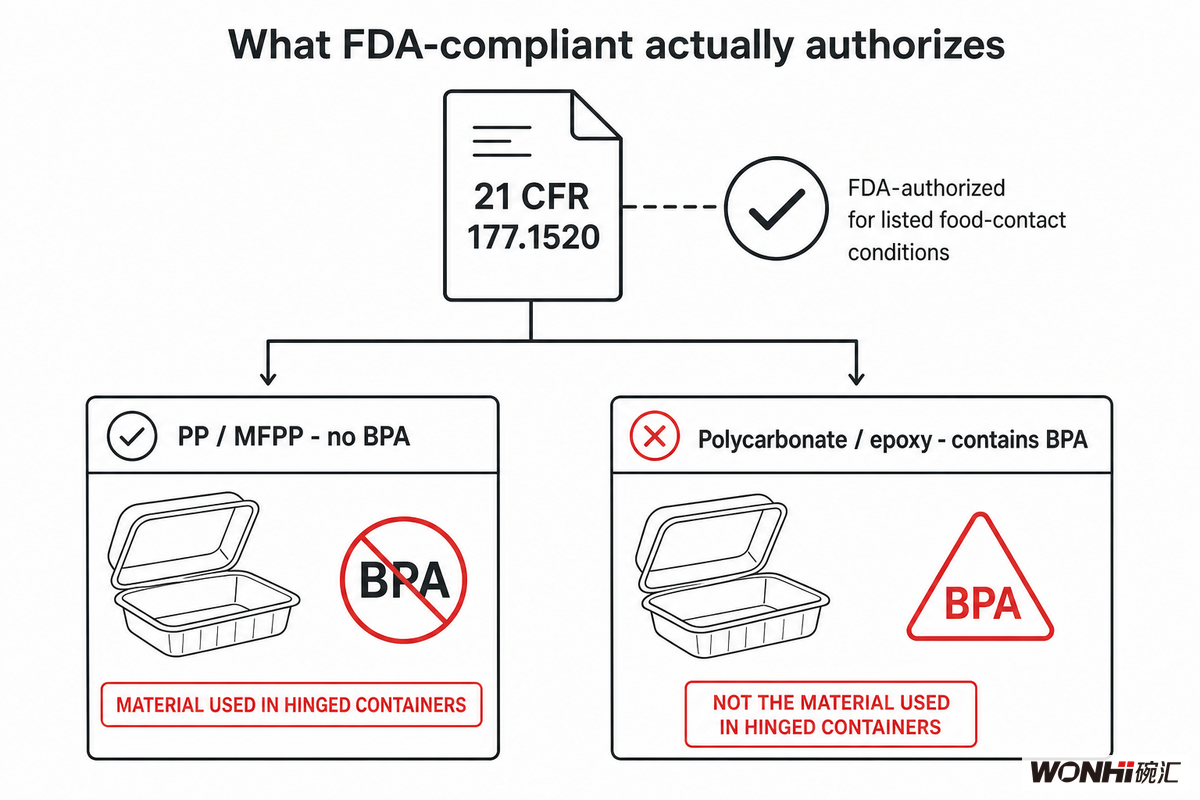
Polypropylenharze in Lebensmittelqualität sind Autorisiert gemäß 21 CFR 177.1520 “(Auch diese Genehmigung ist eine bedingte, keine pauschale Genehmigung.”Diese Verordnung listet auf, welche Olefinpolymere “sicher verwendet werden dürfen”, vorbehaltlich der in der Sektion genannten spezifischen Lebensmittelarten und -bedingungen. „Keine unbegrenzte Lizenz für Lebensmittel oder Temperaturen.“Die Frage der Sorgfaltspflicht eines Käufers ist, ob das Harz und die Verwendung eines Lieferanten unter die genannten Bedingungen fallen, nicht nur, ob „FDA-konform” auf einem Spezifikationsblatt erscheint.
Zwei weitere Abzeichen, die neben “FDA-konform”auf den meisten Spec-Blättern angezeigt werden. “Mikrowellengeeignet (oder mikrowellengeeignet) und auslaufsicher”, werden anders verdient als die Harzgenehmigung. Mikrowellengeeignet und mikrowellengeeignet sind Leistungsansprüche darüber, wie sich das spezifische Formteil unter Hitze verhält, keine Garantie für die Harzfamilie; ein dünnwandiger PP-Behälter und ein dickwandiger MFPP-Behälter aus demselben Basisharz können unterschiedlich bewertet werden. Der Fehler, den Käufer macht „FDA-konform“für die ISO-Zertifikat-Angabe”2, anstatt zu überprüfen, ob die spezifische Lebensmittelart und Temperaturbereich mit den tatsächlich genehmigten Bedingungen des Harz-Profiltrahat-1 übereinstimmt.
Undicht ist ein Verschluss-Anspruch, kein Materialanspruch – das Harz kann vollständig lebensmittelecht sein und der Behälter kann immer noch undicht sein, wenn Scharnier und Felge nicht gleichmäßig sitzen, was genau der Defekt ist, den die Checkliste zur Aufnahme-Inspektion unten auffängt Es ist gebaut, wirklich sichere Behälter auf allen drei Halterungen gleichzeitig aufzusetzen: zugelassenes Harz, eine überprüfte Mikrowellenbewertung für diese spezielle Form und ein Verschluss, der tatsächlich Platz bietet.
Dieses “BPA-freie”-Emblem, das auf fast jedem Kunststoff-Scharnierbehälter-Eintrag zu sehen ist, verdient einen zweiten Blick. BPA ist eine Chemikalie, die in Polycarbonat-Kunststoffen und Epoxidharzen verwendet wird, nicht in Polypropylen, eine Auszeichnung Stanford Medicine eigener Erklärer zu Bisphenol A FDA unabhängig bestätigt. Die FDA-eigene aktuelle Position Direkt ist: “Die aktuelle Perspektive der FDA, basierend auf ihrer jüngsten Sicherheitsbewertung, ist, dass BPA in den aktuellen Mengen, die in Lebensmitteln vorkommen, sicher ist” “BPA-frei” auf einem PP-Behälter zu drucken, ist wahr, und es gilt auch für jeden anderen PP-Behälter auf dem Markt, denn PP war nie ein BPA-Quellenharz.
Es signalisiert nichts über das spezifische Produkt, außer zu bestätigen, dass es sich um das Material handelt, von dem alle bereits angenommen haben, dass es sich um das Produkt handelt.
Warum aufklappbare Behälter austreten, sich verziehen oder reißen und wie man sie beim Empfangen fängt
Wanhuis eigene Produktionslinie behandelt Scharniermüdigkeit und Verschlussfehlschläge als den Defekt, den ein Restaurant am häufigsten bemerkt. Eine halbmillimetergroße außermittige Basis sieht auf einer Fabriklinie vollkommen vernünftig aus und taucht dann in einer Liefertasche auf. Unabhängige Fehleranalyse der Kunststofftechnik für Scharnierbaugruppen Stellt fest, dass Scharnierausfälle im Feld größtenteils auf Ermüdung bei niedrigem Zyklus und Kriechbruch zurückzuführen sind, wiederholte Belastungen des Materials an einem Biegepunkt, von denen die ursprünglichen Konstrukteure nie angegeben haben, dass es standhalten kann, und nicht auf einen riesigen Bruch.
Viele aufklappbare Lebensmittelbehälter verfügen über manipulationssichere Dichtungen – eine kleine Klappe oder Perforation, die beim ersten Entfernen des Deckels reißt. Dies wird hauptsächlich für die Lieferung oder Abholung durch Dritte verwendet, bei der Sie sicherstellen möchten, dass der Behälter zuvor nicht gestört wurde, bevor der Kunde ihn abholt Ziel ist hier ein Trust-One-Container, kein Leak-Container, daher ist dies kein Ersatz für einen guten Deckelverschluss; Selbst ein versiegelter, dichter Behälter wird undicht, wenn das Scharnier nicht richtig darin passt.
Eine noch einfachere küchenseitige Ursache zeigt sich jedoch bei der Schließmethode Ein einzelner Koch in einem aufklappbaren Feinkostladen, der die geformten Rippen auf einem Behälter beschreibt, fasste die Begründung zusammen: “Sie sitzen auf der unteren Hälfte, damit man den Behälter nicht direkt in die Kondensation stellt.”Es war trocken, dann weint es” Eine kleine Änderung der Verpackungsausrichtung könnte einen übergroßen Einfluss auf das Reklamationsvolumen haben, als viele wissen.
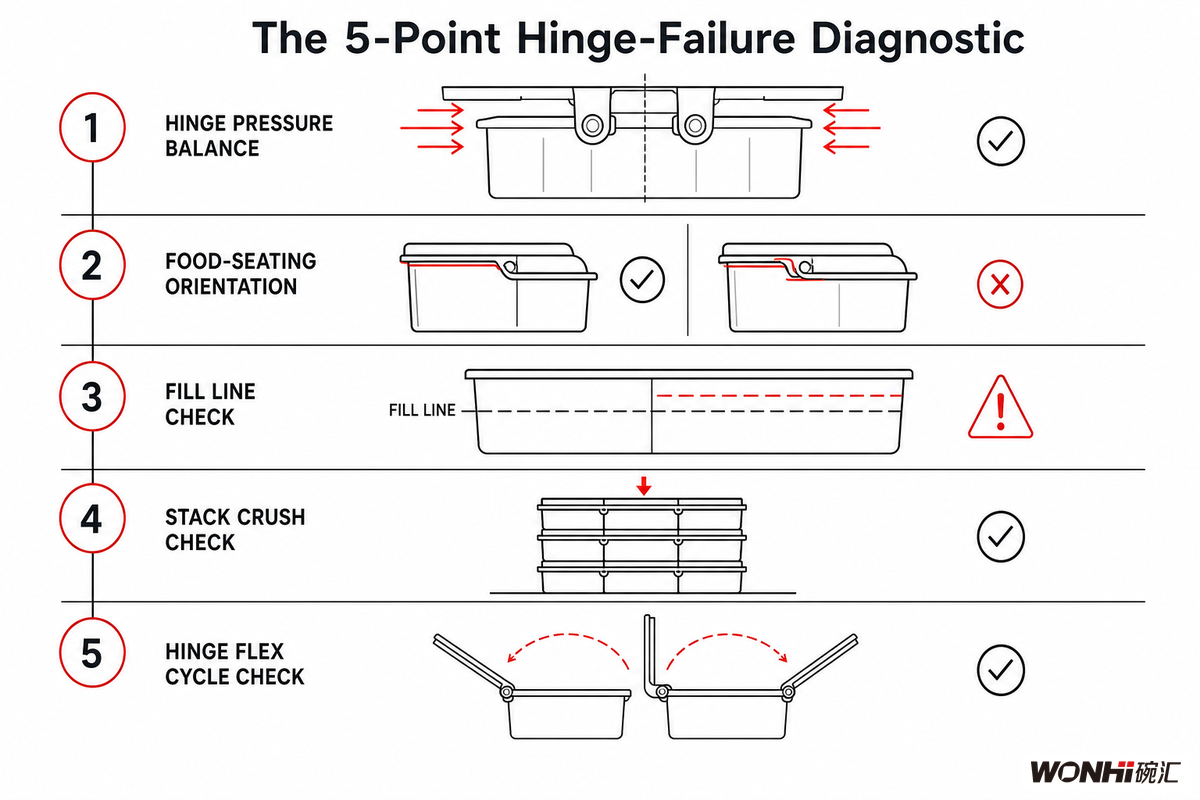
Die unten aufgeführte 5-Punkt-Scharnierfehlerdiagnose ist für die Verwendung am Empfangsdock konzipiert, wenn Sie eine bereits angekommene Sendung untersuchen, und nicht im Rahmen eines Produktions-QC-Vorgangs im Werksgeschoss. Sie gilt gleichermaßen für einen auslaufsicheren Klappdeckel für heiße und kalte Lebensmittel oder für eine leichte Box für gekühlte Sandwiches/Salate; Die 5 Kontrollpunkte konzentrieren sich auf die Verschlussmechanik, nicht auf den Temperaturbereich, für den der Behälter angegeben wurde.
- ✔ Flex 5-Zufallsscharniere durch einen vollständigen Öffnungs-Schließ-Zyklus von Hand. Wenn es sich eng anfühlt oder eine weiße Spannungslinie entwickelt, kann es zu Ermüdungserscheinungen kommen, bevor der Endverbraucher es überhaupt sieht.
- ✔ Stellen Sie sicher, dass Deckel und Boden gleichmäßig unter dem gleichen Druck über die gesamte Peripherie zusammentreffen. “A-Yme”eine Seite ist außer Kontrolle geraten, was für den „Clamshell”-Verschluss sorgt, der unterwegs aufgespalten wird.
- ✔ Stellen Sie sicher, dass die Verpackungsmannschaften die Lebensmittel auf der richtigen Hälfte aufsetzen, basierend auf dem in den Behälter geformten First/Lüfter, und nicht auf der Seite, die schneller zu verpacken ist.
- ✔ Markieren Sie jeden Container, der über der Fülllinie gefüllt ist. Eine Überfüllung führt dazu, dass sich das Scharnier bei einer Ladung schließt, für die es nie gedacht war, dem häufigsten Grund für Lecks während des Transports.
- ✔ Probieren Sie das gestapelte Gehäuse aus, um die Quetschfestigkeit zu überprüfen, bevor eine volle Palette auf einen heißen LKW oder einen Walk-in-Kühler geladen wird.
Über die staatlichen Verbote der USA hinaus das globale Regulierungsbild für Nicht-Schaumbehälter
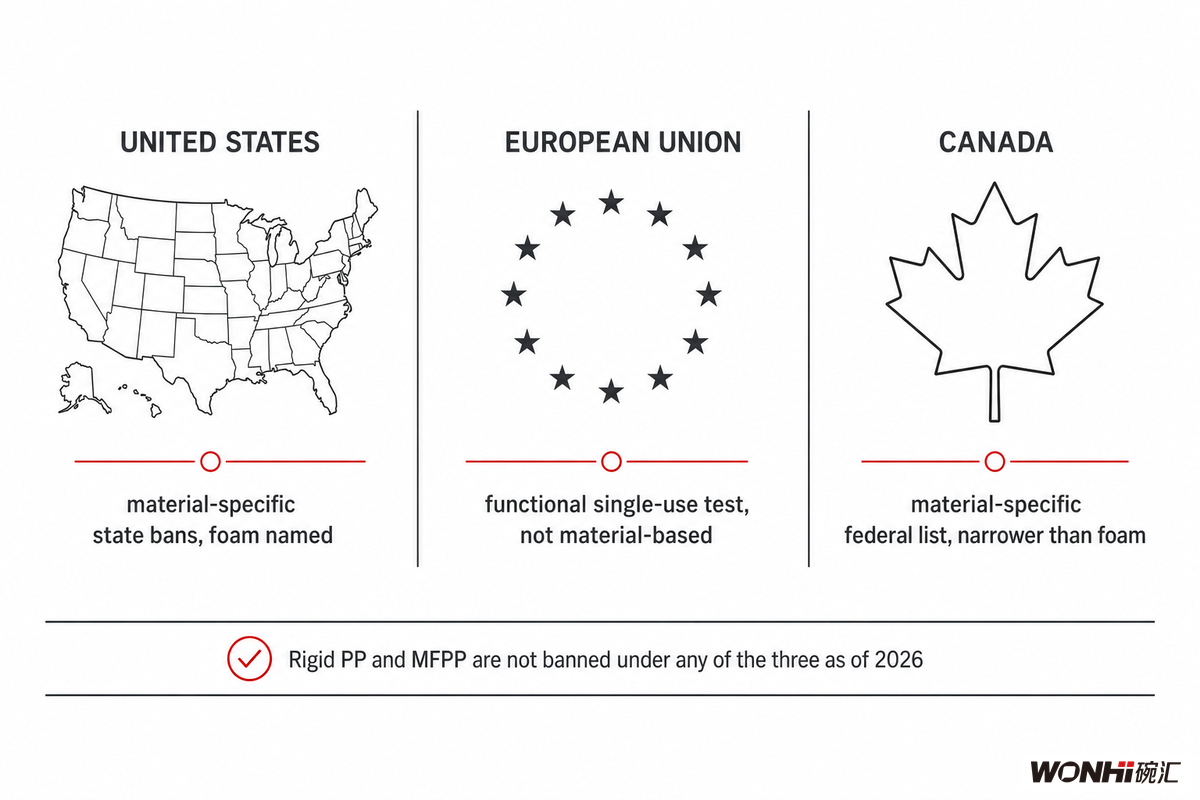
Wanhuis eigene Die Compliance-Seite verfolgt die Karte zum Verbot von Schaumlebensmitteln in den USA aus 12 Bundesstaaten Speziell für Behälter mit aufklappbarem Schaumstoffdeckel, aber dieser ist nur auf Schaumstoff ausgerichtet und ist ausschließlich eine Karte mit Schwerpunkt auf den USA. Käufer, die für Europa oder Kanada einkaufen, unterliegen völlig unterschiedlichen Vorschriften, die überhaupt nicht auf Scharnier basieren.
Europa wendet im Rahmen seiner Einwegkunststoffrichtlinie einen Funktionstest an und kein Materialverbot: Ein Lebensmittelbehälter fällt unter die Richtlinie, wenn er für den einmaligen Gebrauch bestimmt ist, normalerweise direkt aus dem Behälter verzehrt wird und keiner weiteren Zubereitung bedarf, eine Definition, die weit genug gefasst ist, um einen heißen Hart-PP-Scharnierbehälter für Fast Food sowie einen Schaumstoffbehälter einzubeziehen. Darüber hinaus ist der neuere Verordnung (EU) 2025/40 (Verordnung über Verpackungen und Verpackungsabfälle) Schreibt vor, dass HORECA-Vertriebshändler zum Mitnehmen ihren Kunden bis zum 12. Februar 2028 die Möglichkeit bieten, ihre verzehrfertigen Lebensmittel in wiederverwendbaren Verpackungen innerhalb eines Wiederverwendungssystems zu bestellen und zu erhalten. Diese Frist gilt unabhängig davon, ob es sich bei dem Behälter um MFPP, PP oder PET handelt.
Das US-Verbot scheint vom Kanadier bestätigt zu werden Vorschriften zum Verbot von Einwegkunststoffen Durch die Heraushebung bestimmter Materialien, obwohl diese schmaler als “Schaum” sind, wird nur expandiertes oder extrudiertes Polystyrol, PVC, Oxo-abbaubarer Kunststoff oder schwarzer Kunststoff mit Ruß als verbotene Materialien für Gastronomieartikel eingeschränkt Starre PP – und MFPP-Scharnierbehälter gehören nicht dazu.
Ein verstecktes Risiko für Käufer besteht darin, dass die Konformitätsabmeldung einer Region überall hin verlagert wird: Ein im Rahmen des europäischen Funktionstests abgefertigter Container kann immer noch die materialspezifische Liste Kanadas verlassen, und der häufige Fehler besteht darin, eine einzelne Genehmigung als eine globale Pass-Real-Lücke zu behandeln, wenn eine Sendung wird beim Zoll aufbewahrt, während die richtige Papierarbeit nachträglich beschafft wird. Da Wanhui Klappbehälter nach Europa, Amerika, in den Nahen Osten, im asiatisch-pazifischen Raum und in Südamerika unter einer ISO 9001- und FDA 21 CFR 177-zertifizierten internen Produktionssystem exportiert, das rund 20 Jahre lang Export-Compliance-Erfahrung aufgebaut ist, geht davon aus, dass ein OEM-Käufer in der Praxis eine bestimmte Zielregion die Ziel-Konform-Konformitätspapier-Konformität für eine Container-Konformität abgibt.
Was passiert tatsächlich mit einem PP- oder PET-Scharnierbehälter nach der Entsorgung
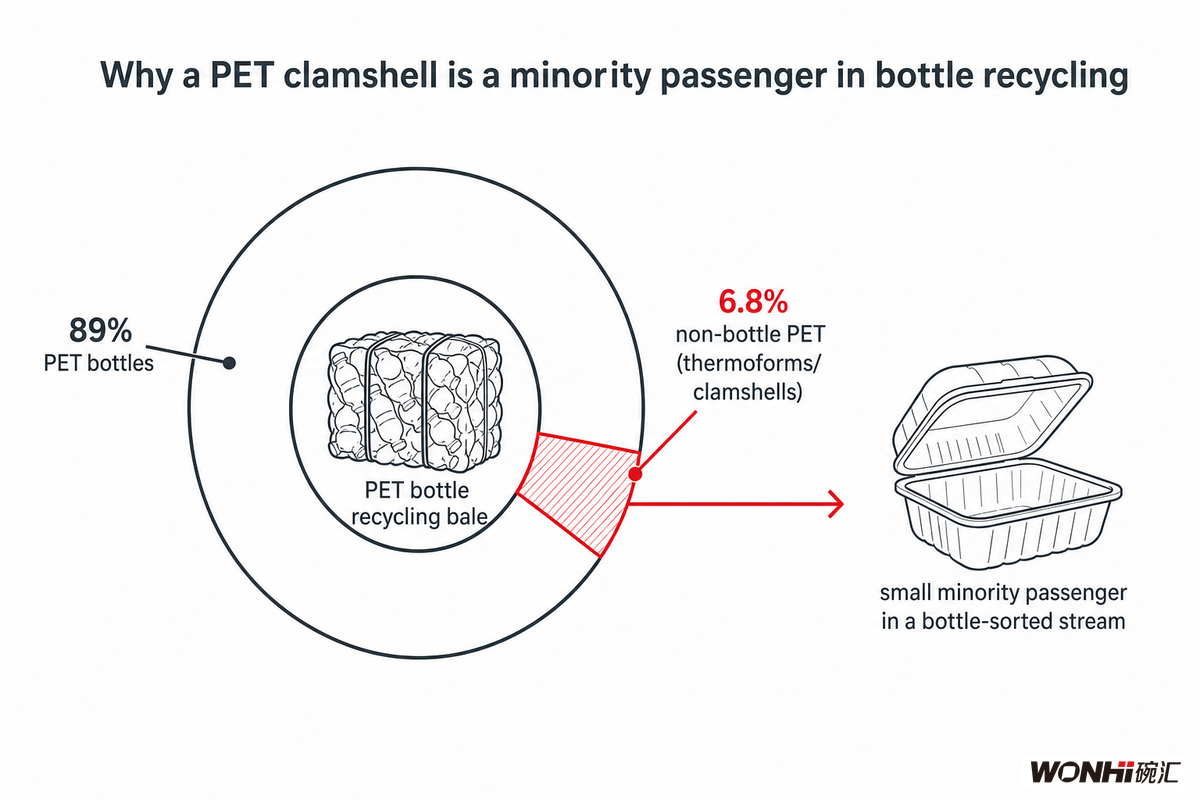
NAPCORs PET-Recyclingbericht 2024 Beziffert die Recyclingrate von PET-Flaschen in den USA auf 30,21 TP3T im Jahr 2024, verglichen mit 32,5 TP3T im Jahr 2023, liegt aber immer noch über dem Durchschnitt von 29,51 TP3T im vorangegangenen Jahrzehnt. PET-Thermoformen, zu denen die Muscheln der Harzfamilie gehören, erzählen eine andere Geschichte: Derselbe Bericht zeigt, dass die thermoformspezifische Rückgewinnung im Vergleich zum Vorjahr um 521 TP3T auf 264 Millionen Pfund in den USA und Kanada im Jahr 2024 gestiegen ist. Die reale Dynamik einer kleinen Basis ist unterschiedlich, obwohl die Marktnachfrage nach dem zurückgewonnenen Material uneinheitlich geblieben ist.
Von Experten begutachtete wissenschaftliche Forschung zu US-amerikanischen Kunststoffrecyclingströmen Erklärt einen Teil der Gründe: Ein Materialflussmodell in derselben Studie beziffert einen typischen PET-Ballen auf 89,01 TP3 T PET-Flaschen und 6,81 TP3 T Nicht-Flaschen-PET, und die Reinheit des echten Flaschenballens ist an anderer Stelle im selben Papier 91,11 TP3 T noch höher auf 99,3%, gemäß den darin genannten DSM Environmental Services. In jedem Fall wird die Muschel, da sie ein kleiner Minderheitspassagier in einem Prozess ist, der stark auf Flaschen ausgerichtet ist, nicht abgelehnt, weil das Harz von Natur aus nicht recycelbar ist, weil es aufgrund der Art und der Zusammensetzung der eingehenden Ballen zusammengesetzt wird, obwohl die Zusammensetzung als thermoformspezifische Skalen hochverschiebauplastik.
In Kanada nehmen offizielle Leitliniendokumente eher eine realistische als eine ermutigende Haltung ein: Die Entscheidung für ein recycelbareres Harz wie PP erhöht das Wertschöpfungspotenzial, garantiert jedoch keine positiven Ergebnisse am Ende der Lebensdauer, und abgelehnte Behälter würden unabhängig davon entsorgt Harzcode. Vereinfacht ausgedrückt für einen Käufer: Harz ist nur ein Bestandteil eines Endergebnisses; Wie der Behälter in einem bestimmten Endmarkt gesammelt, sortiert und verarbeitet wird, ist der andere wichtige Teil der Geschichte, und #5 oder #1 ist lediglich der Ausgangspunkt.
Branchenausblick, wohin das Klappcontainerformat führt
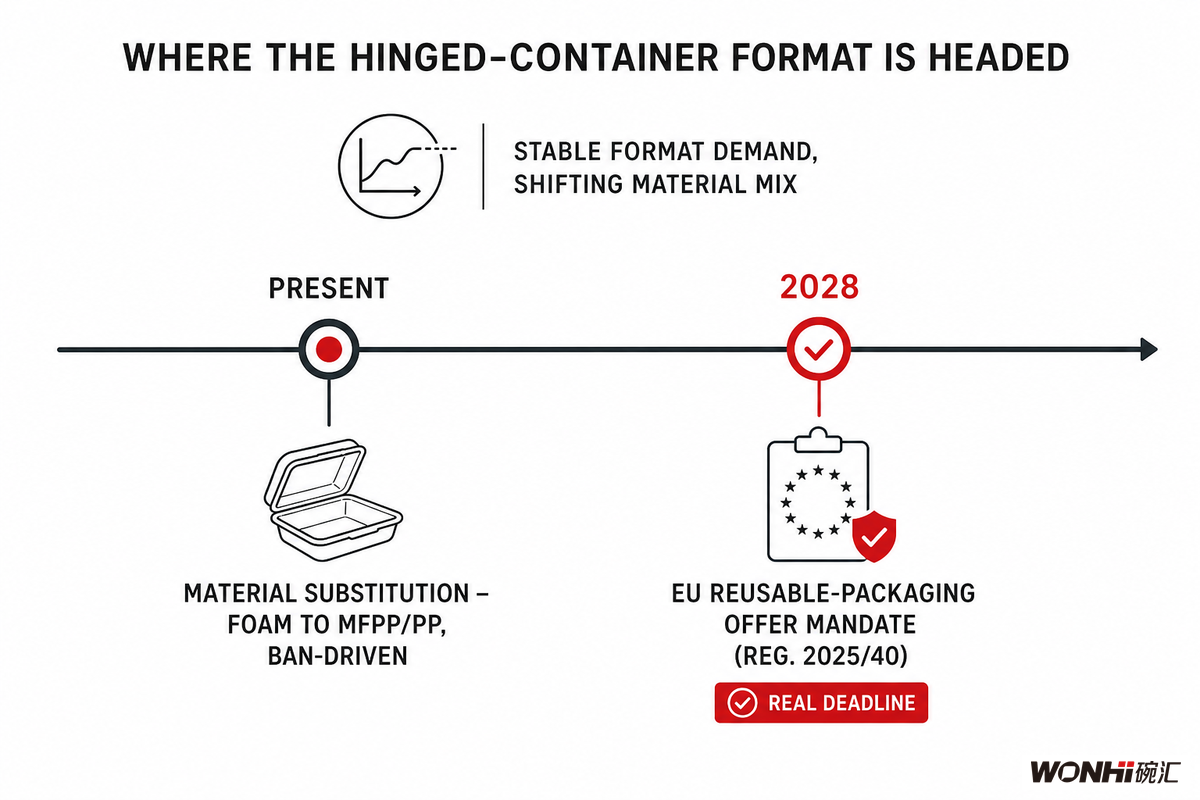
Die Nachfrage nach “Scharnier-/Clamshell-Kategorien”wächst auch nicht wirklich; Die aggregierte Suche nach „Clamshell-Containern” hat sich in den letzten Monaten nicht verändert. Das ist, wie ich anmerken würde, ein Hinweis auf die Reifung der Kategorie, nicht auf die Belastung. Soweit es tatsächlich Bewegung gibt, liegt sie auf der Unterkategorieebene auf zwei Ebenen:
Zunächst steht die Materialsubstitution an, die bereits im Gange ist und eine Folge der Verbotswelle ist: Die Schaumnachfrage wird schwächer, da MFPP und klare PP aufgrund einer ständig wachsenden Liste von Staaten, in denen die Das Material kann für diese Zwecke nicht verkauft werden. Die Regulierungsbewegung ist für viele Käufer die zweite Front, die aus einer unerwarteten Richtung kommt (wie das verbindliche Angebot der Verordnung (EU) 2025/40 für wiederverwendbare Verpackungen aus dem Jahr 2028 materialneutral ist, was für jeden starren PP- oder MFPP-Finged-Behälter ebenso wichtig sein wird wie für einen Schaumstoffbehälter für jeden Betreiber, der in die EU vermarktet. Fachpresse berichtet über die Verpackungstrends im Foodservice 2026 Rahmen den Wandel um Nachhaltigkeit, Komfort und Wert zusammen – nicht Nachhaltigkeit allein – was mit den Gründen übereinstimmt, warum Bestellungen in die Praxis umgesetzt werden: Haltbarkeit und Compliance stehen an erster Stelle, Recyclingfähigkeit an zweiter Stelle.
Ein praktischer Aktionspunkt: Wenn Ihre Lieferkette den EU-HORECA-Kanal berührt, beginnen Sie jetzt mit der Suche nach einem Angebot für wiederverwendbare Verpackungen, anstatt auf die Frist 2028 zu warten, um eine überstürzte Lieferantensuche zu erzwingen, und schließen Sie eine Schleife ab Großhandelslieferant Die bereits Multimaterialleitungen betreiben und nicht eine, die einem einzelnen Harz zugeordnet ist. Der Preis folgt der gleichen Substitutionslogik: Schaum hält immer noch einen niedrigeren Preis pro Einheit, wo er legal bleibt, aber der Vorteil von MFPP bei der Isolierung und Nacherwärmungsleistung schließt die Gesamtkostenlücke, sobald Verbotsstrafen, Rückerstattungen und Ein-Stern-Bewertungen von durchnässten Lieferboxen gezählt werden. MFPP ist das Material, das entwickelt wurde, um den Isolationsvorteil des Schaums abzüglich der Verbotsbelastung des Schaums zu ersetzen.
“Deckelpassung ist da, wo billige Klappschalen ausfallen, ein Sockel, der einen halben Millimeter daneben liegt, sieht auf der Linie in Ordnung aus und springt in der Liefertasche aufWir probieren-Test-Verschluss bei jedem Lauf, weil das der Defekt ist, den ein Diner tatsächlich sieht”
Wanhui Qualitäts- und Ingenieurteam
Das Team hinter diesem Bericht
Dieser Leitfaden wurde von Shandong Wanhui Environmental Protection Technology Co., Ltd. zusammengestellt, einem 20-jährigen Hersteller, der 20 Thermoformlinien, 6 Blattextrusionslinien und 60 Spritzgusslinien über MFPP-, PP-, PET- und Schaumscharnierbehälter hinweg betreibt Produktion. Die Rahmengestaltung für die Lebensmittelsicherheit und die Checkliste für die Aufnahme und Inspektion in diesem Artikel basieren auf unseren eigenen Tests zur Bodenverriegelung und zum Scharnierzyklus, die mit den unten zitierten FDA-, USDA-, EU- und kanadischen Regulierungsquellen abgeglichen werden.
Referenzen und Quellen
- 21 CFR 177.1520 Lebensmittelkontakt-Stoffinventar „Eine Lebensmittel- und Arzneimittelverwaltung
- Bisphenol A (BPA): Verwendung in der Lebensmittelkontaktanwendung „Eine Lebensmittel- und Arzneimittelverwaltung
- Bisphenol A Fakten Stanford
- Verhinderung von Kreuzkontaminationen Lebensmittelsicherheit und -inspektion
- Verordnung (EU) 2025/40, Verpackungs- und Verpackungsabfälle Årsag
- Einweg-Kunststoffverbotsvorschriften: Technische Richtlinien Umwelt und Klimawandel Kanada
- PET-Recyclingbericht 2024 „NAPC) Association for PET Container
- Recycling von Kunststoffen in den Vereinigten Staaten: Kunststoffströme (PMC) Gesundheitsinstitute
- Die Verfügbarkeit von Snack-Food-Displays, die den Kauf anregen können (PMC) Gesundheitsinstitute
- Experimentelle Analyse an einem additiv hergestellten lebenden Scharnier texanischen
- US7685676B2, Lebendes Scharnier „Patent- und Markenamt“(Google Patente)
Häufig gestellte Fragen
F: Was ist ein Behälter mit Klappdeckel und worin unterscheidet er sich von einer Wanne mit separatem Deckel?
Antwort anzeigen
Ein Klappdeckelbehälter (oder Klappdeckelbehälter) wird einstückig spritzgegossen, wobei Deckel und Boden durch ein lebendes Scharnier anstelle einer separaten Kappe verbunden sind. Im Gegensatz dazu zeigt eine Schnappdeckel-Deli-Wanne den Deckel als völlig separates Stück, das leicht verlegt, mit dem falschen Behälter vermischt oder absichtlich ausgetauscht wird Diese einteilige Scharnierkonstruktion legt Wert auf die garantierte Sicherheit des Deckels am Boden, weshalb Lebensmittelbehälter mit Klappdeckel überwiegend für die Einwegverpackung zum Mitnehmen und Ausliefern verwendet werden Verpackungen aus Sandwiches und chinesischen Mitnahmekartons zur vollständigen Verpflegung von Tabletts im Vergleich zu Kunststoffschläuchen mit abnehmbaren Kappen.
F: Sind aufklappbare Kunststoffbehälter lebensmittelecht?
Antwort anzeigen
Das in Klappbehältern verwendete Polypropylen ist gemäß 21 CFR 177.1520 für Lebensmittelkontakt (FDA) konform, für die darin aufgeführten Lebensmittel und Verwendungsbedingungen “Food and Drug Administration”keine breite, unbegrenzte Zulassung für Lebensmittel bei jeder Temperatur. Dieser allgegenwärtige „BPA-freie” Vermarktungsbegriff, der diesen Auflistungen beigefügt ist, ist zwar sachlich korrekt, aber weitgehend bedeutungslos, da BPA eine Chemikalie ist, die in Polycarbonat/Epoxidharzen und nicht in Polypropylen verwendet wird. PP-Behälter hatten nie ein BPA-assoziiertes Risiko.
F: Wie viele Fächer sollte ich für Catering vs. Einzelhauslieferung bestellen?
Antwort anzeigen
Ein einzelner heißer Einlauf ohne Seite braucht keine innere Trennwand Eine nasse Soße oder ein nasses Dressing erfordert eine Trennung, um eine Vermischung mit dem Hauptartikel während des Transports zu verhindern, und zwei Seiten rechtfertigen eine Teilung zur Klarheit und Kontrolle der Kreuzkontamination, wie vom USDA für Buffets und Catering-Dienstleistungen empfohlen Berücksichtigen Sie die Art des Kurses und den Feuchtigkeitsgehalt, nicht nur die allgemeinen Abmessungen des Behälters.
F: Welche Größen und Formen sind über das Standardrechteck hinaus erhältlich?
Antwort anzeigen
Über das standardmäßige quadratische/rechteckige Raster von Kunststoffboxen mit 6 bis 9 ×6 hinaus werden Hersteller auch spezielle Werkzeuge für formspezifische Lebensmittelverpackungen aus Kunststoff herstellen, wie zum Beispiel einen etwa 7 ×4-Zoll-Hot-Dog- und Sandwichbehälter oder einen 13-Zoll-Hoagie-Behälter, oft für Großbestellungen erhältlich. Erkundigen Sie sich immer bei Ihrem Lieferanten nach Lebensmittelart und Platzbedarf und nicht nur nach Zoll.
F: Wie lange halten Scharnierbehälter normalerweise, bevor das Scharnier ausfällt?
Antwort anzeigen
Die Haltbarkeit von Scharniern ist bei Einwegbehältern selten ein Problem, da sie nach einer Fahrt sofort entsorgt werden, im Gegensatz zu mehrfach geöffneten wiederverwendbaren Scharniern. Eine relevantere Statistik ist, dass herkömmliche, spritzgegossene Polypropylen-Wohnscharniere typischerweise für Millionen von Leerzyklen bei wiederverwendbaren Anwendungen ausgelegt sind; Folglich ist ein Scharnierfehler beim Verpacken oder Liefern ausnahmslos auf einen Defekt oder eine Überfüllung zurückzuführen, nicht auf eine Erschöpfung des Designs. Die Analyse von Fehlern bei der Scharnierbaugruppe zeigt an, dass Ermüdung und Kriechbruch bei Spannungskonzentrationen, die nicht in den Teil ausgelegt sind, für die meisten Fehler verantwortlich sind. Praktisch wurde ein Scharnier beschrieben, das beim ersten Verschluss entweder überfüllt, oder bei einer unzureichenden Belastungsprobe, 5.
F: Sind PP- und PET-Scharnierbehälter recycelbar?
Antwort anzeigen
Technisch gesehen ja, und das Bild verbessert sich schneller, als die meisten Käufer erkennen: Das Recycling von PET-Flaschen in den USA lief im Jahr 2024 mit 30,21 TP3 T (NAPCOR), während die PET-Thermoform in die Kategorie der Muscheln einsteigt und im Jahresvergleich um 521TP3 auf 264 Millionen Pfund ansteigt pro Derselbe NAPCOR-Bericht, „Obwohl immer noch von einer kleinen Basis aus im Vergleich zu den 89,01 TP3T-Flaschen / 6,8%-Nichtflaschen-PET ein Materialflussmodell einen typischen Ballen einfügt (die Reinheit in der realen Welt ist oft höher, 91,1%-99,3% pro DSM Environmental Services-Daten). Die Materialauswahl verbessert die Chancen nur geringfügig; Die Akzeptanz durch das lokale Sammelprogramm bestimmt immer noch das endgültige Schicksal.
F: Haben Vorschriften außerhalb der USA Einfluss darauf, welches Material ich bestellen sollte?
Antwort anzeigen
Ja. Die Einweg-Kunststoffrichtlinie der EU definiert eine Funktionsprüfung (sofort verbraucht, keine weitere Zubereitung erforderlich und mit Behälter verzehrt), dass ein heißer PP – oder MFPP-Behälter wie ein Schaum behandelt werden könnte, während die neue Verordnung (EU) 2025/40 eine materialneutrale, wiederverwendbare Verpackung für HORECA Takeaway ab Februar 2028 fordert, Kanada hat einen kleineren Anwendungsbereich (verboten sind nur Schaum, PVC, Oxo-abbaubare und Schwarzkohlenstoff-Kunststoffe), so dass sich dies dort nicht auf PP-Hart – und MFPP erstreckt.
Verwandte Artikel
- MFPP-Scharnierbehälter „Die mit Mineralien gefüllte PP-Leitung von Wanhui für heißes, wieder erhitztes Stromnetz
- Kunststoff-Scharnierbehälter „PP/PET für Salate, Obst und Feinkost
- Schaumstoff-Scharnierbehälter: Verbote, Sicherheit und Alternativen (2026) 2026 US-Schaumverbotskarte und Entscheidungsleitfaden für Schaltfahrer
- Auswahl der Behältergröße Kapazität auf Ihre Portionsgröße
- Essenstabletts: Wegweiser für Einweg-Serviertabletts und Catering-Tabletts