Póngase en contacto con la empresa Wanhui


Updated July 2026.
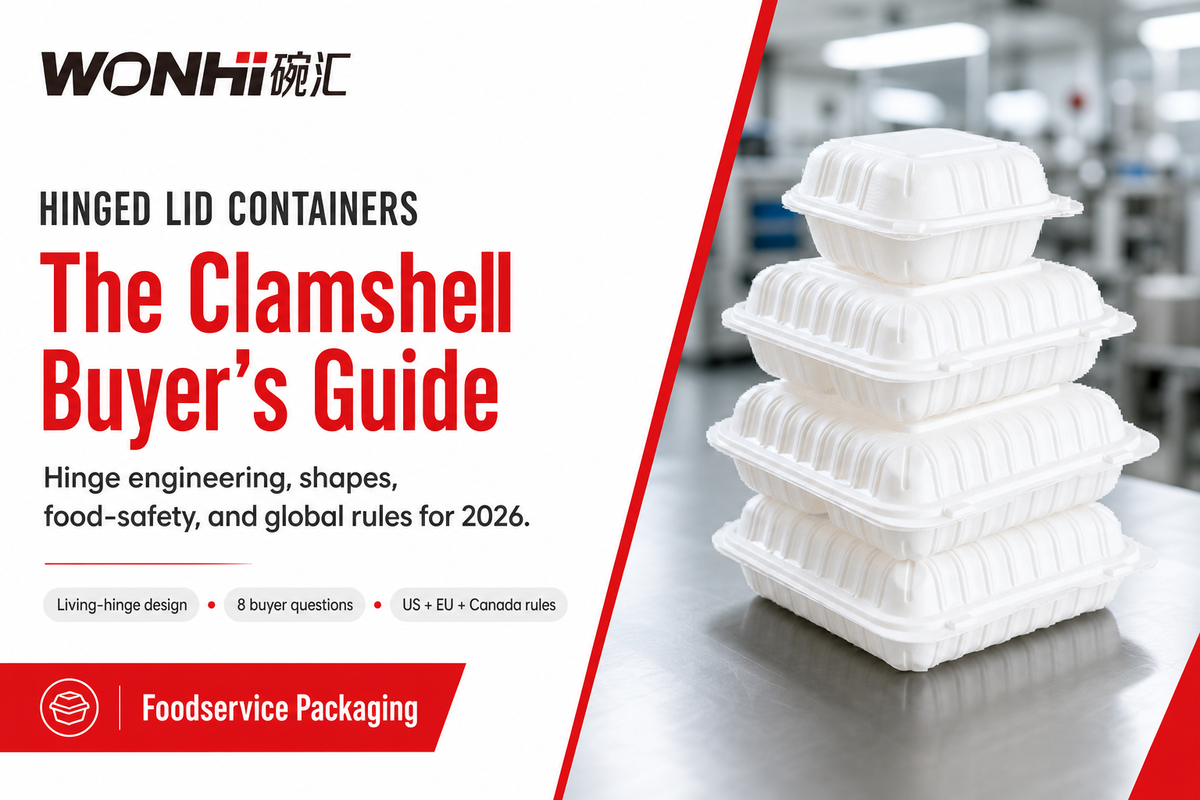
Hinged lid containers are one-piece foodservice packages — often called clamshells — where a molded living hinge joins the lid and base into a single part, and they’re the default takeout format for fast food, delivery, and catering. Whether the search is for plastic hinged lid containers or the foam versions covered separately below, Wanhui’s own hinged lid containers solution page already breaks down which material to pick: MFPP, clear PP, or foam. This guide starts where that page stops. It covers the questions a buyer asks after the material is chosen, how the hinge itself is engineered, which shapes exist beyond the standard rectangle, when a compartment count is a food-safety decision rather than a size preference, and what changes once a container crosses a border.
Especificaciones rápidas
| Formato | One-piece body; lid and base joined by an integral living hinge |
| Materiales comunes | MFPP, clear PP, PET/RPET, EPS foam (state-regulated in 12 U.S. states) |
| Rango de capacidad | Roughly 4 oz to 64+ oz, depending on mold family |
| Compartment options | 1, 2, or 3-compartment |
| Stackable / transport | Yes — nests flat for storage, stackable for pallet transport |
| Leakproof / microwavable | Leakproof when closed per fill line; microwave safe in food-grade polypropylene and MFPP grades |
| Material selection | See Wanhui’s Selector de ajuste de material |
What Makes a Container “Hinged Lid” — The Living-Hinge Design Explained
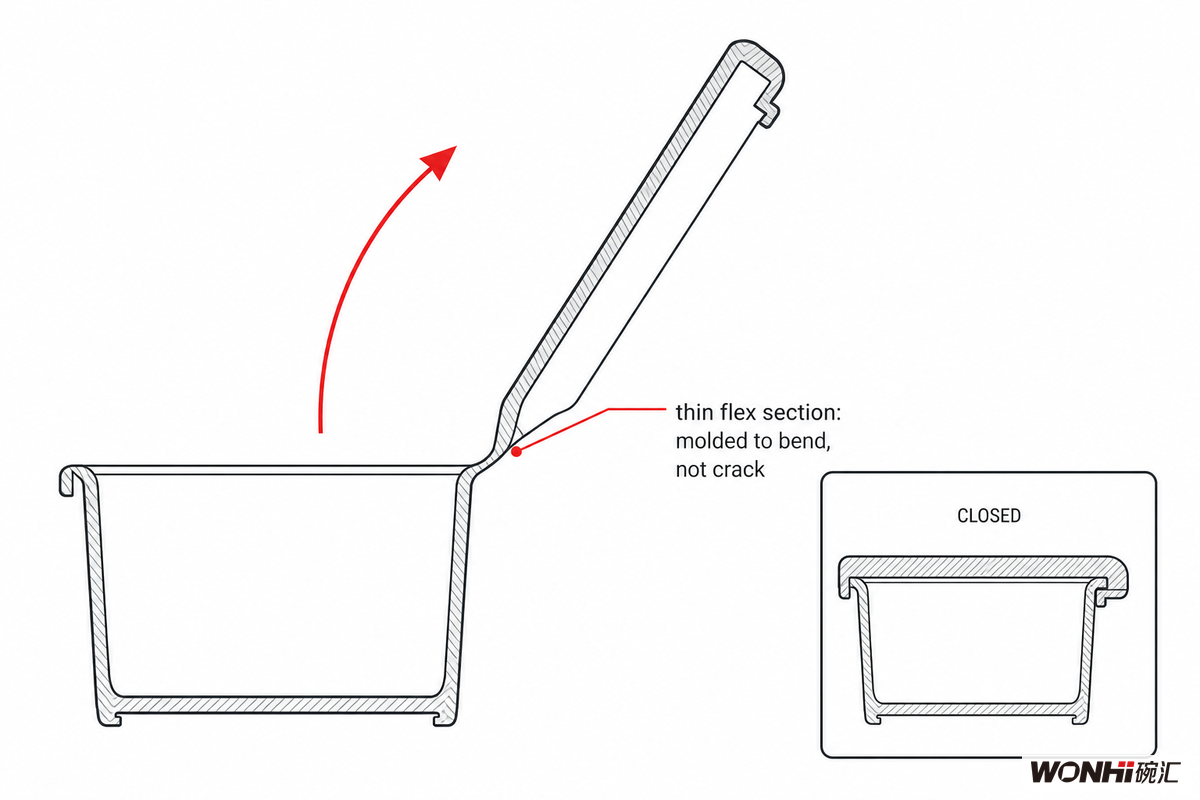
One molded piece, that’s all there’s to a hinged lid container. Instead of a lid, cap, snap ring or band, there’s a short, bendable connection of the same plastic – a living hinge – to hold lid and base together. In injection-molded polypropylene, traditional hinge structures last for millions of open-close cycles, say engineers at the University of Texas, because the flexible part is either heat formed or injection molded specifically to bend instead of crack under stress.
At MIT, research on hinged flexures also points to PP and PE as the dominant materials for their elasticity. The basic mechanism itself is documented in U.S. Patent 7,685,676, which describes the living hinge as a pliant section engineered to tolerate repeated tension and compression without cracking. Call it the Zero-Piece-Loss Hinge (sometimes called an “attached-lid” or “attached-hinged” design): since the lid can never get separated from the body of the container, no lids get lost on the packing line, no empty take-out bags end up with an isolated lid rolling in the bottom, and no customers will need to search through a messy drawer. In short, there’s no real engineering argument to be made in favor of the lid/body tub design over a stand-alone one: one part, instead of two, and one part that can never go astray. (Though a snap-on lid deli container solves a different, albeit related, problem-a seal for storage-the hinged container is designed for single-use, quick close functionality, and hence its proliferation across Wanhui’s broader disposable food containers range, in place of loose disposable plastic tubs.)
Not all hinge designs are continuous structures, either. Dart Container’s foam series, for example, employs a patented “Performer” perforated hinge comprised of small perforations instead of a continuous bend, an alternate approach for addressing durability issues within the lower-density foam material. This perforated-hinge approach makes a compromise between the fatigue resistance of a continuous hinge and the better bending properties needed in a foam material that lacks PP’s inherent flexibility. Getting the hinge geometry wrong is a real risk, not a cosmetic one: a flex section molded noticeably too thin risks premature cracking well before the millions-of-cycles figure cited above, while one molded too thick fights the operator’s hand on every open, because the whole design lives inside a narrow tolerance window between “flexible enough to open one-handed” and “durable enough to survive a delivery route.” Wanhui’s own tooling holds that hinge-thickness tolerance to a consistent precision across every mold family, in-house, built on years of production experience specifically with PP and MFPP living-hinge geometry rather than a generic thermoplastic mold adapted after the fact.
Specialty & Non-Standard Hinged Shapes Beyond the Rectangular Grid
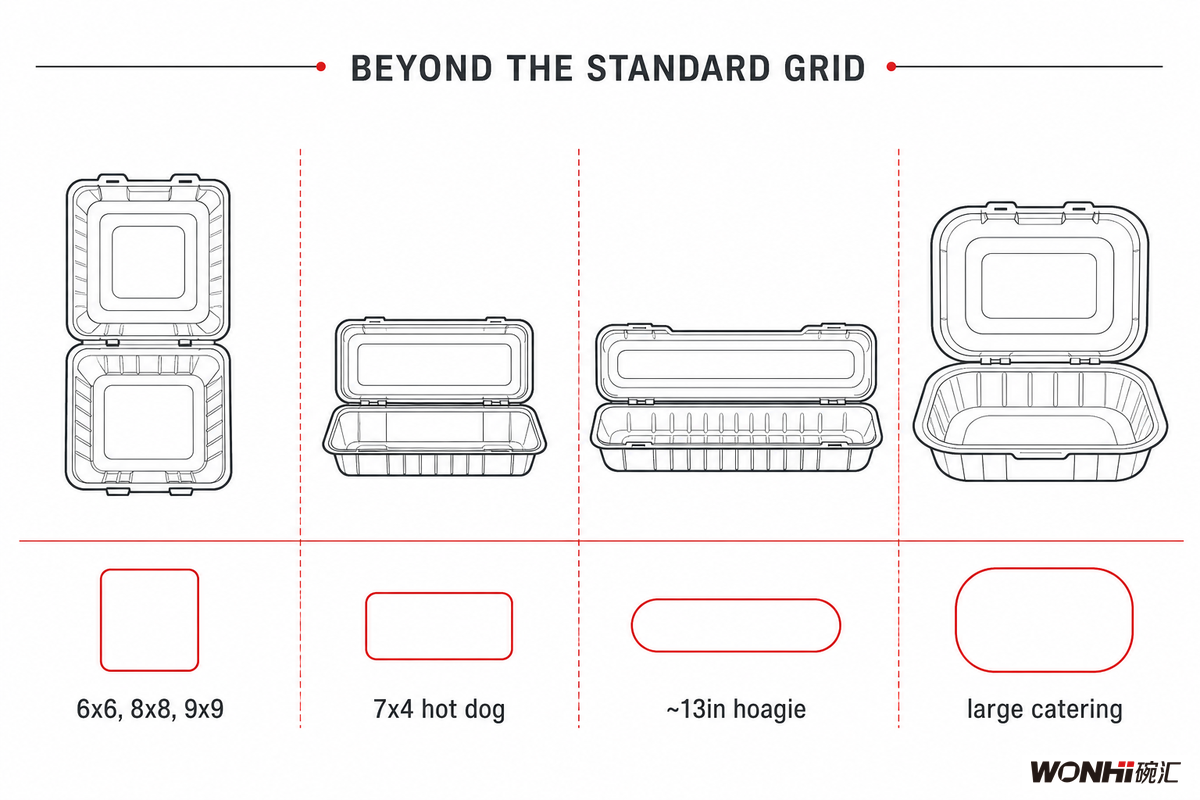
Though people commonly picture a boxy or square container (Wanhui’s own standard grid runs 6×6, 8×8, 9×6, and 9×9 inch), the hinge design isn’t limited to these sizes. Established US makers are also capable of making tooling for containers specific to a food item, not a generic box size, for example, a 7×4-inch hinged rectangle, large hinged lid containers sized for full catering trays, and a roughly 13-inch hinged hoagie tray for a hot dog or sub. You won’t find these if you just type “hinged container” into any search engine.
Most often, buyers of food products get a better, more practical outcome by specifying the product (hot dog, hoagie, sandwich) and the target footprint shape and size of the delivery bag or counter display it will be placed into, not simply by citing dimensions of a box in inches. No hot dog needs a 9×9 box that’s 80% air. It needs a shape perfectly cut to its form, and that includes an appropriately small plastic hoagie-tray size. This optimizes material use along with unit cost, across a wide variety of sizes. Wanhui’s 60 injection-molding lines and in-house mold development can produce custom tooling for such custom, shape-specific requirements along with standard square and rectangular layouts, enabling a USA restaurant chain that currently buy square containers from one plastic vendor to switch for both everyday squares and specialty hot-dog or hoagie-tray containers without having to go through a second vendor-qualification process.
📐 Nota de ingeniería
When the hinge is on the short side of an elongated container shape (like that for a hoagie), the material need a longer, narrower flex-section compared to the shorter, broader flex-section required for a hinge on a square container with the same wall thickness, the hinge geometry has to scale with the span it’s bridging, not just the material.
Compartment Configuration as a Food-Safety and Presentation Decision
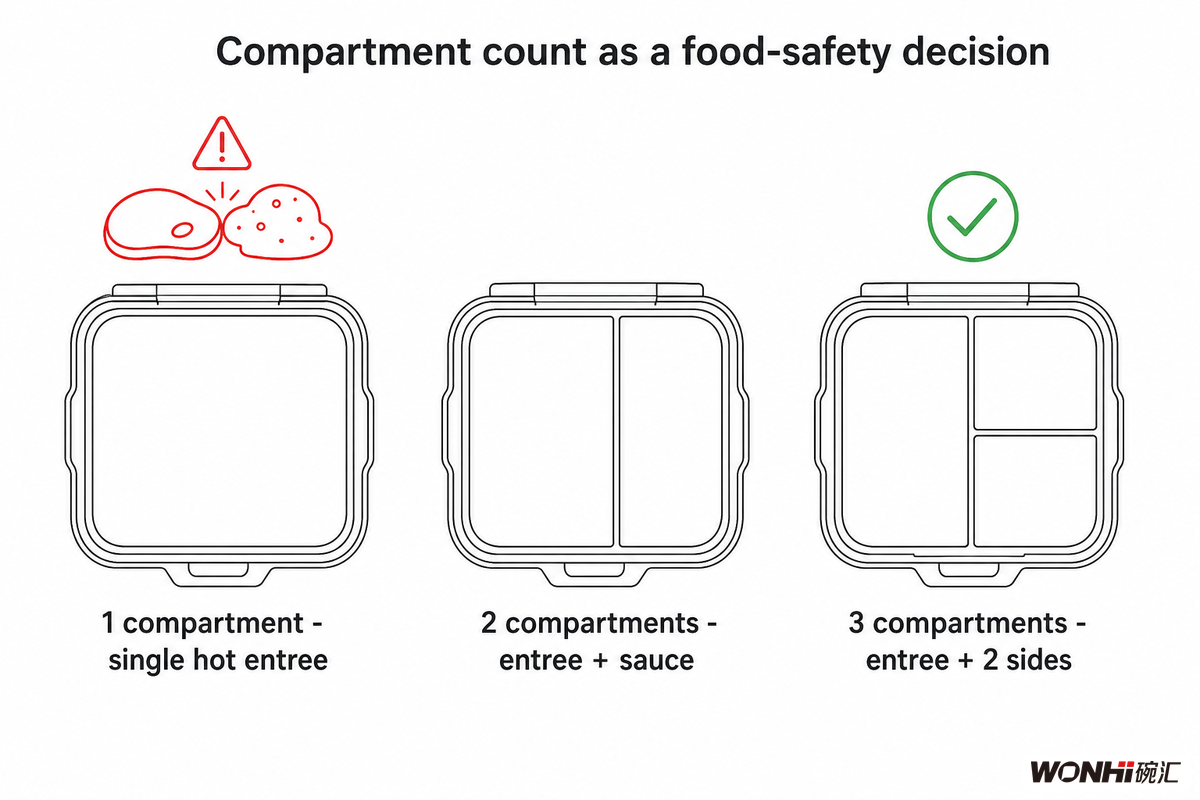
Cross-contamination, as defined by the USDA, refers to the transmission of bacteria from one food or surface to another through contact when the items aren’t physically separated. In a single-compartment hinged container, the prevention of such contamination is dependent entirely on how kitchen staff pack the box. A raw or highly moist item and a ready-to-eat item placed next to each other have no protection from the transmission of bacteria in such an open design; physical partitions can provide that protection, which is the primary argument for a multi-compartment container from a food safety perspective, rather than a food plating aesthetic.
There’s a secondary argument to the one for food-safety, though, and that’s for presentation. On an order delivered by a third-party service and shown on the app’s listing, or even just on a platter presented for a catered event, having foods touching each other suggest an unappealing, sloppy packing job, which often leads to the kind of one-star reviews that complain of “everything mixed together.” For a few cents, a partition can keep that soggy mess from occurring and thus save a potentially lost repeat customer.
Getting this wrong carries a real risk that’s measurable, not just aesthetic: a single mis-packed multi-course order that triggers a refund or a one-star review can erase the margin on several correctly packed orders across a typical 8-hour shift, because the compartment wall does the food-safety separation job a busy line cook can’t reliably replicate by hand in practice under order-volume pressure. Wanhui’s own compartment tooling, built with years of precision in-house production experience, is engineered to hold wall separation to a consistent tolerance across the 3-Course grid below, rather than relying on a generic mold shared across unrelated container families.
| Course / Food Pairing | Compartimentos | Por qué |
|---|---|---|
| Single hot entrée, no sides | 1 | No mixed-moisture food to separate |
| Entrée + wet sauce or dressing | 2 | Keeps sauce from soaking the base item in transit |
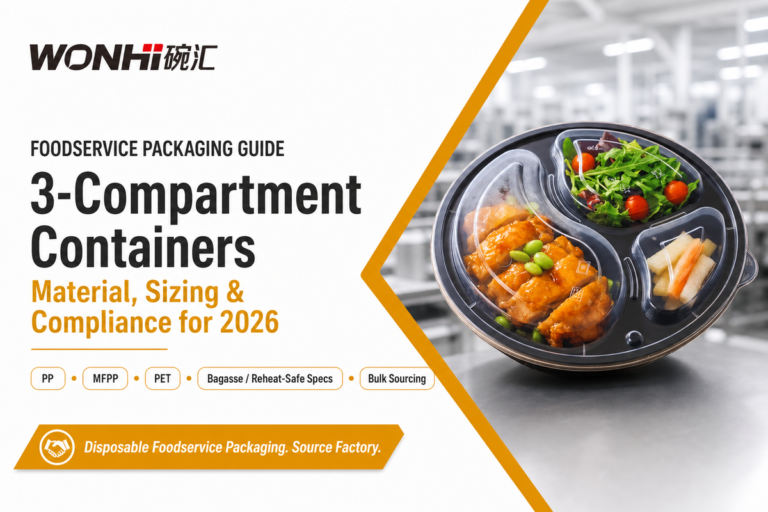
| Entrée + 2 distinct sides (e.g. rice + vegetable) | 3 | Prevents cross-flavor bleed and moisture transfer between sides |
| Catering plate-up, buffet-style | 3 | Physical separation supports the cross-contamination control the USDA describes |
This idea of partitioning by default also extends beyond a single-order delivery scenario. A medium-size restaurant that runs both take-out and catering, a household meal-prep subscription service, or any business fulfilling orders for a large event all naturally favor three-compartment take-out containers as the default because the partition works for food safety and presentation whether they’re packing one lunch or 200.
Clear Hinged Containers as a Merchandising Tool, Not Just Packaging
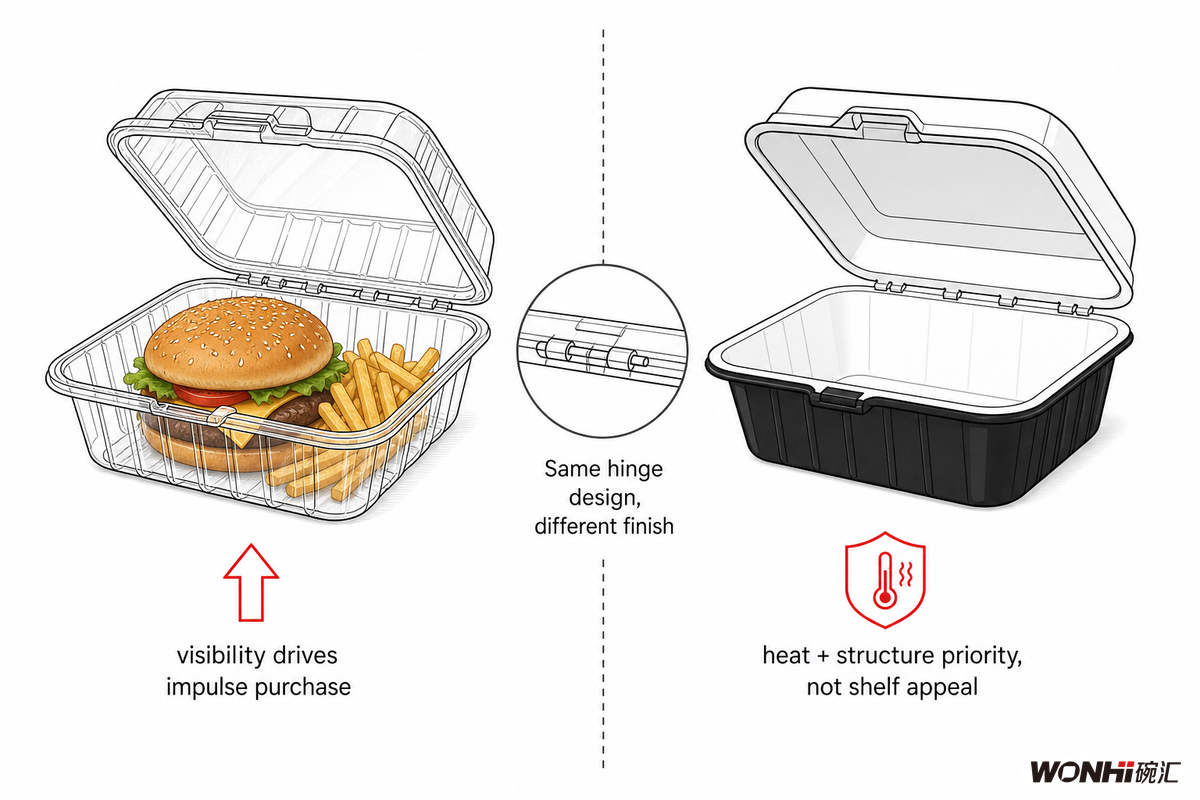
In many bakery and deli cases that store and display pre-packaged sandwiches, salads, or pastries, for example, the decision to use a clear plastic container isn’t driven by food-safety (since it would be just as safe in an opaque container). Instead, the clear plastic is selected because a study on snack food displays published in the National Institutes of Health’s own literature found that visibility at points of purchase, such as cash register displays or end-of-aisle presentations, can directly influence impulse purchases. Customers tend to purchase items that they can readily see. Indeed, clear plastic lid options with anti-fog treatments are specifically manufactured to “improve product visibility in cold food merchandising displays” because, if fog obscures the view, the entire benefit of selecting clear plastic is nullified.
This is a use-case decision, not a universal upgrade: clear packaging trades away the light- and moisture-barrier properties that protect oxygen-sensitive or light-sensitive fillings, which is one reason Wanhui’s own hinged-container range still runs black and white opaque MFPP as the default for hot entrées rather than clear PP across the board. Choose clear when the product need to sell itself through the lid; choose opaque MFPP when the job is holding heat and structure, not shelf appeal.
Because the same core hinge design underlies both, a premium bakery counter and a budget grab-and-go cooler can stock the same 8×8 or 9×9 clamshell footprint in two different finishes without requalifying a second container shape – the decision is finish, not format. Buyers sourcing containers with hinged lids for a dine-in salad bar, a to-go containers program, or a grocery deli case are really choosing a surface finish on the same molded shell.
Picking a finish for shelf appeal alone, only to discover the barrier tradeoff after a light- or oxygen-sensitive filling loses freshness early in a clear case, is a mistake worth avoiding — the gap between “looks better on the shelf” and “holds up for the product’s actual shelf life” is a real risk for anything beyond dry or shelf-stable fillings. Because Wanhui runs both clear PP and opaque MFPP across the same 60 injection-molding lines under one ISO 9001-certified production system, an OEM buyer sourcing a mixed merchandising-and-hot-hold program in practice qualifies a single supplier and mold family (the same 8×8 or 9×9 footprint used above) instead of running two separate vendor approvals for what is, structurally, one container in two finishes.
Is the Plastic in a Hinged Container Actually Food-Safe?
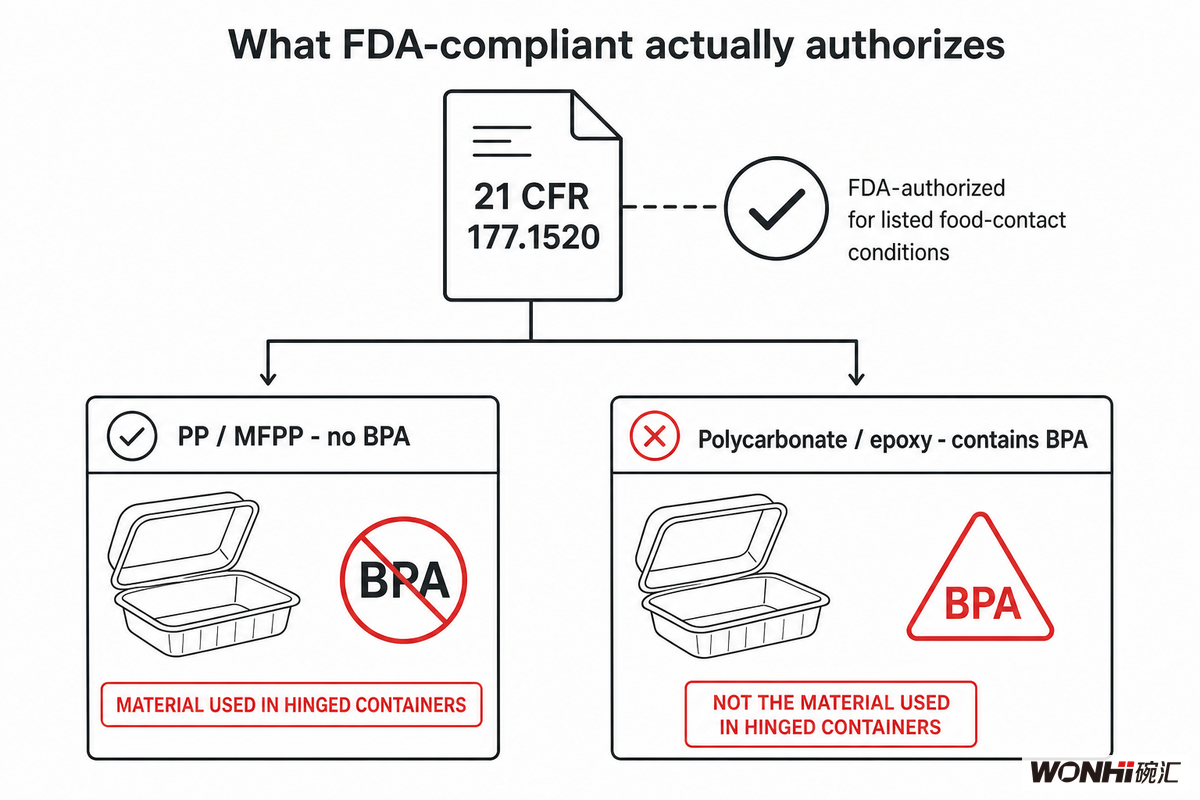
Food-grade polypropylene resins are authorized under 21 CFR 177.1520 – but that authorization is conditional, not a blanket approval. That regulation lists which olefin polymers “may be safely used,” subject to the specific food types and conditions of use named in the section — not unlimited license for any food or temperature. A buyer’s due-diligence question is whether a supplier’s resin and use fall inside those named conditions, not just whether “FDA-compliant” appears on a spec sheet.
Two other badges that show up alongside “FDA-compliant” on most spec sheets – microwave safe (or microwavable) and leakproof – are earned differently than the resin authorization is. Microwave-safe and microwavable are performance claims about how the specific molded part behaves under heat, not a resin-family guarantee; a thin-wall PP container and a thick-wall MFPP container made from the same base resin can rate differently. The mistake buyers make is treating “FDA-compliant” as a single pass/fail badge instead of checking whether the specific food type and temperature range match the resin’s actual authorized conditions — a gap that carries real risk if a supplier substitutes an unverified resin lot to hit a price target. Because Wanhui’s polypropylene and MFPP lines are engineered to hold conformance run to run, qualified under 21 CFR 177.1520 and produced under an ISO 9001 and ISO 22000-certified in-house testing system, an OEM buyer sourcing in practice can request the actual certificate of conformance for each production run rather than accepting a spec sheet’s word alone — the same due-diligence habit that catches a mismatched resin lot before it reaches a hot-food application.
Leakproof is a closure-fit claim, not a material claim – the resin can be fully food-safe and the container can still leak if the hinge and rim don’t seat evenly, which is exactly the defect the receiving-inspection checklist below is built to catch. Genuinely safe containers rest on all three holding at once: authorized resin, a verified microwave rating for that specific mold, and a closure that actually seats.
That “BPA-free” badge showing up on nearly every plastic hinged-container listing deserves a second look. BPA is a chemical used in polycarbonate plastics and epoxy resins – not in polypropylene, a distinction Stanford Medicine’s own explainer on bisphenol A confirms independently of the FDA. The FDA’s own current position is direct: “FDA’s current perspective, based on its most recent safety assessment, is that BPA is safe at the current levels occurring in foods.” Printing “BPA-free” on a PP container is true, and it is also true of every other PP container on the market, because PP was never a BPA-source resin.
It signals nothing about the specific product beyond confirming it’s the material everyone already assumed it was.
Why Hinged Containers Leak, Warp, or Crack, and How to Catch It on Receiving
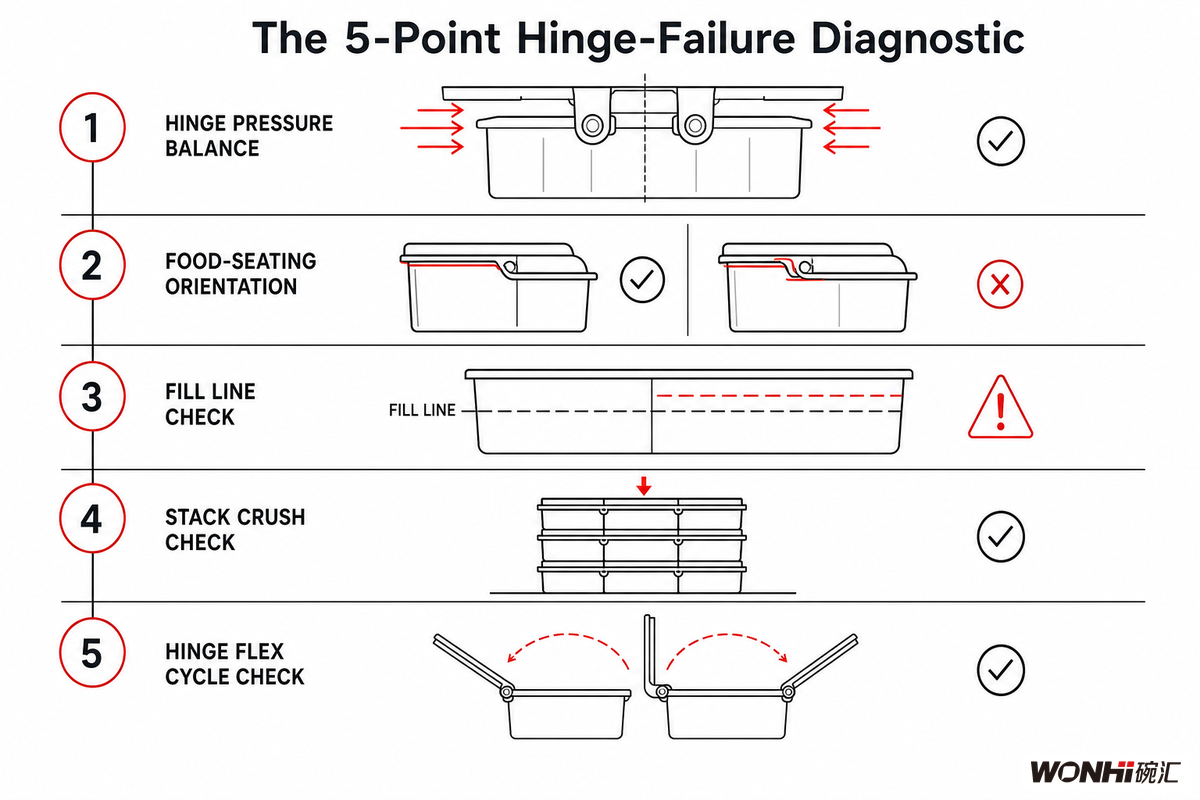
Wanhui’s own production line treats hinge-fatigue and closure-fit failure as the defect a diner most commonly notices, a half-millimeter off-center base looks perfectly reasonable on a factory line, then pops open in a delivery bag. Independent plastics-engineering failure analysis of hinged assemblies finds that in-field hinge failures largely stem from low-cycle fatigue and creep rupture, repeated stress on the material at a flex point the original designers never specified it could withstand, rather than one giant fracture.
Many hinged food containers include tamper-evident seals- a small flap or perforation that tears the first time the lid is removed. This is primarily used for third party delivery or pick up where you want assurance the container hasn’t been previously disturbed prior to the customer picking it up. The goal here’s a trust one, not a leak one so this isn’t a substitute for a good lid closure; even a sealed tight container will leak if the hinge doesn’t fit properly in it.
An even simpler kitchen-side cause shows itself, though, with the closing method. A single cook in a hinged deli describing the molded ridges on a container summed up the rationale: “They sit on the bottom half so you don’t put the container directly into the condensation. It was dry, then it’s weeping.” A small change in packaging orientation might have an outsize impact on complaint volumes than many realize.
The 5-Point Hinge-Failure Diagnostic listed below is designed to be used on the receiving dock, as you examine a shipment that has already arrived, rather than on the factory floor as part of a production QC operation. It’s equally applicable to a leak-resistant hinged lid rated for hot and cold foods, or to a lightweight box for chilled sandwiches/salads; the 5 checkpoints focus on closure mechanics, not on the temperature range the container was specified for.
- ✔ Flex 5 random hinges through a complete open-close cycle by hand – if it feels tight or develops a white stress line, it may fatigue out before the end consumer even sees it.
- ✔ Make sure the lid and base meet evenly under the same pressure across the entire periphery – one side is out of whack which makes for that “clamshell” closure that’ll split open on the go.
- ✔ Ensure packing crews is seating food on correct half based on the container molded ridge/vent, and not on whichever side is quicker to pack.
- ✔ Flag any container filled above its fill line – over-filling will cause the hinge to close on a load it was never intended for, the most common reason for leaks during transit.
- ✔ Try the stacked case to check for crush resistance, before a full pallet is loaded onto a hot truck or a walk in cooler.
Beyond U.S. State Bans, the Global Regulatory Picture for Non-Foam Containers
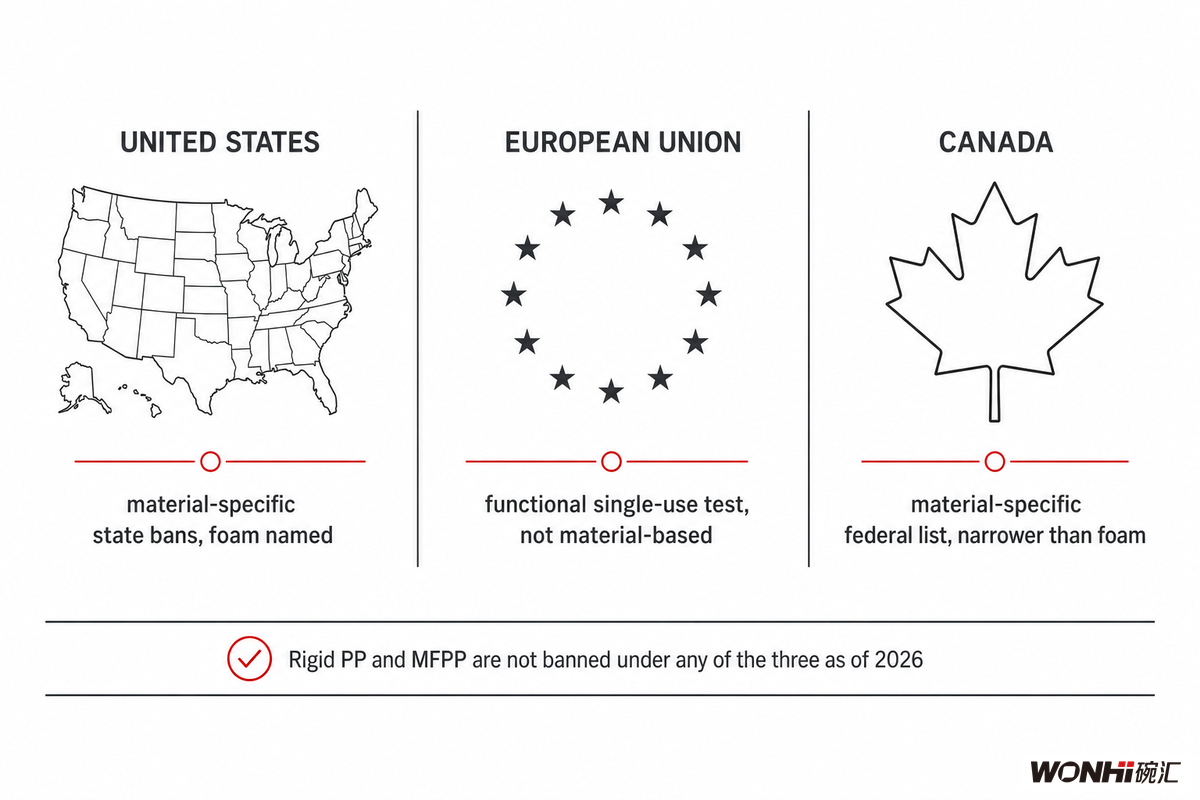
Wanhui’s own compliance page tracks the 12-state U.S. foam foodservice ban map for foam hinged lid containers specifically, but this is scoped to foam alone, and is entirely a U.S.-centric map. Buyers purchasing for Europe or Canada are operating under entirely different sets of regulations which aren’t hinge based at all.
Europe applies a functional test under its Single-Use Plastics Directive, rather than a material ban: a food container is covered under the directive when it’s designed for single use, usually consumed directly from the receptacle, and doesn’t require further preparation, a definition broad enough to include a hot rigid-PP hinged container for fast food as well as a foam one. In addition, the newer Regulation (EU) 2025/40 (the Packaging and Packaging Waste Regulation) mandates that by February 12, 2028, HORECA takeaway distributors shall offer customers the possibility of ordering and receiving their food ready to consume in reusable packaging within a reuse system. This deadline will apply whether the container is MFPP, PP, or PET.
The U.S. ban appears to be echoed by the Canadian Single-Use Plastics Prohibition Regulations by singling out certain materials, although this is narrower than “foam”, restricting only expanded or extruded polystyrene, PVC, oxo-degradable plastic, or black plastic with carbon black as prohibited materials for foodservice ware. Rigid PP and MFPP hinged containers aren’t among them.
A hidden risk for buyers is assuming one region’s compliance sign-off travels everywhere: a container cleared under Europe’s functional test can still trip Canada’s material-specific list, and the common mistake is treating a single approval as a global pass — a real gap when a shipment gets held at customs while the correct paperwork is sourced after the fact. Because Wanhui exports hinged containers to Europe, the Americas, the Middle East, Asia-Pacific, and South America under an ISO 9001 and FDA 21 CFR 177-certified in-house production system built around 20 years of export-compliance experience, an OEM buyer sourcing in practice can request destination-specific compliance documentation per production run rather than assuming one region’s paperwork covers a shipment bound for another — the same due-diligence habit that catches a mismatched jurisdiction before a container ever leaves the factory.
What Actually Happens to a PP or PET Hinged Container After Disposal
NAPCOR’s 2024 PET Recycling Report puts the U.S. PET bottle recycling rate at 30.2% for 2024 — down from 2023’s 32.5% peak, but still above the prior decade’s 29.5% average. PET thermoforms, the resin family clamshells belong to, tell a different story: the same report shows thermoform-specific recovery grew 52% year-over-year to 264 million pounds across the US and Canada in 2024 — real momentum from a small base, though market demand for the recovered material has stayed inconsistent.
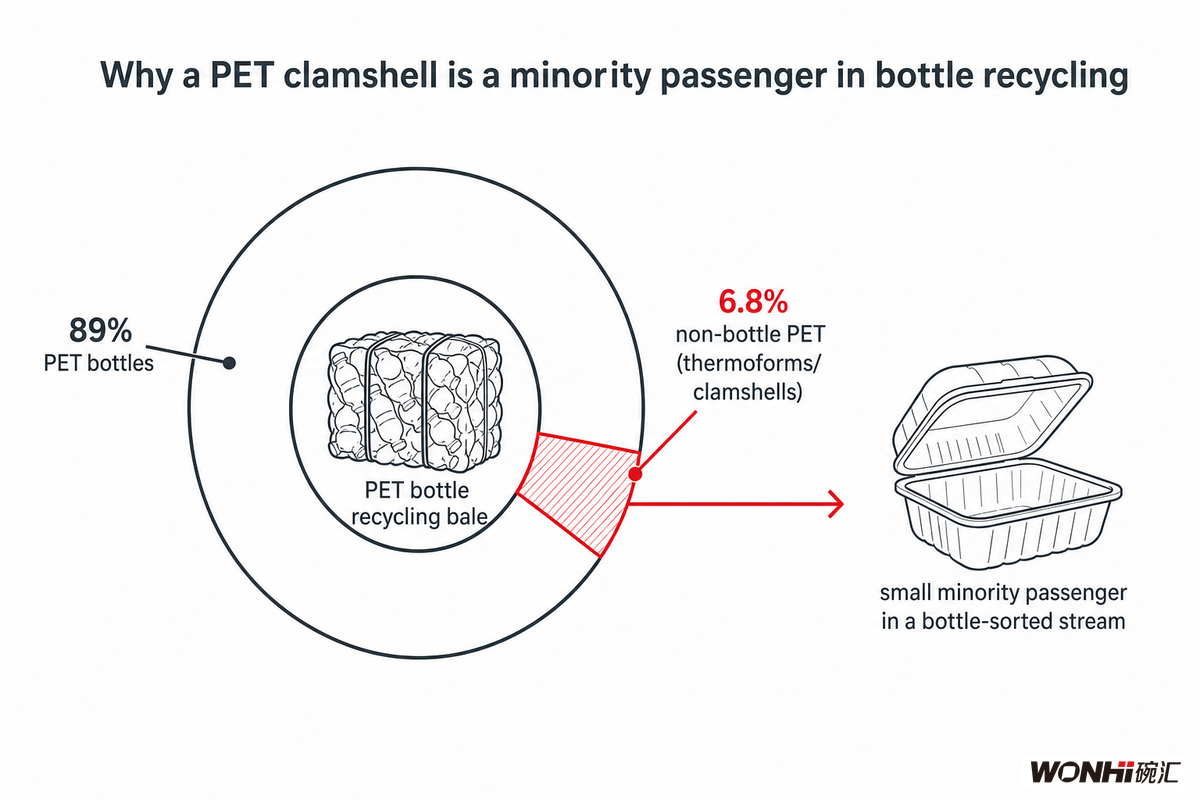
Peer-reviewed scientific research on U.S. plastics recycling flows explains part of why: a materials-flow model in that same study puts a typical PET bale at 89.0% PET bottles and 6.8% non-bottle PET, and real-world bottle-bale purity runs even higher elsewhere in the same paper — 91.1% to 99.3%, per the DSM Environmental Services data it cites. Either way, the clamshell, being a small minority passenger in a sorting process heavily skewed toward bottles, isn’t rejected because the resin is inherently unrecyclable — it’s rejected because of how the incoming bales are composed, though that composition is now shifting as thermoform-specific recovery scales up.
In Canada, official guidance documents take a realistic rather than an encouraging stance: opting for a more recyclable resin like PP enhances value recovery potential, but doesn’t guarantee positive end-of-life outcomes, and rejected container would be disposed of irrespective of resin code. In simpler terms for a buyer: resin is just one component of an end-of-life outcome; how the container is collected,sorted, and processed in a specific end-market is the other major part of the story, and #5 or #1 is merely the starting point.
Industry Outlook, Where the Hinged-Container Format Is Headed
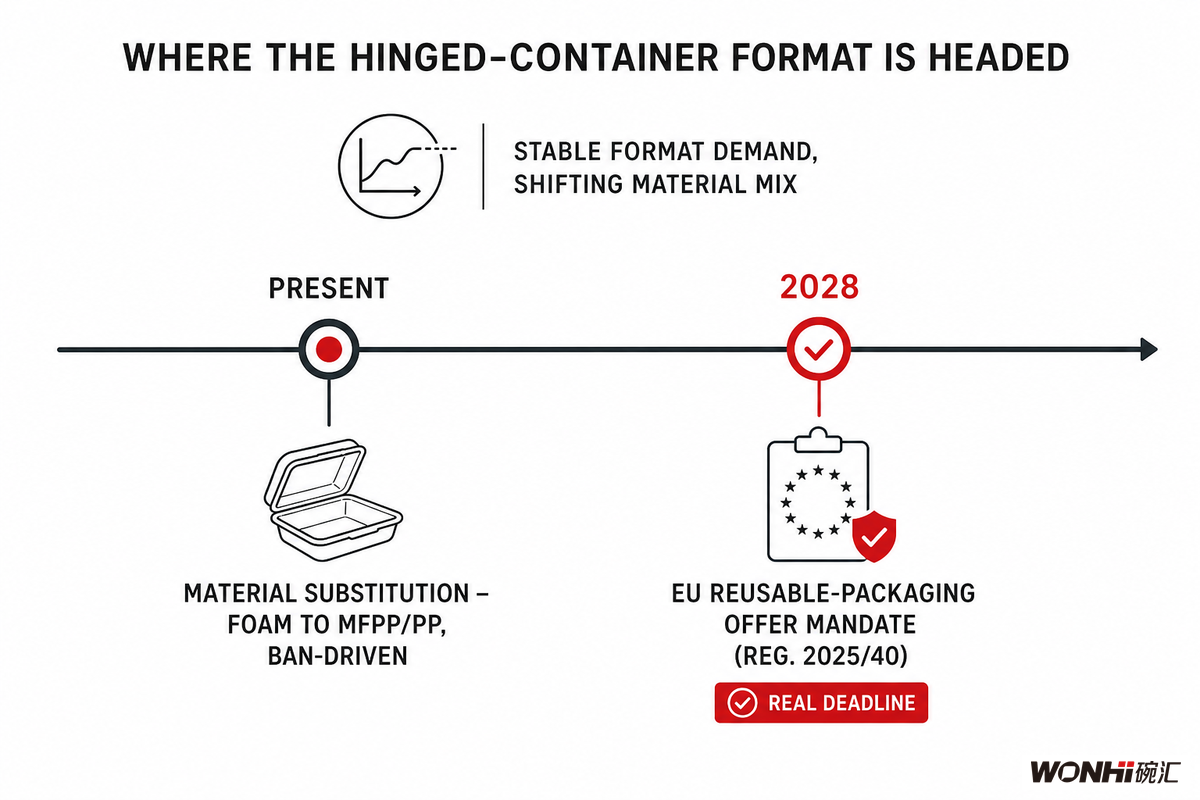
hinged/clamshell-category search demand isn’t actually expanding, either; the aggregate search for “clamshell containers” hasn’t moved in the last several months. That, I’d note, is an indication of category maturation, not distress. So far as there being actual motion, it’s at the sub-category level on two levels:
First up is material substitution – that’s already in progress and is a consequence of the ban wave: foam demand is softening, as MFPP and clear PP take over hot-food and reheat from foam due to an ever-expanding list of states where the material can’t be sold for those purposes. Regulatory movement is the second front – coming from an unexpected direction for many buyers – as the Regulation (EU) 2025/40’s 2028 mandatory offer for reusable-packaging is material neutral, which will be as much a concern for any rigid PP or MFPP hinged container as it will be for a foam one for any operator marketing into the EU. Trade press covering 2026 foodservice packaging trends frames the shift around sustainability, convenience, and value together – not sustainability alone – which aligns with why orders are being placed in practice: durability and compliance come first, recyclability second.
One practical action item: if your supply chain touches the EU HORECA channel, start scoping a reusable-packaging offer now rather than waiting for the 2028 deadline to force a rushed supplier search, and loop in a wholesale supplier that already run multi-material lines rather than one committed to a single resin. Price is following the same substitution logic: foam still holds a lower per-unit price where it remains legal, but MFPP’s edge on insulation and reheat performance closes the total-cost gap once ban penalties, refunds, and one-star reviews from soggy delivery boxes are counted, MFPP is the material engineered to replace foam’s insulation advantage, minus foam’s ban exposure.
“Lid fit is where cheap clamshells fail, a base that’s a half-millimeter off looks fine on the line and pops open in the delivery bag. We sample-test closure on every run because that’s the defect a diner actually sees.”
Wanhui Quality & Engineering Team
The Team Behind This Report
This guide was compiled by Shandong Wanhui Environmental Protection Technology Co., Ltd., a 20-year manufacturer running 20 thermoforming lines, 6 sheet-extrusion lines, and 60 injection-molding lines across MFPP, PP, PET, and foam hinged-container production. Compartment-food-safety framing and the receiving-inspection checklist in this piece draw on our own production-floor closure-fit and hinge-cycle testing, cross-checked against FDA, USDA, EU, and Canadian regulatory sources cited below.
Referencias y fuentes
- 21 CFR 177.1520 Food Contact Substances Inventory « Administración de Alimentos y Medicamentos de EE. UU
- Bisphenol A (BPA): Use in Food Contact Application « Administración de Alimentos y Medicamentos de EE. UU
- Bisphenol A Facts — Stanford Medicine
- Preventing Cross-Contamination — USDA Food Safety and Inspection Service
- Regulation (EU) 2025/40, Packaging and Packaging Waste — Official Journal of the European Union
- Single-use Plastics Prohibition Regulations: Technical Guidelines — Environment and Climate Change Canada
- 2024 PET Recycling Report — National Association for PET Container Resources (NAPCOR)
- Recycling of Plastics in the United States: Plastic Material Flows — National Institutes of Health (PMC)
- The Availability of Snack Food Displays That May Trigger Impulse Purchases — National Institutes of Health (PMC)
- Experimental Analysis on an Additively Manufactured Living Hinge — University of Texas
- US7685676B2, Living Hinge — U.S. Patent and Trademark Office (Google Patents)
Preguntas frecuentes
Q: What is a hinged lid container, and how is it different from a separate-lid tub?
Ver respuesta
A hinged-lid container (or clamshell) is injection-molded in a single piece with the lid and base connected by a living hinge instead of a separate cap. In contrast, a snap-on lid deli tub features the lid as an entirely separate piece which is easily misplaced, mixed up with the wrong container, or intentionally swapped. This one-piece hinge construction prioritizes the guaranteed security of the lid to the base, which is why hinged lid food containers are overwhelmingly used for single-use takeout and delivery packaging – from sandwiches and Chinese takeout boxes to complete catering trays – compared to plastic tubs with removable caps.
Q: Are hinged plastic containers food-safe?
Ver respuesta
The polypropylene utilized in hinged containers is Food and Drug Administration (FDA) compliant for food contact as described in 21 CFR 177.1520, for the foods and usage conditions listed therein – not a broad, unlimited approval for any food at any temperature. That ubiquitous “BPA-free” marketing term accompanying these listings, while factually accurate, is largely meaningless as BPA is a chemical used in polycarbonate/epoxy resins, not in polypropylene. PP containers never had BPA-associated risk.
Q: How many compartments should I order for catering vs. single-entree delivery?
Ver respuesta
Un solo plato principal caliente sin lado no necesita pared de separación interna. Una salsa o aderezo húmedo requiere separación para evitar que se mezcle con el artículo principal durante el transporte, y dos lados justifican la partición para mayor claridad y control de la contaminación cruzada como recomienda el USDA para buffets y servicios de catering. Considere el tipo de plato y el contenido de humedad, no solo las dimensiones generales del contenedor.
Q: What sizes and shapes are available beyond the standard rectangle?
Ver respuesta
Más allá de la rejilla estándar de cajas de plástico cuadradas/rectangulares de 6 × 6 a 9 × 9 pulgadas, los fabricantes también producirán herramientas dedicadas para envases de alimentos de plástico con formas específicas, como un recipiente para sándwiches y perritos calientes de aproximadamente 7 × 4 pulgadas, o un contenedor hoagie de 13 pulgadas, a menudo disponible para pedidos al por mayor. Consulte siempre con su proveedor por tipo de alimento y huella, en lugar de únicamente por pulgadas.
Q: How long do hinged containers typically last before the hinge fails?
Ver respuesta
Hinge durability is seldom an issue with single-use containers, given their immediate disposal after one journey, unlike hinged reusables opened numerous times. A more pertinent statistic is that conventional injection-molded polypropylene living hinges are typically designed for millions of open-close cycles in reusable applications; consequently, a hinge failure at packing or delivery is invariably due to a defect or overfilling, not design exhaustion. Analysis of hinged assembly failures indicates that low-cycle fatigue and creep rupture at stress concentrations not designed into the part account for most failures – in practical terms, a hinge that cracks upon the first closure was either overfilled, inadequately dimensioned, or damaged prior to packing. A manual stress test of a sample (as per the 5-Point Hinge-Failure Diagnostic, described elsewhere) effectively detects these issues before they impact customers.
Q: Are PP and PET hinged containers recyclable?
Ver respuesta
Technically yes, and the picture is improving faster than most buyers realize: U.S. PET bottle recycling ran 30.2% in 2024 (NAPCOR), while PET thermoform recovery — the category clamshells fall into — grew 52% year-over-year to 264 million pounds per the same NAPCOR report, though still from a small base against the 89.0% bottles / 6.8% non-bottle PET a materials-flow model puts in a typical bale (real-world purity often runs higher, 91.1%-99.3% per DSM Environmental Services data). Material choice only marginally improves the odds; acceptance by the local collection program still drives the final fate.
Q: Do regulations outside the U.S. affect which material I should order?
Ver respuesta
Yes. The EU’s Single Use Plastic directive defines a functional test (immediately consumed, no further preparation required and eaten with container) that a hot PP or MFPP container could be treated to like a foam, while the new Regulation (EU) 2025/40 demands a material neutral, reusable packaging for HORECA takeaway from February 2028. Canada has a smaller scope (only foam, PVC, oxo-degradable and black-carbon plastics are prohibited), so this does not extend to rigid PP and MFPP there.
Artículos relacionados
- Contenedores con bisagras MFPP — Wanhui’s mineral-filled PP line for hot, reheated mains
- Contenedores con bisagras de plástico — clear PP/PET for salads, fruit, and deli display
- Foam Hinged Containers: Bans, Safety & Alternatives (2026) — the 2026 U.S. foam ban map and switch-driver decision guide
- Selector de tamaño de contenedor — match capacity to your portion size
- Bandejas para alimentos: Guía de bandejas desechables para servir y bandejas de catering