Get in touch with Wanhui Company


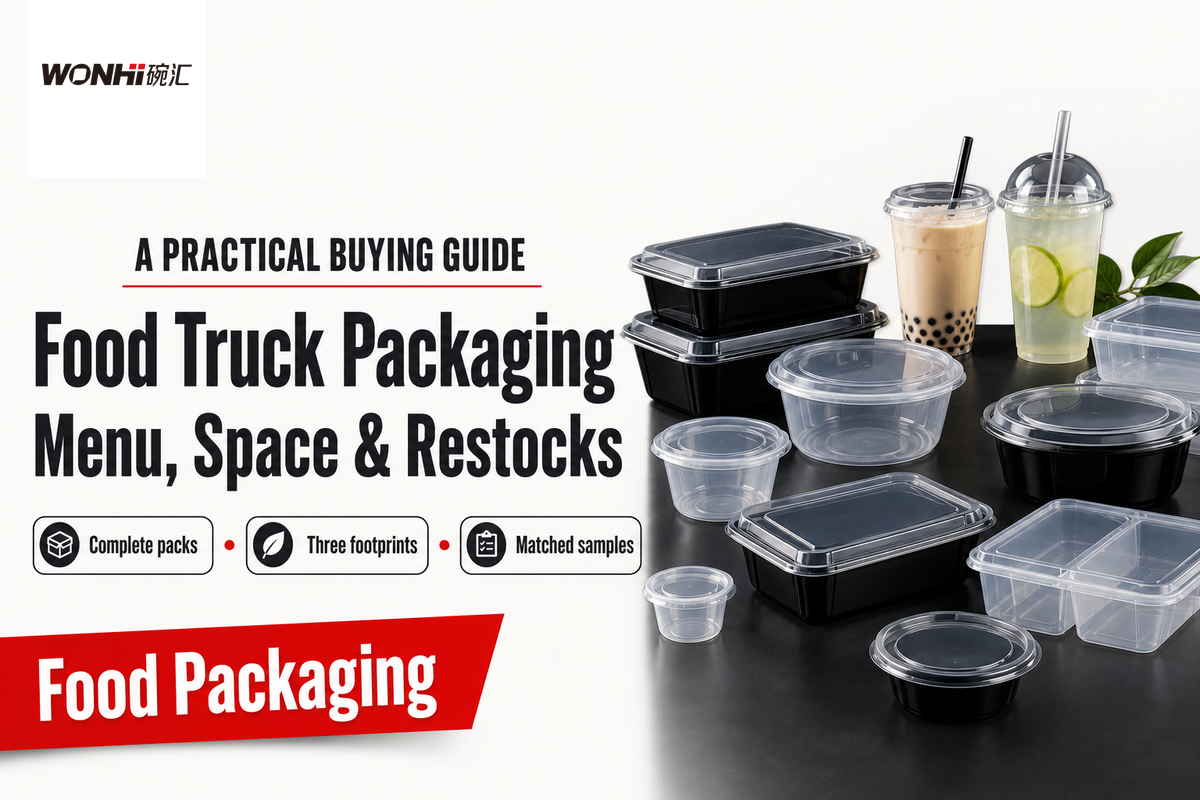
Food truck packaging is the set of all the containers, cups, wraps and other supplies used to hand over a meal to a customer. Choose a kit that goes with your food, the complete set and the space required to store and close it.
A cheap bowl becomes an awkward purchase when its lid needs another shelf. A flat box saves space before assembly but still requires someplace to open. A short list of meal formats should be followed by a 3-Footprint Packaging Check. The worksheets following are examples of buying methods and aren’t results from a Wanhui truck trial.
By GW · Updated October 2026
Buying decision: Match each menu item to a complete serving pack, measure its storage and packing positions, and buy only the quantity your restock route can support.
Build a Food Truck Packaging Kit Around Your Menu
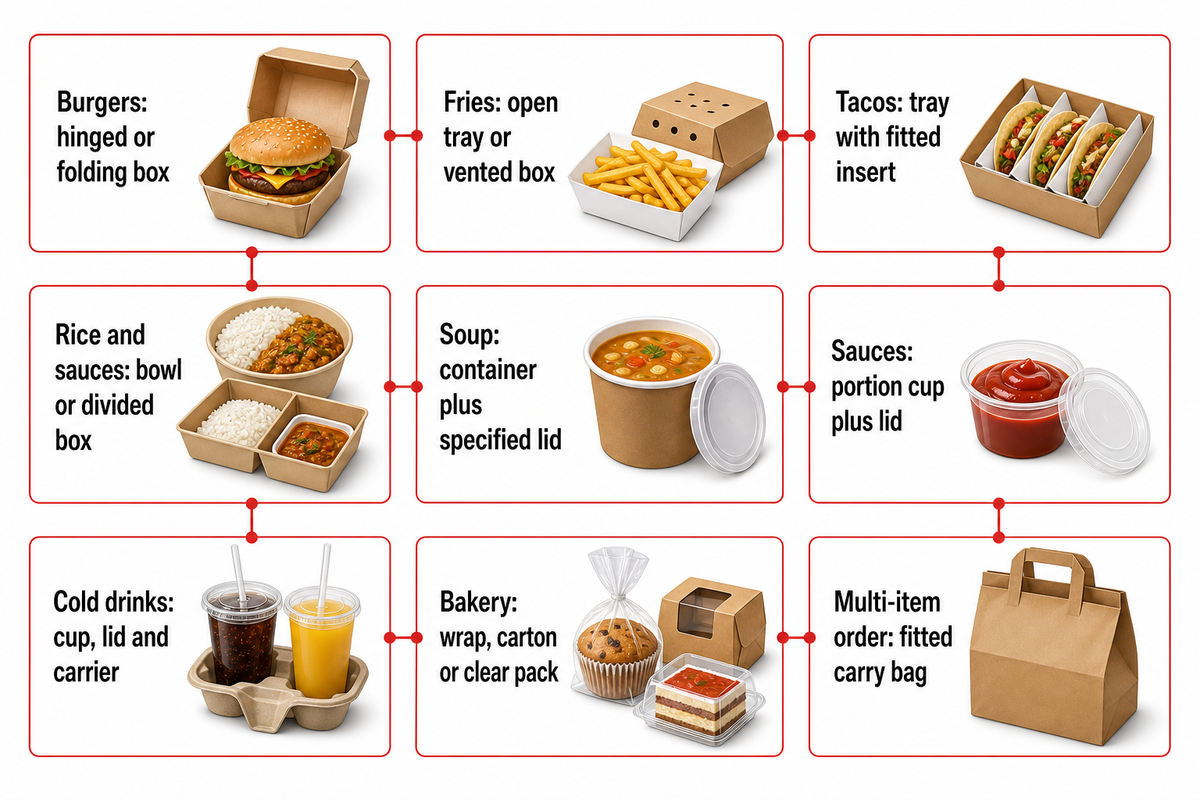
A food truck packaging kit must be complementary to the meals sold, including their separate sauces and beverages. Group together menu items that can share a container, and list exceptions. When grouping, count the base and its matching lid as a complete set and keep the counts of the individual components separate.
For food businesses with a short menu, begin with your busiest order. Separate takeout boxes from prep containers used behind the counter. How does the format of the meal affect the food tray, divider and carrier you need? This menu map gives candidate types of packaging to sample. A name of a material doesn’t show if that material is fit to take food of a particular temperature.
| Menu or order | Packaging type | Sample check | Limitations / not suitable for |
|---|---|---|---|
| Burgers | Hinged clamshell or folding food box | Close over the tallest topping | A shallow lid can press into the meal |
| Fries | Open tray or purpose-designed vented box | Compare texture at the intended eating time | An open tray does not contain liquids |
| Tacos | Tray with a fitted insert | Carry the filled order in its bag | A loose insert can shift |
| Rice and saucy mains | Bowl or compartmented meal box | Check the lid with the full portion | A divider does not guarantee liquid separation |
| Soup | Soup container and specified lid | Review use conditions and filled-pack handling | A cold dessert cup is not an automatic substitute |
| Sauces and dressings | Portion cup and matching lid | Fit the closed cup into the meal pack | Nominal capacity leaves no allowance for your fill practice |
| Cold beverage | Cold cup, lid and drink carrier | Test the complete order in the carrier | A cup family may use several lid sizes |
| Bakery item or dessert | Wrap, paperboard carton or clear container | Check grease marks and topping clearance | Visibility and grease resistance are separate needs |
| Multi-item takeout order | Carry bag with suitably shaped packs | Lift a representative loaded order | A tall stack may tip even when individual packs fit |
Shared packaging works when the portions, intended use and handoff needs fit the same sample. A rice bowl and a salad may share a base, but a soup portion brings up a different containment issue. Keep exceptions to cases where a common pack would crush toppings, mix components, or create excess empty space.
Compare compartmented meal containers to another undivided alternative for a small street food menu, and see which is better. An owner might prefer fewer stock items; the cook still needs space to place the food in an orderly fashion. Record which menu items passed the sample check. Not every rectangular container serves the same function. Add the napkin and utensil only where the order requires it.
Choose Portion Cups and Disposable Soup Containers
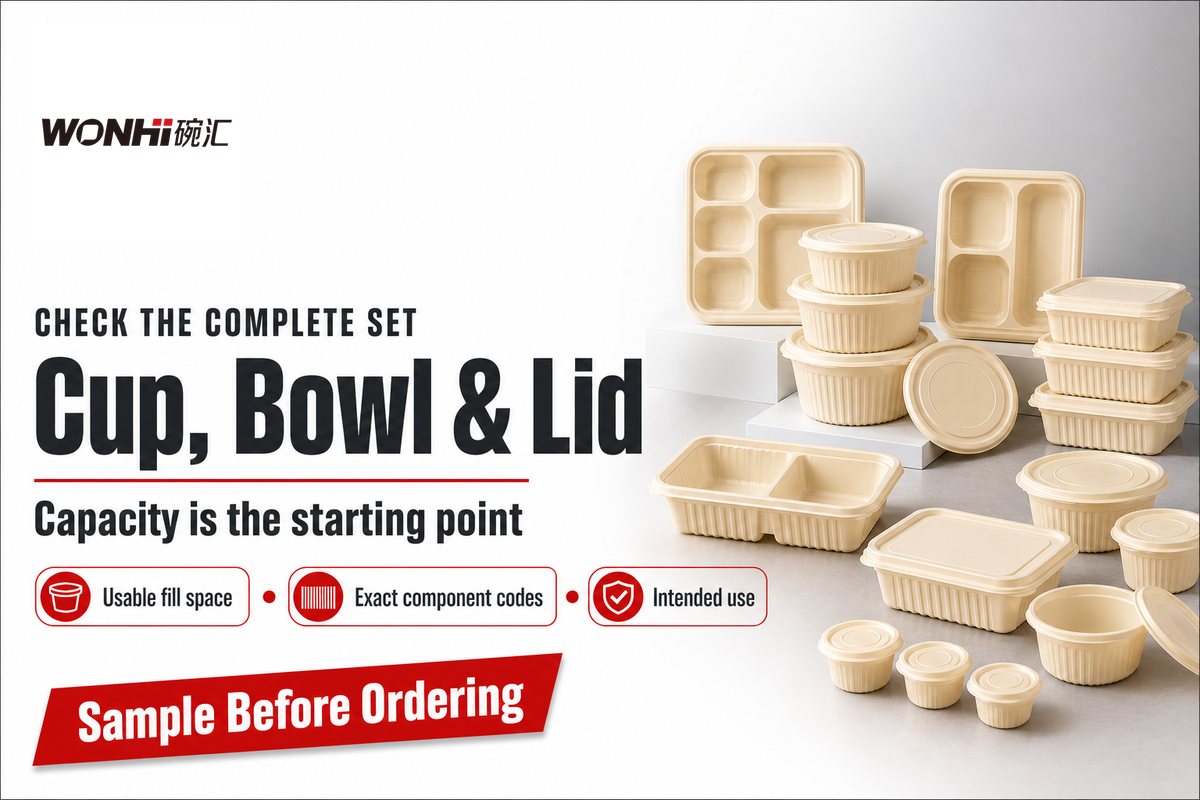
Disposable soup containers and portion cups must be taken with their corresponding lids and used in the right way for food. Capacity is only the starting point. Check usable fill space, closure access and whether the component fits properly in the customer’s to-go bag. Components of the same size don’t necessarily match.
The FDA food-type and conditions-of-use tables distinguish fatty or aqueous foods and different filling, storage and reheating conditions. Use the information provided in the tables when requesting supporting documents for the exact product in question. The tables do not approve any specific bowl or lid.
For a sample request, you might compare a nominal 2 oz cup and 4 oz cup for a sauce, or a 12 oz container and 16 oz container for soup. Measure served portions separately. These are illustrative nominal sizes, and are not suggested fill volumes, or a promise that Wanhui stocks any of these.
Ask the supplier to label both component codes on the sample bag. Try closing the pack with the meal assembled as sold, keeping the rim clear. A closure trial helps assess handling; it can’t establish chemical suitability or replace the product’s stated use limits. For open snacks, compare food-tray formats before adding an unnecessary lid.
Measure Three Footprints Before Buying Takeout Containers
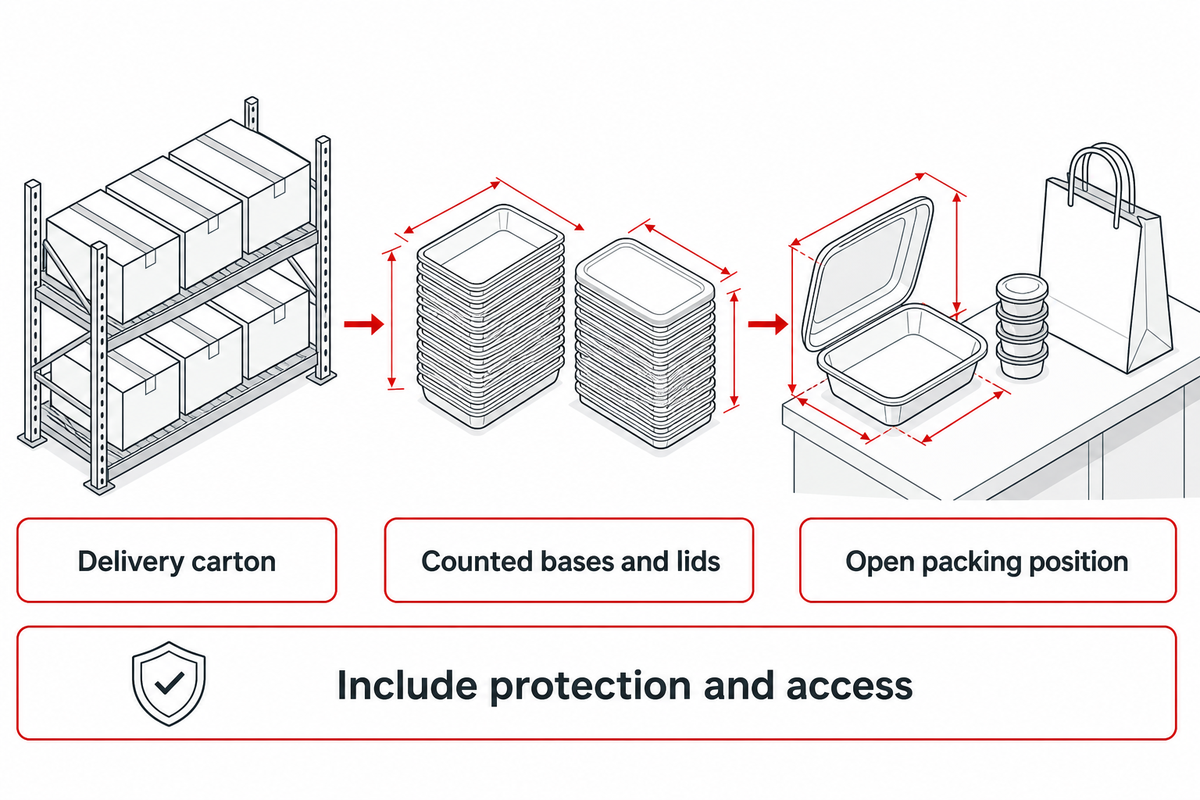
Takeout containers occupy three different spaces: the delivery carton, the counted stack at the serving station and the open packing position. Measure each with its separate lids and packaging. A compact shipping case does not prove that the assembled pack fits the counter, and single-container dimensions do not reveal a nested stack’s height.
The 3-Footprint Packaging Check
Use the following worksheet with the same candidate pack. Every measurement in the example column is illustrative. Measurements should be in your units of choice, and should be consistent. The pass condition is your available space, your operating procedures, and your container size limits, not universal limits.
| Footprint / check | Hypothetical example | Buyer decision | Limitations / not suitable for |
|---|---|---|---|
| Carton: outside dimensions | Base case: 20 × 16 × 18 in | Compare with the receiving shelf | Case volume alone misses shelf shape |
| Carton: separate lid case | Lid case: 18 × 12 × 14 in | Allocate a second storage position | Base case dimensions exclude lids |
| Carton: access space | Available opening: 22 × 20 in | Check loading and removal | Door hardware reduces usable opening |
| Nested stack: counted bases | 25 bases: 9 × 9 × 8 in | Compare equal meal counts | A different count changes height |
| Nested stack: counted lids | 25 lids: 9 × 9 × 3 in | Reserve lid-stack space | A similar lid diameter is not a match |
| Nested stack: protection and access | Protected shelf opening: 12 in high | Check wrapper and hand clearance | Bare-stack height understates access needs |
| Packing position: open pack | Open clamshell: 9 × 18 in | Check counter depth | Closed dimensions hide the lid’s reach |
| Packing position: bag opening | Bag base: 10 × 10 in | Trial-load a 9 × 9 in pack | Nominal clearance does not prove an easy fit |
| Packing position: occupied area | Working area: 24 × 20 in | Place the pack and sauce-cup stack together | An empty-counter test misses other supplies |
Protected storage matters as much as geometry. For example, Washington’s storage rule addresses clean, dry locations, protection from contamination and protective packaging. Apply the requirements of your own jurisdiction when identifying usable shelves. A bare stack measured on an empty counter isn’t a storage plan.
Using our burger truck example again, let’s say the truck is deciding between a hinged pack and a box with a separate lid. The buyer measures both closed samples and sees little difference. During a mock-up of the counter display, the hinged sample uses space that’s typically used for the sauce-cup stack. Moving that stack would fix the reach issue, but places it in the bagging position. The box with the separate lid requires protected storage as well. No sample has won yet. The crew again lays out the filled packs with sauce, napkin and carry bag, and repeats the handoff. The owner records the taken area, and decides which configuration is best for the truck. No claimed percent savings are needed to make that determination.
Compare Hinged Clamshells and Flat Boxes at the Service Window
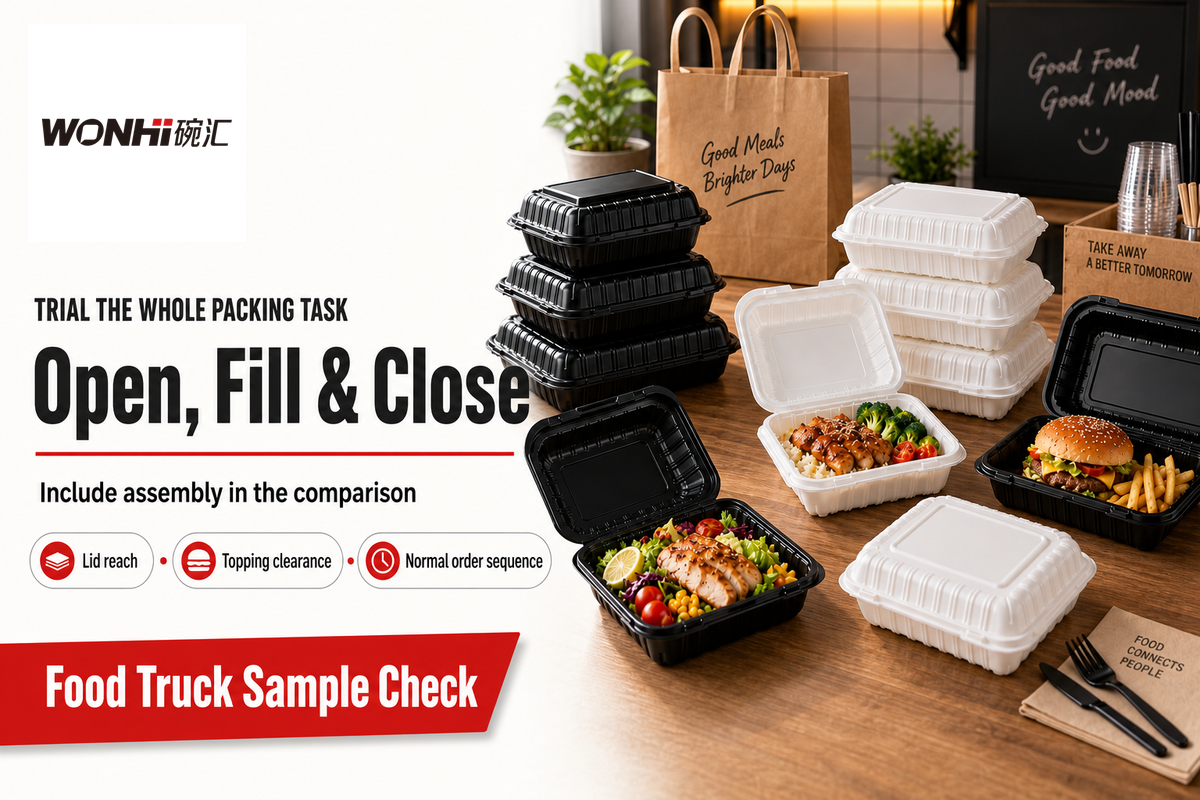
Hinged clamshells keep a lid attached; flat boxes require assembly. Either style can work with a food truck, if its open shape and handling sequence fit the counter. Compare the complete packing task with your crew and your menu. There’s no verified universal speed advantage in the data reviewed here.
A closed burger and fries order can be a good test prompt. An order eaten beside the truck may require a different format. Use the packaging product within the constraints for which it was designed. Don’t alter the food contact surface or improvise vents.
Hinged clamshell
- Measure the open lid’s reach.
- Check closure over the filled portion.
- Count the protected nested stack.
Flat folding box
- Allocate space for assembly.
- Check folds with the filled portion.
- Count flat blanks and preassembled stock.
Compare hinged-lid container options with the folding box you intend to buy. Record assembly time separately from filling and closing. Otherwise, a box assembled before service can appear faster simply because part of the work was left out.
Picture a truck that sells fried chicken at lunch and desserts at an evening event. The purchasing lead wants one case line for both menus. A sample clamshell holds the chicken portion, but the lid touches the topping for the dessert. A tall box solves that problem and adds another stack beside the window. The crew trials both menus with the same bag and normal order sequence, recording closure attempts. They also record assembly work and visible damage. The decision may be a base with different lids, or different food boxes, based on the work and the fit, not on the claim that one format is always more efficient packaging.
Check Bagasse and Other Packaging Materials Against Actual Use
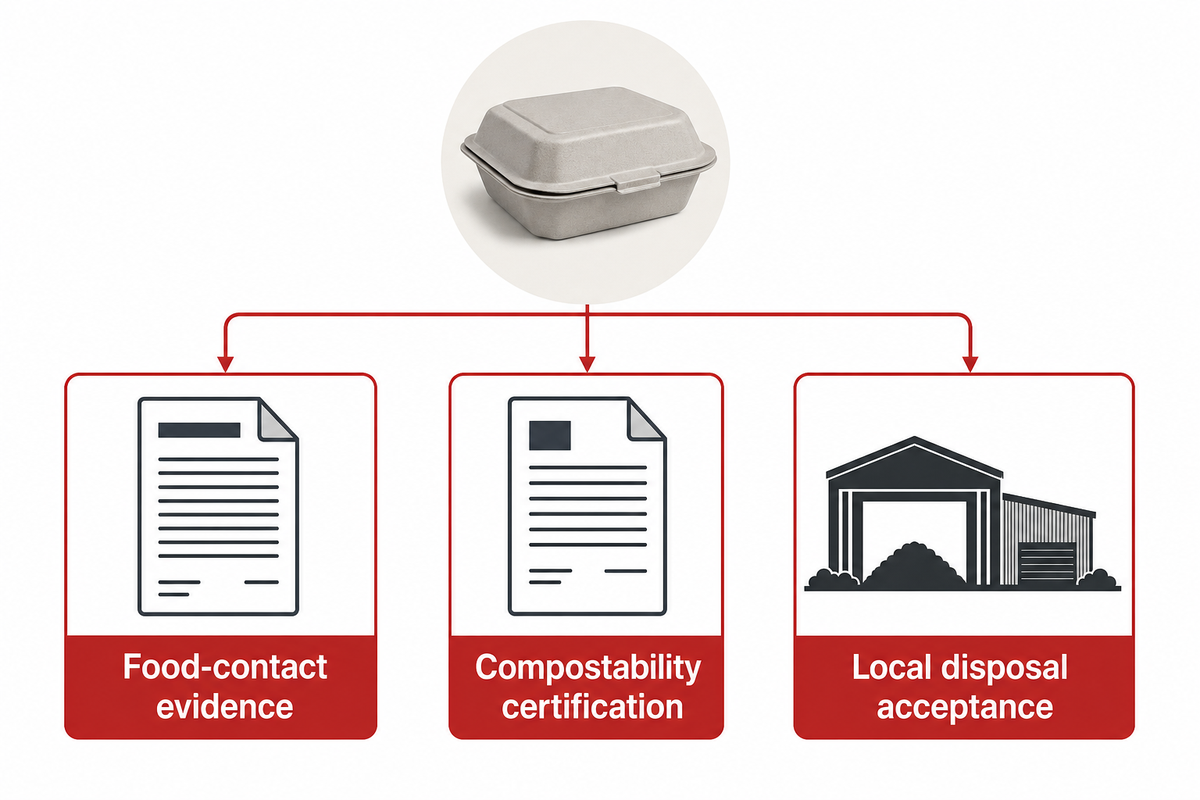
When selecting packaging material, the specific food, use conditions and available disposal route should be considered, and bagasse, paperboard, foil and plastic products should each be assessed. A compostable label doesn’t establish hot food performance, local acceptance or a lower overall environmental footprint. Compare the complete construction, including coatings and lids.
Are natural fiber containers sturdy enough for hot food items like stews and burritos?
Natural fiber containers may be considered for a specific hot meal, if the exact product is specified for that use and a sample demonstrates the handling of the portion. Fiber type alone doesn’t answer the question. Assess food and the contact time and temperature, deformation, closure and carrying of the proposed meal.
A bagasse clamshell and a coated kraft bowl can have different constructions. Likewise, PLA cold cups, paper cups and other paper products shouldn’t inherit each other’s use claims. Compare the supplier’s compostable clamshell specifications at item level. A family-page description isn’t a certificate for every shape and size.
When not to buy on a material label alone
Pause an order if “hot-food suitable” has no stated use conditions, or a certificate cannot be tied to the quoted item. Evidence for grease-resistant construction and durable handling should be assessed separately. A sample that feels sturdy during one handoff does not prove food-contact suitability, microwave use or repeatable durability through every intended holding period.
Disposal is another failure point. EPA’s food service ware guidance ties commercially compostable purchases to collection and composting facilities that accept those product types. Check the event or destination route before printing disposal instructions. A reusable system needs an achievable return-and-wash arrangement; a recycle symbol doesn’t create a collection service.
Environmental comparisons need more than a label. Oregon DEQ’s 2018 life-cycle literature review found that compostability alone was a poor predictor of environmental benefit. Its historical comparisons don’t rank today’s products. The FTC Green Guides also call for supported, properly qualified environmental claims. Treat “eco-friendly food truck supplies” as a question to investigate, not a specification.
Check restrictions at your destination before choosing disposable food containers. For example, Oregon has foodware restrictions effective January 2025. The rules where you sell matter; a federal food-contact reference does not settle them. For terminology, see the separate guide to compostable, biodegradable and recyclable labels.
Set Stock Levels Between Restocks
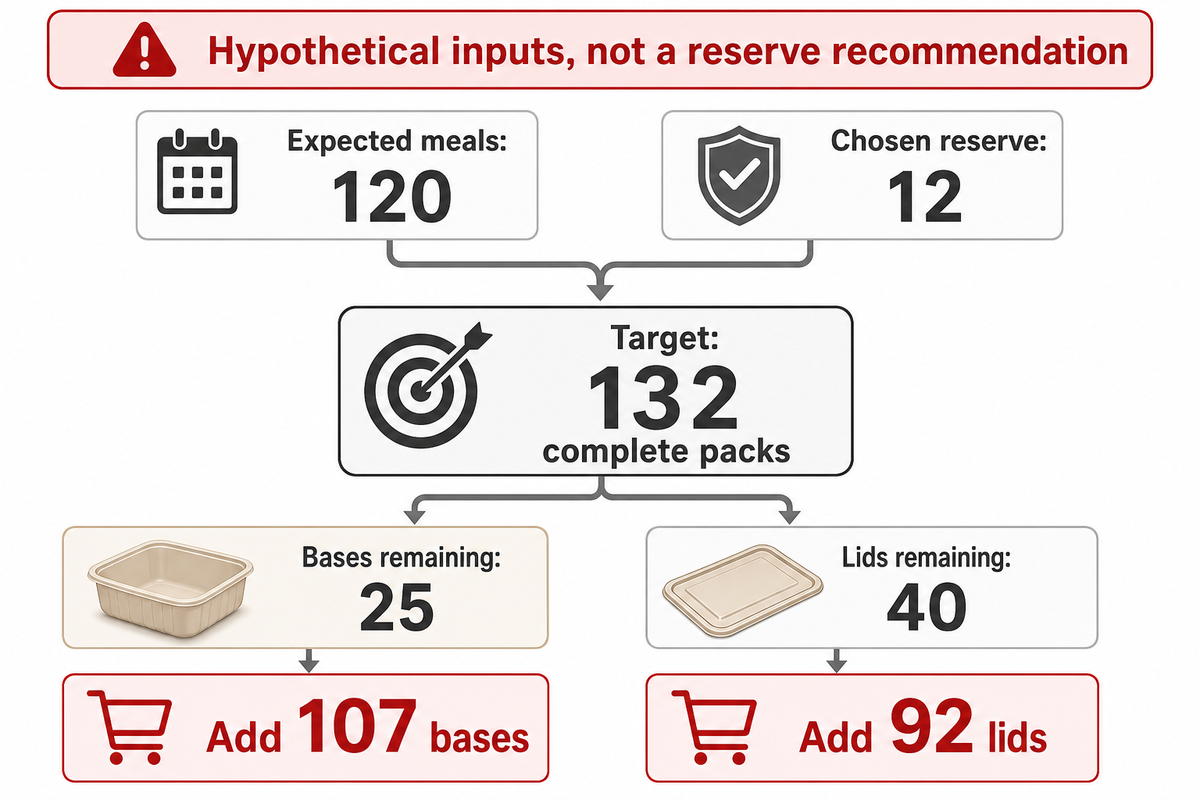
Service period stock levels must include expected orders up to the next usable replenishment, and be adjusted to consider your own level of uncertainty and your storage constraints. Account for bases and lids separately. A forecast is an input to evaluate after service, not a prescribed percentage that every food truck must apply.
NC State’s 2011 periodic-review inventory tutorial outlines ordering up to a target after adjusting for existing inventory. Although the model is useful in teaching the necessary arithmetic, it isn’t useful in providing a demand forecast for your business. Keep in mind the time required to obtain stock from the commissary, and not just the time between stock checks.
| Input or result | Bases | Matching lids |
|---|---|---|
| Expected meals | 120 pieces | 120 pieces |
| Operator-chosen reserve | 12 pieces | 12 pieces |
| Target ready stock | 132 pieces | 132 pieces |
| Usable stock remaining | 25 pieces | 40 pieces |
| Pieces to add | 107 pieces | 92 pieces |
Let’s say the expected load for a hypothetical lunch route is 120 meals before the next replenishment and the owner selects 12 spare complete packs. The target would then be 120 + 12 = 132 packs. With 25 usable bases and 40 matching lids already on board, the crew adds 107 bases and 92 lids. Loading 107 of each would result in a lid surplus; loading 92 of each would result in a base stock shortage. The buyer then converts the pieces needed to the supplier’s sleeve or case quantities, and documents what remains at the commissary. If the truck can’t hold the target with protected access, adjust the restock route or menu plan rather than forcing stock into a space that isn’t suitable.
For finance, the delivered cost of a complete usable pack, including the lid, print charge and freight, should be compared. The owner should track leftovers and missed replenishments after each route. Procurement can then modify order quantities using the same component codes. Bulk discounts have little value when excess cartons occupy the only working shelf.
Ask Food Truck Packaging Suppliers for a Complete Sample Set
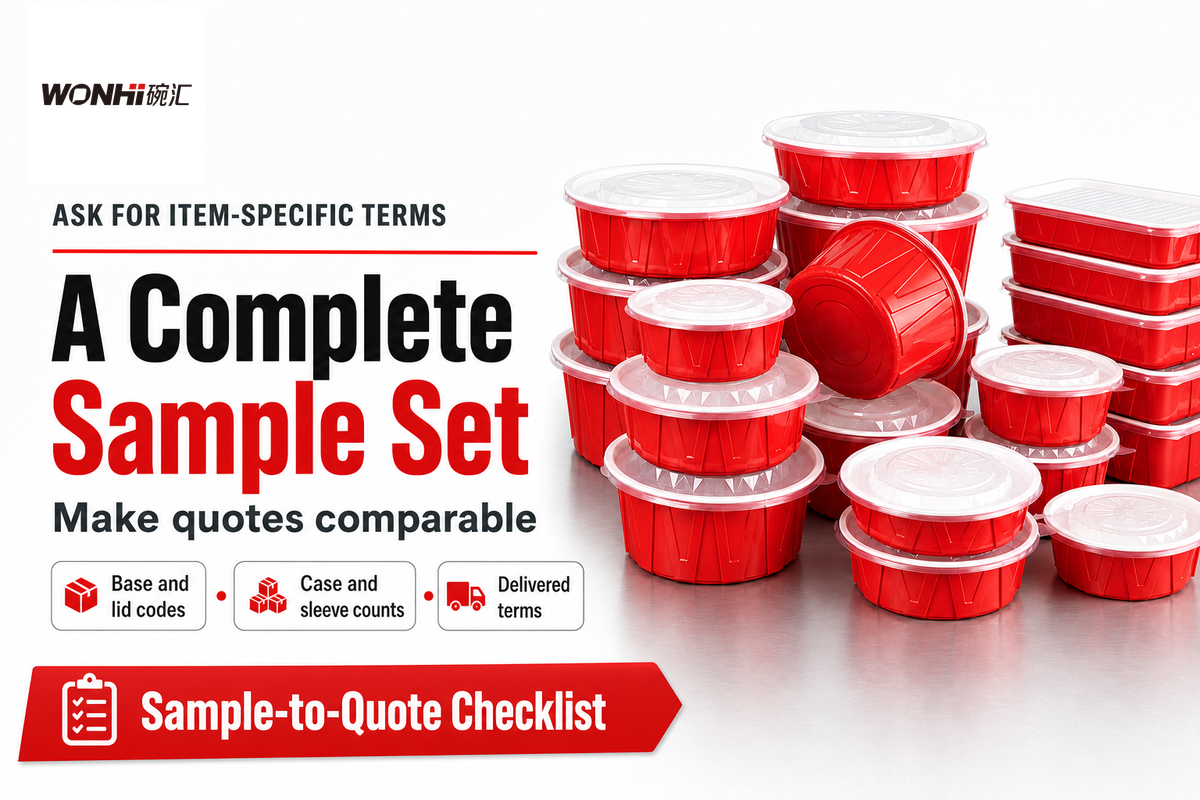
Food truck packaging suppliers require a brief that identifies the meal, complete component set, and the delivery destination. Provided sample items should be reviewed prior to commitment with custom printing. The same purchasing unit should be compared across quotes. A base-only price and a base-plus-lid price describe different orders.
Use the request for quotation checklist enclosed herein in your supplier query. Enter measured limits instead of accepting a broad claim about functionality. The recommended range column deliberately asks for your figures where public evidence cannot supply a universal value.
Sample-to-Quote Checklist
| Parameter | Recommended range | Why it matters | How to verify |
|---|---|---|---|
| Portion and fill space | Your measured volume in oz or mL | Nominal capacity may exceed usable fill | Fill the exact sample with the menu portion |
| Food-use conditions | Your contact time and temperature | Use limits vary by construction | Match the item code to supplier evidence |
| Base and lid | Exact codes; count in pieces | Separate components must match | Receive a labeled complete set |
| Three footprints | Your limits in in or cm | Storage and packing use different spaces | Measure cases, counted stacks and open packs |
| Case and sleeve counts | Pieces per case and per sleeve | Buying quantities differ from service stock | Check pack list and quote line items |
| Printing | Your artwork and order quantity | Setup and proofs affect the commitment | Approve the exact print proof and charges |
| Delivery | Required arrival date and destination | Production time excludes some transit steps | Obtain an itemized delivered quote |
| Disposal claim | Exact item and destination route | Certification and local acceptance differ | Match certificate scope and facility response |
Stock packaging with a label may fit changing menus before a printed run makes sense. Keep your logo or order labels away from food-contact surfaces unless specified construction permits their contact. Samples may be production, print proofs, or illustrative; they answer different questions.
Wanhui’s wholesale food-container ranges offer an opening point for an inquiry. Send your ‘menu map’ and measured limits with your request. Inquire about item-specific availability, minimum quantity, sample terms and freight rather than assuming the terms for another packaging product would be the same.
What Is Changing in Food Truck Packaging?
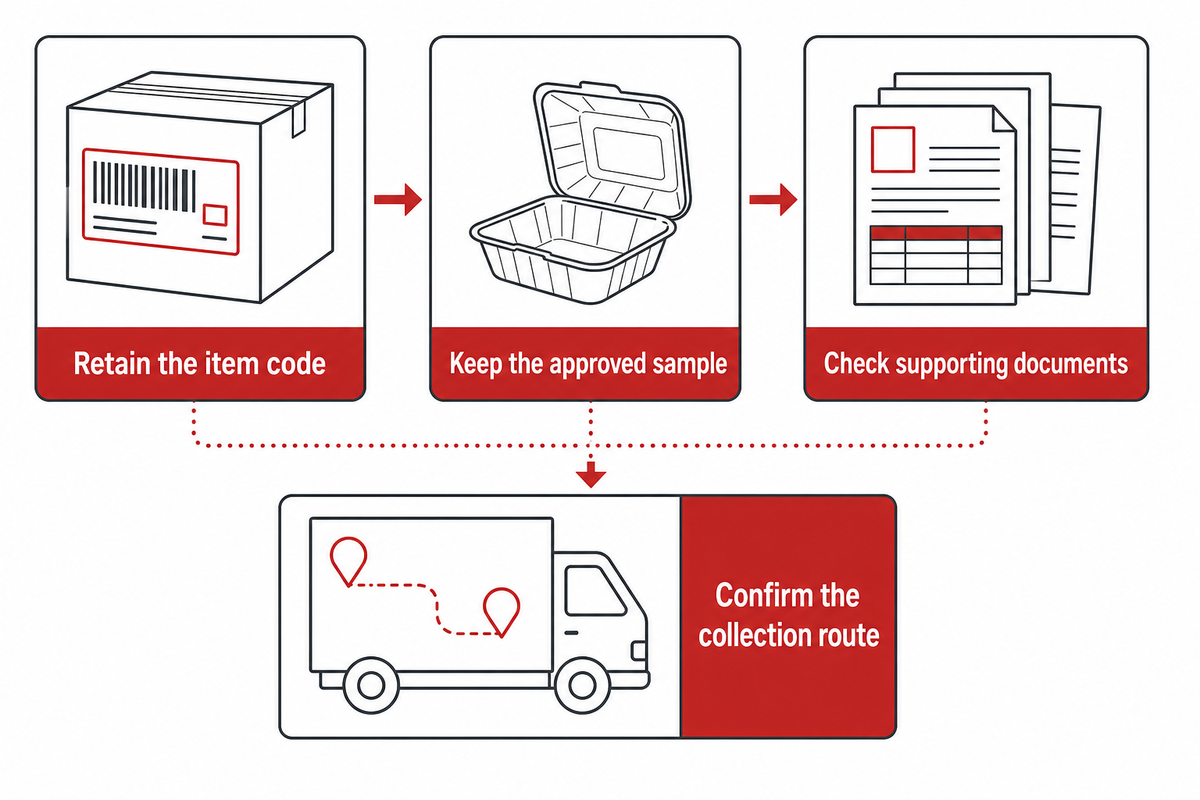
Food truck packaging buyers must view newly developed standards and certification programs as opportunities to assess the scope of supplier claims. A new designation doesn’t validate that a quoted item meets the claim. Prior to a repeat order, ask which product version and certificate the supplier will ship, and if the destination’s collection route will still accept it.
ASTM announced a revision of D6400 in September 2026. The August 2025 announcement describes field methods D8618 and D8619, which examine breakdown under specified conditions of composting facilities. Field methods and laboratory methods address related, but different questions. Neither announcement is evidence that a Wanhui product is certified.
“composting is not a standardized process”
BPI’s September 2025 Commercial and Home compostable program announcement illustrates the importance of the specified setting. The terms “Commercial” and “Home” shouldn’t be used interchangeably. Verify the certification that’s attached to the compostable products being quoted, and check how the certificate describes the intended setting.
These changes support a good business practice: retain item code, approved sample and supporting documents with each order. Review substitutions before delivery. A new lid or coating can change what needs checking, even if the order description still says “compostable food container”. A sustainable purchasing plan also requires a collection route that people can use.
Broad food service forecasts don’t generally help you decide how many cartons your truck should need next month. Rely on your route sales, committed events and available storage for that. If you cater private events, separate your committed meals from your forecast walk-up orders. Operating a food truck with a seasonal menu requires a different commitment from stocking an unchanged menu every weekday. Keep long printed orders tied to known demand and revisit sustainability practices when the event operator changes its waste service.
FAQ
Where can I buy wholesale food packaging?
Wholesale food packaging is available through distributors and manufacturers; compare complete packs and delivered terms.
A distributor may offer stock take-out containers in case quantities, while a manufacturer may quote a custom run. Ask for the matching lid code, case count and destination freight before comparing prices. For a small eatery, available shelf space and reorder access may matter more than the lowest unit price. Request samples of the quoted items, not an unrelated assortment.
What is the minimum order quantity for Food Truck Packaging?
The minimum order quantity depends on the item, stock availability and printing requirements.
Ask for separate figures for unprinted stock, a new printed design and a repeat order. A minimum for one container does not establish the minimum for another lid or material. Compare the commitment in complete meals as well as pieces. Wanhui’s quantity for your proposed order needs an item-specific quote; this guide does not promise a universal minimum.
How much should I budget for custom branded packaging versus generic containers?
Budget from itemized quotes for the same complete pack, quantity and delivery destination.
Include print setup, artwork or proof charges, matching lids and freight. Compare a stock pack with a label against a printed version if your menu is still changing. Divide the delivered total by the usable complete packs you expect to consume. There is no verified universal printing premium here, and a lower piece price can require a larger cash commitment.
Is shipping included with Food Truck Packaging orders?
Shipping is included only when the supplier’s quote states that it is.
Provide the delivery address and unloading needs. Confirm which freight, duties or destination charges are included, and compare quotes using the same delivery basis.
What materials and certifications are available for Food Truck Packaging?
Available materials and certifications depend on the exact container, lid and supplier offering.
Ask for the construction and item code before choosing among fiber, paperboard and plastic options. Food-contact evidence, compostability certification and local disposal acceptance answer different questions. Request current documents whose scope matches the quoted item, including any lid or coating. A family-page badge does not establish every product’s status. Avoid calling the whole kit environmentally preferable without evidence for that comparison, and confirm requirements at the locations where you serve customers.
How long does it take to produce Food Truck Packaging?
Production time depends on stock, artwork approval, materials and order size.
Obtain a written schedule from approved proof to dispatch, then add transport and receiving time. Confirm repeat-order timing separately.
What are the five types of food packaging?
Five useful buying groups for a food truck are containers, cups, wraps, trays and carry bags.
This is an editorial grouping, not a universal industry classification. A single order can use several groups: a meal container, a sauce cup and a carry bag, for example. Lids and inserts belong on the component list even when they are sold separately. Other classifications organize packaging by material or function. Use the grouping that helps you identify everything needed to hand customers on the go a complete order.
Key takeaway
Buy an entire packaging system for the meal and the truck: compatible components, measured storage, a workable packing position and a restock quantity you can explain.
Ready to compare samples? Send Wanhui your menu, target portions, measured shelf space and destination. Include the Sample-to-Quote Checklist so the response can identify the proposed bases, lids and ordering terms.
How this packaging guide was prepared
Wanhui supplies food packaging and has a commercial interest in container selection. This document uses public sources and proposed checks for food truck storage and packing. Measurement and restock examples are illustrative and don’t represent customer usage tests. Availability, use limits and certifications must be established for the quoted items. Byline: GW; no professional qualification is claimed.
References & Sources
- Food Types & Conditions of Use for Food Contact Substances FDA; intended-use taxonomy.
- Identifying Sustainable Food Service and Food Service Ware EPA; current procurement guidance.
- Guides for the Use of Environmental Marketing Claims Federal Trade Commission, 16 CFR Part 260; current electronic text checked October 2026.
- Material Attribute: Compostable Oregon DEQ, 2018; historical life-cycle review.
- Compostable Products Standard Revised ASTM, September 2026.
- Periodic Review System: Inventory Management Models NC State, 2011; general accounting model, not current truck demand data.
- WAC 246-215-04920: Storage Washington State Legislature; jurisdiction-specific rule.
- Foodware Containers and Polystyrene Foam Oregon Department of Environmental Quality; jurisdiction-specific restrictions.
- New Standards for Compostable Products ASTM International, August 2025; source of the attributed short quotation.
- Commercial and Home Compostable Program Announcement Biodegradable Products Institute, September 2025.