Get in touch with Wanhui Company


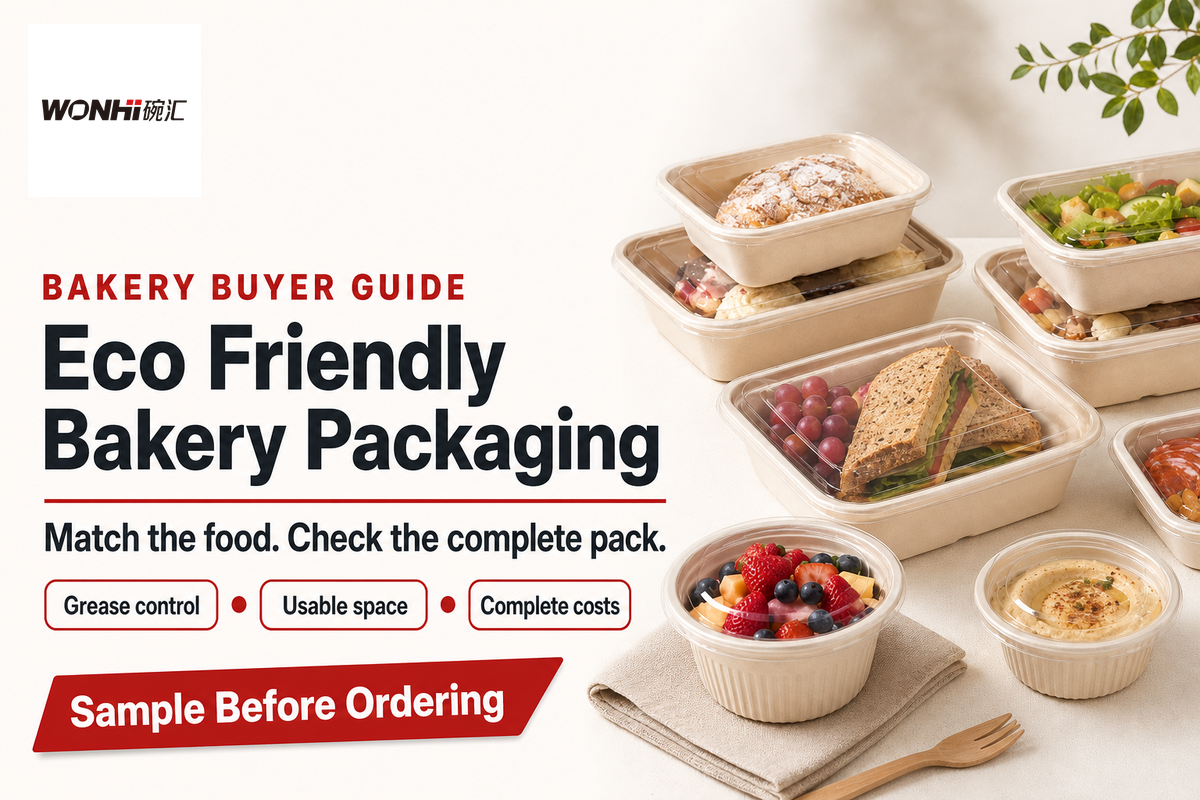
Eco friendly bakery packaging is food packaging chosen to protect baked goods while pursuing a specific, substantiated environmental benefit. A brown box that leaks butter or crushes a cake solves little. Compare packaging solutions around the finished pastry, cookie or cake, then pick the complete pack: base, liner, window, insert and closure.
Updated October 2026
Choose eco friendly bakery packaging by matching grease control, moisture behavior and physical protection to your menu. Verify the finished construction’s intended food-contact use, test it through your actual handoff, and confirm the disposal route. Compare complete-pack quotes only after those requirements are fixed.
Before ordering
- Grease resistance doesn’t establish a moisture barrier.
- A film certificate may not cover the finished bag.
- Catalog dimensions don’t prove usable internal clearance.
- Lower packaging weight alone doesn’t prove lower overall environmental impact.
This guide covers bakery counter sales, takeaway and short distribution routes. It sets no shelf life for sealed retail products. It doesn’t replace controls for perishable fillings. The proposed trials are purchasing methods. Catalog examples are published specifications, not Wanhui laboratory test results.
Check the complete bakery pack before making an eco claim
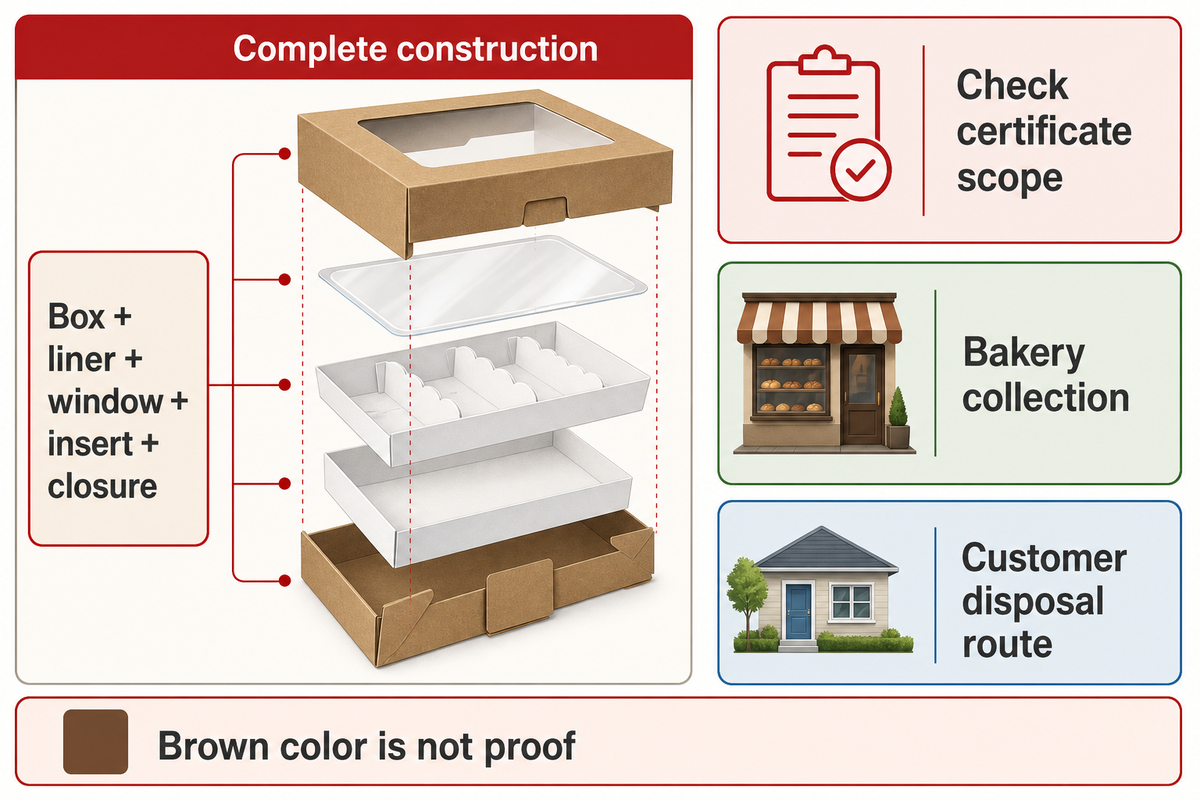
A sustainable packaging claim requires a defined benefit and package. Name paper, coating, window and adhesive, then pick disposal wording. Then check where the finished assembly can actually go. A brown color, substrate name or plant-based ingredient won’t answer that for all bakery boxes.
The summary of the Green Guides by the Federal Trade Commission cautions against overbroad and unqualified environmental claims. Keep claims for recycled materials or compostability specific to the construction provided. Suitability for food contact, source of the material, and disposal are separate claims. For a recycled paper box, ask which elements, if any, are made from recycled material, and what the stated percentage refers to. A biodegradable claim needs its own conditions; it doesn’t establish a meaningful disposal route.
There are two routes to investigate: the bakery’s commercial waste collection and the residential systems available to customers taking food home. Your own hauler’s approval doesn’t establish customer access. The EPA’s composting guidance also distinguishes industrial composting from home conditions and warns that compostable plastics don’t belong in ordinary plastic recycling.
Don’t omit food protection in the comparison. EPA states that wasted food also wastes the resources used to produce and deliver it. Keep track of damaged or unsold baked goods and packaging waste. This gives a starting point for a sustainability discussion before deciding that a change is environmentally beneficial. Neither a lighter pack nor successful local collection shows that an entire food and packaging system has the lower environmental impact.
Do
- Identify every layer of the finished pack.
- Ask which product a certificate covers.
- Check store and customer disposal routes.
Don’t
- Infer recycled content from brown color.
- Transfer a film claim to every finished bag.
- Print an unqualified disposal promise.
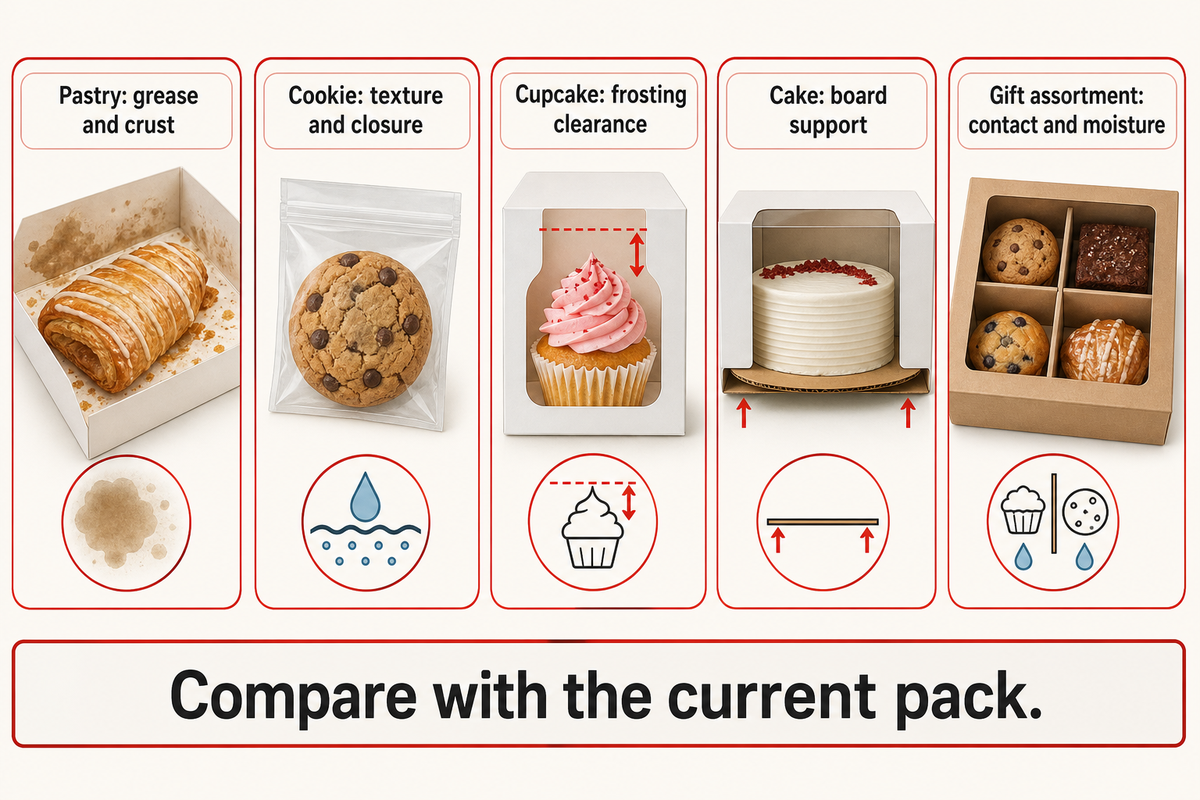
Bakery packaging should follow the food’s dominant failure mode. A pastry, for example, needs control of its grease without ruining its crust; a crisp cookie needs protection from unwanted moisture; a cake needs spacing and support. Test those needs separately before trying to standardize several products into a single format.
The 5-Product Bakery Trial Map below groups nine candidate formats around pastries, cookies, cupcakes, cakes and gift assortments. These formats are samples for selection, and not recommendations for shelf-life. With the current recipe and intended use case, pair the candidate format with the pack you currently use, and see if it serves the purpose.
| Product / format | Reason to sample | Check at handoff | Limitations / Not suitable for |
|---|---|---|---|
| Pastry: paper bag | Quick counter service | Crust texture and grease marks | Unsupported decorations or crushing loads |
| Pastry: lined paperboard box | Separate the food from the outer board | Liner movement and stained corners | Unverified liner compatibility with the food |
| Cookie: closed bag | Evaluate closure and moisture control | Crispness or softness against the control | Unknown barrier grade or weak closure |
| Cookie: window carton | Display a set arrangement | Movement and viewing angle | Longer freshness claims without validation |
| Cupcake: insert box | Locate individual bases | Frosting clearance with the lid shut | Insert openings that don’t fit the actual cups |
| Cupcake: hinged container | Reduce separate lid handling | Latch retention and decoration contact | Nominal capacity used as proof of fit |
| Cake: board and carton | Support the whole cake during lifting | Base deflection and side contact | A board that slides inside the assembled box |
| Cake slice: rigid tray and cover | Protect a tall, narrow serving | Tipping when carried | Unmatched tray and cover |
| Gift assortment: divided box | Separate fragile or differently textured items | Contact between cookies, chocolate and dividers | Assuming dividers create a moisture barrier |
Paper packaging preserves cookie quality only when its complete barrier and closure are compatible with the recipe and holding conditions. Plain kraft paper, coated paper and a paper carton around a sealed inner bag behave differently. Exploratorium’s cookie-storage explanation describes moisture exchange between crisp and soft cookies and advises storing them separately in airtight containers. It doesn’t set a holding time for a commercial paper bag.
Think of a counter selling a crisp cookie and a soft filled cookie from the same gift box. The owner wishes to have an attractive package. However, the two recipes raise different storage questions. Propose to pack each recipe separately in the current pack and a candidate pack, then test the proposed mixed arrangement as a separate condition. Note when the texture changes compared with the control pack. Also, note if an inner bag changes presentation or the way the pack is assembled. Keep food safety limits as they are. A divider may prevent contact; however, it doesn’t seal moisture away from the neighboring cookie. The purchase decision should reflect the arrangement customers will actually receive.
Choose liners and coatings by the job they must do
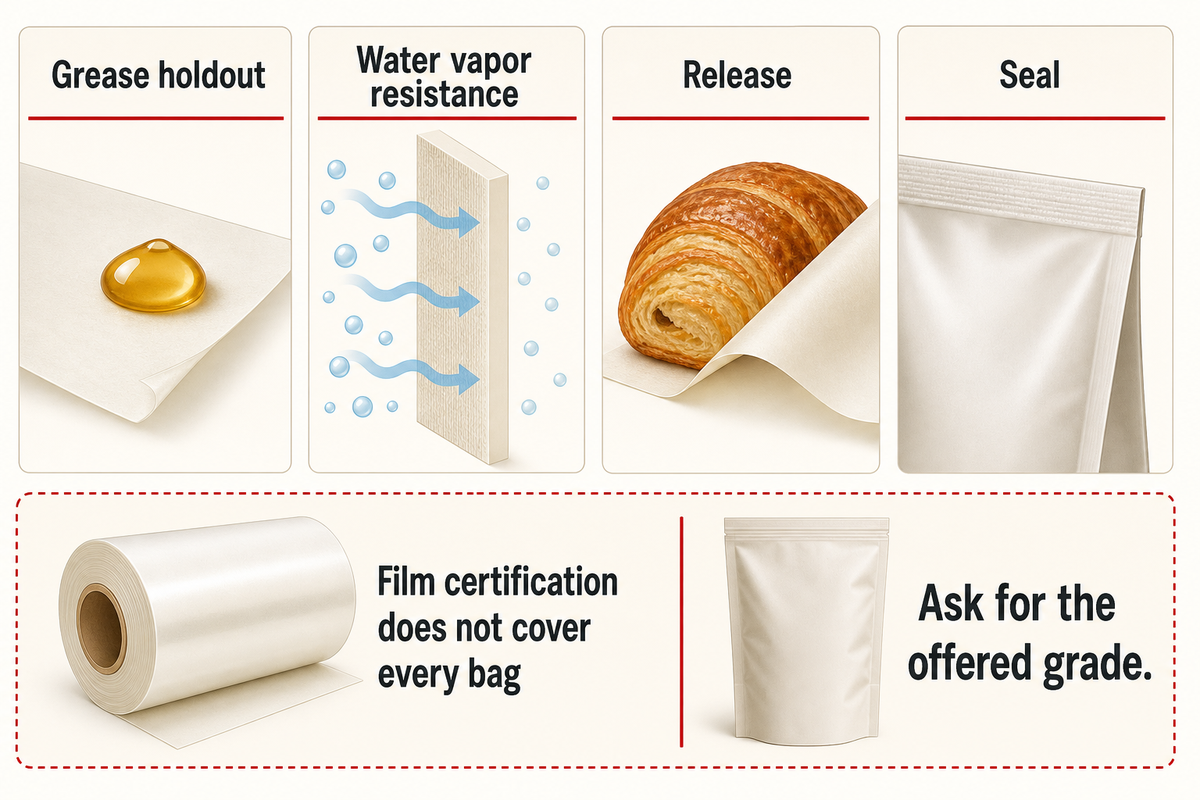
If specifying liners and coatings for function, there are attributes like grease holdout, water vapor resistance, release, and seal. Ask the supplier which grade would provide each function, then test the finished construction. A paper or cellulose label doesn’t define how a pack manages moisture.
Ahlstrom’s confectionery and baked-goods paper range, for example, differentiates grease resistant biscuit liners from base papers for barrier coating. Ahlstrom provided grade descriptions, not specifications for Wanhui packaging. A supplier should identify the actual grade offered for your order.
“Product design balances all of the performance attributes.”
That distinction matters when changing a coat or lamination to achieve a disposal goal. Check if the new construction seals, releases cleanly, and works with the adhesive. Compare food box material options at the assembled pack level rather than considering the outer board as the whole specification.
When not to buy the proposed bakery pack
Hold an order when the supplier cannot identify the finished construction. An example of a partial description is “food grade cardboard.” As the FDA’s component-status guidance points out, a material’s suitability for a use is subject to the conditions of its intended use. Request documentation that shows the offered product is suitable for your intended use.
The scope of certification deserves the same care. Good Start Packaging’s listing on the cellophane bag, for example, states clearly that the film is certified but the finished bags are not. This doesn’t mean that the bags are unsuitable. The cellophane bag listing illustrates why a certificate can’t silently extend to cover a different product. Don’t use an unrelated material’s certificate to validate a printed compostability claim for a different product.
Reject sample configurations that require an unquoted accessory to work. If a cookie box requires an inner bag or a cake requires a stronger insert, then include the accessory in the specification and price comparison prior to approval of production.
Compare window boxes and clear bags for display
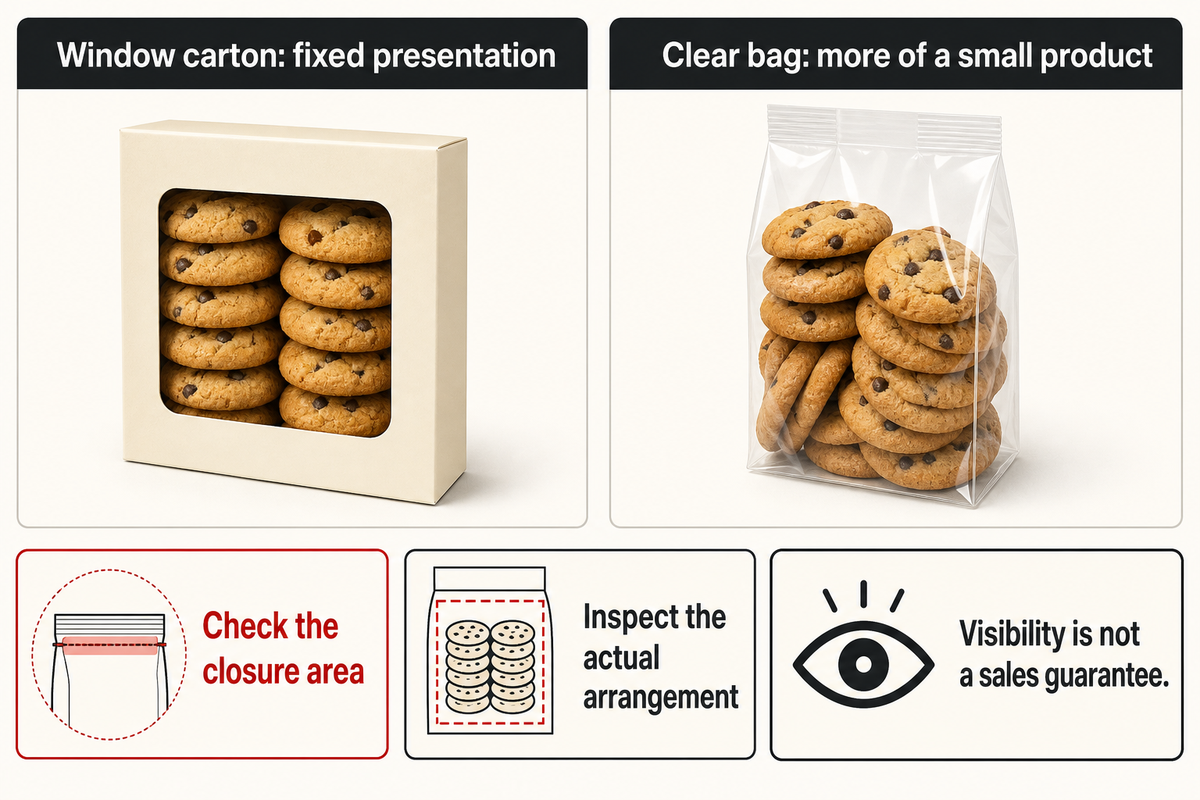
Window boxes support a fixed presentation, but clear bags allow customers to see more of a small product. Choose between them, based on the filled pack, closure and counter workflow. Visibility of a small product doesn’t necessarily mean higher sales, and it doesn’t justify poor product protection, fogging, or an unsuitable barrier.
With the liner and barrier specified, determine what the customer can see.
In a 2020 screen-based food-packaging study, results from tested foods showed no consistent preference for transparent packaging over food graphics. The study used a college student sample, and screen images weren’t a bakery counter-sales trial. Results shouldn’t be used to forecast sales; rather they should be used to evaluate the display.
According to Good Start, a flat bag is 5 × 7 inches and a gusseted bag is 4 × 2.75 × 9 inches, both in cases of 1,000 bags. Those dimensions show that width is an inadequate measure. Test the cookie stack, usable opening and closure allowance; a flat bag and a gusseted bag with similar names don’t yield the same usable shape.
For a “box with window,” determine the film and whether it’s removable. Transparent PVC and PLA windows aren’t interchangeable merely because both allow customers to see the food. Mondi’s September 2024 bread-bag case describes a glassine paper window and a removable-film construction for the UK. Its recycling assessment doesn’t establish acceptance by a US customer’s local program.
Inspect the 5 × 7 inch sample bag with the actual cookie arrangement before approving a printed alternative. Check the closure area and front view. For packaging boxes sold as eco-friendly bakery boxes, conduct the same test: does the filled display serve the food and selling situation? A premium finish earns its extra material and packing work only if it serves a useful purpose.
Protect cakes and cupcakes during chilled display
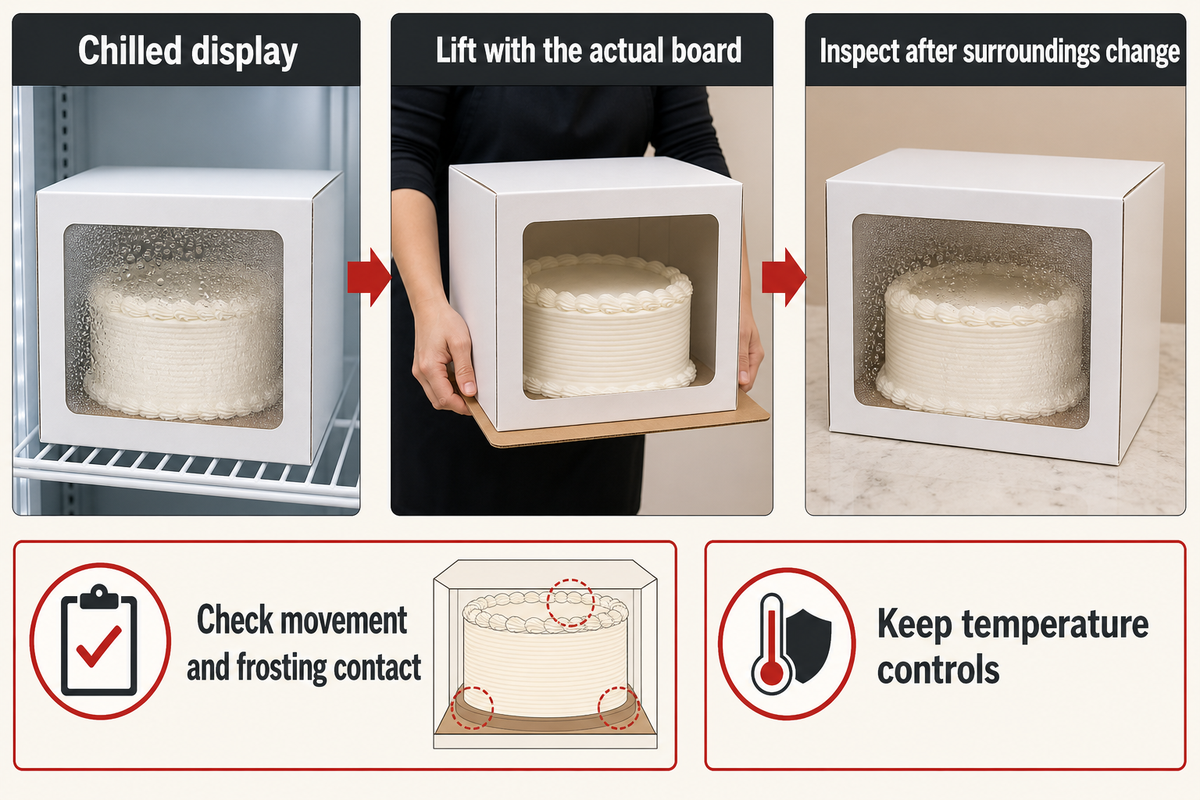
Chilled cake packaging requires usable space for the board and decoration, plus a base and closure that remain suitable through the service cycle. A box used for refrigeration isn’t a substitute for temperature control. A clear lid is evaluated after refrigeration as well as before.
Oklahoma State University explains condensation as occurring when a surface reaches or falls below the surrounding air’s dew point. This physical phenomenon offers a reason for a cold package to collect moisture as it moves through warmer air. It isn’t a general cooling schedule for cream-filled cakes or other perishable desserts.
Imagine a decorated cake shown in a chilled display and, later, carried to a vehicle by your staff. Observe staff lifting a closed box with the actual board and tallest decoration inside. Observe the window after the normal change in surroundings. Once observed, check the base and corners for softening. Ask the person carrying it if the board moved or the lid touched the frosting. Always follow the existing temperature controls for the bakery. If the sample only works while sitting on a shelf and not while being transported, it hasn’t answered the handoff question. A deeper cake box may help clearance; however, it also needs support that keeps the board from sliding. Durable box packaging still needs a board that fits.
An insert may locate a cupcake or muffin and must fit the actual baking cup. Compare food tray formats (forms) if the base needs more support, or evaluate takeaway container options, if rigid support is needed, for a matched assembly. Neither link substitutes for documented chilled-use suitability.
Size and customize bakery boxes for the sales counter
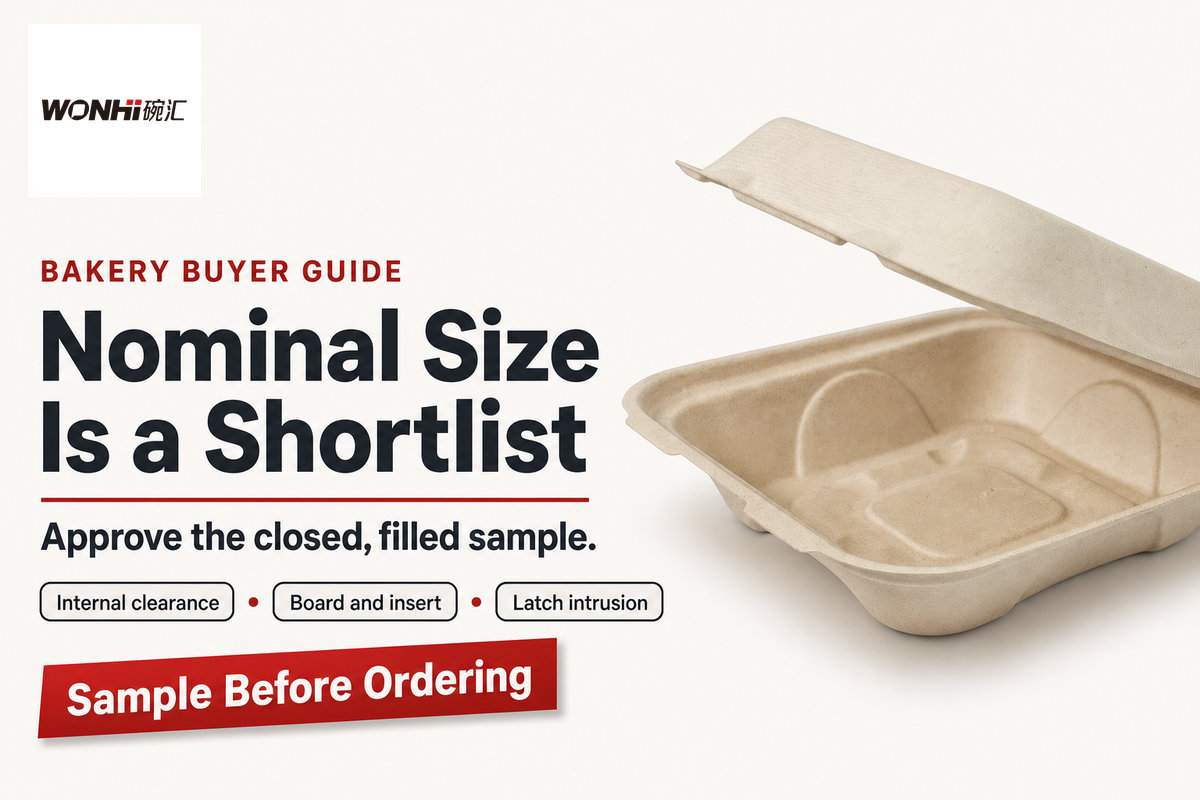
Bakery box sizing starts with the finished food, board and insert in a closed sample. Measure usable inner dimensions and check staff carrying and shelf fit. The catalog dimensions help in selecting a few candidates but don’t determine clearance from frosting, latch intrusion or the space around a shaped base.
Sizes listed for Wanhui’s hinged clamshell range show limits. Volumes and case counts are catalog figures, not bakery estimates. The minimum order shown on the listing is 5,000 pieces; confirm the current quote and exact material construction.
| Listed model | Nominal size | Capacity / case | Sample decision | Limitations / Not suitable for |
|---|---|---|---|---|
| WH-BG-66-1C | 6 × 6 × 3 inches | 590 ml / 500 pieces | Check the whole pastry footprint | 590 ml does not define decoration clearance |
| WH-BG-88-1C | 8 × 8 × 3 inches | 1,360 ml / 300 pieces | Check board fit and latch intrusion | 8 inches is not a verified internal width |
| WH-BG-88-3C | 8 × 8 × 3 inches | 3 compartments / 300 pieces | Fit each item in its own cavity | Outer width does not describe each compartment |
| WH-BG-96-HG | 9 × 6 × 3 inches | 1,120 ml / 500 pieces | Check a narrow product arrangement | 6 inches does not establish usable base width |
| WH-BG-99-1C | 9 × 9 × 3 inches | 1,775 ml / 200 pieces | Lift the filled sample on its board | Nominal volume does not establish load capacity |
| WH-BG-99-3C | 9 × 9 × 3 inches | 3 compartments / 200 pieces | Check dividers against the menu | Dividers are not sealed moisture barriers |
| WH-PLA-88-1C | 8 × 8 × 3 inches | 1,360 ml / 300 pieces | Confirm the listed bagasse-plus-PLA liner | Liner identity does not prove local acceptance |
| WH-CPLA-96 | 9 × 6 × 3 inches | 945 ml / 200 pieces | Confirm the listed clear PLA construction | Model letters do not prove crystallized PLA |
| Any listed model with an added insert | Measure the closed sample in mm | Recheck the actual assembly | Approve the insert and pack together | No usable height can be inferred after adding it |
Custom sizes and custom printed finishes require another sample. Specify paperboard or corrugated cardboard by grade and not heavy-duty or high-quality. Card stock and corrugated stock address different issues. A lightweight carton may suffice at the counter, but might need protection in transit.
Before choosing a matte surface, metallic effect or gold foil, ask how the finish changes the complete specification. The same holds true for emboss work and holographic foil and UV cured printing. FDA research on exterior printing inks is a reminder to request intended-use documentation for the finished printed construction; it does not show that every printed box is unsafe.
A 9 × 6 × 3 inch listing is a shortlist tool, not approval for a cake slice. Document the actual fit and internal dimensions. If a product requires custom dimensions, approve the sample before using the catalog pictures or descriptions to make a purchase.
Run a bakery sample trial before placing a wholesale order
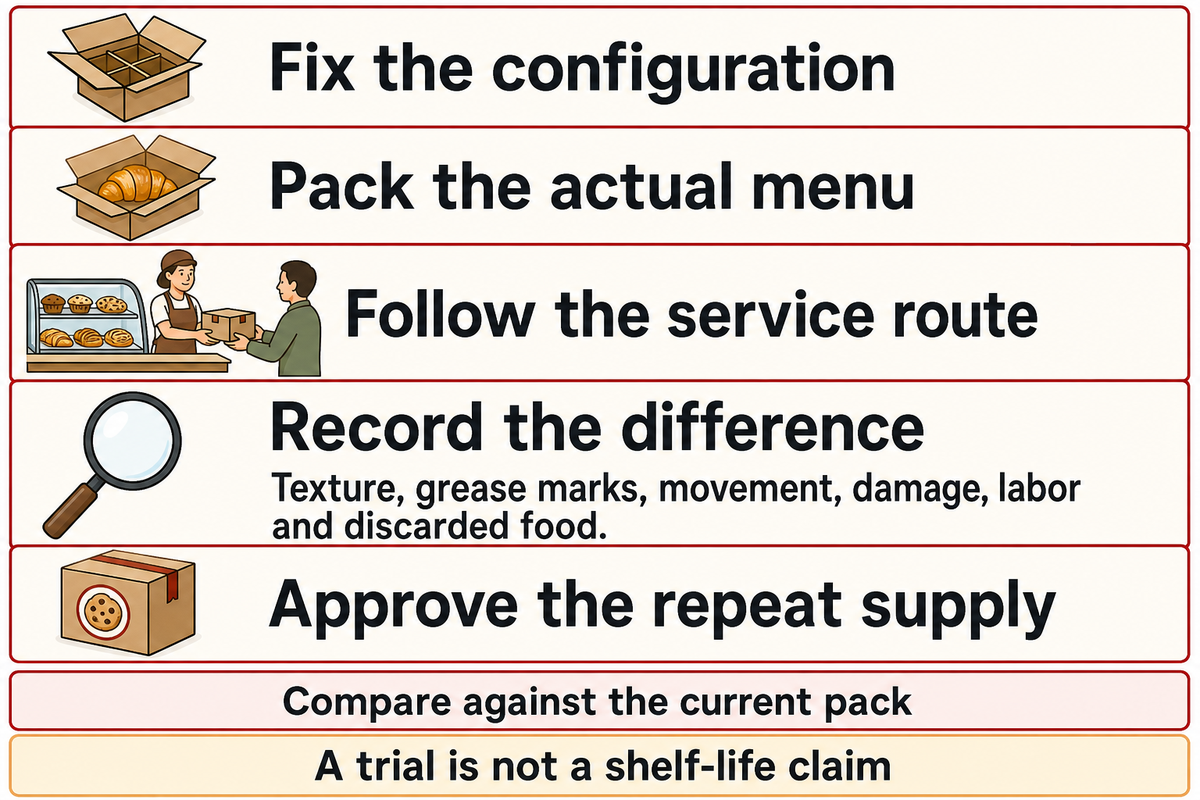
The Bakery Hold-and-Handoff Trial compares a proposed complete pack to the pack that’s currently in use. Keep ingredients, amounts and operating conditions the same, and observe both packs through actual storage, display and transport. Use results to support a claim of configuration acceptability, or to identify a failure; don’t convert a visual inspection to a claim of shelf life.
Start with the menu item most likely to expose a weakness. A greasy donut box needs a different observation from a fragile macaron pack or the tallest decorated cupcake. A fragile macaron and a tall cupcake need different protection, so each should produce a different set of observations. Record the times and conditions of the observations, the work required and food discarded. Quantities and reasons for waste are tracked and analyzed, rather than assuming all waste is packaging failure, with the assistance of the EPA’s Food and packaging Waste tools, available at Food and packaging Waste Tools.
- Fix the configuration. Identify the box, liner, window, insert and closure for both candidates.
- Pack the actual menu. Use the finished recipe and normal portion, with food-safety controls unchanged.
- Follow the service route. Include the intended holding, display, carrying and opening actions.
- Record the difference. Note texture, grease marks, movement, damage, labor and discarded food.
- Approve the repeat supply. Attach the accepted specification and photos to the order.
For a proposed trial of 12 packs per candidate, label the two sets and record every failure rather than only photographing the best sample. Twelve is a manageable pilot quantity, not a statistically validated acceptance plan. Repeat the trial under the conditions that matter to your operation before making a broader performance claim.
Compare complete-pack quotes and prepare your supplier brief
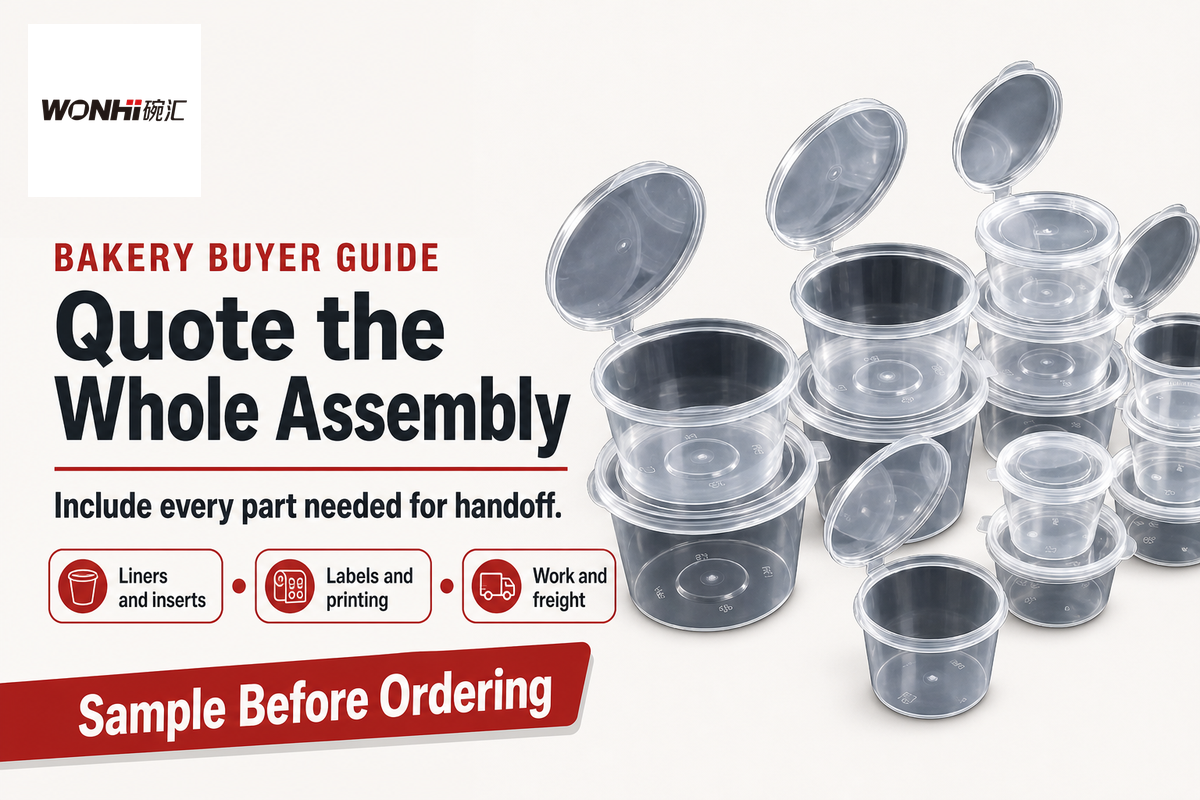
A complete-pack quote should include everything to deliver an acceptable order. Compare boxes, liners, inserts, labels, printing, packing work and delivered freight on the same basis. Separate first-order set-up costs from repeat costs, and differentiate the cost per purchased pack from the cost per acceptable handoff.
Is eco friendly packaging more expensive?
There’s no reliable price answer without a matching specification and quantity. A cheaper empty box may require a separate liner, more assembly or additional protection. University of Florida’s food-product costing guidance includes direct and allocated costs; its example is a costing method, not a bakery packaging price benchmark.
If a bakery needs 1,000 complete cookie packs, quotes may vary from one supplier that includes a liner and sticker, while the other may just quote the box. The buyer first asks the second supplier to price the missing items and confirms whether both quantities mean 1,000 usable assemblies. Staff record the time to pack a sample during a trial run. The finance team compares delivered spend per purchased pack, keeping losses from damaged or defective cookies, rework and unsold food visible. Only after these observations can the bakery determine the cost per acceptable handoff. The supplier that offers the largest discount or the cheapest cartons doesn’t necessarily give the lowest cost in use.
The food packaging product range of Wanhui lists WH-KFT-bakery as Kraft with a clear PLA top. Request its current internal dimensions and finished-pack documentation with a quote. The wider plant-based container range can satisfy alternative requests, but its category label doesn’t confirm every model’s disposal claim.
Add these fields in your supplier brief. The ranges below mean your measured operating range, not a universal recommended temperature or holding time.
RFQ checklist — complete bakery pack
| Parameter | Recommended range | Why it matters | How to verify |
|---|---|---|---|
| Finished product and board | Your minimum–maximum length, width and height in mm | Defines required usable space | Measure actual products in a closed sample |
| Pack contents | Your item count per pack, in pieces | Keeps the assortment consistent | Approve a filled arrangement |
| Operating conditions | Your documented food temperature range in °C and holding period in hours | Defines intended use | Match supplier documents to the bakery’s controls |
| Order quantity | Your first and repeat orders in pieces | Separates case rounding from consumption | Confirm cases, minimum order and delivered terms |
| Decoration and label | Your artwork coverage and label dimensions in mm | Fixes the printed construction | Approve the finished printed sample |
| Packing work | Your observed time range in seconds per pack | Exposes assembly differences | Time the same menu and trained operator |
Key takeaway
A quote for 1,000 boxes is comparable with another offer only after both cover the same complete pack and delivery basis. Record food loss separately before claiming a lower cost per acceptable handoff.
Industry Outlook: Plan Seasonal Bakery Packaging Orders
Bakery packaging suppliers are diversifying the kinds of barriers and window constructions they offer, but buyers still need grade-specific evidence. Use dated product announcements to improve supplier questions. Place seasonal orders based on actual sales and storage capacity from the bakery, instead of assuming search interest or a supplier launch reflects demand.
The July 2026 Packaging Strategies report on Sappi’s bakery papers describes different barrier levels for different applications. The report outlines Sappi’s product claims; it doesn’t provide an independent comparison showing that every bakery should replace its current packaging. Determine which grade is suggested for your pastry, and assess what conditions its data covers. Consider if modifications to sealing and/or handling are required.
Regulatory developments also mean that current documents are more useful than an old sales sheet. The FDA’s January 2025 notice on 35 grease-proofing food-contact notifications pertains to abandoned uses. They do not establish a broad ban on the use of PFAS in all applications and do not show a particular Wanhui box meets a buyer’s specification. To evaluate the use of a changed barrier grade, ask for documents pertaining to the specific construction and the intended use.
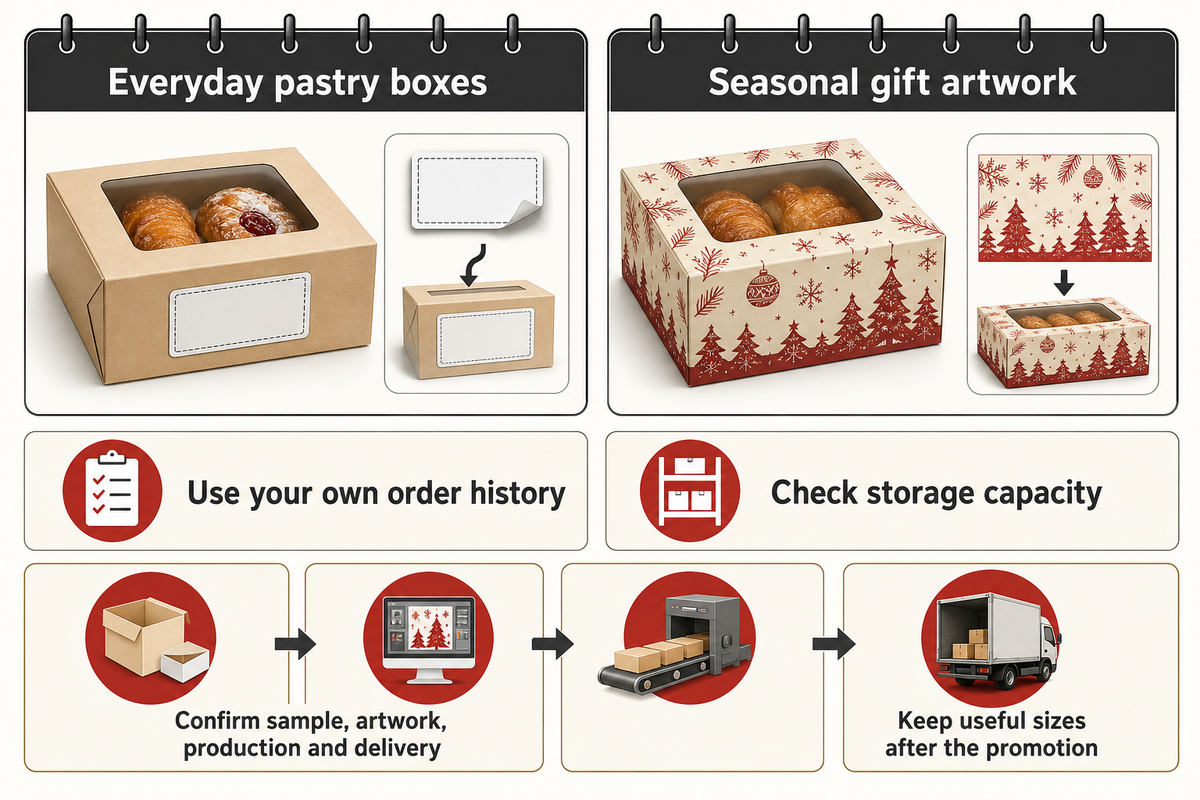
Seasonal planning begins with your own order history. Separate everyday pastry boxes from a holiday gift box carrying dated artwork. Look at November and December sales where those months matter to the bakery, and determine which packaging sizes remain useful after the promotion. See what the interested public is asking and use that as the foundation of a research query; however, that can’t explain to a bakery how many dessert boxes it will use.
Stock kraft bakery boxes with a replaceable label may offer a different inventory decision than a fully custom printed carton. Evaluate if a customizable design serves several assortments before choosing a larger run for a unit-price discount. A replaceable label may personalize the same approved carton for different uses. Have the supplier confirm sample, artwork, production and delivery timing separately; those stages don’t have to share one lead time.
Take the accepted sample and repeat-order quote back to operations for the next seasonal order. Check the menu to see if it still fits and the finish is unchanged. Is the disposal instruction still correct? An option called eco-friendly packaging becomes useful if it works through the bakery’s complete service route and can be consistently supplied.
Frequently asked questions
Are bakery bags recyclable?
Bakery bags may be recyclable where the local program accepts their finished construction and condition.
Check the coating, window, closure and food residue against the collector’s instructions. A plain-looking surface does not reveal every layer. Ask whether a removable part needs separate disposal, and distinguish the bakery’s commercial collection from the system available to customers at home. Compostable film should not be assumed suitable for ordinary plastic recycling.
Is kraft paper eco friendly?
Kraft paper alone does not establish the environmental performance of a complete bakery pack.
The amount of material, its origin, any recycled content, additional layers and the available disposal route all matter. Brown color proves neither recycled content nor compostability. A bakery also needs to consider the food protected by the package: changing materials is not an improvement if an unsupported environmental claim hides increased damage or waste.
Can eco friendly bakery packaging be recycled?
A specific bakery package can be recycled only through a system that accepts that construction.
Ask which components the claim covers and whether the customer must remove a window, liner or label. Keep the instruction attached to the approved specification so that a material substitution triggers a review. Food residue does not justify a blanket answer for all paper packs; the local program’s guidance should determine the practical instruction.
Does bakery packaging need to be refrigerated?
Refrigeration depends on the food, not the environmental label on its packaging.
Choose a finished pack documented for the intended chilled use. Check condensation, base stiffness and closure through the normal service cycle while maintaining the bakery’s food-safety controls. Packaging cannot make an unsafe storage practice acceptable.
Is bulk wholesale pricing available for bakery boxes?
Wholesale pricing requires a current quote for the specified box, quantity, print and delivery terms.
Request the same complete configuration at each quantity tier, including liners, inserts, labels and tooling. Separate the first order from repeat orders so setup costs remain visible. A larger purchase can reduce a quoted unit price while increasing cash tied up in inventory. Check whether the bakery can store and consume the stock before artwork, menu dimensions or supplier specifications change. Compare delivered usable assemblies, and record assembly labor and food losses separately before drawing a conclusion about operating cost.
Can I put a bakery box in the oven?
Oven use requires explicit supplier documentation for the finished package and intended conditions.
Window film, adhesive and printed surfaces may have different limits. A grease-resistant liner, brown board or disposable food container label establishes neither baking suitability nor a safe temperature limit.
Bakery pack sizing requires the finished food, decorations, board and insert inside a closed sample.
Request usable internal dimensions rather than relying only on a catalog’s nominal measurements. Check frosting clearance, movement during carrying, shelf fit and how staff lift the base. For mixed assortments, test the fullest planned arrangement as well as smaller orders. A divider can locate items without sealing moisture between them. Approve enough space for practical protection and access, then record the exact construction so the next delivery can be checked against the same sample.
Send Wanhui the finished product dimensions, board or insert, intended holding conditions, order quantity and destination. Request the complete specification and a filled-pack trial before approving a printed production run.
How this bakery guide was prepared
Wanhui supplies food packaging. This guide combines published product listings, government and academic sources, and proposed bakery purchasing methods. Supplier developments are attributed to their owners. We haven’t presented the sample procedures as completed customer tests or claimed that any listed pack has a proven overall environmental advantage.
References & Sources
- Environmental claims: Green Guides summary Federal Trade Commission
- Plastic recycling and composting questions EPA
- Prevent wasted food through source reduction EPA
- Cookie storage and moisture Exploratorium
- Strategies to reduce moisture condensation Oklahoma State University
- Regulatory status of food-contact components FDA
- Transparent packaging and food choices Ma, Zhuang and Ma, Frontiers in Psychology, 2020
- Exterior packaging ink hazard-identification research FDA
- Food product costing and pricing University of Florida
- Food and packaging waste assessment tools EPA
- Sappi bakery paper announcement Packaging Strategies, July 2026; supplier-origin claims
- Update on 35 grease-proofing food-contact notifications FDA, January 2025