Get in touch with Wanhui Company


Updated August 2026
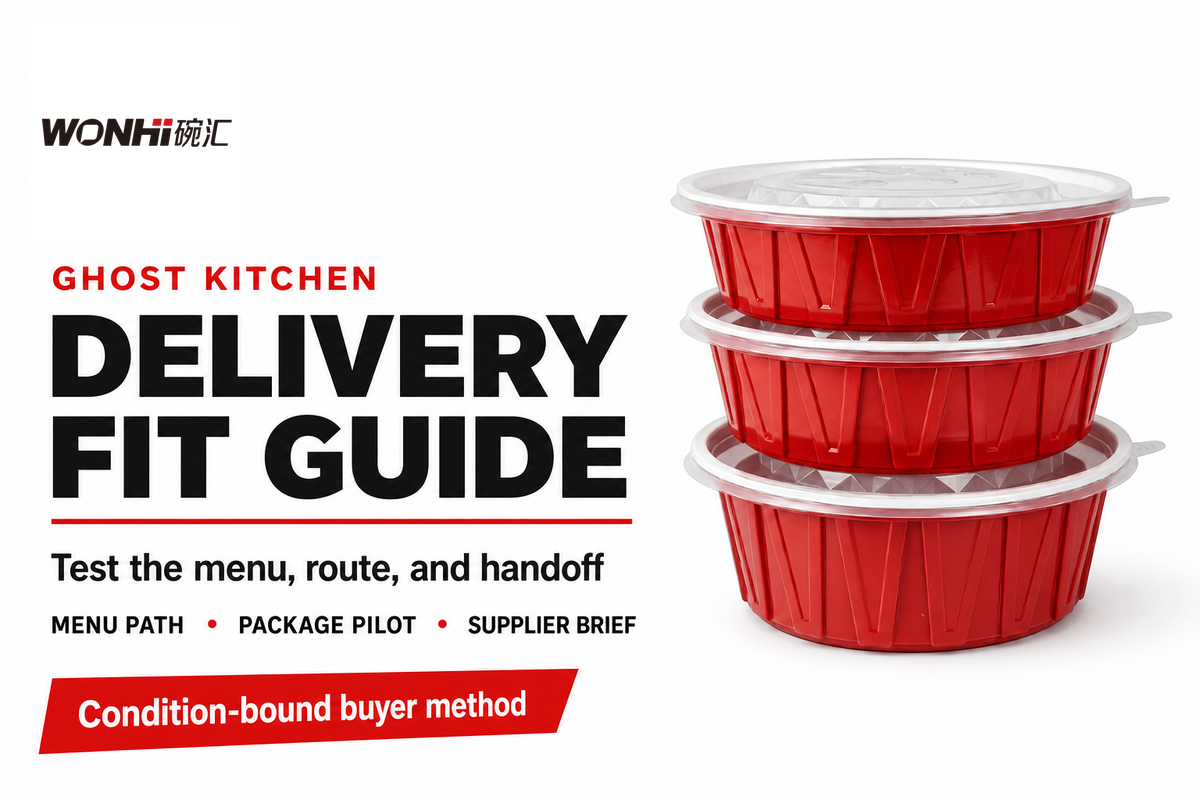
Ghost kitchen packaging guide is a decision tool for testing bowls, boxes, clamshells, and related formats under an actual delivery condition. It should help a delivery-only operator record what happened between fill and handoff, then send every shortlisted supplier the same evidence.
Short answer
Ghost kitchen packaging should be approved against four observed conditions: containment, vapor and texture, load and stacking, and handoff evidence. Food-contact records, allergen information, local rules, and environmental claims remain separate checks.
Guide scope at a glance
| Primary reader | U.S. ghost kitchen operator, procurement lead, quality lead, or virtual brand owner |
| Decision unit | One menu family, one package candidate, one delivery path |
| Evidence to retain | Fill state, hold time in min, travel time in min, stack load in kg or lb, photographs, and failure notes |
| Separate checks | Allergen information, intended food-contact use, local Food Code adoption, state chemical restrictions, and destination-market documents |
| Commercial output | A supplier-comparable RFQ and a controlled sample request |
What this article deliberately does not cover
Readers trying to start a ghost kitchen, open a ghost kitchen, or build a ghost kitchen business plan need a different complete guide. Choosing a commercial kitchen, licensed commercial kitchen space, shared kitchen space, commissary kitchen, professional kitchen, kitchen rental, kitchen suites, kitchen layout, kitchen setup, kitchen equipment, or ghost kitchen equipment sits outside this packaging decision.
That boundary also applies to ghost kitchen startup costs, startup costs, ghost kitchen costs, hiring kitchen staff, the ghost kitchen business model, ghost kitchen model, ghost kitchen concept, and launching a ghost kitchen. Apps like DoorDash and Uber Eats, a delivery app, online ordering, and a delivery platform shape the dispatch path, but this article does not compare their fees or tell a food business how to market without a storefront. It is packaging support for an existing restaurant, established ghost kitchen, virtual restaurant, virtual kitchen, cloud kitchen, dark kitchen, or delivery-only kitchen.
Choosing the right ghost kitchen or an effective ghost kitchen model is also outside scope. Operators who need a licensed commercial kitchen should resolve that facility question before using this packaging method. A ghost kitchen model offers a different storefront setup, but it does not choose packaging. This is not a Kitchen United comparison, a forecast for the ghost kitchen industry, or a guide to ghost restaurants. It does not promise the success of your ghost kitchen, an efficient kitchen, or a successful ghost kitchen brand. Apps like Uber Eats and delivery apps like DoorDash appear only because the dispatch path affects the test.
Queries such as “How to start a ghost kitchen at home,” “Ghost kitchen monthly cost,” and “Ghost kitchen for rent” concern facility or startup planning, not the package pilot described here.
Start With the Delivery Path, Not the Container Catalog
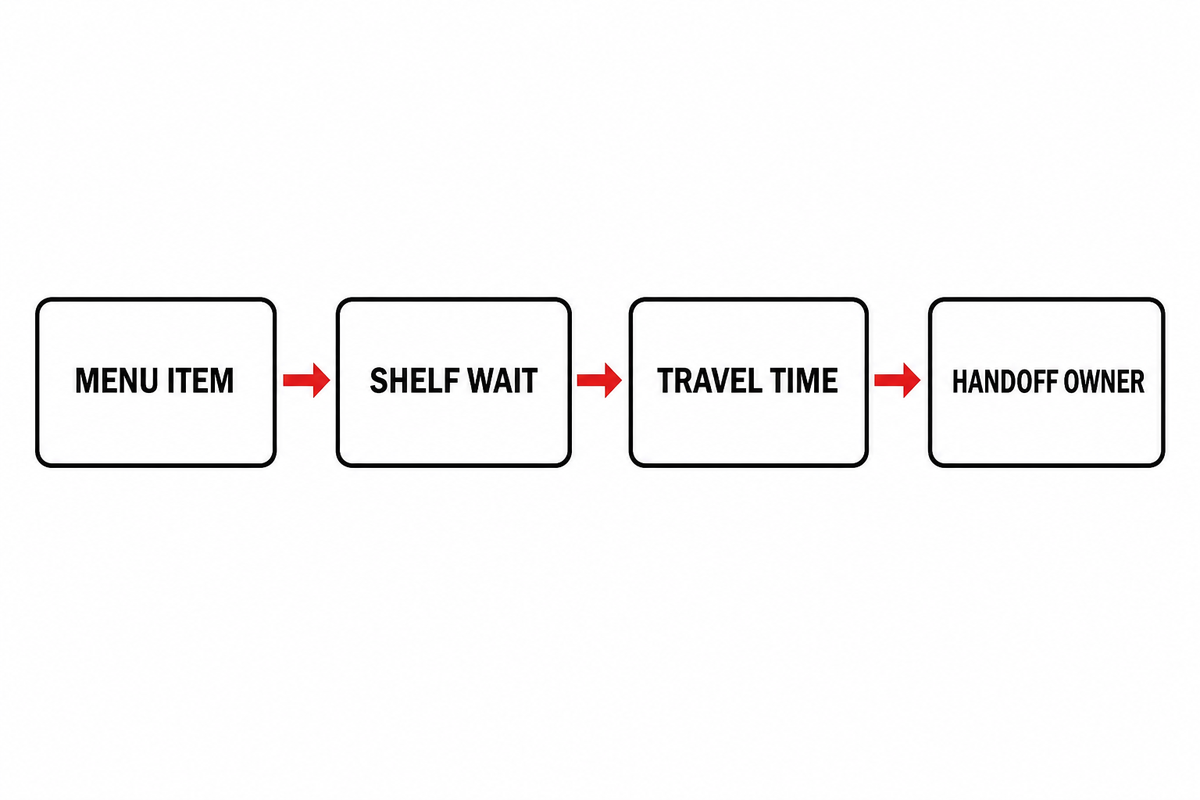
A ghost kitchen operation should define the path from kitchen staff to delivery drivers before comparing package formats. The path determines which events can be observed: waiting on a shelf, movement inside a carrier, pressure from stacked orders, and the transfer to a third-party delivery driver.
FDA’s online-delivery update includes ghost kitchens in the delivery ecosystem and describes packaging, temperature, contamination, and allergen control as separate risk parameters. FDA calls the material recommendations and best practices. That wording matters: it supports a structured review, not a universal package prescription.
Write the path down as a sequence of observable states. Record the menu item and fill mass in g or oz, the temperature at packing in °F or °C when your food-safety procedure requires it, the shelf wait in min, the expected travel time in min, the delivery radius in km or mi, the number of packages per bag, and the maximum stack load in kg or lb. These are inputs, not promises about performance.
Traditional restaurants can notice a spill or texture change at the table. Another traditional restaurant may use a different service path even with the same menu. In your own operation, record any later signal captured in a refund, a delivery-app message, or a brand review. Virtual brands may also share a commercial kitchen with other concepts, so the package must be identified by menu family and brand rather than by container SKU alone. For this packaging method, keep the food-service record specific enough to reproduce the test.
Do
- Map every handoff owner.
- Record actual wait and travel times.
- Separate package observations from safety conclusions.
- Keep each virtual brand traceable to its menu family.
Don’t
- Approve from an empty sample.
- Assume one carrier represents every delivery driver.
- Treat a sealed lid as proof of compliance.
- Mix startup cost or margin claims into the test.
This section produces a one-page path map. It gives the operator a stable baseline before the first sample arrives and keeps business model questions from swallowing the packaging decision.
Build a Menu-to-Handoff Risk Map Before You Pick a Format
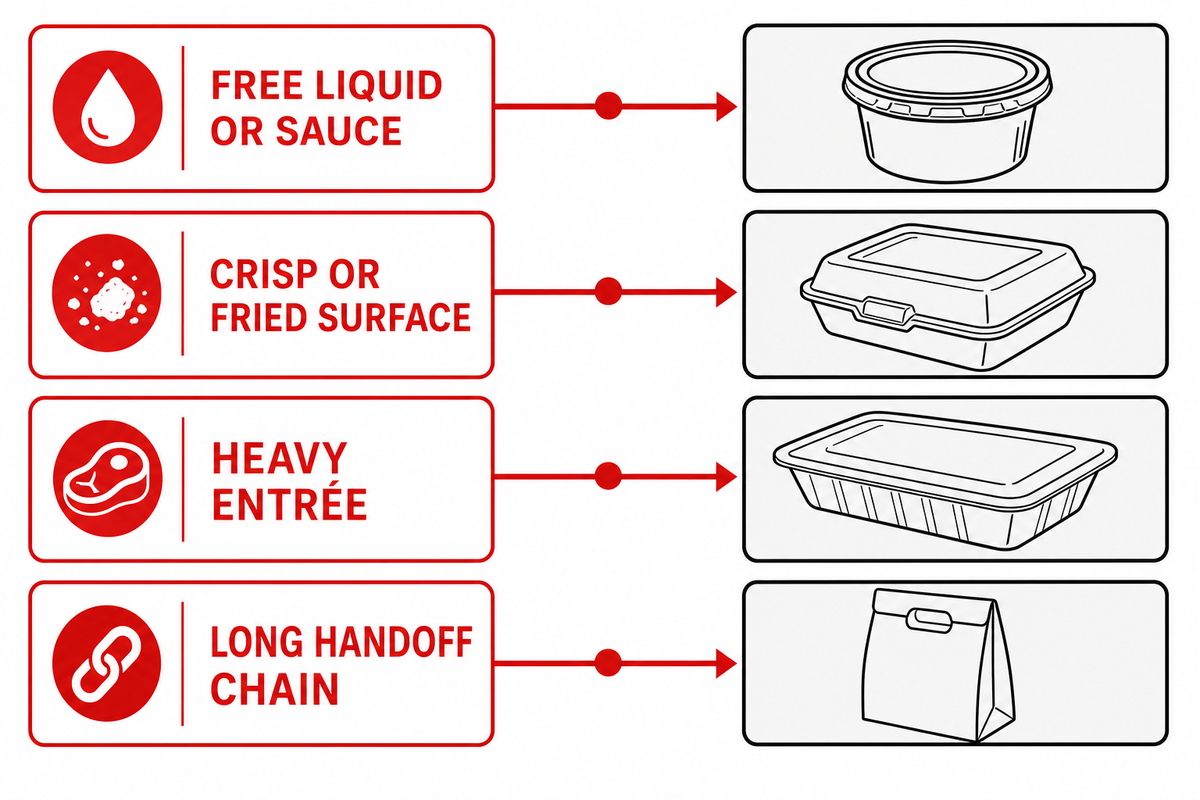
For each ghost kitchen menu family, relate the food behavior to a physical test or a separate information control. Liquid movement, vapor, headspace, fill geometry, stack exposure and allergen information require different observations; a single label such as leak-proof can’t resolve the decision.
A Frontiers article on online food-packaging complaints grouped more than 250 complaints into 12 design categories. It does not provide a ghost kitchen failure rate, and this guide does not adopt it as one. Its useful lesson is methodological: record the failure category instead of arguing from a vague satisfaction score.
| Menu signal | Record in the brief | Test or separate control | Limitation / not suitable for |
|---|---|---|---|
| Free liquid or sauce | Fill mass in g or oz; fill line in mm | Containment tilt and travel test | An empty-package squeeze is not evidence |
| Crisp or fried surface | Hold time in min; visible condensation | Vapor and texture observation | Do not infer food safety from crispness |
| Steam-producing food | Initial condition; headspace in mm | Closed-carrier vapor test | One vent pattern is not universal |
| Mixed wet and dry items | Compartment fill and contact points | Migration and divider observation | A compartment count does not prove isolation |
| Heavy entrée | Total mass in g or lb; base deflection in mm | Load and base-support test | Do not extrapolate from a lighter fill |
| Tall garnish or layered food | Product height and headspace in mm | Lid-contact observation | Nominal volume alone is insufficient |
| Multi-order stack | Stack count; total load in kg or lb | Load/stack and carrier test | Bench stacking may miss bag movement |
| Long handoff chain | Owner, timestamp, and transfer point | Handoff-evidence control | A seal does not prove who handled the order |
| Major-allergen information | Menu, order, kitchen ticket, and package wording | Separate information-control review | A package test cannot prove allergen compliance |
| New destination market | State, country, and intended food-contact use | Separate documentation check | Do not reuse a domestic document set by default |
Use the map before choosing between bowls, clamshells, trays, and takeaway food boxes. A row can end with “no hard claim; verify in pilot.” That’s a better procurement input than a precise but unsupported promise.
How Do You Select the Ideal Packaging for Diverse Ghost Kitchen Menus?
Select packaging by the highest-consequence failure for each menu family, then test that failure using the actual fill, hold interval, stack, and carrier. Keep physical observations separate from allergen, food-contact, and destination-market documentation. The right candidate is the one that passes the defined pilot, not the one with the broadest catalog claim.
Use the Four-Lock Delivery Fit Test to Compare Candidates
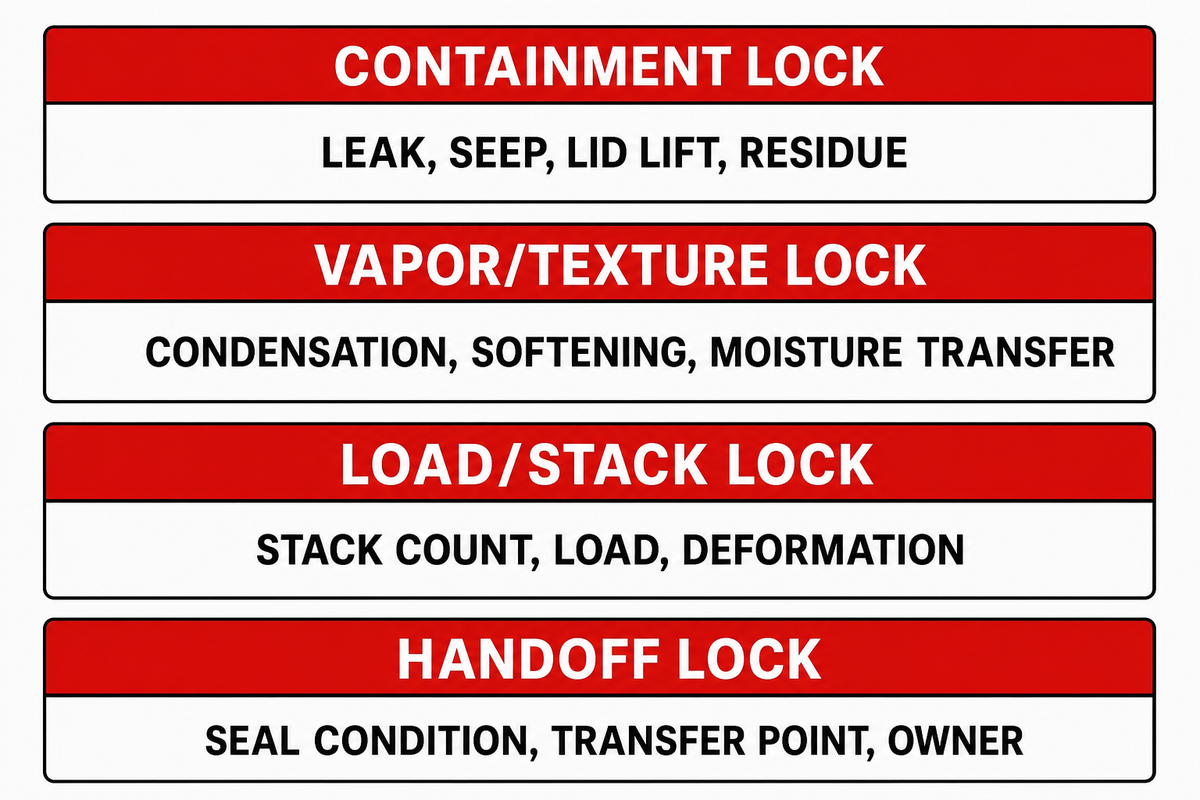
This guide’s Four-Lock Delivery Fit Test is a buyer worksheet for comparing containment, vapor and texture, load and stack, and handoff evidence. It is not an industry standard, certification, or validated food-safety protocol; each lock records an observation, owner, and retest trigger.
FDA’s online-delivery best-practices update treats proper packaging, temperature control, physical and chemical contamination control, and allergen control as related but distinct delivery considerations. The FDA describes this as best-practice guidance, rather than product approval or a universal rule. It supports the test architecture because it prevents one feature from carrying the weight of an entire delivery system.
- Pack the real menu item — record fill mass, headspace, initial condition, and closure method.
- Run the planned wait and travel path — use the same shelf interval, carrier, stack, and movement expected in service.
- Inspect all four locks — photograph the closure, vapor or texture result, load response, and handoff evidence.
- Decide and assign — pass, reject, or change one variable; name the person responsible for the retest.
Change one variable at a time. If the first sample leaks after a 30 min path, changing the fill mass, closure, venting, carrier, and stack together hides the cause. The next run should change the most plausible variable and hold the others stable. Your worksheet may use 30 min because that’s your route; it must not say every ghost kitchen should use 30 min.
| Example only | Fill | Pack temperature | Wait | Travel | Route | Stack | Load | Deflection |
|---|---|---|---|---|---|---|---|---|
| Example 1 | 450 g | 71 °C | 12 min | 28 min | 4.2 km | 3 packs | 1.8 kg | 2 mm |
| Example 2 | 620 g | 68 °C | 20 min | 35 min | 7.0 km | 4 packs | 2.6 kg | 3 mm |
| Example 3 | 350 g | 65 °C | 8 min | 18 min | 2.0 km | 2 packs | 1.1 kg | 1 mm |
| Example 4 | 500 g | 73 °C | 15 min | 32 min | 5.5 km | 3 packs | 2.1 kg | 2 mm |
4-Lock Test Register
For illustration, a fifth synthetic record might contain 480 g, 69 °C, 10 min of waiting, 25 min of travel, a 3.5 km route, a 1.5 kg stack load, and 1 mm of observed deflection. Replace every value with the actual run before sharing the sheet.
| Field | What to record | Pass rule | Retest trigger |
|---|---|---|---|
| 1. Candidate identity | Supplier, SKU, size in mm, lot | Traceable sample | Any supplier or lot change |
| 2. Fill condition | Menu item, mass in g, headspace in mm | Matches service condition | Portion or recipe change |
| 3. Containment lock | Leak, seep, lid lift, residue | No defined containment failure | Closure or liquid profile changes |
| 4. Vapor/texture lock | Condensation, softening, moisture transfer | Within the menu’s accepted result | Hold time or vent path changes |
| 5. Load/stack lock | Stack count, load in kg or lb, deformation in mm | No defined crush or opening | Bag or order mix changes |
| 6. Handoff lock | Seal condition, transfer point, owner | Evidence intact at transfer | Courier process changes |
| 7. Failure evidence | Photo, time, location, category | Enough detail to reproduce | Unexplained complaint recurs |
| 8. Decision | Pass, reject, or one-variable change | Owner signs the result | Any condition leaves the tested range |
How Do Ghost Kitchens Handle Delivery?
Ghost kitchens handle delivery as a system: container closure, bagging, order identification, waiting, courier handoff, and the delivery route. A delivery-only operator should document each transfer instead of relying on a “delivery-proof” product label. For this guide, assign the operator as the keeper of the internal test record.
Use Format Trade-offs Instead of Universal “Best Container” Claims
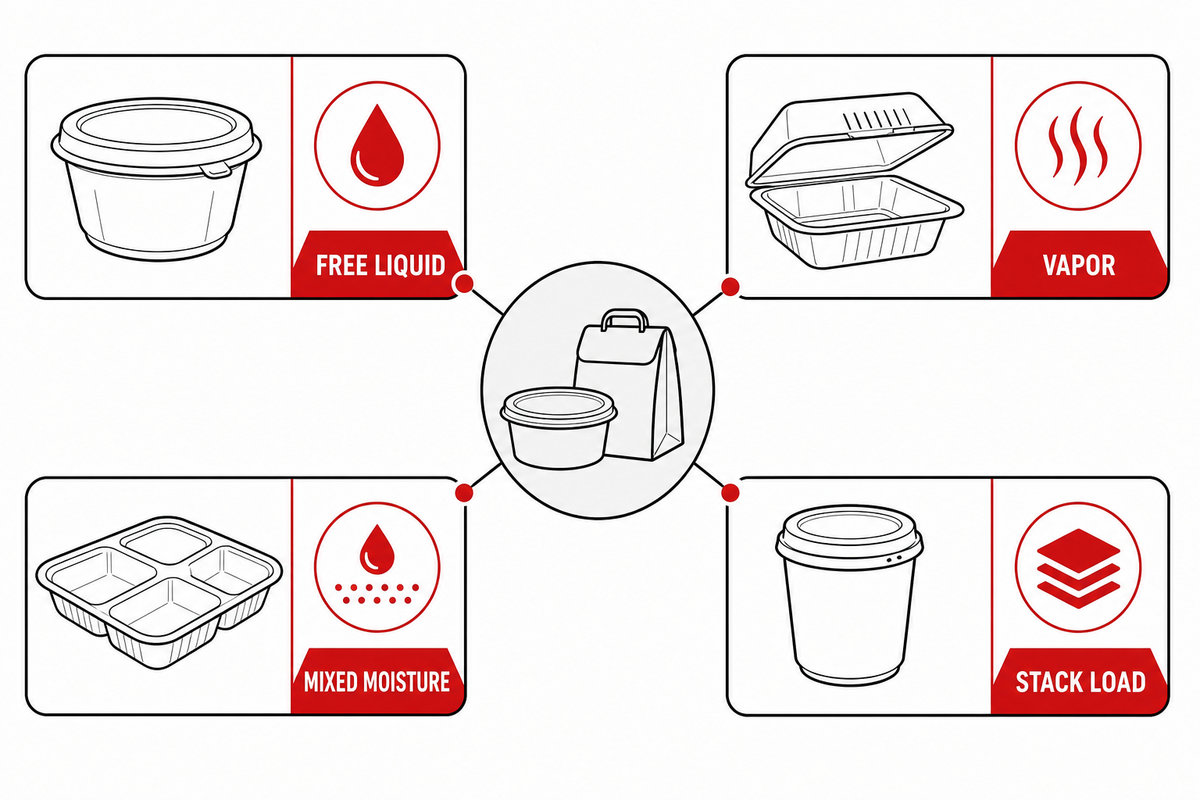
Bowls, clamshells, lidded trays, compartment containers, and boxes expose different failure points. The format decision should follow the menu risk map and Four-Lock results; shape, lid architecture, headspace, stack behavior, and label area matter more than an unsupported claim that one format is best.
Catalog data can tell you nominal capacity or dimensions. It cannot tell you whether a specific sauce moves under your route, whether a crisp surface tolerates your closed carrier, or whether a tall garnish touches the lid. These are ghost kitchen menu questions, not generic material rankings.
Catalog phrases such as to go packaging food service supplies, food containers to go, restaurant to go containers, clamshell to go containers, and tamper evident food packaging are entry points, not validation results. Use them to build the candidate list, then return to the actual menu and delivery test.
| Risk type | Primary observation | Format question |
|---|---|---|
| Free liquid | Seepage or lid movement | Which closure remains stable with the actual fill? |
| Vapor | Condensation and accepted texture | Which vent and headspace combination should enter the pilot? |
| Mixed moisture | Migration across items | Does the divider support the actual menu? |
| Heavy fill | Base and edge deformation | Which geometry supports the recorded mass? |
| Tall profile | Lid contact | Which depth preserves required headspace? |
| Stack load | Crush, opening, or shift | Which architecture fits the bag and order mix? |
| Handoff evidence | Seal condition at transfer | Where should evidence sit without becoming a safety claim? |
| Allergen information | Menu-to-package wording | Which label area supports the separate information control? |
| Destination market | Required document set | Which components and suppliers can support the intended market? |
| Format | Useful starting question | Four-Lock focus | Limitations / not suitable for |
|---|---|---|---|
| Round bowl with lid | Does the fill move against the closure? | Containment and stacking | Do not assume every lid fit handles free liquid |
| Rectangular lidded tray | Do corners and long edges stay closed? | Containment and load | Corner behavior varies by fill and closure |
| Hinged clamshell | Does the hinge or latch move in the bag? | Handoff and load | Not proof against sauce migration |
| Vented clamshell | Does vapor release improve the accepted texture? | Vapor/texture | Venting can conflict with containment |
| Compartment tray | Do wet and dry items cross the divider? | Containment and load | A divider does not guarantee isolation |
| Paperboard meal box | How does closure behave under the real fill? | Containment and handoff | Verify food-contact and local claim boundaries |
| Windowed box | Does the window or joint change under heat and load? | Load and containment | Multiple components need separate documentation |
| Cup and lid set | Is the closure repeatable after filling? | Containment and handoff | A dry bench fit is not a filled travel test |
| Sleeve plus inner pack | Which component carries load and which carries evidence? | Load and handoff | More components create more document fields |
| Custom molded format | Which repeated failure justifies a custom route? | All four locks | Do not begin tooling before the pilot defines the failure |
Once the risk is defined, compare it with the relevant custom takeout box design choices or the broader take-out container sizing guide. Those pages should extend a known question; they should not replace the pilot.
Separate Delivery Observations From Compliance and Allergen Controls
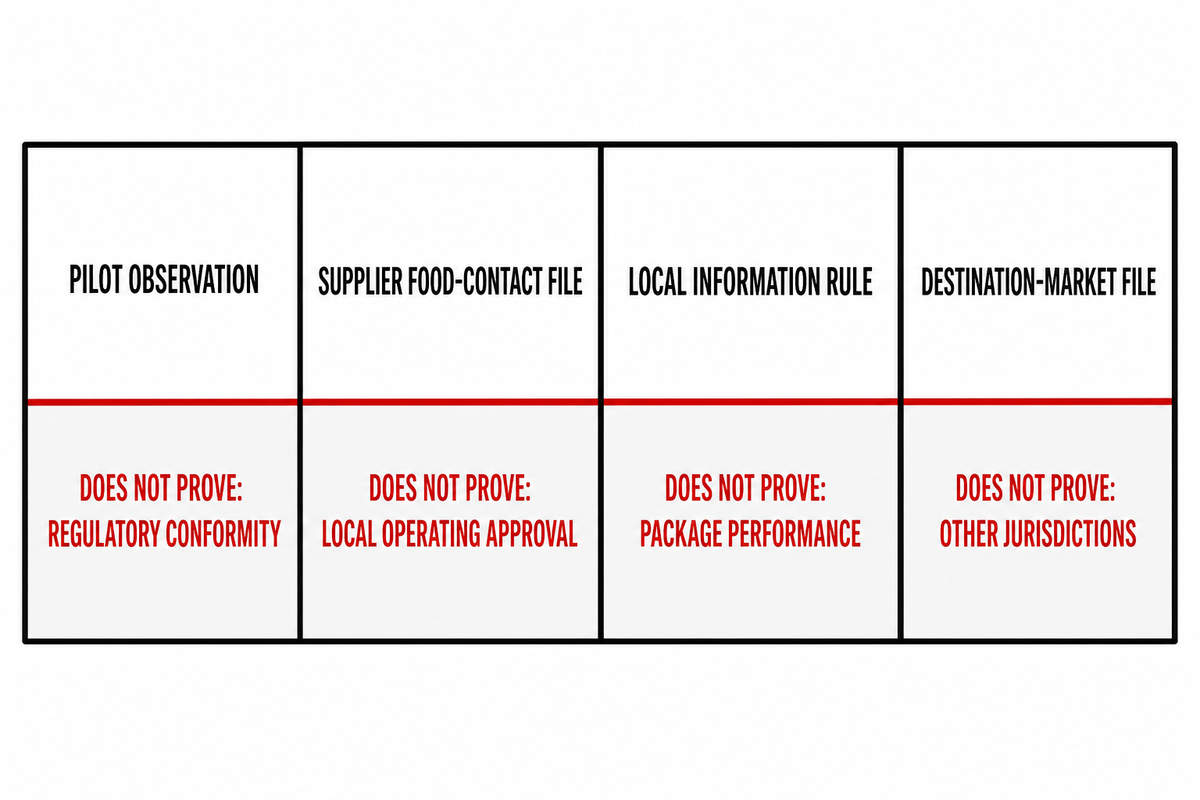
Position of the lid during a defined pilot can show if the closure stayed on; it can’t prove food-contact compliance, allergen control, legal compliance, or a market-wide environmental outcome. U.S. ghost kitchen operators should separate observed result, supplier document, locally adopted rule, state restriction, and non-U.S. destination requirement.
That format choice leads to another evidence question: which result came from the pilot, which document came from the supplier, and which requirement must be checked for the sale destination?
“The model Food Code is neither federal law nor federal regulation.”
That FDA statement is the control point for this section. FDA/CFP delivery guidance has recommendations and best practices. A model Food Code provision only becomes a local requirement through the relevant adoption path. An operator should ask the local authority which code version applies instead of publishing “FDA requires” as a universal message.
FDA’s food-contact regulatory-status page says a composite material must be considered component by component, including identity, specifications, and limitations on conditions of use. It also notes that an effective food-contact notification can be proprietary to the identified manufacturer. Ask for the actual manufacturer, authorization or notification basis, notification holder when applicable, intended food type, temperature, contact duration, and evidence tracing the substance back to the manufacturer; do not ask for a generic “FDA-approved box.”
State law can add another layer. The New York DEC food-packaging page describes a prohibition on intentionally added PFAS and supplier compliance certifications that may be requested by the regulator. That is a New York example, not a nationwide rule. The buyer action is to name the sale destination and request the applicable evidence.
Non-U.S. markets may require a different document set. EU Regulation 10/2011 requires a written declaration of compliance and supporting documentation for covered plastic food-contact materials and articles. That European framework is not U.S. compliance evidence. It belongs in a destination-market column, not in the U.S. pass/fail rule.
| Evidence lane | Owner | Record | What it does not prove |
|---|---|---|---|
| Pilot observation | Operator / quality | Four-Lock result and photos | Regulatory conformity |
| Supplier food-contact file | Supplier / procurement | Intended use and authorization basis | Local operating approval |
| Local information rule | Operator / local authority | Applicable code version and allergen wording | Package performance |
| Destination-market file | Procurement / qualified adviser | State or country-specific evidence | Other jurisdictions |
Separate the evidence provider from the file owner in the worksheet: the actual manufacturer or authorization holder provides the food-contact basis, while procurement records the supplier response and traceability evidence for the intended use.
Allergen information needs its own line. Keep the menu description, online ordering record, kitchen ticket, package identifier, and handoff record aligned. A successful leak test does not show that this information remained accurate, and a delivery bag does not replace the restaurant’s applicable allergen-control procedure.
Convert a Passing Pilot Into a Supplier-Comparable Brief
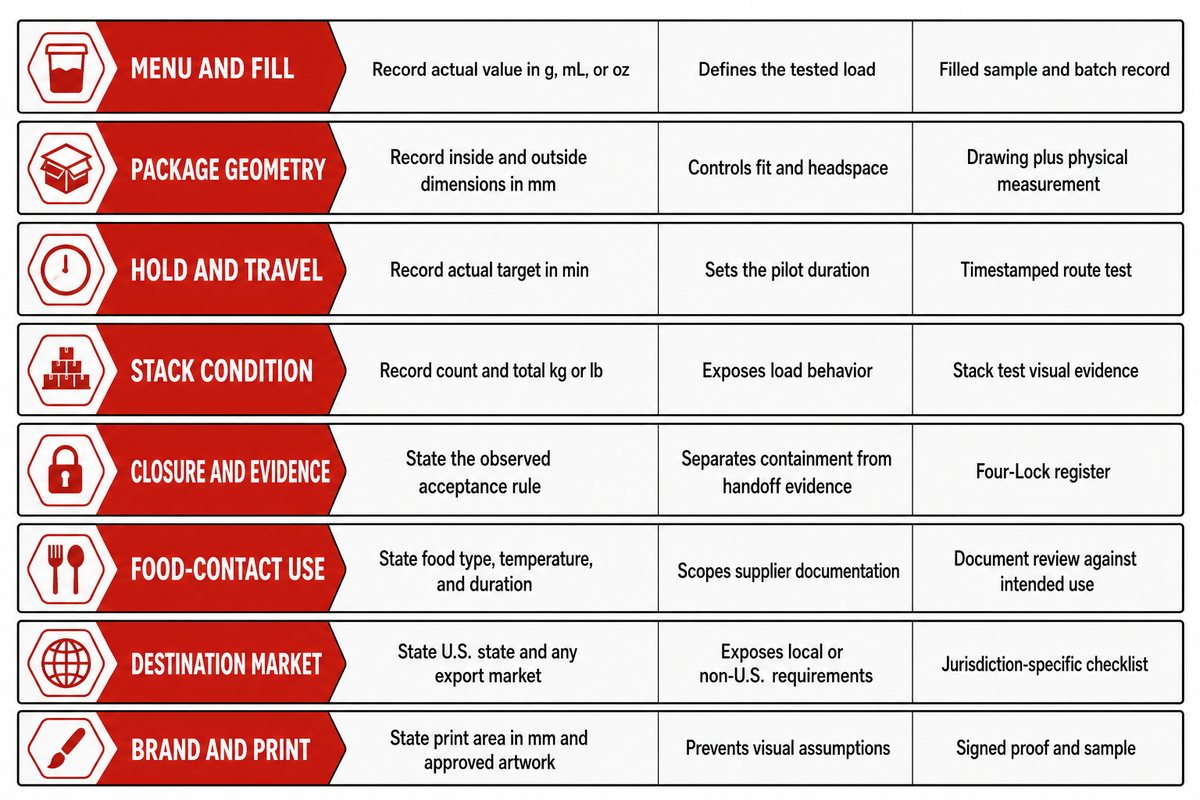
One supplier-comparable brief turns a passing ghost kitchen pilot into controlled procurement data. Give every supplier the same menu condition, dimensions, failure evidence, Four-Lock result, destination market, and document questions. Unit price alone cannot support a like-for-like decision without those fields.
Start the brief with the failure you’re trying to prevent. “Need 5,000 bowls” is a quantity. “Current lid opens at one corner after the defined stack and route” is an engineering problem a supplier can answer. Record the actual package dimensions in mm, fill mass in g, volume in mL or oz, headspace in mm, hold in min, travel in min, stack load in kg or lb, label area in mm, and acceptable visual result.
Pre-RFQ Failure Evidence Sheet
RFQ checklist — copy these into your quote request:
| Parameter | Recommended range | Why it matters | How to verify |
|---|---|---|---|
| Menu and fill | Record actual value in g, mL, or oz | Defines the tested load | Filled sample and batch record |
| Package geometry | Record inside and outside dimensions in mm | Controls fit and headspace | Drawing plus physical measurement |
| Hold and travel | Record actual target in min | Sets the pilot duration | Timestamped route test |
| Stack condition | Record count and total kg or lb | Exposes load behavior | Photographed stack test |
| Closure and evidence | State the observed acceptance rule | Separates containment from handoff evidence | Four-Lock register |
| Food-contact use | State food type, temperature, and duration | Scopes supplier documentation | Document review against intended use |
| Destination market | State U.S. state and any export market | Exposes local or non-U.S. requirements | Jurisdiction-specific checklist |
| Brand and print | State print area in mm and approved artwork | Prevents visual assumptions | Signed proof and sample |
Send the completed sheet to each supplier without changing the input fields. That lets procurement compare the answers, quality compare the sample evidence, and the owner decide whether a custom route is justified. If a supplier cannot identify the intended-use records behind a claim, mark the answer incomplete rather than filling the gap yourself.
Wonhi Meal Box publicly presents custom printing and mold-development services on its custom food packaging page. Treat that as attributed first-party capability context. It is not independent proof that a proposed package passes your menu, route, or destination-market requirements.
Bring a tested brief, not a broad request
If your current package has a reproducible failure, send the menu conditions, Four-Lock record, required dimensions, destination market, and evidence questions with your sample request.
Re-test When the Menu or Delivery System Changes
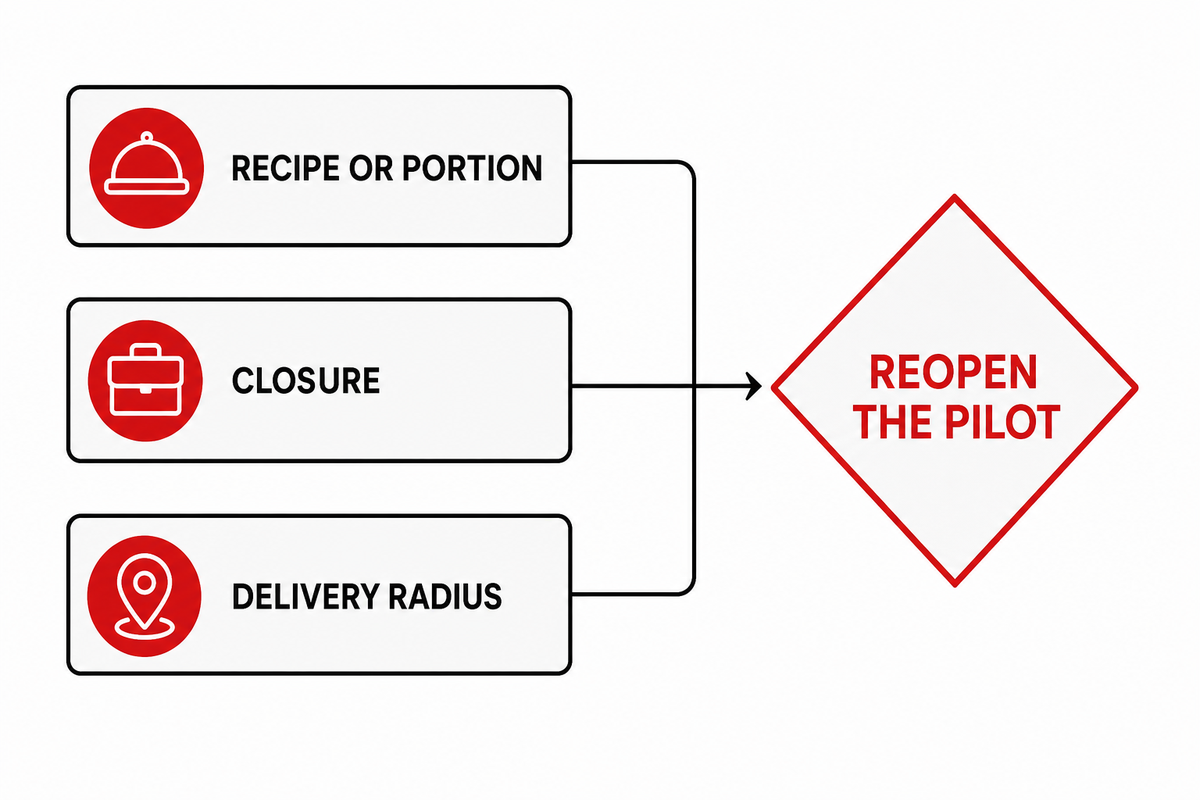
Earlier packaging results remain useful only while the tested conditions remain stable. Re-test when the recipe, portion, fill geometry, closure, supplier, label, carrier, order stack, waiting process, delivery radius, or handoff evidence changes enough to leave the recorded pilot range.
FDA’s online-delivery best-practices update places risk assessment alongside packaging, temperature, contamination, and allergen controls. This FDA update is best-practice guidance, not a prescribed re-test schedule; this worksheet uses those separate controls to identify when a buyer should refresh evidence.
For this guide, change control is intended to avoid unnecessary full retests while keeping decisions tied to recorded conditions. A virtual brand that changes one sauce ratio may need only the containment and vapor locks. A new shared kitchen process or third-party carrier may require the full four-lock sequence.
- Menu trigger: new recipe, portion, garnish height, liquid profile, or allergen-information flow.
- Package trigger: new format, dimension, lid, supplier, lot, print, seal, or component.
- Dispatch trigger: longer shelf wait, different bag, higher stack, new kitchen staff step, or changed carrier.
- Market trigger: sale into a new state or country, or a change in the documentation requested for the intended use.
- Complaint trigger: repeated failure category, unexplained refund pattern, or evidence that the approved range no longer represents service.
Key takeaway
Approve the tested condition, not the catalog claim. When a menu, package, route, or destination market leaves that condition, run the affected lock again and preserve the new evidence.
Frequently Asked Questions
What are the requirements for a ghost kitchen?
Ghost kitchen requirements depend on location and locally adopted rules; keep package-pilot results separate from local operating requirements, and use the Food Code boundary as a prompt to verify applicable rules before treating a pilot as operational approval.
A U.S. operator should confirm the locally applicable Food Code and other operating requirements with the relevant authorities and platform contracts. For packaging, define the delivery path, allergen-information handoff, intended food-contact use, pilot conditions, and supplier document request. The FDA Food Code is a model, not federal law, so do not assume one rule set applies everywhere. State chemical restrictions can add separate duties, and an export market may require another document framework. Keep the local authority decision, supplier document review, and package pilot as three different records.
What is the best packaging for ghost kitchens?
The best ghost kitchen packaging is the candidate that passes the actual menu, wait, route, stack, carrier, and handoff test under documented conditions, with the buyer retaining the evidence.
No bowl, clamshell, tray, or box is a universal winner. Start with liquid movement, steam or texture sensitivity, fill geometry, headspace, stack exposure, and handoff evidence. Run the Four-Lock test with the actual menu item and actual delivery bag, then retain the result with photos and timestamps. Check food-contact and destination-market documentation separately instead of treating the sample result as approval.
How do ghost kitchens handle delivery?
For this guide, model delivery as a chain of packing, waiting, bagging, courier handoff, route observation, and an internal package pilot; record the actual menu and handoff so the review stays tied to that service condition.
The container is one part of that chain. Record closure condition, carrier, stack, time, transfer point, and owner. A third-party delivery platform may define the dispatch channel, but the operator should keep a reproducible internal pilot with the actual menu and handoff. The package alone cannot prove food safety, tampering, allergen control, or customer satisfaction, and a seal cannot replace a documented transfer process.
How do you run multiple virtual brands without a packaging explosion?
Group virtual brands by verified menu behavior and test condition, then keep allergen information, artwork, and approval records separate for each brand and approved menu family.
Share a format only when the fill, vapor, stack, and handoff conditions fit one approved range. Keep allergen information and artwork separate.
Is sustainable packaging suitable for ghost kitchens?
Sustainable ghost kitchen packaging is suitable only when the use condition, package test, claim boundary, destination market, and local recovery system are all verified for the intended place of sale.
A material label does not prove a leak, heat, recycling, or composting outcome. Test the actual menu and route first. Then verify the claim and the destination market. State chemical rules, collection systems, and non-U.S. document requirements can differ, so a broad environmental statement needs evidence beyond the package description.
Which measurements should a ghost kitchen record before using a container size guide?
Record the filled menu condition, portion mass or volume, headspace, closure geometry, delivery bag, and stack condition before sending a size question to a container guide.
This guide records the delivery condition rather than owning the full size-selection decision. Once the measured inputs are known, use the detailed custom take-out container guide to compare layout and size choices, then carry the selected dimensions into the same RFQ sheet.
Why This Guide Uses a Test Record
Wonhi Meal Box states on its public website that it manufactures food-packaging containers and offers custom printing and mold-development services. This first-party description does not prove delivery performance. The article uses public authority sources to separate packaging observations from food-contact, allergen, state-law, and destination-market questions, then turns those boundaries into a ghost kitchen pilot and RFQ method.
Related Articles
- Custom takeout boxes guide — follow up on a box-format question after the delivery-fit test.
- Custom take-out containers guide — compare layout and size after fill and headspace are recorded.
- Custom food packaging options — discuss a controlled sample when a passing brief supports a custom route.
References & Sources
- FDA Highlights Best Practices on Food Safety for Online Delivery Services U.S. Food and Drug Administration
- Online Food-Packaging Complaint Research Frontiers in Sustainable Food Systems
- Addition to the 2022 Food Code: Sesame as a Major Food Allergen U.S. Food and Drug Administration
- Determining the Regulatory Status of Food-Contact Material Components U.S. Food and Drug Administration
- PFAS in Food Packaging New York State Department of Environmental Conservation
- Commission Regulation (EU) No 10/2011 European Union / EUR-Lex