Get in touch with Wanhui Company


By GW · Updated October 2026
School and hospital foodservice packaging consists of the complete container assembly used to portion, transport, identify and serve institutional meals.
Foodservice meal routes: the 9-Checkpoint Meal Route Passport
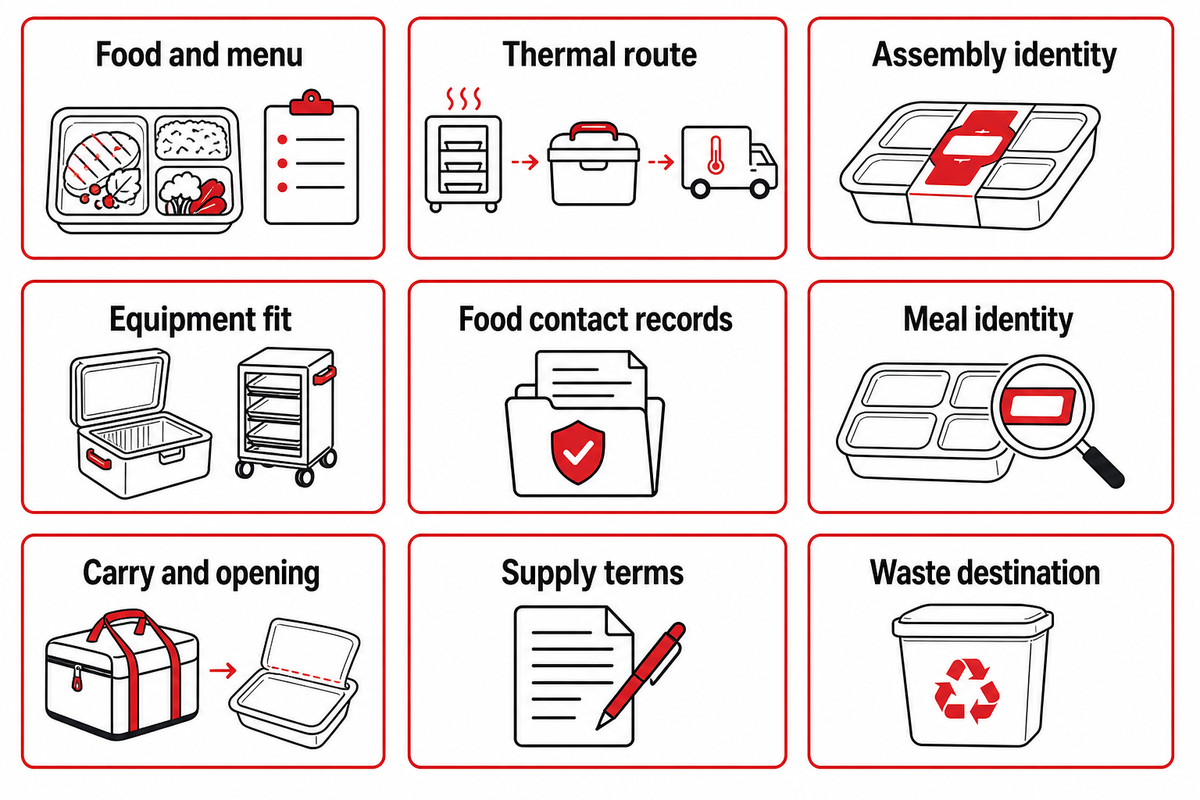
School and hospital foodservice packaging consists of the complete container assembly used to portion, transport, identify and serve institutional meals. There are numerous variables along the meal route e.g. the type of food, its documented food-contact use and exposure conditions, the equipment it fits in, dietary considerations and the access needed for its opening and the fate of the used packaging. Material names alone can’t address these considerations.
The tray route means the path from portioning through service to disposal. School lunch trays move through a cafeteria line, while a hospital meal tray may move through a transportation cart, then wait for bedside service and finally reach a diner who needs help opening a container lid.
For available product options, see Wonhi eco-friendly food packaging options. This resource supports product discussion for school and hospital food packaging and doesn’t certify a product or prescribe a therapeutic diet. It’s intended to be used in conjunction with the facility’s food safety procedures.
The 9-Checkpoint Meal Route Passport is an editorial worksheet for school and hospital foodservice packaging. It assigns school or hospital evidence owners and acceptance records; it does not score delivery performance or predict failure. It assists in understanding container assembly (foodservice) and its menu, handling conditions, equipment, identity, access, supply and waste route. It’s to be used by the buyer to document evidence and/or questions before a sample is accepted or an approved product is changed.
Start from the point where food is portioned and then follow the journey of the meal until the packaging leaves the site. Kitchen managers, purchasing operators and waste contractors may each know a different step in that journey. Invite the people that know each of the steps to review the same sample record. The FDA’s food types and conditions of use explain the importance of defining “food contact.”
| Checkpoint | Record or question | Limitations |
|---|---|---|
| Food and menu | Food type, portion, sauces and planned menu items | A dry-food sample does not establish suitability for another food. |
| Thermal route | Actual filling, holding, chilling and any reheating conditions | Supplier use limits and local food handling rules are separate checks. |
| Assembly identity | Container, lid, liner, coating and accessory identifiers | Evidence for one component does not cover every substitute. |
| Equipment fit | Rack, cart, tray carrier and available refrigerator space | A nominal container size cannot establish equipment compatibility. |
| Food contact records | Applicable authorization basis and documented intended use | A generic “food grade” statement leaves the use scope unresolved. |
| Meal identity | Diet instructions, label placement and authorized handoff checks | Compartment layout does not prevent allergen cross-contact. |
| Carry and opening | Spills, lid release, grip, utensils and assistance observations | A route trial does not establish clinical or population-wide outcomes. |
| Supply terms | Complete kit, freight, delivery, lot identification and change control | Quoted lead time is a supplier commitment, not a market benchmark. |
| Waste destination | Collection, washing or local acceptance of the exact product | A compostability claim does not establish local collection access. |
Unresolved entries must be kept visible. If a buyer claims completing the worksheet will slow down purchasing, use the missing entry to identify a specific supplier question. An undefined route for composting needs an acceptance answer; an undocumented reheating condition needs a use statement. The passport is a record aid. A validated scoring system and universal acceptance threshold don’t exist.
Serving food includes hot and cold items that require different documented conditions. Shared meal kits should be recorded according to their actual food and exposure settings. Staff must be able to direct questions to the responsible party to ensure food handling requirements are reviewed before an assembly is accepted.
School lunch trays: nutrition, portions and cafeteria handling
School lunch trays should be assessed based on the actual menu, portioning method and service route, including any authorized meal accommodations. Buyers can assess the compartment layout, carrying space and opening access with the school team. Packaging supports the meal service plan, while the school remains responsible for nutrition standards, dietary decisions and applicable procedures.
Chefs’ plating plans can include protein, a sauce, and fruit, and can also include a separate cold item. Record which foods share space and whether a closed lid touches a garnish or food portion. When looking at a self-serve salad bar, consider item placement where containers are picked up, space for a napkin and utensil, foodservice equipment, prep tools and the right equipment for carrying.
Illustrative school route: a sauce and a separate cold item
Let’s look at a hypothetical school serving a hot entrée with sauce, a cold fruit portion, and a drink. We’re looking at a compartment tray with a separate lidded bowl. During a sample, employees follow the usual portioning and carrying order. Staff note if the entrée extends to another compartment, if the cold item needs a different container, and if children can easily carry the entire meal. The 2016 guidance provides context for individualized accommodation, while current school procedures govern the decision.
USDA’s SP 59-2016 school meal disability guidance covers reasonable modification to meals and meal services. Staff members looking to buy a container should tell the school team about the opening or carrying concerns and leave decisions about dietary restrictions to the school team. The 2016 guidance offers context for individualized accommodation, and school procedures govern the decision.
When the concern is that one compartment tray should be suitable to every menu option, invite the team to propose food combinations that actually require separation within the tray. Locally sourced ingredients or a nutritious menu don’t establish the tray’s compatibility. Match the assembly to the service task.
Hospital meals in healthcare: cart fit and patient opening access
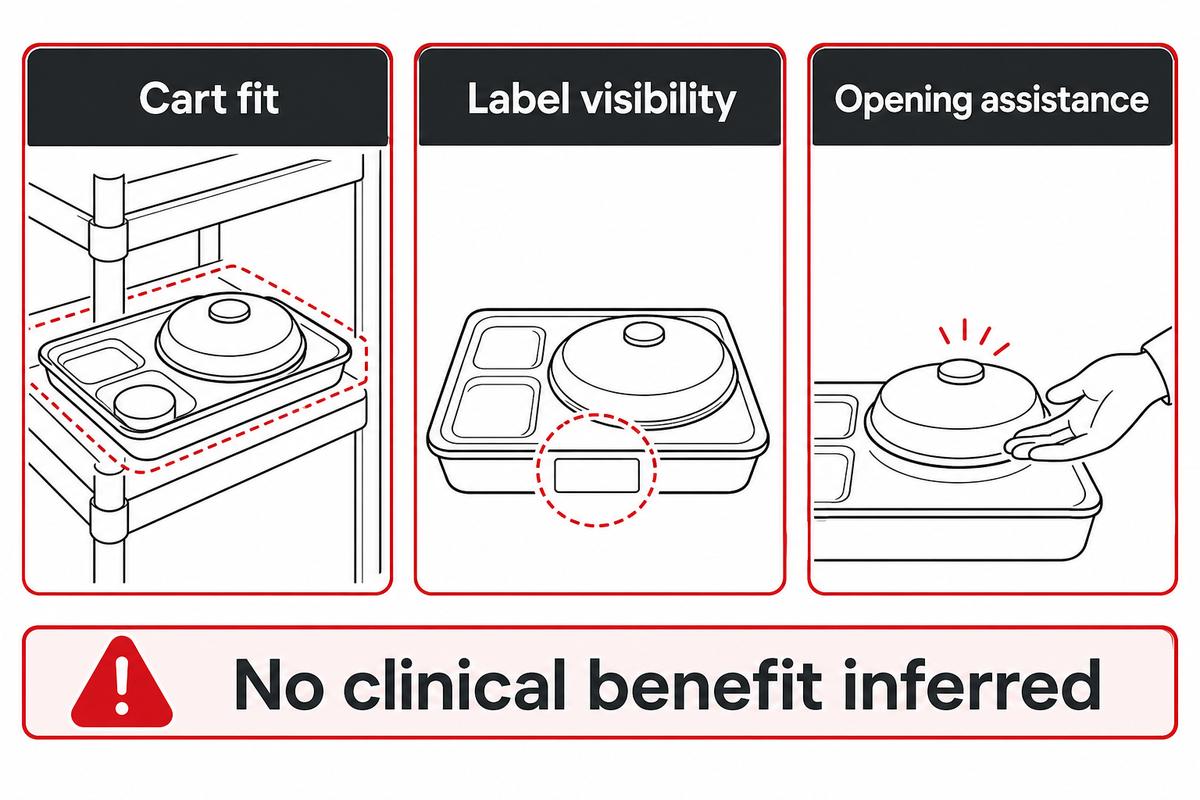
Hospital meals need packaging that fits the hospital foodservice route and can be opened with the assistance available at service. Having a compatible cart, the visibility of labels and the observations made during the opening process are all information that deserves to be documented separately. Historical research has documented opening challenges in selected groups, but this doesn’t establish current U.S. opening failure rates or show that a change in packaging would result in an improvement of nutrition.
Food and nutrition services are able to look at hospital food containers at the bedside and on the kitchen tabletop. There may be differences in ordering systems for room service versus cart service, and in how food is served. Find out how the food will be served, when staff are able to assist, and if mugs and bowls compete for space with the meal carrier. A patient’s appetite or hospital stay shouldn’t become a promised package outcome.
Bell and colleagues’ 2013 Australian hospital packaging study involved 140 predominantly elderly inpatients and 64 staff across four hospitals. Reported opening difficulty included milk and juice packs at 52%, cereal at 49%, condiments at 46%, and tetra packs or water bottles at 40%. Those observations justify asking about access. They don’t rank today’s materials or predict your patients’ experience.
The separate 2020 study of sealed and pre-opened packaging involved 62 independently living adults aged 65 or older in a simulated hospital ward. Overall intake didn’t differ significantly between the conditions. Both papers involve the same research group; treating them as independent confirmation of a clinical benefit would overstate the evidence.
The Hospital Caterers Association’s packaging accessibility discussion reports a series of user tests and work by Alaster Yoxall, a researcher at Sheffield Hallam University. The important purchasing question is practical: can the person for whom the packaging is intended identify its opening point, open the package and release the contents without spilling, under the assistive arrangements approved by the hospital?
“Staff can open every pack” is an example of a purchasing objection. Check whether support staff assistance is available at the actual service time. Document the facility’s answer about support staff assistance. Package access is one aspect of healthcare foodservice. Clinical decisions remain with authorized professionals.
Hospital food service teams may receive complaints about an unappealing covered meal. Document the observation. Don’t attribute changes in appetite or wellness during a hospital stay to the package. The opening questions the service team explores are based on the patient’s specific needs and authorized support.
Match each material to its documented use conditions
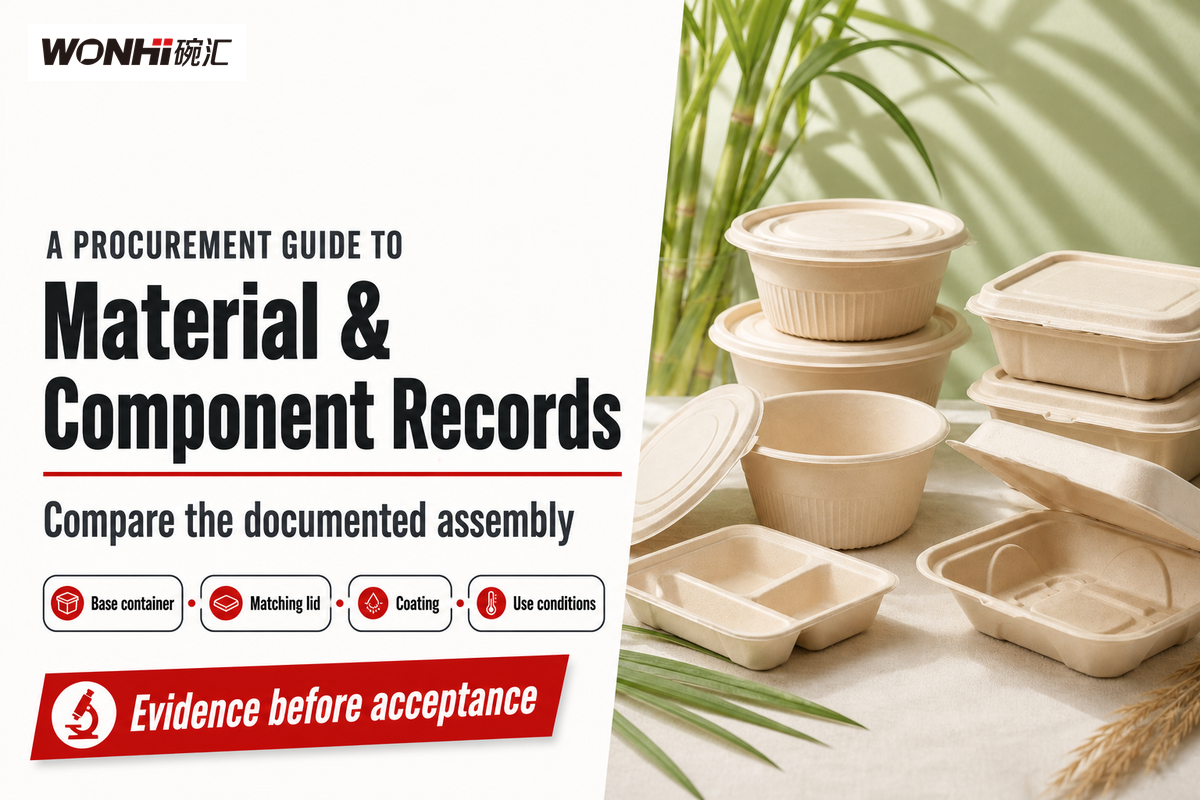
Selecting materials means comparing the defined food container assembly with documented food contact and use conditions. For each format (fiber, plastic, paper, reusables) evidence is required. Buyers should evaluate lids, coatings and accessories with the base container, and then test the permitted assembly for the intended route of service without making assumptions about universal service temperatures, leaks or disposal performance.
The following matrix groups formats by the evidence a buyer needs. It’s a conditional comparison, not a performance analysis. The actual bounds must be documented by the supplier before a trial begins. For a broader material range, see the eco-friendly food packaging materials guide.
| Format | Evidence to request | Route question | Limitations |
|---|---|---|---|
| Molded fiber tray | Composition, coating and documented food/use scope | Does the permitted sample maintain its shape during service? | A fiber name does not establish hot-food or compost suitability. |
| Coated paperboard box | Board, barrier and contact-use records | What happens at folds and seams with the planned food? | Coating and seam design vary by product. |
| Plastic base container | Exact product identity and permitted exposure conditions | Does the base fit the assigned carrier? | A resin abbreviation does not authorize every use. |
| Clear plastic lid | Matching lid identity and intended-use statement | Can staff see the meal label and close the approved assembly? | The lid may have different use limits from the base. |
| Fiber lid | Closure pairing and component documentation | Can the user locate and release the opening edge? | A matching color does not establish a reliable closure. |
| Separate portion cup | Cup, lid and permitted food-contact conditions | Does the portion remain identifiable through handoff? | Another small pack adds another opening task. |
| Liner or barrier film | Material identity and contact authorization basis | Does the evidence cover the intended assembly? | Base-container records may omit the liner. |
| Utensil and napkin kit | Accessory identities, food-contact scope where relevant | Can the diner use the supplied utensil with the meal? | A complete kit still needs access and handling checks. |
| Reusable meal container | Permitted reuse, cleaning and operating procedures | Can the site collect, wash and return the container? | Return logistics alone do not establish safe refill eligibility. |
What’s meant by “heavy-duty” and “high-quality?” Define this for the supplier. What assurances are they giving? What will the service check be? Don’t invent a wall thickness, service temperature or number of reuse cycles. An inexpensive lid substitution can also generate a question about the records.
For a buyer looking for a single material solution, evaluate the documented conditions for each route. Single material strategies can be useful only where the exact products fulfill those conditions. The matrix leaves performance values open until evidence is provided.
Food safety records: food contact, holding temperatures and single use
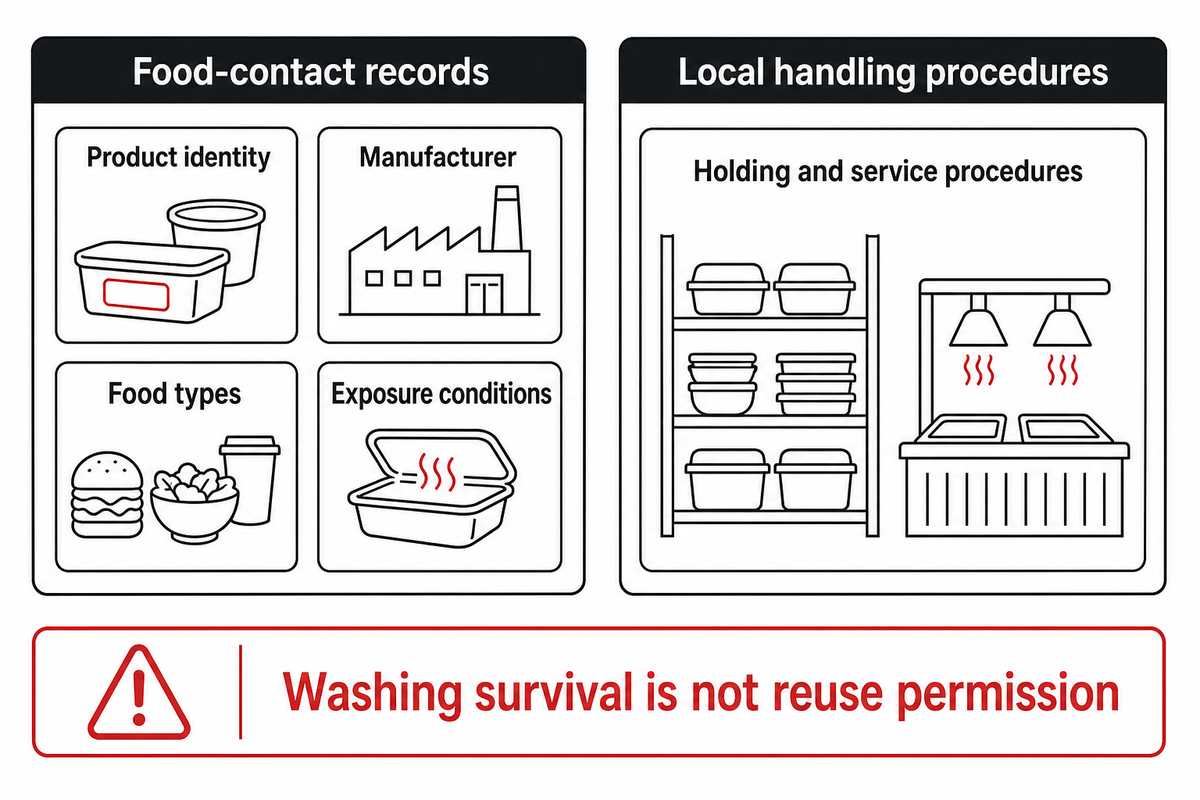
Food safety review needs to distinguish product food-contact records from the facility’s food handling procedures. Container use limits, authorized food types and any permitted reheating need product-specific records that identify the exact base, lid, liner and coating, distinguish filling from holding and reheating, and show which food and exposure conditions the supplier’s evidence covers before the facility schedules a trial under its own approved handling procedures. Holding and service procedures should comply with local jurisdiction. A disposable container should not enter a refill or reuse program merely because a sample survives washing.
FDA explains the scope of food contact notifications in its food-contact regulation overview:
“Food contact notifications are specific to the company submitting the notification and to the specified intended use of the substance.”
Ask the supplier for the basis of their applicable authorization, the covered manufacturer, and the product ID. Ask about the container, lid and any food-contact coating. A document may support a specific use without covering every food, exposure condition, and component of your meal kit. If the supplier offers only a generic “FDA approved” phrase, ask for the underlying basis and scope.
FDA’s conditions-of-use table distinguishes, among other settings, hot filling above 150°F and hot filling at or below 150°F, refrigerated storage, frozen storage and reheating in the container. The 150°F distinction belongs to that food-contact exposure table. It is not a universal container heat limit or the facility’s hot-holding rule. Record the actual route and ask which documented conditions cover it.
FDA now lists the 2026 Food Code as the current full edition. The Food Code is a model used by jurisdictions; publication alone does not establish local adoption. Its 2026 changes summary includes revised refill provisions with contamination controls. Local eligibility, hygiene, cleaning and contamination prevention need their own review before a reusable program starts.
Do
- Match documentation to the exact container assembly.
- Record the food and exposure conditions the documents cover.
- Check the facility’s applicable handling and reuse procedures.
Don’t
- Assume a material name authorizes reheating.
- Extend a base-container statement to an undocumented lid.
- Treat washing survival as permission for refilling.
From an administration perspective, a supplier’s broad temperature range may appear attractive. Ask which test or authorization supported the claim, and keep food limits and conditions of use separate. Easier administration of a temperature range doesn’t remedy a missing use condition.
Preserve meal identity and dietary instructions through handoff
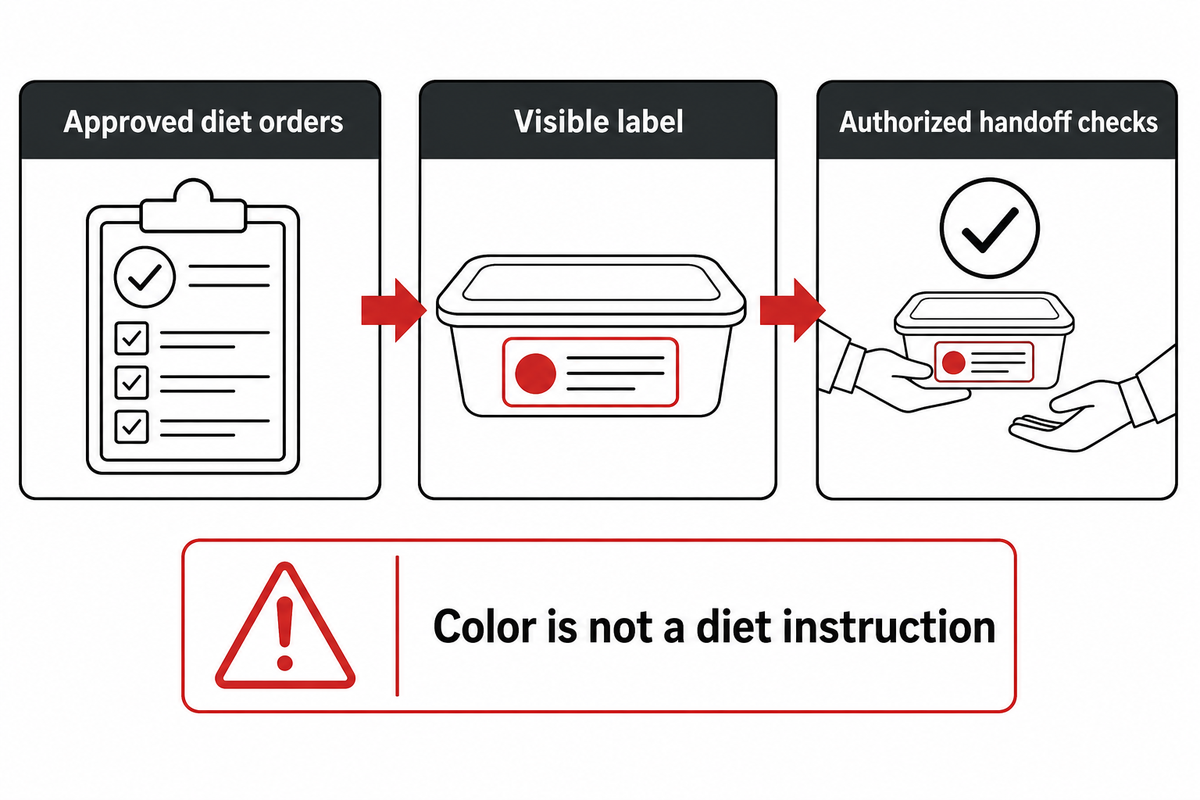
Meal identity checks should ensure that the dietary instructions approved at the point of order are received with the meal. Buyers can verify procedures related to label placement, visibility, and separation as well as handoff procedures with the responsible team. Hospital diet orders and school requests for accommodation require authorized decisions; therefore, packaging staff shouldn’t infer a diet based on a container color or compartment.
In the applicable U.S. hospital conditions of participation, diet-order responsibility is assigned to the responsible practitioner or an authorized qualified dietitian or nutrition professional, consistent with state law, 42 CFR 482.28. A current approved therapeutic diet manual must be made available to appropriate staff. Packaging procurement supports this process and doesn’t make assumptions about a low-sodium meal or make a modification to a therapeutic diet.
Illustrative hospital route: label visibility after closing
Let’s hypothesize a hospital with a foodservice program that sends a hot meal and a separate cold dessert via a delivery cart. The hospital uses approved diet orders and its own identification process. There’s a sample case to determine if the label remains legible after the lid is secured; to determine if condensation obscures the label, and if staff can check the meal at handoff to determine if it’s correct for the ordered patient, without moving the container of an unrelated patient. In cases of dietary uncertainty, an authorized professional or clinician makes the final determination. The sample case logs who provides opening assistance. Improvement of patient food intake and patient experience is not assumed. Acceptance is based on the facility’s documented requirements and observed routes.
FDA’s 2026 changes summary adds a Major Food Allergen Framework reference and updates language for cross-contact. A compartment or closing a lid does not ensure allergen control. Food preparation, utensils, hygiene and handling procedures still apply. If the objection is to color coordinated packaging making separate identification unnecessary for meals or allergen-related requirements, how does the authorized check work if the color or lids change?
Protect patients’ information under the site’s procedures when circulating sample records. The purchasing copy should retain the handling requirement without an unnecessary personal case history. The hospital’s foodservice program can customize label placement according to its approved process, without letting the color of the patient’s container determine the dietary instruction.
Run a route trial before accepting a bulk order
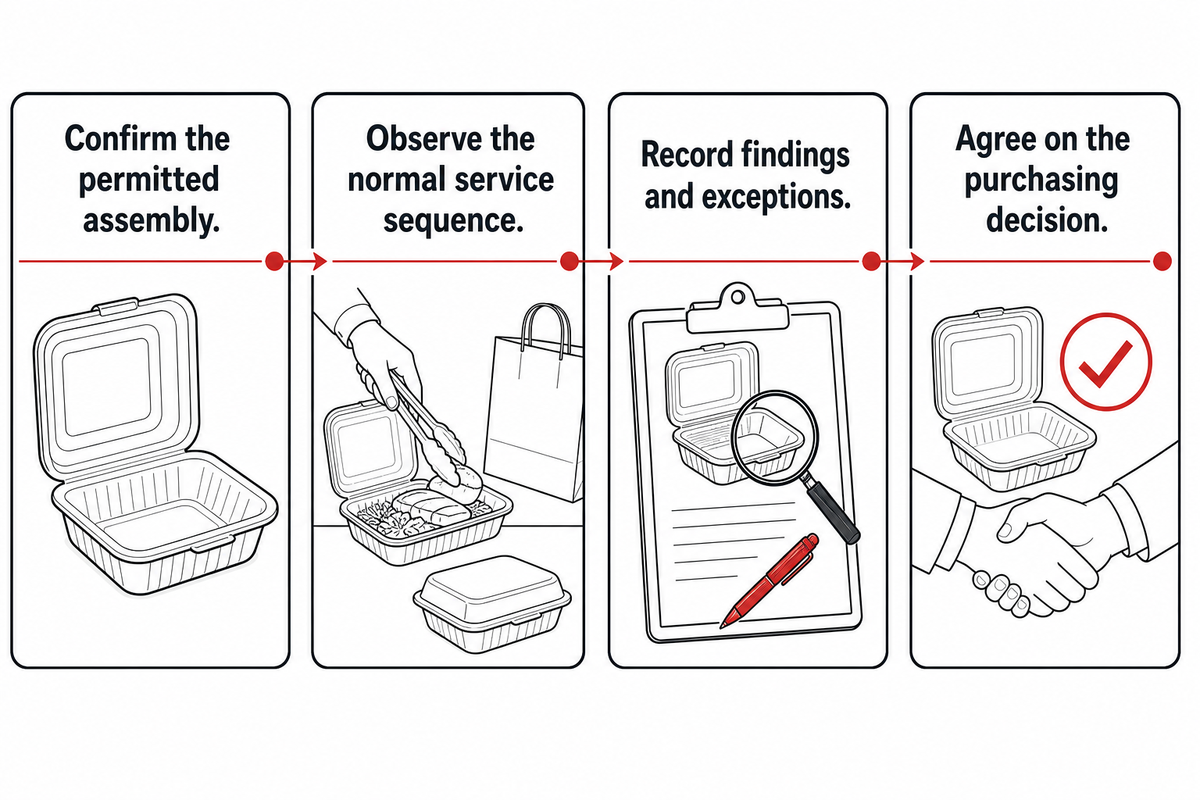
Route trials can document whether a permitted container assembly meets the facility’s stated purchasing requirements. Adhere to the routine for food delivery, observe carrying and opening, and record unresolved issues. The trial should be conducted using approved foods and procedures within documented limits. Findings of the trial support a procurement decision; they don’t validate nutrition, sterility, or clinical benefit.
Complete the observation form before opening the sample carton. Identify the product and lot, food to be sampled, fill method, intended closure pairing and route conditions, recording the planned carrier and handoff sequence, the label position, the opening assistance available at service, and the unresolved supplier or contractor questions so that another member of the purchasing team can follow what was actually observed. Record actual observations rather than documenting “pass.” A lid that needs an unexpected opening technique is a finding. Spilling incidents require a description of where and how they occurred.
- Confirm the permitted assembly. Review product identity and use records before exposing the sample to the proposed route.
- Observe the normal service sequence. Use the facility’s approved handling, equipment and assistance arrangements.
- Record findings and exceptions. Keep photographs and descriptions that the site permits, with unresolved questions visible.
- Agree on the purchasing decision. The responsible team sets the acceptance criteria, and decides if another sample is required.
Discussion of the Hospital Caterers Association’s user-testing provides additional perspective on opening access. Older parent forum posts raise carrier fit, lid handling, and spills as real world questions, but those anecdotes don’t provide institutional failure rates. The purchasing team should test the actual assembly, not borrow a forum’s preferred product.
Where a route trial is insufficient
Successful carrying demonstrations don’t establish the legal food-contact basis, local reuse eligibility or the compostability claims. Evidence for those questions must be documentary and procedural. A pack may also be unsuitable for the planned route because a relevant use condition is lacking, the cart fit is unresolved, or the facility can’t supply the needed opening assistance. Stop that proposed use and resolve the question before scaling an order.
Opening observations have a narrower meaning than clinical outcomes. Bell’s studies describe historical groups and the 2020 simulation didn’t identify a significant overall intake difference. Therefore, a buyer should report access issues and not say improved nutrition is expected. A returned container, even if it appears clean, may not have been washed and may not demonstrate control of contamination. The site must approve the reusable product process separately. If the purchasing staff is asked to accept a sample immediately, they should identify which requirement isn’t met and request evidence for that requirement.
Keep the accepted sample with the order and if the lid, barrier or material changes later, evaluate the related observations and records.
Quote the whole meal kit and agree on supply terms
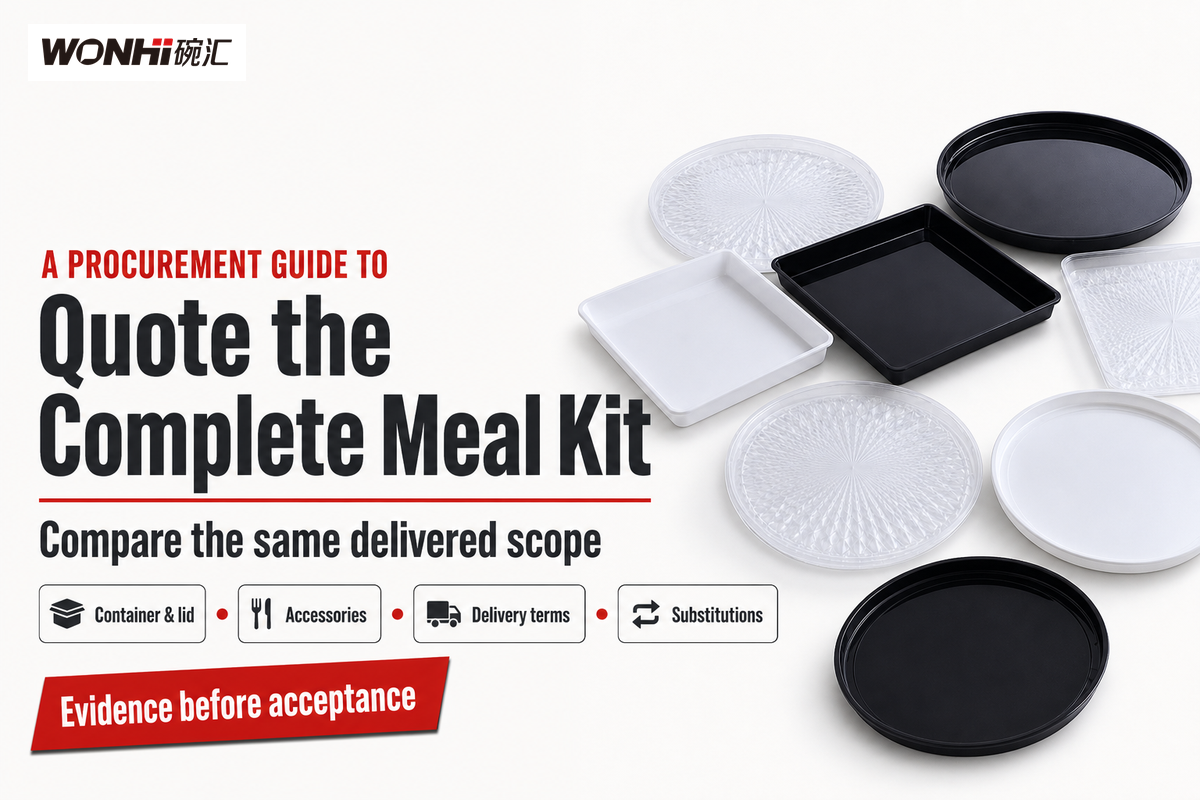
In order to evaluate quotes appropriately, a buyer must ensure that a quote provides the same level of detail across competing offers. A ‘complete quote’ for a meal kit should identify the container, lid, accessories, packing unit, and delivery terms, stating whether labels, a utensil, napkin or portion cup are included, which product identifiers will be supplied, and how substitutions are communicated so that competing offers can be compared against the same buyer-owned scope. The price of the product should be broken out from the freight, storage and service obligations. Both bundled and separately sourced assemblies should be assessed for compatibility. The purchasing organization determines the competition rules and acceptance criteria. It’s the supplier’s responsibility to provide product evidence.
Ask vendors to disclose whether quotations include labels, a utensil, napkin or portion cup. Request carton quantity, minimum order, currency, freight terms, delivery commitment and notice of substitutions. These are vendor supplied values, and may not represent prevailing market conditions. Supplier portals can store records, but check which version is applicable to the order.
Some operators seek operational efficiency by purchasing a kit; others already have compatible accessories. Make sure you review the full delivered scope. This is especially the case where a site vends packaged meals or offers multiple dining options. The bundled award isn’t always the cheapest, most efficient or more reliable option.
With respect to procurement governed by federal award rules, 2 CFR 200.319(b), excludes contractors from competing for procurements in which they developed or drafted the specifications or procurement requirements. Keep the boundary clear: The buyer is the owner of its bid criteria and process. Supplier technical records and sample questions in this guide aren’t substitutes for a thorough procurement review by the organization.
For claims of energy efficiency or an energy-efficient kitchen, an operational basis should be established. Packaging quotes don’t establish utility savings or operational excellence. Request actual washing, return, storage, and handling cost inputs when comparing a reusable system.
When a lower quote omits a matching lid, or allows unreviewed substitutions, ask for a like-for-like scope. An accepted assembly should be preserved for repeat orders, as should the process for change control. For company context prior to a product discussion, review the Wonhi Food Packaging Company Background.
What is changing: PFAS documentation and accepted waste routes
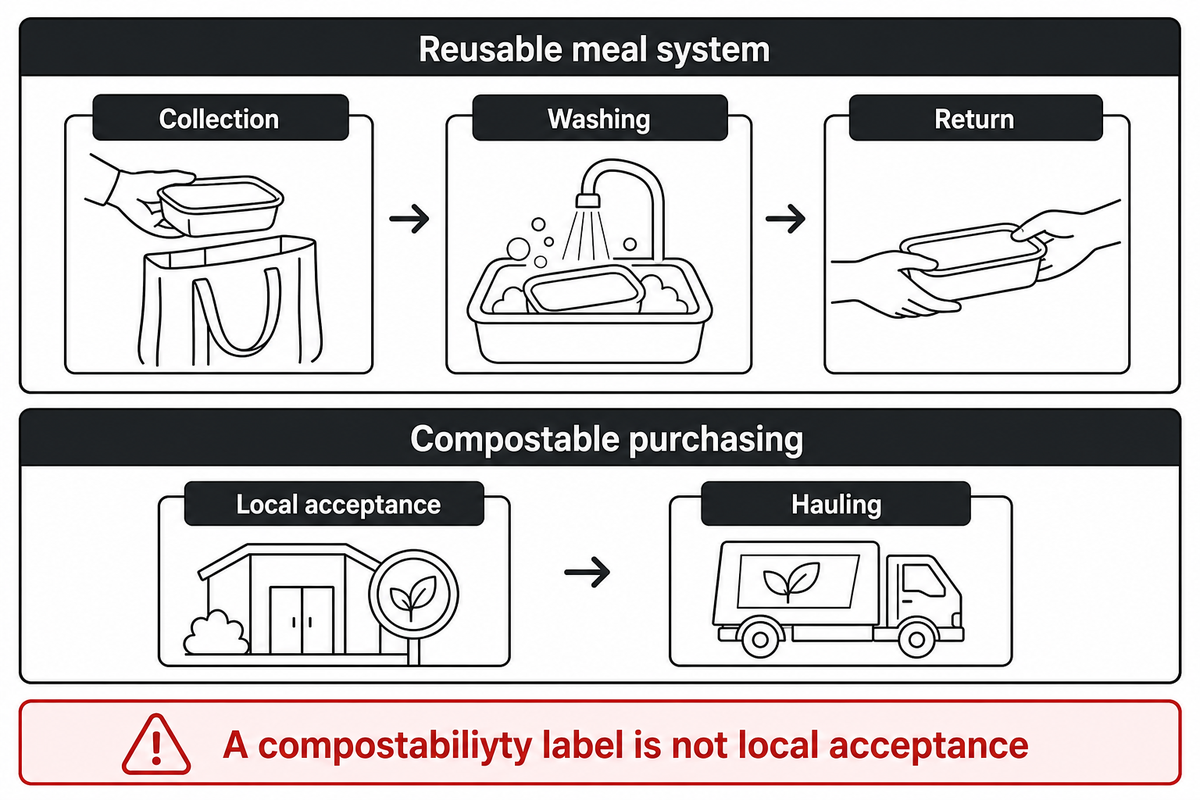
Sustainable procurement should review current product records and the actual destination for used packaging. The EPA places reusable food service ware first, if the operating system supports it. EPA conditions compostable purchasing on collection and local acceptance. PFAS development affects specified food-contact uses; a fiber label or a compostability seal doesn’t mean that every environmental and/or safety claim is supported.
FDA announced on January 3, 2025 that 35 specified PFAS grease-proofing food-contact notifications for paper and paperboard would become ineffective on January 6, 2025. The limited existing-stock compliance date was June 30, 2025, which has passed. That defined action is not an all-PFAS ban or evidence that any Wonhi product has a particular measured PFAS result. Request current evidence for the exact product and any claimed test scope.
EPA’s food service ware procurement guidance prefers reusable if the operating system supports it. Review collection, washing, and return systems along with food safety controls. If compostables are considered, confirm that the exact product is accepted at local compost facilities and that hauling is provided. A certification seal doesn’t remove the responsibility to ensure all claims are supported.
Illustrative disposal route: certification without collection
Let’s imagine a scenario with a cafeteria looking at both certified compostable trays and a reusable meal system. The waste contractor has agreed to take some food scraps, but has not agreed to collect the proposed tray and lid. The buyer keeps the option unresolved and doesn’t assume that certification covers local composting. The reusable system is assessed for collection points, washing capacity, return transport and applicable hygiene procedures. Neither system is declared the winner based on their label. The purchasing team requests the acceptance or operating information that’s missing, and assesses systems that are within feasibility. In order to substantiate any savings or waste reduction, local assessments and measurements would be needed; the scenario describes no such benefits.
The FTC’s October 2012 Green Guides summary states that compostability claims need reliable substantiation for all materials in the product or packaging and qualifications where the claimed setting is unavailable. Certification seals don’t relieve the claimant from substantiation. The biodegradable food containers guide provides background and terminology. Check the specific claim, setting and accepted assembly before purchase.
EPA’s wasted-food assessment resources suggest measuring the amount, type and source of food and packaging waste. Keep observations of food waste and packaging waste separate in order to assist the team in reviewing the cause of each waste. Use local assessments and observations when reviewing sustainability and food quality. If a buyer objects that sorting is difficult, ask the contractor what collection systems can actually operate before ordering that format.
Key takeaway
The 9-Checkpoint Meal Route Passport connects purchasing questions to evidence for the actual assembly and service route. Unresolved food-contact scope, opening access or local waste acceptance should stay visible before an order is accepted.
Working on a product discussion? Contact Wonhi about your meal route and packaging requirements including the food, documented use conditions, assembly components and questions that are still open in your passport.
FAQ: school and hospital foodservice packaging
Does school and hospital foodservice packaging need certified food-contact documentation?
School and hospital foodservice packaging requires evidence of actual food contact use and assembly. A general certificate or label stating “food grade” doesn’t establish scope for each component. Before accepting the proposed use, ask the supplier for the authorization basis, covered manufacturer, food types and conditions of use.
What should the purchasing record include?
Keep product identifiers for the base, lid and relevant coatings with the documents used to support the proposed application. FDA explains that food contact notifications are company- and intended-use-specific. Other authorization bases may apply, so request the actual basis rather than insisting on one document type. The facility should separately confirm applicable handling procedures. A sample route trial can describe fit and opening, but it cannot replace missing authorization or use-scope evidence.
Can schools and hospitals use the same food containers?
When considering the same food container, schools and hospitals must review records and route observations for both proposed uses. Menu, carrier fit, authorized dietary instructions, opening assistance and waste collection may vary. Approval of a route for one facility doesn’t equate to approval for another. An unreviewed lid substitution for either facility also warrants review.
How should a shared purchasing team compare routes?
Keep a route record for each service, even if the product identifier is the same. Each delivery service may require a different layout or portion: cafeteria carrying access and a visible bedside label with scheduled opening assistance address different route questions. Compare the exact assembly against its documented food and exposure conditions before either site starts a trial. Record your observations of the equipment and the service in the sequence that it’s actually used. Contact your local waste contractor to check acceptance of the entire container and lid combination. Joint purchasing decisions can use common evidence where it applies, but retain unresolved questions and requirements for acceptance at both sites.
Where should used compostable school and hospital meal containers go?
Compostable school and hospital meal containers, when used, require an available collection route and a facility that accepts the exact product type. Check the base, lid and accessories, separately, with the contractor. The presence of a compostability label on a container doesn’t ensure acceptance in a household composting, recycling or ordinary waste stream.
What if the contractor has not accepted the format?
Keep the proposed compostable purchase unresolved until collection and processing acceptance are confirmed. EPA guidance conditions procurement of compostable food-service ware on a suitable local collection and composting system. The FTC Green Guides also explain that compostability claims need qualification where the claimed composting setting is unavailable. Review available options for reuse (or other acceptable practices) based on the operating limitations and safety of the site.
Do compartments prevent allergen cross-contact in meal trays?
Compartments don’t establish allergen cross-contact control, even when foods occupy separate spaces in a meal tray. Approved preparation, utensils, handling and meal identification procedures require review by the responsible facility team under the site’s applicable food safety and dietary procedures.
Who approves the handling process?
The facility’s authorized dietary and food safety personnel review and approve the process under applicable procedures. The packaging purchaser provides assembly and handling information.
Does a closed hospital food container make the meal sterile?
A closed hospital food container doesn’t establish a sterile system. Observations of a closed container and a review of the assembly describe closure; they do not establish a sterile system claim. However, claims of a sterile system would require separate evidence for the specific product and process.
What can the trial record show?
The trial can describe closure, fit, spills and opening based on the approved route. The trial provides no evidence for the validation of a sterile package or clinical outcome.
Are biodegradable food containers automatically compostable locally?
The presence of biodegradable food packaging doesn’t mean the local composting facility accepts it. Supporting evidence and a defined setting of the claim are required, and the local contractor must accept the exact product type, including its lid, liner and accessories in the planned collection route.
Which parts of the assembly need checking?
Review the container, lid and liner and relevant accessories. Evaluate substantiation of the claim. Review the actual collection route rather than extending one component’s label to the entire meal kit.
References & Sources
- U.S. Food and Drug Administration: Understanding food-contact regulation and food types and conditions of use.
- USDA Food and Nutrition Service: SP 59-2016, modifying school meals to accommodate disabilities.
- Bell et al.: 2013 hospital packaging observations; 2020 sealed versus pre-opened packaging study. Historical Australian samples; no U.S. prevalence or clinical benefit inferred.
- Hospital Caterers Association: Packaging and accessible opening, professional discussion including Alaster Yoxall.
- Electronic Code of Federal Regulations: 42 CFR 482.28, hospital food and dietetic services; 2 CFR 200.319, federal-award procurement competition.
- U.S. Food and Drug Administration: Food Code editions; 2026 changes summary; January 2025 PFAS notification action.
- U.S. Environmental Protection Agency: Food-service ware procurement; wasted-food assessment resources.
- Federal Trade Commission: Environmental Claims: Summary of the Green Guides, October 2012.
GW writes for Wonhi Meal Box. This procurement education article draws on the cited public sources. Illustrative scenarios and the Meal Route Passport are editorial tools, with no claimed Wonhi customer trial, product certification or clinical validation.