Get in touch with Wanhui Company


Compostable vs biodegradable vs recyclable packaging explained means separating three claims: biodegradation consists of a breakdown process. Compostability adds specified composting conditions. Recyclability refers to the recovery of the material. Your purchasing decision requires proof for the precise package, as well as the collection route that will take it.
By GW · Updated October 2026 · US foodservice purchasing context
Restaurants may purchase a certified container, but still have no way to compost it. Boxes may contain recycled material and be rejected for recycling. Before choosing packaging, verify the claim on the quotation with the item that you received, the market that you sell in, and the waste management system that will receive your customers’ packaging waste.
This companion guide focuses on verifying environmental claims for the finished item and confirming an accepted collection route. For material performance and cost comparisons, use our materials, performance and cost overview.
The purchasing sequence: identify the claim, verify the finished item, then confirm the accepted collection route. The 3-Route Disposal Compass below turns that sequence into a buying decision.
Compostable vs biodegradable vs recyclable: what each label promises
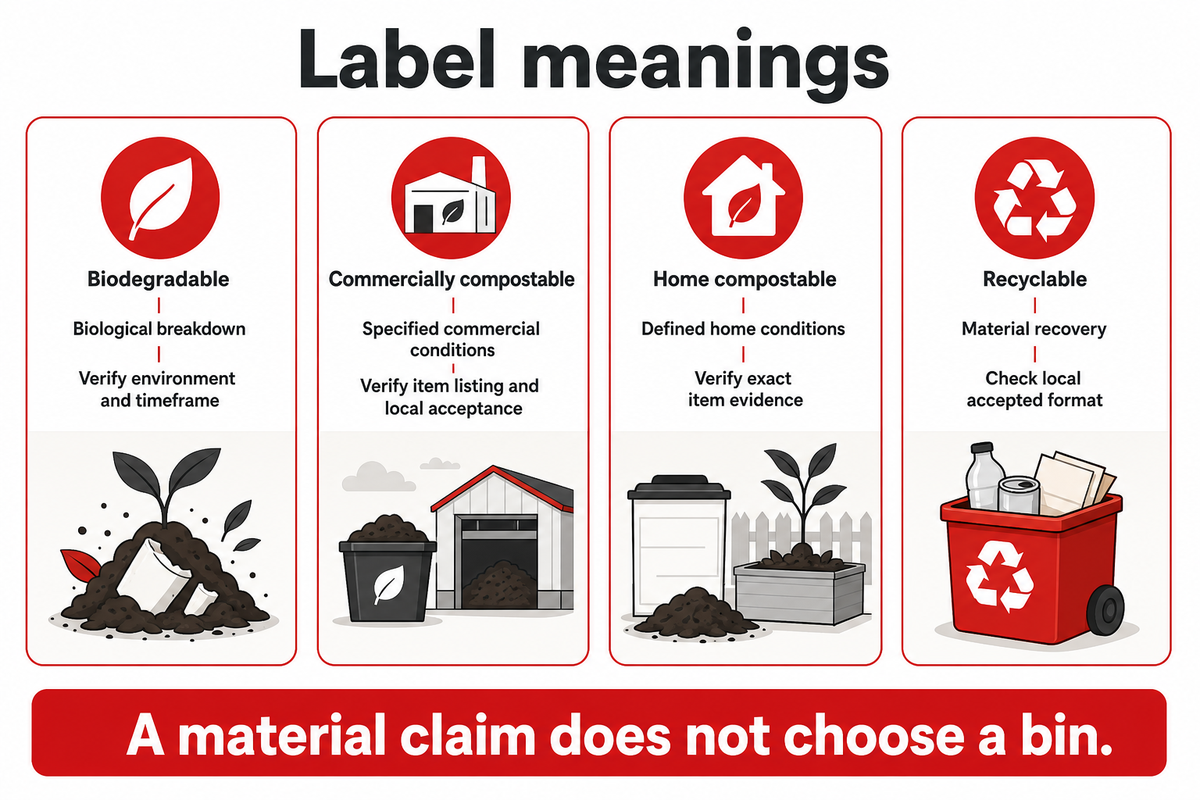
Biodegradable refers to biological breakdown; compostable adds requirements for usable compost in a specified composting environment. Recycling refers to the recovery of the material through a specified recycling system. The differences between these three terms matter because a material property alone can’t identify a collection bin. Your choice between biodegradable and recyclable formats requires local collection instructions.
| Label | What it describes | What still needs checking |
|---|---|---|
| Biodegradable | Breakdown through biological processes under stated conditions | Environment, timescale, whole-package evidence and permitted claim wording |
| Commercially compostable | Composting under specified commercial or industrial conditions | Exact item certification and acceptance by the receiving program |
| Home compostable | Evidence for a defined home-composting claim | Applicable certification, item instructions and destination-market requirements |
| Recyclable | Recovery through appropriate collection and processing | Material and format compatibility, preparation instructions and actual local acceptance |
| Recycled content | Recovered material used to manufacture the package | Content substantiation; this does not determine disposal after use |
EPA’s plastic recycling and composting FAQ makes the distinction clear for plastics: compostable plastic is biodegradable, but biodegradable plastic isn’t necessarily compostable. Compostable plastic isn’t intended for conventional plastic recycling streams. Don’t extend that plastic-specific warning into an unsupported claim that every fiber package is unrecyclable. EPA describes aerobic composting biodegradation into carbon dioxide, water and biomass; that process needs its specified conditions.
Biodegradable vs compostable: what’s the difference?
In biodegradable vs compostable, the real difference is in evidence and the conditions. Bioplastics require a careful description. Feedstock descriptions need qualification: Plant-derived carbon by itself doesn’t establish either a composting route or recyclability. Rather than treating the feedstock as a disposal instruction, we should ask what a material does in what conditions.
Buyer questions: “Is compostable the same as biodegradable?” and “Is biodegradable the same as compostable?” Request separate evidence and instructions from the supplier for each claim; one certificate cannot establish every end-of-life route.
Biodegradable packaging: what a claim must specify
Biodegradable claims should identify what breaks down, what environment it breaks down in, and the timeframe. Biological conversions shouldn’t be confused with a package breaking down to smaller pieces. For marketing to the US, the FTC Green Guides say marketers should substantiate and appropriately qualify the claim. Vague, general statements that a package will “disappear” aren’t appropriate.
Under the FTC’s degradable-claims guidance, for an unqualified solid waste claim, the burden is on the marketer to show, with competent and reliable scientific evidence, that under customary disposal conditions, the entire package and/or product will completely break down and return to nature in one year. This has to do with the substantiation of the claim, not the science of breakdown of biodegradable materials.
An eco-friendly packaging label also needs a supported, qualified explanation. Broad green claims can be deceptive to the consumer and lead to greenwashing. Relying on microbial activity to biodegrade naturally through microbial processes requires certain conditions; hence the need to explain what conditions are present to help prove the claim. “Years to degrade” isn’t a helpful specification to a consumer; the purchaser needs to know the environment and supporting evidence. It’s not enough to say a material can disintegrate; there has to be proof of complete biological conversion in the stated environment before describing an environmental benefit.
In a hypothetical takeaway scenario, two boxes are quoted as ‘biodegradable’ and ‘composting certification’. Staff can’t track what happens after patrons leave the store. The company hasn’t checked receiving programs. Paying more for either label doesn’t resolve that issue. The first box’s test conditions and qualified wording should be requested, and both packages’ realistic disposal routes should be considered. If customers ordinarily discard them as general waste, the menu and boxes shouldn’t indicate composting is quick and guaranteed. The comparison should consider supported claims, realistic disposal routes, and food service industry performance.
Do not replace missing evidence with a calendar estimate. Biodegradable claims must describe the conditions they can substantiate.
Compostable packaging: commercial and home conditions
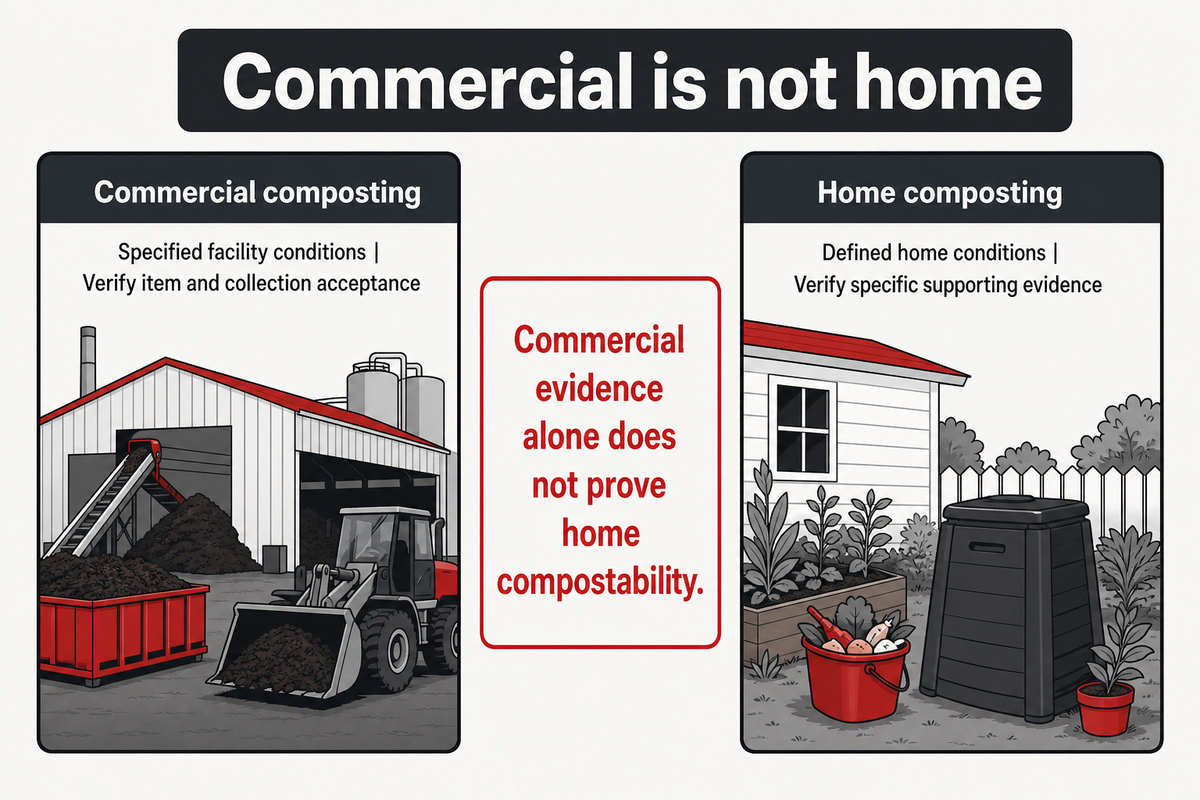
Commercial and home compostability are distinct claims. The conditions in industrial composting facilities may not be achieved in a backyard pile. Therefore, a commercial certificate can’t prove home compostability by itself. Home compostable materials need an explicit supporting basis for the exact item followed by instructions that are appropriate for the target consumer.
The EPA’s home composting guidance generally leaves compostable foodservice ware and bags out of a typical backyard pile because the temps may not get hot enough. The guidance also suggests checking with a commercial facility to see if they’ll take it. Oxygen, moisture and heat affect the biological process, which means a generic compost bin isn’t the same as the tested environment.
What does a home compostable claim need?
BPI’s current certification page distinguishes its commercial program from a home program launched in 2025. Commercial assessment uses ASTM D6400 as its base. BPI’s home program uses NF T 51-800 and requires commercial certification first. Verify the particular listing; the existence of a program does not certify every package made from similar materials.
“what’s actually compostable in their backyard versus what products should be sent to a professionally managed compost facility”
The difference between biodegradable and compostable packaging should be visible on customer instructions. If a supplier provides commercial evidence only, specify commercial collection only where the local program confirms acceptance. Buyers requiring home compostability would need item-level evidence and a review of destination market labels.
A broad “home compost” promise can create a purchasing mismatch. Establish the correct certification and collection conditions before approving artwork.
Recyclable packaging and recycled content are different
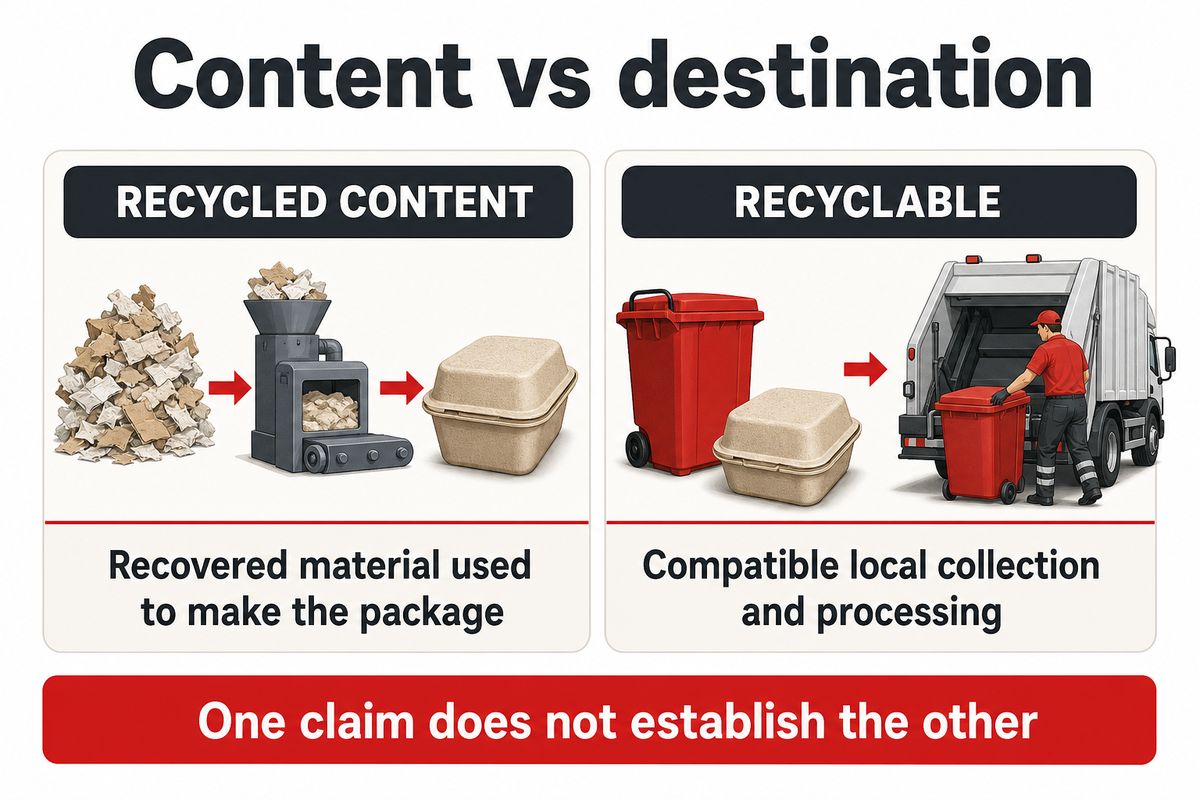
Recyclable packaging refers to end-of-life recovery claims and recycled content to material used in production. A package can have one, both or neither of these claims. Choosing the right option requires looking at the downstream recycling system to understand what formats and preparation rules are accepted, as a recycled content claim doesn’t describe disposal.
The FTC recycling-claims summary says marketers should qualify recyclable claims when appropriate facilities aren’t available to at least 60% of consumers or communities where the product is sold. That figure measures access for claim qualification. It doesn’t mean 60% of packages are actually recycled, and it doesn’t replace state requirements.
Comparing biodegradable vs recyclable packaging includes two parts: is the material biodegradable under certain conditions, and is the format able to enter an appropriate recovery system? Neither answer addresses both. Don’t combine compostable plastic with conventional plastic recycling, unless instructed to do so in a particular case. A clear lid and its base may need separate instructions. Always check both.
Is compostable the same as recyclable?
No. Composting treats accepted organic inputs biologically, while recycling recovers accepted materials for further use. Recyclable options still require compatible local collection. Sustainable packaging depends heavily on local infrastructure, but also on the product, its contamination and the supported claims in the sales market.
Ask for two separate statements on the quotation: substantiated recycled content, if claimed, and disposal instructions for the actual package.
Certification applies to the finished item
Certification should be verified for the packaging offered rather than assumed from a description of the raw materials or from a logo that might be familiar. Construction matters: a coating, liner, or other component could affect the evidence. Verify the documents connecting the purchased item with the current certifier’s listing.
BPI’s product-catalogue guidance provides a route to verify whether particular items are certified and in good standing. Separately, ASTM D6400-26’s public scope addresses end items, including packaging using polymer coatings or binders. Its public summary is not the complete standard or a certificate for a named supplier.
For market-specific certification screening, use our Compostability Certification Decoder. The Disposal Compass below addresses collection-route acceptance after the applicable evidence has been identified.
Review whether the evidence covers the quoted thickness, coating and printing, and whether a lid is included or assessed separately. Certified compostable materials don’t automatically establish the scope of a finished cup including a separate lid. Food contact suitability is another document question; an end-of-life certificate shouldn’t be used as an answer to this question.
Consider a buyer that approves a sample and asks for a printed version with a different liner. The container looks almost the same, so the buyer keeps the original disposal wording. That’s a hypothetical document-control failure, not a reported factory issue. Prior to shipment, review the revised product code and construction against the certification record. Ask the supplier or certifier if the change is still covered. Keep a confirmed scope with the approved artwork, and separate any lid instruction. Comparing a lower quote for a different item or narrower evidence scope is less straightforward.
For more options, check the biodegradable food container materials guide. This article serves more for verifying claims and routes than for providing a general rank order comparison of packaging materials.
Buyer objection: “The resin already passed.” Request a traceable item-level listing and confirmation of the finished construction before accepting a product claim.
The collection route decides what happens next
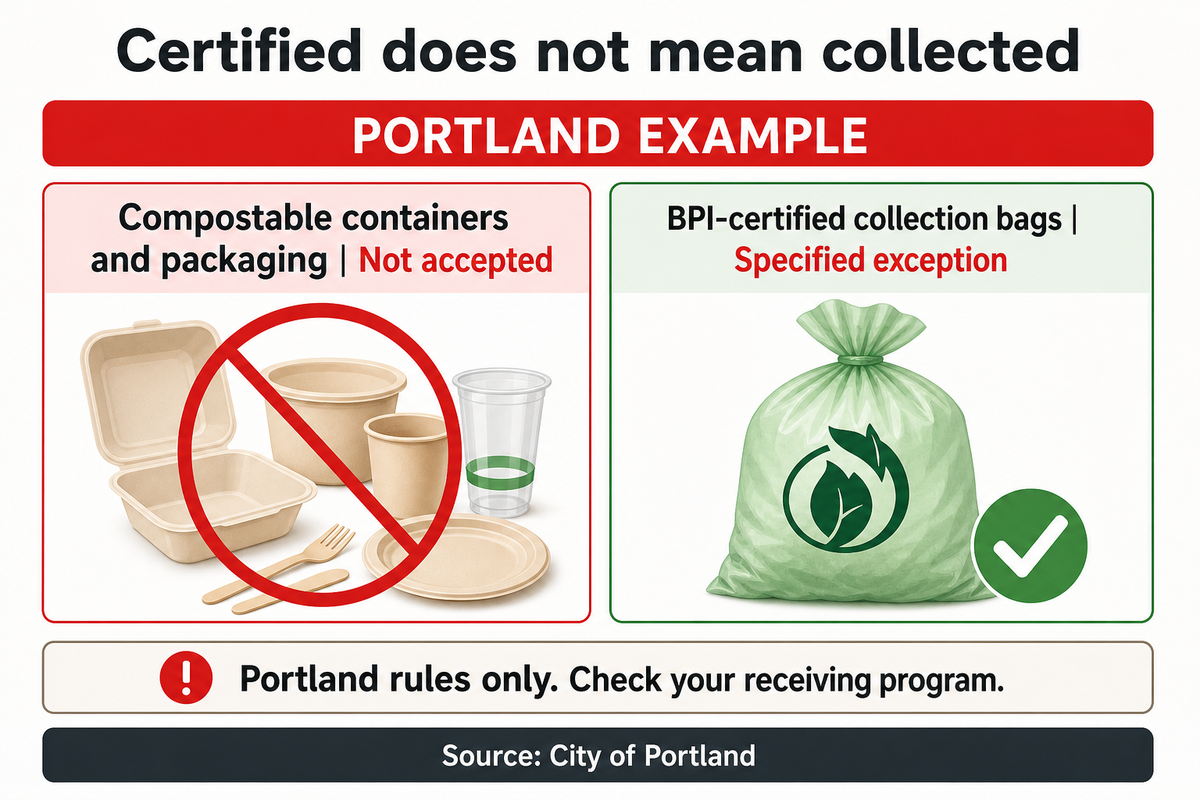
The receiving collection program determines whether a certified package can enter an organization’s organics stream. Certification and collection acceptance address different questions. Different rules can apply when food waste is collected but food-contact packaging is excluded, while specific collection bags may be accepted. Determine the rules that apply based on the location and type of customer.
Portland’s compost instructions illustrate the boundary. The city excludes compostable containers and packaging, including items labeled biodegradable or made from plants. Its stated exception is BPI-certified compostable bags. Residential collection accepts food and yard waste; business collection principally accepts food, with specified exceptions for paper coffee filters and tea bags.
For homes, bin liners can be made of paper or paper bags or BPI-certified bags, according to the instructions; businesses are directed to BPI-certified bags only. Therefore, a city can allow a collection liner while not allowing a compostable food container. These are the rules of Portland, not a national ban on compostable cups and bags.
A historical BioCycle infrastructure survey published in 2023 indicated that 142 of 200 responding facilities reported accepting compostable food-contact packaging; 58 did not. Most observations described 2022. The BioCycle survey, supported by the Composting Consortium, illustrates variation among respondents. An acceptance rate of 71% isn’t a current estimate of national household access or the likelihood that a customer’s box would be composted.
In addition to what was stated previously, downstream compost users may need to confirm other additional requirements. Acceptance by a hauler doesn’t determine eligibility for organic agriculture. Buyers with that destination should check the facility’s feedstock policy and other requirements. In this respect, the USDA-hosted National Organic Standards Board compost petition review is discussed in the current change section below.
Common mistake: printing “put in the compost bin” before checking the receiving program. Confirm the exact item, stream and accepted liner separately.
Choose packaging with the 3-Route Disposal Compass
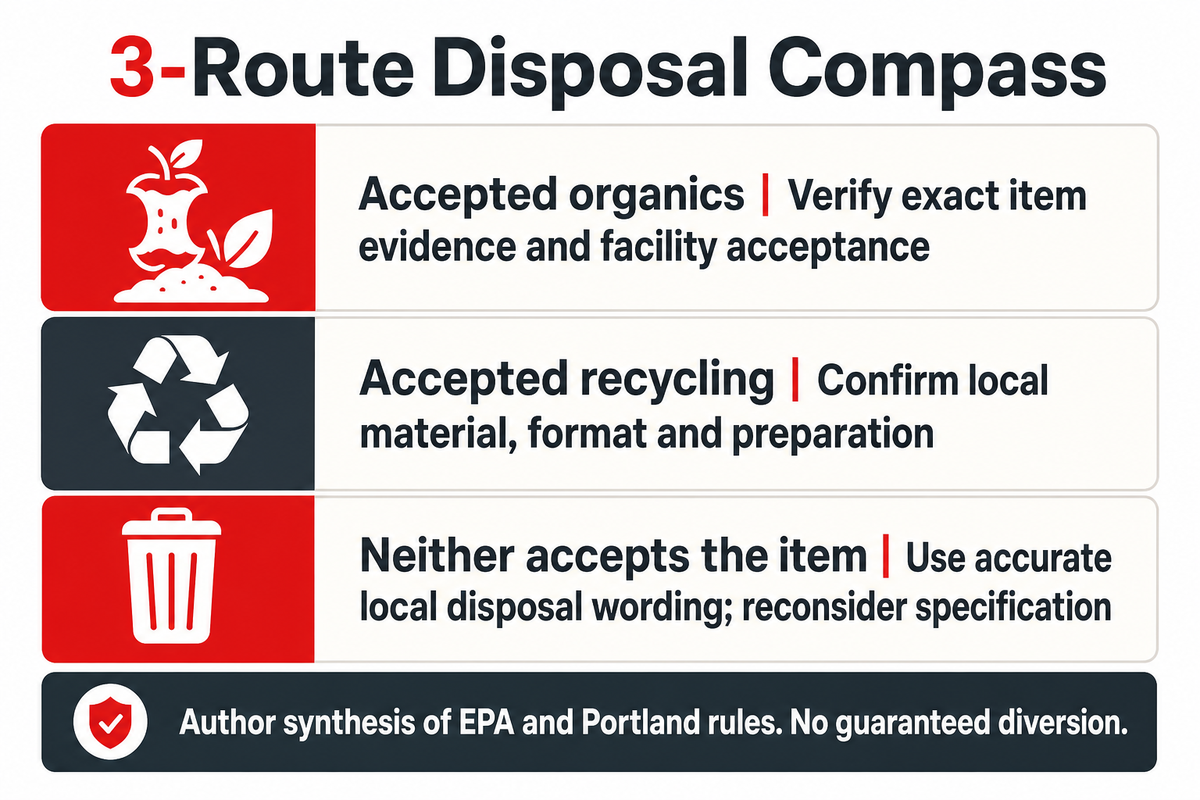
The 3-Route Disposal Compass is a tool to help buyers assess disposal infrastructure and understand accepted organics, accepted recycling and the route taken when neither accepts the item. It provides a means to review packaging choices against a true collection system. It isn’t a certification, a measured sustainability score or a definite answer that one choice is always the best choice.
| Route | When to consider it | Evidence before promising diversion |
|---|---|---|
| Accepted organics | The exact foodware is accepted and collected for composting | Item evidence plus written hauler or facility acceptance |
| Accepted recycling | The exact material and format are accepted for recovery | Local accepted-item and preparation instructions |
| Neither route accepts the item | The intended customer’s collection system excludes it | Accurate local disposal wording; reconsider the specification or service model |
| Mixed lid and base | The components have different accepted routes | Separate component instructions and scope checks |
| Controlled venue | The operator controls bins and collection | A confirmed receiving facility, signage and contamination controls |
| Dispersed takeaway | Customers leave for different collection areas | Qualified wording that acknowledges local variability |
| Claim or listing unclear | Supplier paperwork cannot identify the item | Hold the environmental claim pending verification |
| Artwork changes | A liner, coating or printed construction changes | Reconfirm item scope before reusing disposal wording |
| Organic-agriculture outlet | The facility markets compost for a regulated use | Check downstream eligibility separately from collection acceptance |
EPA’s plastic disposal guidance and Portland’s program rules support checking the route. The rows above are our synthesis of those boundaries. No waste diversion rate or financial return is implied.
Consider a hypothetical stadium concession with controlled bins. Depending on the receiving facility accepting each item and the venue controlling contamination, using compostable packaging may be acceptable. However, the takeaway shop can’t assume that the stadium concession arrangement applies to its customers. The supply chains and disposal arrangements may differ. Finance should consider the cost of the packaging, the collection and staff instructional costs and contamination. Industrial composting infrastructure arrangements for one customer may not apply to dispersed customers. Making the right choice starts with checking the route.
The eco-friendly food packaging guide covers a broader range of considerations. Keep performance and end-of-life issues in separate consideration and evidence boxes, respectively.
Supplier documents for the finished packaging item
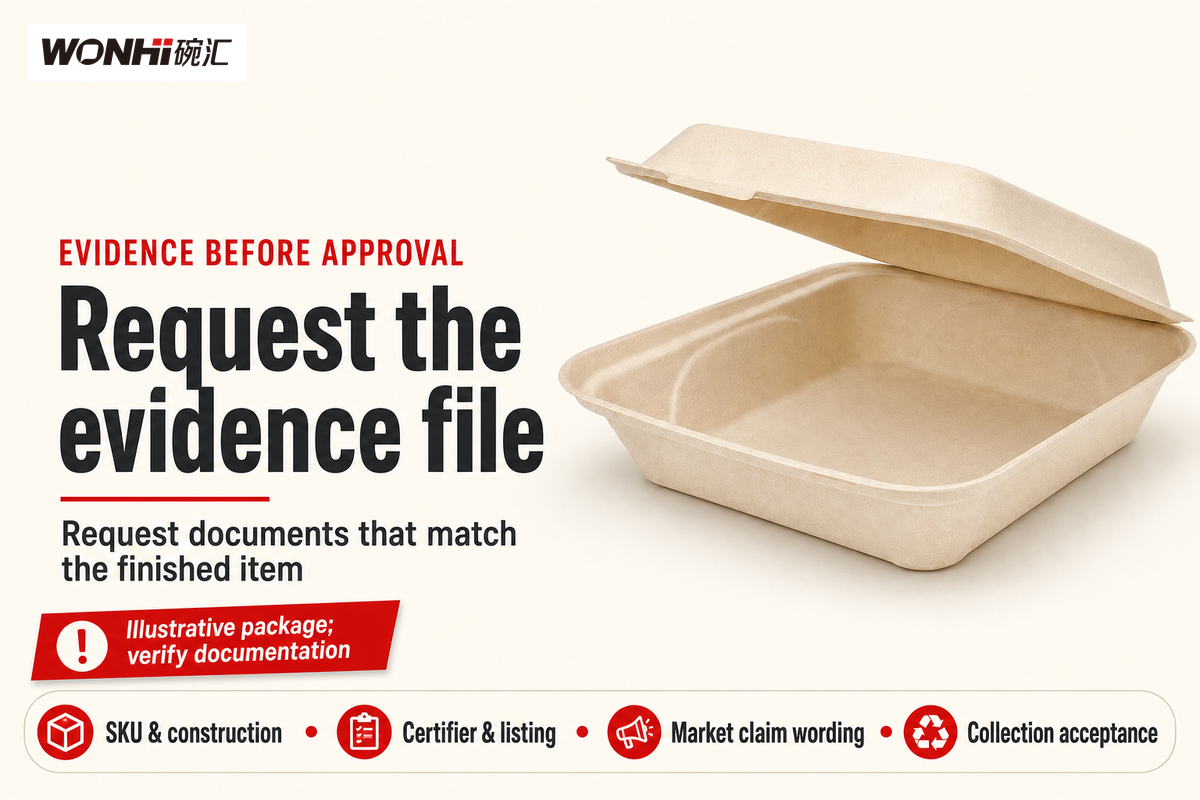
Product packaging suppliers should be able to explain the specific item, its structure, and the foundation for each environmental claim. A purchasing document should link the quote to the accepted collection route and the tested or certified product. Similar packaging solutions and other packaging options should require similar document scope; naming similar dimensions and materials isn’t sufficient.
The Wanhui clamshell catalogue lists WH-BG-88-1C as bagasse and WH-PLA-88-1C as PLA-lined fiber. Both are listed as 8 × 8 × 3-inch, single-compartment formats. This is first-party catalogue information, not an independent test. It doesn’t establish that either SKU has a current commercial or home compostable certification.
| Request | What the buyer records |
|---|---|
| Exact item identity | Product code, dimensions, thickness and construction |
| Complete assembly | Base, lid, liner, coating and printing included in the offer |
| Environmental evidence | Certifier, current listing and claimed route |
| Evidence scope | Connection between the purchased construction and assessed item |
| Claim wording | Qualifications appropriate to the sales market |
| Collection acceptance | Receiving program, item restrictions and preparation |
| Food-use documentation | Intended food-contact conditions assessed separately |
| Change control | Recheck trigger for substitutions or revised artwork |
| Quotation comparison | Price tied to the same item and supporting document scope |
The FTC guidance provides more context as to why substantiation is required even with third-party certification. Don’t accept a logo on a supplier slide as your evidence file. A claim of certified compostable should refer to the actual item offered.
Consider options for eco-friendly food packaging based on your menu, destination market and intended collection route. The compostable clamshell container selection guide provides additional questions. Require product-specific documentation prior to approving environmental artwork.
What is changing in compostable packaging claims?
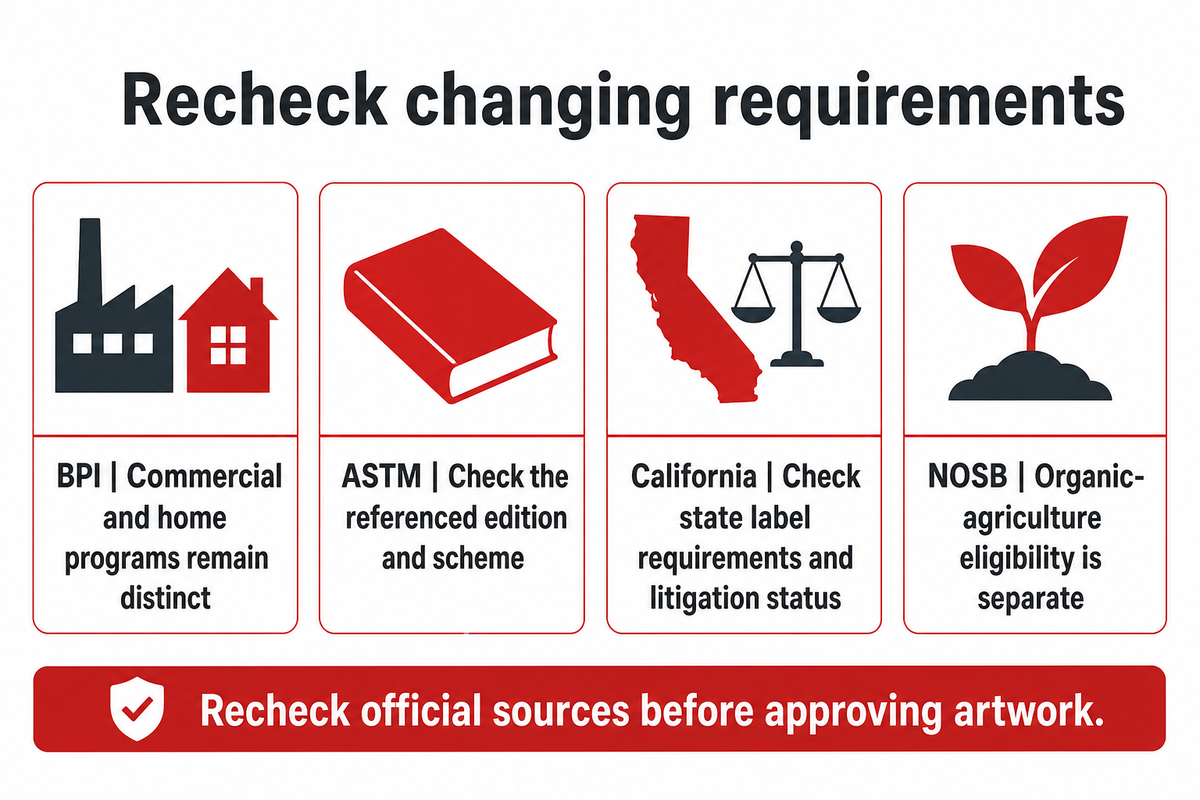
Compostability programs and packaging-label requirements change, and an old comparison may miss important differences. BPI has a new home-certification program, and ASTM has revised D6400. State requirements may cite different editions, or have different label requirements. Check your destination market and your product evidence, before relying on an old comparison, when making an environmental claim.
BPI announced its Commercial & Home program on September 18, 2025, with applications scheduled to begin on December 1, 2025. This gives buyers an alternate verification route, but it doesn’t turn all commercially compostable packaging into home compostable packaging.
ASTM’s September 11, 2026 revision notice describes a reduction in the D6400 incidental-constituent allowance from 5% to 3% and an expanded independent constituent-testing band from 1–10% to 1–15% of dry mass. Ask which version and certification scheme is being referenced. The notice alone does not establish that an older certificate is invalid.
California’s official labeling summary separately specifies D6400-19 for compostable plastics, D6868-19 for plastic-coated fiber, and OK compost HOME certification for home claims. Buyers shouldn’t assume a newer technical standard or a different home program automatically satisfies that state’s specified label requirements. Other listed conditions and transition dates also need review.
CalRecycle’s SB 343 page describes regularly collected and processed materials, rather than simply applying the FTC access benchmark. As checked in October 2026, the page reports a July 14, 2026 preliminary injunction blocking enforcement of SB 343 while study updates continue. Recheck that status for a California label decision; this comparison isn’t a complete state-law compliance review.
The USDA compost petition record, updated March 24, 2026, lists the feedstocks/polymers review as not recommended for rulemaking by the National Organic Standards Board in 2026. Keep downstream organic-agriculture eligibility separate from commercial compostability and collection acceptance.
Next procurement review: recheck the certifier listing, market-specific wording and receiving facility. A program launch or standard revision is a reason to verify documents, not evidence of guaranteed disposal.
Frequently Asked Questions
Are egg cartons compostable or recyclable?
Egg-carton disposal depends on the material, any coating and your local collection rules; check the actual carton with your recycler or organics collector before choosing a bin.
Don’t assume a fiber carton, plastic carton or foam carton, for example, will all take the same route. Food residue or a coating may affect acceptance. Composting guidance for a backyard pile is different from a commercial program. Ask the recycler or organics collector about the carton of interest. No single instruction covers every egg carton.
Why are compostable bags not allowed?
Some programs exclude compostable bags because their operating rules differ from certification criteria, so check the specific collection program and permitted liner rather than assuming a certificate guarantees acceptance.
A bag that meets its compostability requirements may be excluded from a given program. Look-alike contamination and processing issues are some of the reasons cited in a historical BioCycle survey. Check the actual local instructions rather than assuming the reasons for a given ban. Portland, for example, allows the use of BPI-certified compostable collection bags, but does exclude compostable containers. Verify what’s allowed before buying.
Do compostable bags release microplastics?
A compostable label alone does not prove zero microplastic release in every environment; certification addresses specified conditions, so request item-specific evidence and follow the accepted collection route.
Compostability certification specifies certain test conditions and requirements. It doesn’t prove what happens to bags in soil or waterways or what happens to bags in a poorly managed pile. A universal particle-free claim would require evidence addressing that claim and those situations. Request the appropriate item-specific test conditions and use the accepted collection routes. Don’t treat fragmentation as evidence of complete biodegradation. The information sources in this brief review don’t support a universal zero-release claim.
What are 5 items that should not be composted?
EPA home guidance excludes meat, dairy, fats or oils, pet waste and treated wood; commercial collection programs can differ, so follow the instructions for the receiving program.
You shouldn’t include meat, dairy products, fats or oils, pet waste or treated wood in a typical backyard pile. Commercial collection programs can vary. Follow the accepted-item instructions for that program.
Can biodegradable packaging go in the recycling bin?
Biodegradable packaging belongs in recycling only when the exact material and format are accepted locally; the label alone does not identify a compatible sorting or reprocessing system.
Biodegradable and recyclable represent different characteristics. While some biodegradable products may have compatible recovery routes, others don’t. A statement regarding biodegradation doesn’t identify a sorting or reprocessing system. The EPA specifically states that compostable plastics aren’t to be included in conventional plastic recycling and can disrupt that stream. Check the accepted-item instructions for your actual container, lid and liner. Separate components only as directed and follow preparation instructions for food residue. Don’t put an unknown plastic into recycling just because the package has environmental language. The same logic applies to biodegradable and compostable packaging: a claim must be coupled to evidence and a supported disposal route. If a program can’t confirm acceptance, follow the disposal instructions and ask your supplier to provide a better supported format, prior to the next order.
What if compostable packaging ends up in landfill?
A compostability claim does not promise rapid breakdown after landfill disposal; commercial testing concerns specified composting conditions, so verify the collection route before buying and printing disposal instructions.
Commercial evidence for composting contains information for specified composting conditions, not landfill conditions. A package shouldn’t be marketed as guaranteed to disappear quickly without the presence of the appropriate environment. The FTC also has concerns with unqualified degradable claims for items normally sent to landfill. Reduce the disparity by checking the collection route before buying and give printed customer instructions.
Our scope for this packaging comparison
Wonhi Meal Box provides food packaging and has a commercial interest in the selection of food packaging. This material distinguishes between compostable and biodegradable labels, evidence specific to products and local disposal rules, and catalog examples as first-party information. Illustrated cases serve to demonstrate decisions made by potential purchasers rather than reflect stated outcomes by customers. GW prepared this source-based assessment without private factory tests, a whole-life environmental assessment, or independently verified certification certificates for the illustrated SKUs.
Bring the exact item, sales market and collection instructions to your supplier discussion. Review Wanhui’s food packaging range and request documentation for the construction you plan to order.
References & Sources
- Plastic recycling and composting FAQ, US EPA
- Composting at home, US EPA
- Environmental claims: Green Guides summary, FTC
- Compostability certification and product verification, BPI
- Commercial & Home program announcement, BPI, September 2025
- D6400-26 public abstract and scope, ASTM International
- Compostable products standard revised, ASTM, September 2026
- Compost collection instructions, City of Portland
- US food waste composting infrastructure, BioCycle, 2023 historical survey
- Truth-in-labeling laws, CalRecycle
- Accurate recycling labels and program news, CalRecycle
- Compost petition and rulemaking status, USDA