Get in touch with Wanhui Company


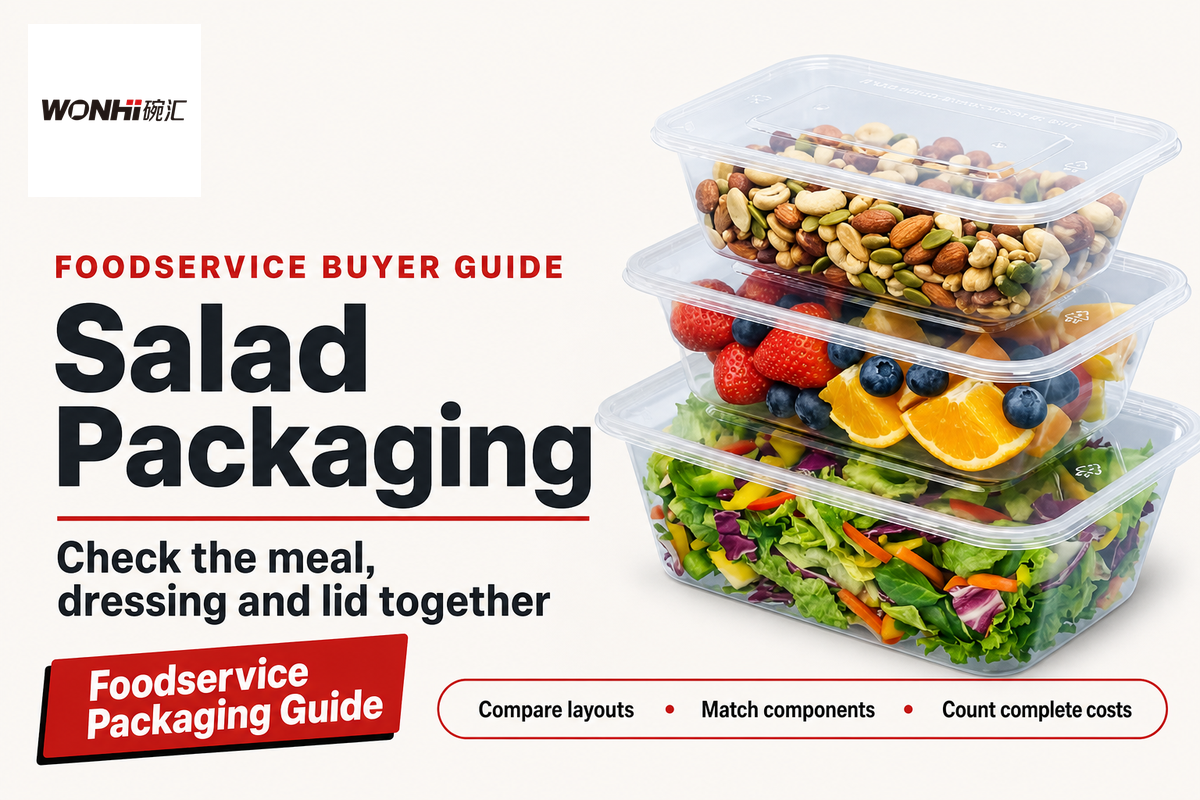
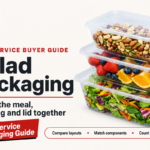
Salad packaging works when the filled container, dressing cup and closure all fit the same meal. A bowl can have enough nominal capacity and still have a crouton pressed against the lid. Check the complete assembly and compare prices before making the purchase. Check it against the menu and delivery route it will serve.
Updated October 2026
Salad packaging is the complete food container and its closing, separating and serving accessories. Compare 3 layouts with the same meal. Match component codes, verify intended food-contact use, and price every item needed for one serving.
Key points
- A dressing-cup holder doesn’t necessarily include a cup or its lid.
- Nominal ounces don’t show the space left below an insert.
- Transparent packaging helps customers inspect food; it doesn’t guarantee higher sales.
- Consumed packaging cost and the cash required to buy whole cases are different figures.
The methods of selection below are for chilled, assembled foodservice salads for takeaway, catering and retail display. Gas-flushed fresh-cut production requires validation of product, film and atmosphere. An attractive bowl won’t determine shelf-life and can’t replace the food safety control of the operator.
Quick Specs to Request
Base and lid codes; insert and cup dimensions in mm; finished portion in g; intended contact conditions; units per case; and delivered price per complete serving. Record the specification for each component, including accessories supplied separately.
Match salad containers to the service job
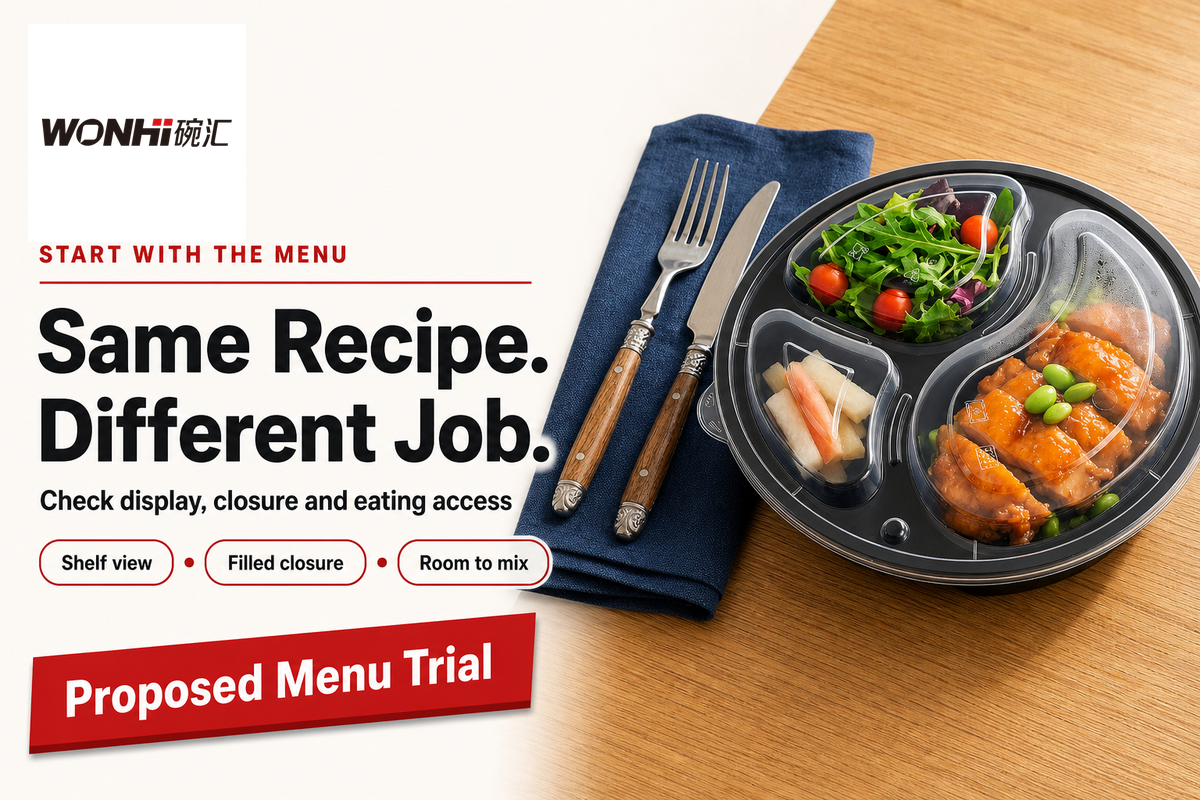
The salad container for grab-and-go salad bars and a deli display needs to show the meal in its selling position. For takeout or a delivered lunch, sealing and eating access are also important. Beginning with the recipe and the packing sequence is important, as well as understanding the customer’s use of the pack. A catalogue photograph won’t answer these questions.
Consider a proposed trial of a lunch counter using one fixed recipe: leaves and sliced vegetables, a separate dressing and a dry topping. Staff compare salad takeaway boxes and bowls with the same weighed portion. The customer photographs both on the intended shelf, removes the cup and tries mixing the meal with a fork. If the bowl looks full but offers no room to mix, increasing the label size may not resolve the problem. Moving the cup out of the food space may be more helpful. Document that extra packing action and accessory in the quotation.
Small snack portions and fruit and dense pasta mixtures require their own trials. They fill space differently than loose leaves. The USDA-hosted fresh-cut lettuce study also shows why fill quantity and storage conditions matter in modified-atmosphere bags. The results of the study don’t however provide a definitive headspace percentage for a typical salad bowl.
What is the best container to store salads in?
The best container for an assembled salad is one that closes around the whole portion, is approved for the intended food contact, contains separately packed dressing and is suitable for the planned chilled handling. Select it with the finished recipe. Just the printed volume and the appearance don’t establish freshness or safe storage time.
Ask about the meal being mixed in the pack, or being spooned on to the plate. The container may have a narrow opening that suits transportation but makes eating awkward. For repeated home use, washing and accessory retention introduce different requirements from disposable foodservice packaging. A broader reuse discussion can be found in the meal prep container comparison.
Compare clear clamshells, bowls and inserts
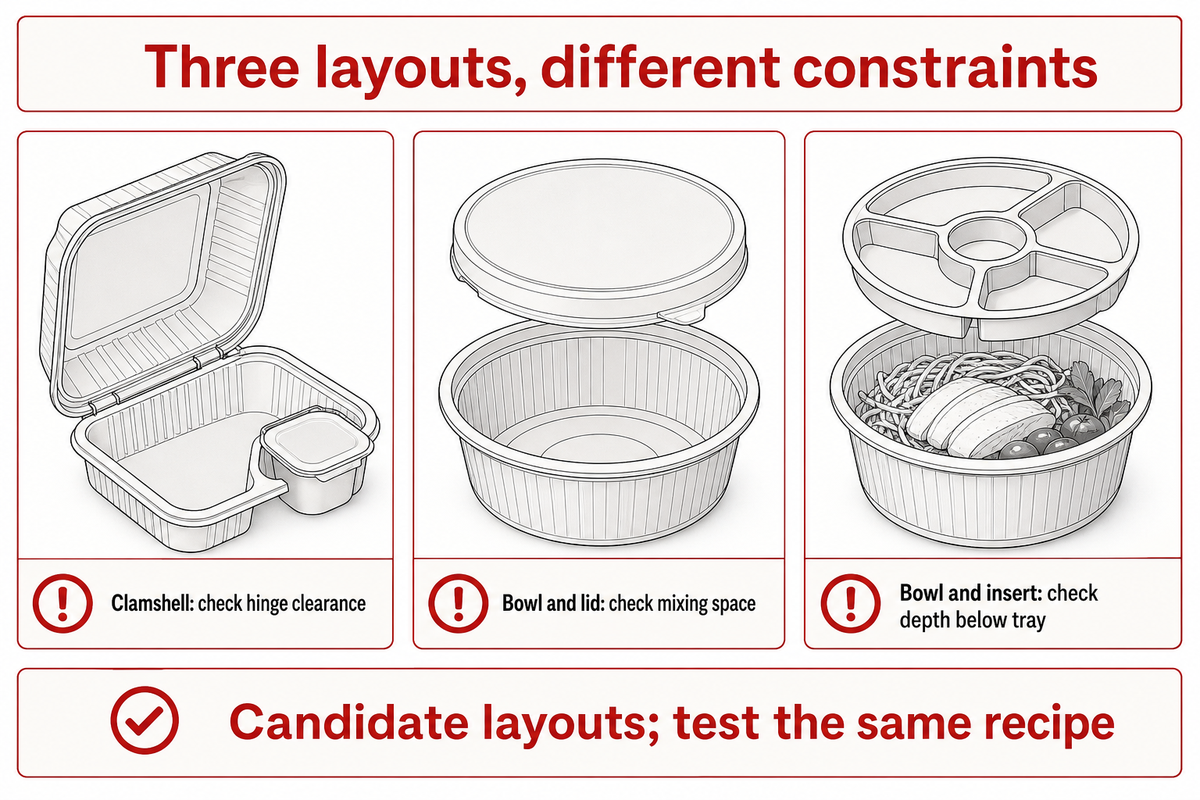
There are many ways to arrange food within a bowl. An insert in a pack may aid in the separation of food but affect eating access. Improving one feature may create another limitation.
3-Layout Salad Assembly Map
The 3-Layout Salad Assembly Map shows a fixed menu in outer packs, accessory positions, and constraints for each.
| Layout and task | What to inspect | Decision owner | Limitations / Not suitable for |
|---|---|---|---|
| Clamshell: leafy lunch | Cup location and hinge clearance | Kitchen | Reject if the cup prevents complete closure |
| Clamshell: mixed pasta | Food touching the closure edge | Quality team | No assumption of sauce containment from a dry sample |
| Clamshell: retail display | Top and side views with a label | Merchandising | A top label can hide the main ingredient |
| Bowl and lid: leafy lunch | Room to mix after removing the cup | Kitchen | Nominal volume does not prove eating space |
| Bowl and lid: grain bowls | Dense base and tall topping position | Quality team | Do not force a flat lid onto protruding food |
| Bowl and lid: retail display | View through the installed lid | Merchandising | Opaque sides can limit visibility on a high shelf |
| Bowl and insert: leafy lunch | Food space below the removable tray | Kitchen | An insert can reduce usable depth |
| Bowl and insert: separate toppings | Support and removal of each compartment | Quality team | A divider is not a sealed dressing-cup lid |
| Bowl and insert: bulk supply | Separate case counts and replenishment | Procurement | An available bowl cannot replace a missing insert |
Source basis: Publicly listed Anchor FreshMate and Lacerta examples, plus an editorial sample method, informed this matrix. The matrix doesn’t evaluate either manufacturer’s performance. Use the food tray selection guide to evaluate formats outside this salad assembly comparison.
Paper bowls and kraft bowls also require an end-of-use check. EPA food service ware guidance relates commercially compostable purchases to local acceptance and arranged collection. A renewable-looking surface doesn’t establish a working recovery route.
Reserve space for toppings and dressing
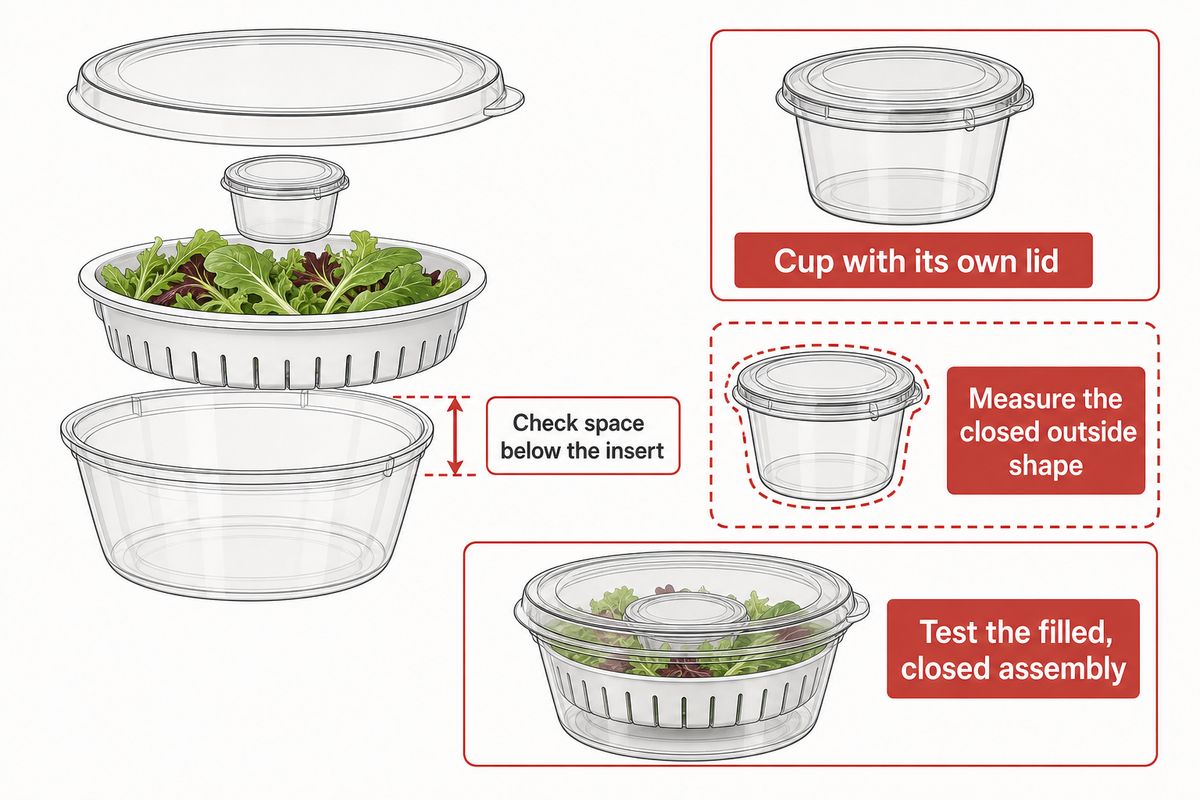
Leave room for dressing and topping in the closed assembly, not just in the empty base. Measure the outside dimensions of the salad dressing container, including its lid, and check the position of the insert if one is provided. A cup’s fluid capacity describes the volume of the cup’s contents; it doesn’t describe the volume or shape of the cup.
Anchor’s August 2025 FreshMate sheet lists the CP8502A lid for its CP8500 24 oz, 32 oz and 48 oz bases. The lid holds two portion cups, which aren’t included. The sheet specifies stackability with 1.5 oz portion cups. Those details belong to the named assembly; they don’t establish interchangeability with another brand’s cups.
Lacerta’s T32440-1 3-compartment insert is listed with the T32440, 6 oz capacity, with outside dimensions of 6.19” x 2.88” x 1”. Neither the insert’s capacity nor its outside bounding box tells you exactly how much salad will fit beneath it. The assembled sample is required to evaluate that.
What is the best way to pack salads for lunch?
Pack a lunch salad with the dressing in its own suitable closed cup and position dry toppings where the chosen assembly keeps them separate until eating. Fill and close a sample with the intended portion before ordering. Check that the cup can be removed without spilling its contents or pulling the main lid loose.
A proposed catering trial can compare the same portion with the cup beside the bowl and with the cup held inside the lid. Keep ingredients and serving quantity unchanged. Staff then check opening, removal and mixing. Neither arrangement earns a longer storage claim from that exercise; it answers whether the menu and accessories fit conveniently.
- Fix the portion. Weigh the finished recipe and keep the topping arrangement consistent.
- Place the accessories. Install the intended cup, its own lid and any removable insert.
- Close and handle. Check the complete closure and the planned carry arrangement.
- Open and eat. Remove accessories and confirm usable mixing space.
For the proposed evaluation of 24 oz and 32 oz bowls, keep the serving weight the same. Extra nominal capacity earns its place only if the sample shows a useful change in clearance or eating access. Don’t increase the food portion when assessing the package.
Choose salad bowls with lids as a matched assembly
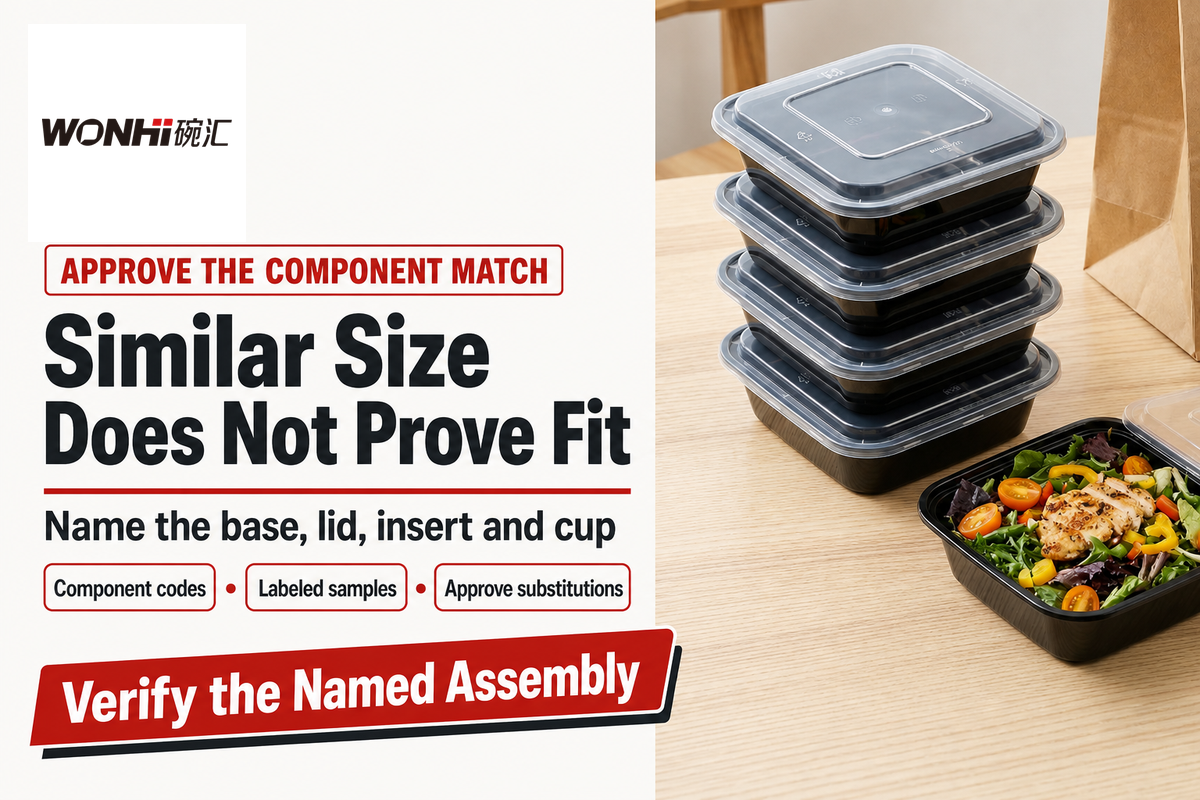
Salad bowls with lids are to be quoted with a supplier-documented component match. Similar diameter or capacity is insufficient evidence of fit. The quote should name the base and lid and every insert or cup, and say which of the substitutions require approval before a repeat supply of the order can be shipped to the business.
A named lid, base family, and cup condition describe a good buying pattern and are the type of information that should be provided in a request, as opposed to another manufacturer’s dimensions. For closure mechanisms, the hinged-lid container guide covers the main aspects of variation.
When not to buy the proposed assembly
If a supplier can identify the bowl but not its lid, don’t allow the order. A sample lid that seems to fit doesn’t define the repeat supply. The same applies to an insert that’s classified by a general category name: ask for the part number and the base it’s specified to fit.
Mechanical compatibility is only one requirement. The FDA explanation of food-contact components links suitability to the constituent substances and their authorized conditions of use. Request documentation for the intended food, contact conditions and destination market. A generic “BPA-free” description cannot answer every intended-use question.
Pause a sample decision when the finished meal pushes food into the closure edge, a cup dislodges during the proposed carry check, or an insert can’t be removed conveniently. Record the observed problem and change the affected part. Don’t consider “durable” or “leak resistant” as a promise covering all recipes and routes. No sample handling exercise described here certifies a transport standard.
Keep clear plastic bowls visible on the actual shelf
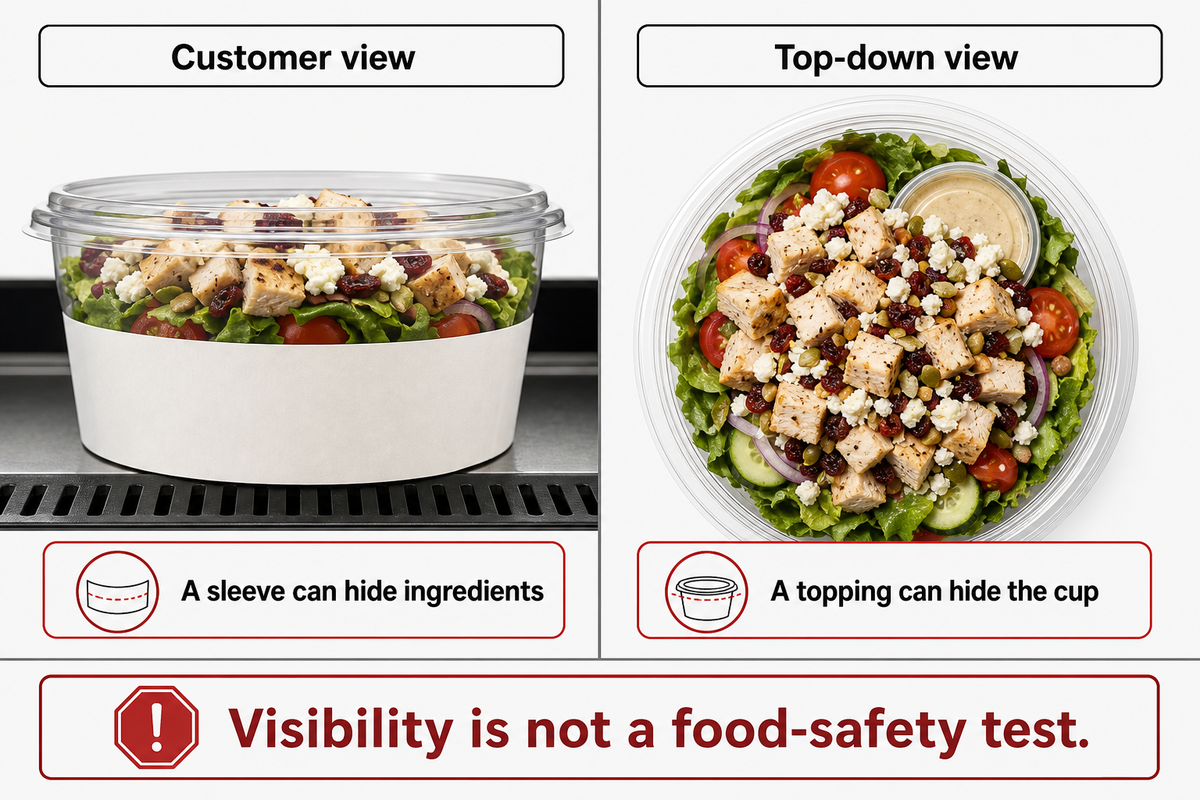
A plastic salad bowl should be assessed with the label, insert, and food on the intended shelf. An empty container photographed at eye level obscures many display issues. Record the viewing position and product temperature; visibility can’t determine if the product is safe to hold or if it’s contaminated.
In a proposed to-go salad comparison, photograph all packs from the customer’s perspective that are filled. A sleeve may cover the lower ingredients. A tall topping may cover the dressing cup. Keep the shelf position fixed while changing one package feature to answer a specific comparison question.
A 2020 study by Ma, Zhuang and Ma found no general purchase intention edge for food graphics over transparent windows in their screen-based snack food experiment. This wasn’t a salad sales trial. Treat a clear view as a display requirement and measure sales separately if that is the objective.
USDA ARS scientist Yaguang Luo discusses differences in temperatures across refrigerated displays. She notes that bagged-salad contamination can’t be determined by appearance. Make visibility checks using the site’s validated chilled handling controls. A clear lid doesn’t compensate for wrong holding conditions.
Compare the price of one complete serving
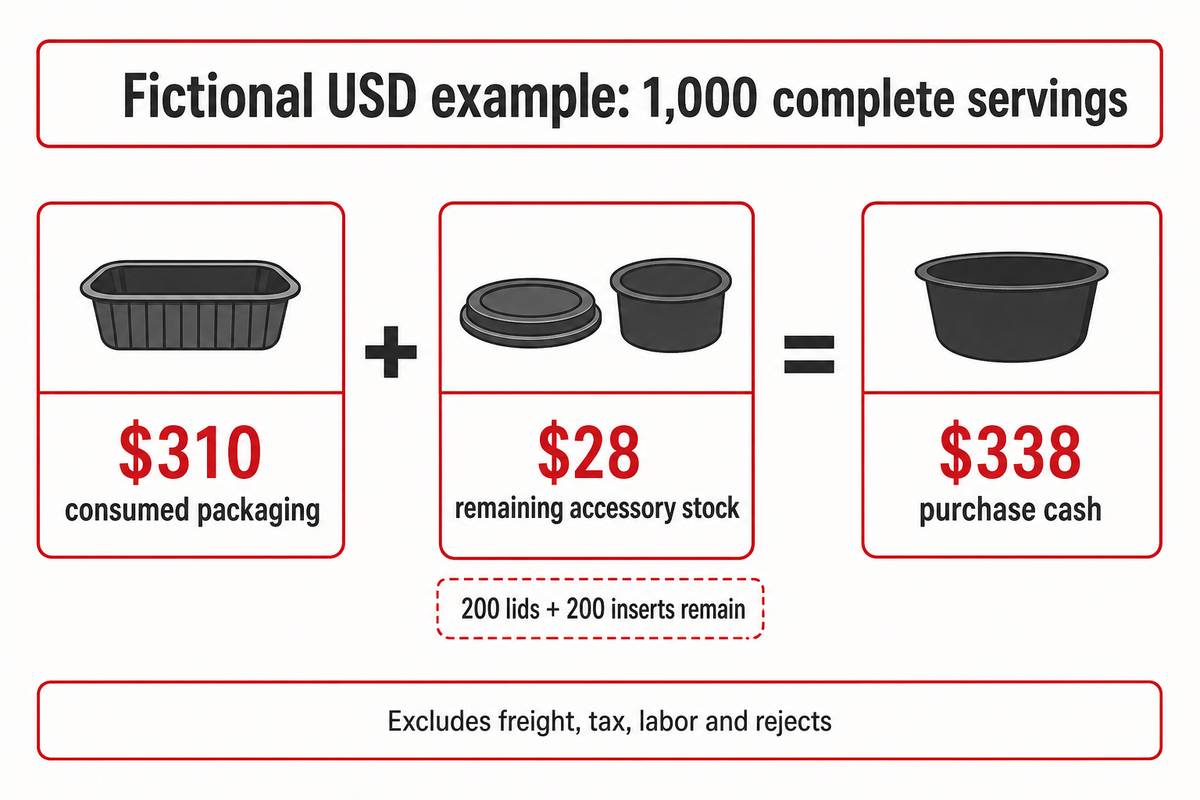
Count packaging components consumed per meal and determine the price per complete serving. Calculate whole-case purchase cash separately, because unused accessories remain in stock. A low bowl price can require an additional lid or cup sold in a different carton quantity.
Complete-Serving Pack Count
The Complete-Serving Pack Count separates components consumed per meal and whole cases purchased, with unmatched stock remaining after the planned order.
Assume a fictional order of 1,000 complete servings, with no opening stock and no rejects. With each serving containing one of each component, what prices would you consider for a purchase? The prices below are USD teaching input prices for this example, and aren’t Anchor, Lacerta or Wanhui prices. Use your delivered quotes and actual loss allowance for each purchase.
| Component or calculation | Input | Result | Limitations / Not suitable for |
|---|---|---|---|
| Bowl | 500 units/case; $60/case | 2 cases; $120 cash; 0 left | Assumes one bowl per serving |
| Main lid | 600 units/case; $48/case | 2 cases; $96 cash; 200 left | Only the specified matching lid |
| Dressing cup | 1,000 units/case; $30/case | 1 case; $30 cash; 0 left | Cup lid is priced separately |
| Cup lid | 1,000 units/case; $20/case | 1 case; $20 cash; 0 left | No loose dressing assumed |
| Insert | 400 units/case; $24/case | 3 cases; $72 cash; 200 left | Omit only if the menu works without it |
| Unit consumption | $0.12 + $0.08 + $0.03 + $0.02 + $0.06 | $0.31 per serving | Packaging components only |
| Consumed total | 1,000 servings × $0.31 | $310 consumed packaging | Excludes packing labor and rejects |
| Whole-case cash | $120 + $96 + $30 + $20 + $72 | $338 purchase cash | Excludes freight, tax and other charges |
| Closing accessory stock | 200 lids × $0.08 + 200 inserts × $0.06 | $28 unused stock at input cost | Not automatically waste or a saving |
Method basis: editorial arithmetic using clearly fictional inputs, informed by the University of Florida product-costing primer. The university’s method assigns relevant costs to a consistent output unit; it doesn’t supply these salad-pack prices.
For this order, dividing $338 by 1,000 gives $0.338 cash outlay per planned serving. That differs from the $0.31 of components consumed. Finance needs both figures. Procurement also needs to know whether the remaining 200 lids and 200 inserts will fit the next order; a base change can leave apparently usable stock without its matching component.
Add labels, cutlery, bags, and any sleeve actually supplied with the meal. Record labor and measured rejects separately. A convenient layout still has to work with the menu. Removing the fictional $0.06 insert reduces component consumption only if the revised layout still works; it isn’t evidence of net savings after extra packing time or damage.
Ask suppliers for a documented component match
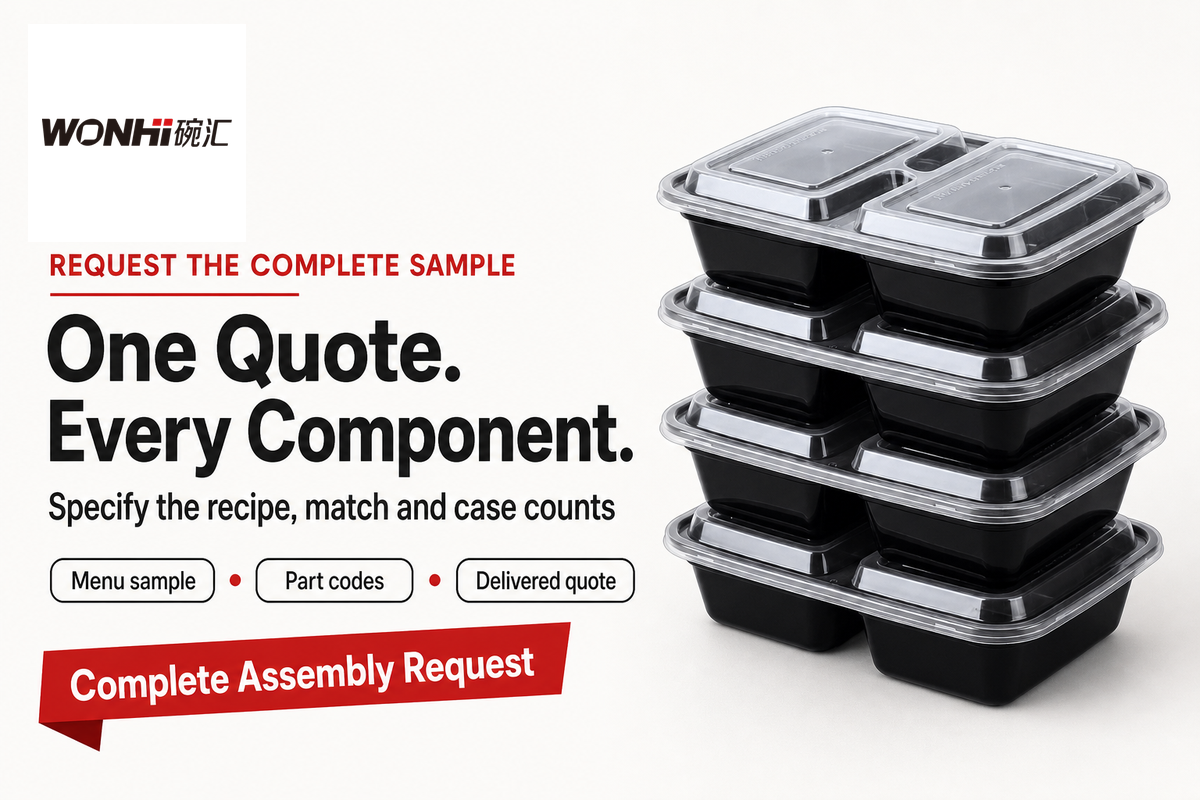
Ask salad packaging companies to quote against the menu, identify the components, state the intended contact conditions, and specify commercial quantities. Request a complete sample assembly prior to a wholesale order. Procurement can then validate the same scope while the kitchen and quality teams validate the components they’ll physically touch.
Copy the following fields into the request and replace the example entries with operation specific requirements. Ranges are determined by your recipe and validated handling conditions, not by a universal “best salad” capacity.
| Parameter | Recommended range | Why it matters | How to verify |
|---|---|---|---|
| Finished recipe | Record portion in g; each recipe separately | Loose leaves and dense toppings occupy different space | Fill the weighed menu sample |
| Component codes | One approved code per required part | Prevents undocumented substitution | Written match and labeled samples |
| Cup geometry | Outside width and closed height in mm | Nominal cup volume does not prove clearance | Measure with the cup lid installed |
| Contact conditions | State food type, time and temperature range in °C | Fit and intended-use suitability are separate | Supplier’s applicable food-contact documentation |
| Purchase quantity | Planned servings and units per case | Exposes unmatched stock | Complete-Serving Pack Count |
| Landed charges | Currency per case; freight and tax separately | Keeps quotes comparable | Written delivered quotation |
Ask whether free samples include every accessory and whether freight is charged. Don’t expect stock photos to establish whether customization or specific materials are supplied. FTC Green Guides address environmental marketing claims. Ask suppliers to certify environmental claims for a product and support their claims with similar specificity.
Compare Wanhui’s food container options for salad packaging against the assembled menu sample, and then state the codes and quantities required. This will allow the responding party to look for potential alternatives and/or determine if modifications will be required.
What changing salad packaging demand means for buyers
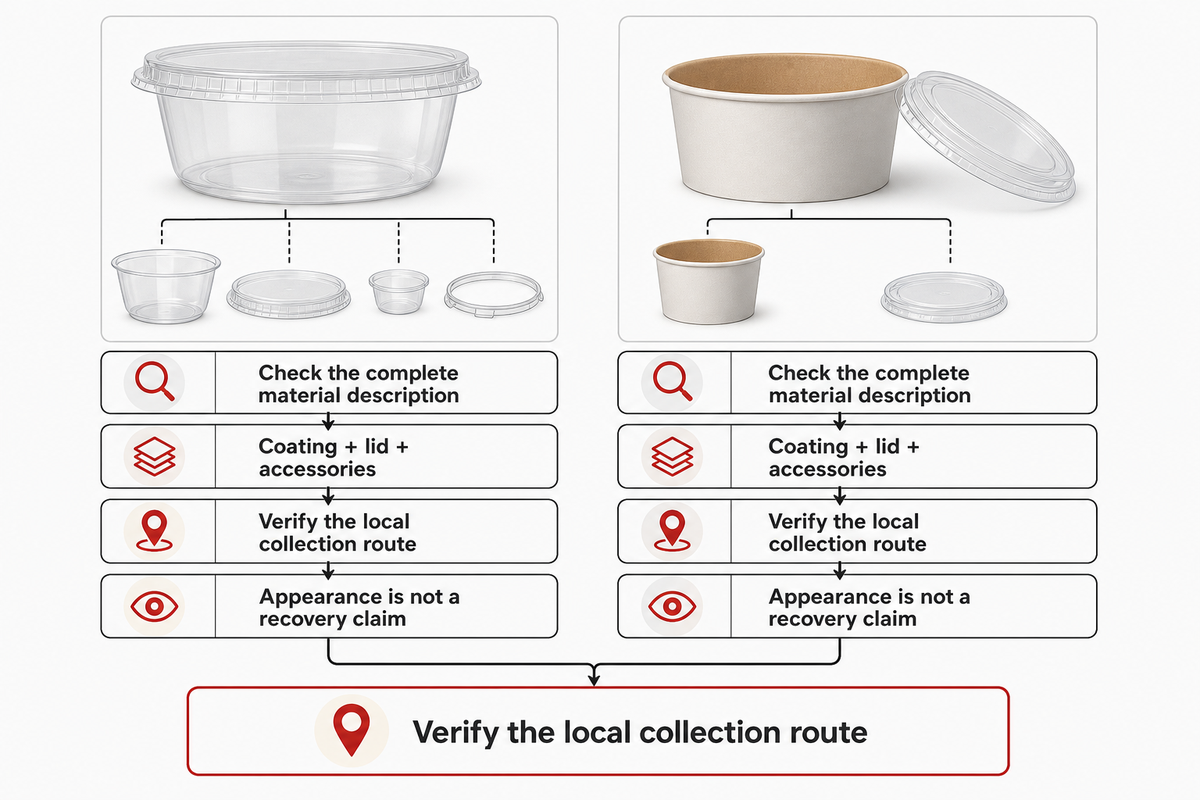
Review consequences associated with changing salad packaging, such as using new materials that sound more sustainable, together with documented function, sustainability goals and an available recovery route. For example, changing the lid can affect the whole assembly’s cost, visibility and disposal.
Packaging Europe editors reflect on cost-competitive business cases, the functional limitations of alternative materials, and the infrastructure required for reuse, in their January 2026 industry outlook. This European industry commentary isn’t a formal projection of salad-container sales in the United States. The practical buying question is whether the proposed change would operate in the buyer’s own collection and service system.
An older example demonstrates what a structural change could look like. In August 2023, Graphic Packaging announced a paperboard snap-closing lid developed in collaboration with Picadeli for its salad bowls. As a supplier-owned development, it represents a historical example, not a new development for 2026 or Wanhui technology. It doesn’t establish that all paper lids are accepted by all local recyclers, either.
The EPA’s plastic resin symbols explanation shows the collection boundary:
“However, this symbol does not necessarily mean it can be collected for recycling in your community.”
What’s being requested during the next purchasing cycle is the full material description, including coating, lid and accessories. Please verify local handling instructions for the actual assembly. A “premium”-looking paper bowl with an unverified coating shouldn’t automatically receive a carbon benefit or recyclability claim. Likewise, a clear plastic bowl shouldn’t be automatically rejected because an alternative looks more natural. Compare the documented options and the costs of operating them.
Salad packaging questions from buyers
Do the clear salad bowls come with lids, and can they be customized?
Confirm the bill of materials; lids and customization may be quoted separately.
Ask the supplier to list the base, main closure, insert and dressing-cup components on separate quotation lines. A photograph of a complete meal doesn’t establish what a case contains. For customization, request the print method, minimum quantity and artwork requirements for the selected part. Keep those details separate from the stock-product match, and approve a representative sample before committing to printed inventory.
What does "eco-friendly" actually mean for salad packaging?
The claim needs a specific, supported benefit and a workable local disposal route.
Ask which feature the claim describes and what evidence supports it. Recycled content, renewable feedstock and compostability answer different questions. Industrial composting facilities must accept the particular product, and collection must be arranged. A bowl and its lid may need different instructions. The compostable, biodegradable and recyclable packaging comparison explains those distinctions without treating the words as interchangeable environmental guarantees.
Can these compostable PLA bowls be microwaved or frozen?
Use only the heating or freezing conditions documented for the exact bowl and lid.
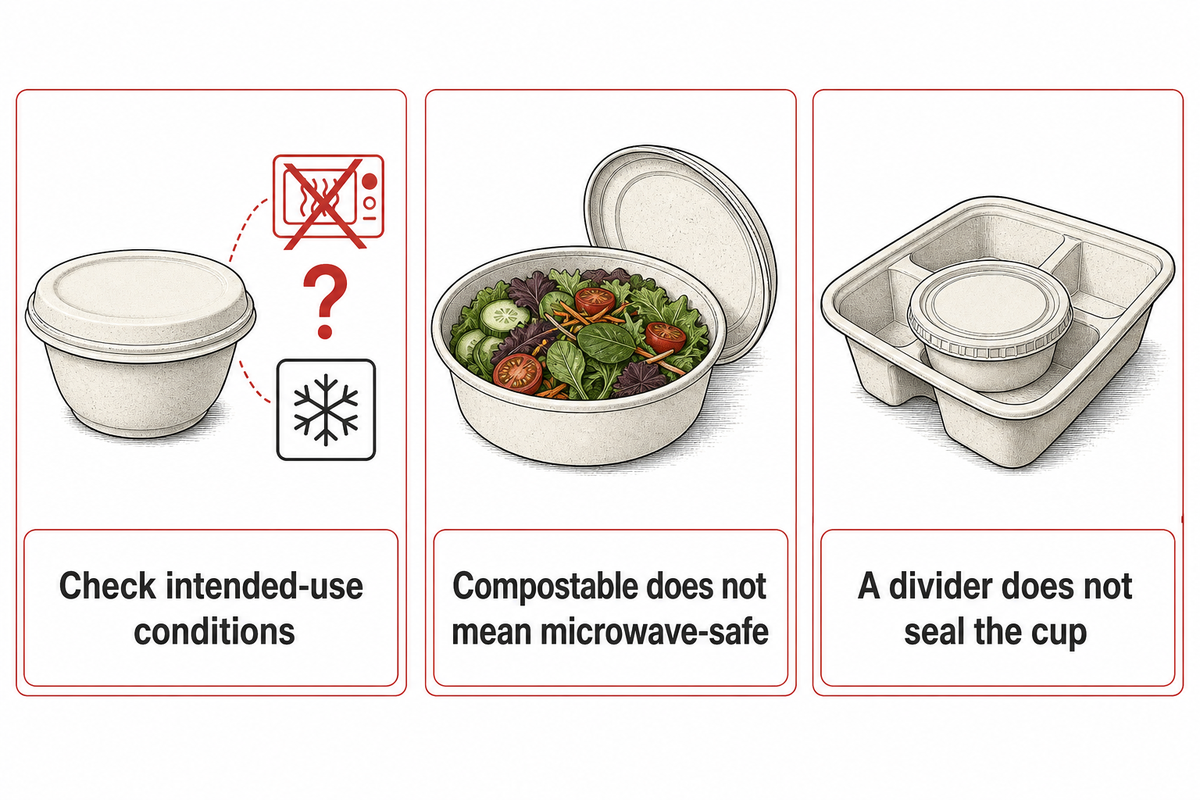
Compostability doesn’t establish microwave or freezer-safe performance. PLA describes a material family, while the finished product has its own construction and intended-use limits. Ask for the supplier’s stated conditions for every part, including the cup and closure. Don’t transfer a soup container’s heating instructions to a cold salad pack. If the required conditions are undocumented, choose a product with the necessary evidence.
What size salad bowl do I need for takeaway?
Choose by a filled, closed menu trial rather than nominal ounces alone.
A 16 oz, 24 oz or 32 oz label can’t establish a portion weight. Check the finished meal with its cup and toppings, then confirm mixing space after the accessories are removed.
Does a topping insert replace the dressing-cup lid?
No, unless the manufacturer explicitly specifies that complete sealing arrangement.
A removable divider can hold an accessory in position without sealing its contents. Keep the cup’s own approved closure in the component count unless the documented assembly says otherwise.
Key takeaway
Approve the filled assembly before the bulk order. The fictional 1,000-serving example consumes $310 of components but requires $338 in whole-case purchases; a bowl-only price reveals neither figure.
For a comparable quotation, request a salad container sample and complete quote with the menu, approved handling conditions and component quantities. Ask the supplier to explain the match and the evidence needed to approve it.
Method and limits: The public product documentation and cited research were checked in October 2026. The proposed sample exercises and cost worksheet are examples created for editorial purposes and shouldn’t be considered Wanhui test examples. Catalogue numbers remain attributed to their manufacturers. No universal shelf life, leak rating, sales increase or environmental benefits are claimed.
References & Sources
- Peng and colleagues: fresh-cut lettuce in modified-atmosphere packaging, 2020, USDA Agricultural Research Service publication record.
- Identifying Sustainable Food Service and Food Service Ware, U.S. Environmental Protection Agency.
- Determining the Regulatory Status of Components of a Food Contact Material, U.S. Food and Drug Administration.
- Transparent Windows on Food Packaging Do Not Always Capture Attention and Increase Purchase Intention, Ma, Zhuang and Ma, Frontiers in Psychology, 2020.
- Keeping Bagged Leafy Greens Safe and Nutritious, USDA Agricultural Research Service interview with Yaguang Luo.
- Knowing Your Product Costs, University of Florida IFAS Extension.
- Green Guides, U.S. Federal Trade Commission.
- The packaging stories and trends to follow in 2026, Packaging Europe editorial team.
- How Do I Recycle Common Recyclables?, U.S. Environmental Protection Agency.