Get in touch with Wanhui Company


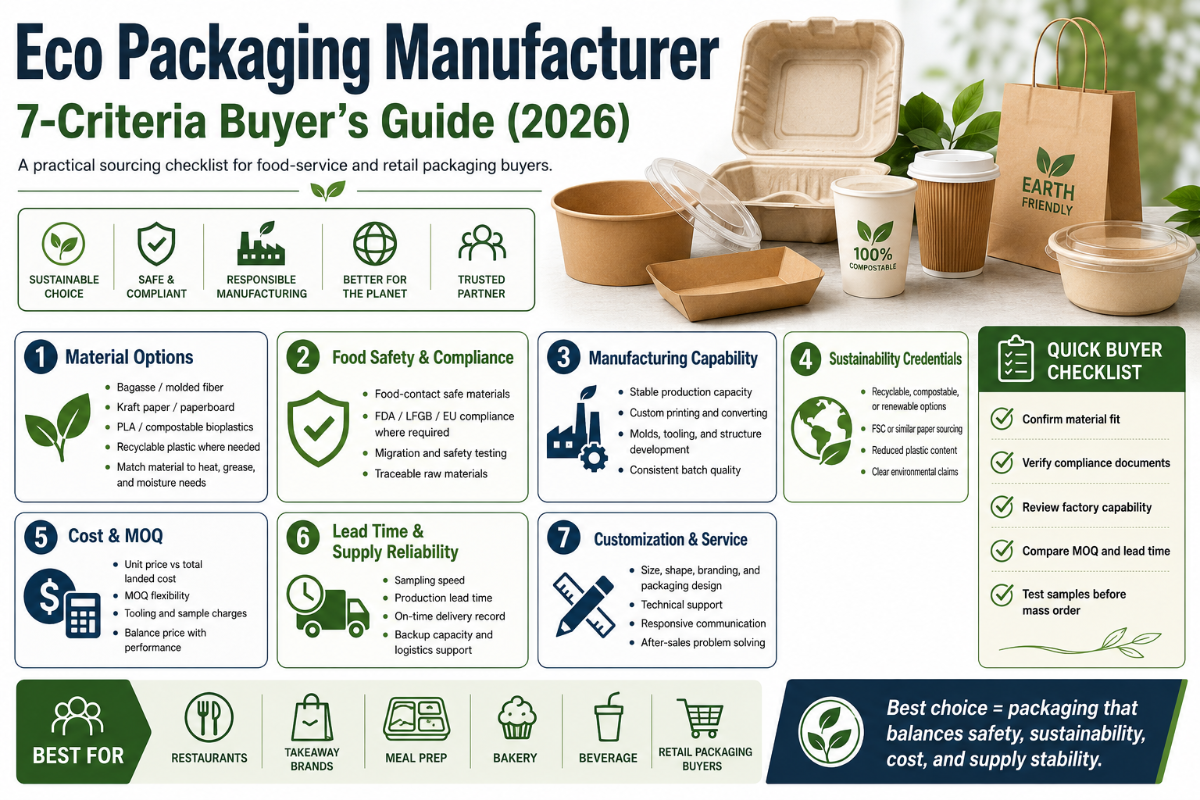
How to Choose an Eco Packaging Manufacturer: A Procurement Guide to Sustainable Packaging
Updated for 2026 procurement cycles · 12-minute read · By the Wanhui environmental packaging team
Selecting the right eco packaging manufacturer in 2026 is no longer a branding play-it’s a compliance, cost, and supply-chain matter. From April 1, 2026, new regulations from the EU Packaging and Packaging Waste Regulation 2025/40 take full effect.
And already, the U.S. Federal Trade Commission has slapped retailers with record fines for overstating the eco credentials of their product packaging. PFAS bans targeting food contact packaging are rapidly cutting off many materials manufacturers can even sell in maine, California, and eu member states.
This guide offers procurement, brand and operations leads a blueprint to assess eco-packaging facilities against seven verifiable criteria, unpack legal certifications, and avoid the marketing pitfalls that have already cost competitors millions of dollars in ftc settlements. This is not a supplier list; it’s a repeatable framework to apply to your existing and future partners, including Wanhui.
Quick Specs — What This Guide Covers
| Reader | Procurement, brand, ops — B2B buyers |
| Output | 7-criteria vendor scorecard you can apply in your next RFQ |
| Regulatory window | EU PPWR (Aug 2026), UK PPT (Apr 2026), FTC Green Guides, state PFAS bans |
| Decision tools | 3-step cert verification SOP · 7-criteria scorecard · TCO 5-dim framework · industry-to-material map |
| Data sourcing | FTC, EU Commission, UK gov, Maine DEP — see References below |
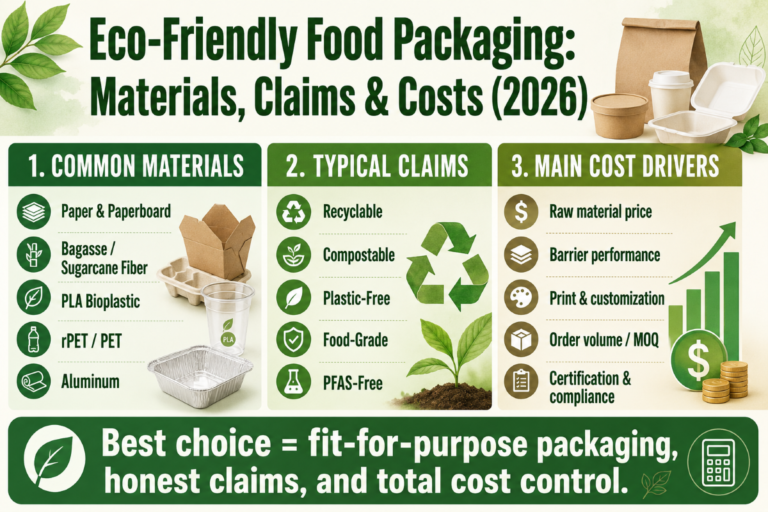
What “Eco Packaging” Actually Means — and Why Buyers Misuse the Term
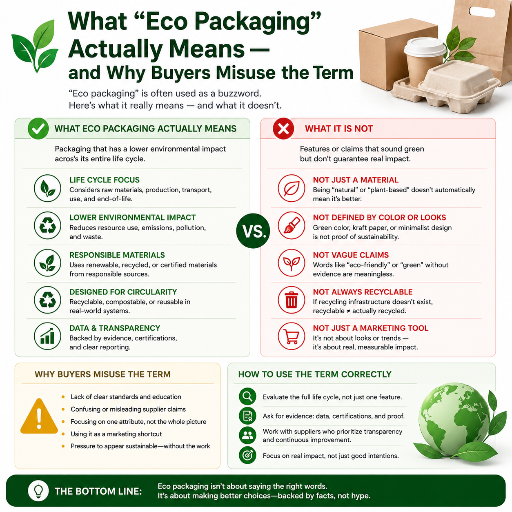
“Eco packaging” isn’t a regulatory or technical term — and that’s your procurement team’s very first takeaway when drafting an RFQ. Eco packaging currently covers at least five distinct product categories (including recyclable, compostable, biodegradable, reusable and recycled-content) that fall under varying standards, require different audits, and present different legal risks. Bundling them into one vague category is a leading cause of packaging audits failure or marketing claims challenges.
In the eu, the 2025/40 regulation sets binding definition of recyclable as packaging that can be collected, sorted and recycled “by as many actors of the supply chain and for as many consumers as is technically feasible”. This definition becomes more stringent by 2035 (recylable at scale by design) and 2038 (at market can be only Grades A or B packaging).
In the U.S., FTC’s Green Guides (16 CFR Part 260) approach the problem differently, as they focus on labeling rather than material certifications, mandating that “biodegradable claims must be substantiated with sufficient evidence of complete decomposition within one year under conditions of customary disposal.”
| Term | Core idea | Who governs claims | Common buyer misuse |
|---|---|---|---|
| Recyclable | Can be collected and reprocessed at scale | EU PPWR; FTC Green Guides | Calling something recyclable because the material is — ignoring whether local facilities accept it |
| Compostable | Breaks down into nutrient-rich biomass under defined conditions | ASTM D6400, EN 13432, BPI, TUV | Assuming “compostable” means home-compostable; most certs require industrial facilities |
| Biodegradable | Will decompose by biological action — no time or end-state specified | FTC requires substantiation within one year | Using the word in marketing without an FTC-compliant disclaimer (high-risk) |
| Reusable | Designed for multiple use cycles by the consumer or operator | EU PPWR sets minimum cycle counts by format | Calling a sturdy single-use container “reusable” without meeting cycle thresholds |
| Recycled-content | Made from post-consumer or post-industrial recovered material | UK PPT (30% threshold), EU PPWR mandates by 2030 | Confusing recycled-content with recyclability — they are independent claims |
Accounting for nearly 40% of plastics consumption and about half of plastic ocean litter in European Commission figures, a more thorough approach to managing packaging at this scale has spurred every major global jurisdiction to redefine what counts as a compliant packaging solution — and, by extension, demand far greater clarity and precision in how eco-packaging is described, manufactured, and regulated.
Takeaway: The next time you issue a request for “eco packaging”, remember to specify which of these five types you require, for which market, and in accordance with which standards. Vagueness invites product failure and significant regulatory risk.
The Five Material Families — Strengths, Limits, and Where Each Wins
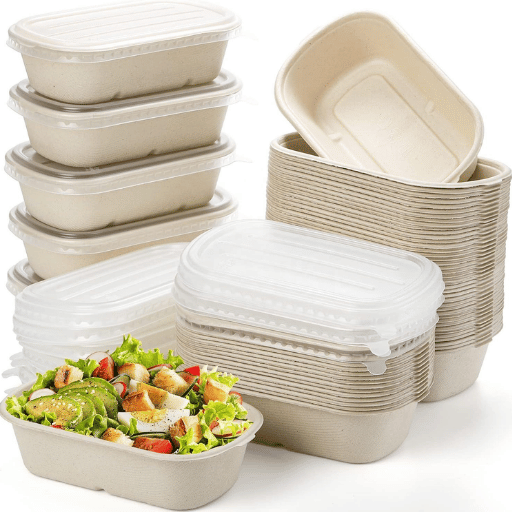
Every eco-packaged product contains components manufactured from one or a combination of these five broad material classifications. While each offers valuable sustainable packaging properties under varying circumstances, none presents an all-purpose solution. Ideal material choice balances packaging function, regional policy, total cost of ownership, and environmental impact across the product’s entire lifecycle, rather than how it sounds on an advertising label.
| Family | Where it wins | Where it loses | Common certification path |
|---|---|---|---|
| Cornstarch (PLA + starch blends) | Cold to warm food, deli, salad, meal prep — branded ESG storylines | Hot soup, prolonged high humidity, home composting (industrial only) | BPI · ASTM D6400 · EN 13432 |
| Bagasse / sugarcane fibre | Hot food, oily food, microwave-safe takeaway, low-cost compostable | Deep liquid retention (without PLA lining), translucent presentation | BPI · ASTM D6868 · TUV OK Compost INDUSTRIAL |
| Kraft paper and recycled board (mailers, boxes) | E-commerce shipping, retail bags, dry-goods, secondary packaging | Wet/greasy primary food contact, microwaving, leak-prone formats | FSC · SFI · FDA 21 CFR 176 for food-contact grades |
| Recycled-content rigid plastic (rPET, MFPP) | High-volume budget takeaway, microwave-safe meal containers, leak-proof seals | Compostable marketing claim (rPET is not biodegradable), home-composter consumer base | FDA · EU 10/2011 · UK PPT 30% recycled threshold |
| Emerging — mycelium, lignin, seaweed | Protective inserts, luxury secondary packaging, brand differentiation | Mass-volume food contact (still scaling), price-sensitive categories | Project-specific certs; no universal standard yet |
What is Ocean Bound Plastic (OBP)?
Ocean Bound plastic (OBP) – Material collected within a prescribed range (50 km) from a coastline before it enters the ocean environment – is a recycled-content material class gaining traction under schemes like Zero Plastic Oceans certification. OBP is not a separate material family, rather it is rPET, rHDPE, or rPP collected from high-risk geographies. OBP claims should be treated just like any other recycled-content claim – inquire about the batch traceability paperwork and the certification body.
OBP is primarily a procurement discussion, not a materials discussion.
“For food companies wanting to use compostable packaging via the standard wholesale supply chains, they find a consistent challenge – composting facilities aren’t set up to accept residential compostable. Therefore, even a BPI-certified container can still wind up in the landfill at the end-customer stage if that customer doesn’t have an industrial composter in close proximity to them.”
— Operations comment thread, r/composting community discussion on compostable food packaging
Mycelium-based packaging is graduating from an R&D novelty into selective commercial use.
Researchers at the University of Maine have developed a compostable, industrially scaled composite food packaging made of mycelium-and-cellulose-nanofibrils, first presented in 2024. The commercial market for mycelium-based packaging is anticipated to expand from an estimated USD 99 million in 2026 to USD 228 million in 2035. For a procurement executive, this means mycelium is a 2027-2030 wishlist item, not a default material for Q1 2026 sourcing plans.
The Big Idea: Match the material family to the intended heat, moisture, and ultimate disposal pathway. The most eco-material that cannot perform in-service is not eco, rather it is large-scale waste.
Recyclable vs Compostable vs Biodegradable — Why the Distinction Decides Your Liability
This is the portion that, based on our extensive experience of reading buyer briefs, causes the greatest confusion.
These three terms, at first glance, appear to be interchangeable. In practice under U.S. and EU regulation, they are not, and confusion has cost retailers tens of millions in civil penalty awards.
What is Compostable Packaging?
Compostable packaging is defined as material that, in a specific timeframe, degrades into water, carbon dioxide, biomass, and an inorganic substance, without leaving a visible or toxic residue.
To be considered compostable by industry standards, materials are evaluated against ASTM D6400 (for ridged items) and ASTM D6868 (for coated papers). These tests require 90% biodegradation in 180 days under typical industrial composting environments – 58°C with managed moisture and actively working microbes. A comparable standard in Europe is EN 13432.
A more specific category, “home compostable,” requires biodegradation under ambient conditions, often certified via TUV OK Compost HOME. In the absence of these specifications, “compostable” alone implies industrial composting.
⚠️ Important — FTC enforcement is active
The FTC levied a fine in April 2022 – the largest civil penalty in a green marketing case – on Kohl’s and Walmart for false claims about their bamboo products and rayon.
Previously, other significant settlements include one in 2017 against ECM BioFilms for additive-treated “biodegradable plastic,” another against Truly Organic in 2019 for false “organic” marketing, and one against California Naturel in 2016. The message is clear: unverified environmental marketing claims are a live enforcement concern, not a distant risk.
| Claim | Time to break down | Facility needed | Legal risk (US) |
|---|---|---|---|
| Recyclable | N/A — recovered and reprocessed | Local material recovery facility (MRF) | Low — if local recycling exists for the format; misleading if not |
| Industrial compostable | 90% in 180 days at ~58°C | Industrial composting facility | Medium — must disclose facility access in the US |
| Home compostable | Usually 12 months at ambient temp | Backyard / domestic compost bin | Low — if certified (TUV OK Compost HOME) and proven in service |
| Biodegradable (unqualified) | FTC requires substantiation within 1 year | Any disposal — including landfill | High — FTC has prosecuted multiple cases; “biodegradable” without timeline and end-state qualifier is the riskiest unqualified claim |
The key confusion lies in the fact that these three categories are separate.
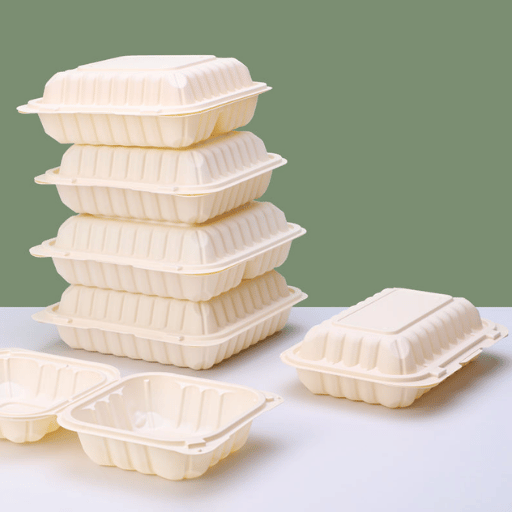
It is possible for packaging to be recyclable but not compostable (consider an rPET container like the one pictured). Packaging can be compostable but not recyclable (e.g., a PLA cornstarch take-out clamshell). Packaging may also be made from biodegradable plastic; however, if it is ultimately disposed of in an oxygen-tight landfill with suppressed biodegradation (landfill), and its eco claims fail to highlight this reality, it becomes a marketing practice that the FTC defines as deceptive.
Packaging: claims must always be backed by a specific verified standard and a real-world, transparent disposal route. Any claim like “biodegradable” in isolation is the single-most expensive type of claim to make for any company sourcing packaging materials.
The Certifications That Actually Matter (And How to Verify Them)
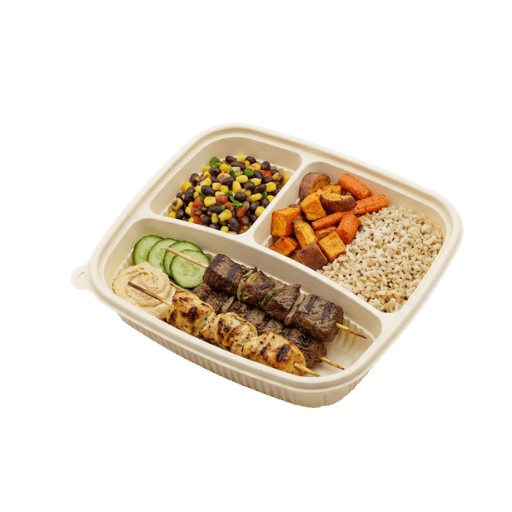
A certification is the tool by which a packaging customer shifts regulatory and public compliance risk to the manufacturing partner — specifically onto that manufacturer’s supply chain and compliance audit trail. An eco-packaging certification is only as valuable as the chain of evidence behind it, and that chain is only as valuable as your internal verification process.
Most Procurement departments don’t go much further than accepting at face value: “supplier says they’re BPI certified.” Setting the minimum standard higher means reviewing the certificate number, confirming the polymer scope it covers, and checking the cert hasn’t expired.
| Certification | What it covers | Geography | Validity |
|---|---|---|---|
| BPI Compostable | Industrial compostability against ASTM D6400 / D6868 | United States, Canada | Renewed every two years; bpiworld.org product database |
| TUV OK Compost (HOME / INDUSTRIAL) | EN 13432 compliance, home vs industrial composting | European Union (most accepted scheme) | Multi-year certification, listed in TUV directory |
| FSC / SFI | Paper and board from responsibly managed forests | Global (FSC) / North America (SFI) | Chain-of-custody auditable through certificate code |
| FDA 21 CFR 174–186 | Food contact substance compliance, US | United States food contact | Material declaration; renewed when formulation changes |
| EU 10/2011 | Plastic materials in food contact, EU | European Union food contact | Declaration of compliance per batch |
| GB 4806.x | China national food safety standard for food contact materials | China and re-export | Periodic testing per material type |
- ✔
Step 1 — Get the certificate number, not just a logo. A logo on a brochure means nothing. A certificate number resolves to a specific product, a specific factory, and a specific expiry date in the issuing body’s database. - ✔
Step 2 — Look up the certificate in the issuing body’s database. BPI maintains a public certified-products database at bpiworld.org. TUV publishes its certified product directory. FSC has a chain-of-custody database. If a certificate cannot be located in the issuing body’s records, the cert is either expired, withdrawn, or invented. - ✔
Step 3 — Match the scope to your product. A cert for one SKU does not transfer to another. A factory-level certificate does not equal product-level certification. Read the scope statement. If the cert covers “Cornstarch bowls 350–750 ml” and you are ordering 1,200 ml bowls, the cert may not apply.
Two other commonly-flagged warning signs are worth highlighting. The first relates to expired certifications — we’ve all seen brand style guides still referencing logos from certificates that lapsed up to two years ago. Check the expiry against the issuing organization’s verification database, don’t trust the supplier’s PDF summary of the cert.
Second, scope drift. A certificate covering a single polymer compound loses its validity when the supplier switches base resin suppliers. Ask the manufacturer to confirm the specific current base resin supplier matches what was originally certified.
What a certificate ultimately is is simply another data point; another item in a database or a checkmark box in a spreadsheet. We’ll generally treat any eco-packaging claim that you can’t easily trace on-line (via the issuing organization) with in approximately 3 minutes or less of work as unverified and go with a better alternative.
How to Evaluate an Eco Packaging Manufacturer: A 7-Criteria Vendor Scorecard
Unfortunately many of the eco-packaging sustainable supplier evaluation scorecards that have been published have been authored from the view point of the supplier, out lining their desirable qualifications. What follows here is the “other side of the coin”, the supplier evaluation scorecard that’s more aligned with the perspective of the Purchasing Lead evaluating potential long term contracts with new eco packaging manufacturers.
| Criterion | What to ask | Red flags | Weight |
|---|---|---|---|
| 1 · Material capability | Which material families do you produce in-house vs source from third parties? | “We can supply anything” — usually means trading, not manufacturing | 15% |
| 2 · Certification stack depth | Show me cert numbers for BPI / TUV / FSC / FDA / EU 10/2011 covering the SKU we are quoting | Expired certs · scope mismatches · “in progress” | 20% |
| 3 · Production scale and capacity headroom | What is your daily output and how much spare capacity exists in the line that would run our SKU? | No daily-output figure · single-line dependency · seasonal bottlenecks not disclosed | 15% |
| 4 · Compliance track record | Any FDA / EU / customs holds in the past 24 months? Any recalls? | Defensive answer · no incident log at all | 15% |
| 5 · Customisation depth | Do you support digital print, Film-in-Mould, custom moulds — and at what MOQ thresholds? | “Yes” without MOQ tiering · custom mould lead time over 90 days | 10% |
| 6 · Lead time and MOQ transparency | Stock SKU, custom-print, and custom-mould lead times in writing | Verbal commitments only · variability above ±30% | 10% |
| 7 · Sustainability reporting depth | Can you provide carbon-footprint data per unit, recycled-content percentage by batch, and end-of-life guidance? | Marketing brochure only · no per-batch paper-trail | 15% |
How do you ensure that your packaging materials are ethically sourced?
Ethical sourcing in eco-packaging falls into three basic categories. First is raw-material origin — for starch-based items, ask the supplier for a non-GMO declaration; for fiber or paper, request the SFI or FSC certification code for responsibly managed forest sourcing; post-consumer content has its own chain-of-custody verification requirements.
Second is ethical manufacturing practice — social audits such as BSCI or Sedex, ideally paired with a published code of conduct for the production site. Third is traceability across the supply chain for any third-party inputs. Sustainability you can’t track back to a paper-trail is simply words on a slide deck, nothing else.
📐 Engineering Note — Production ScaleFor a frame of reference on what “scale and room for growth” looks like in practice: many leading integrated eco packaging manufacturing facilities run 20+ thermoform lines, 6+ sheet extrusion lines, and 60+ injection-moulding machines, with daily output above 30 metric tons of extruded sheet and 1+ million finished units.
This is the type of production base our team benchmarks against when scoring scale criteria — and if you ever want to see how a vertically-integrated eco packaging manufacturing facility runs, a factory tour is a reasonable reference point.
The Sustainable Packaging Coalition (“SPC”) provides a set of Design Guidelines which could be very useful to supplement and align your Purchasing evaluation Scorecard – specifically from a design-recyclability / design-for-material-recovery perspective. It’s more of sophisticated approach to supplier engagement if you can demonstrate a supplier engages with these designs principals.
Key takeaway: Apply the same scorecard to every shortlisted vendor – including your incumbent. Discipline reveals gaps missed in selection and gives you a renewable reference point.
Beyond Unit Price: The Real Cost of Eco Packaging (TCO Framework)
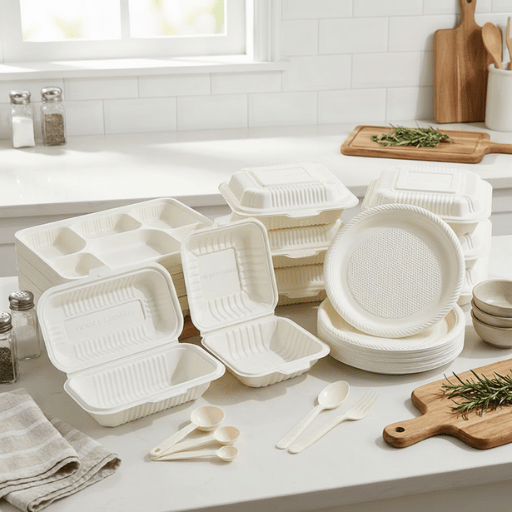
Eco packaging’s most frequent objections to procurement leads: “It costs more.” While largely true at the unit-price level (biodegradable and compostable containers are 8-15% costlier than plastic incumbents), the story shifts dramatically over two years at the total-cost-of-ownership (TCO) level.
How can sustainable packaging help reduce my brand’s carbon footprint?
Brands’ carbon footprint can be reduced by eco packaging using three independent levers: Lower embodied carbon (plant feedstocks, high-recycled content vs. virgin fossils); Lower end-of-life emissions (recovery pathway vs. landfill, with partial landfill methane suppression); Avoided plastic tax exposure (UK Plastic Packaging Tax on low-recycled content provides an effective subsidy). Success depends on both materials and disposal infrastructure.
| TCO dimension | Conventional plastic | Eco packaging |
|---|---|---|
| 1 · Unit price (FOB) | Baseline | +8 to +15% |
| 2 · Plastic packaging tax (UK, where applicable) | £228.82 per tonne from 1 April 2026 (where recycled content is below 30%) | Zero — fully exempt at high recycled-content or compostable |
| 3 · EPR fees (EU, expanding) | Higher modulated fees for hard-to-recycle formats under PPWR | Reduced fees for recyclable / compostable designs |
| 4 · Brand premium / willingness-to-pay | No measurable premium | Documented willingness-to-pay among ESG-engaged consumer segments (NielsenIQ tracking) |
| 5 · Compliance / claim risk | Rising — PFAS bans, single-use restrictions, FTC enforcement | Lower if claims are properly substantiated; otherwise equal |
Current and verifiable UK data anchors the argument: the 2025/6 levy stands at £223.69-£228.82/tonne on plastic components below 30% recycled. EU PPWR features modulate EPR fees similarily (higher costs for harder-to-recycle designs).
💡 Pro Tip — Build a category-specific TCO model
Higher landed costs can occur as compostable and fiber containers are denser than thin-wall plastic – resulting in lower volume/pallet, and higher weight/pallet. Model freight, EPR, and tax two years forward of contract award to avoid false unit-price-driven assumptions.
Key takeaway: Eco packaging rarely wins at the unit-price level, but is increasingly competitive – and sometimes cheaper – on a TCO basis. Adding plastic taxes, EPR modulation, and claim-risk insurance closes the gap rapidly. Procurements relying solely on unit price are outdated.
Industry Playbook — Match Material to Use Case
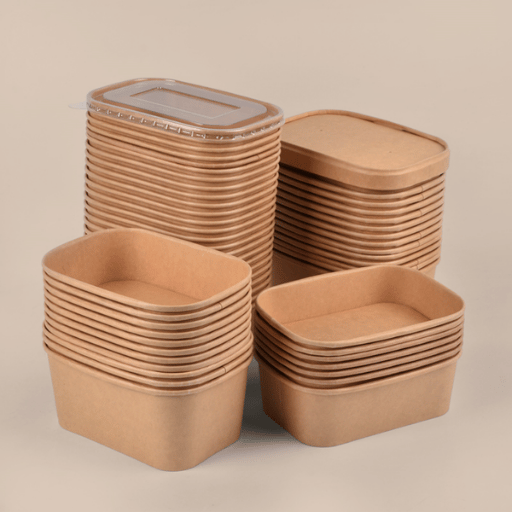
Eco packaging markets vary significantly – restaurants, food service, direct-to-consumer, and food delivery all have distinct requirements. Use this as a starting point; actual material choices are context-dependent (geography, brand positioning, real-world realities).
| Industry | Primary pain | Recommended material | Watch-out |
|---|---|---|---|
| Chain restaurant (50+ locations) | Brand consistency across regions, ESG reporting | Recycled-content MFPP with Film-in-Mould branding · cornstarch for ESG-led SKUs | Mix of cornstarch and rigid plastic complicates back-of-house disposal |
| Food delivery / takeaway | Leak-proof seal, 30-minute integrity, microwave reheat | Cornstarch hinged clamshell or bagasse with PLA lining | PLA-lined paper struggles with very oily food beyond ~30 min |
| Foodservice / school and hospital canteens | Food safety compliance, procurement stability, budget | Cornstarch bowls plus compliant rigid plastic combo with multi-region certification | GB 4806 + FDA + EU 10/2011 stacking matters for institutional buyers |
| D2C meal prep / subscription brands | Microwave plus freezer, leak-resistant, brand storytelling | Cornstarch bento with compartments · kraft mailer for outer pack | D2C shipping favours lighter mailer formats — overspec adds freight cost |
For food delivery and takeout brands transitioning. Leak rate – The one operational metric that beats all else. A leaking compostable container within 30 minutes will do more damage than the classic clamshell it replaces. Always pilot with your actual delivery time and food before rolling. If you’re looking at cornstarch and MFPP takeaway box options, don’t ask for demo SKUs — ask for samples matching your actual food.
D2C and subscription businesses. EU PPWR take-away “own container” provision. Restrictions to single-use, such as plastic for condiment sachets, increase and become more stringent.Brands shipping to the EU will want to re-examine the scope of their sachet and portion size usage before the August 2026 entry into force.
Key takeaway: Industry trumps material type. A restaurant’s eco brief should generate a different list of considerations than a D2C brand’s eco brief. Work with the use case first.
Eco Packaging Outlook 2026 — Regulations, Materials, and Buyer Behavior
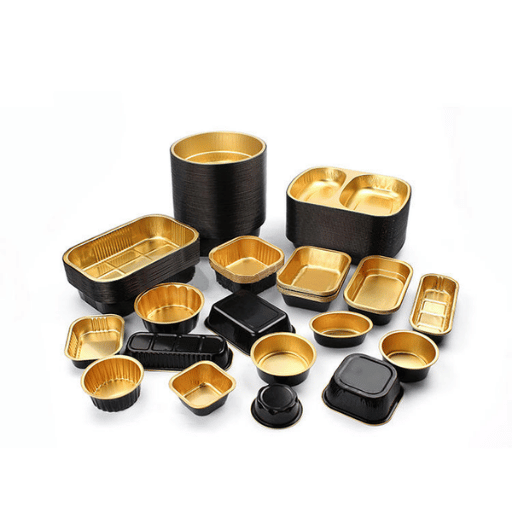
The 18 months between the mid-2026 and early-2028 will be busy ones for procurement teams, as enforcement grade-making and “optional” milestones create friction with unverified, green-claimed packaging.
Five Regulatory Signals Worth Building Into Your 2026–2028 Sourcing Plan
- The EU PPWR goes into full effect in all member states – 12 August 2026. It makes it illegal to place any package that can’t be recyclable economically on the market by 2030. By January 2035, recycling must be demonstrably “in practice on a large scale”. Only A-and-B-grade packaging are permitted from January 2038.
- UK plastic Packaging Tax increases on – 1 April 2026 – rate jumps to £228.82/tonne. recycled content requirement could even exceed 30% within the decade.
- Maine and California State bans on PFAS in food contact. Maine’s Public Law 2021, c. 477, requires all products intentionally added with PFAS to phase them out completely by 2030. Other States follow. Californians will be unable to purchase anything that contains purposefully added PFAS in food packaging,juvenile products, cosmetics and textiles by 2030.
- EU REACH PFAS evaluation nearing completion end-2026. ECHA’s scientific report is expected in late 2026 to guide possible restriction proposals through the legislative process.
- Federal FTC Green Guides updates. It’s more than been pending since the FTC received public comment and held public work sessions through out 2023. Revision of “recyclable,” “biodegradable” and other general and specific eco claims is expected as enforcement proceeds apace on any unsubstantiated claims.
On the materials side, the move of mycelium-based food packaging from basic research toward more selective commercial trials accelerated in 2024 – led by a University of Maine scalable mycelium and cellulose nanofibrils composite, and on track toward projected mycelium packaging market growth from approx. $99 million in 2026 to $228 million by 2035, or a near-10% CAGR. Algae-based bioplastics remain at earlier R&D stages but are viable thin-film sustainable packaging solutions for food and personal care applications in 2028+.
“The story in 2025-2026 is one of the progressive constriction of what is provable as a defensible eco claim. The winning Buyers are those that bake compliance into the spec as a critical sourcing criterion – not an afterthought marketing message – and who demand evidence, at the certificate level, before they issue a purchase order.”
— Wanhui engineering and procurement team
Buyer behavior will always follow the incentive system created by regulators. NielsenIQ’s sustainability tracking continues to document willingness-to-pay premiums among the more ESG-motivated consumer segment, but also highlights a durable value-action gap — consumers say they will pay more often than they actually do. The signaled driver of buyer behavior – by a wide margin – is regulatory (not Consumer Preference), which comes into play via taxes, recalls or bans which alter the Economics.
Key takeaway: If you’re thinking about designing a 2027 supply contract, build EU PPWR Article-level recyclability, PFAS-free formulations and recycled-content certification requirements into the spec now. Retrofitting solutions into a 2027 contract cost considerably more than building compliance into a 2026 spec sheet.
Frequently Asked Questions
What’s the real difference between compostable, biodegradable, and recyclable packaging?
View Answer
The criteria of “recyclable” mean the material must be collected, sorted and reprocessed at a meaningful scale, and “compostable” requires the material to break down into water, CO2 and biomass in controlled (usually ~58 C/180 day industrial composting) conditions. “Biodegradable” remains the most vague and potentially problematic category – “biological decomposition occurs” but provides no information about timeline, the environment where decomposition is expected to occur or the end state. An unqualified claim for “biodegradable” in the United States requires supporting evidence of complete biodegradation of all the advertised product under conditions of disposal typically expected by consumers (usually over a period of one year or less).
How do I verify that an eco packaging manufacturer’s certifications are legitimate?
View Answer
How it works, generally: 1) Ask for the certificate number and certified scope (not just a logo). 2) Look up the cert in the issuer’s website database. 3) Ensure scope is consistent with the product you are quoting, the expiration date is valid, and the cert exists on the issuer’s public database. No public cert? Treat it as unsubstantiated.
Are eco packaging materials always more expensive than conventional plastic?
View Answer
At the unit-price level, most eco packaging will command an 8-15% premium over traditional packaging solutions. A TCO calculation for eco-friendly packaging may narrow or even reverse this gap once accounting for plastic taxes (e.g., UK PPT at ~£229/ tonne in 2026), EPR modulated fees in the EU (per PPWR regulations) and claims liability costs. TCO break-even arrives earlier in places that already have established plastic taxes and PFAS restrictions and later elsewhere.
Which eco packaging materials are best for hot food, cold food, and oily food?
View Answer
Hot food Bagasse and sugarcane fiber tend to do quite well because of their high heat tolerance. Cold food/meal prep Cornstarch-based packaging can stand up to freezer-to-microwave cycling for most formulations. Oily food The most reliable barrier is usually a PLA-lined fiber container or a recycled-content rigid container. (As always, pilot your actual food profile -published data typically reflects neutral conditions, not your specific sauce, oil content, or hold time.)
Can I get custom-branded eco packaging at low MOQ (under 5,000 units)?
View Answer
Yes, for digital print on stock SKUs- most manufacturers will run as little as 1,000-5,000 units on custom printed designs. For custom moulds or Film-in-Mould containers, minimum order quantities (MOQs) start around 50,000-100,000 units per SKU (since the cost of tooling amortises over many runs). If these volumes are too large to start with, inquire about custom sticker or digital print on our existing range of stock SKUs as an interim solution.
What’s the lead time for sourcing eco packaging from an overseas manufacturer?
View Answer
Stock SKUs ship within 7-15 days of ordering. Standard production times for custom printing on an existing mould range from 20-30 days. Lead time on a completely custom mould development project typically extends to 45-60 days for tooling, plus a production run of 20-30 days. Factor in another 25-35 days if your product needs to be shipped via sea freight from Asia to North America or Europe. To control your initial risk, ask samples to be produced on the actual production line for your order- not on a sample-cell test rig.
Will compostable or biodegradable packaging affect my product’s shelf life?
View Answer
It really depends on the material and product itself. For moisture-sensitive dry products, cornstarch and pla-based films typically exhibit lower barrier properties to oxygen than their PP or PET film counterparts, and this can shorten shelf-life. For a wet ready meal with a short hold cycle, material becomes a minor consideration; for long-shelf-life dry products, look at OTR (oxygen transmission rate) and WVTR (water vapour transmission rate) for the manufacturer’s specified film and match to your product’s requirement.
Apply this scorecard to a real shortlist
If you’d like a copy of the 7 criteria scoring card, our current certification list and a samples of documentation from the vertically-integrated factory, feel free to reach out to our team.
About the Authors
This guide was research and written by the Wanhui Environmental Protection engineering and purchasing teams, and it draws on approximately 1,000 sourcing RFQs processed by our company in 2024 and 2025. Wanhui’s 20-year experience as an eco food packaging manufacturer includes the production of cornstarch, MFPP, rigid thermoforms and FIM packaging on 86 separate lines, serving clients across five distinct export regions. Procurement evaluation data is based on real trends encountered over that period. Buyers interested in our 20-year track record are invited to review our due diligence package.
How This Buyer’s Guide Was Sourced
Procurement data in this eco packaging manufacturer guide reflects 12 months of RFQ patterns across our cornstarch and MFPP production lines (2025 fiscal year). Certification timelines were cross-checked against BPI, FSC, and CEN databases as of May 2026. Regulatory citations were verified directly against the FTC, European Commission, UK gov.uk, and Maine DEP source pages on the day of publication. Where our internal numbers diverged from public benchmarks, we used the more conservative figure.
References & Sources
- Packaging Waste — Environment — European Commission (PPWR 2025/40 official page)
- Regulation (EU) 2025/40 on Packaging and Packaging Waste — EUR-Lex
- Green Guides — U.S. Federal Trade Commission
- Plastic Packaging Tax: Steps to Take — UK Government (HMRC)
- PFAS in Products Program — Maine Department of Environmental Protection
- Containers and Packaging: Product-Specific Data — U.S. Environmental Protection Agency
- ASTM D6400-19 — Standard Specification for Labelling of Plastics Designed to be Aerobically Composted in Municipal or Industrial Facilities (ASTM International)
- EN 13432:2000 — Requirements for packaging recoverable through composting and biodegradation (European Committee for Standardization)
Related Articles
- Wanhui’s eco food packaging manufacturing capability — solution overview, product lines, and procurement terms
- About Wanhui — 20 years in environmental food packaging