Get in touch with Wanhui Company


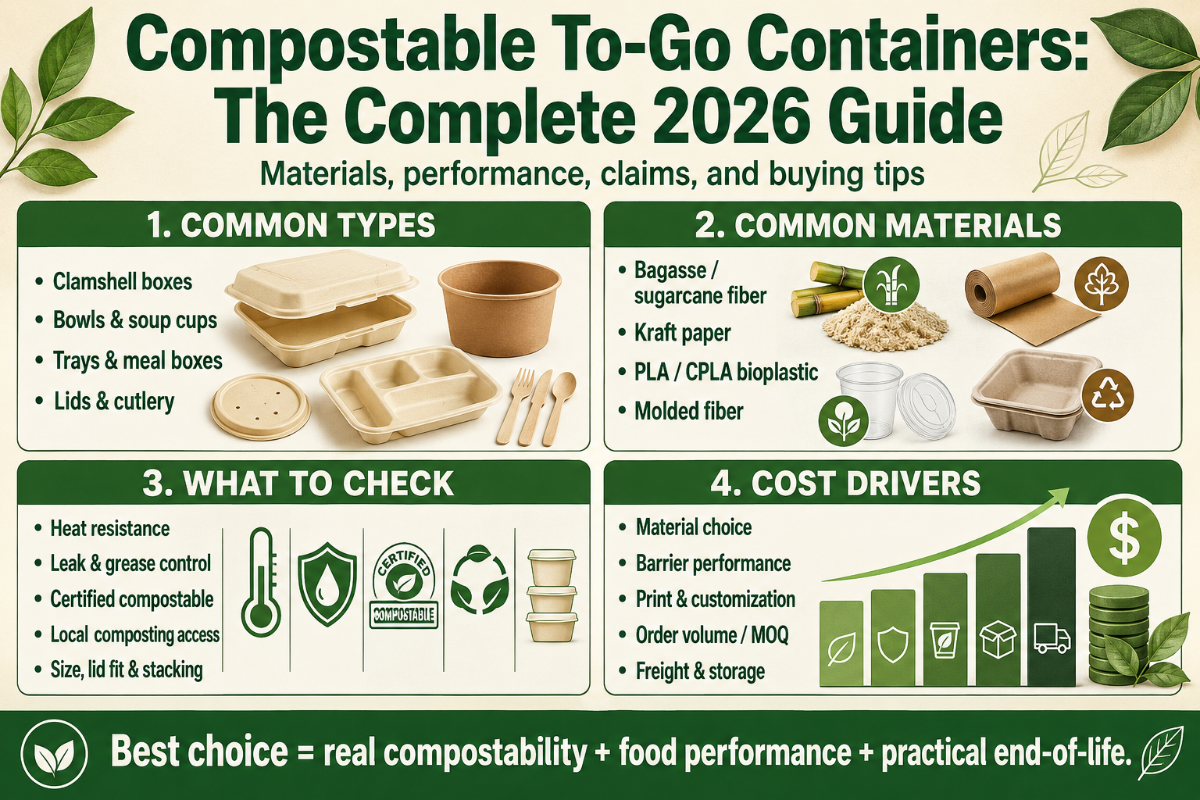
Compostable to-go containers promise a clean break from plastic and foam. The catch is in the fine print: the word compostable carries more nuance than most labels admit. A container can be certified compostable and still refuse to break down in your backyard, contaminate a recycling load, or carry a grease-proofing chemical you never agreed to. This guide cuts past the marketing to the mechanics — what these containers are actually made of, which certifications mean something, where they really decompose, whether they’re safe, and how to throw them out so the promise actually holds up.
If you operate a restaurant, café, or food-delivery brand and want to skip straight to product specs and bulk options, see our compostable to-go containers solution page. If you want to understand the category before you buy, read on.
Quick Specs: Compostable To-Go Containers at a Glance
| Common materials | Bagasse (sugarcane fiber), molded fiber/pulp, PLA, CPLA, paper/paperboard |
| Core certifications | ASTM D6400 (plastics), ASTM D6868 (fiber + coatings), BPI logo, EN 13432 (EU) |
| Breakdown standard | ~90% biodegradation within 180 days at ~58°C (industrial conditions) |
| Heat ceiling | Bagasse ~95–120°C; CPLA ~90°C; PLA softens ~45–55°C |
| Disposal reality | Most need a commercial composter; will not break down in landfill |
| Watch for | Vague “biodegradable” claims, missing certification, undeclared PFAS |
Compostable vs. Biodegradable vs. Recyclable: What the Labels Actually Mean
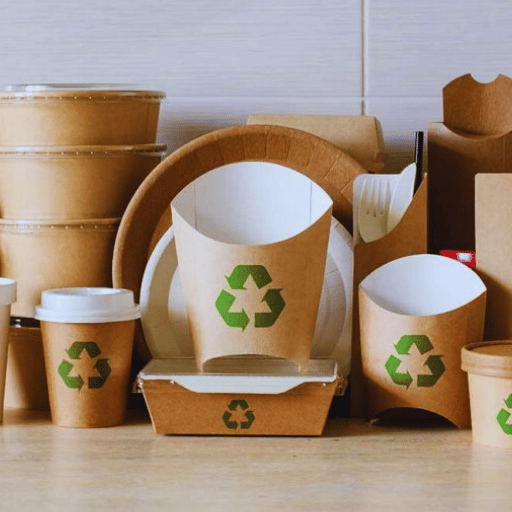
Compostable means a product breaks down into water, CO₂, and nutrient-rich biomass under defined composting conditions within a set time, leaving no toxic residue. Biodegradable is a much weaker word: it only promises that something will eventually break down by biological action, with no required timeframe and no defined end-state. That gap — between a measured standard and a vague promise — is exactly where buyers get misled.
The U.S. Federal Trade Commission draws the line sharply. Under the FTC Green Guides, an unqualified “degradable” claim is only allowed if the entire item fully breaks down within roughly one year after customary disposal — which means products headed for a landfill cannot legitimately carry an unqualified biodegradable claim. “Compostable” claims must be qualified if the item can’t be composted at home or if industrial facilities aren’t available to a substantial majority of consumers.
Which Is Better, Biodegradable or Compostable?
For foodservice packaging, “compostable” is the stronger, more accountable claim — but only when it’s tied to a standard like ASTM D6400 and a third-party logo. “Biodegradable” on its own is close to meaningless: a conventional plastic fork can technically biodegrade over several centuries. If a supplier leads with “biodegradable” and offers no certification, treat it as a marketing word, not a disposal instruction. Recyclable is a third, separate path — and as you’ll see below, mixing compostable items into recycling causes real problems.
What Compostable To-Go Containers Are Made From: The 5 Core Materials
Nearly every compostable to-go container is one of five materials. They are not interchangeable — feedstock determines heat tolerance, grease resistance, and where the container can actually be composted. Below is our 5-Material Compostability Report Card, synthesized from material datasheets and standards bodies so you can match material to use rather than trust a generic “eco” label.
Beyond these five, you will also see bamboo and wheat straw fiber used for plates, take-out containers, and trays; both behave much like molded fiber. Whatever the feedstock, an “eco-friendly” badge on takeout containers tells you nothing about heat tolerance or composting path — only the material and its certification do. Material science is moving fast here: research groups such as Michigan State University are developing PFAS-free biobased barrier coatings that let fiber containers hold grease and liquid without fluorinated chemicals.
| Property / material type | Bagasse | Molded fiber | PLA | CPLA | Paper/board |
|---|---|---|---|---|---|
| Feedstock | Sugarcane waste | Recycled paper/plant pulp | Corn/sugar starch | Crystallized PLA | Wood pulp |
| Max temp | ~95–120°C (203–248°F) | ~95°C (203°F) | ~45–55°C (113–131°F) | ~85–90°C | Moderate |
| Grease/oil resistance | Good (inherent) | Needs coating | Good (film) | Good | Needs coating |
| Liquid hold | 2–3 hrs | Coating-dependent | High | High | Coating-dependent |
| Microwave | Usually yes | Usually yes | No | Limited | Varies |
| Industrial compostable | Yes | Yes | Yes (only) | Yes (only) | Yes (if uncoated/D6868) |
| Home compostable* | Sometimes | Sometimes | No | No | Sometimes |
| PFAS risk (legacy) | Possible (coating) | Possible (coating) | Low | Low | Possible (coating) |
| Best-fit foods | Hot meals, greasy, wet | Dry/cool, trays | Cold salads, drinks | Hot lids, cutlery | Dry, baked goods |
*Home compostability is material- and condition-dependent and frequently overstated — see the next section.
How to Read a Compostability Claim: ASTM D6400, BPI & the Greenwashing Test
A genuine compostable claim rests on a published standard, not a green leaf icon. Two standards do the heavy lifting. ASTM D6400 governs compostable plastics like PLA: it requires roughly 90% of the material’s organic carbon to convert to CO₂ within 180 days, disintegration to under 10% residue through a 2 mm screen within 12 weeks, and an ecotoxicity check showing at least 90% plant germination versus a control. ASTM D6868 covers coatings and fiber substrates such as paper and bagasse. The EU equivalent is EN 13432.
In North America, the practical shortcut is the BPI certification mark, which audits products against those ASTM standards. Use this four-check point Compostable Claim Decoder on any product or spec sheet:
- ✔Standard cited? Look for ASTM D6400, D6868, or EN 13432 — not just the word “compostable.”
- ✔Third-party logo? BPI, TUV OK Compost, or CMA — a real certifier, not a generic leaf.
- ✔Home vs. commercial qualifier? “Commercially compostable only” is honest; silence usually means commercial-only.
- ✔PFAS-free statement? A written declaration matters for fiber products (see safety section).
“A leaf icon and the word ‘green’ are not certifications. If a product can’t point to a standard and a certifier, the compostable claim is unverifiable.”
Home vs. Industrial Composting: Where These Containers Actually Break Down
This is the single most misunderstood fact about compostable to-go containers — call it the 180-Day Industrial-Compost Rule. The ASTM D6400 timeline assumes an industrial composter running near 58°C (136°F) with managed moisture and microbial activity. A backyard pile rarely sustains even 30–40°C (86–104°F). So a PLA-based container that looks “compostable” on the label will usually just sit in your home compost and do nothing.
The data backs this up bluntly. The UCL Big Compost Experiment found that about 60% of items certified as home-compostable did not fully disintegrate under real home conditions, and concluded home composting was not a reliable processing route for these materials. So even the “home compostable” column in the table above deserves a skeptical read.
⚠️ Important
In a sealed landfill, compostable containers behave like ordinary trash. Without oxygen, moisture, and warmth they do not compost — and PLA can persist for 100 to 1,000 years. Compostable packaging only delivers its benefit when it actually reaches a facility that can process it.
Will Compostable Containers Break Down in a Backyard Compost Bin?
Usually only the uncoated plant-fiber types (some bagasse and molded-fiber items) stand a chance, and even then results are inconsistent. Bioplastics like PLA and CPLA need industrial heat and should not go in a home bin. If backyard compostability is a priority, buy only products explicitly certified home compostable (TUV OK Compost HOME) — and still expect slower, partial breakdown than the label implies.
Are Compostable Containers Safe? PFAS and Food Contact
Two separate safety questions live inside one container, and people routinely conflate them. First: compostability certification is not a food-safety certification. ASTM D6400/D6868 and BPI verify how a container breaks down — not whether it is safe in contact with hot, fatty, or acidic food. Food-contact safety is a separate assessment (migration and toxicology) handled under U.S. FDA rules. A container can be genuinely compostable and still be the wrong choice for a long-dwell hot curry.
Second: PFAS, the “forever chemicals,” were historically added to fiber containers as a grease barrier. A 2025 peer-reviewed study (RSC Environmental Science: Advances) that sampled compostable foodservice items reported PFAS concentrations as high as roughly 86,000 µg/kg in some bagasse samples — a striking reminder that “plant-based” does not automatically mean “clean.” That said, the U.S. picture has shifted: in February 2024 the FDA announced that grease-proofing agents containing PFAS are no longer sold for paper food packaging in the U.S. market.
📐 Practical takeaway
PFAS-free is now the norm for domestic U.S. paper packaging — but imported stock, older inventory, and non-paper coatings can still carry it. For any fiber container, ask the supplier for a written PFAS-free declaration. As a 20-year foodservice packaging manufacturer, our team treats food-grade raw materials and a PFAS-free statement as non-negotiable baseline documentation, not an upsell.
Matching Container Type to Food: Hot, Wet, Greasy & Cold Performance
Choosing well is less about “which is greenest?” and more about “which one survives my food?” Run each menu item through this 4-Question Container Decision Tree:
The 4-Question Container Decision Tree
- Hot or cold? Hot → bagasse or molded fiber. Cold → PLA is fine.
- Wet/saucy? Yes → deep bagasse bowl; pair with a CPLA or recyclable PP lid for a leak-resistant seal.
- Greasy? Yes → bagasse handles oil inherently; coated fiber works if the coating is grease-rated.
- Reheated by the customer? Yes → avoid PLA (softens ~45–55°C); choose microwave-rated bagasse/fiber.
In practice, a deep bagasse bowl holds hot, saucy food reliably through typical delivery windows, which is why it’s the default for soups and rice bowls. Clamshells and hinged boxes suit burgers and entrees; deli containers suit cold sides; CPLA is reserved for hot-drink lids and cutlery. A classic mistake is using a clear PLA clamshell for a hot meal — it warps, leaks, and arrives deformed. Heat performance is also a food-safety question, not just a structural one: the U.S. FDA evaluates a material’s suitability for hot, fatty, or acidic contact separately from any compostability claim.
How to Dispose of Compostable To-Go Containers Correctly
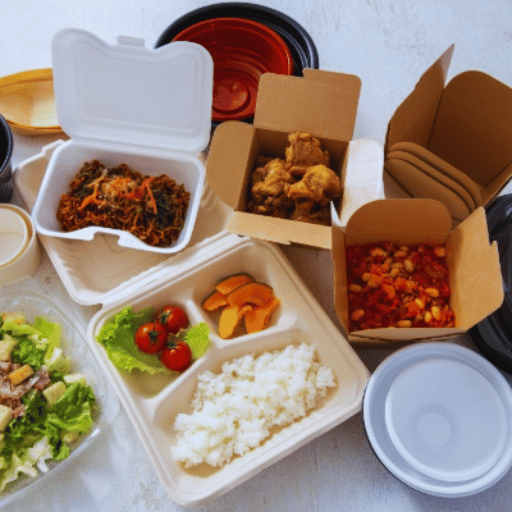
A compostable container is only as good as its end-of-life path — and most never reach the right one. Disposal preference runs in a simple order: commercial composting facilities that accept packaging → municipal organics (if accepted) → trash. That last option bothers people, but when industrial access doesn’t exist, the trash bin is the honest answer.
How Do I Dispose of Compostable To-Go Containers?
Never put compostables in your recycling. Compostable plastics like PLA look like #1 PET but contaminate the recycling stream and can ruin a batch. The contamination problem is narrower than the scare stories suggest, though: a 2024 study reported that certified compostables integrated cleanly into properly equipped industrial composters (about 98% mass loss in four months with no quality harm). The real failures come from non-certified look-alikes, items sent to facilities that don’t accept packaging, or compostables tossed in the wrong bin.
💡 Pro Tip
Before assuming your “green bin” composts packaging, check the facility type. The U.S. EPA notes that anaerobic digestion (AD) plants — where many municipal organics actually go — are generally not designed to break down compostable foodservice ware. A program that accepts food scraps does not automatically accept compostable containers.
Why Foodservice Is Switching: Foam Bans, PFAS Rules & Labeling Laws
Three distinct regulatory waves are pushing the shift to compostable to-go containers — and operators who track only one get caught by the others.
| Regulatory axis | What it does | Key 2026 marker |
|---|---|---|
| Foam (polystyrene) bans | Phase out EPS food containers | 12 states incl. CA, NY, NJ, WA; Virginia full ban July 1, 2026 |
| PFAS bans | Prohibit intentionally added PFAS | 12 states; Maine plant-fiber rule effective May 25, 2026 |
| Labeling laws | Govern how “compostable” appears | CA, WA, CO, MN claim/tinting rules; CalRecycle input window to June 30, 2027 |
Foam bans now cover roughly a dozen states, and Virginia’s full polystyrene ban reaches all food vendors on July 1, 2026. On PFAS, twelve states restrict intentionally added compounds in food packaging, with Maine’s plant-fiber rule taking effect May 25, 2026. The often-missed third axis is labeling: California, Washington, Colorado, and Minnesota regulate how the word “compostable” can appear (certification, color/tinting, claim substantiation) independent of any foam or PFAS ban. Internationally, the EU’s Packaging and Packaging Waste Regulation (Reg. 2025/40) caps PFAS and leaves penalty levels to member states by February 2027 — its compostability mandate targets specific formats like tea bags and produce stickers, not takeout clamshells.
Here is where the three waves stand across the most active states (a snapshot, not legal advice — confirm your jurisdiction before sourcing):
| State | Foam ban | PFAS rule | Key date / note |
|---|---|---|---|
| California | Yes | Yes + labeling rule | Foam in effect; tinting/claim rules |
| Colorado | Yes | Yes | PFAS since Jan 1, 2024 |
| Delaware | Yes | — | Foam in effect |
| Maine | Yes | Plant-fiber rule | Effective May 25, 2026 |
| Maryland | Yes | — | Foam in effect |
| New York | Yes | — | Foam in effect |
| New Jersey | Yes | — | Foam in effect |
| Oregon | Yes | — | EPR program from Jul 1, 2025 |
| Rhode Island | Yes | — | Foam in effect |
| Vermont | Yes | Yes | PFAS since Jul 1, 2023 |
| Virginia | Phasing in | — | Full ban Jul 1, 2026 |
| Washington | Yes | Yes + labeling rule | PFAS since Feb 1, 2023 |
Choosing Compostable Containers for Your Business: A Quick Framework
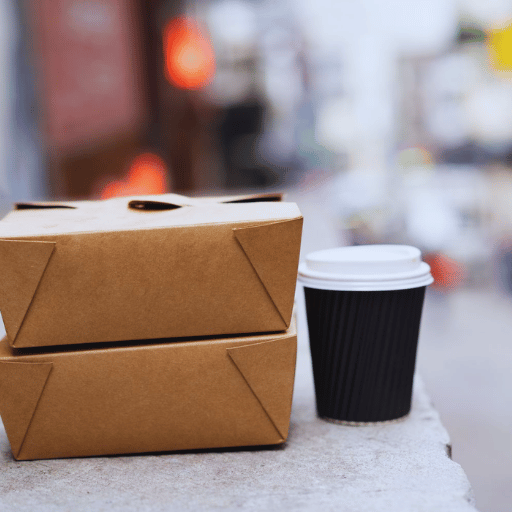
Once you understand the material and disposal realities, sourcing comes down to a short vetting checklist:
- ✔Certification on file (ASTM D6400/D6868 or BPI), not just a claim
- ✔Written PFAS-free declaration for fiber items
- ✔Material matched to your hottest, wettest, greasiest menu item
- ✔Lid compatibility and leak testing for delivery
- ✔Compliance with your state’s foam, PFAS, and labeling rules
For sizes, bulk pricing, and certified options matched to your menu, see our compostable to-go containers page, or compare the full disposable range in our wholesale food containers buyer’s guide.
Need certified, PFAS-free compostable to-go containers matched to your menu?
Industry Outlook: Compostable Packaging Through 2026 and Beyond
This category is growing and getting cleaner at the same time. Analysts size the compostable foodservice packaging market at roughly USD 3.7 billion in 2024, projected toward USD 8.8 billion by 2034 at about a 9% CAGR (estimates range from ~4% to ~9% depending on scope). The bigger story for buyers is material innovation: as PFAS exits, suppliers are commercializing PFAS-free barrier coatings — water-based dispersions, plant-derived polymers, and clay or silica layers — and dry-fiber tray technology with integrated aqueous barriers reached market in early 2026.
Two practical moves for the next couple of years: time your purchasing around your state’s compliance dates — foam and PFAS deadlines cluster in 2026–2027 — and start treating a verifiable PFAS-free, certified-compostable spec as the baseline you require, not a premium add-on. If you’re betting on one format, watch molded fiber: its structural strength and PFAS-free coating options are improving fastest.
Frequently Asked Questions
Q: Are compostable to-go containers recyclable?
View Answer
No — and you should not put them in recycling. Compostable plastics such as PLA resemble #1 PET but are a different polymer; mixing them into a recycling stream contaminates the bale and can spoil otherwise recyclable material. Fiber containers like bagasse are designed for composting, not paper recycling, especially once soiled with food. The correct path is a commercial composter that accepts packaging, or the trash if none is available.
Q: Can compostable containers go in the microwave or oven?
View Answer
It depends entirely on the material. Bagasse and molded fiber generally tolerate microwave reheating and temperatures up to roughly 95–120°C, making them safe for hot food. PLA-lined containers are the opposite — PLA softens around 45–55°C, so it warps and can leak in a microwave and should never go in an oven. Always check the specific product’s rating; “compostable” tells you nothing about heat tolerance.
Q: Do compostable containers break down in a landfill?
View Answer
No. Composting requires oxygen, moisture, warmth, and microbial activity. A modern landfill is compacted and largely anaerobic, so a compostable container behaves like ordinary waste there — and PLA in particular can persist for 100 to 1,000 years. This is why disposal access matters more than the label: a compostable container sent to landfill delivers almost none of its intended environmental benefit.
Q: Are #5 (PP) to-go containers compostable?
View Answer
No. A #5 resin code means polypropylene, a conventional plastic that is recyclable in some programs but not compostable. Compostable containers carry an ASTM D6400/D6868 or BPI mark instead of a resin number.
Q: How long do compostable containers take to break down?
View Answer
Under ASTM D6400 industrial conditions, about 90% within 180 days. At home or in landfill, far longer — often not at all.
Q: Are compostable containers more expensive than plastic?
View Answer
Typically yes, at a modest premium that has narrowed as volume grew — and that gap is shrinking further as foam and PFAS bans remove cheaper alternatives from the market. For many operators the deciding factor is now compliance and brand expectation rather than unit price alone.
References & Sources
- Green Guides — U.S. Federal Trade Commission
- Industry Actions to End Sales of PFAS in U.S. Food Packaging (Feb 2024) — U.S. FDA
- Sustainable Management of Food & Composting — U.S. EPA
- The Big Compost Experiment — Frontiers in Sustainability / UCL
- PFAS in compostable foodservice packaging (2025) — RSC Environmental Science: Advances
- Compostability Certification & ASTM D6400/D6868 — Biodegradable Products Institute
- U.S. Food Waste Composting Infrastructure Survey — BioCycle
- Virginia Bans Polystyrene and Single-Use Plastics — Food Packaging Forum
- Regulation (EU) 2025/40 (PPWR) — EUR-Lex
Related Articles
- Compostable To-Go Containers — certified, PFAS-free options and bulk sizes
- Types of Disposable Food Containers — full material spectrum compared
- Wholesale Food Containers Buyer’s Guide — sourcing and cost framework
- Disposable Food Containers — product range overview
About This Guide
This guide was compiled and reviewed by the Wonhi foodservice packaging team, drawing on 20 years of manufacturing disposable food containers for restaurants, delivery brands, and institutional kitchens. Compostability, certification, and disposal claims here are sourced to standards bodies, government agencies, and 2024–2026 regulatory updates rather than supplier marketing — including corrections we made after an adversarial fact-check flagged common overgeneralizations about home composting and EU rules.