
Get in touch with Wanhui Company


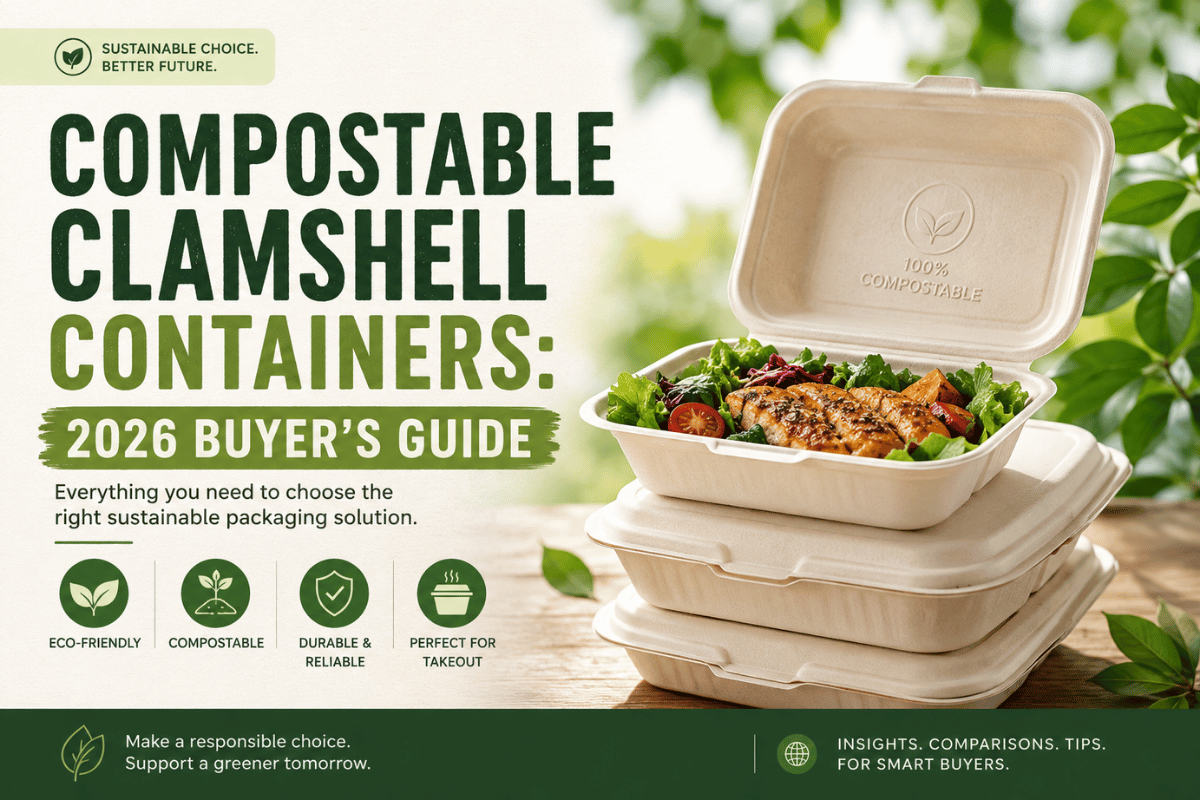
Compostable clamshell containers are hinged, plant-fiber or bioplastic food boxes certified to break down into clean compost under industrial conditions. Buying them looks simple until your first hot order springs a leak, a composter turns away your shipment, or a state inspector demands an explanation for the label. We’ve sifted the greenwashed marketing to give you what really matters-what “compostable” is actually certified to do, how to compare bagasse, molded fiber, PLA, and CPLA on the specs that count, and how to pick the right clamshell for your food, your certifications, and-the one thing other guides forget-if it will ever actually make it to a composter’s door. Updated June 2026.
Quick Specs: Compostable Clamshell Containers at a Glance
| Common materials | Sugarcane bagasse, molded plant fiber, wheat-straw fiber, PLA (clear bioplastic), CPLA |
| Heat limit (hot food) | Bagasse/fiber: >200°F | Clear PLA: ~105–110°F |
| Key certifications | BPI (to ASTM D6400 / D6868); TÜV OK compost |
| Common footprints | 6×6×3, 8×8×3, 9×6×3 in; 1/2/3-compartment; hinged lid |
| Composts where | Industrial facility (~55–60°C) — not a home bin or landfill |
What Makes a Clamshell “Compostable” (vs Biodegradable & Recyclable)
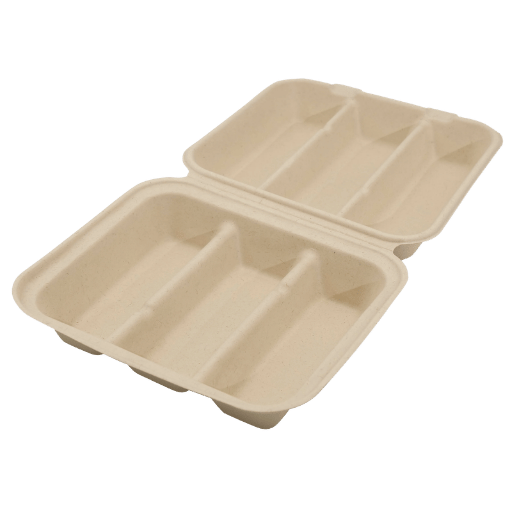
A “compostable” clamshell is a hinged plant-fiber or bioplastic container certified to break down into clean compost under specified commercial conditions — not a vague “earth-friendly” promise. Under US standard ASTM D6400, it must clear two tests: 90% disintegration within 84 days (about 12 weeks), then 90% biodegradation within 180 days. Those are different stages — disintegration is the container falling apart, biodegradation is microbes turning it into nutrients.
Clarity is essential because “biodegradable” guarantees neither. US EPA views an unqualified “biodegradable” claim as deceptive if an item doesn’t fully break down in a year or so; all compostable items are biodegradable, but not all biodegradable items are compostable. And as for “recyclable”? Conventional plastic recycling lines will almost certainly reject your compostable fiber and PLA clamshells.
⚠️ Common mistake
Treating the terms as interchangeable: It’s possible for a clamshell to be legitimately “biodegradable” (but perhaps take years to decompose, leaving fragments), but buying certified-compostable products means you are buying from sellers whose products meet specific standards, ensuring actual disintegration in a commercial composting facility rather than simply looking cute with a leaf graphic.
Compostable Clamshell Materials Compared: Bagasse, Molded Fiber, PLA & CPLA
The material-which you’ll see listed as bagasse, molded fiber, PLA, or CPLA-is your most important upstream consideration, dictating heat tolerance, grease resistance, clarity, cost, and the type of composting facility your containers will be accepted in. Before comparing products, we advise evaluating each candidate through what we call The 4-Gate Compostable Clamshell Selection Filter: Gate 1: Material suitability for the food; Gate 2: Certification and PFAS status; Gate 3: Heat and food endurance; and Gate 4: Compost facility access. A clamshell must clear all four to be truly compostable.
| Material | Heat limit | Clarity | Grease/moisture | Relative cost | Best for |
|---|---|---|---|---|---|
| Sugarcane bagasse | >200°F | Opaque | Strong | Low–mid | Hot, greasy, saucy entrees |
| Molded plant fiber | >200°F | Opaque | Strong | Low–mid | General hot takeout |
| Wheat-straw fiber | ~200°F | Opaque | Good | Mid | Hot food, lighter color |
| PLA (clear) | ~105–110°F | Crystal clear | Good (cold) | Mid–high | Cold salads, fruit, bakery display |
| CPLA (crystallized) | ~185°F | Opaque | Good | High | Warm food, lids/cutlery |
| Foam/plastic (reference) | Varies | Clear/opaque | Strong | Lowest | Banned in 12+ states |
Our heat limits should be treated as pragmatic estimates based on typical in-use maximums provided by industry and PLA producers; actual values vary depending on product thickness and formulation.
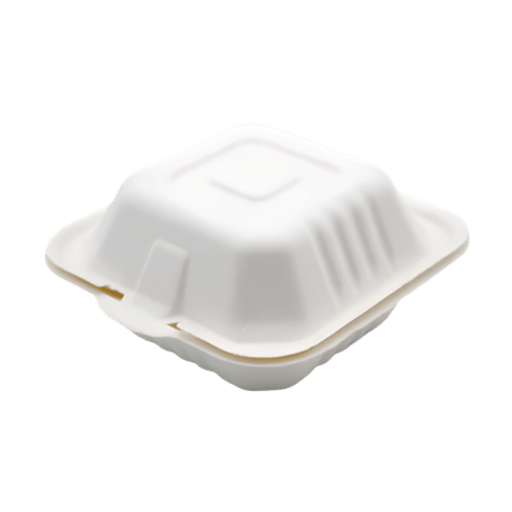
Compostable PLA is a transparent, corn- or sugarcane-based bioplastic that is food safe as certified by FDA; bagasse is the pressed fibrous material remaining after sugarcane juicing. Key distinction: clear clamshells typically sacrifice heat resistance for their clarity. For best-in-class cold item visibility, opt for PLA; for piping-hot meals, bagasse or other molded fiber options fare better. Made from a byproduct of the sugarcane harvest, these molded fiber compostable clamshell containers provide impressive strength and stackability even with a heavy load. That trade-off is structural: the crystal clarity comes from PLA’s tight polymer, which is also the reason it fails above 110°F, so in practice a bakery showcasing cold pastries and a taqueria boxing 200°F (93°C) carnitas need opposite materials for the same use case.
Certifications That Actually Matter: BPI, ASTM D6400/D6868 & PFAS-Free
A compostable claim is only as reliable as the third-party mark it carries. If you buy compostable products in the US, the two relevant standards are ASTM D6400 (for bio-based plastic products like PLA) and ASTM D6868 (for paper or fiber products with a coating or laminate). Many manufacturers use the Biodegradable Products Institute (BPI) to certify to D6400 standard-the company’s website offers additional standards such as D6868 and D8410. The easiest proof that a clamshell meets the 84-day disintegration test and the 180-day biodegradability test? The BPI logo and a lot number.
Certification isn’t the only requirement for compliance. FTC Green Guides insist on “competent and reliable scientific evidence” to back compostable claims, and require sellers to clarify the claim if a substantial majority of customers do not have access to compost facilities. Many states push further: California’s AB 1201 mandate specifies ASTM certification is required for anything labeled “compostable,” while prohibiting “biodegradable,” “degradable,” and “decomposable” claims. Washington has similar legislation. This means that a product that *is* technically certified could still be prohibited from being sold due to false claims or misleading labels. In practice, for any OEM or private-label production order, ask the supplier for the BPI certificate number and a PFAS test report before you lock a SKU.
Are there PFAS-free fiber clamshell containers?
Yes — and you should insist on them. The FDA confirmed in 2024 that grease-proofers containing PFAS are no longer sold for US paper food packaging, with 35 authorizations void by January 2025. But that phase-out targets intentionally added PFAS; it can still show up as a processing impurity, and BioCycle found over a quarter of composters reject molded fiber over PFAS risk. Demand “no added PFAS” on the spec sheet, backed by test data.
Sizing, Compartments & Lids: Spec’ing the Right Clamshell
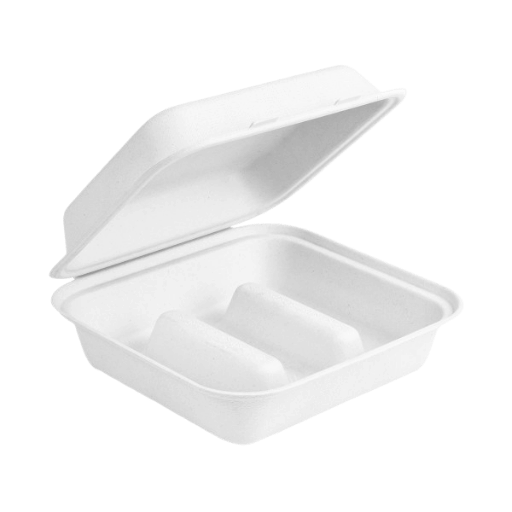
Menu needs determine the available size options beyond general catalogs. Standard size footprints include 6×6 in. (sandwiches), 8×8 in. (single dishes, burgers, combos), and 9×6 in. or 9×9 in. (large combos). The number of compartments is important to prevent cross-contamination-a one-compartment for simple items, a three-compartment if you want to keep hot and cold components separate. Use the general rule of thumb that an 8×8-inch container, depending on depth, can hold between 24 and 46 oz.
- ✔A hinged (attached) lid eliminates mismatches and speeds line service — the default for most delivery containers. Compare hinged options against separate-lid hinged lid containers for stacking efficiency.
- ✔Look for designs that allow for nested stacking to minimize storage and transport expenses by maximizing space efficiency.
- ✔A deeper configuration will greatly increase usable volume; a 3-inch deep tray has approximately double the holding capacity of a 2-inch version without requiring a larger table footprint.
Will It Hold Hot, Greasy or Wet Food? Performance Limits
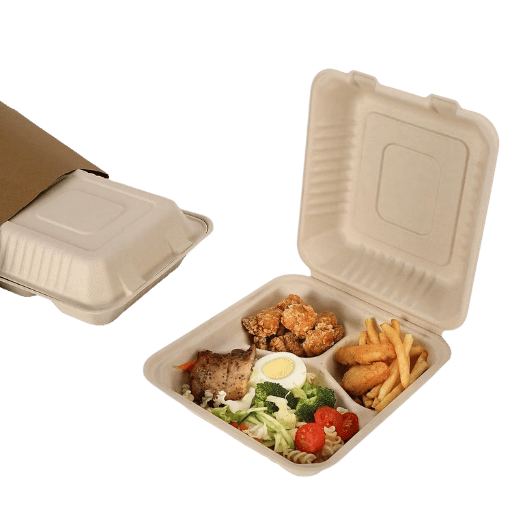
By far the most expensive mistake is filling a clear PLA container with hot food. This is The Fiber-vs-PLA 110°F Heat Line: clear PLA looks premium but softens and warps around 105–110°F — below most freshly cooked meals — causing lid failure and leaks in transit. Bagasse and molded fiber hold their shape above 200°F and stay rigid for roughly two hours at 160°F+, while resisting grease well enough for fried and saucy items.
Whether you serve hot or cold food should drive the pick. Fiber take-out containers stay safe for hot, greasy take-out food, while a clear clamshell — including clear PLA clamshells from brands such as World Centric — is built for cold food, chilled deli items, and display. Some clear options are also freezer safe and naturally grease- and moisture-resistant, which matters for food service operators sending a guest home with leftovers. For example, a delivery kitchen that packs hot pho or curry into clear PLA will watch lids bow by the third drop-off, because PLA softens below 110°F (43°C) — the reason fiber is the safer default in practice for any steam-heavy menu or high-volume production run.
“On hot-fill orders we see the same pattern every season: clear PLA fails first at the lid seal once the food crosses roughly 110°F, while bagasse from the same order line ships hot and greasy without warping. We steer hot menus to fiber and reserve PLA for cold display.”
— Wanhui Packaging Engineering Team
📐 Engineering Note
The only exception is if your menu is steaming – we offer vented bagasse or a CPLA lid which has been rated at around 185 °F (trapped steam softens every type of lid eventually), with a leak proof rim seal, and enough thickness to not collapse and to prevent stack failure. Hot food should also stay above 140°F (60°C) in transit per the FDA Food Code, a holding temperature fiber sustains far better than PLA.
Compostable vs Styrofoam & Conventional Plastic Clamshells
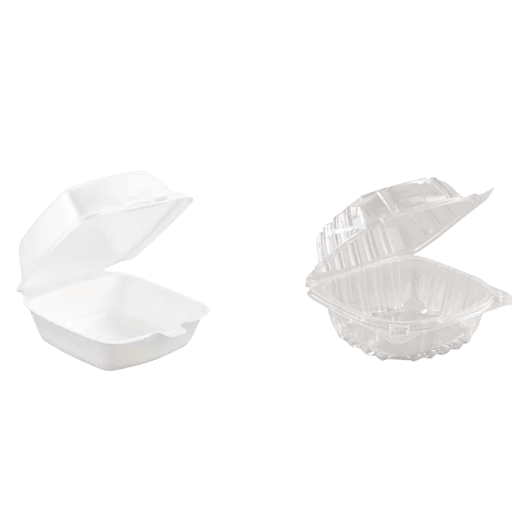
Many operators no longer have a choice: expanded polystyrene (EPS) foam foodware is now banned in at least 12 US states, and California has effectively ended EPS foodservice use through its SB 54 producer-responsibility framework after EPS failed to meet required recycling rates. Beyond compliance, the trade-offs are concrete:
✔ Advantages of compostable
- Compliant where foam/plastic is banned
- Renewable inputs; no microplastic shedding
- Brand signal customers reward
- Fiber handles hot/greasy food well
⚠ Limitations to plan for
- Higher unit cost than foam
- Only composts where facilities exist
- PLA unsuitable for hot food
- Not accepted in plastic recycling
Where Compostable Clamshells Actually Break Down: Commercial vs Home Composting
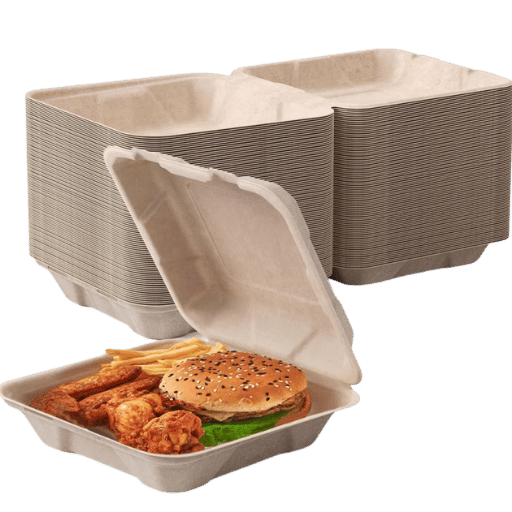
Most product pages dodge the question that decides everything: whether these containers actually compost where your customers live. Most certified compostable clamshells need an industrial facility running at roughly 55-60°C. They will not fully break down in a backyard bin, and nothing composts in a landfill. So the composting path you can reach – not the label on the box – decides the real-world outcome. In practice, one call to your regional hauler settles it before you order.
This is The Commercial-Compost Access Gap, and the numbers are sobering. According to BioCycle’s nationwide survey, only about 12% of US households have residential food-waste collection (roughly 14.9 million homes), and only around 5% of US food waste is actually composted. Even among composters, acceptance of certified compostable foodware sat at 62% of surveyed facilities (87 of 141) in 2023 — up from 48% in 2018, but far from universal. The top reason the rest refuse it: 78% cite contamination from look-alike plastics that workers and customers can’t tell apart from the certified product. The practical risk is that a buyer ships a certified box into a region with no composter, so it lands in a landfill anyway — which is why composting access, not the label, drives the real environmental outcome. In practice, one call to your regional hauler settles the question before you order.
💡 Pro Tip
Always verify a hauler or local municipality composter in your vicinity supports certified compostable foodware before committing a SKU. If your options are limited, it is honest to say so – and as per the EPA Wasted Food Scale, the primary methods to reduce food waste are source reduction and reuse over composting. Compostable single-use is a viable option when it can actually be composted; it is not automatically a positive environmentally impact.
What Compostable Clamshells Cost: Pricing, MOQ & Wholesale
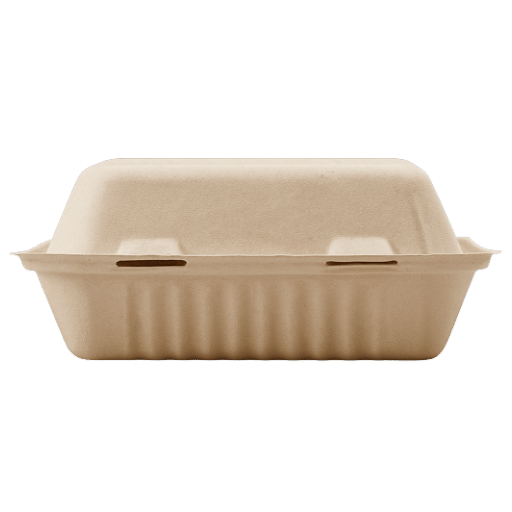
Compostable clamshell pricing varies widely, so treat any listed number as indicative and confirm landed cost for your region, order volume, and freight. As a rough guide, bagasse runs lower per unit than clear PLA, and by 2025 the gap between compostable and conventional plastic had narrowed to roughly 15% or less in many wholesale contracts.
One widely shared operator example: a fully compostable container added about $4 to a $40 order, so the kitchen switched to a hybrid – compostable base, recyclable lid – at roughly $2 per meal, a reminder that configuration, not just material, drives cost; check our wholesale food containers for volume discounts. Free shipping on a case (or more) at a number of wholesale providers also effectively reduces the per-unit shipping expense. Because distributors add a markup at each tier, a busy delivery restaurant ordering 50,000 units a month often sees the per-unit price swing more on the sourcing route than on whether the box is bagasse or PLA.
As our in-house manufacturer running twenty thermoforming lines and producing over a million units daily, we hold sturdy walls that stand up to high-pressure conditions and are watertight at volume for our customers while also absorbing the additional markups that many intermediaries carry when acting as resellers between manufacturers like ourselves and restaurants, thus bringing down per unit cost. We generally take into account MOQ and any custom tooling or print requests on orders for certified compostable clamshell food containers over other considerations.
Matching Clamshells to Your Operation: Restaurant, Deli, Delivery & Meal-Prep
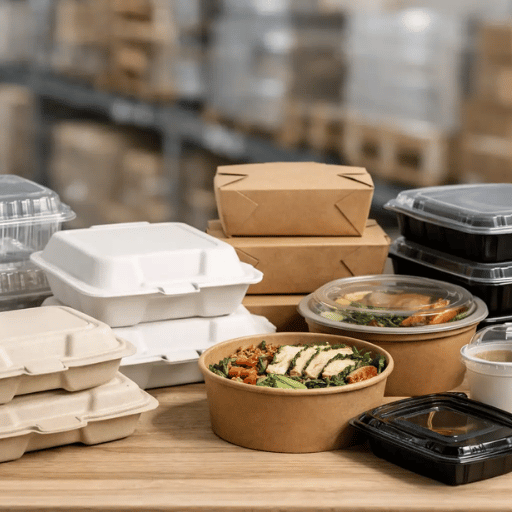
This scenario map is meant to speed up the selection process; pick an operation type for your specific needs and find your recommended specification.
| Operation | Material | Size / feature |
|---|---|---|
| Hot-food restaurant / QSR | Bagasse / molded fiber | 8×8×3, hinged, vented |
| Deli / cold grab-and-go | Clear PLA | 6×6×3, clear lid for display |
| Delivery-heavy | Bagasse, leak-proof rim | Hinged, 2–3 compartment |
| Meal-prep / catering | Fiber base + CPLA lid | 3-compartment, stackable |
| Bakery / cold display | Clear PLA | Shallow, crystal-clear |
In instances of mixed menus, numerous operators take advantage of using a single product – a hot food fiber clamshell and a clear PLA for all cold items – decreasing from typically five to two options on their packaging menus. Branded prints and custom mold production begin to pay for themselves in cases where a single SKU begins to sell at volumes over three- hundred thousand pieces; look into our custom food packaging guides for an overview of mold tools and how long each can take, in addition to all the additional products our wider eco-friendly food packaging product range offers to pair with it. A deli running cold grab-and-go can standardize on a 6×6×3 clear PLA clamshell, while a QSR plating hot burgers needs an 8×8×3 vented bagasse box, because the heat and moisture profiles are completely different.
What’s Changing in 2026: Foam Bans, PFAS Rules & EPR
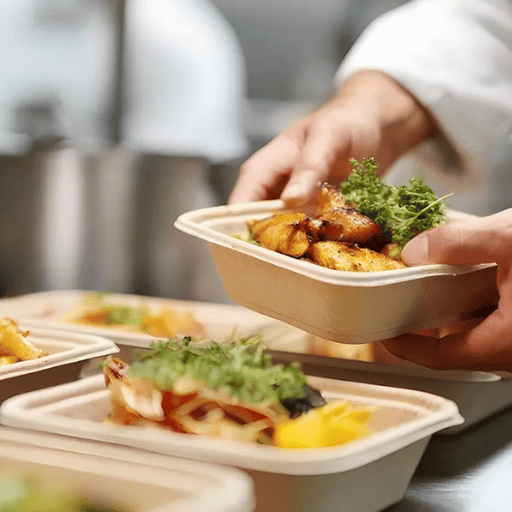
Regulation, not search trends, is the decisive force in this category. Three shifts should shape any 2026 sourcing decision: spreading EPS foam bans, tightening PFAS rules, and extended producer responsibility (EPR). Each one pushes buyers toward certified, documented PFAS-free compostable formats whether they are ready or not.
The overriding factor driving purchasing trends within this market isn’t consumer demand, but instead legislative mandates and environmental regulations. You will want to base any sourcing decision made for the upcoming 2026 year on these three policy-related trends that will undoubtedly play a significant role: 1) continue widespread EPS foam ban enforcement- more than twelve states have passed legislation that restricts Styrofoam food ware and California, has also removed the usage of said products from its inventory with its new SB 54 laws – pushing companies into compostable and PLA alternatives even if they aren’t fully prepared; 2) ever tightening pfas restrictions-FDA rules regarding grease-proofing methods are now further augmented by several states, such as New York as of 2022, California as of 2023, Colorado, Maryland, as well as Minnesota, all since 2024, including Oregon and Rhode Island as of next year, 2025, even Maine will be imposing similar restrictions on plant fiber products as of 2026, so selecting a fiber clamshell without any form of “no added PFAS” certification presents future problems. 3) expansion of EPR – this mandate involves the passage of such legislation as California’s SB 54 to shift end of life (EOL) costs directly onto product manufacturers which would make both truly compostable and recyclable products more appealing.
What this means for a buyer : The safe & sustainable 2026 spec is certified compostable( ASTM D6400/D6868, BPI ), documented PFAS-free, and labeled to the strictest state you ship into. Compostable foodservice packaging market size projections differ tremendously and should be seen only as an indicator; regulatory drivers are what you want to focus on, above. Buyers feel this directly, because a fiber clamshell without documented “no added PFAS” turns into a compliance risk the moment a state ban takes effect. In practice, that makes a certified, PFAS-documented spec the safe default for any 2026 production order.
Frequently Asked Questions
Q: What is the difference between biodegradable and compostable clamshells?
View Answer
Compostable clamshells are certified to break down into clean compost under set conditions — under ASTM D6400 that means 90% disintegration in 84 days and 90% biodegradation in 180 days at a commercial facility. “Biodegradable” carries no time limit or residue guarantee, so a biodegradable container can take years and leave fragments. Everything compostable is also biodegradable, but the reverse is never true — which is why a certified mark matters more than a green graphic.
Q: What is compostable clamshell packaging made from?
View Answer
Most are made from sugarcane bagasse, molded plant fiber, or wheat-straw fiber for hot food, or from PLA — a clear bioplastic made from plant sugars like corn and sugarcane — for cold items. CPLA, a heat-treated form of PLA, suits warm food and lids, while all of them stay plant-based and renewable rather than petroleum foam or plastic.
Q: What types of food can go in compostable clamshell containers?
View Answer
Bagasse and molded fiber handle hot, greasy and saucy food — burgers, fried items, full entrees — because they tolerate temperatures above 200°F. Clear PLA suits cold or room-temperature food such as salads, fruit and cold bakery items, since it softens around 105–110°F. Simplest rule: match the material to the food’s serving temperature first.
Q: Do compostable clamshells help with plastic and foam bans?
View Answer
Yes. Certified compostable clamshells are a compliant replacement in the 12-plus states that ban EPS foam foodware, as long as the printed labeling also meets each state’s certified-compostable claim and logo rules. Always confirm the specific statute you ship into.
Q: What makes compostable clamshells better than traditional plastic?
View Answer
They are made from renewable plant material rather than petroleum, shed no microplastics as they break down, and — where industrial composting exists — can divert food-soiled packaging from landfill that plastic never leaves. They also keep operators compliant with spreading foam and PFAS rules. One honest caveat: the benefit depends on composting access, since a certified clamshell sent to landfill behaves like any buried waste. For hot, greasy food, fiber also beats thin plastic on rigidity.
Q: How long do compostable clamshells take to break down?
View Answer
In a commercial facility, ASTM D6400 products reach 90% disintegration in about 84 days and 90% biodegradation within 180 days, with bagasse usually faster than PLA. In a home bin or landfill, they may not fully break down at all.
About This Analysis
The material, heat and certification guidance here reflects 20 years of manufacturing disposable and compostable food containers at Wanhui, including the hot-fill leak patterns we track across thermoforming and bagasse production lines. Composting-access and regulatory figures are drawn from public BioCycle, FTC, EPA, FDA and state sources cited through out. Reviewed by the Shandong Wanhui Environmental Protection Technology technical team.
References & Sources
- Environmental Claims: Summary of the Green GuidesUS Federal Trade Commission
- Composting & the Wasted Food ScaleUS Environmental Protection Agency
- Market Phase-Out of Grease-Proofing PFASUS Food and Drug Administration
- ASTM D6400 Standard SpecificationASTM International
- Commercial Compostability CertificationBiodegradable Products Institute
- Residential Food Waste Collection Access in the U.S.BioCycle
- AB 1201 Compostability & Biodegradability LabelingCalifornia Legislature
Related Articles
- Compostable To-Go Containers: A Sourcing Guidebroader takeout formats
- Disposable Food Containers Guidefull container landscape
- Biodegradable Food Containershow the terms differ in practice
- Eco-Friendly Food Boxesfolded-carton alternatives