Get in touch with Wanhui Company


Updated August 2026
Comparing EXW, FOB, and DDP food packaging quotes from price only offers a flawed picture. The proper method is to agree to an exact clause, including the same exact named place/port, same cargo data, same importer arrangement, and the same list of inclusive services, before comparing costs.
FOB vs EXW vs DDP food packaging describes three different handover boundaries. Normalize each quote to the same destination and cargo basis, then check risk, customs capability, food-contact evidence, and excluded charges before selecting a term.
Quick buyer brief
- Most overlooked: DDP convenience does not prove that a lawful importer, correct tax treatment, or suitable food-contact evidence is in place.
- Container caution: FOB is for sea or inland-waterway transport, but FCA may fit better when containers are handed to a carrier before loading on board.
- Cost rule: compare one named destination, one quantity, one carton plan, and one exclusion list.
- Contract rule: Incoterms do not settle payment, title, product specifications, remedies, sanctions, or governing law.
FOB vs EXW vs DDP at a Glance
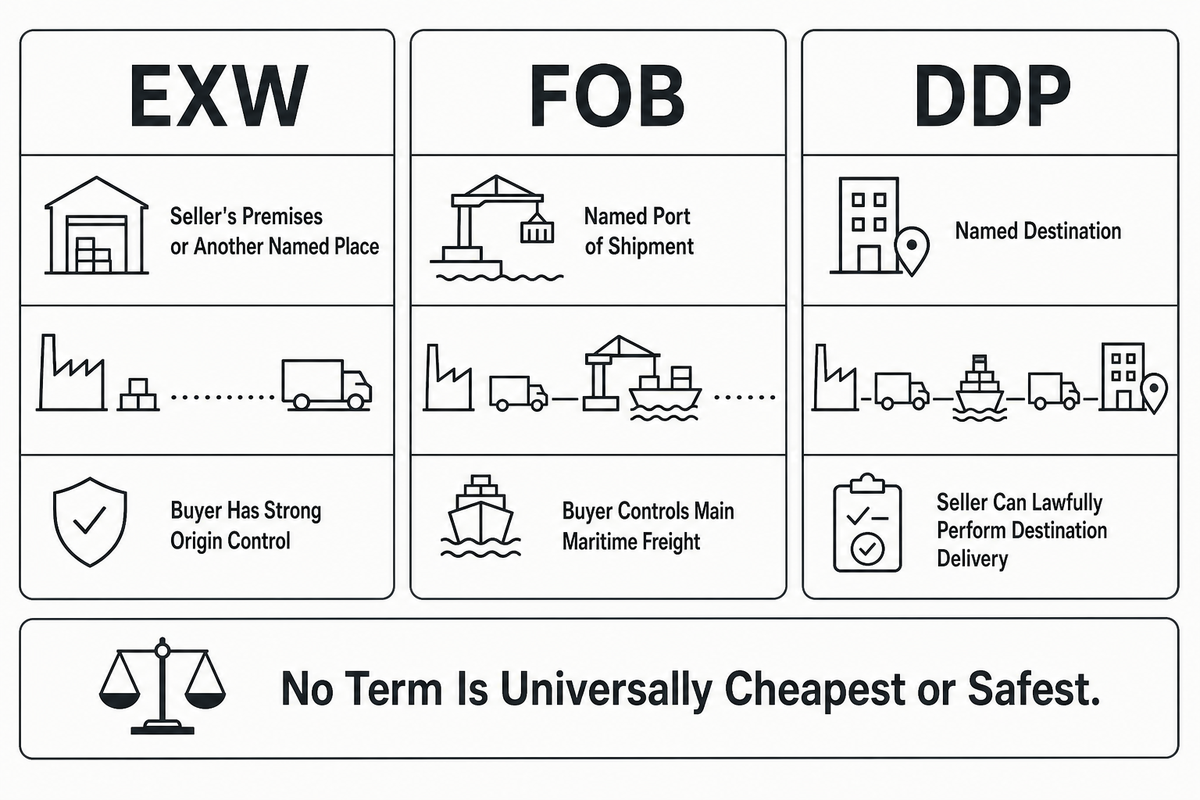
EXW, FOB, and DDP divide delivery, cost, and risk at different points. EXW places the smallest transport obligation on the seller, FOB carries the goods through on-board delivery at the named loading port, and DDP gives the seller the broadest obligation through the named destination.
With the contract limits separated from the delivery rule, the comparison can focus on each named point and responsibility boundary.
| Responsibility type | EXW | FOB | DDP | Limitations / verify |
|---|---|---|---|---|
| Named point | Seller’s premises or another named place | Named port of shipment | Named destination | A city alone may be too vague. |
| Factory loading | Normally buyer’s cost and risk | Seller arranges the origin movement | Seller arranges origin movement | Write any loading variation into the contract. |
| Export clearance | Buyer under the rule | Seller | Seller | Origin law can impose separate duties. |
| Main carriage | Buyer | Buyer | Seller | Confirm route, mode, validity, and surcharges. |
| Import clearance | Buyer | Buyer | Seller under the rule | DDP may be impractical under local law. |
| Duties and tax | Buyer | Buyer | Seller under the rule | Confirm VAT/GST recovery and invoice treatment. |
| Final delivery | Buyer arranges | Buyer arranges | Seller to named destination | Appointments, liftgates, and unloading may differ. |
| Risk transfer | At delivery at the named place | When goods are on board | At delivery at the named destination | Risk and freight payment are not the same. |
| Cargo insurance | Buyer decides after early risk transfer | Buyer normally arranges for onward exposure | Seller may insure its own delivery exposure | Check the actual policy, insured value, and exclusions. |
| Best starting use | Buyer has strong origin control | Buyer controls main maritime freight | Seller can lawfully perform destination delivery | No term is universally cheapest or safest. |
U.S. International Trade Administration guidance summarizes the mode distinction: EXW and DDP may be used with any mode, while FOB is limited to sea and inland-waterway transport. Always write the rule, named point, and “Incoterms 2020” together.
A responsibility table is not a complete contract
Incoterms do not determine product specifications, inspection and acceptance, payment, ownership transfer, breach remedies, sanctions, prohibitions, force majeure, dispute resolution, or governing law. Those subjects need separate terms in the sales contract.
“Incoterms® do not constitute a complete contract of sale, but rather become a part of it.”
Where Each Term Hands the Shipment Over
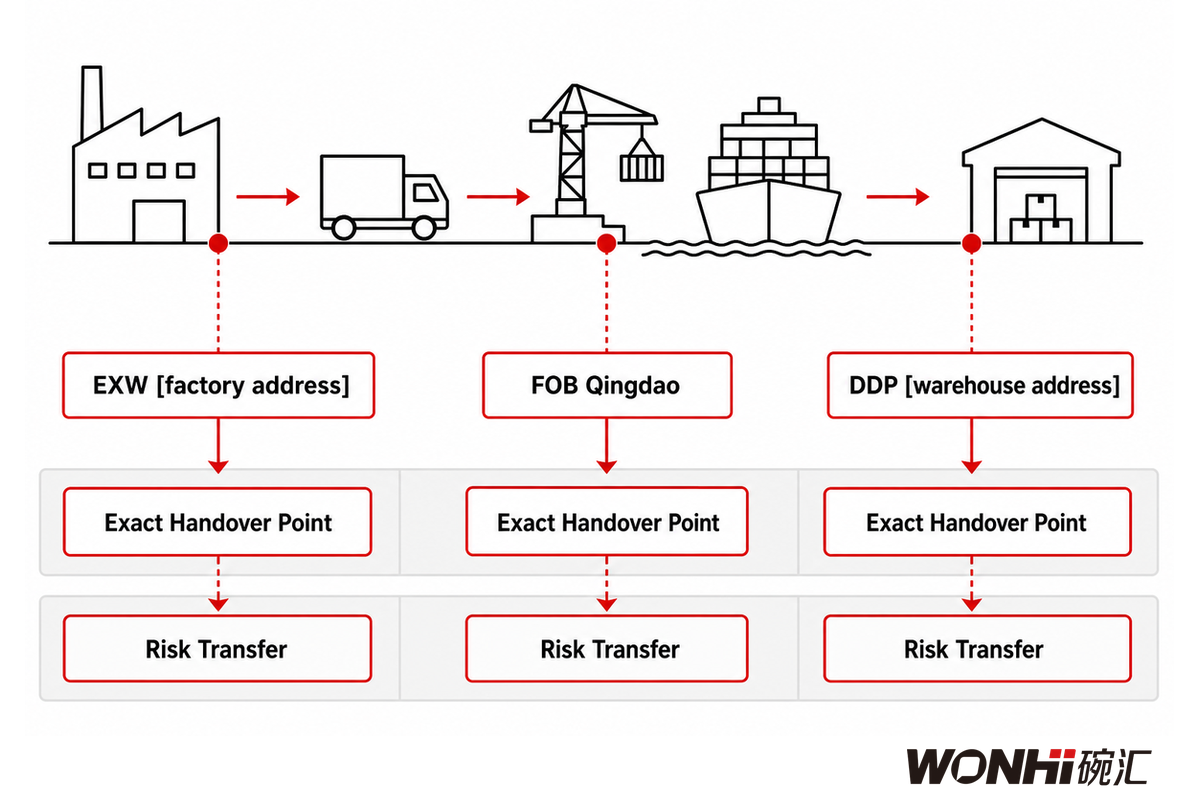
Seller delivery moves from the named factory or place under EXW, to on board the vessel at the named loading port under FOB, and to the named destination under DDP. That point controls risk transfer, but it does not answer every cost or legal question.
That responsibility comparison becomes operational only when the parties identify the exact handover point.
EXW [factory address]
Goods are made available at the stated point. Unless the parties write a variation, the buyer bears loading and onward arrangements.
FOB Qingdao
Under Free on Board, the seller delivers when the goods are on board the nominated vessel at the named port of shipment.
DDP [warehouse address]
Under Delivered Duty Paid, the seller carries risk through arrival at the named destination, ready for unloading, and handles import formalities if legally possible.
Supplier-language decoder
Ex Works is the full name behind EXW; Free on Board is FOB; Delivered Duty Paid is DDP. Under EXW terms, the seller makes goods available at the named place. FOB means the seller moves goods to the port and completes export customs clearance until the goods are loaded onto the vessel. Once loaded onto the ship, the buyer normally controls the main carriage and import customs.
When comparing EXW and FOB, do not compare the EXW price with the FOB price until origin shipping costs are added. A request that says “quote EXW” should identify loading, pickup, and export clearance. A freight forwarder can coordinate the shipping process, but the shipping terms still decide responsibility on the seller and responsibility on the buyer.
International shipping requirements extend beyond the rule name. EXW and FOB may give an experienced buyer more control over shipping costs, while DDP can mean limited control over shipping. Under DDP, the seller is responsible for freight to the named destination and takes maximum responsibility for delivery, but DDP compliance and insurance coverage still need separate proof.
Search shorthand varies: “FOB vs EXW,” “EXW vs FOB,” “FOB and EXW,” “FOB or EXW,” “FOB vs DDP,” “EXW vs DDP,” and “FOB or CIF” all need a named-point analysis. A “DDP vs FOB destination” question must fix the destination, while “FOB vs Ex Works” or “FOB vs DAP vs DDP” must separate shipment and destination obligations. EXW Incoterms may give the buyer’s forwarder more control over the shipping process, but no rule controls every aspect of the shipping. Record the seller’s export and import scope to the final destination and cargo-insurance decision on separate lines.
A buyer who writes only “FOB China” has not fixed the port. A seller who writes only “DDP USA” has not fixed the delivery address, unloading condition, appointment requirement, or exceptional-charge boundary. Precision changes who must act when a terminal, warehouse, or customs broker requests instructions.
Some buyers can manage origin pickup directly; others prefer supplier-managed export steps before taking control of the shipment.
Statutory rules sit beside the commercial term. For example, U.S. Bureau of Industry and Security rules for routed export transactions show that appointing an agent does not automatically relieve every party of export-control responsibility. That U.S. example should not be copied to China or another origin without checking the applicable law.
Common failure: the purchase order, supplier invoice, and forwarder booking show different terms or named points. Reconcile all three before cargo moves.
Is FOB the Right Rule for Containerized Food Packaging?
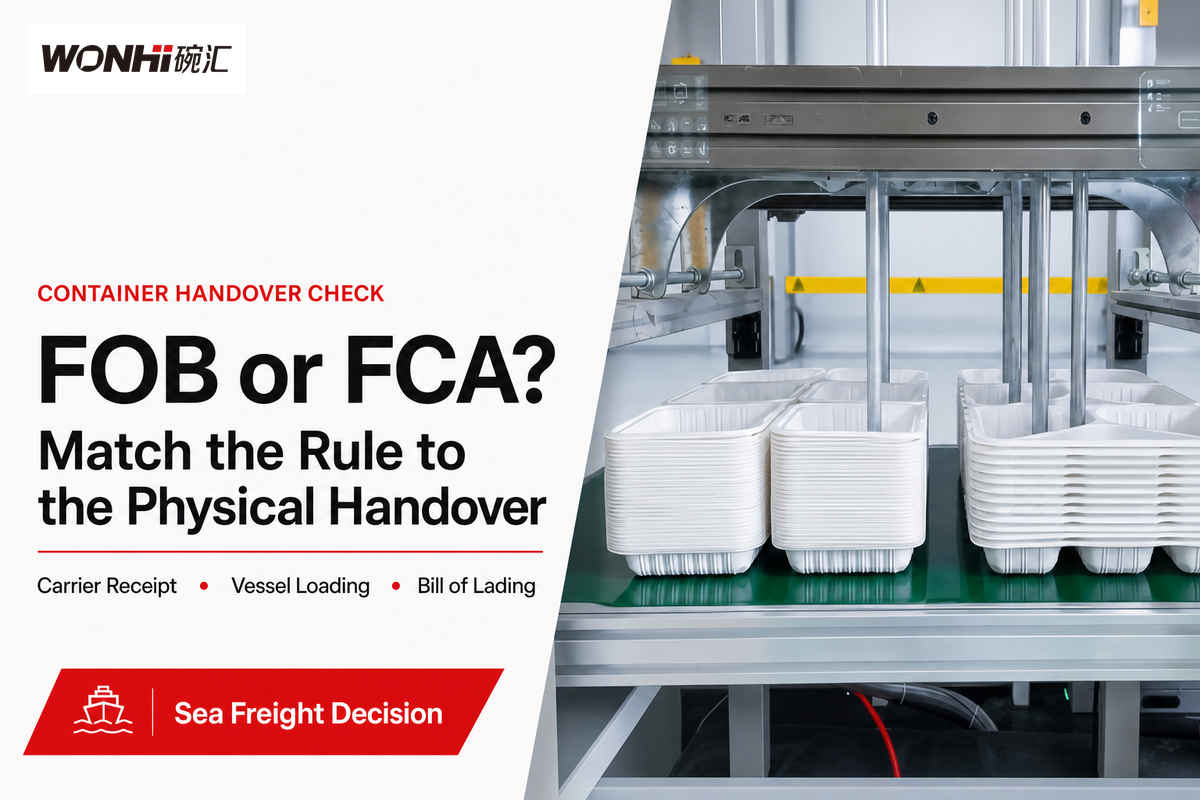
FOB can be used for maritime cargo, but it may not match a container handed to a carrier or terminal before the seller can deliver it on board. ICC guidance points buyers toward FCA when the real handover occurs earlier, while allowing parties to address on-board bill-of-lading needs.
That handover analysis matters most when a container leaves the supplier’s control before vessel loading.
Disposable food boxes and bowls are often shipped as containerized cargo rather than as loose bulk commodities directly beside a vessel. If the supplier loses physical control at a container yard before loading, an FOB contract can leave the contractual delivery point later than the operational handover.
FOB / FCA checkpoint
- Where does the carrier first receive the packed containers?
- Can the seller maintain control of the cargo until it is on board the designated vessel?
- Does a bank need an on-board bill of lading, and has that document path been settled?
- Is the move really sea or inland-waterway, and not air, rail, or courier?
A practical answer is not “FOB is wrong for every container.” It is “match the rule to the handover.” Review the ICC’s FCA and on-board bill-of-lading explanation, then ask the supplier and forwarder to confirm the physical chain.
Normalize Landed Cost with the Named-Point Bridge
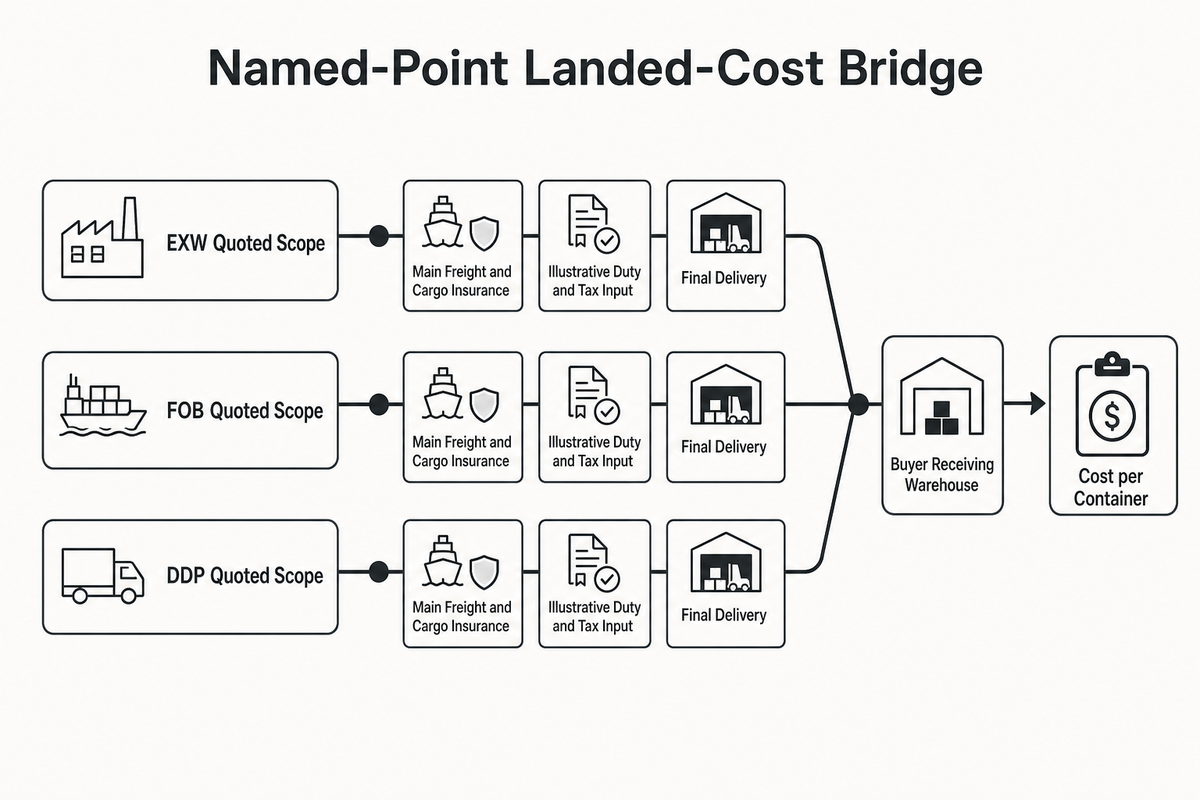
The Named-Point Landed-Cost Bridge adjusts EXW, FOB, and DDP pricing to the same destination and commodity basis. Add all the costs between each quoted boundary and the comparison destination, list any exclusions, and divide the total landed cost by the same number of usable units.
Once the operational handover matches the shipping chain, every quote can be normalized to the same destination boundary.
Named-Point Landed-Cost Bridge
The Named-Point Landed-Cost Bridge is a quote-normalization method that moves different Incoterm prices to the same destination boundary.
Consider an order of 100,000 food containers with a quote valid for 30 days. The following numbers are illustrative only, not a freight quotation, duty calculation, or Wanhui shipment record. The comparison point is the buyer’s receiving warehouse.
| Illustrative cost line | EXW | FOB | DDP |
|---|---|---|---|
| Quoted product / service scope | $9,600 | $10,250 | $13,900 |
| Factory loading and origin pickup | +$420 | Included | Included |
| Origin handling and export clearance | +$380 | Included | Included |
| Main freight and cargo insurance | +$1,650 | +$1,650 | Included* |
| Destination handling and broker | +$540 | +$540 | Included* |
| Illustrative duty and tax input | +$760 | +$760 | Included* |
| Final delivery | +$310 | +$310 | Included* |
| Normalized total | $13,660 | $13,510 | $13,900* |
| Cost per container | $0.1366 | $0.1351 | $0.1390* |
“Included” must be confirmed in writing. The DDP total is different if the quote does not include examination, storage, tax recovery, appointment, unloading, remote-area, or re-delivery charges.
Straight arithmetic gives $13,510 ÷ 100,000 = $0.1351 per container. Harder work lies in fixing the same carton plan, delivery address, quotation date, validity window, and customs assumptions. Use Wanhui’s food packaging landed-cost estimator or the FOB-to-landed-cost calculator after suppliers provide complete cargo data.
For U.S. imports, CBP notes that an examination can create movement, unloading, reloading, and storage costs. Its importer and exporter guidance supports adding an exceptional-charge row without inventing an amount.
Risk Transfer and Cargo Insurance Are Separate Decisions
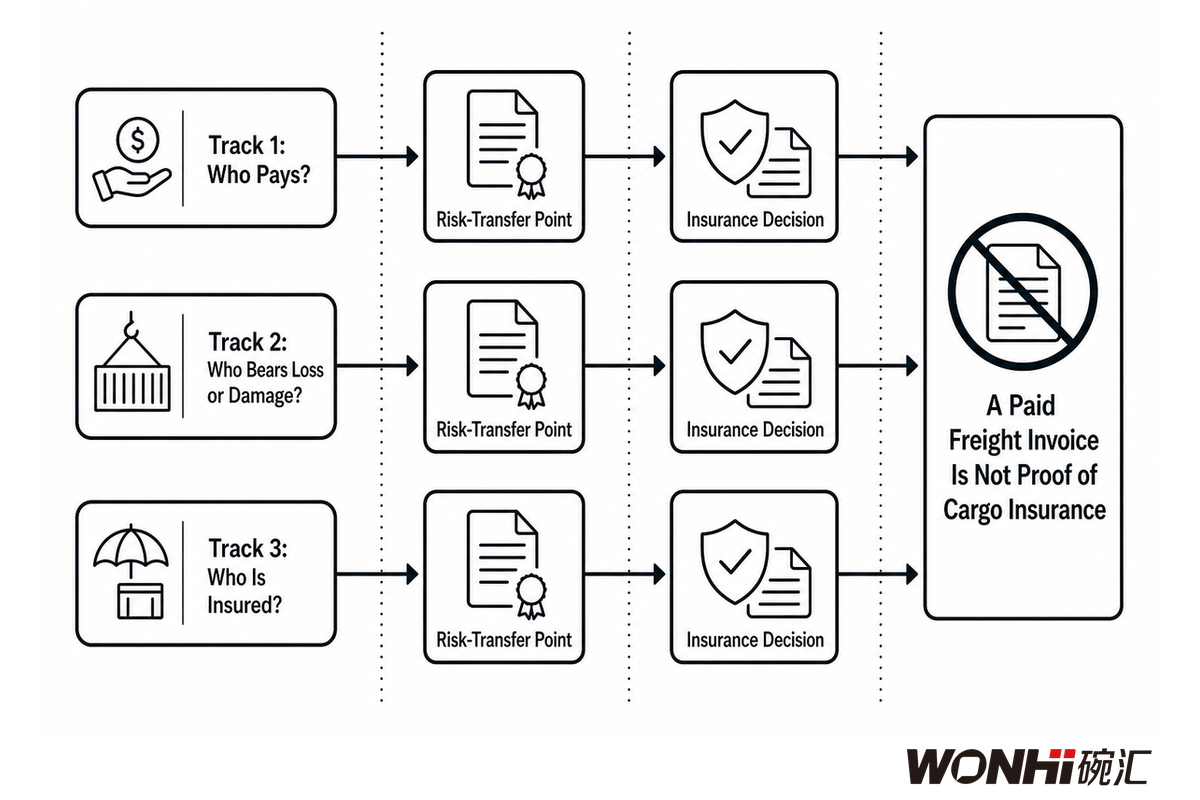
Risk transfer does not necessarily follow the party paying the longest freight leg. Under FOB, for instance, the buyer can assume cargo risk after on-board delivery and pay main carriage; under DDP, the seller assumes delivery risk to the named destination but may insure that exposure for itself.
The normalized landed-cost total still does not show who bears loss in transit, so risk transfer and insurance need a separate check.
Track 1: who pays? Record origin, main carriage, destination, duty/tax, and final-mile payment separately.
Track 2: who bears loss or damage? Record the contractual delivery point and the exact moment risk moves.
Track 3: who is insured? Check insured party, voyage, value basis, deductible, exclusions, claim documents, and notification deadline.
A procurement team may accept FOB Qingdao and then assume the supplier’s freight relationship protects the shipment until arrival. That is the wrong question. The purchase order should identify on-board risk transfer, while the buyer’s policy or forwarder arrangement should cover the voyage from that point. A paid freight invoice is not proof of cargo insurance.
Key takeaway: put the risk-transfer point and insurance decision on different lines of the quote comparison.
DDP Does Not Erase Customs, Tax, or Food-Contact Duties
A DDP quotation assigns import formalities and delivery obligations under Incoterms to the seller. It cannot prove the proposed importer arrangement is lawful, tax treatment is complete, or food-contact materials comply for the buyer’s destination, food type, temperature, and intended use.
Insurance is only one frontier in the previous section; customs, tax, and product conformity each need their own evidence and accountable party.
ICC guidance on EXW and DDP warns that a foreign seller may encounter difficulties completing import formalities or tax obligations. A lawful alternative such as DAP may better suit the situation when the buyer needs to act as importer, but that is a transaction-specific issue.
| Check | Incoterm allocation | Separate legal or technical question | Evidence to request | Limitation / not suitable when |
|---|---|---|---|---|
| Importer identity | Seller handles import under DDP | Who may legally enter the goods? | Legal name, number, broker authority | Seller cannot lawfully act or appoint the party. |
| Tariff classification | Not determined by the term | Which code fits actual goods? | Product description and ruling/advice | Quote relies on an unverified generic code. |
| Duty basis | Seller pays under DDP | Is value and origin treatment correct? | Entry basis and origin records | Assumptions are hidden or under-declared. |
| VAT/GST/sales tax | Seller bears named import taxes under DDP | Who registers, invoices, and recovers tax? | Tax registration and invoice path | Buyer cannot recover embedded tax as expected. |
| Customs examination | Term alone may not list exceptions | Who pays movement and storage? | Written exceptional-charge clause | “All in” excludes unpredictable charges. |
| Resin and additives | Outside Incoterms | Are all components authorized? | Composition and authorization basis | Only the finished-item name is supplied. |
| Manufacturer linkage | Outside Incoterms | Can the authorization be relied on? | Supplier/manufacturer traceability | Evidence belongs to another manufacturer. |
| Conditions of use | Outside Incoterms | Which food, time, and temperature? | Use conditions and test support | Room-temperature evidence is used for hot fill. |
| Destination documentation | Outside Incoterms | Which declaration, test, or traceability records apply? | Market-specific document set | A generic “food grade” statement is the only proof. |
In the United States, FDA says the status of a food-contact article depends on each substance in it. Its component-status guidance also explains that many Food Contact Substance Notifications are specific to the named manufacturer, substance, and conditions of use.
EU rules use another framework. The European Commission’s food-contact legislation overview covers good manufacturing practice, traceability, compliance documentation, and migration support for relevant materials. Neither example creates a worldwide certificate.
Buyers focused on the U.S. can pair this section with Wanhui’s guide to food-container import tariffs from China. Confirm the current code, origin, rate, and special measures for the actual shipment.
Food-Packaging Details That Change Freight per Unit
Food-container freight comparisons require more than product weight. Units per carton, packed outer dimensions, gross weight, total CBM, pallet arrangement, stack height, loading technique, and deformation protection all influence the cargo basis that a forwarder can quote and a buyer can compare. For palletized shipments, assess pallet strapping and stretch film from UD Packaging against that cargo record, including carton compression limits and the finished stack dimensions.
After compliance responsibilities are separated, packed dimensions establish the freight basis used in every supplier quote.
Food-Packaging Cargo Basis Card
- SKU and material
- Order quantity
- Units per carton
- Number of cartons
- Outer L × W × H
- Net and gross weight
- Total CBM
- Pallet quantity and footprint
- Maximum stack height
- Floor-loaded or palletized
- Compression/deformation protection
- Receiving-site constraints
Worked Example: RFQ Cargo Data String
For a quote-comparison exercise, a buyer might specify a 750 mL bowl, 100,000 units, 500 units/carton, and 200 cartons. If each carton is 60 cm × 40 cm × 35 cm and 8.4 kg gross, the stated totals are 1,680 kg and 16.8 m³ before pallet effects.
Record 7.6 kg net/carton, 0.8 kg tare/carton, 1,520 kg net/order, and 160 kg packaging/order in the weight breakdown. Volume lines would then show 0.084 m³/carton, 0.84 m³/pallet, and 84 kg gross/pallet.
For pallet planning, state a 1.2 m × 1.0 m footprint, 1.6 m maximum stack height, 10 cartons/pallet, and 20 pallets. Schedule fields might add 5 days for sample review, 30 days for production, a booking buffer of 7 days, a document cutoff of 48 hours, an appointment window of 24 hours, packing-data confirmation within 12 hours, booking confirmation within 72 hours, document review after 14 days, and a surcharge-validity field of 60 days. These figures are illustrative RFQ inputs, not a Wanhui shipment record or live freight quote.
Two suppliers may quote the same 750 ml bowl at nearly the same unit price while using different nesting counts and cartons. If one plan needs 220 cartons and another needs 180 for the same sellable quantity, the freight comparison changes before any Incoterm is applied. Ask for packed measurements, not catalogue dimensions.
For an illustrative 60 cm × 40 cm × 35 cm carton, volume is 0.60 m × 0.40 m × 0.35 m = 0.084 m³. Multiply that packed-carton figure by carton quantity, then add any pallet footprint or stack-height effect before asking for freight.
Wanhui’s supplied company profile states 20 years in food-packaging containers, 20 thermoforming lines, 6 sheet-extrusion lines, and 60 injection-molding lines. It also states daily sheet output above 30 tons and processing capacity above 1 million units. These first-party figures describe production context; they do not prove container utilization, delivery time, freight savings, or defect rates.
Choose by Scenario with the 5-Gate Term-Fit Matrix
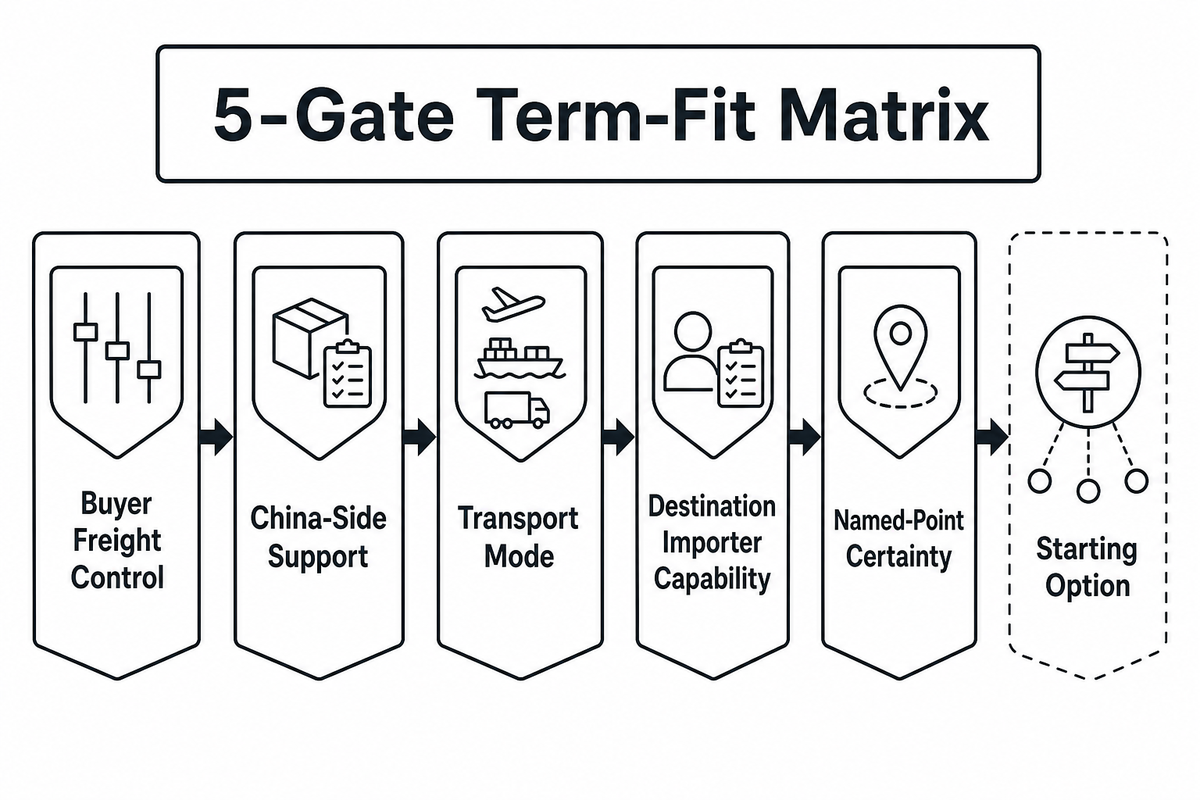
The 5-Gate Term-Fit Matrix chooses a starting Incoterm for food packaging imports by testing buyer freight control, China-side support, transport mode, destination importer capability, and named-point certainty. It is a logistics screen, not a complete contract or a substitute for sanctions, export-control, tax, or product-compliance due diligence.
With the food-packaging cargo basis visible, the remaining question is whether each party can perform the assigned freight and import duties.
After the cargo-basis assumptions are established, the next step is to decide whether both buyer and seller can execute the duties assigned under the offer.
5-Gate Term-Fit Matrix
The 5-Gate Term-Fit Matrix tests whether a delivery term fits the actual operating capabilities on both sides of the transaction.
| Buyer scenario | Starting option | Why it may fit | Verify first | Limitations / not suitable for |
|---|---|---|---|---|
| New importer with no origin agent | FOB/FCA or lawful delivered option | Avoids unsupported EXW pickup | Handover, importer, broker, exclusions | DDP fails if destination importer setup is not lawful. |
| Experienced buyer with China-side forwarder | EXW or FCA | Buyer controls origin consolidation | Loading and export-clearance capability | Poor fit without cooperative export documents. |
| Buyer controls ocean contract | FOB or FCA | Keeps main freight visible | Container handover and named port | FOB does not fit air or rail; FCA may fit container yards. |
| Multiple suppliers consolidated in China | EXW/FCA to consolidation point | One forwarder coordinates combined cargo | Pickup windows, export party, carton labels | Fails when origin coordination is not staffed. |
| Restaurant chain wants warehouse delivery | DDP or DAP discussion | Reduces handoffs for procurement | Importer, tax, appointment, unloading | A vague door promise is not sufficient. |
| Airfreight sample or urgent replenishment | EXW, FCA, or delivered rule | Uses an any-mode term | Chargeable weight and handover | FOB is not an airfreight rule. |
| Buyer requires tax-recovery evidence | Buyer-import DAP/FOB/FCA path may fit | Keeps entry and tax records visible | Local tax advice and importer role | Do not choose solely from a lower delivered price. |
| Destination has difficult import restrictions | Buyer-controlled import path | Places formalities with capable party | Licenses, prohibitions, broker opinion | DDP may be legally or operationally impossible. |
| Price comparison lacks carton data | No selection yet | Prevents false landed-cost certainty | Cargo Basis Card and dated quotes | Any term decision is premature. |
When not to choose from the term name alone
Do not select EXW because the factory price is lowest, FOB because it is familiar, or DDP because it sounds all-inclusive. Pause when the named point is vague, the cargo basis differs, the seller cannot name the importer, the tax invoice path is unclear, or the food-contact evidence does not match the material and intended use.
A distributor comparing three offers may see DDP only 2% above FOB and treat the difference as an easy decision. If the DDP seller cannot show the importer arrangement or valid tax treatment, the apparent saving is not a comparable service. The right next step is evidence, not a different spreadsheet color.
Put Seven Checks in the RFQ and Purchase Order
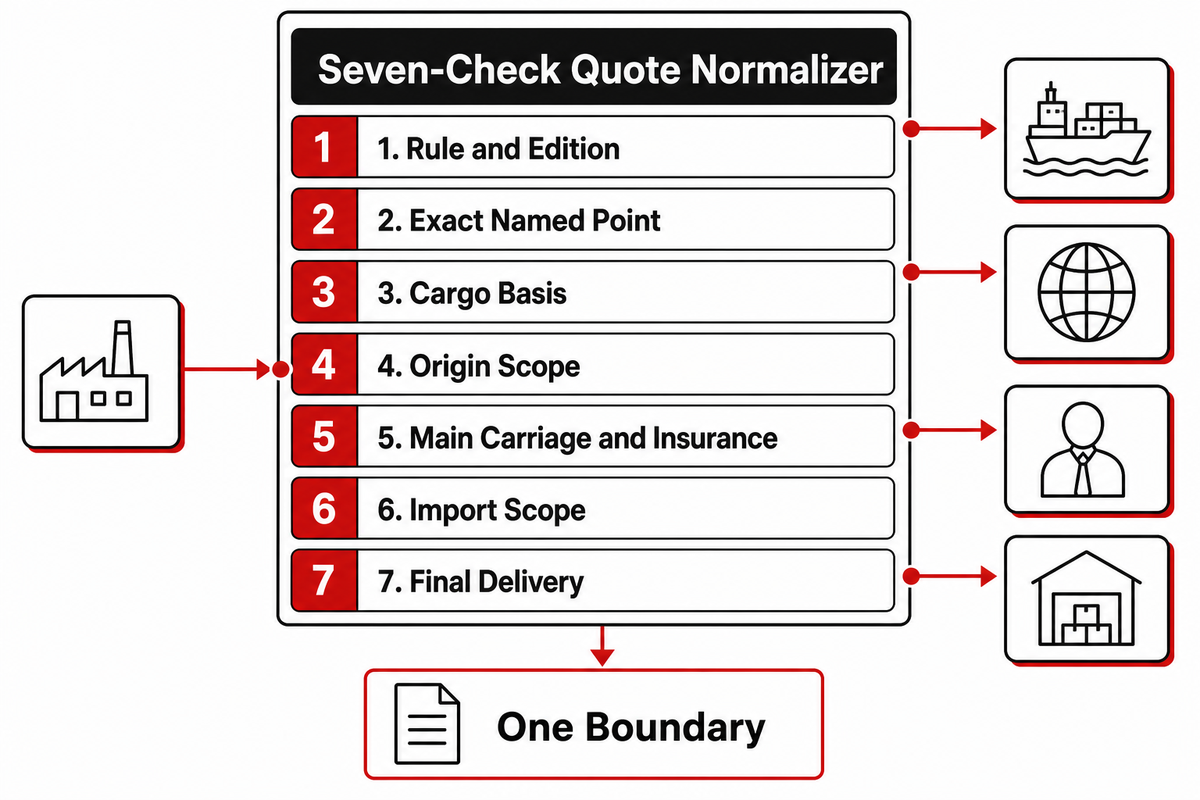
A comparable RFQ states the Incoterm and edition, exact named point, cargo basis, origin scope, main freight and insurance, importer and destination-charge scope, plus final-delivery exceptions. Copy those seven fields into the purchase order so the supplier, forwarder, broker, and receiving site use one boundary.
Seven-Check Quote Normalizer
The Seven-Check Quote Normalizer turns a delivery-term label into fields that a buyer can compare and audit.
- Rule and edition: EXW, FOB, or DDP, Incoterms® 2020.
- Exact named point: full factory address, loading port, or destination address.
- Cargo basis: SKU, quantity, units/carton, outer dimensions, gross weight, CBM, pallet plan, and quote validity.
- Origin scope: loading, pickup, handling, export clearance, documents, and exceptions.
- Main carriage and insurance: route, mode, service level, insured party, value, deductible, and exclusions.
- Import scope: importer, broker, classification basis, duty/tax, destination charges, and examination/storage treatment.
- Final delivery: appointment, access, liftgate, unloading, remote-area, re-delivery, and delay exclusions.
After those seven logistics checks, add the subjects outside Incoterms: product specification, approved sample, inspection and acceptance, payment, title, remedies, force majeure, sanctions and prohibitions, governing law, dispute resolution, statutory export duties, and destination food-contact evidence.
When product, carton, and destination data are ready, request a custom food packaging quotation on one clearly stated term. If you also compare CIF, keep that adjacent intent in the FOB vs CIF landed-cost estimator rather than mixing four rules in one quote table.
Frequently Asked Questions
These short answers keep the same named-point, jurisdiction, and evidence boundaries used in the comparison above.
Are FOB and DDP the same?
Short answer
No. FOB delivers goods on board at the named port of shipment, after which the buyer controls main carriage and import. DDP carries the seller’s delivery obligation to the named destination and assigns import formalities to the seller, subject to destination-law feasibility. The named point and actual service inclusions still have to be written precisely.
Who is the Importer of Record under DDP?
Short answer
The actual importer of record depends on destination law and the entry arrangement, not the DDP label alone. The seller must handle import formalities under DDP, but a foreign seller may be unable to act directly. Require the importer’s legal identity, broker authority, tax registration or representation where relevant, classification basis, entry-record access, and responsibility for examinations or storage before accepting the quote. In the United States, CBP says the importer of record remains responsible for entry accuracy and applicable duties, taxes, and fees even when a licensed customs broker is used. Other countries define the role differently, so obtain destination-specific advice.
Is FOB better than EXW for new importers?
Short answer
FOB may reduce origin work because the seller handles export clearance and delivers on board, but it is not automatically better. New importers still need a forwarder, broker, insurance decision, and destination-cost plan. For container handover before loading, ask whether FCA is the more accurate rule for the actual shipment.
Choose the Boundary, Then Compare the Price
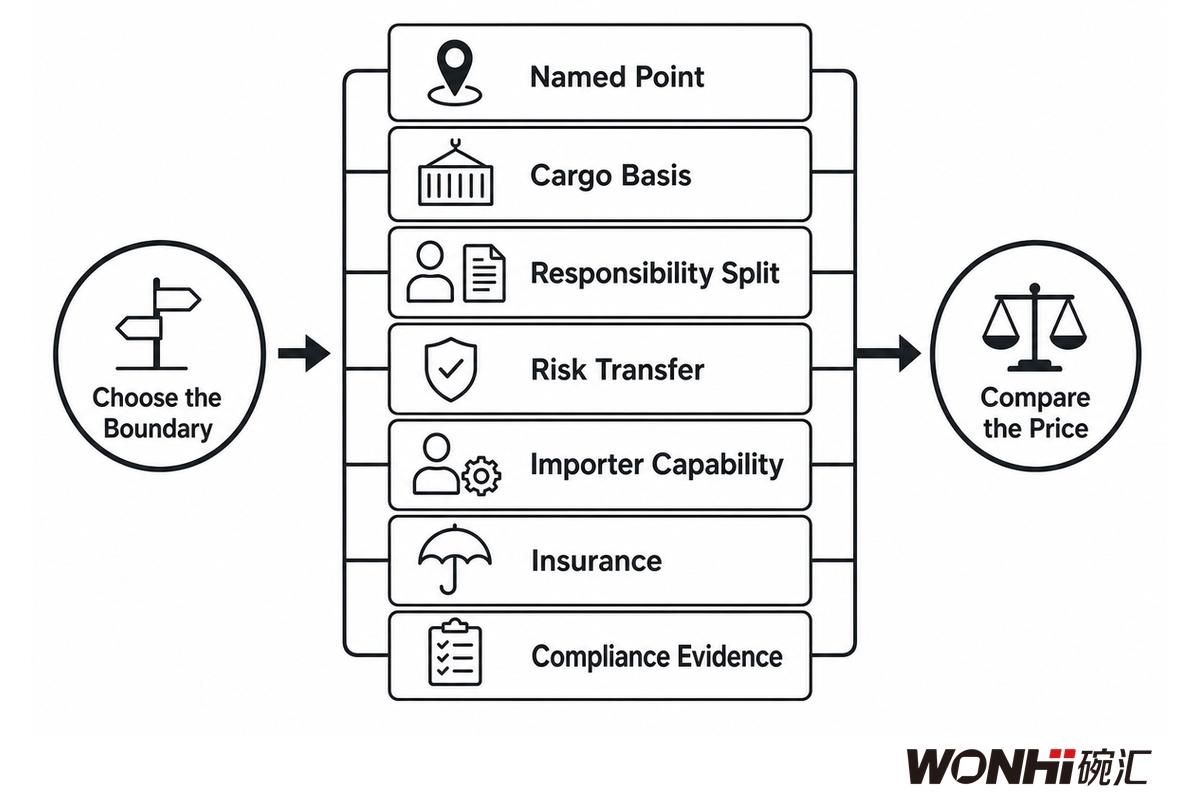
A defensible choice fixes the named point, cargo basis, responsibility split, risk transfer, importer capability, insurance, and compliance evidence before comparing landed cost. The term should describe the real shipment and capable parties, while the sales contract covers the commercial and legal subjects Incoterms leave outside.
Those FAQ boundaries now feed one final decision: choose the real delivery point before comparing prices.
Prepare a term-specific food-packaging request
Send the product specification, quantity, carton plan, destination, receiving constraints, and preferred Incoterm when you discuss delivery terms for your order. Wanhui can then prepare a term-specific quote instead of an ambiguous unit-price comparison.
Transparency note: This guide is educational and was prepared from ICC, U.S. government, European Commission, and company-supplied sources, then reviewed against Wanhui’s food-packaging context. It is not legal, customs, tax, insurance, or regulatory advice. The signed sales contract and the laws and authorities of the origin, transit, and destination markets control each transaction.
References & Sources
- Know Your Incoterms U.S. International Trade Administration
- Incoterms® 2020 Questions and Answers International Chamber of Commerce
- EAR Part 758: Responsibilities of Parties U.S. Bureau of Industry and Security
- Incoterms® 2020 vs 2010: What’s Changed? ICC Academy
- Incoterms® 2020: EXW or DDP? ICC Academy
- Importer and Exporter Tips U.S. Customs and Border Protection
- Packaging & Food Contact Substances U.S. Food and Drug Administration
- Determining the Regulatory Status of Components of a Food Contact Material U.S. Food and Drug Administration
- Food Contact Materials Legislation European Commission