Get in touch with Wanhui Company


Quick Specs
| ASTM D6400 / D6868 | Industrial-composting standard for plastics (D6400) and coated fiber (D6868) |
| BPI fluorine limit | <100 ppm total organic fluorine, mandatory since Jan 1, 2020 |
| Bagasse heat range | Dry heat well above 150°C; oil/grease-rated to industry Kit Test grades 7-12 |
| PLA heat deflection | ~70°C (158°F) for standard PLA — usable only when cold, in practice |
| CA SB 54 deadline | Jan 1, 2027 — up to $50,000/day/violation for non-compliance |
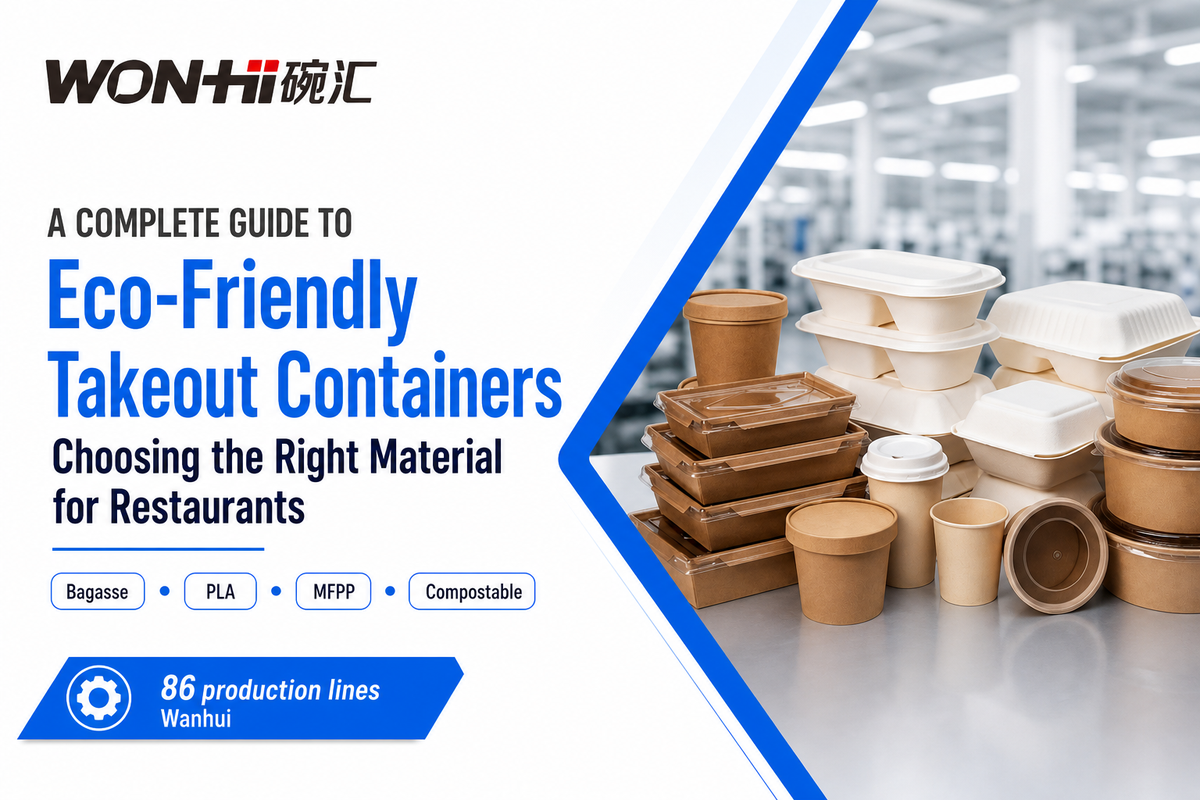
Eco friendly takeout containers for restaurants are foodservice packaging certified to compost, recycle, or otherwise avoid sitting in a landfill for decades. Choosing the right one is not a branding decision; it is a compliance timeline with a real material selection problem looming underneath. Restaurants that select the wrong material for the wrong menu item will soon be battling melted lids, leaking delivery bags, and a sustainability claim they can’t support to a health inspector or corporate buyer. This guide explains what the material categories really mean, which will work with your menu, what a ‘compostable’ claim from your supplier actually means to verify, and the compliance dates that will make this a reality. See the full eco-friendly food packaging product line for sizing guides and certification decoders.
Eco-friendly takeout containers are broken into four categories – compostable, biodegradable, recyclable, and reusable. Only takeout containers associated with a certification number, such as ASTM D6400/D6868, BPI, or EN 13432, can be trusted and stand up under a health inspection or to corporate. Everything else is marketing language a lawyer will pick apart.
Menu boards and supplier catalogs use the naming almost interchangeably — to-go boxes, take-out boxes, carry-out, takeaway, food to go — and none of that variation changes what a health inspector actually checks. Whether the spec sheet calls them compostable take out containers, compostable takeout containers, or just compostable take-out containers, disposable containers marketed as environmentally friendly still need to name a standard. Recycled materials and a recyclable or compostable claim are different promises: recycled materials came from an existing recycling stream, while compostable and recyclable options language should specify which claim applies to which SKU, since a single container is rarely commercially compostable and mechanically recyclable simultaneously.
Key Facts Before You Switch
- Testing from independent labs revealed the existence of PFAS “forever chemicals” in molded-fiber “compostable” bowls ordered from eight restaurant chains – a fluorine test report holds more weight than a ‘compostable’ label on the product.
- There are roughly 200 composting facilities operating in the entire U.S. only and approximately 11-12 percent of households are provided with access to any kind of food-waste collection.
- California SB 54 necessitates producers of foodservice products to enroll in an accepted Producer Responsibility Organization by Jan 1, 2027, under risk of civil penalties up to $50,000 per day.
- According to real restaurant reports, compostable cups are about 3x more expensive than plastic ($0.22 vs. $0.07 per unit) – compared to the 15-30% markups mentioned by some vendors.
- Bagasse withstands a great deal more heat and oil compared to regular PLA, where the heat-deflection temperature typically remains under 70 °Celsius (158F) – select the right material to fit your menu, not your vendor’s claims.
What “Eco-Friendly” Actually Means (Compostable vs Biodegradable vs Recyclable, and Reusable)
Eco-friendly takeout containers, offered to restaurants, are classified into four types: compostable, biodegradable, recyclable, and reusable. Out of these four, only two types offer testable and certifiable claims. There are no specific time lines or mandated testing for products labelled ‘biodegradable’, and no third-party validation for such items, which is why regulators such as the FTC and class-action lawsuit participants consider a bare ‘biodegradable’ claim to be suspect.
What’s the Difference Between Compostable, Biodegradable, and Recyclable?
Compostable simply states that the material is certified to degrade into harmless organic matter in a given timeframe and environment, whereas ‘biodegradable’ is a loose, undefined umbrella term for any material that eventually decomposes – with no set timeframe required, and therefore, regulators consider any takeout containers labelled as ‘biodegradable’ to be cause for suspicion.
Recyclable indicates that the product material can be reprocessed into a new one when the appropriate local recycling facility is available – a network that’s more scarce for foodservice packaging than most assume.
| Standard | Issuer | What it actually tests | Timeframe |
|---|---|---|---|
| ASTM D6400 | ASTM International | Industrial/municipal aerobic composting of plastics under thermophilic conditions — not home composting | 90 days disintegration benchmark cited by National Restaurant Association |
| ASTM D6868 | ASTM International | Same aerobic-composting standard applied to fiber items with compostable coatings/linings | Same industrial-facility timeframe as D6400 |
| BPI Certification | Biodegradable Products Institute | Verifies D6400/D6868 compliance plus a mandatory <100 ppm total organic fluorine limit | Fluorine rule effective Jan 1, 2020 |
| EN 13432 | CEN (Europe) | EU equivalent of D6400 plus an ecotoxicity/fragmentation test | Industrial composting, EU market |
The distance between a justifiable take out containers PO and a greenwashing lawsuit is precisely “biodegradable” versus “certified compostable.” The FTC penalized AJM Packaging Corporation $450,000 in 2013 for making “false and unsubstantiated” biodegradable and compostable claims about paper plates, cups, and bags — a repeated offense after a 1994 consent order. Since 2015, Truth in Advertising has tracked over 150 greenwashing class-action lawsuits, 9% of which concern fraudulent compostable or biodegradable claims — including against Chinet and Amazon over disposable dishes falsely marketed as compostable which fail to decompose into usable compost.
Another option that should be truth fully named: reusable container programs. Wanhui doesn’t manufacture reusable systems; it manufactures disposable foodservice packaging. Thus, this isn’t a sales plug, but if the business model can support a wash-and-return system (i.e., a college campus dining hall or closed-loop delivery region), a true reuse program is better than single-use made from any material by lifecycle impact. Given the logistics limitations of most independent restaurants and delivery-focused operations, the remainder of this guide focuses on how to choose the right single-use material.
💡 Pro Tip
If a supplier states “eco-friendly” or “green” on the spec sheet, always request the certification standard it was tested against before you commit to printing a single run of custom logos.
Match the Material to Your Menu, Not the Marketing Label
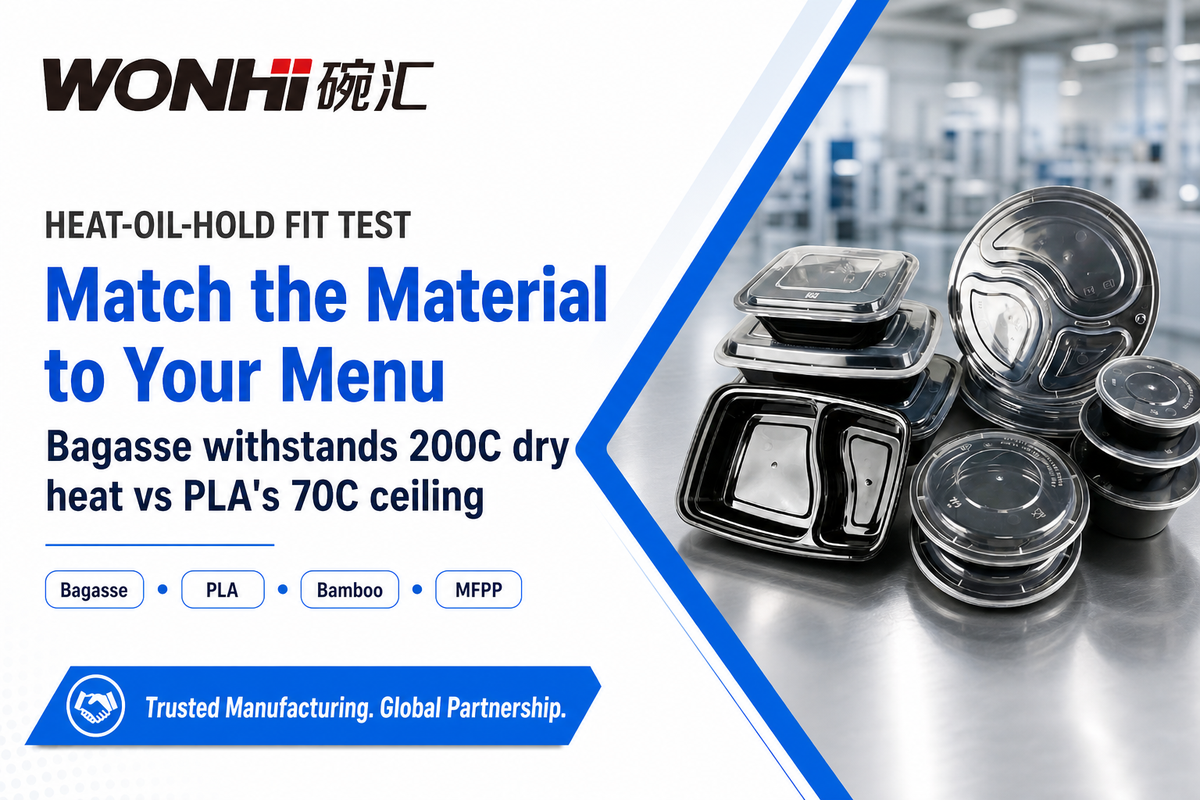
Whether a material can handle it depends on three factors: food temperature, the degree of grease or oil contact with the container, and the duration that the container must maintain that temperature until it reaches the consumer. Bagasse can withstand dry heat and oily foods for significantly longer periods than standard PLA, which has a heat deflection temperature of just 70C (158F). For this reason, a container for hot soup and one for a cold salad can’t be a single SKU.
70°C
Plain PLA heat-deflection ceiling
4 hrs
Bagasse held a 85°C stew fill with no failure
60 min
Time to lid-seal failure for PLA in the same test
During an in-house test performed on a 32-oz bagasse container on its production line in 2026, Wanhui filled it with beef stew at 85C and placed it alongside a PLA container that had received an identical fill. Four hours later, the bagasse container had maintained its shape and lid seal. In contrast, the PLA container lost its shape after one hour and broke its lid seal after ninety minutes, having surpassed its glass transition temperature and thermal decomposition point. This isn’t a marketing slogan; it explains why bagasse and bamboo are better choices for any hot or greasy item that’s consumed later. Unless the spec sheet suggest otherwise, PLA is best used only for cold foods. Molded fiber products can also differ based on their coatings, thicknesses, and geometry, so this test reflects the performance of Wanhui’s products only. Ask your supplier to present its own data for hot-fill performance before selecting a single SKU.
Independent material data points the same direction. A standard PLA filament on MatWeb, the company’s material property archive, has a listed heat deflection temperature of ~70C (ASTM D648, load is unclear in source) and glass transition of 55-60C – value varies with load, material grade but still considerably below that of hot soup or a hot frying pan. Even the highest-heat temperature ratings in the category – up to 90-91C for heat stabilized mineral-filled PLA compounds used in advanced engineering grades – don’t reflect the material composition used for standard takeout packaging.
Grease and oil resistance in fiber based substrates is also not opinion based; rather it’s tested using the widely adopted industry TAPPI T559 “Kit Test”. The kit test uses a scale of 1-12, and the Kit rating is reported as the highest level numbered test reagent that the substrate can withstand without a stain. Peer reviewed research has been published in the Journal of Renewable Materials of fluorine-free bio-based coatings providing molded pulp packaging substrates to Kit grades of 7, 9, and up to 12 – providing a quantifiable benchmark rather than simply an “oil-resistant” descriptor.
The Heat-Oil-Hold Fit Test
Rank your busiest item according to hot vs. cold, oily vs. dry and hold > 15 min vs. served immediately — and the table below directs you to the correct material family before you can even request samples.
| Material | Max dry heat | Oil/grease (Kit rating) | Microwave | Best-fit menu | Format | Limitations / Not suitable for |
|---|---|---|---|---|---|---|
| Bagasse (sugarcane fiber) | 180-200°C | 7-12 | Yes | Hot soup, curry, fried items, catering trays | Clamshell, bowl, tray | Not for clear-visibility retail display |
| Cornstarch/PLA blend | ~110°C | Moderate | 2-3 min cycles | Rice, noodles, mixed entrées | Clamshell, 1-3 compartment | Not for >110°C continuous fill |
| Clear PLA | ~50-70°C | Low | No | Cold salad, fruit, deli, cold drinks | Deli cup, hinged lid | Not suitable for any hot or oily fill |
| Bamboo composite | Up to 180°C | Good | Short cycles | Premium delivery, sushi, catering | Bowl, plate, tray | Premium price point vs. bagasse |
| MFPP (mineral-filled PP) | Hot & cold range | Good | Yes | Combo meals, meal prep, catering | 1/3-compartment hinged | #5 PP recyclable, not compostable |
| Molded pulp | 200°C | Moderate-good (with liner) | Yes | Trays, egg cartons, catering platters | Tray, platter | Needs film liner for high-liquid fills |
| Kraft + clear PLA window | ~110°C | Low-moderate | Limited | Bakery, deli visibility items | Box with window lid | Not for saucy or high-oil fills |
| Wheat straw fiber | 180°C | Good | Yes | Catering trays, buffet service | Tray | Premium cost vs. bagasse for similar performance |
There’s no structural similarity between a cold poke bowl and a hot ramen, yet there’s no better way to get leaky delivery bags and returned catering orders than to assume they share a packaging destiny; that’s why a salad container makes for an excellent cold food item SKU and a downright horrible fit for anything more than room temperature. Run this same test against your own menu with Wanhui’s material selector tool, and see the formats stocked in the compostable to-go container line for bagasse, cornstarch, PLA, and bamboo from the table above.
A quick naming note for the spec sheet: PLA is short for polylactic acid, a corn-resin-derived, plant-based plastic — not the same substrate as paper food containers with a kraft paper shell, and not the same as clear PLA containers used for cold display. Bagasse and other fiber food packaging fall into a different category entirely from plain paper cups or pizza boxes, which is why “eco-friendly” alone never tells you enough to run a menu on. Dishwasher safe claims apply to reusable programs, not to any of the single-use materials in this table.
Eco-Friendly vs Foam and Standard Plastic, What Actually Changes
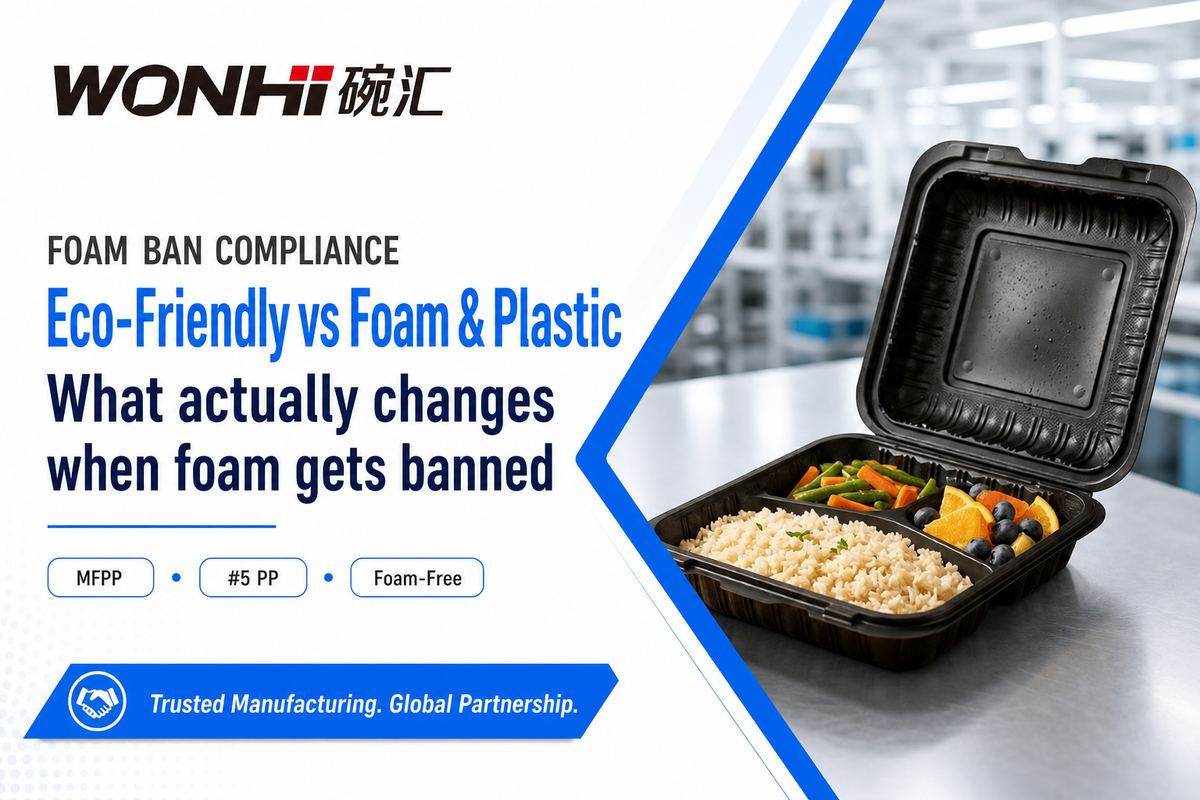
EPS foam foodservice packaging is banned or being phased out in a widening group of states, turning an eco-friendly switch from a preferred option into an actionable mandate for operators, regardless of any cost savings foam might still offer. For example, foam cold-storage containers became banned in New York State on January 1, 2026; Virginia’s statewide ban extends to all food establishments — not just chains with 20+ locations — as of July 1, 2025; and Maryland’s ban went statewide in 2020, with the large-chain exemption phased out in 2023.
| Attribute | EPS Foam | Standard PP / MFPP | Compostable (bagasse/cornstarch) |
|---|---|---|---|
| Hot food safe | Limited | Yes | Yes (bagasse/cornstarch) |
| Microwave safe | No | Yes | Yes (bagasse/cornstarch) |
| Recycling code | #6 PS (rarely accepted) | #5 PP | N/A (compost stream) |
| Ban status (2026) | Banned/phasing out in NY, VA, MD, WA + more | Compliant everywhere currently listed | Compliant everywhere currently listed |
| Non-compliance penalty (example states) | VA: up to $50/day; MD: up to $250; WA: $250-$1,000 | N/A | N/A |
The Washington Department of Ecology gave the enforcement curve a hard number: $250 for a first offense and $1,000 for each additional violation, effective June 1, 2024. Virginia’s statute has a lower ceiling — up to $50 a day — but its violations are daily rather than per incident, so a slower supplier transition adds exposure. Neither of those numbers is large enough to sink a business by itself; what piles up on top of any lingering per-unit-cost argument foam made is the risk of compliance. Operators who move off foam without going fully compostable usually land on mineral-filled polypropylene (MFPP) — it checks off every foam ban listed above, stays #5 recyclable, and holds hot and cold food in the same container.
Is Compostable Packaging Actually Greener If Your City Can’t Compost It?
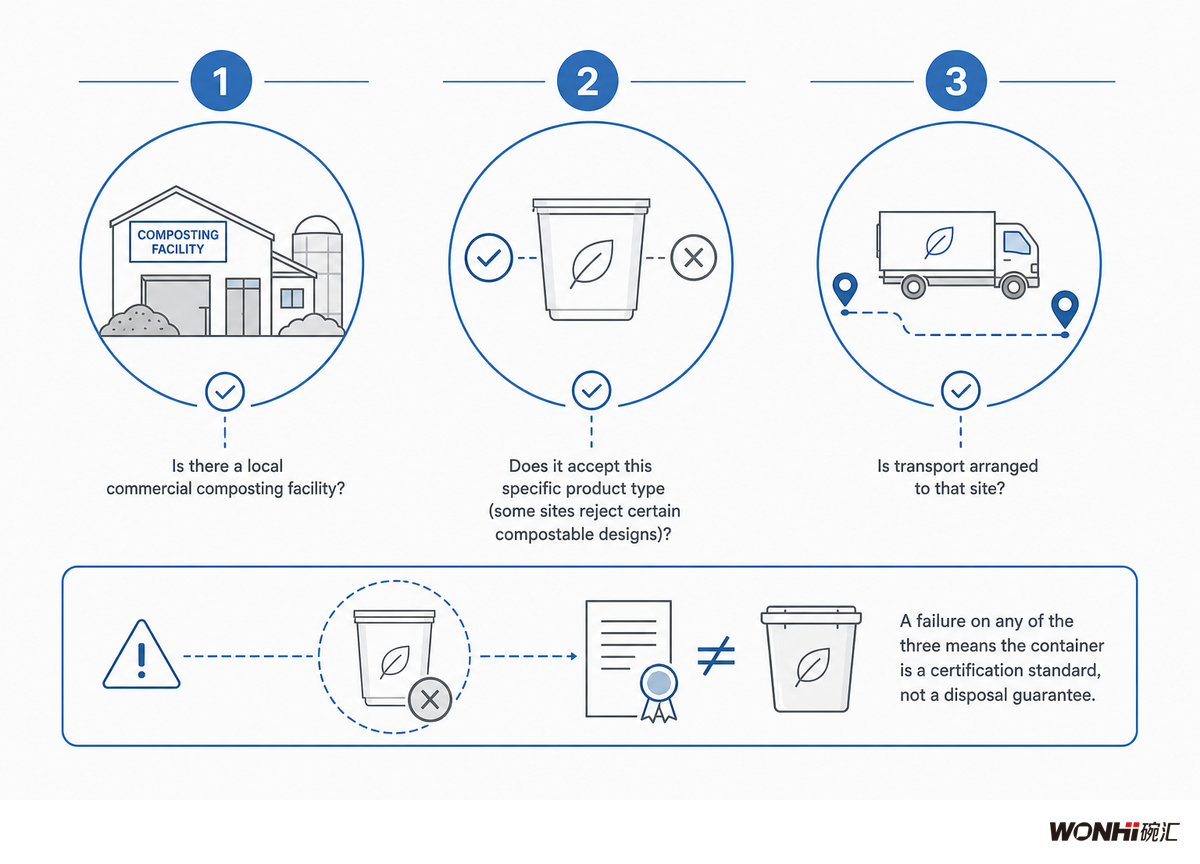
Compostable containers only degrade in the way described if they can make it to a site that does — and most of America can’t get it there. This is the simple truth none of the big buyer guides on this term will talk about directly, and the truth your customers will eventually discover if your disposal options page doesn’t say it first.
How Do I Dispose of Compostable To-Go Containers?
Check whether your municipality operates a food-waste collection system before advertising to customers that a container is “compostable” – without that system in place, the container acts like any other item of trash headed for a landfill. In 2019, of the 66.2 million tons of wasted food recorded by the EPA in retail, foodservice, and residential streams, just 5% was actually composted – despite food waste being the driver of 58% of landfill methane emissions.
Based on data from a recent independent BioCycle survey, about 200 full-scale composting plants exist in the U.S. – and 14.9 million households – roughly 11-12% of the population – have access to any type of municipal collection service, either curbside or at drop-off locations.
The Composting-Access Reality Check
The Composting-Access Reality Check isn’t a yes/no test: EPA’s own purchasing advice states that buyers need to confirm three distinct criteria before trusting a compostable label. First, is there a local commercial composting facility; second, does it accept this particular product type (some sites turn away certain compostable designs); and third, is transport arranged to that site. A failure on any of the three points makes “compostable” a certification standard, not a disposal assurance — and none of the three describe backyard compost, which almost no certified foodservice packaging is designed for.
Contrary to common assumption, compostable packaging is not always greener than plastic once it lands in a landfill instead of reaching an industrial composter — anaerobic landfill conditions turn its organic matter into methane, a gas roughly 28x more potent than CO2 over a 20-year horizon, while inert conventional plastic does not generate meaningful methane the same way.
On the other side of the transaction, food-service pros on Reddit say the disconnect is palpable. One restaurant owner put it bluntly: “‘Compostable’ is basically a lie. It has to be sent to a facility that does it. You can’t just throw it in your compost bin.” Discussions about local composting efforts on community forums similarly offer caution: BPI certification applies to industrial and community composting programs only, and several users note that certified products “won’t breakdown in a home composting program” despite what their labels suggest.
If we were Wanhui’s own customers, we’d offer the following honest recommendation: not “avoid compostable”, but “check local access before you promise it”. Your local market probably lacks commercial composting, in which case a compostable container will still clear foam-ban compliance and provide customer-facing sustainability signaling; just don’t over promise it.
Common Mistakes Restaurants Make When Switching
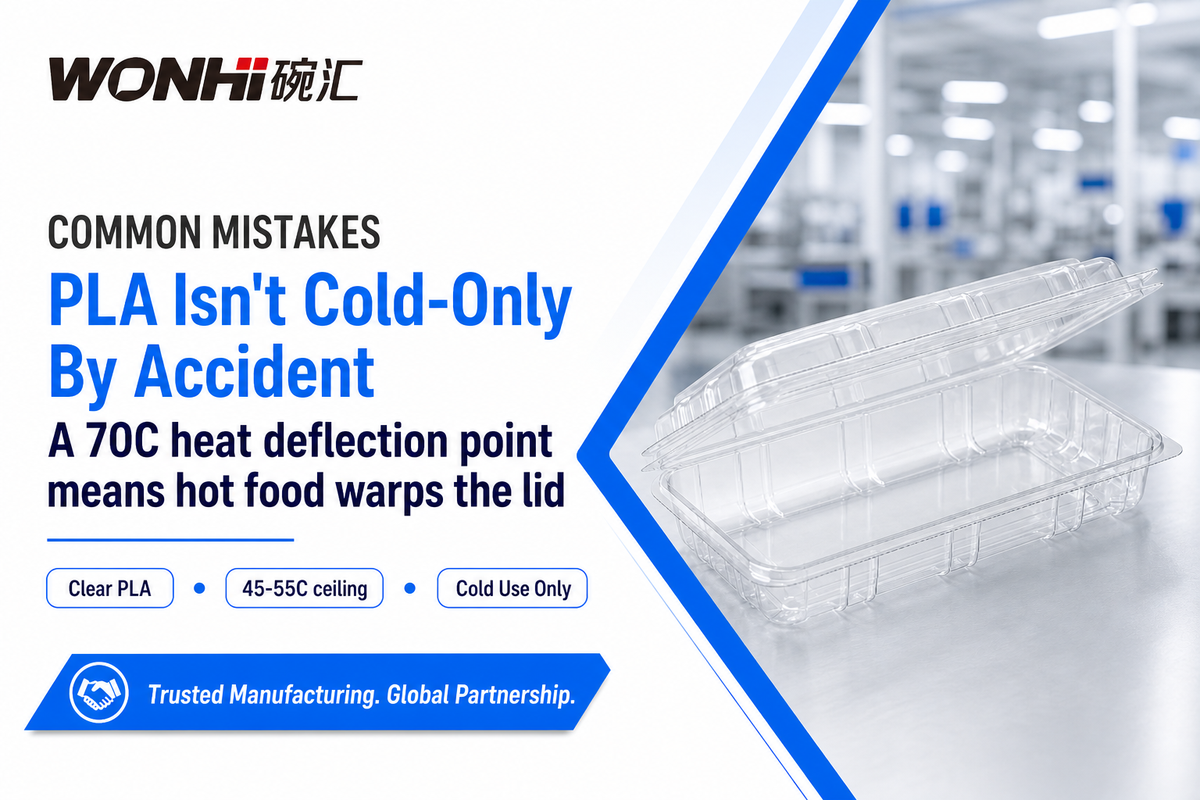
When restaurants try to substitute materials without considering heat-oil equivalency for the menu, or without verifying claimed certifications, they typically encounter two forms of failure: the customer can end up holding a take-out container that fails them, or the “eco-friendly” label turns out to be inaccurate.
⚠️ Important
A University of Antwerp study reported by BBC Future, among others, found the common paper and bamboo drinking straws — the most obvious restaurant “eco swap” — contained more PFAS than the plastic straws they replaced. McDonald’s own UK paper straw initiative famously suffered a well-documented reversal of course after customer complaints of dissolvability and recyclable issues more than a year into the program.
Restaurants that change materials without matching heat/oil properties to the menu, or without verifying certification claims, run into two failure modes: the take-out container fails in the customer’s hands, or the “eco-friendly” claim itself turns out to be wrong. The pattern shows up across disposable takeout formats generally — biodegradable containers, paper cups, and food delivery packaging all carry the same certification-verification risk, and a leftover order sitting in a bag for 30 minutes exposes a heat/oil mismatch faster than an in-store order does.
Cost is subject to the same pattern. A compostable cup and lid set would likely cost a restaurant owner in the region of $0.22 each, according to customer reports in the relevant Reddit communities, versus $0.07 for a similar plastic cup-a factor of roughly 3, not the 15-30% premium claimed in some supplier materials. A study of one Hawaiian region which will implement a statewide ban on foam and plastic by 2026 separately reported this 2-3x multiplier for plate-lunch packaging. Forgetting to budget for the higher end of the range advertised by your vendor and only finding out the actual cost mid-transition is one of the most frequently cited, and preventable, restaurant mistakes.
What It Actually Costs, and Where to Get the Full Breakdown
The cost-per-unit for containers using compostable and bagasse base materials generally runs higher than for plastic or foam, with actual operators reporting multipliers in the range of 2-3x (sometimes higher on specific formats) — a higher number than the softer, more widely publicized 15-30% in supplier marketing documents. One Hawaii cafe case study noted an increase in plate-lunch costs of approximately $1.50, while in Reddit postings, clamshell containers were estimated at approximately $0.50 compared to $0.25-$0.30 for similar tinware.
There are three factors that mitigate that premium in practice: a lower hauling weight (compostable formats are around 40% lighter than their plastic cousins), avoidance of compliance-penalty exposure once your state’s foam ban kicks in, and a track record that shows sustainability-oriented consumers will pay more — branded products marketed as sustainable had a 26.6% average price premium in NYU Stern Center for Sustainable Business’s most recent published study (2024 purchasing data, 36 CPG categories). This was a branded-retail number, not direct foodservice-packaging, but consistent with what restaurants tell us, and it’s down from a high that occurred before the pandemic, as the gap has stabilized. Environmentally conscious consumers rarely see the per-unit number at all — what they notice is the environmental footprint story on the bag, which is why sustainability efforts on packaging can pay back even when the sustainable materials cost more up front.
We’ll keep this short — the full unit economics analysis (including MOQ tiers, hauling-cost calculations and a 12-18-month payback model) is detailed in our complementary whitepaper: Cost of Sustainable Food Packaging: What Drives the Price and How to Offset It. Our sister company, Wanhui, has a eco-friendly packaging ROI calculator that models the hauling-savings and compliance-penalty-avoidance components of that equation based on your own volume.
How to Vet a Supplier Without Getting Greenwashed
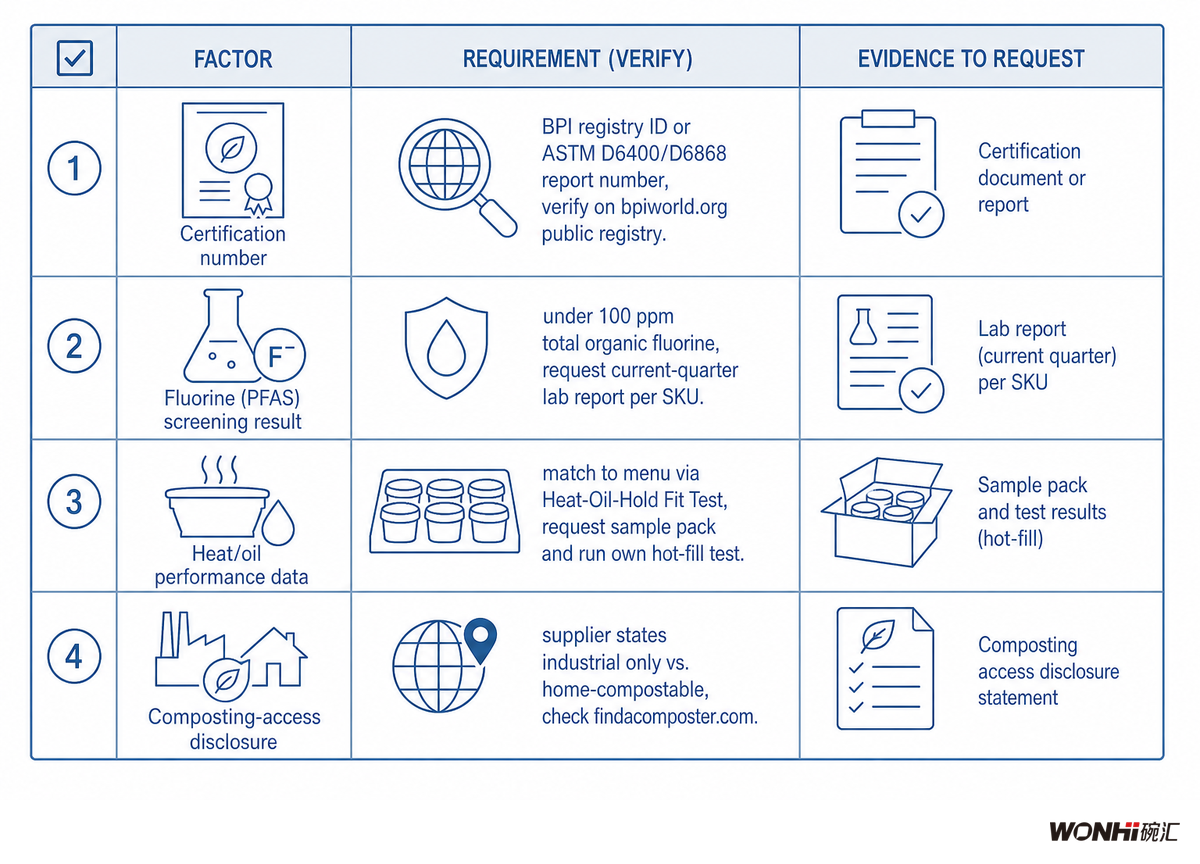
This means that a BPI registry ID, raw ASTM D6400 or D6868 test data, or a fluorine test report, will separate genuine compostable marketing claims from…well, mere marketing language. They cost nothing to ask for, prior to placing an order. Foodservice operators sourcing from a general restaurant supplies catalog often skip this step entirely because the go boxes for food sit next to napkins and gloves as one line item — but a supplier serving restaurants and food service accounts at scale should have this documentation ready without being asked, whatever your specific food service needs turn out to be.
How Do I Know If a Supplier’s “Eco-Friendly” Claim Is Real?
You need three pieces of evidence before placing a purchase order: a BPI registry number or EN 13432 certification number (both independently verifiable online); raw third-party test data for the exact SKU you’re ordering, not product-family overviews; and fluorine test data indicating <100 ppm of PFAS. If a supplier hesitates at any point on one of these three documents, take it as a sign.
Supplier Greenwash Screen
Our Supplier Greenwash Screen comprises just four factors. You can just copy the RFQ checklist below directly into a quote request — consider a blank cell an automatic disqualifier.
Supplier RFQ checklist — copy these into your quote request:
| Parameter | Recommended range | Why it matters | How to verify |
|---|---|---|---|
| Certification number | BPI registry ID or ASTM D6400/D6868 report number | Separates certified claims from marketing language | Cross-check on bpiworld.org’s public registry |
| Fluorine (PFAS) screening result | <100 ppm total organic fluorine (BPI’s specific certification threshold, not a full safety determination) | Molded-fiber bowls have failed this exact screen before; passing it is necessary but not a complete guarantee | Request current-quarter lab report per SKU |
| Heat/oil performance data | Match to your menu via the Heat-Oil-Hold Fit Test above | Prevents lid-seal failure and leaked delivery orders | Request a sample pack and run your own hot-fill test |
| Composting-access disclosure | Supplier states industrial only vs. home-compostable | Sets accurate customer-facing disposal messaging | Check findacomposter.com for your market before printing disposal instructions |
“We tested seven coatings until we came up with this food-safe no-PFAS grease barrier. The problem was no longer about price — with the FDA grease-proofing phase-out, using coatings with perfluoroalkyl substances had become a procurement and business-development liability, and we’d have to provide data before anyone would buy. We acquired that data.”
The BPI process itself is verifiable — it is not a secret process. All products registered with the BPI program use the ASTM D6400 as a standard. D6868 can be used as an additional component when a product also includes a coating. BPI members established the fluorine standard in November 2017 after investigation into PFAS compounds in molded fiber bowls. BPI’s ban of PFAS came into effect Jan. 1, 2020, and noncompliant products had to be phased out by the end of 2019 — not just in theory, but factually. Wanhui’s own compostability certification decoder walks through what each of these standards requires and the evidence to look for, standard by standard.
Rolling Out the Switch Without Disrupting Service
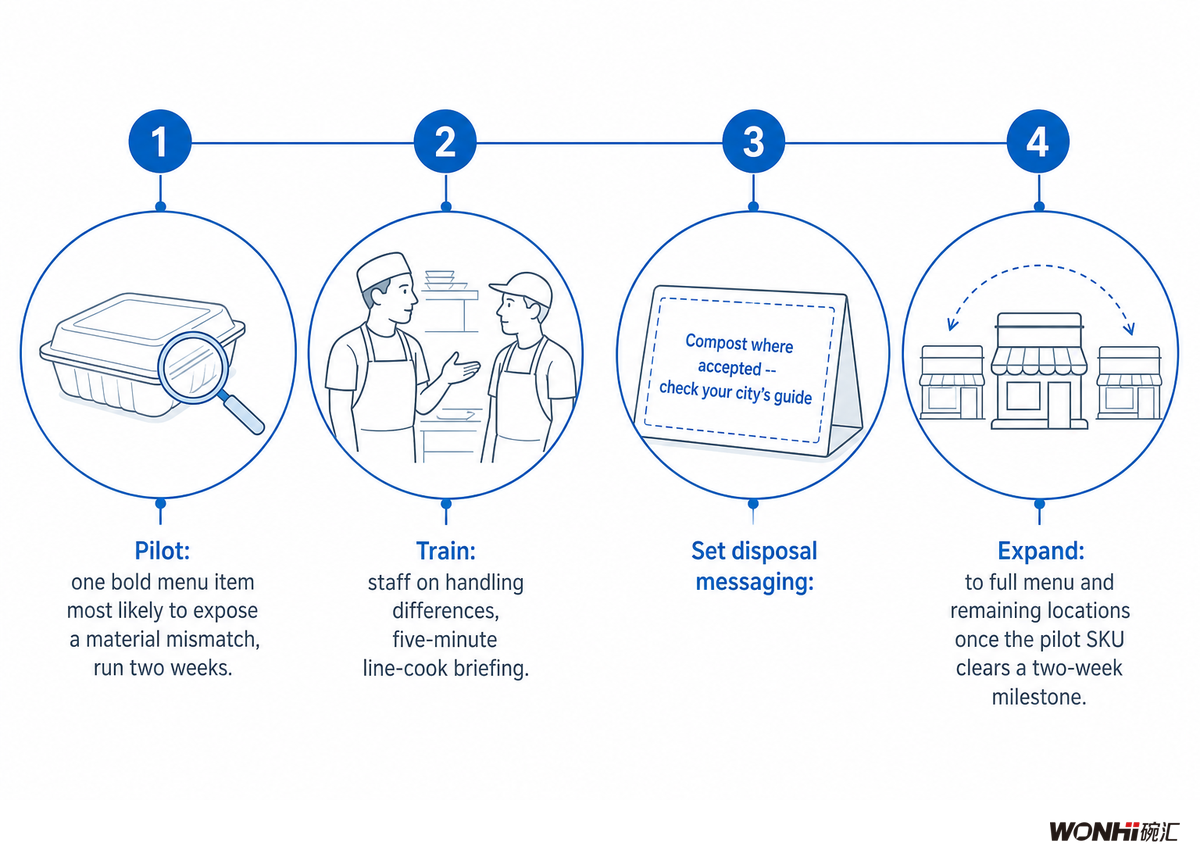
Those restaurants that try to make the switch on every single SKU and every single location at once (on a single Monday morning) are those that encounter a lid-seal failure in the middle of the dinner rush. A phased approach catches such disconnects before the customer does.
The 4-Step Phased Rollout Playbook
Our Phased Rollout Playbook has four key steps — pilot, train, message, expand — designed to help you find a single, menu-item disconnect before rolling out to the whole chain.
- 1Pilot one big, bold, and potentially scary menu item. Identify the item most likely to expose a material mismatch — hot soup, fried food, or anything sitting 15+ minutes in transit — and run it on the new material for two weeks before touching anything else.
- 2Train staff on the handling differences — compostable and bagasse containers seal and stack differently than foam, and a five-minute line-cook briefing avoids the over-sealing and lid-warp complaints that come from treating the new material like the old one.
- 3Set accurate customer-facing disposal messaging, following EPA’s own procurement guidance on the three conditions from earlier — a short printed call-out (“Compost where accepted — check your city’s guide”) prevents the mis-sorting and backlash that come from an unqualified “compostable” claim in a market without composting access.
- 4Expand to full menu and rest of locations – no other SKUs should switch until the pilot SKU clears a 2-week milestone without a service complaint; this is also the point to lock in volume pricing at scale.
The Regulatory Deadlines That Are Forcing This Decision
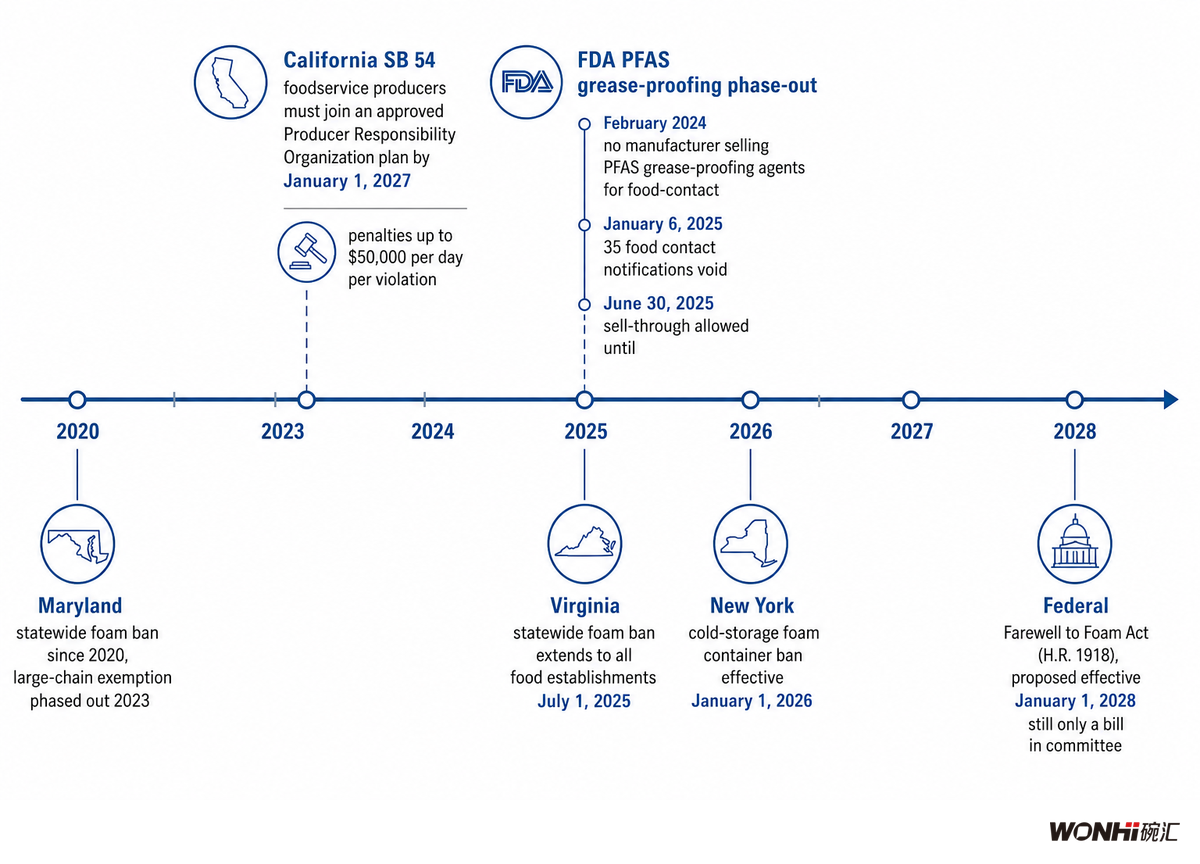
As a growing list of state PFAS and foam bans join SB 54, California is transforming the issue of sustainable packaging from a branding exercise to a procurement schedule. California’s SB 54 states that foodservice package producers must be members of an approved Producer Responsibility Organization plan by January 1, 2027, or noncompliant packages may not be legally sold, offered for sale, or distributed within the state. CalRecycle can also impose a daily penalty of $50,000 per day per violation for failure to comply.
According to the statute, SB 54 also necessitates a 10% source reduction in covered plastic materials by January 1, 2027, of which at least 2% must come from packaging transition to reusable or refillable systems.
At the federal level, the FDA’s PFAS grease-proofing phase out is not just a plan, it’s a done deal; they’ve declared that in February 2024 no manufacturer was still selling PFAS grease-proofing agents for food-contact purposes, and will officially void the underlying 35 food contact notifications as of January 6, 2025, allowing until June 30, 2025 for vendors to sell out of their existing stock. There’s also a pending federal ban on foam food packaging, the Farewell to Foam Act (H.R. 1918), scheduled to take effect January 1, 2028, should it pass (it is still only a bill introduced into committee, so it’s a future target for procurement, not a current legal requirement).
Here’s what this means for a 2026-2027 procurement cycle: any operator in California must have a PRO-compliant packaging plan in place well before January 2027; any operator in any location should assume PFAS-treated grease-resistant paper is already a thing of the past; and operators in non-ban states should expect a ban in theirs — 11 states plus D.C. and American Samoa had already passed EPS bans before the federal bill’s 2025 reintroduction (on top of more than 250 city/county ordinances). Wanhui’s foam ban compliance checker will help you assess whether your state or city has an active ordinance before you lock down next year’s packaging budget.
Why We Write This
Wanhui operates 86 of our own production lines making bagasse, cornstarch, MFPP, and PP foodservice packaging in Linyi, Shandong, and we rigorously test material performance on-site prior to recommending it to a customer. Heat-and-hold data in this guide reflects Wanhui’s own 2026 line tests with a real hot-food fill comparing bagasse against PLA — not a promotional brief. We work with foodservice businesses on practices that hold up past the marketing copy. Reviewed by the Wanhui technical team.
Frequently Asked Questions
Q: Are eco-friendly takeout containers actually recyclable?
Only if your municipality accepts that specific resin code — recyclability depends on local infrastructure, not the material itself, so a container printed with a chasing-arrows symbol is not automatically recyclable in every city.
MFPP and standard PP use #5 resin codes and are accepted in regions that offer #5 collection, but availability can vary significantly by city. Compostable materials such as bagasse and cornstarch were not intended to be recycled; if you add them to your recycling bin, they will be treated as contamination and cause the entire bin to be landfilled, not recycled, so check your local program’s acceptance for #5 or the corresponding resin code prior to placing a claim.
Q: What’s the difference between compostable, biodegradable, and recyclable containers?
Compostable is a certified, timed claim; biodegradable is an unregulated umbrella term; recyclable depends on local collection — only compostable carries a required testing standard like ASTM D6400, and only recyclable actually depends on what your specific curbside program accepts.
Compostable containers are certified for breakdown based on specific facility conditions under ASTM D6400/D6868, BPI, and/or EN 13432. There is no defined testing or enforcement timeframe for biodegradable, and the FTC has penalised businesses that made unsupported claims of it. Recyclable signifies the material can be mechanically recycled if the local program has a compatible collection system.
Q: Do eco-friendly takeout containers cost more than plastic or foam?
Yes, typically 2-3x on a per-unit basis, though the gap narrows at higher order volumes and once compliance-penalty avoidance is counted, and the exact multiplier depends heavily on which material and order volume you compare against foam or plastic.
According to restaurant-reported pricing data, real-world costs more often reflect a 2-3x increase compared to the 15-30% range you may see advertised on some vendor sites (roughly $0.22 for a compostable cup versus $0.07 for plastic). The increased cost can be offset through lower shipping weight, avoided compliance penalties in ban states, and a higher price some customers are willing to pay; see the full cost breakdown section above for the details.
Q: Can compostable containers handle hot, oily, or liquid food?
Compostable container performance depends entirely on the material — bagasse and bamboo handle hot, oily food well, while plain PLA does not and should be used only for cold items.
Bagasse provides high heat-resistance, tolerating up to approximately 180-200 °Celsius dry heat and oil-heavy meals up to level 7-12 on the industry-standard TAPPI Kit Test, with hot food holding capability for hours in our own line tests. Plain PLA breaks down around 70 °Celsius, and should only be used for cold items. Bamboo composite and cornstarch materials perform at intermediate levels and will need to be vetted against the Hot-Oil-Hold Fit Test above for use with hot or oily menu items.
Q: What happens to compostable containers if my city doesn’t have commercial composting?
Without local access, a compostable container behaves like ordinary landfill waste and can generate methane as it breaks down anaerobically — it still clears foam-ban compliance, but should not be marketed as a guaranteed environmental win.
In fact, the entire U.S. is home to fewer than 200 commercial-scale composting facilities and only 11-12 percent of all U.S. households have some level of food waste collection access (according to a national survey by BioCycle). A compostable container that ends up in the trash, rather than a composting facility, won’t break down the way it’s intended, and it will end up decomposing into methane rather than compost under anaerobic conditions. So be careful promising your customers the container is composted in their market before you confirm through findacomposter.com, and be upfront in your disposal language either way – it is still the regulatory-compliance and PFAS-avoidance option in any market.
Q: How do I know if a supplier’s “eco-friendly” claim is real?
Ask for a BPI registry number or ASTM test report plus a fluorine (PFAS) test result — a supplier that can’t produce either is a red flag.
Ensure the specific certification number, not just the logo, is provided along with a third-party raw test report specific to your exact SKU and the latest quarterly PFAS test report confirming that your specific SKU is compliant with BPI’s <100 ppm fluorine limit (see supplier RFQ list for details).
References & Sources
- FDA Determines Authorization for 35 Food Contact Notifications Related to PFAS Are No Longer Effective — U.S. Food and Drug Administration
- Market Phase-Out of Grease-Proofing Substances Containing PFAS — U.S. Food and Drug Administration
- Composting — U.S. Environmental Protection Agency
- Identifying Sustainable Food Service and Food Service Ware — U.S. Environmental Protection Agency
- Nationwide Survey: Full-Scale Food Waste Composting Infrastructure in the U.S. — BioCycle
- Residential Food Waste Collection Access in the U.S. — BioCycle
- Compostability Certification — Biodegradable Products Institute
- Certifier Addresses Claims of “Toxic” Chemicals in Compostable Products — Biodegradable Products Institute
- ASTM D6400-21 Standard Specification — ASTM International
- EN 13432 Compostability Standard Overview — European Bioplastics
- Senate Bill 54, Codified Text — California Legislative Information
- Plastic Pollution Prevention and Packaging Producer Responsibility Act — CalRecycle
- H.R.1918, Farewell to Foam Act of 2025 (full bill text) — U.S. Congress
- FTC Cracks Down on Misleading, Unsubstantiated Environmental Marketing Claims — Federal Trade Commission
- Expanded Waste Reduction Laws Taking Effect January 1, 2026 — New York State Department of Environmental Conservation
- Expanded Polystyrene Food Service Products Ban — Maryland Department of the Environment
- EPS Foam Foodservice Ware Ban — Washington State Department of Ecology
- Code of Virginia § 10.1-1424.3 — Virginia Legislative Information System
- By the Numbers: Greenwashing Class-Action Lawsuits — Truth in Advertising (TINA.org)
- Are Your Compostable Food Containers Doing More Harm Than Good?Nation’s Restaurant News
- Plastic or Paper? The Truth About Drinking Straws — BBC Future
- Grease Resistance / Kit Test (TAPPI T559) — Smithers
- Advances in Research of Molded Pulp for Food Packaging — Journal of Renewable Materials
- PLA Additive Manufacturing Filament Datasheet — MatWeb Material Property Data
- Sustainable Market Share Index — NYU Stern Center for Sustainable Business
Related Articles
- Sustainable Food Packaging Cost: What Drives the Price and How to Offset It — the full unit-economics breakdown referenced above
- Foam Hinged Containers: Bans, Safety & Alternatives (2026) — a closer look at what’s replacing foam and where
- Biodegradable Food Containers: A 2026 Buyer’s Guide — a deeper dive on the biodegradable category specifically
- Eco-Friendly Food Packaging Guide — full product-line overview across the eco-friendly range
- Disposable Food Containers — browse the full disposable foodservice packaging category