Get in touch with Wanhui Company


Sustainable food packaging cost is the real per-unit price gap between eco-friendly materials like bagasse, PLA, and recycled PET and conventional plastic packaging, once actual wholesale pricing – not a marketing headline – is factored in. The true sustainable food packaging cost runs higher than its conventional plastic counterpart – but it’s not by the flat premium figure most cost comparison studies lead you to believe. A real cost comparison to the sustainable packaging price of the most common alternatives goes beyond the marketing figure, to look at the true cost and the real bill of materials. Once we’ve chased back the “82% of consumers will pay more” figure that’s cited in virtually every single blog article ever written about the topic to its origin, and we’ve cross-referenced typical price ranges for sustainable food packaging materials that are touted by vendor blog posts with actual wholesale prices, we get a more concrete answer than the Search results give us: Standard PP plastic food containers cost between $0.11 – $0.86 a unit depending on your total volume order, and the “sustainable premium” runs between right around the same and three times as much, depending on material, volume, and how efficient your supplier’s manufacturing processes actually are.
Here’s an analysis of what the cost of eco-friendly packaging and compostable food packaging is in 2026 for each and every major sustainable option, material by material, tier by volume, as well as the costs of failing to make a sustainable change which none of the other articles on this topic cover.
Quick Specs
| Conventional PP (US wholesale) | $0.11–$0.86/unit, volume-dependent |
| Bagasse / PLA / bamboo (UK benchmark) | $0.05–$0.19/unit |
| Typical premium at scale | 15%–30% |
| Typical premium at small order volume | up to 2×–3× |
| Compostable certification | ASTM D6400 (plastics/films) / D6868 (paper/board), ≤100 ppm PFAS |
| US states with enacted EPR packaging laws | 7 (as of Oct 2025), 8 more introduced |
What Sustainable Food Packaging Actually Costs Per Unit
A compostable piece of food packaging like those made from bagasse, PLA or bamboo can cost between $0.05 to $0.19 a unit compared with $0.11 to $0.86 a unit for typical PP packaging (in general eco packaging can range anywhere between those numbers, but that range is much closer than the “50% to 10 times more expensive” refrain on blogs discussing the topic). That difference varies wildly by the material you’re sourcing, and how much you’re ordering.
A peer-reviewed review of emerging food-packaging solutions in the National Institutes of Health’s PMC repository flags production cost as the unresolved barrier to industrial-scale adoption of most bio-based materials.
| Material | Wholesale $/unit | Source |
|---|---|---|
| Conventional PP (US) | $0.11–$0.86 | Cary Company + Karat/Lollicup bulk pricing |
| Bagasse (UK) | $0.05–$0.10 | Herald Packaging 2026 |
| PLA (UK) | $0.08–$0.15 | Herald Packaging 2026 |
| Bamboo (UK) | $0.10–$0.19 | Herald Packaging 2026 |
Let’s camp out on this for a minute. One of the more quoted numbers in this result – that sustainable packaging “is $0.50 to $2.00+ per unit, a 20-50% premium,” has roots in an AI-written summary with no original source, and not one of the top three highest-ranked articles in our search query of this topic references any governmental or academic source for their pricing figures. When we did some cross-shopping between two U.S.-based plastic container vendors, and two sources for compostable materials, actual costs came in closer together and lower than that headline suggests. The real answer to “how much does eco friendly packaging cost” tracks resin cost of plastic per kg more than any single flat percentage, so that’s a better starting point than a headline premium – and it’s a question sustainability in packaging discussions rarely answer with real numbers.
Material-by-Material Cost Breakdown
Choosing between eco-friendly materials and biodegradable materials isn’t an apple-to-apples pricing comparison; it’s a compromise between cost, thermal performance, and certification complexity, and what looks cheap on paper can be expensive in practice when you factor in freight and failure rate. Building packaging systems around a single traditional packaging type usually doesn’t transfer to a new type of packaging without modification of tool design and packaging designs, which comes at a price beyond paper products and raw materials. Our Material-to-Cost-Driver Matrix maps the materials we manufacture and those most frequently encountered in cost-focused search queries, to the actual factors that drive price — the molded-fiber-plus-biopolyester row below is backed by real lab data from a 2025 USPTO patent grant, not a vendor claim.
| Material | Compostable? | Max service temp | Best-fit use | Limitation |
|---|---|---|---|---|
| PP (polypropylene) | No | ~120°C / 250°F short-burst | High-volume hot/cold takeout | Not compostable, curbside recyclability varies by region |
| MFPP (mineral-filled PP) | No | >220°F / 104°C operating | Hot-fill with reduced petroleum content (30–40% mineral filler) | Still petroleum-based, not compostable |
| PET / RPET | No / Recyclable | ~70°C / 158°F max | Clear cold items, deli display | Deforms above ~70°C, unsuitable for hot food |
| Bagasse (sugarcane fiber) | Yes (BPI/ASTM D6400) | High (natural fiber) | Hot food, compostable-mandate markets | Requires industrial composting access to actually compost |
| PLA (corn-based bioplastic) | Yes (BPI/ASTM D6400) | Low (~40–50°C) | Cold items, clear cups | Deforms in hot liquids/microwave; industrial compost only |
| Bamboo fiber | Verify cert per SKU | Good | Premium positioning | Highest-priced of the three UK-benchmarked materials |
| Molded fiber + biopolyester blend | Yes (EN 13432) | Compression 450–500N vs ~180N conventional tray | High-strength compostable trays, ~20% lighter than CPET/PP | Newer process; confirm supplier’s production scale |
| Recycled-content plastics (rPET/rPP) | Recyclable, not compostable | Same as base resin | Bridge option, smaller premium | Still a plastic waste stream at end of life |
| Cornstarch-blend bioplastic | Often, verify BPI listing | Moderate | Cost-sensitive compostable option | Premium varies sharply by region and scale (up to ~2.5x in smaller markets) |
With PP, MFPP, PET/RPET, and bagasse formats manufactured across 86 production lines, the temperature and thickness data provided for our in-house materials is from the factory floor, not marketing collateral – our own PP and MFPP tooling runs 0.45mm-0.65mm wall thickness depending on the service-temp and drop-resistance target, thinner walls cut material cost but also cut heat and drop tolerance. We suggest asking any potential supplier for their in-house service temperature and wall thickness figures on demand, prior to commitment.
The 4-Tier Volume Cost Curve
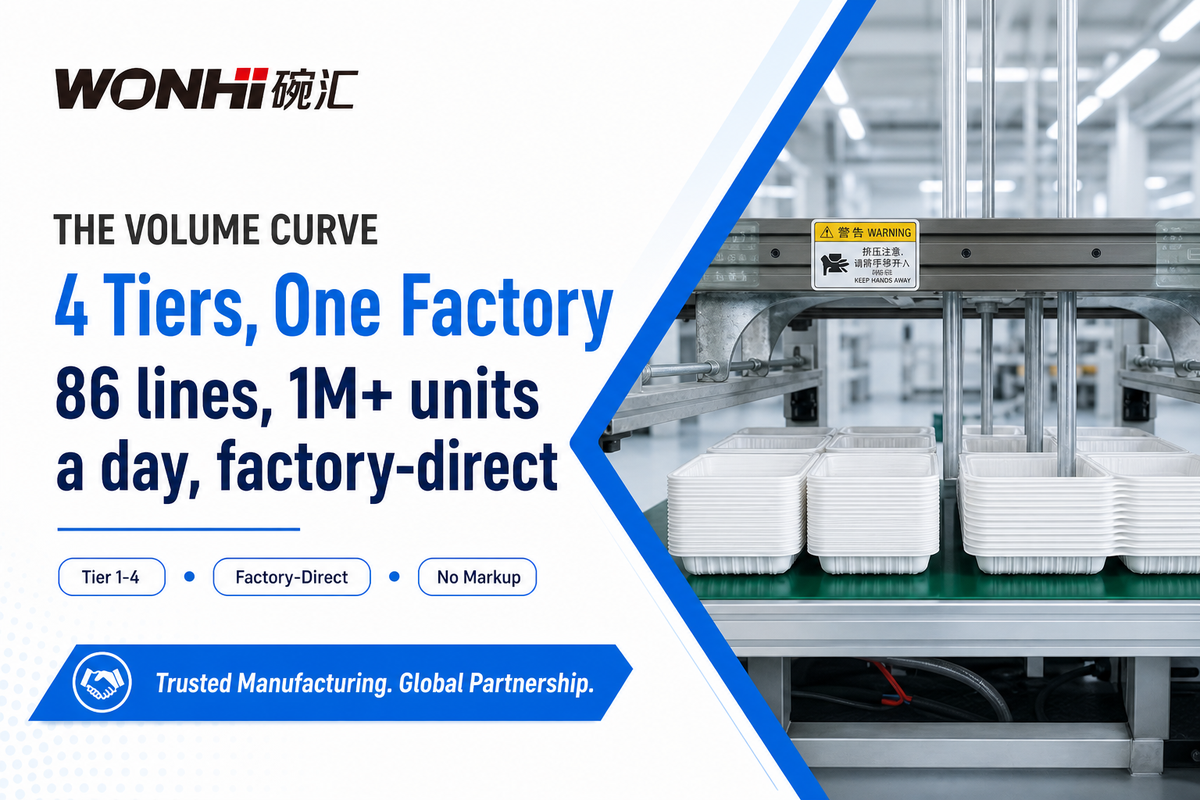
Purchase quantity drives unit cost downwards, though the curve isn’t linear; the location on that curve is often influenced more by logistics to your factory than the size of your order. Initial cost for a pilot run of a given material and the upfront cost of a large-scale run of the same material can differ significantly (by a factor of three or more), which is exactly why a cost-effective packaging plan starts with matching order size to supplier tier. We’ve found that wholesale pricing data for available suppliers clusters around four tiers — manufacturing process choice is itself an independent volume-economics lever, since research in the NIH’s PMC repository notes that extrusion blow molding is favored industrially specifically for cost-effectiveness at scale.
Tier 1 — Sample/Trial
<5,000 units
Highest $/unit
Tier 2 — Small Business
5,000–50,000 units
Mid-range
Tier 3 — Regional Chain
50,000–500,000 units
Lower-mid
Tier 4 — Factory-Direct Bulk
500,000+ units
$0.11–$0.16/unit range
Conventional PP containers are priced in a bulk tier range of approximately $0.14 to $0.86 per unit across various quantities, with bottom-of-the-bulk-break pricing hovering around $0.14 to $0.16 per unit. This bottom tier generally reflects direct orders placed with a manufacturer at true production volume – rather than orders routed through a distributor, which will involve additional markups without additional capability. We’re structured to supply the factory-direct Tier 4 pricing, where 86 production lines and over 1 million units a day is the norm. If your order size fits Tier 2 or 3, don’t hesitate to confirm directly with your supplier whether the pricing you received is from the factory floor or if it already includes a distributor markup; the difference between these two price points can be even greater than the cost premium for the sustainable alternative itself. A sound purchasing strategy is to align with the right supplier relationship to your real order tier, instead of simply chasing the lowest advertised price; it requires an analysis of pricing, freight, and failure rate simultaneously.
Restaurant & Foodservice To-Go Container Costs at Scale
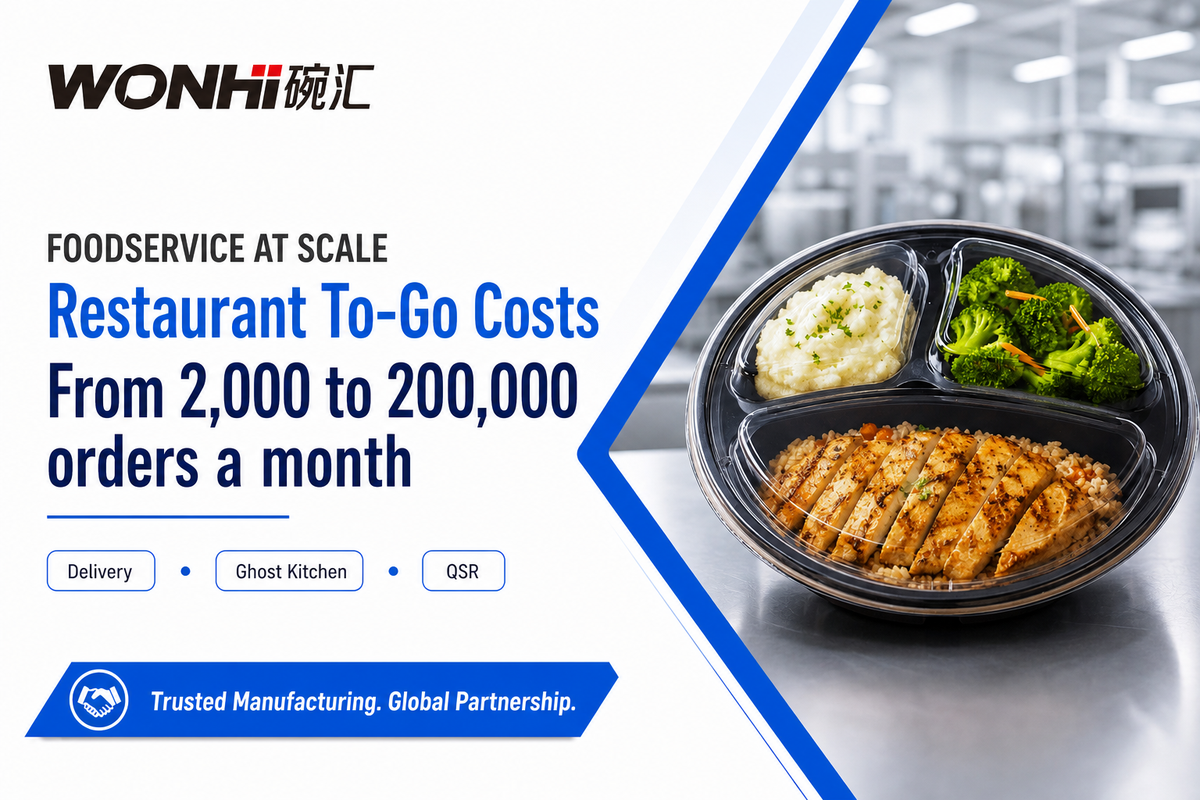
Commercial food packaging for foodservice – restaurants, cafés, ghost kitchens, and quick-service restaurants – is the dominant segment of the sustainable food packaging market, with over 41% of the 2024 revenue share, and it’s also the fastest-growing segment of the market, fueled significantly by on-demand delivery platform volumes. This massive scale makes a significant difference to the cost analysis, which varies substantially between a small, independently-owned restaurant placing 2,000 to-go orders monthly and a multi-location chain fulfilling 200,000 orders per month.
Consider a medium-sized delivery-heavy operator going from foam clamshells to compostable 3-compartment bagasse containers at approximately 15,000 units per month. With a $0.05-$0.10 per bagasse unit compared to a $0.03-$0.05 foam baseline, you’re looking at a monthly difference in the range of $300-$750. This is a considerable amount of money, but it’s only a small percentage of what a headline saying “50% more expensive” implies once you factor in an actual invoice. Another Reddit post shared a similar pattern after one small business owner switched to all 100% recycled shipping materials, seeing the per-unit price climb from its approximately $0.40 baseline (though the actual per-unit final price wasn’t specified). Bottom line from both instances: the cost delta is real, but it can be easily calculated ahead of time from your own order volumes – it’s not a hidden mystery.
For a 3-compartment option that’s intended for a delivery or catering menu specifically, you may want to refer to our 3-compartment container guide. In it we dive deeper into the various material options, sizes and tradeoffs for exactly this purpose. Transitioning to sustainable packaging works best as a phased change to your existing packaging, high-volume items first rather than replacing packaging across various industries and menu items simultaneously – using sustainable packaging on a pilot basis let you test performance before committing your order to high volumes.
A 2025 peer-reviewed study of restaurants and consumers in off-premises food service backs up the phased-rollout logic: restaurants in the study consistently preferred recyclable or biodegradable packaging but resisted paying for full reuse systems, and recyclable plastic and natural-fiber containers delivered the best utility-per-cost of the options tested – which lines up with starting your own switch on your highest-volume item rather than converting the whole menu at once.
Certification Costs, What BPI/ASTM D6400 Compostable Certification Really Adds
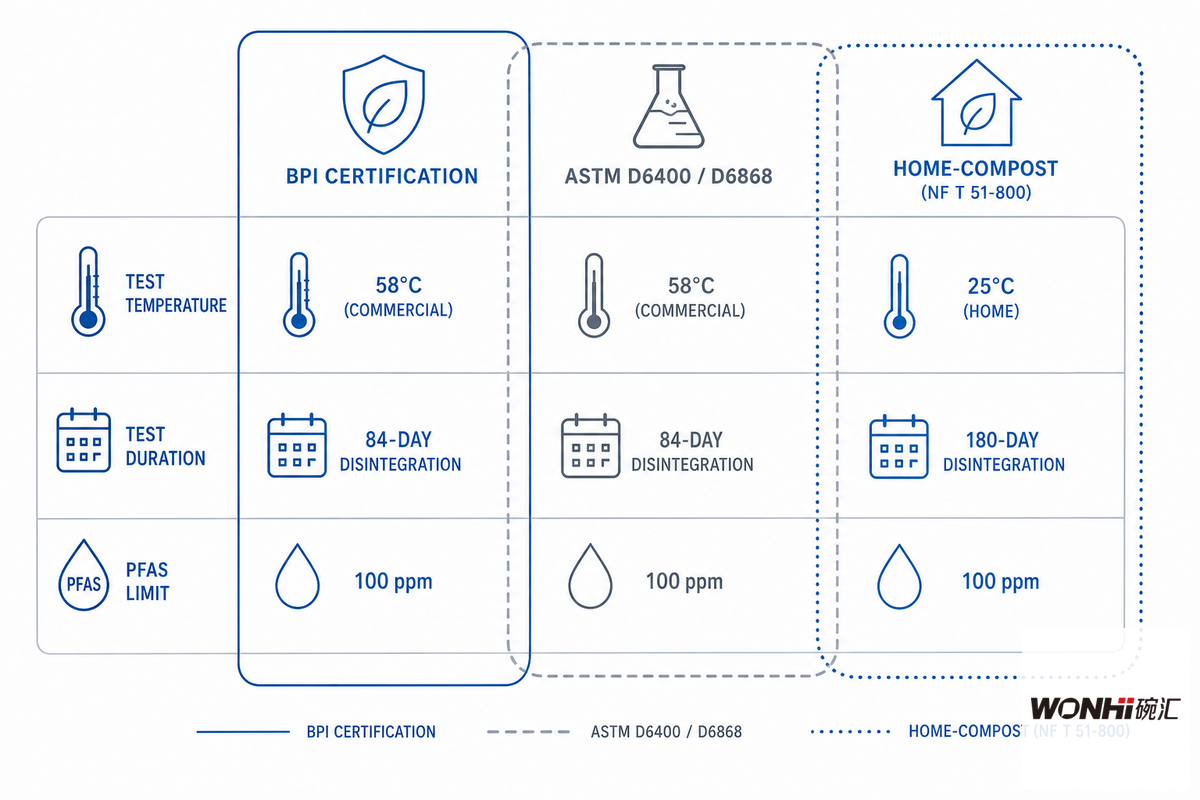
Many often confuse BPI Certification and ASTM standards as being the same when looking at the costs associated with compostable packaging. ASTM D6400 (for plastics, films, bags, etc.) and ASTM D6868 (for plastic-coated papers, including recycled papers, board and others) are actually technical standards specifying what materials can be commercially compostable through tests (84-day disintegration, 6-month biodegradation tests run at 58±2°C). A separate, “Home” composting standard, (based on BPI but uses a French standard – NF T 51-800), tests disintegration at a more home-realistic 25±2°C for 180 days and biodegradation for 12 months, which is why you see two sets of testing periods even under the BPI certification system. BPI Certification itself is a third party verification system that works above and beyond these ASTM standards, with additional criteria, the main one being a limit of less than 100ppm of total fluorine, with no intentionally added fluorine (PFAS). So even if a material “meets” an ASTM test method, it may not have the BPI certification on it – hence, why “ASTM D6400 compliant” is not always the same as “BPI certified” on product specifications sheets (though sometimes it is presented that way by suppliers).
That 90% (not 100%) biodegradation requirement actually references the 10% variability allowance inherent in biological testing, not that a tenth of the product is left as microplastic, and since each individual ingredient making up between 1% and 15% of the total product’s weight must be tested separately under the protocol, small additives don’t skate through undetected. Our compostable lines are manufactured to the BPI + ASTM D6400/D6868 standard and EN 13432 for EU markets-our certification numbers are available on request as unadorned “claimed” certifications carry zero weight with buyers hoping to verify their legitimacy. Type of eco-friendly packaging selected is a significant part of the puzzle here, too-while paper goods are typically covered by ASTM D6868, resin-based films and plastic wraps require the D6400 standard; be sure the actual standard you need applies to your particular format, and don’t assume that any existing certification automatically transfers between the two.
The Hidden Cost Side, EPR Fees, State Bans, and Waste-Tax Avoidance
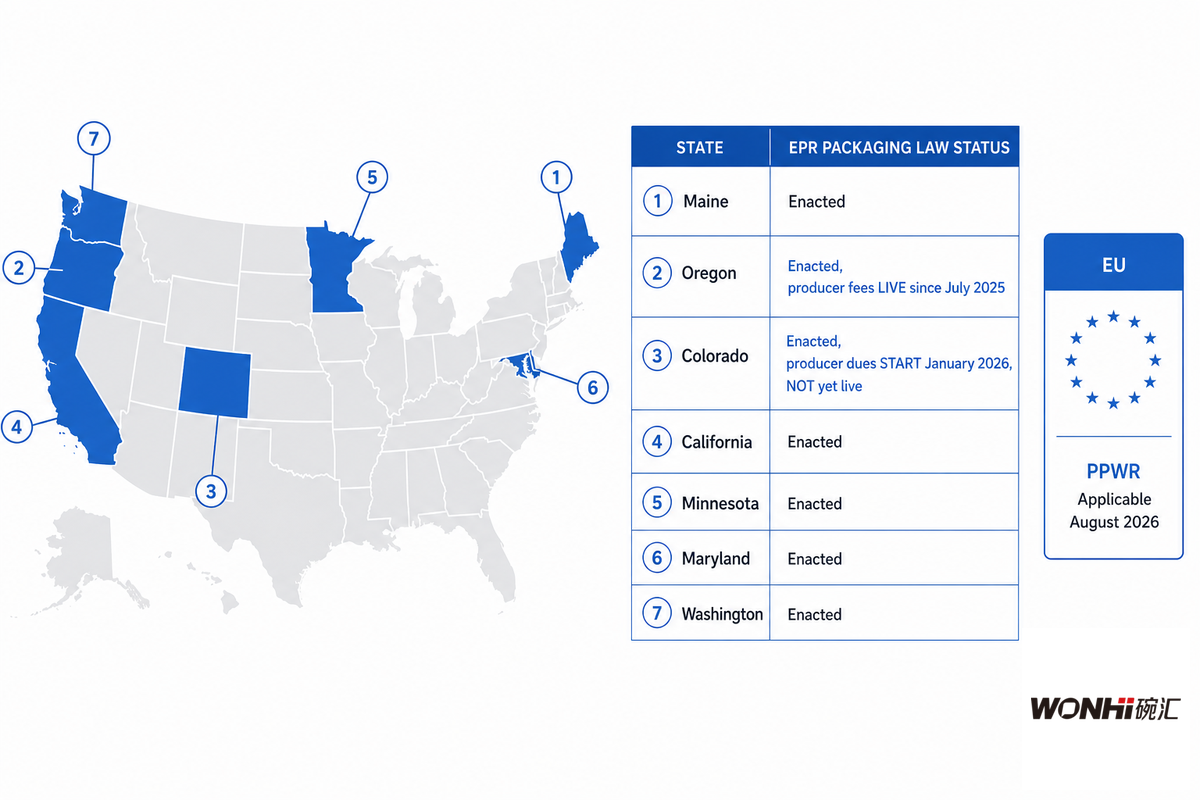
Every cost-comparison article we reviewed for this piece frames the decision as “pay more now for sustainable packaging” — and none of them mention the waste management and compliance cost of not switching. As of October 2025, seven US states have enacted full-scope Extended Producer Responsibility (EPR) packaging laws, Maine, Oregon, Colorado, California, Minnesota, Maryland, and Washington, with eight more introducing bills in 2025. These aren’t proposals sitting in committee: Oregon’s Recycling Modernization Act has been charging producer fees through its Producer Responsibility Organization since July 1, 2025, and failing to register carries a Class 1 violation penalty of up to $25,000 per day. Colorado’s program requires producer dues starting January 2026. Europe’s Packaging and Packaging Waste Regulation becomes applicable across member states on August 12, 2026.
Run your own exposure against this EPR Exposure Checklist before assuming a state law does not apply to you: are you the obligated producer or a distributor claiming an exemption, have you registered with your state’s PRO, and do you know your reporting-volume threshold?
📐 Engineering Note
While no published statewide per-ton rates exist on the state public agency sites for either Oregon or Colorado, those actual fee schedules are on a private producer-reporting portal for that state’s PRO (Circular Action Alliance in both instances) — your obligation will be based not just on package weight, but also on whether you’re classified as an “obligated producer,” any statutory exemptions, and the specific reporting volume threshold your business triggers. Account for the obligation and any product re-design it necessitates-but go to the source, the PRO itself, to find your rate.
In a related point that can be overlooked, packaging scientist Claire Sand highlights a lever most cost articles skip entirely:
“Food-waste prevention is a far more effective tool for reducing overall EPR fee liability than any change in packaging material – it reduces overall system greenhouse gas emissions by over 80% for every kilogram of food that’s not wasted. Even a moderate shift to a modified atmosphere package might raise per-unit packaging costs slightly but prevent a far more costly volume of food waste.”
— Claire Sand, Packaging Technology and Research; adjunct professor at Cal Poly, Michigan State, and University of Minnesota
In effect, these packaging regulations work similarly to a plastic packaging tax in that they push up the economic price of conventional packaging until reduced waste and more environmentally sound options begin to look attractive from a total cost perspective factoring in waste management costs, even where no formal “plastic tax” is enacted.
Is the Premium Worth It? Consumer Willingness-to-Pay and ROI
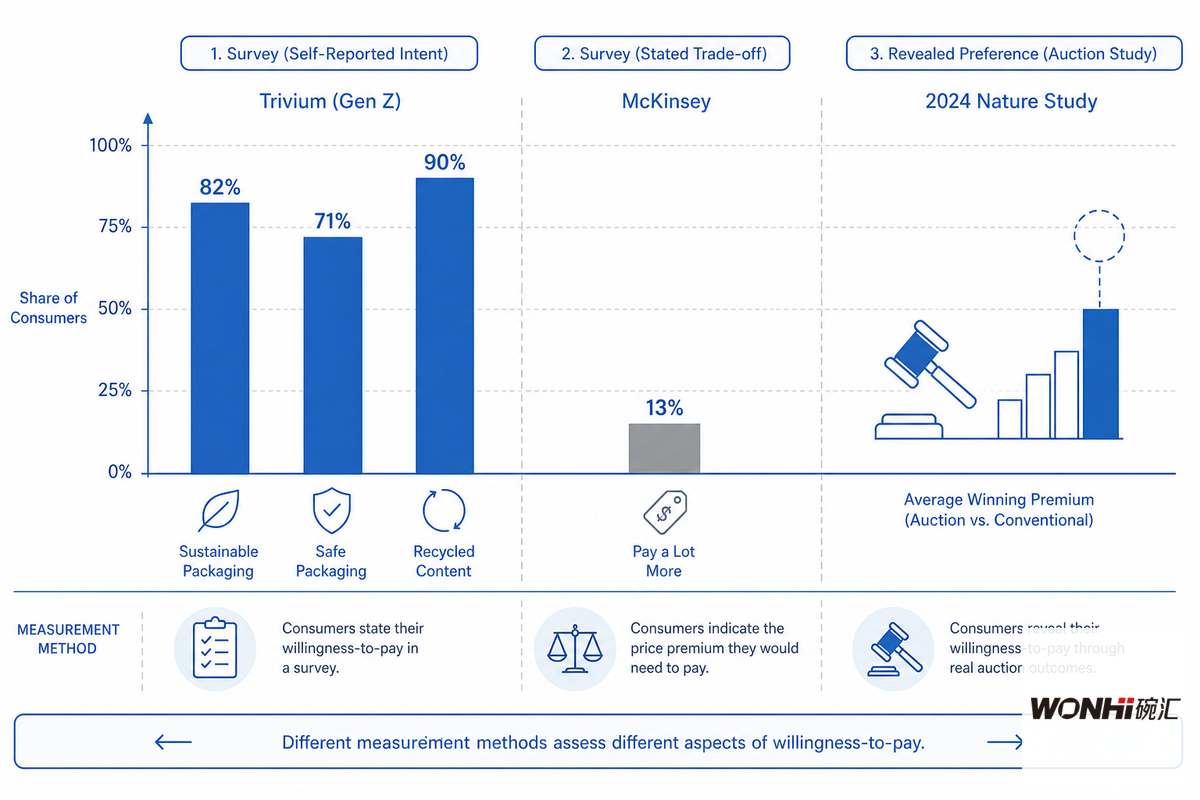
Almost every “consumer-driven sustainable packaging” article includes the statistic “82% of consumers are willing to pay more for sustainable packaging.” It’s real; our tracing found it as a key finding in Trivium Packaging’s 2023 Buying Green Report (prepared by Euromonitor International based on a survey of 9,000+ consumers in North America, South America and Europe) which specifically found “82% of consumers said they would pay more for sustainable packaging (up 4% from 2022),” and that “71% of respondents have purchased a product in the past six months due to its sustainability features,” a number that rises to 90% for Generation Z consumers.
That said, a more conservative reading from McKinsey’s 2025 US consumer packaging research found only 13% of Americans say they’d pay “a lot more” for sustainable packaging, even as the share of Americans citing environmental impact as a top purchasing factor has climbed steadily – from 14% in 2020 to 27% in 2023 to 33% in 2025, per the same McKinsey research line. These two surveys aren’t really in conflict, they’re answering different questions (general willingness to pay something more, versus willingness to pay a lot more)-but the honest read is that sustainable packaging is a real, measurable purchase driver, not a guarantee that customers will absorb a large price jump without noticing. If your brand’s sustainability goals are part of the pitch, the environmental benefits are easier to sell to a customer than to a CFO deciding whether a premium price is worth paying-lead with the CFO-facing numbers in this article, and treat the consumer-demand data as supporting evidence, not the whole business case.
Both of those numbers come from surveys, though, and survey answers tend to run higher than real purchase behavior since there’s no actual money changing hands. A 2024 experimental auction study in Nature‘s Scientific Reports put real bids behind the question instead, testing pasta buyers against different packaging and labeling combinations, and found a genuine willingness-to-pay premium for biodegradable packaging paired with an environmental-footprint label. A separate peer-reviewed auction study found the premium isn’t unconditional, though – once packaging looked visually unfamiliar to shoppers, willingness to pay actually dropped, and general pro-environment attitudes alone didn’t move the bid. The honest takeaway for a packaging-cost decision: the premium is real on average, but it’s conditional on the packaging still looking and feeling familiar to the customer, not just on the sustainability claim being true.
Estimate Your Switch-Over ROI →
When Reusable Beats Compostable, The Life-Cycle Cost Hierarchy
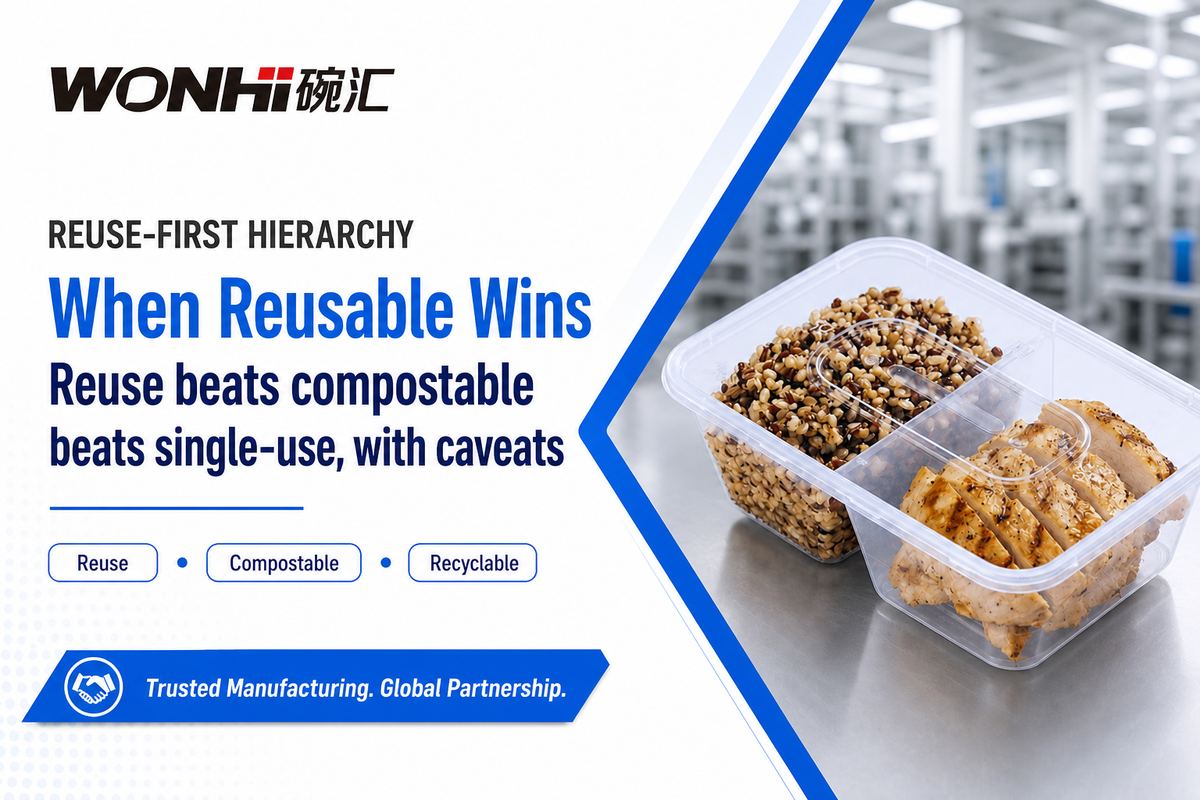
Call it the Reuse-First Material Hierarchy: a common framing holds that reuse beats a compostable and recyclable packaging blend beats single-use plastic – a genuinely greener packaging hierarchy, directionally right, but it hides two real caveats worth knowing before you commit budget to any one sustainable alternative.
First: reuse isn’t automatically the cheapest option. A peer-reviewed 2020 review in Resources, Conservation & Recycling: X found that reuse and refill pricing strategies have “not always” reduced retail price, and premiums have persisted in some refill systems-the return-and-wash logistics can offset the material savings.
Second, and more consequential for a compostable-packaging budget decision – and a real check against greenwashing rather than a genuine fossil-fuel offset: The EPA is explicit that certified commercially-compostable foodservice ware should only be purchased where a local composting program actually accepts it, with collection and hauling services in place. That’s a real cost most per-unit price comparisons – including the ones earlier in this article – don’t account for. If your facility isn’t near an accepting industrial composter, a “compostable” container that’s cheaper on paper still ends up in a landfill, where compostable materials commonly behave more like conventional plastic. Scale of the problem: containers and packaging accounted for 77.9 million tons of U.S. municipal solid waste in a single year, with more than a third of that landfilled rather than recycled or composted, per EPA data, and thin plastic film in particular remains one of the hardest packaging formats for standard municipal recycling systems to actually process. Compostable film can actively contaminate those standard recycling streams if it ends up there by mistake – which is exactly why “recyclable or compostable” isn’t a single interchangeable green packaging claim, and why biodegradable and compostable materials need the right end-of-life system to actually deliver the benefit you’re paying for.
✔ When compostable makes sense
- Local industrial composter confirmed to accept your certified material
- Collection/hauling arrangement already in place or budgeted
- State or local regulation mandates it (see hidden-cost section above)
⚠ When NOT to buy compostable
- No accepting local composting program (most US municipalities)
- No collection/hauling contract, it will end up landfilled anyway
- Hot, wet, or liquid-heavy menu items with PLA (heat/moisture limits)
How to Vet a Sustainable Packaging Supplier Without Overpaying
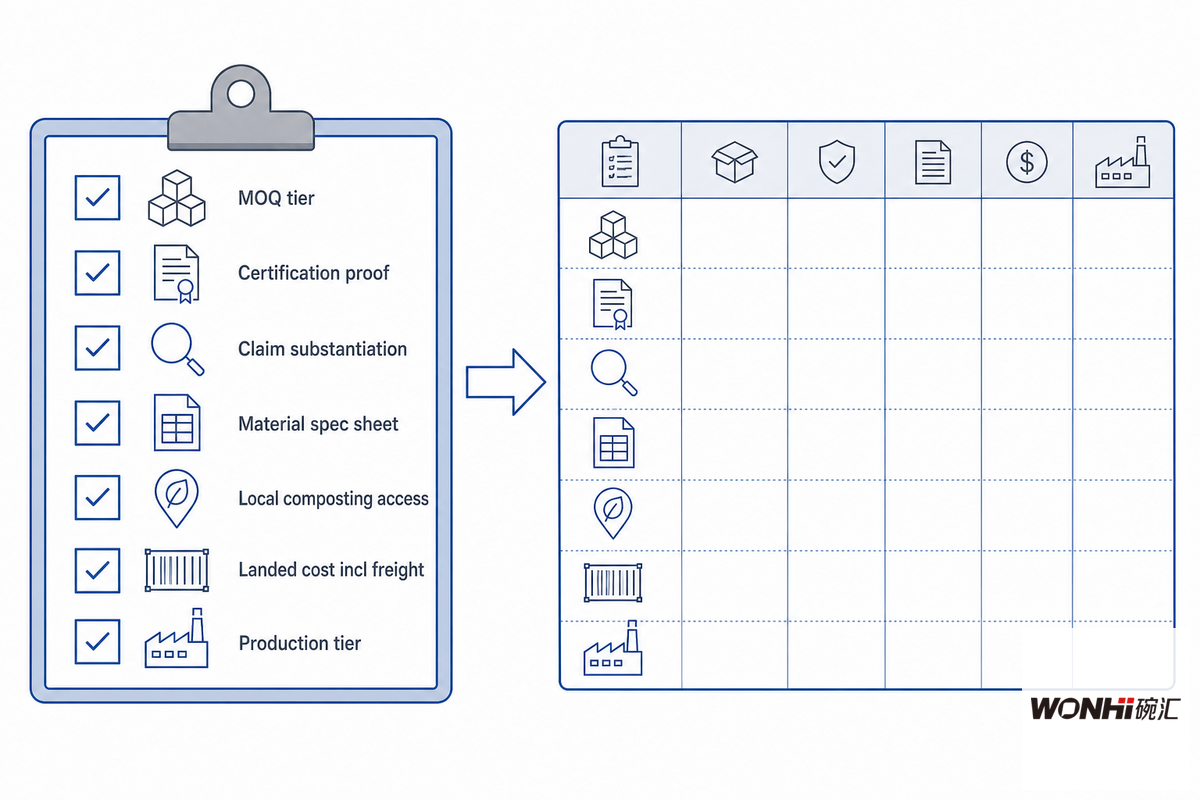
Don’t trust a vendor’s “eco-friendly packaging solutions” or sustainable packaging solutions promise if they’re just resellers – it’s wise to conduct a bit of homework and see if your supplier owns any packaging lines – and not just a branding name of an eco packaging line, since selecting packaging from a real manufacturer is a different exercise than choosing the right packaging reseller. Manufacturing method choice can move cost on the item just as much as your choice in packaging materials; for example, published packaging-manufacturing research notes that extrusion blow molding is favored over both injection molding and stretch-blow molding in the packaging industry, solely based on its cost effectiveness for products that don’t require ultra-high precision in dimension. Ask yourself, if the material cost seems high for a unit price, is it due to the cost of packaging itself or due to the materials choice, or production/tooling?
Choosing a manufacturer instead of a reseller can have additional advantages such as your secondary packaging options – secondary packaging is shrink wrap, shipping cartons and cases. Because it comes from a single packaging source, it helps save time and money compared to using multiple suppliers for the same thing. Additionally, it’s much simpler to verify if your ingredient choices or any applied coatings are negatively influencing the food safety measure you take to improve food safety on hot or wet menu items, especially when compared to different suppliers for different food types. If your primary concern is sustainable packaging, then it matters not only which eco-friendly products and materials like recycled paper your packaging provider offers, but also how they themselves do business and operate within the industry – a packaging strategy built around a real manufacturer beats a selection of eco-friendly branding with no factory behind it. Plenty of sustainable packaging companies advertise circular packaging or green food packaging lines without disclosing whether they actually run production, so ask directly.
One more check most buyers skip: a supplier’s third-party certificate alone doesn’t fully cover you. The FTC’s Green Guides are explicit that a certification mark doesn’t by itself substantiate every claim on the package – a recyclable claim needs qualifying language unless recycling facilities are available to at least 60% of the population where it’s sold, and a compostable claim needs its own competent, reliable evidence behind it, not just a logo. Ask your supplier for the actual test data or compliance letter behind the claim, not just the certificate.
RFQ checklist — copy these into your quote request:
| Parameter | Recommended range | Why it matters | How to verify |
|---|---|---|---|
| MOQ tier | Match to your real monthly volume, not aspirational volume | Wrong tier = overpaying for capacity you won’t use | Ask for pricing at 2 adjacent tiers, not just your target |
| Certification proof | BPI mark + ASTM D6400/D6868 or D6868 cert number | Distinguishes real cert from an uncited “compostable” claim | Request the certificate document, check the registry number |
| Claim substantiation (not just cert logo) | Written compostable/recyclable evidence beyond the certification mark | Per FTC Green Guides, a cert mark alone doesn’t substantiate every claim; recyclable claims need ≥60% facility access | Request the underlying test data or compliance letter, not just the logo |
| Material spec sheet | Service temp, wall thickness, wt% filler/blend | Confirms fit for your hot/cold use case before committing | Compare against your menu’s actual temperature range |
| Local composting/collection access | Confirmed accepting facility within your service area | Per EPA guidance, compostable-labeled ware without local acceptance still lands in a landfill | Check your municipal composting program’s accepted-materials list |
| Landed cost including freight | Quoted FOB price + freight to your dock, not FOB alone | Bulkier sustainable materials can shift freight cost more than the unit price suggests | Request a landed-cost quote, not just ex-works pricing |
| Production tier (factory-direct vs. distributor) | Confirm whether the quote is factory-floor or includes distributor markup | Markup layers can exceed the sustainable-material premium itself | Ask directly; compare against Tier 4 benchmark above |
Industry Outlook, What’s Actually Driving Sustainable Packaging Costs in 2026
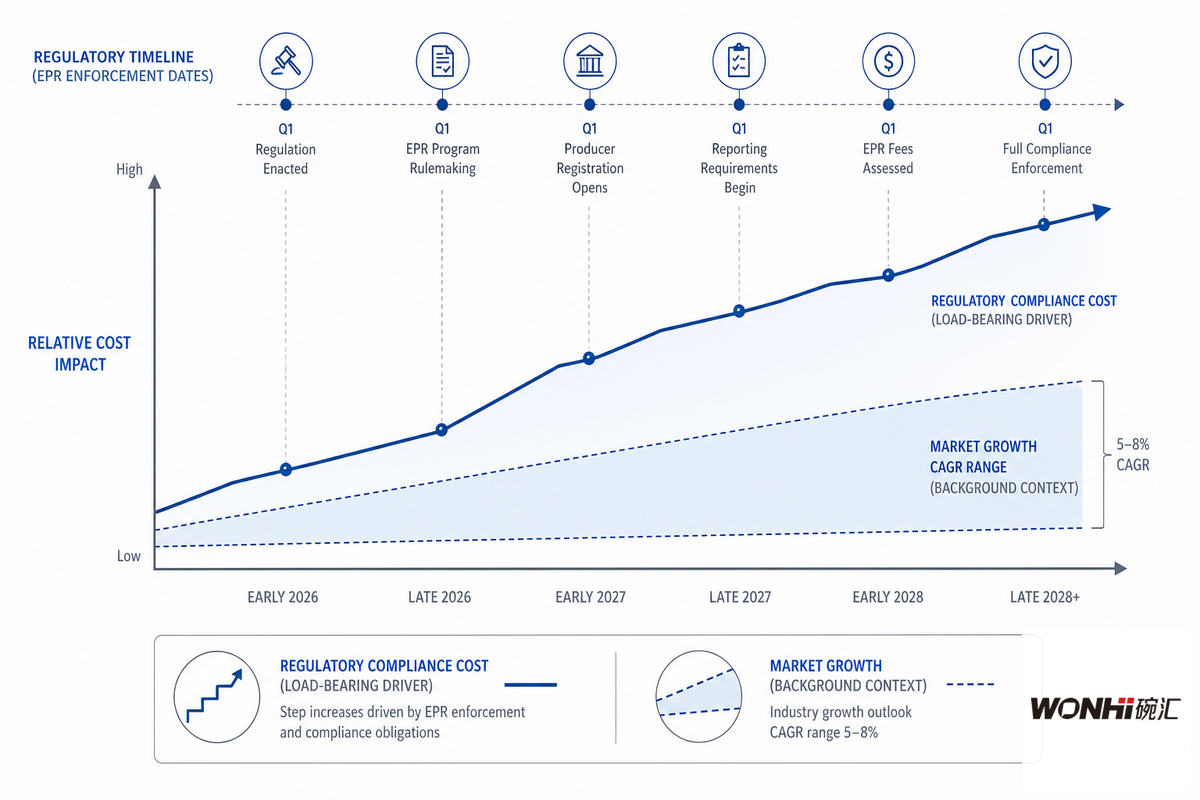
In reality, the true driver of the change in cost of sustainable packaging in the general packaging industry isn’t just market growth, but is the changing laws that are forcing packaging companies and brands to change how they do business. Any company that chooses to adopt sustainable packaging – whether that means bagasse, biodegradable materials, or another format – prior to a legally enforced deadline is often able to cut down on overall costs more so than companies that decide to wait for a compliance date to pass before making any changes; broader market trends show adoption of sustainable formats climbing regardless of any single company’s timeline, so moving early functions as a hedge against future compliance cost, not a discretionary spend. Several states in the U.S. currently have a mandate in place for packaging laws or are gradually enacting one – Oregon’s program is already live – several others are pushing for a bill in the legislature that would institute a packaging mandate, and the EU’s new regulation for PPWR will be applied throughout the region by August 2026. Companies that have failed to incorporate reporting fees, compliance costs and registration costs in their budget in these areas can expect major financial surprises in 2026 and 2027, not because packaging material costs are rising, but because the compliance measures will become mandatory.
These legislative initiatives are being coupled with increasing overall inflation costs. According to a 2025 L.E.K. Consulting survey conducted on over 400 U.S.-based brand-side packaging specialists, 83% anticipated a rise in packaging costs for 2025, citing multiple causes that extend beyond sustainability. Among these are cost pressure on the input material as well as supply chain factors. For comparison, independent market researchers project a growth range of 5%-8% CAGR in the broader category of eco-friendly food packaging through 2030-2036; while these estimates differ regarding base year value by a substantial margin ($130 billion+), they all share consistent directional indications of market expansion.
Key Takeaway
Sustainable food packaging cost isn’t a fixed premium, it’s a spectrum shaped by material choice, order volume, and whether you’re paying a regulatory cost now or a compliance penalty later. Bagasse and PLA at real production volume can land close to conventional plastic packaging pricing; smaller orders and less-optimized supply chains see a bigger gap. There’s no single “sustainable solution” that fits every menu or budget, and matching your sustainable practices to your actual local infrastructure matters more than chasing the lowest quoted unit price. Packaging may cost noticeably more a year from now once more of the seven-state EPR wave is fully enforced, the clearest cost mistake in either direction is skipping the two questions this guide keeps coming back to: does your local infrastructure actually support the “compostable” claim, and is your quoted price factory-direct or padded with distributor markup?
Frequently Asked Questions
Q: How much more does sustainable packaging cost than plastic?
Sustainable packaging typically costs 15% to 30% more than conventional plastic at production-level order volume, rising to 2x–3x at smaller order sizes or with less-optimized suppliers.
The range in the wholesale costs of food packaging are wide, but at their core, it comes down to materials and volume.
While conventional plastic — often PP — might cost anywhere from $0.11-$0.86 per unit, popular sustainable materials such as bagasse, PLA, and bamboo, often come in at $0.05-$0.19 per unit. At its lower end, this even makes bagasse cheaper than the high-end plastic packaging. Larger buyers at the wholesale level are likely to see a premium closer to 15% to 30% of traditional packaging, whereas smaller domestic or international buyers could face prices double or triple the standard rate.
Q: Is compostable packaging expensive compared to biodegradable packaging?
Compostable packaging carries a real cost premium over biodegradable-but-uncertified formats, mainly because certification testing (ASTM D6400/D6868 plus BPI review) is a separate line-item cost on top of the material itself.
Biodegradable versus Compostable There’s often confusion over what “biodegradable” actually means, as it is not a regulated or tested claim unlike the word “compostable.” “Biodegradable” can refer to a material that will break down under the right conditions without undergoing the rigorous 90%-conversion-within-6-months ASTM commercial testing that certifies compostable packaging must undergo. This process not only drives up the cost of certified compostable packaging but also offers you the opportunity to back up claims to consumers and regulators, whereas a vague “biodegradable” label does not offer this support.
Q: Are 82% of consumers really willing to pay more for sustainable packaging?
Yes — that figure is real and traces to Trivium Packaging’s 2023 Buying Green Report (with Euromonitor International, 9,000+ consumers), though a separate 2025 McKinsey survey found only 13% of US consumers would pay “a lot more.”
Consumer demand for sustainable packaging is real but uneven — surveys show high consumer interest in sustainability, though they reveal a distribution of willingness to pay rather than an across-the-board acceptance of large price increases. Trivium’s 82% represents any level of willingness to pay more for sustainable products, and of those, 71% had made a purchase based on those factors within the past six months, rising to 90% among Gen Z. McKinsey’s more precise 13% figure reflects those willing to pay a lot more, alongside a steady 2020-2025 climb in shoppers naming environmental impact a top purchase factor.
Q: What’s the difference between biodegradable, compostable, and recyclable packaging?
Compostable meets a tested standard (ASTM D6400/D6868) for breaking down under composting conditions; biodegradable breaks down naturally with no standardized timeframe; recyclable can be reprocessed into new material through existing recycling systems.
The terms “compostable,” “biodegradable,” and “degradable” do not serve as equivalent descriptors of materials.
Instead, their suitability depends entirely on the infrastructure that will be used to dispose of the packaging.
Q: Will switching to sustainable packaging disrupt my current supply chain?
Switching to sustainable packaging can disrupt your supply chain, mainly through minimum-order-quantity mismatches with a new supplier and freight-weight differences versus your current plastic packaging, but a phased switch on your highest-volume SKUs first minimizes the disruption and lets you validate the new material before committing your full order volume.
The heavier weight of some sustainable packaging options can affect freight costs. Make sure to factor the full delivered price, not just the per-unit cost, into your overall budget.
Q: What is the most cost-effective sustainable packaging material?
Bagasse is typically the most cost-effective certified-compostable material at production volume, running $0.05–$0.10 per unit in the wholesale data we checked — close to or below the low end of conventional PP pricing.
Application Matters Some packaging materials work best in specific situations, so you’ll need to consider the type of food you serve. For example, bagasse can handle hot foods, but PLA may not be suitable due to its performance issues with heat and moisture, although it is less expensive for cold food packaging.
Why We Write This
Wanhui currently operates 86 in-house production lines — for PP, MFPP, PET, and bagasse foodservice packaging — in Linyi, Shandong, and sells factory-direct to foodservice buyers throughout the US, Europe, and elsewhere. The cost data presented in this article are based on a comparative analysis of wholesale prices on real market value and our in-house production line specifications. They don’t simply reproduce the ubiquitous (but unsourced) percentage cited in other pieces on this subject.
References & Sources
- Identifying Sustainable Food Service and Food Service WareUS EPA
- Producers of Covered ProductsOregon Department of Environmental Quality
- Extended Producer Responsibility ProgramColorado Department of Public Health and Environment
- Beyond Fossil Plastics: Next-Generation PLA-Based Bio-PackagingNational Institutes of Health, PMC
- Sustainability of Reusable Packaging, Current Situation and TrendsResources, Conservation & Recycling: X (Elsevier)
- Biodegradable Products Institute, Certification FAQs
- 2024-25 Impact ReportUS Plastics Pact
- The 2025 Guide to EPR Packaging ComplianceProskauer Rose LLP
- 2023 Buying Green ReportTrivium Packaging with Euromonitor International
- Moulded Fiber Packaging with Biodegradable Aliphatic Polyester (US12434892B2)Huhtamaki Molded Fiber Technology, USPTO
Related Articles
- 3-Compartment Container Guidematerial and sizing tradeoffs for foodservice compartment formats
- Eco-Friendly Food Packaging Guidefull overview of our sustainable material lines
- Biodegradable Food Containers Guidebiodegradable vs compostable vs recyclable in depth
- Eco-Friendly Food Packagingour compostable and bio-based product line