Get in touch with Wanhui Company


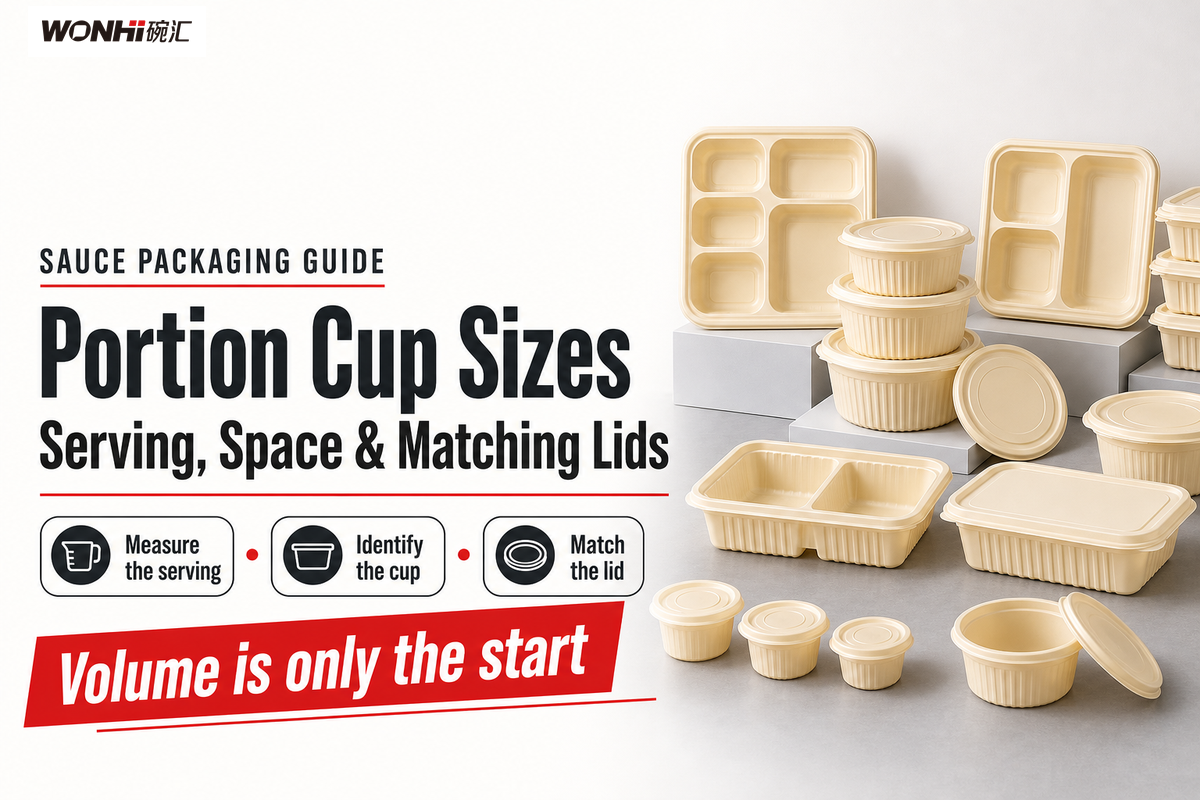
Choosing portion cup sizes starts with identifying the serving you wish to pack. A sauce cup must hold that portion with its matching lid closed, fit the takeout package, and suit the food and handling conditions. The ounce label helps you evaluate volume; the cup and lid model numbers help you identify which components belong together.
By GW · Updated October 2026
Portion cup sizes are nominal volume labels. In this US guide, 2 fl oz is about 59 mL, and 4 fl oz is about 118 mL. Identify a serving first, test the closed-cup fit, and choose the exact matching lid code. Fluid ounces measure volume, not sauce weight.
- Two 1 oz cups can require different lids, even within one manufacturer’s range.
- Nominal capacity and the amount you can pack beneath a closed lid are separate measurements.
- A complete quote identifies both components, the intended use, and separate cup and lid quantities.
Quick Specs
Unit basis: US fluid ounces; Conversion: 1 US fl oz ≈ 29.57353 mL; Reference capacities below: 0.5-5.5 US fl oz; Working fill: established with the actual food and closed lid; Lid selection: manufacturer family plus cup code plus lid code.
Portion cup sizes chart: nine reference capacities
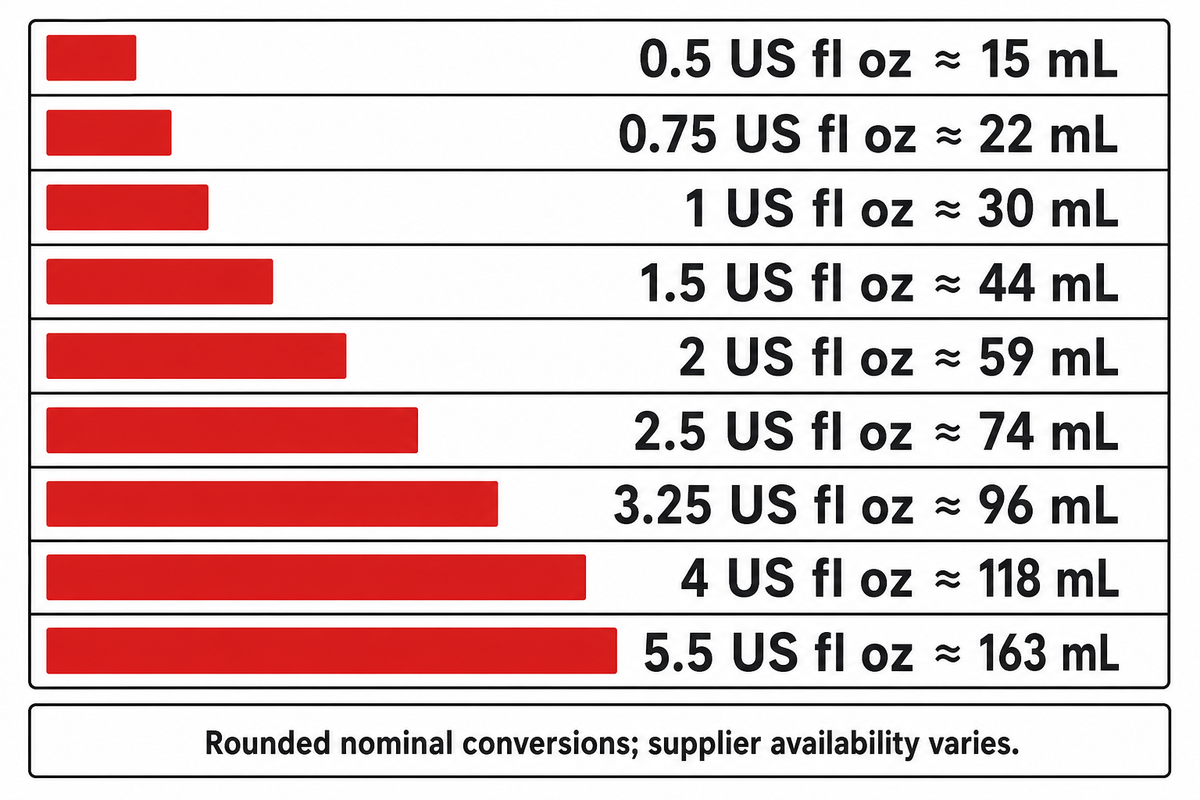
Portion cup sizes are typically given in nominal fluid volume, and recipes may be in mL or grams. The chart provides a round-off of 9 reference capacities in mL to support comparison. The range and capacity convention of each supplier and the usable fill for the selected model must still be verified.
| Nominal reference size | Rounded volume | Share of a US measuring cup |
|---|---|---|
| 0.5 fl oz | 15 mL | 1/16 cup |
| 0.75 fl oz | 22 mL | 3/32 cup |
| 1 fl oz | 30 mL | 1/8 cup |
| 1.5 fl oz | 44 mL | 3/16 cup |
| 2 fl oz | 59 mL | 1/4 cup |
| 2.5 fl oz | 74 mL | 5/16 cup |
| 3.25 fl oz | 96 mL | 13/32 cup |
| 4 fl oz | 118 mL | 1/2 cup |
| 5.5 fl oz | 163 mL | 11/16 cup |
Use the factor displayed in the NIST unit-conversion table to convert the volume, then round the result to the nearest mL. Note that these are equivalences and don’t imply measured fill lines or that each supplier stocks all nine sizes. A 5 oz cup and a 5.5 oz cup denote a difference in nominal volume.
How big is a portion cup?
A portion cup is a small container for individually packed sauce, dressing, dip, topping or food sample. Its capacity label describes volume, not its physical footprint. For example, 2 US fl oz converts to about 59 mL, but two cups with that capacity can have different heights, mouths, and lid designs.
The variety of sizes in a condiment or souffle cup catalog can obscure differences in shape. To find the range, use the name, and to determine the disposable portion cup, use dimensions and model codes. A compact, small size may fit beside a meal, but it may be too narrow for the dipping food. To know what size fits your foodservice needs, measure both the serving and the space available in the meal package.
US fluid-ounce conversions keep the comparison consistent: 1 fl oz is approximately 29.57 mL, whereas an ounce of mass is approximately 28.35 g. A recipe weighed in grams therefore needs its own volume measurement before it can establish the plastic cup size to order.
Compare 2 oz, 3.25 oz and 4 oz portion cups
A 4 oz portion cup has twice the nominal volume of a 2 oz cup; a 3.25 oz cup sits between them at roughly 96 mL. Those ratios help compare capacity. They do not establish the diameter, the amount of sauce beneath the lid, or whether existing lids fit the replacement.
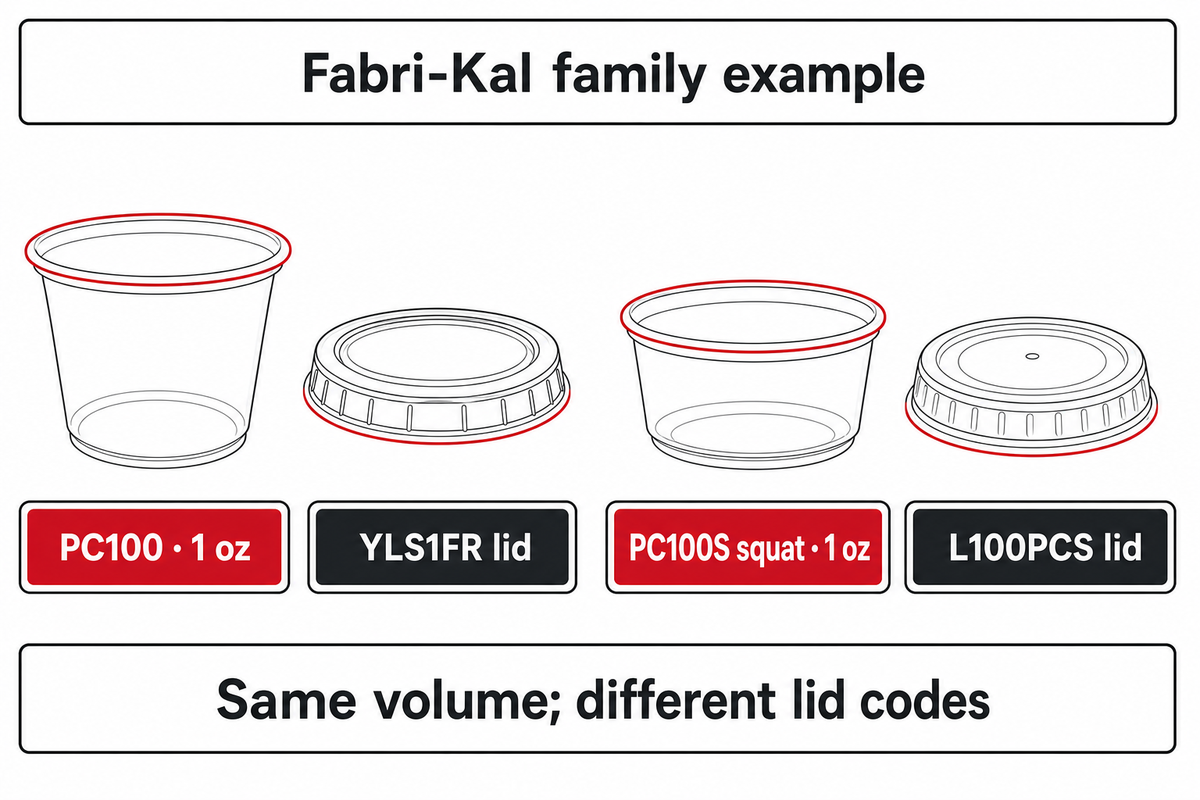
Fabri-Kal’s 2024 sheet pairs its PC100 1 oz cup with YLS1FR, but pairs its PC100S 1 oz squat cup with L100PCS. Equal capacity hasn’t always ensured equal lid compatibility. Conversely, that sheet lists XL345PC for three capacities: PC325, PC400, and PC550.
Consider a restaurant wishing to switch from a 2 oz dressing cup to a 4 oz cup. The restaurant can easily calculate an increase in nominal volume, but the packing team still needs samples. Place the proposed cup in the actual bowl or meal box, and close both packages. Check if the sauce container presses against the main lid. Compare the additional storage space as well. If the larger cup offers no benefit for the chosen serving, its extra volume alone is not a reason to switch. A change that improves access for dipping may be useful even when the portion stays the same.
When comparing larger meal packages, evaluate the disposable food container range, alongside the sauce compartment. Nominal volume is one field in that comparison; cup height, rim dimension, and the closed assembly’s fit determine whether the proposed combination works.
Choose the serving before the sauce cup
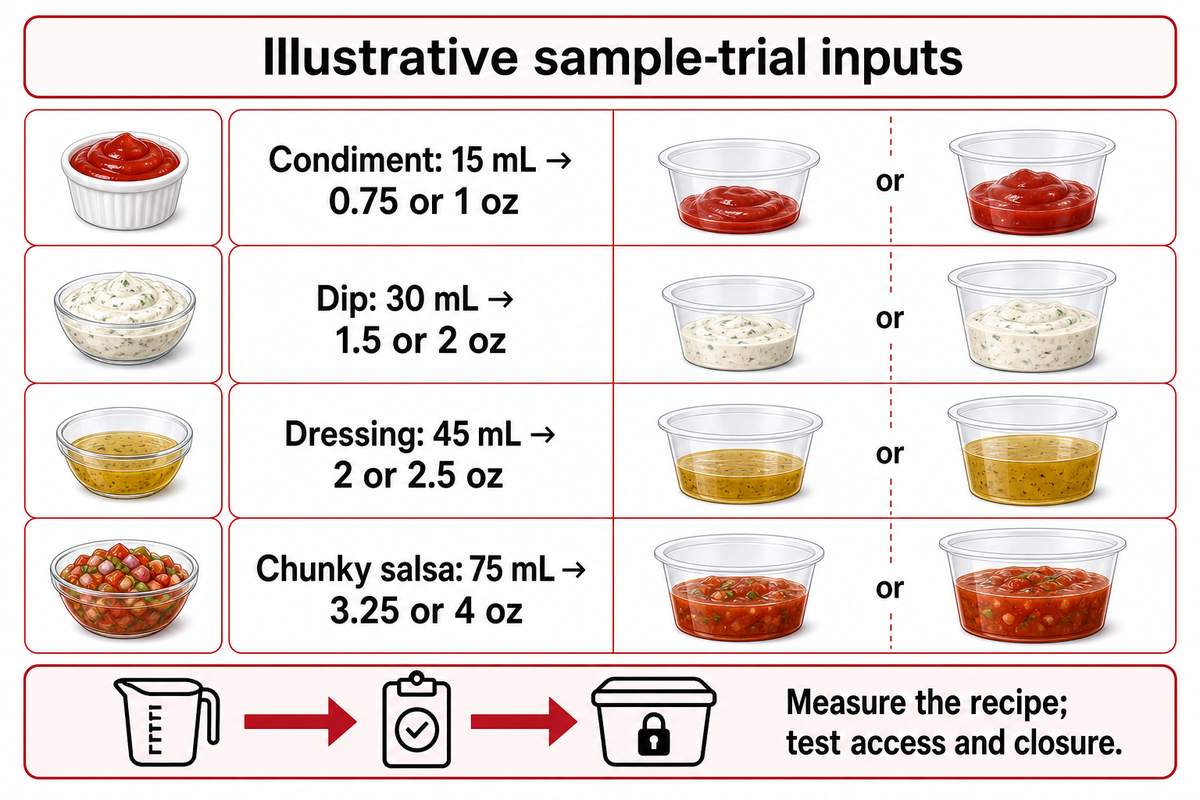
Measure the portion on your menu to select a sauce cup. Test candidate containers with that volume. Ketchup, chunky salsa, hummus, and salad dressing can behave differently during filling and dipping. A good selection would be starting with the serving and customer access rather than a universal cup size.
| Menu use | Chosen serving | Candidate to test | Check with the food |
|---|---|---|---|
| Condiment or tasting sample | 15 mL | 0.75 or 1 oz | Dispensing control and access |
| Dip or topping | 30 mL | 1.5 or 2 oz | Food entry through the mouth |
| Salad dressing | 45 mL | 2 or 2.5 oz | Closure and transport position |
| Chunky salsa | 75 mL | 3.25 or 4 oz | Solid pieces beneath the lid |
Which size cup do I need?
The size cup you need is the smallest tested assembly that accommodates your chosen serving, closes properly, and provides the access your customer needs. Measure the serving with the actual recipe, shortlist available capacities above it, then compare samples. If a 30 mL dip fits but a chip can’t enter comfortably, compare a wider model.
Portion control also depends on how staff dispense the food. Even for identical measured servings, a ladle, scoop, pump, or piping bag may produce different shapes. The filled surface is important. Don’t just look at how much you’re removing from a bulk container. This is particularly relevant to yogurt and toppings which are above the liquid level.
Small servings need a usable opening as well as enough capacity. For a 30 mL snack accompaniment, check spoon or chip access before ordering the case. For salad, make sure the dressing cup is aligned with the salad packaging format, so the customer can open and remove it without unpacking the entire meal. For easy handling (part of the customer experience), compare how the cup opens when the other hand is holding the meal.
For dine-in service, a cafe may require other decisions. An open dip on a tray is different from a closed dip packed for travel. Portion cups provide a separate space for the accompaniment, but the surrounding package still needs to hold it securely.
Leave fill space for the lid and food
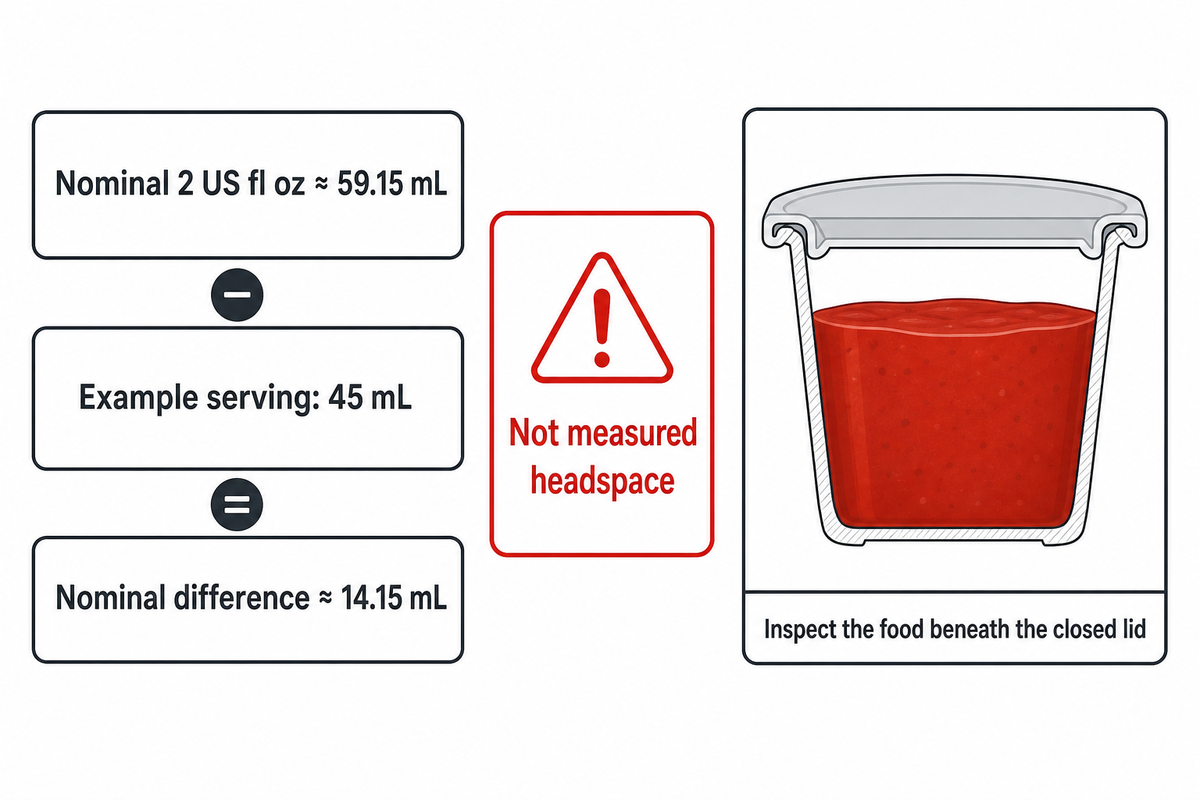
Usable fill is the amount your cup and lid can contain under the conditions of packing and handling. Nominal capacity of the cup alone doesn’t determine this amount. Test the recipe beneath the specified closed lid, especially when a mound of thick food or an inward lid profile occupies space above the liquid surface.
Consider a worked example with a 45 mL dressing serving and a nominal 2 US fl oz cup. Multiplying 2 by 29.57353 gives about 59.15 mL. The calculation leaves approximately 14.15 mL of nominal capacity unused; this does not measure empty space. That doesn’t indicate how much empty space there is, how far the lid protrudes into the cup, or the cup maker’s convention on capacity. Close a sample with the correct recipe, and see where the food is in relation to the sample edge. If dressing is displaced onto the rim during closure, compare a lower fill or a different model. Record the successful serving volume separately from the catalog capacity.
A sauce that’s too thick may leave a peak where it exits the dispenser. Flattening that peak, changing the dispensing method, or selecting more suitable geometry are different interventions; increasing capacity is only one option. Check what happens during normal filling, as opposed to creating an unusually neat sample that staff can’t repeat during service.
A closed sample, together with the measured serving, cup code, lid code and closure observations, tells you more than a percentage of nominal capacity.
Match portion cup lids by product code
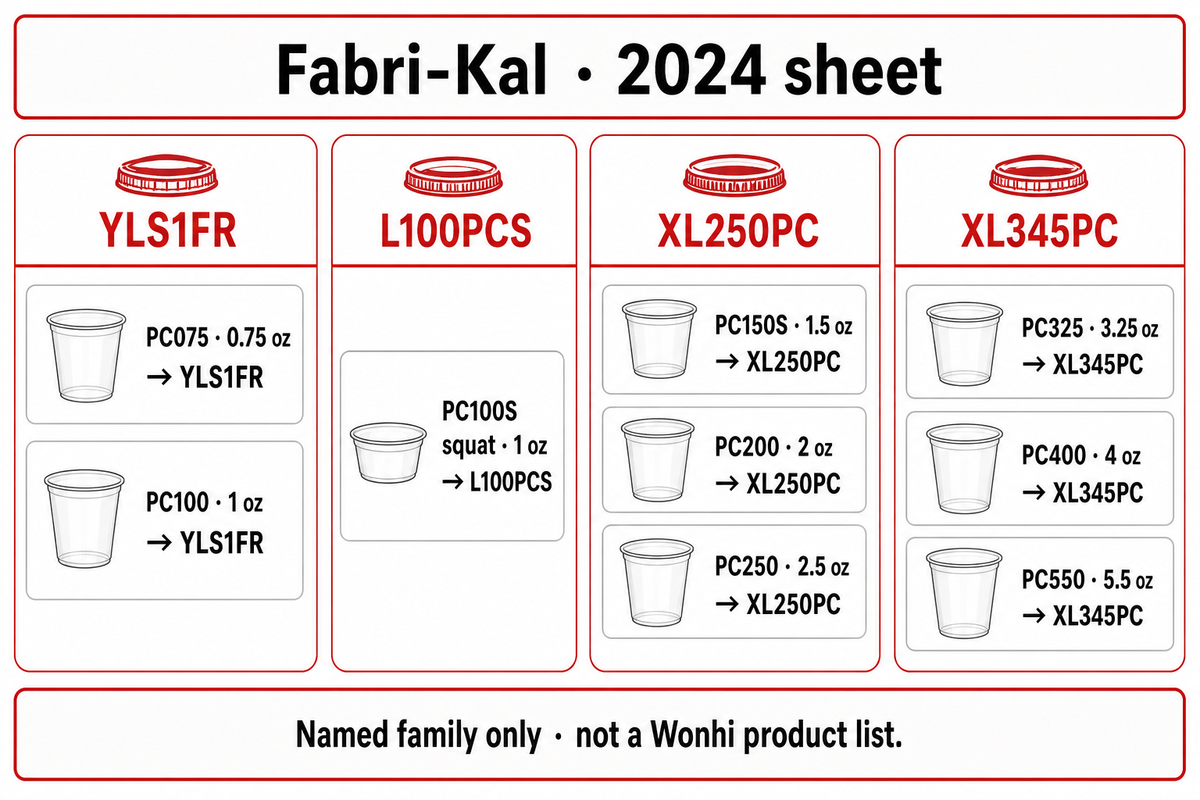
Match portion cup lids to the cup code within the named manufacturer’s product family. Capacity labels aren’t sufficient because equal-volume models may use different rims, and several capacities can share one lid. Keep the supplier’s pairing evidence with the order, and upon receipt compare the approved pairing with the received pairing.
| Cup model | Nominal capacity | Listed lid code |
|---|---|---|
| PC075 | 0.75 oz | YLS1FR |
| PC100 | 1 oz | YLS1FR |
| PC100S, squat | 1 oz | L100PCS |
| PC150S | 1.5 oz | XL250PC |
| PC200 | 2 oz | XL250PC |
| PC250 | 2.5 oz | XL250PC |
| PC325 | 3.25 oz | XL345PC |
| PC400 | 4 oz | XL345PC |
| PC550 | 5.5 oz | XL345PC |
The crosswalk is a named-family example, not a universal compatibility chart or a Wonhi product list. It demonstrates why an order line of “1 oz cups + lids” doesn’t provide sufficient information to make a purchasing decision. Add the cup model, shape where relevant, and lid model.
Another family uses different pairings. Pactiv’s 2023 portion-cup sheet lists YS300A and YS400A with YLS3FR, but YS550A with YLS5FR. Do not transfer the Fabri-Kal three-capacity pairing to those codes, just because the nominal sizes look similar.
At receiving, retain a labeled sample pair and compare carton labels before opening stock for service. A lid that appears to fit on the rim of a cup still needs its closure checked around the circumference. For grab-and-go or other on-the-go orders, include the assembled package in the handling trial described below. Cups used in restaurants should remain identifiable once their outer cartons are removed, and model numbers should be retained when replacement stock is selected.
Fabri-Kal’s PC100 and PC100S are 1 oz. cups, but their lids are different. The family and model codes carry compatibility info. Be sure to provide those codes when you compare suppliers, quotes, or while replacing one of the components in a cup/lid inventory.
Check plastic cups and lids for their intended use
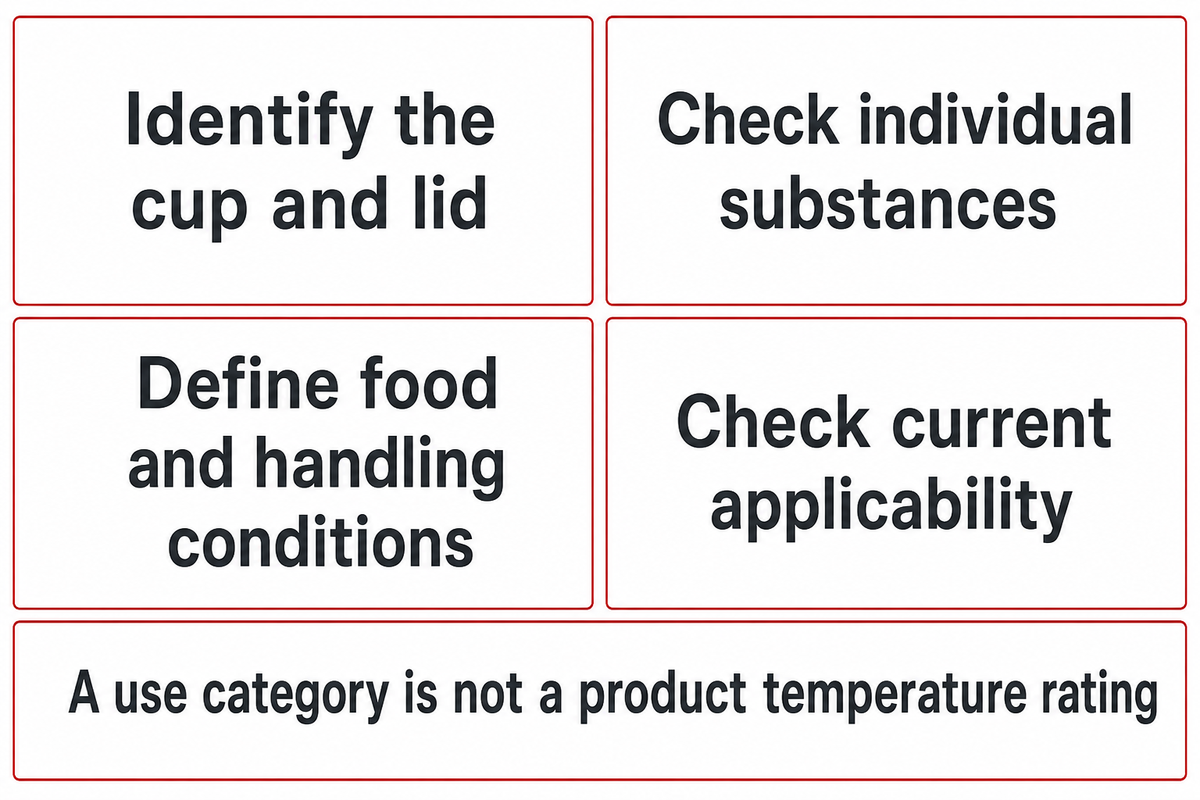
Plastic portion cups and lids should be assessed for the food and conditions they’ll come in contact with, such as storage, transportation, and any filling and heating. A material abbreviation or optical clarity doesn’t define every component’s allowed use. Request documentation that describes the proposed cup-and-lid assembly and the food-contact conditions.
“The overall regulatory status of a food contact material is dictated by the regulatory status of each individual substance that comprises the article.”
That evaluation can encompass the polymer as well as additives, coatings, adhesives and other substances in the article. The FDA food-type and conditions-of-use tables distinguish food categories and handling conditions, including refrigeration, freezing, hot filling, and reheating. A category in that table is not a temperature rating for a specific container.
Where a supplier relies on a Food Contact Notification, the FDA notification inventory ties applicability to the identified manufacturer or supplier, substance, and stated conditions. Other authorization routes exist, so this supplier-specific point should not be applied indiscriminately to every regulatory basis.
Keep document dates in the purchasing file. The FDA’s March 2024 notification-rule update describes reasons an authorization may cease to be effective, including reasons unrelated to safety. An old reference number alone does not establish current applicability to the proposed supply.
For the purpose of sustainable packaging, analyze the complete package and the disposal route available to the customer. A claim about one component does not describe the other. The guide to compostable, biodegradable, and recyclable packaging covers those distinctions beyond this size-selection guide.
Trial the complete package before ordering
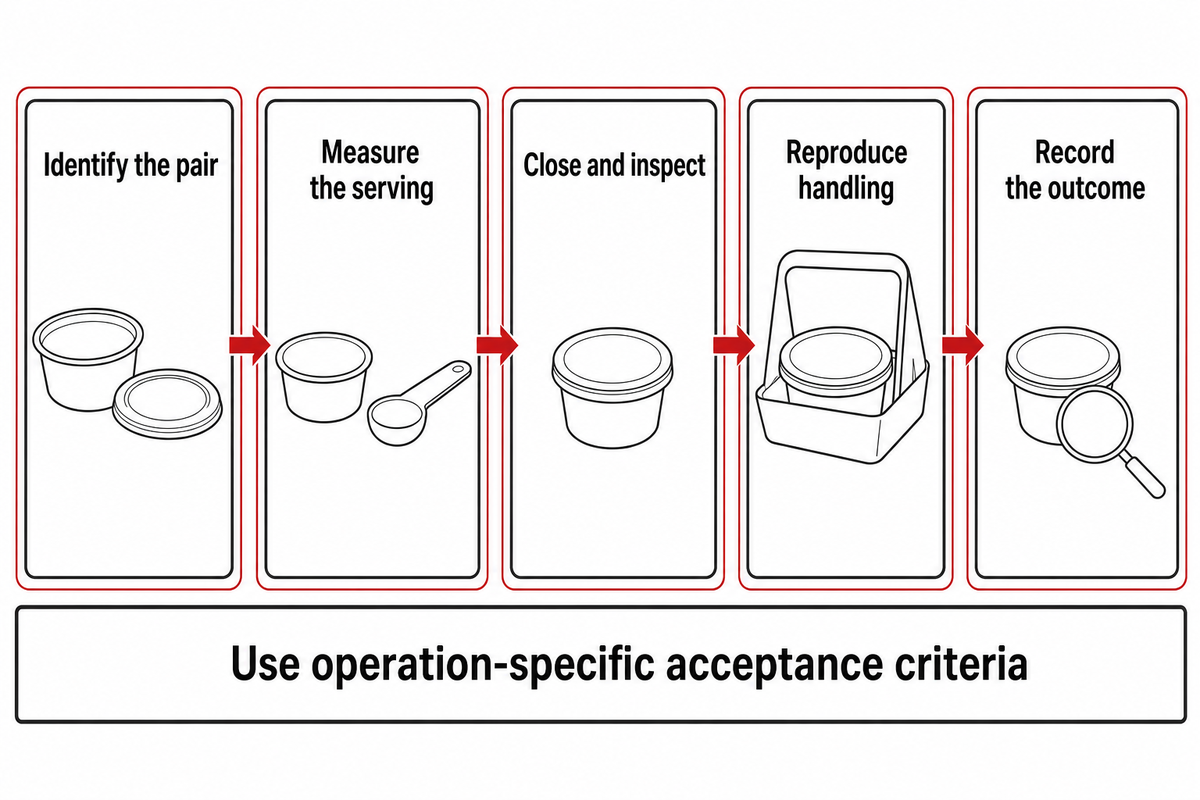
A useful portion-cup trial reproduces the intended serving, closure, and storage and handling sequence with identified samples. Record your observations against acceptance criteria chosen for your operation. Testing an empty lid fit addresses a different concern from testing a filled cup in a meal package, where contact and movement can affect the assembly.
- Identify the pair — record the manufacturer, cup code, lid code, and sample or lot reference.
- Measure the serving — fill with the intended food using the normal utensil or dispenser.
- Close and inspect — check the circumference, rim cleanliness, and any displaced food.
- Reproduce handling — use the planned storage conditions and actual secondary package.
- Record the outcome — note the fill amount, observations, and approval or reason to change the candidate.
Use a filled sample in a meal carrier for a food truck preparing a 45 mL chilled dip. Staff should close it with their normal technique and then check it following the intended handling sequence. Record whether the lid remains seated, whether food reaches the outside, and whether customers can open it without awkward contact with the meal. Set the storage duration and conditions based on the operation’s actual plan and applicable handling requirements. A neat cup on a desk can’t answer these questions. If the sample fails, change only one variable at a time so the next trial can answer whether the problem was fill, closure, geometry, or packaging contact.
Distinguish a leak through the closed assembly from a spill during filling or opening, and record which event occurred. Use the same observations to compare candidates from the wide variety of food service formats. For a wider choice of package construction and format, the disposable food containers buying guide provides the surrounding selection context.
Put the cup and lid specification into the quote
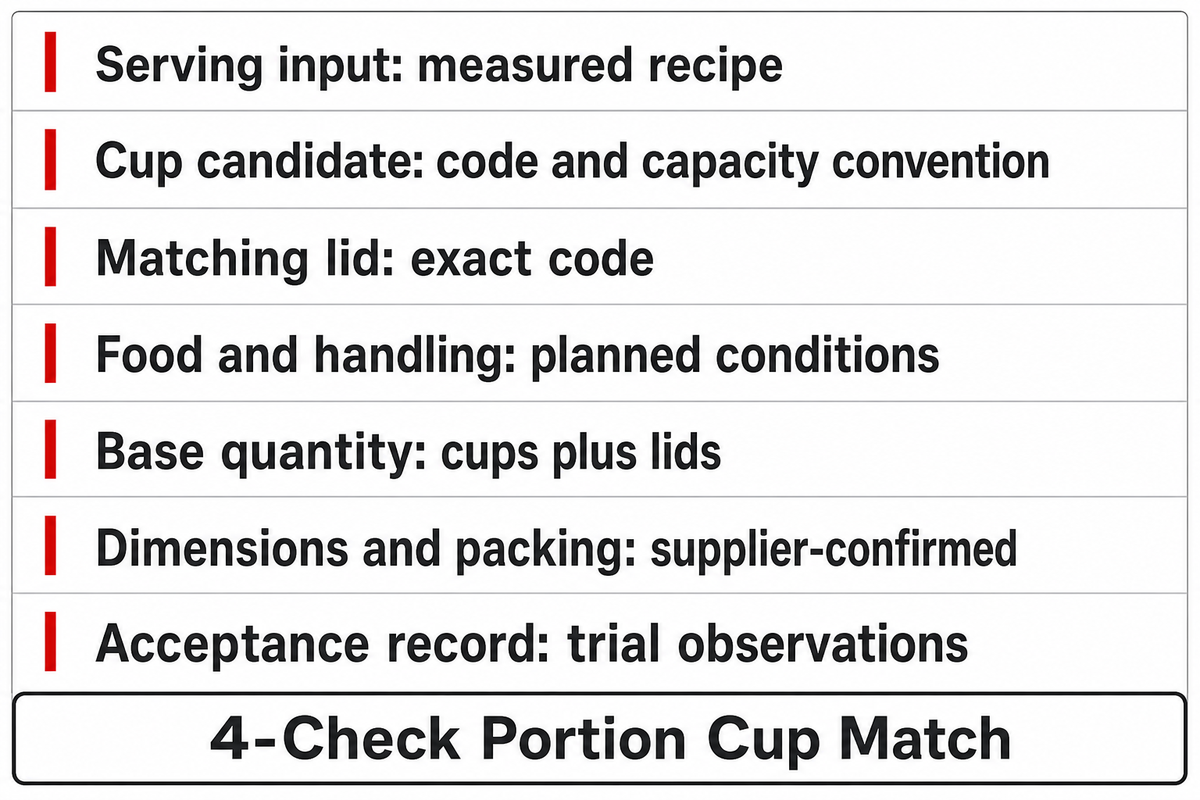
A portion-cup quote should identify the foodservice application, the selected serving, the proposed cup and lid codes, the required quantities, and the evidence needed for approval. Separate cup-only pricing from pricing for a pair. This way, procurement, operations, and finance can compare the package, instead of comparing cases with different contents.
The 4-Check Portion Cup Match
The 4-Check Portion Cup Match links serving volume, cup identity, lid identity and intended-use evidence prior to approval of a purchase.
You can use this editorial checklist to prepare an inquiry, and then complete the supplier’s confirmed values. Cut and paste the fields below into a request for quote; the examples provided are illustrative for the serving and event.
| Parameter | Recommended range | Why it matters | How to verify |
|---|---|---|---|
| Serving input | Example: 45 mL | Defines the food portion | Measure the intended recipe |
| Cup candidate | Example trial: 2–2.5 US fl oz | Separates serving from nominal capacity | Record code and capacity convention |
| Matching lid | Exact code for the selected cup | Identifies the complete assembly | Supplier pairing evidence and sample closure |
| Food and handling | Actual recipe and planned conditions | Defines intended contact use | Applicable component documentation |
| Base quantity | Example: 300 cups plus 300 lids | Avoids cup-only comparisons | Guest and serving count, then pack rounding |
| Dimensions and packing | Supplier-confirmed dimensions and case counts | Determines meal fit and storage | Sample package and carton specification |
| Acceptance record | Operation-defined criteria | Connects approval to the tested configuration | Completed trial observations |
If you cater for 150 guests receiving two separately packed sauces each, the base requirement is 150 × 2 = 300 cups and 300 lids. Add your chosen reserve, then round each item to its actual sale pack. Cup and lid pack sizes may differ; request both counts before comparing total order costs.
When addressing a wholesale food container supplier, provide serving and intended-use fields with your inquiry. Have the supplier list candidates and matching lids, instead of assuming the illustrative manufacturer models above are in their offering.
Key takeaway
Order a documented cup-and-lid pair for a tested serving. The 2 oz or 4 oz label compares nominal volume; the model codes, intended-use evidence, and filled sample establish the package you are approving.
FAQs about portion cup sizes
Are portion cup sizes the same across brands?
The volume labels may match, but dimensions, capacity conventions, and lid compatibility can differ across brands and product families.
Compare the actual cup and lid codes, instead of relying on the ounce label. Even one manufacturer can list two 1 oz models that require different lids, as the Fabri-Kal examples above show. When changing supply, obtain the proposed dimensions and pairing information, and check a filled sample inside the package used for service. Keep the package and pairing approved in the purchase record.
Does a 2 oz sauce cup hold 2 ounces by weight?
A 2 US fl oz capacity is about 59 mL of volume; it does not establish the sauce’s weight in ounces or grams.
The mass of that serving depends on the recipe and how it fills the container. Air, solid pieces, and density can affect the relationship between weight and volume. If they produce portions by weight, they should measure the volume of the actual target serving, then test that serving in a closed cup. Keep the recipe’s weight target separate from the packing capacity field on the specification.
Are deli cup sizes the same as portion cup sizes?
Catalog names overlap, but deli cups often serve a broader food-storage or meal role; choose by the identified package and use.
Don’t assume a lid from a deli container will fit a small sauce cup because the descriptions sound similar. Compare capacity, geometry, material, and the listed lid pairing. A snack or yogurt portion may need a spoon opening, and a dressing serving may need to fit inside a salad bowl. Those requirements are more important than whether the catalog uses “deli,” “portion,” or “souffle.”
Is a 1/4 cup serving the same as one portion cup?
One-quarter of a US measuring cup equals 2 US fl oz, but “a portion cup” does not specify one fixed capacity.
Check the packaging label: a 1 oz, 2 oz, or 4 oz container represents a different nominal volume. Test the intended serving beneath the matching lid.
How many portion cups do I need for 150 guests?
Multiply guests by separately packed servings per guest: 150 guests receiving two sauces each require 300 cups and 300 lids before reserves.
First decide which items will actually be individually packed. A shared sauce station has a different demand pattern from a meal with two included cups. Then count cups and lids separately, including any different sizes assigned to different menu items. Add the reserve you choose for your event and round the result to each product’s sale pack.
For example, if every guest receives one dressing and one dip, the base requirement is 150 of each filled cup. If both use the same approved model, that would be 300 identical cups. If they use different models, retain two order lines and verify the matching lid for each. A lid shared by two confirmed models may simplify inventory, but capacity alone can’t establish that sharing. Confirm case counts before placing the order so delivered quantities cover both components.
Prepare your portion-cup inquiry
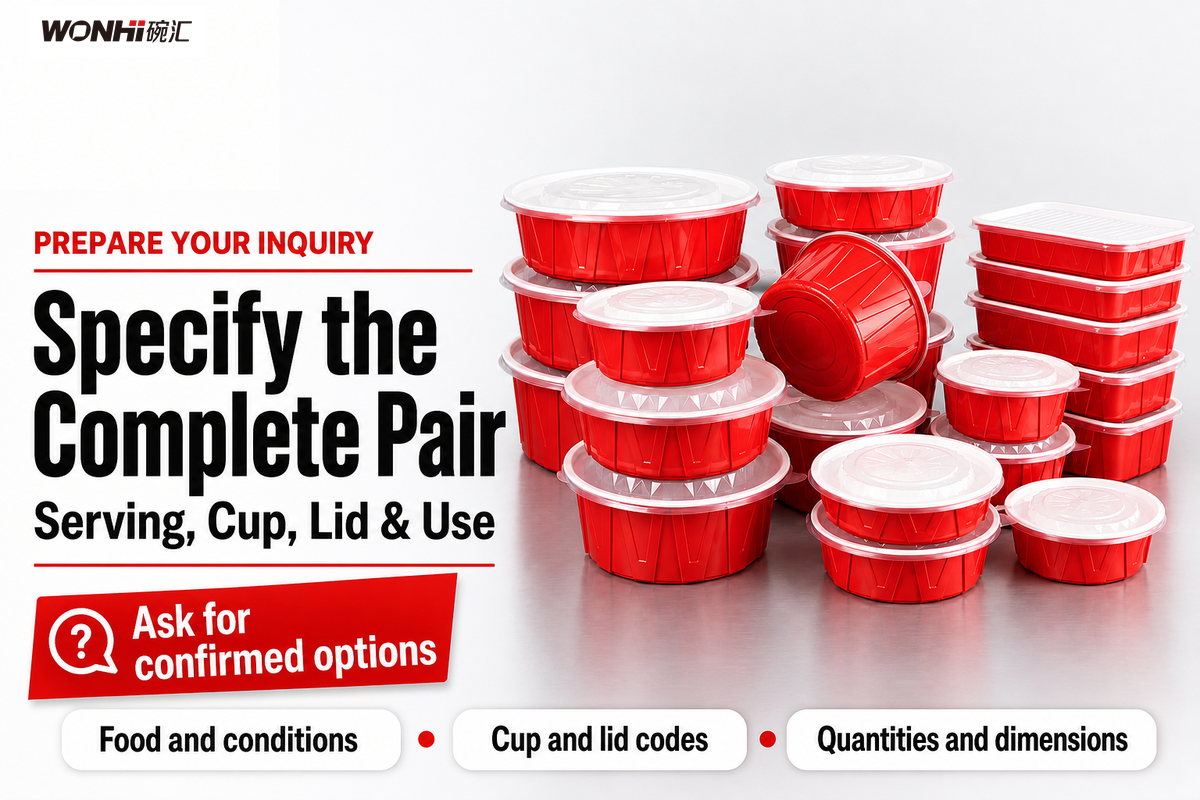
Send the intended serving, food, handling conditions, quantity, and meal-package dimensions to Wonhi. Include current cup and lid codes, if any, so proposed codes may be assessed against clear specs.
References & Sources
- NIST: Appendix B.8 conversion factors
- FDA: Regulatory status of food-contact components
- FDA: Food types and conditions of use
- FDA: Effective food-contact notification inventory
- FDA: March 2024 notification-rule update
Manufacturer model examples were checked against the named Fabri-Kal 2024 and Pactiv 2023 portion-cup sheets and the XL345PC product listing in October 2026. They identify those manufacturers’ product families.