Get in touch with Wanhui Company

Custom Mold Tooling Cost for Food Packaging (2026 Guide)

Contents
show
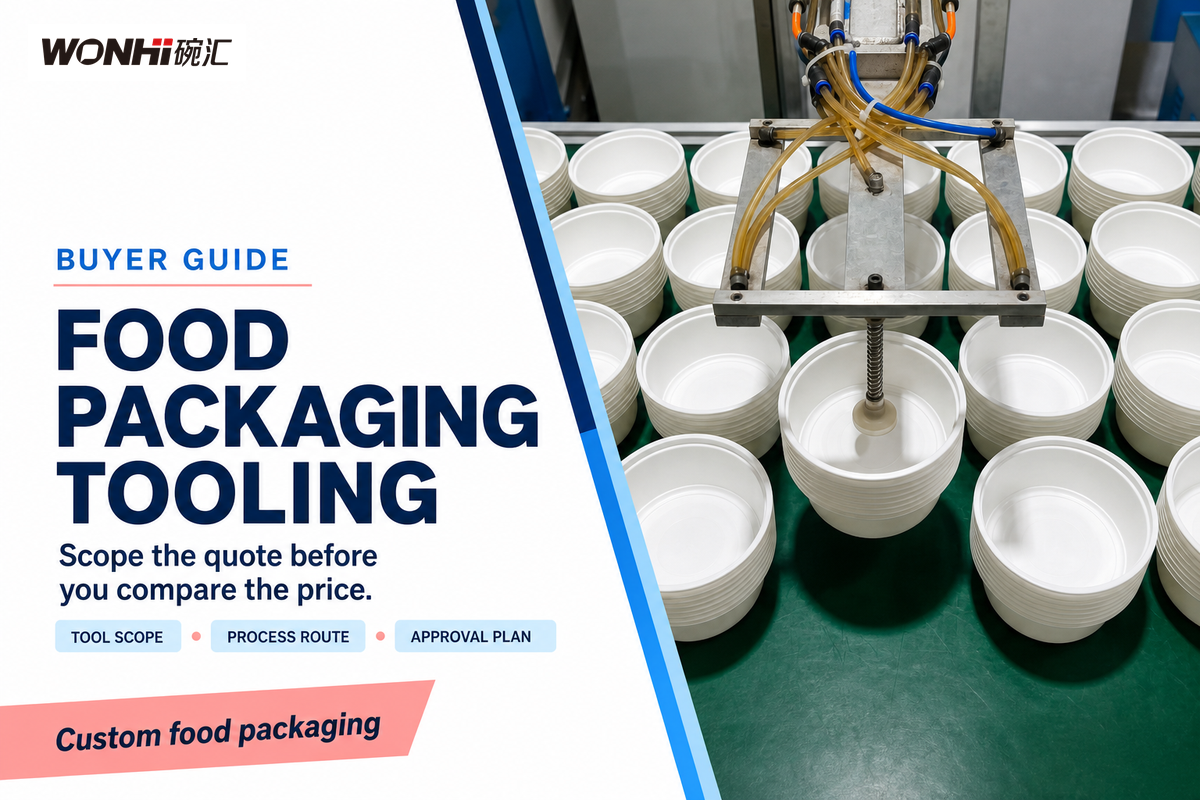
Custom mold tooling cost for food packaging is the one-time scope of design, tool build, samples, validation and commercial responsibilities for a specified pack. One web number cannot answer it responsibly because the quote may cover different package design, manufacturing route, cavities, samples, food-contact review scope and post-approval responsibilities. Two food-packaging quotes can show the same tooling line while describing very different work.
This guide gives procurement teams a way to ask better questions before they request a mold quote. It does not publish a universal tooling price, promise a break-even point, or determine regulatory status for a container. Instead, it turns a vague “how much is a mold?” request into a documented brief that a packaging supplier can evaluate.
The short answer: custom mold tooling cost for food packaging changes when the part, material, process, cavities, tool life, samples, validation and commercial scope change. Compare written scope before comparing the number.
- Separate one-time tooling from unit price and engineering work.
- State the food/package use conditions and target market before the supplier selects assumptions.
- Ask where ownership, maintenance, acceptance and later changes are governed.
Use the sections below as a buyer-side preparation method. Before issuing a quote, the supplier still needs to review the actual drawing, model, sample, resin, machine fit and commercial terms.
What Does Injection Mold Tooling Cost Include?
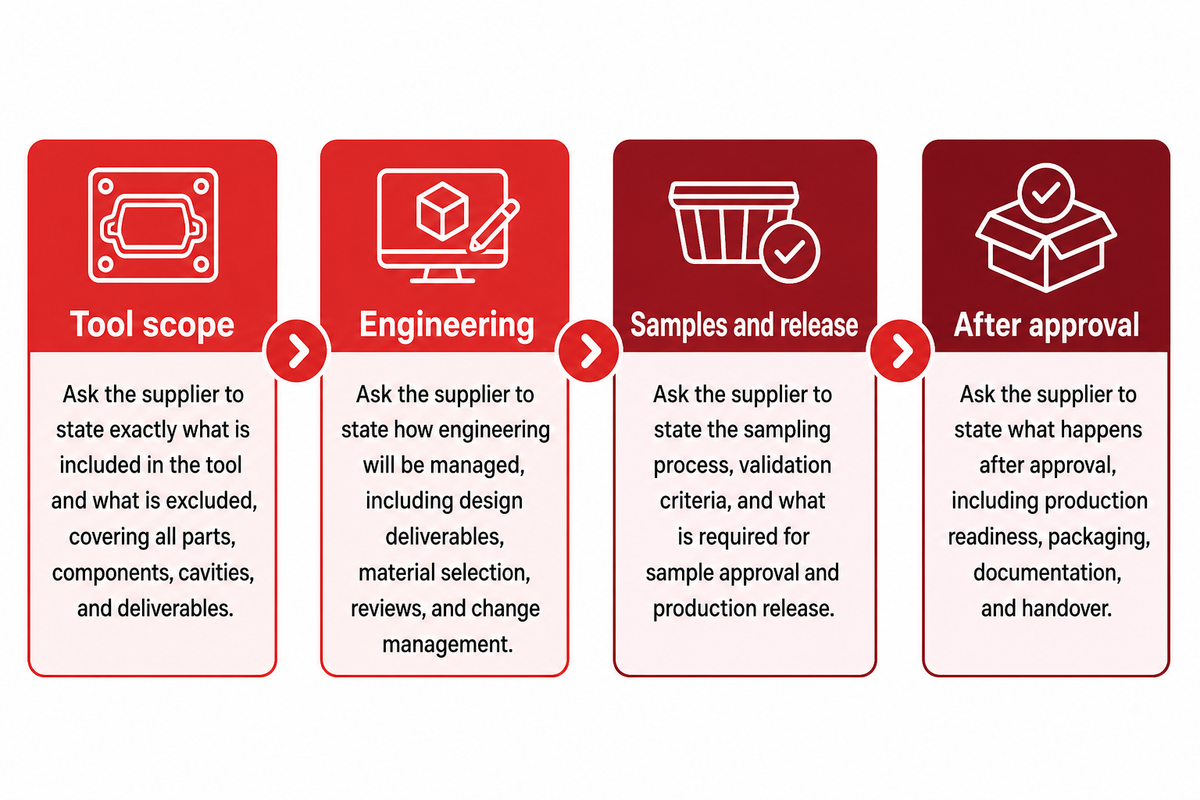
An injection molding quote usually combines several decisions that are easy to overlook when the request simply asks for “the mold cost.” Tool build is one part of the conversation. Design-for-manufacturing work, cavity layout, runners or gates, sample rounds, validation activities, maintenance expectations and the production price may sit beside it, inside it, or in a separate agreement.
Packaging Digest’s discussion of custom thermoformed packaging likewise treats material, tooling complexity, volume, quality requirements, application, validation and recordkeeping as quote inputs rather than one fixed cost bucket. That’s a helpful principle for food-packaging procurement: define the work before treating any line as comparable.
| Quote area | Ask the supplier to state | Why it changes comparison |
|---|---|---|
| Tool scope | Mold base, cavities, inserts, hot/cold runner assumptions and expected service approach. | Quoted figures are not comparable if the tool configuration is different. |
| Engineering | What drawing review, DFM feedback and revision rounds are included. | Unresolved geometry can move work outside the initial quote. |
| Samples and release | Sample quantity, acceptance criteria and any testing/validation responsibilities. | Sample production is not automatically a documented approval plan. |
| After approval | Storage, routine maintenance, repair, modification and transfer terms. | Lifecycle responsibilities may be governed outside the tooling line. |
Buyer method: put each scope item in a column beside each supplier quote. Mark it as included, excluded, pending confirmation or governed by a separate agreement. The result isn’t a legal contract; it’s a way to reveal assumptions before selection; keep the written supplier requirements alongside the comparison.
Build the Mold Design and Packaging Brief Before You Choose a Tool
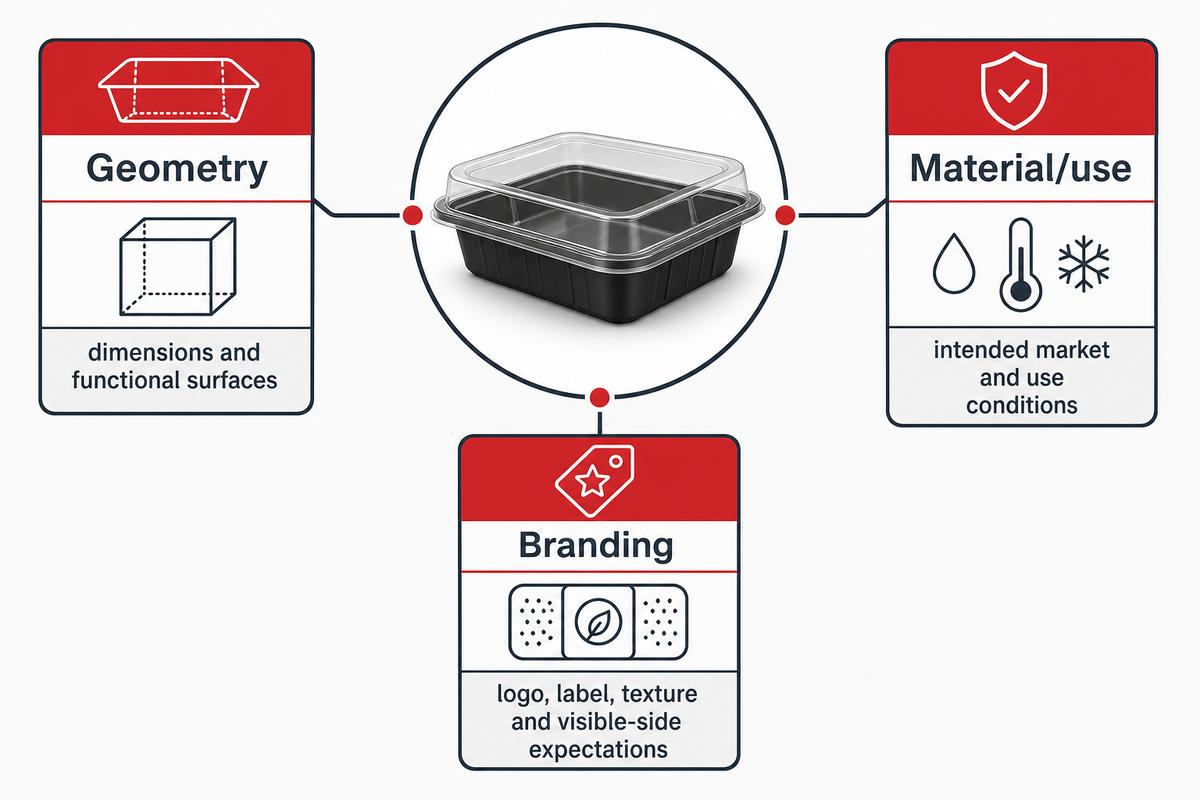
The tooling discussion starts with the package, not with a price target. A tray, bowl, lid, clamshell or compartmented meal box needs a clear reference: a drawing, 3D model, approved sample, or a precise description of the dimensions and functional surfaces. A supplier can’t reliably choose draft, gates, cavity approach or process route from a product photo alone.
Food-contact scope should be described with the actual intended use in mind. The FDA explains that a food-contact material’s status can depend on individual substances reasonably expected to migrate, their applicable authorizations, specifications and conditions of use. For a buyer, the practical action is narrow: state the component/material, destination market, food/use conditions and records you need reviewed. That is not a compliance determination or a substitute for the supplier’s and customer’s own regulatory review.
If recycled resin is part of the brief, create a separate line for it instead of folding it into a generic material request. FDA’s recycled-plastics guidance discusses source controls and recycling-process evidence as case-specific concerns. Ask what material evidence is available for the proposed material and intended application; do not assume that recycled content and virgin resin have identical evidence paths.
Start with the product brief: dimensions, fill or use conditions, lid/closure needs, resin preference, wall and cosmetic expectations, decoration, destination market and sample/approval needs. Then explore custom food packaging options with a supplier instead of asking for a mold in isolation.
| Brief item | Useful detail | Open question to flag |
|---|---|---|
| Container format | Tray, bowl, lid, compartment layout, stacking and closure relationship. | Which surfaces are functional versus cosmetic? |
| Geometry | Dimensions, depth, radii, wall profile, undercuts and drawing revision. | What can change after DFM review? |
| Material/use | Resin, food/use conditions, intended market and any recycled-content request. | Which documents or confirmations must be evaluated? |
| Branding | Logo, label, texture, color and visible-side expectations. | Does decoration alter the mold, post-process or approval scope? |
Thermoforming vs Injection Molding: Choose the Cost Path That Matches the Pack
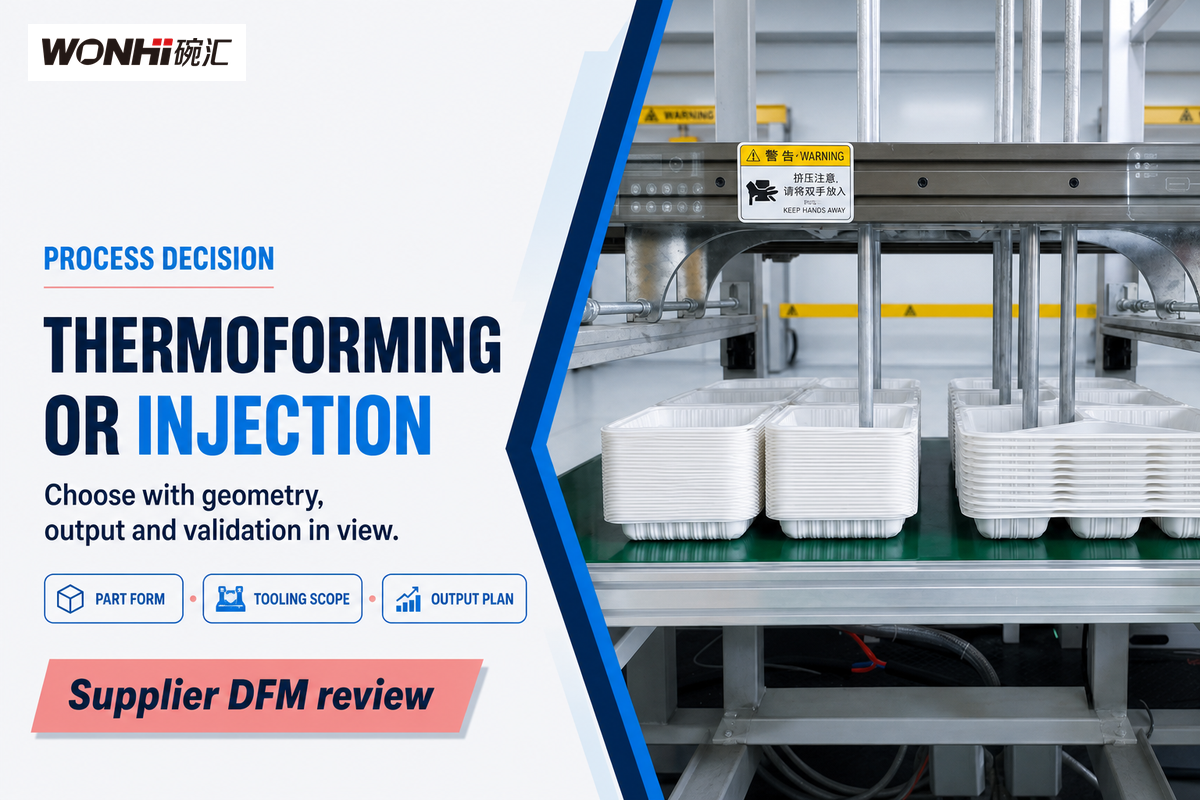
Thermoforming and injection molding aren’t interchangeable quote labels. The better process depends on the package geometry, wall profile, detail, material, expected output, quality requirements and the supplier’s equipment/tooling route. A thin, open food tray may lead to a different conversation from a rigid container with detailed features, a matched lid or a complex underside.
Use a process screen rather than declaring one method cheaper. A cost claim without the part and production context can encourage the wrong comparison. The table below is a request for supplier assessment, not a design rule.
Shandong Wanhui Environmental Protection Technology Co., Ltd. states in its company profile that it operates 20 thermoforming production lines, 6 sheet-extrusion lines and 60 injection molding lines. This is first-party capacity context only, not independent proof that either route fit a particular pack. It gives a buyer a useful factory question: which documented process route and equipment assumptions support this specific design?
Buyer-side decision rule: a thermoforming-versus-injection decision is not a universal “cheaper” judgment. It starts with the approved geometry, intended use, output plan and the supplier’s stated process route.
| Question | Thermoforming discussion | Injection molding discussion |
|---|---|---|
| Part form | Ask about draw, trim, wall distribution and nesting. | Ask about wall sections, gates, runners, cooling and ejection. |
| Tooling scope | Clarify forming and trimming/tooling assumptions. | Clarify cavities, mold base, inserts and machine compatibility. |
| Output plan | State order pattern and pack configuration. | State volume, cycle expectations and any multi-cavity proposal. |
| Validation | Confirm trim, fit, stack and use-function checks. | Confirm fit, appearance, closure and repeatability checks. |
When the choice is still open, use the packaging process selector as an internal planning aid, then give the supplier enough package information to perform DFM and process review. The framework stops there; it can’t replace a machine-and-mold feasibility assessment.
How much does an injection mold tool cost?
Injection mold tool cost depends on part dimensions, geometry, cavities, tool materials, runner approach, expected tool life, sample/validation scope and commercial responsibilities. Sample-learning tooling is not automatically comparable with a production tool. Request written scope before comparing generic price ranges.
What Makes an Injection Mold Cost More?
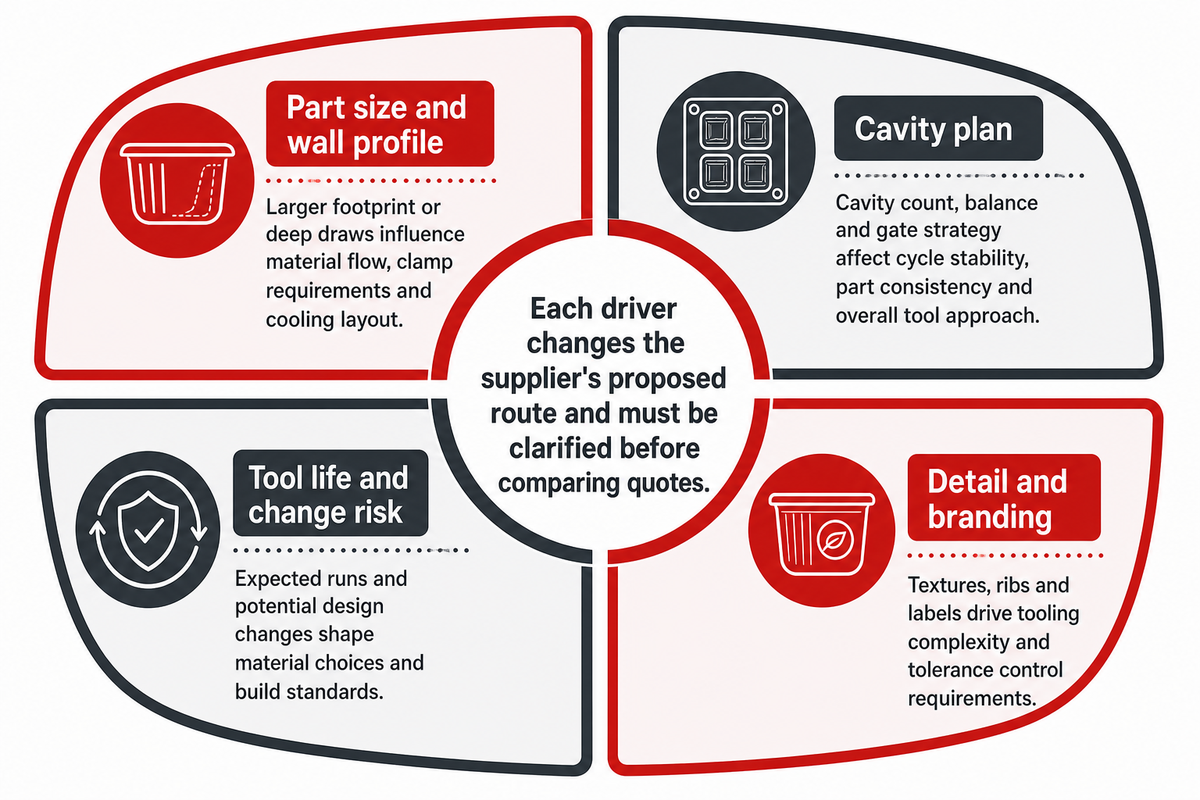
Cost drivers matter because they change the work required to make and run the tool; they don’t carry fixed surcharges. UC Davis’s technical guidance on injection molding highlights design elements such as wall thickness, draft, sprues, runners, gates and cavity-manufacturing route. Those are useful prompts for a supplier conversation, not a price calculator.
Ask the supplier to explain which features affect the selected route and which assumptions remain open. This gives the buyer an early chance to choose a simpler feature, revise a tolerance or plan a staged launch before the tool is built.
In a plastic injection molding project, the part design and part complexity of each plastic part affect the manufacturing process chosen for the molded part. A supplier may evaluate wall sections, gates, runners, cooling and ejection alongside the selected plastic material. That evaluation can affect material cost, machine time, cycle time and the number of parts per cycle, so it belongs in the cost estimate even when none of those variables should be converted into a generic online price.
For example, a supplier may compare an aluminum mold with another tool route, or discuss whether a family mold is appropriate for related components. Those are configuration questions, not automatic savings claims. In custom injection work, the upfront cost, per-part cost, part cost and broader manufacturing cost depend on the actual tool and the molding machines proposed. Ask what production assumptions make the proposal feasible, and treat a revised process, material or cavity plan as a new injection molding project scenario.
| Driver | What to clarify | Quote question |
|---|---|---|
| Part size and wall profile | Dimensions, uniformity goals, draft and structural features. | Which design changes would alter the mold or process approach? |
| Cavity plan | Cavity count, balancing, press compatibility and anticipated order pattern. | What capacity and maintenance assumptions support this proposal? |
| Detail and branding | Texture, logo, decoration, visible surfaces and cosmetic acceptance. | How will detail be checked in the approved sample? |
| Tool life and change risk | Expected production use, storage, repair and likely design changes. | Who approves and pays for modification after release? |
A 2017 buyer discussion on Practical Machinist makes one modest point that still helps: a tooling number is hard to interpret without the part, cavities, material and output context. It isn’t a source of transferable cost data. For a package-format perspective before you refine the drawing, see the guide to custom takeout boxes.
How many cavities should be included?
Cavity count is not a stand-alone buyer lever; it should follow the part, mold dimensions, runner and cooling design, press capability, resin, cycle stability, expected demand and maintenance plan. Ask the supplier to state the assumptions behind the proposed number of cavities before comparing quotes in writing.
Production Volume and Cavity Count: Model the Cost Conversation
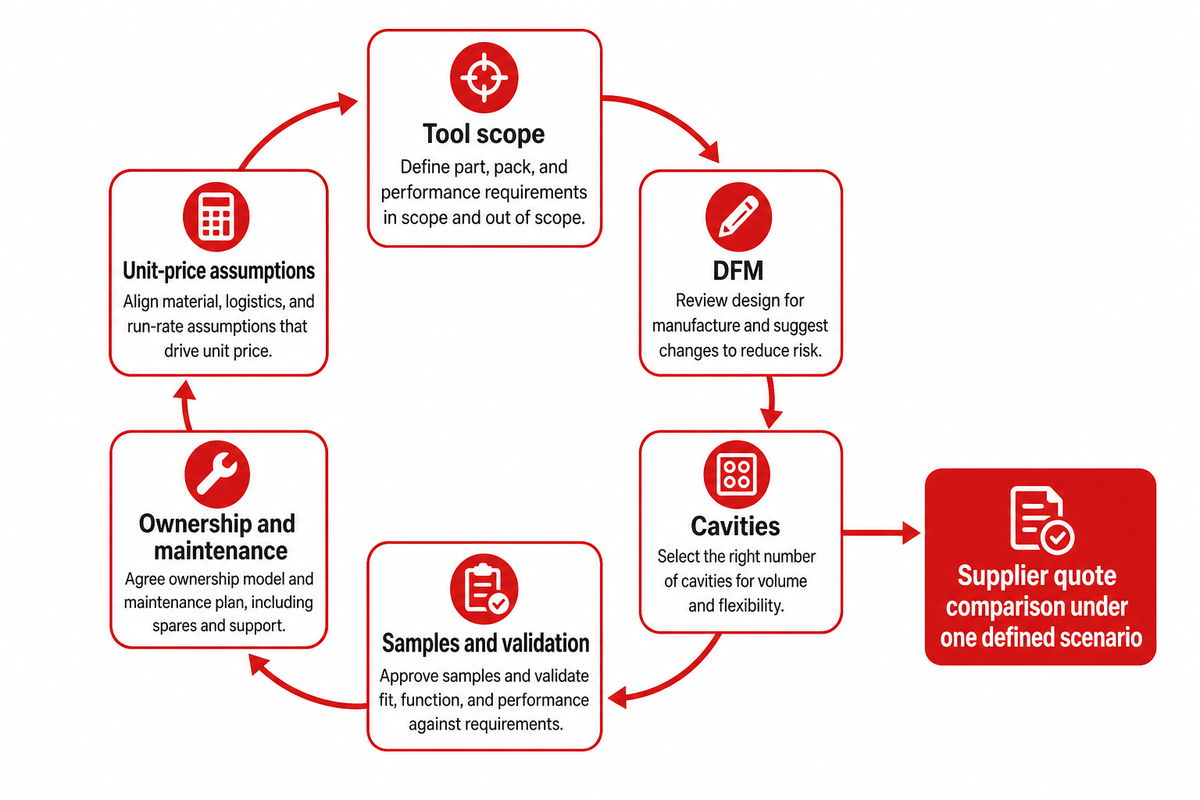
Volume is where buyers often try to force a single break-even number. Avoid that shortcut. A useful model holds the scenario visible: forecast saleable units, order pattern, quoted unit price, one-time tooling scope, expected scrap/reject assumptions, maintenance responsibilities and changes that could interrupt the plan.
More cavities are not always the better answer. A higher count can change output, but it can also change tool complexity, press requirements and the consequence of a stoppage. Keep the approved part, demand pattern and supplier assumptions together before treating a cavity proposal as a savings conclusion.
Use the 6-Line Tooling Quote Test to decide whether the comparison is complete. It’s a procurement framework, not factory data and not a promise that a particular tool will pay back at a stated volume.
- Tool scope: what physical tool and included engineering work are described?
- DFM: which geometry decisions are accepted, pending or excluded?
- Cavities: what part, press and output assumptions make the proposed count feasible?
- Samples and validation: what’s supplied, approved and documented before release?
- Ownership and maintenance: where are storage, repair, modification and transfer terms governed?
- Unit-price assumptions: what material, volume, cycle and quality assumptions sit behind the production number?
The arithmetic can remain simple: divide the one-time tooling budget by the forecast saleable units under one defined scenario, then show the production assumptions that sit outside that division. Repeat only when the demand scenario, approved design and supplier scope are comparable. Don’t use it to turn a web estimate into a supplier commitment.
Template note: the values below are buyer-entered fields, not cost benchmarks. Keep supplier-quoted amounts, installation/commissioning items and lifecycle responsibilities in the same currency and scope before comparing options.
5-year total-cost comparison template — buyer-entered supplier scope
| Cost item | Option A | Option B |
|---|---|---|
| Purchase price / one-time tooling scope | Enter quoted scope and amount | Enter quoted scope and amount |
| Installation & commissioning / release work | State included and excluded activities | State included and excluded activities |
| Energy (5-year production plan) | Supplier-confirmed production assumption | Supplier-confirmed production assumption |
| Maintenance & spares (5-year plan) | Owner, trigger and exclusions | Owner, trigger and exclusions |
| Downtime risk (5-year plan) | Contingency and service terms | Contingency and service terms |
Planning sequence: for each option, insert the supplier-quoted one-time scope, divide only by the forecast saleable units in the same approved scenario, then list the production, maintenance and downtime assumptions that are not captured by that division. If one input differs, treat the result as a new scenario rather than a like-for-like comparison.
If your question is specifically stock packaging versus a custom tray route, test the custom-mold ROI calculator rather than copying calculator defaults into a quote comparison. For container-specific scope, you can also compare custom take-out container requirements.
How does production volume impact cost per part?
Production volume can spread a defined one-time tool budget across planned saleable units, but it does not prove an automatic break-even. Keep forecast, tool, cavity, press, cycle, material and quality assumptions constant when comparing cost per part across quotes fairly.
Compare an Injection Molding Quote Line by Line
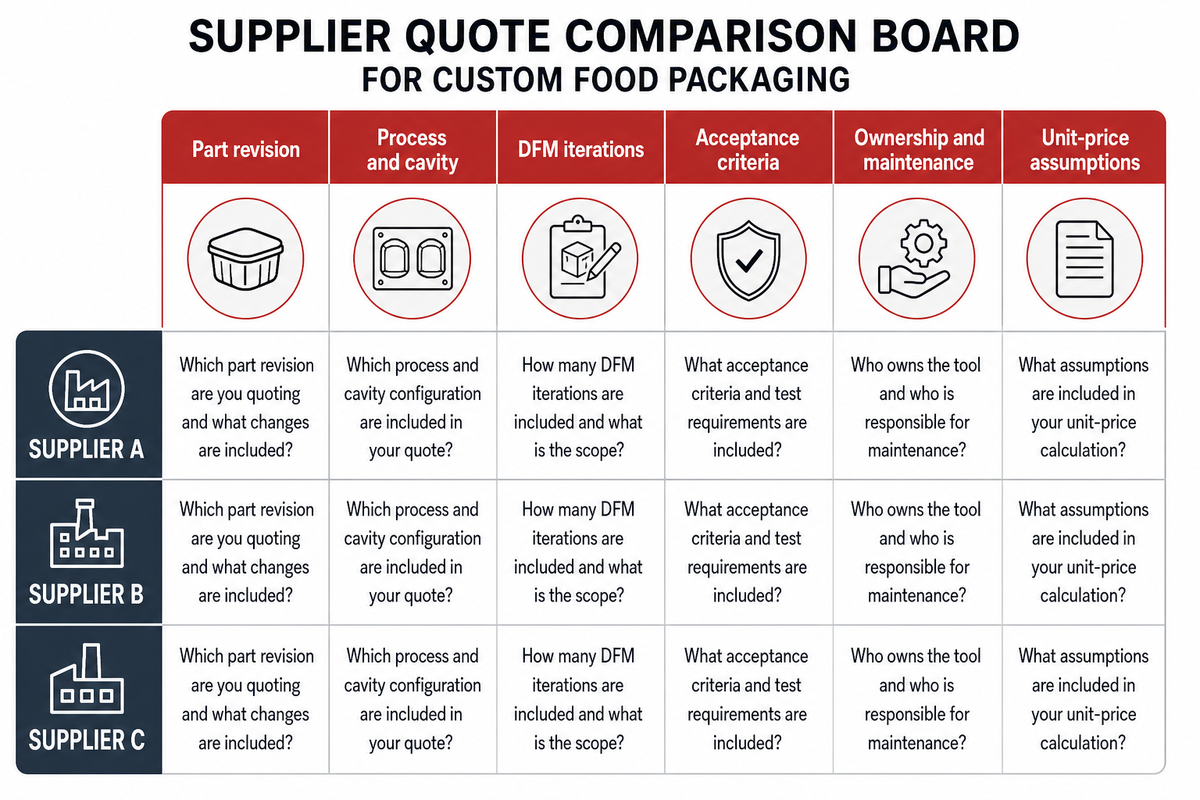
Ask every supplier to answer the same brief. ASQ’s supplier-quality material describes written requirements, including testing, and recognizes prototypes, laboratory testing or validation testing of samples as relevant supplier-evaluation inputs. The practical procurement lesson is to make these items visible, not to demand that every company uses the same document layout.
Some responsibilities may be in a quotation; others may sit in a purchase order, quality agreement or tooling agreement. For each issue, ask the supplier to say where it’s governed and who has approval authority.
Three common buyer searches point to different decisions: injection molding tooling cost, injection mould cost calculator and mold cost meaning. A calculator can organize a planning scenario, but it can’t disclose whether two quotations use the same tool scope, factory assumptions, sample path or ownership terms. The cheapest quote is not necessarily the best comparison when those fields are missing.
Translate cost-search language into quote questions
The following search phrases are not price benchmarks or claims by this guide. They are a buyer-side decoder: use each phrase to identify the missing scope, document or production assumption before requesting an accurate quote.
| Buyer wording | Quote question to ask instead |
|---|---|
| custom plastic injection molding; plastic injection molding cost; cost of injection molding; production cost | Define the food pack, manufacturing process and planned output before comparing a cost category. |
| cost breakdown; injection molding cost calculator; additional cost; understanding injection molding | Ask which work is in the calculation and which additional cost sits in a separate agreement. |
| How much does injection molding cost?; mold complexity; injection molded parts; plastic resin | State the part geometry, mold complexity, plastic resin and approval path rather than asking for a universal amount. |
| injection molding machine; cost factors; reduce injection molding; accurate injection molding quote | Ask which machine, cost factors and design changes the supplier considered before discussing ways to reduce injection molding work. |
| custom injection molding project; initial cost; cost and production; injection molding estimate | Keep the initial cost, demand plan and cost and production assumptions together in one injection molding estimate. |
| cost calculation; injection molding partner; injection molding cycle; insert molding | Confirm who owns the cost calculation, the proposed injection molding cycle and whether insert molding is in scope. |
| cost to make; upfront cost for injection molding; injection molding batch; complexity of the mold | Separate the cost to make the tool from the upfront cost for injection molding, the planned injection molding batch and the complexity of the mold. |
| long-term cost; molds cost more upfront; cost efficiency; steel injection | Ask how a stated steel injection tool route, service plan and order pattern affect long-term cost and cost efficiency; do not infer an outcome from the phrase alone. |
| guide to injection molding; final cost; overall cost; cost factors behind | Use a guide to injection molding to list the cost factors behind a quotation, then ask the supplier how they shape final cost and overall cost. |
| economics of injection molding; actual cost; molding defects; price for injection | Ask for the assumptions behind actual cost, potential molding defects and any price for injection work instead of treating a search result as a commitment. |
Quote comparison checklist
- Is the part revision or sample reference identified?
- Are process and cavity assumptions stated?
- Are DFM iterations and sample rounds identified?
- Are material/use conditions and required documentation review questions visible?
- Are acceptance criteria and release approval steps defined?
- Are ownership, storage, maintenance, repair and change-control terms assigned or linked to another agreement?
- Are unit-price, volume and quality assumptions listed separately from tooling?
After you align the brief, estimate MOQ and tooling together with the on-site calculator. Use it as a planning tool, then validate the assumptions with the actual supplier quote rather than treating a calculator result as final commercial terms.
Validate Samples, Food-Contact Requirements, and Change Control Before Release
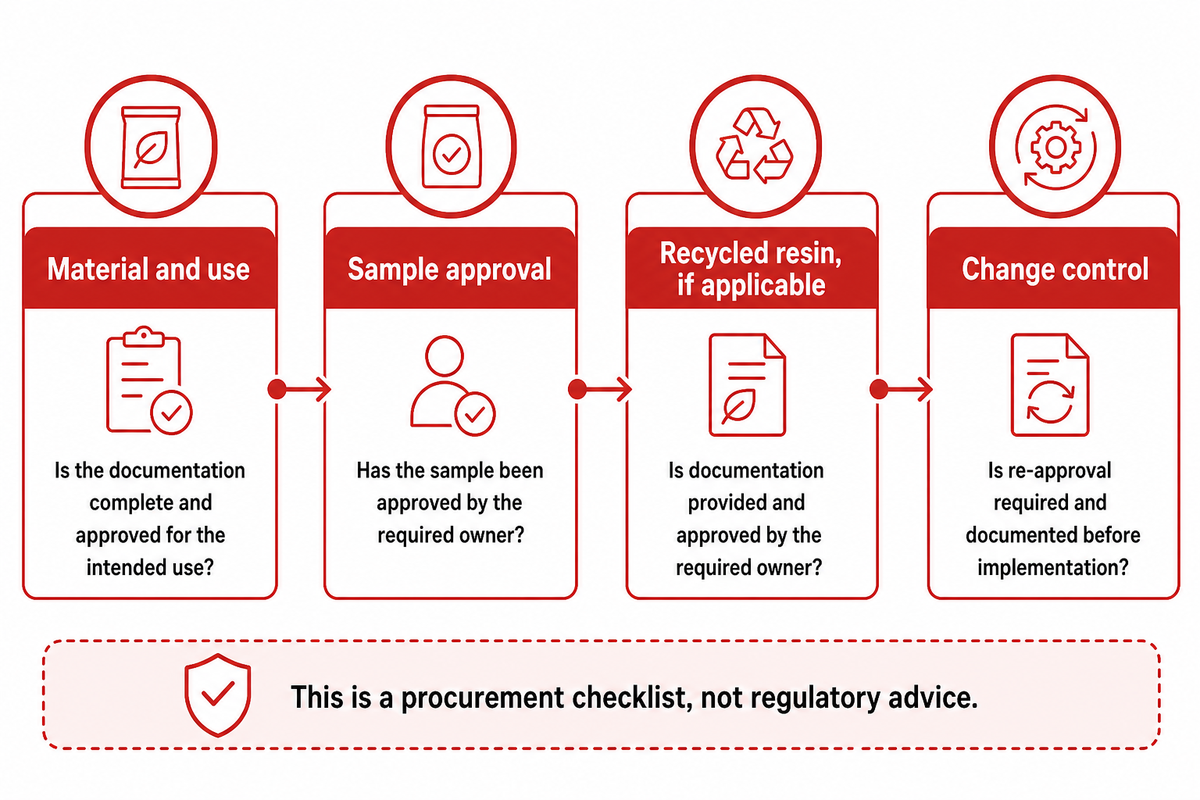
Release is not the moment to rely on an unqualified “food-grade” description. FDA food-contact material guidance explains why the actual substance/component, specifications and conditions of use matter. In a procurement brief, translate that into a simple request: state the intended market and use conditions, identify the material/component to be reviewed, and agree what documentation or confirmation is needed for the package application.
A common assumption is that “food-grade” wording settles the approval question. It doesn’t necessarily do that for a specific package, material, market and use condition; make the intended review scope visible before release.
FDA’s chemistry guidance also ties technical review to the article and its expected food-contact use and conditions. That does not give this article the authority to prescribe tests or approve a package. It does mean a buyer should not leave hot/cold use, food type, contact duration, repeated use, or similar conditions undefined when they matter to the project.
| Approval stage | Record before release | Owner/question |
|---|---|---|
| Material and use | Material identity, intended application/market and document-review scope. | Who provides which documentation and who reviews it? |
| Sample approval | Revision, fit, closure, stack, appearance and functional acceptance points. | Who signs approval and what happens if a point fails? |
| Recycled resin, if applicable | Separate source-control/process-evidence question for the proposed application. | What is available for the material actually proposed? |
| Change control | Trigger, revision, re-sample/re-approval and cost/lead-time treatment. | Which document controls a later change? |
Keep the boundary clear: this is a packaging procurement checklist, not legal or regulatory advice. For a specific product and market, confirm the final obligations with the responsible parties and applicable specialists.
The 8-Field Food Packaging Tooling Brief
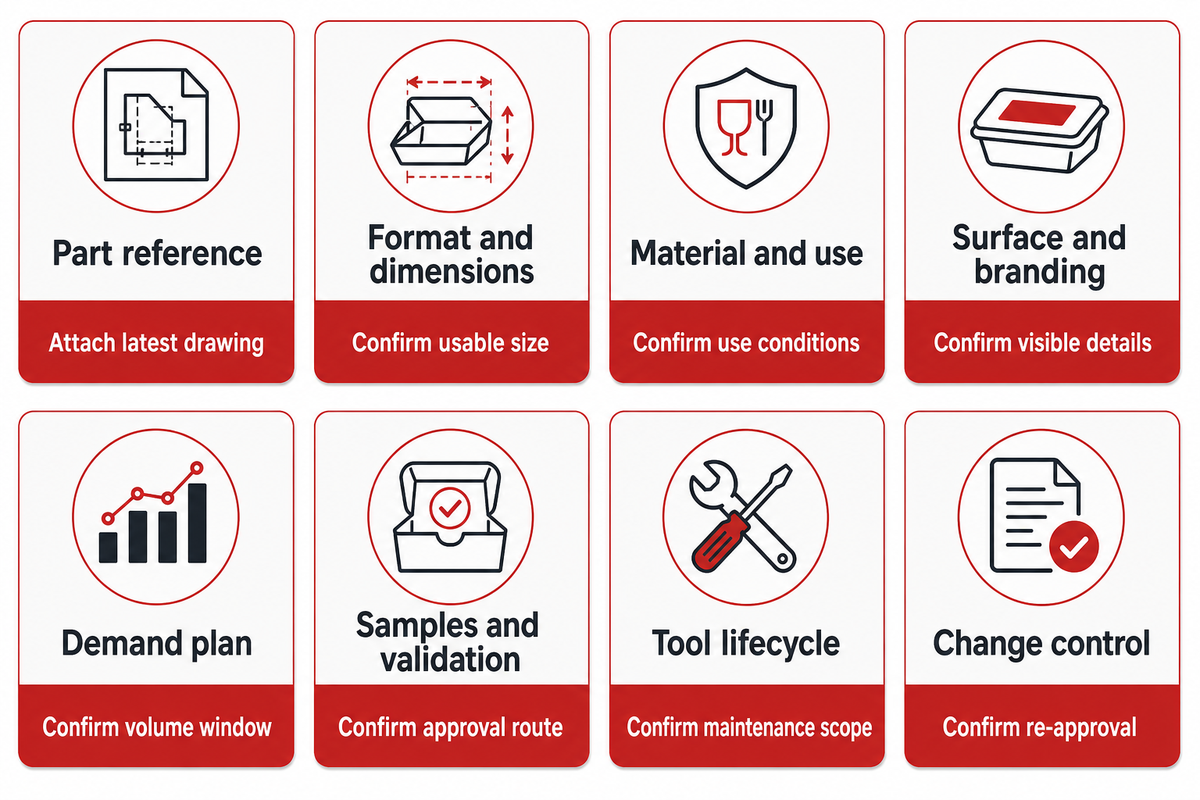
Copy the following template into a quote request. It’s designed to reduce unknowns before a supplier starts a mold discussion. If a field isn’t known, write “open decision” rather than silently omitting it; that gives the supplier a chance to identify the DFM, commercial or material/use evidence-review question before it becomes a late change.
Template-note provenance: the ranges below are request-format ranges, not manufacturing specifications. They tell the buyer how much information to provide and how to verify it in the supplier’s response.
Illustrative unit format only: the next table doesn’t prescribe a container. It simply shows how to write actual requirements with units instead of vague adjectives. One worked format can record a 250 mm × 180 mm × 45 mm envelope, a 1.0 mm wall reference, a 3 mm closure, a 500 mL fill reference, a 25°C use-condition note, a 7-day review window and a final-approval window of 30 days; replace every example with the approved pack’s own drawing and use conditions.
| Input label | Illustrative formatting only | What the supplier should confirm |
|---|---|---|
| Overall envelope | 250 mm × 180 mm × 45 mm | Drawing revision and critical interfaces. |
| Wall callout | 0.8 mm, 1.0 mm, 1.2 mm | Feasible wall profile and DFM impact. |
| Closure/stack interfaces | 3 mm, 4 mm, 6 mm | Fit, nesting and sample checks. |
| Nominal fill reference | 500 mL, 750 mL, 1000 mL | Actual package requirement and test method. |
| Use-condition notation | 0°C, 25°C, 85°C | Actual temperature, duration and intended use. |
| Draft notation | 1°, 2°, 3° | Supplier-selected DFM recommendation. |
| Approval calendar | 7 days, 14 days, 30 days | Buyer approval owner and dependency. |
| Forecast horizon | 6 months, 12 months, 24 months | Scenario used for the quotation. |
| Drawing tolerances | 0.5 mm, 1 mm, 2 mm | Which dimensions are truly critical. |
| Seal-land notation | 2 mm, 3 mm, 4 mm | Actual sealing interface and acceptance check. |
| Rim-radius notation | 1 mm, 2 mm, 3 mm | Actual geometry and cleanability requirement. |
RFQ checklist — copy these into your quote request:
| Parameter | Recommended range | Why it matters | How to verify |
|---|---|---|---|
| 1. Part reference | 1 drawing, 1 model or 1 approved sample reference | Sets the revision being quoted. | Supplier names the received revision and open DFM points. |
| 2. Format and dimensions | All critical length, width, depth and closure interfaces | Drives geometry and fit decisions. | Dimensioned drawing or agreed sample inspection. |
| 3. Material and use | 1 intended market plus stated use conditions | Scopes the documentation discussion. | Written material/documentation response. |
| 4. Surface and branding | Visible surfaces, color, logo or texture requirements | Avoids late cosmetic changes. | Approved visual sample or specification. |
| 5. Demand plan | Annual forecast plus order pattern and scenario horizon | Frames cavity and unit-price assumptions. | Supplier states the assumptions used. |
| 6. Samples and validation | 1 written acceptance plan with open checks identified | Separates sample production from release approval. | Named approval owner and criteria. |
| 7. Tool lifecycle | Ownership, storage, maintenance, repair and transfer questions | Makes ongoing responsibility visible. | Quote or linked agreement identifies where governed. |
| 8. Change control | 1 revision path for post-approval changes | Prevents informal changes from bypassing release. | Written re-approval and commercial treatment. |
Shandong Wanhui Environmental Protection Technology Co., Ltd. states in its company profile that it provides custom mold development and brand-logo printing for food packaging containers. Treat that as attributed first-party context, then use the brief above to start a specific discussion with the team. It isn’t independent proof of a price, certification outcome, or performance claim.
How to use the brief inside a buying team
Before sending the request, have one person own the part revision and one person own the commercial scenario. The engineering or packaging contact should identify the reference drawing, closure interfaces, material/use questions and changes that need DFM feedback. The procurement contact should keep the same forecast horizon, delivery pattern and quotation columns for every supplier. This prevents the team from comparing a detailed proposal with a preliminary concept response as if they were equivalent.
Quality, brand and operations teams should contribute only the decisions that affect release: visible-surface expectations, stacking or sealing needs, approved sample points, destination-market documentation questions and the consequence of a later design change. Finance can then review the tool scope against the same demand scenario rather than converting a broad online cost range into a budget. If the business case changes, revise the scenario and ask suppliers which assumptions must be re-quoted.
Finally, preserve the supplier’s written answers beside the original brief. That record helps when a change is requested after sampling, when a tool must be stored or transferred, or when a new buyer needs to understand why a particular process or cavity plan was selected. It also makes it easier to identify the few decisions that still need a specialist, such as a specific food-contact review, a machine-feasibility question or a commercial term that belongs in a separate agreement.
Use one version-controlled copy of the brief through the inquiry, DFM discussion, sampling and release. A spreadsheet of changing assumptions is less useful than a clearly dated brief with the part revision, open decisions, named owners and supplier responses preserved together. Where a quotation refers to another agreement, link that agreement in the comparison sheet rather than assuming the omission is an exclusion. This small discipline is often what lets a future buyer distinguish an unresolved assumption from a decision that was deliberately accepted.
For an internal approval meeting, bring the original brief, the supplier’s written scope and a one-page list of unresolved decisions. That package keeps product, procurement and quality teams focused on the same questions: what’s being built, what’s being approved, what’s included, and what still needs confirmation.
Frequently Asked Questions
How much does custom mold tooling cost for food packaging?
Custom mold tooling cost for food packaging depends on the process, part geometry and dimensions, cavity plan, material/use conditions, intended tool life, sample/validation scope and what the supplier includes beyond the physical tool. Request a written comparison that separates DFM, samples, validation, maintenance and unit-price assumptions instead of relying on a generic web range. Before approving a supplier, compare the tool, DFM, sample, validation, maintenance and unit-price scope against the same demand scenario and part revision in the quotation itself.
How much does an injection mold tool cost?
Injection-tool scope changes with the part, cavities, wall and feature requirements, runner approach, expected lifecycle and approval plan. A validation-oriented tool and a production tool can serve different purposes. Ask the supplier to identify the proposed tool scope and its operating assumptions in writing before you compare it with another quotation. Ask whether the quotation identifies tool ownership, maintenance, storage and the revision path after sampling, because these responsibilities can sit outside the physical tool-build line in writing.
How much does prototype tooling cost?
Prototype tooling is a different decision from production tooling because it’s often intended to learn from samples, evaluate geometry or confirm function. Define the questions the sample must answer, sample rounds, checks, and the path if the design changes. Keep the process and scope explicit instead of treating prototype and production tools as equivalent categories. State whether production uses the same tool, another tool or revised design; that distinction prevents a sample plan from being treated as a production commitment.
Can a mold be reused for future production?
A mold can be reused for future production only when its ownership, condition, storage, maintenance records, machine compatibility and design stability are confirmed. Before treating an existing tool as ready, ask for its identified revision, inspection status, storage arrangement and the terms that control any required modification or re-approval. Document the requested re-use scenario, including the current pack revision, intended machine, future order pattern and any requirement for re-approval before the supplier relies on the tool in writing.
Is a multi-cavity mold always the better choice?
A multi-cavity mold can change output and unit economics, but it also changes tool complexity, press requirements, balancing, maintenance exposure and downtime consequences. Compare order pattern, package geometry, resin, machine capacity, cycle stability and available capital with the supplier’s stated assumptions. No universal break-even figure replaces that review.
What should I send for an accurate food-packaging tooling quote?
Send a drawing, model or clear sample reference; container and lid details; dimensions and intended use; material and destination-market requirements; wall, cosmetic and branding expectations; demand and order pattern; sample/validation and food-contact review needs; shipping destination; target approval date; and current commercial terms.
Also identify ownership, storage, maintenance and future-change questions. Name the revision that the supplier should quote and list the sample checks for fit, stack, closure, appearance or use-specific behavior. If recycled resin, decoration or a new lid/container interface is contemplated, mark it separately. A complete brief improves quote comparability but does not replace DFM, supplier process selection, validation sampling, document review or commercial terms.
References and Further Reading
References & Sources: the following links support the qualified technical and procurement context used in this guide.
- FDA: Food Packaging and Other Substances that Come in Contact with Food
- FDA: Determining the Regulatory Status of Components of a Food Contact Material
- FDA: Recycled Plastics in Food Packaging
- FDA: Chemistry Recommendations for Food Contact Substance Submissions
- UC Davis Tech Foundry: Injection Molding
- Peer-reviewed injection-molding process review
- ASQ: Supplier Quality
- Packaging Digest: What Determines the Cost of Custom Thermoformed Packaging?
Reviewed by the technical team of Shandong Wanhui Environmental Protection Technology Co., Ltd. Company capability context in this guide is based on the company-supplied profile; external references support only the qualified process, documentation and procurement context described above.