Get in touch with Wanhui Company


Comparing Anti fog food packaging to competitors is worthwhile after the lid gets wet from chilled displays. A clean dry sample doesn’t reflect how a product looks after handling, transportation across a store and refrigeration. Start with the complete pack and a shared observation schedule.
By CYH · Updated October 2026
Comparison brief
- Application: chilled food displays and grab-and-go containers.
- Compare: untreated control, identified treatment and complete tray-and-lid construction.
- Record: food load, temperatures, elapsed time, viewing surface and handling history.
- Keep separate: dry haze, wet visibility, seal performance and food shelf life.
Anti fog food packaging helps condensed water spread across a viewing surface instead of collecting as light-scattering droplets. Compare filled packs at matching temperatures and times. Select the construction that stays readable through your intended display period.
Key points
- Condensation can remain present even when the lid looks clear.
- A film test and a finished-container trial answer different questions.
- Observation time matters as much as the first photograph.
- Approve the pack for its food and route before comparing unit prices.
What Anti-Fog Food Packaging Actually Changes
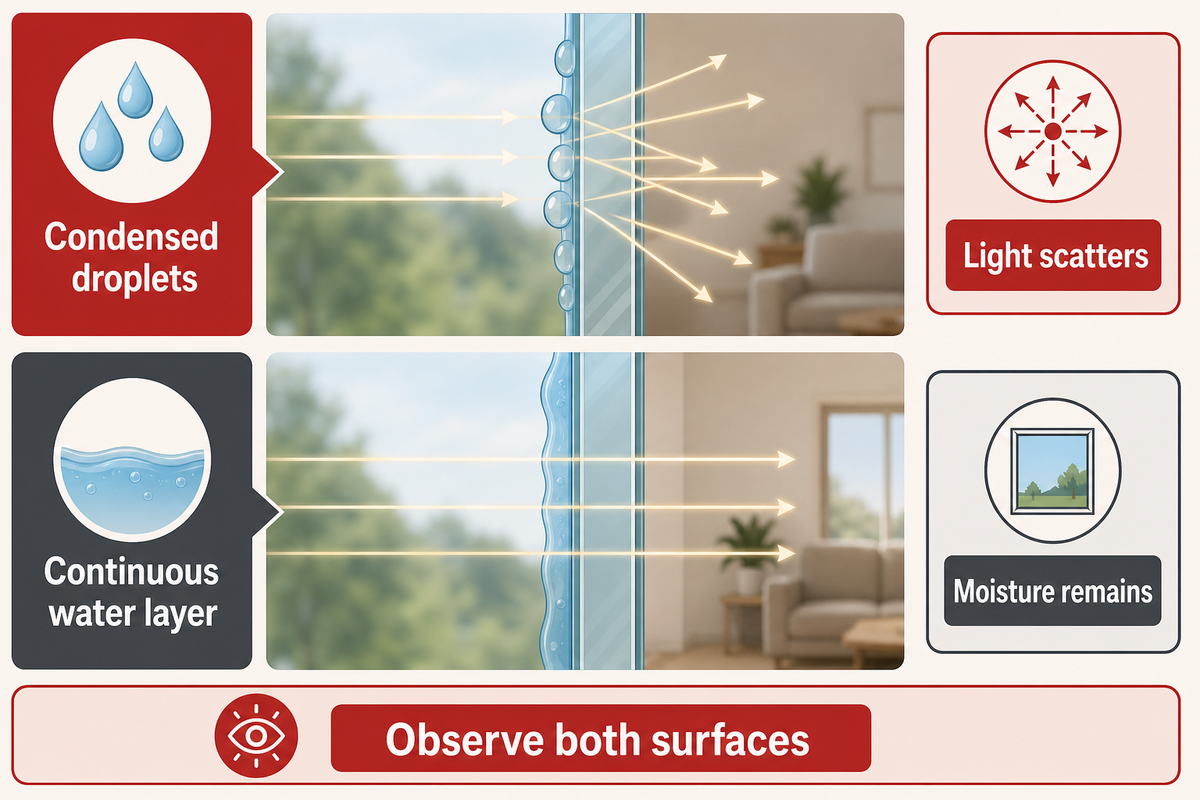
Anti-fog food packaging changes the way condensed water sits on the viewing surface. Tiny water droplets scatter light and make a clear lid look cloudy; a continuous layer of water lets the shopper see through it. These packaging solutions address the fogging effect without removing the food’s moisture.
Water vapor can condense when the surface of the plastic is colder than the dew point of the adjacent air. Inside the package, food and headspace give off moisture. Outside the package, shop air meets a cold lid after it has been taken out of the refrigerator. Those two locations need separate observations: an inside treatment is not an outside-surface treatment.
Cargill’s anti-fog explanation describes condensed droplets spreading into a thin transparent layer. This describes a pack of food being wet and still readable. A photograph of a dry lid doesn’t capture the condition the buyer is trying to address.
To meet clear visibility of packaged food at the point of sale, retailers need product visibility preserved through the selling window. Freshness is a separate product requirement. Quality staff need to distinguish a foggy surface from scratches, inherent haze and distortion. Procurement should tie the treatment to a repeatable structure. Using clarity and transparency as markers for the four issues makes supplier conversations more challenging, as each may require a different material or process change.
Start here: Identify which surface blocks the view, then compare that surface during the actual condensation sequence.
Compare Internal Additives, Coatings and Package Formats
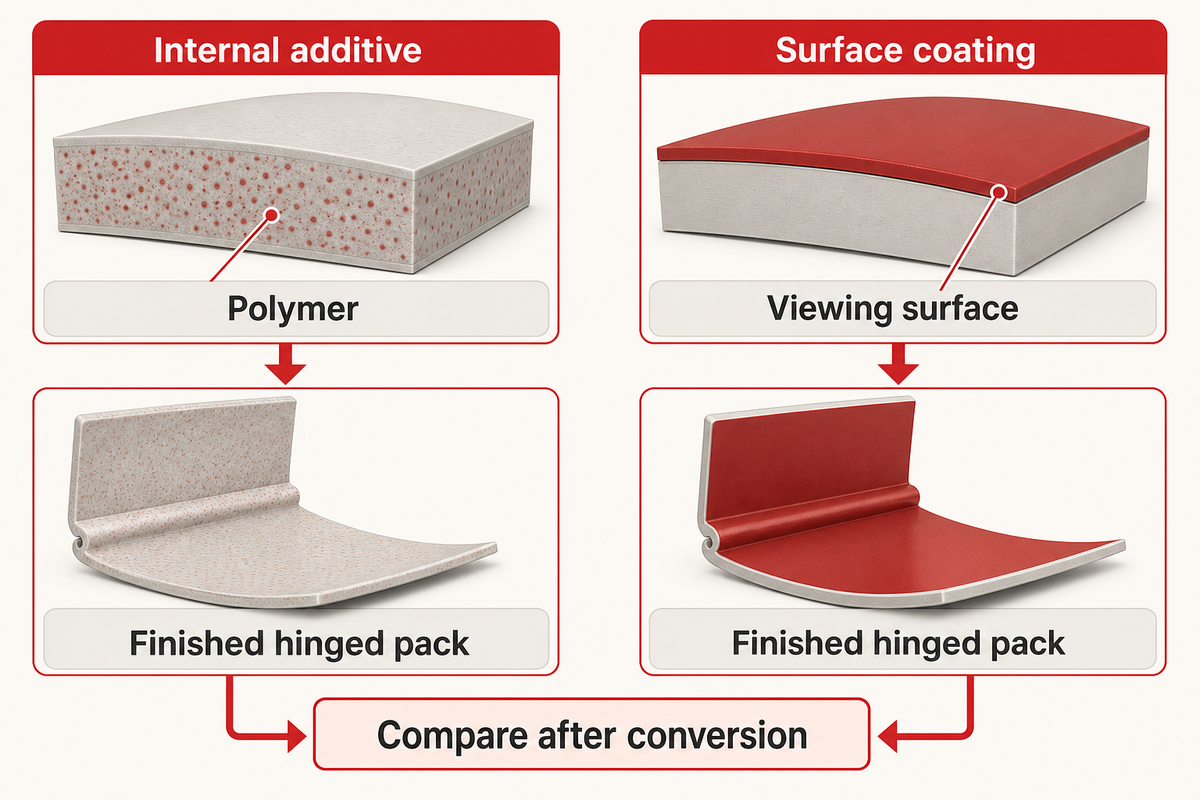
Internal additives and surface coatings are two routes to anti-fog performance. An internal additive enters the polymer during processing of the plastic packaging; a topical coating is applied to the surface. Neither route is a consistent winner for every food packaging application. Selection of a suitable combination of treatment and material among the shortlisted options determines the outcome.
Avient’s packaging white paper describes coating the film surface after extrusion and incorporating a specialty additive concentrate during extrusion. Migratory anti-fogging additives require the desired surface behavior after processing and storage. A surface treatment brings its own coverage and usage requirements. Compare anti-fogging performance in the converted packaging films, rather than comparing additive names.
| Pack or condition | What to compare | Decision for the sample trial |
|---|---|---|
| Untreated clear lid | Dry appearance and wet viewing area | Keep as the baseline; retain it if it meets the display brief |
| Internal additive film | Resin grade, layer and sample age | Compare after the intended storage and conversion history |
| Topical anti-fog coating | Treated side and surface coverage | Include normal nesting, denesting and handling |
| PET hinged container | Formed viewing panel and closure | Use the filled container rather than a flat plastic sheet |
| PP hinged container | Material appearance and wet visibility | Keep the same food load, storage temperature and observation conditions |
| Tray lidding film | Tray, seal layer and film orientation | Include sealing and opening behavior in the comparison |
| Peelable lidding | Peel behavior alongside anti-fog function | Retain the required opening performance after treatment |
| Laminated packaging film | Finished laminate and adhesive system | Compare after lamination, not only before conversion |
| Stretch or shrink film | Film after stretching or shrinking | Use the package after its normal forming process |
A hinged pack has more geometry than a flat film material. It has hinges, ribs and a closure in addition to curved panels. For this design, Wanhui’s clear PP and PET hinged containers are the starting point. The sample brief still needs to state the anti-fog properties required on the surface of the film, or the formed lid.
Dosage units are easily confused. Palsgaard’s Einar 624 coating page provides a generally suggested anti-fog coating amount of 50-150 mg/m² for that product. A percentage loading within a resin is a mass fraction not a coating mass per area. Those figures cannot be substituted for one another or copied into a finished-container specification.
Read Clarity Evidence Without Mixing Up the Tests
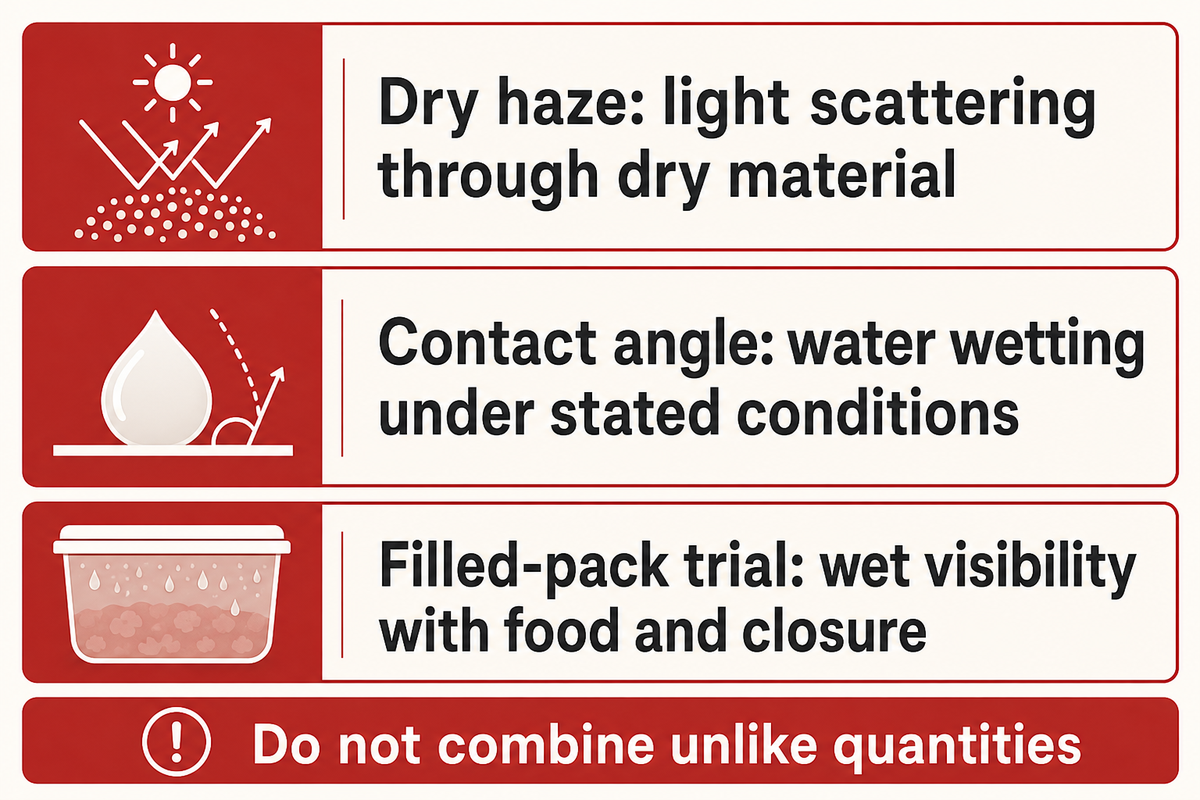
Clarity measurements are different for each specification. Dry haze is described by light scattering by the specimen; contact angle measures the water-wetting tendency of a surface and fog tests are described by the movement of the water pattern under specific test conditions. A filled chilled-display comparison is of the food, closure and viewing geometry. These are important in making the consumer purchase decision.
Clarity Evidence Ladder
The Clarity Evidence Ladder separates material measurements, fog test methods, and finished packs, thus allowing purchasers to compare like with like.
| Evidence item | Published example | Useful comparison |
|---|---|---|
| Substrate identity | Ghaani et al., 2024: BOPP, 20 ± 0.5 µm | Compare the stated film construction |
| Coating conditioning | Same study: 15 days at 25.0 ± 0.3°C in a desiccator | Distinguish conditioning from cold-storage performance |
| Wetting droplet | Same study: 4.0 ± 0.5 µL water drops | Compare the contact-angle method |
| Wetting environment | Same study: 23 ± 1°C and 50 ± 2% relative humidity | Keep measurement conditions alongside angle values for the surface of the film |
| Wetting timing | Same study: 10 drops, observed at 0 and 3 seconds | Separate initial angle from spreading over time |
| Dry optical measurements | Same study: haze measured over 780–380 nm, three measurements | Compare dry light transmission and scattering separately from wet appearance |
| Seal experiment | Same study: 80–130°C, 4.5 bar, 1 second | Keep sealing conditions separate from display temperature |
| Cold-fog film example | Ampacet, 2017: 1 mil LLDPE; prose says 4°C, figure says 5°C | Resolve the setpoint difference before reproducing the method |
| Laminated-film cold fog | Avient: 4°C, observations after 1 and 4 hours, A–E appearance scale | Compare the same observation times and scale |
| Filled-pack example | US6046254A: wrapped meat trays in a 32°F open case, observations through 72 hours | Retain the historical film, food and package context |
The measurements shown above describe published methods, not recommended settings for all packaging materials. Ghaani and others’ 2024 article mentions a pullulan/acrylic coating on BOPP. It places simulated and real food anti-fogging tests under future work. In that work, the measured contact angle describes wetting under the stated experimental conditions.
How do dry haze and wet visibility differ?
Dry haze is light scattering measured through the material specimen; wet visibility is the view through a surface carrying condensed water. A lid can have low dry haze and still become foggy when droplets form. Use dry optical measurements to compare the transparent film or plastic lid, then follow the water pattern during the chilled-display trial.
The present ASTM D1003-21 public scope covers luminous transmittance and wide-angle light scattering in transparent planar specimens. Its two procedures use a hazemeter or spectrophotometer. ANSI’s document history identifies the 2021 version as revising D1003-13. The 2024 BOPP paper cites D1003-00, so its method reference should be interpreted as the edition used by those researchers.
Keep labels. Keep the labels: Contact-angle values, haze percentages, and ordinal fog scores are different values. Don’t average them to a new “clarity rating.”
Build a Controlled Chilled-Display Comparison
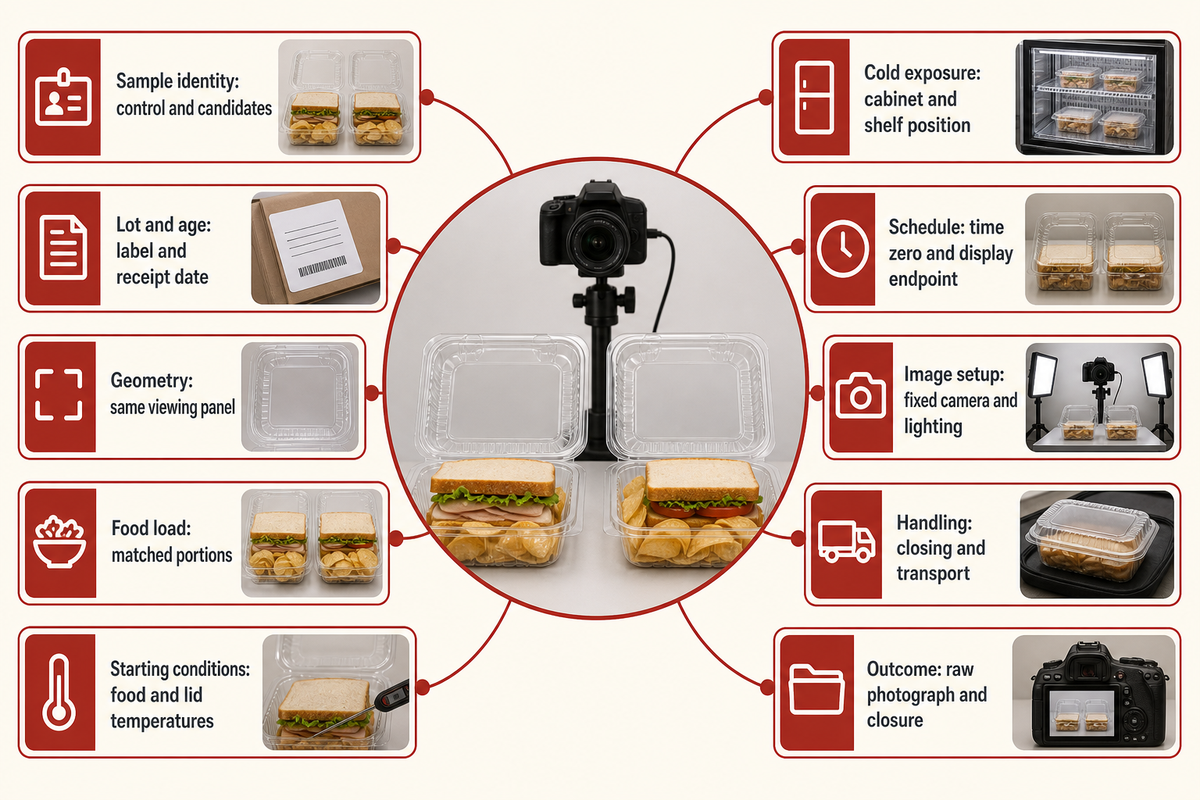
Holding the package, exposure, food, and photography conditions constant, test candidates by controlled chilled-display comparisons. Use an untreated control and identify each sample. Record storage time for each candidate. Compare all samples, photographically, at the same elapsed times. At the conclusion of the handling and storage sequence (what the customer will see) repeat the comparison.
How should two suppliers make a fair cold-display comparison?
Evaluate both suppliers’ production-representative samples side by side, following the same protocol. Match the food portion, starting temperatures, exposure time in the cabinet, sample age, and camera set up. Photograph the same viewing panel at the same check points. For comparisons where the samples have differing temperature history or elapsed time, repeat the comparison rather than ranking the submitted photographs.
In general, observations should be made during the selling period (initial refrigeration, display period and removal from the cabinet). The same physical time zero should be used for all the samples being compared. If samples are filled and photographed right away and other samples are filled and photographed after an overnight chill, differences may be due to the sequencing of the sampling and not to the treatment.
Matched Chilled Display Record
The Matched Chilled Display Record ties observations to sample, food, temperature, elapsed time and history of handling.
| Field | Example entry | Why keep it |
|---|---|---|
| Sample identity | Untreated control; candidate A; candidate B | Connect each observation to one construction |
| Lot and age | Supplier lot label and date received | Track storage and production history |
| Package geometry | Same base, lid footprint and viewing panel | Separate geometry from surface function |
| Food load | One matched salad portion; one matched cut-fruit portion | Keep moisture source and headspace comparable |
| Starting conditions | Measured food and lid temperatures before closing | Record the initial temperature difference |
| Cold exposure | Cabinet identity, logged temperature and shelf position | Retain the actual exposure, including airflow position |
| Observation schedule | Time zero, display endpoint and removal checkpoint | Prevent comparisons between different elapsed times |
| Image setup | Fixed camera, lighting, distance and viewing angle | Keep reflections and exposure changes visible |
| Handling sequence | Normal denesting, closing, stacking and transport | Include what happens before merchandising |
| Outcome and file | Viewing-area description, raw photograph ID and closure observation | Keep visual acceptance tied to retrievable samples |
Example: three constructions, two food loads and two replicate packs require 3 × 2 × 2 = 12 packs for one run. Bulk order consistency may require a sampling plan of its own, and 12 packs shouldn’t be interpreted to be a factory rejection rate.
Keep the original images. A fixed camera can capture details of the food and a small reference target without sharpening, retouching, or adjusting exposure between candidates. Record inside fog, outside fog and any surface damage separately. Retail operations can then select a readable display window while quality staff see the conditions behind the choice.
Actual-food methods exist. The example provided in the US6046254A patent follows wrapped meat trays through repeated observations in an open refrigerated case. Separately, Zhu et al.’s 2022 lettuce-packaging abstract follows the LDPE anti-fog film application. Neither provides a general acceptance level for a hinged salad container.
Match the Pack to Food, Handling and Storage
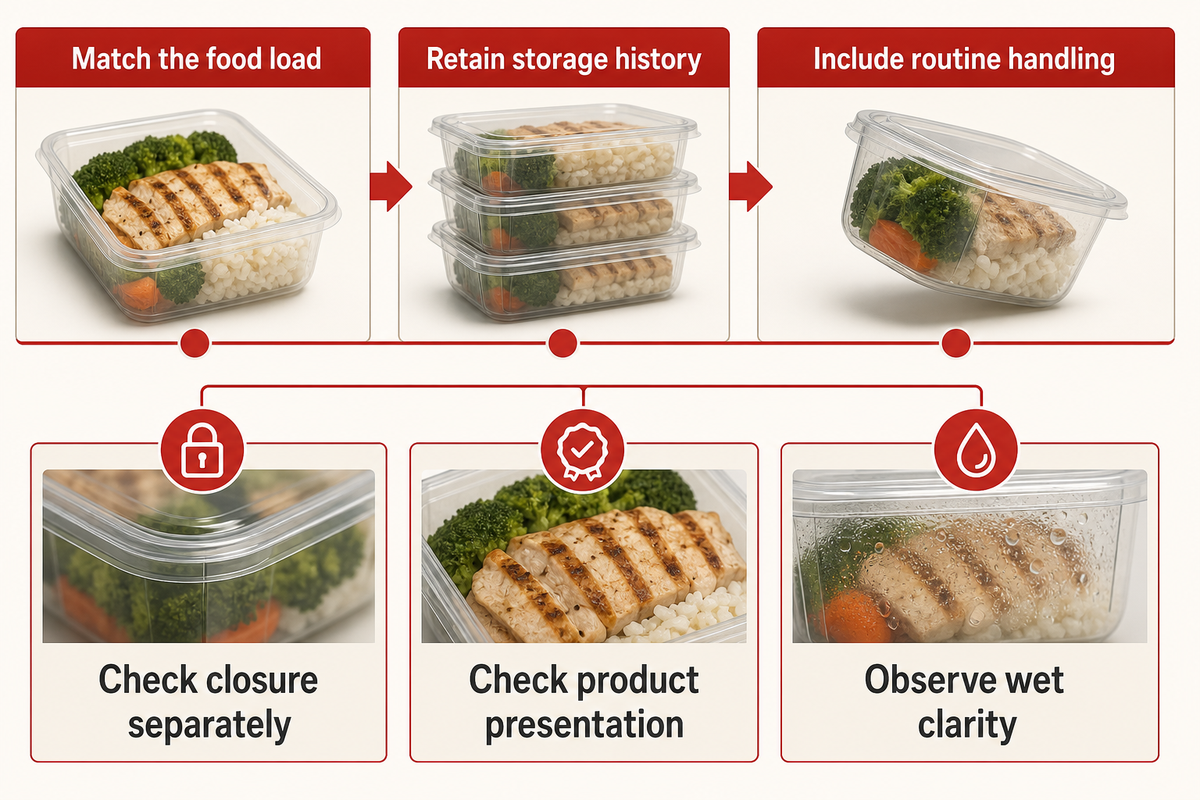
The history of how the food was loaded, transported, stored and handled belongs in the anti-fog comparison. Fresh produce, dressed salads and fresh-cut vegetables bring different contact conditions. High moisture content is one reason to record the food load carefully. The same candidate should be viewed at the end of the intended storage time and after routine handling with closure and product presentation checked alongside wet clarity.
A salad operator can be choosing between a shallow lid and a high dome. A high dome changes reflection and contact with the viewing panel. Keep the assembly decision separate using the salad container layout guide, then compare the selected construction with matched food portions.
For cut fruit, record juice contact with the lid and the position of the pack during transport. A flat, untouched sample on a laboratory bench doesn’t have the same contact as a filled container tilted inside a delivery bag. This comparison is for illustration purposes only and shouldn’t be construed as an official report of Wanhui performance.
Prior conversion history can impact food and/or package performance. Avient’s laminate research indicates that the choice of adhesive impacted the anti-fog performance. Compare the final layer stack of a laminate; for a formed lid, evaluate the formed surface and its nesting history. A raw film or sheet sample belongs earlier in material screening.
“Material selections and product design criteria are key factors in the development process”
Clarity, as with other packaging functions, is relative to the other components of the package. Consider the barrier comparison using the food packaging permeability guide. A clear lid alone is not a reason to extend the shelf life of food or change the food’s storage instructions.
Price the Approved Construction, Not the Clearest Photo
Price considerations are taken after the buyer decides on the construction that meets the requirements for display and handling of the product. Compare the complete packs of the same order quantity and delivery basis and accepted quantity. A less expensive film or lid may actually increase the total cost of a serving pack if the quote doesn’t include a base or insert.
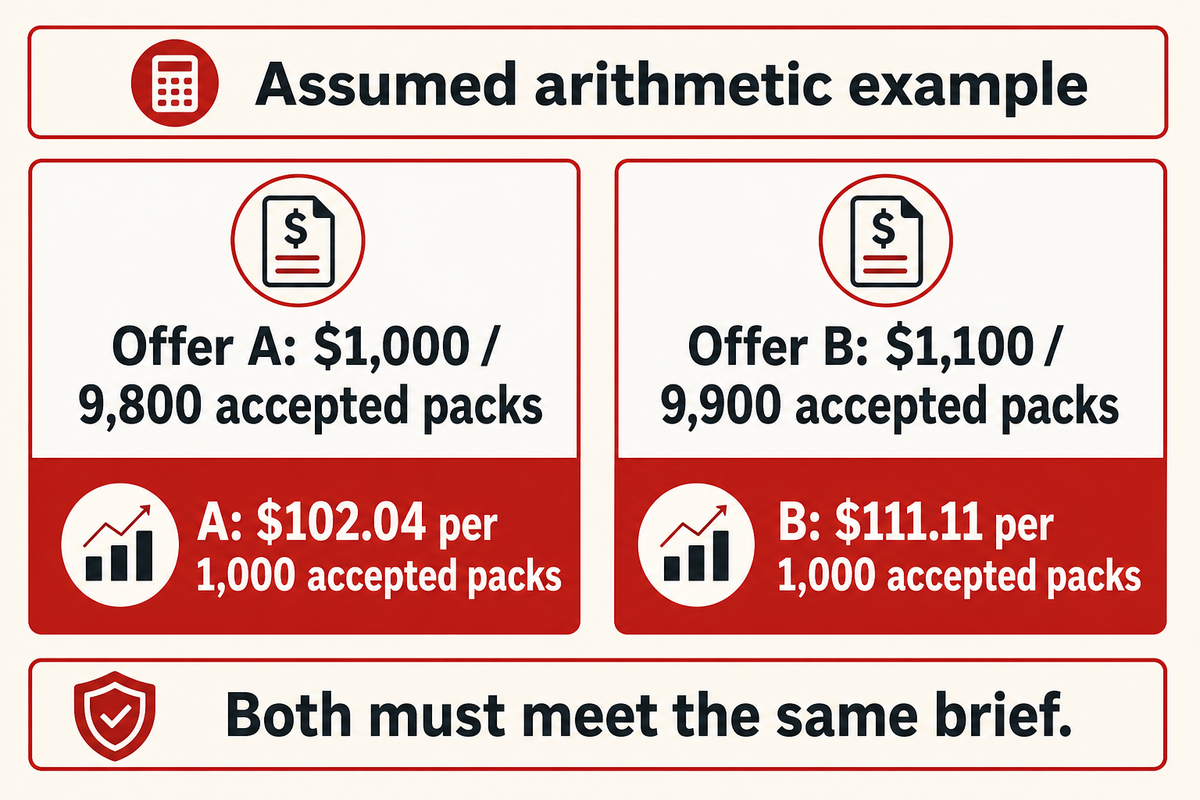
Approved means your purchasing and quality teams have accepted the specified use. Procurement can normalize the cost per 1,000 accepted complete packs as: Total included cost ÷ accepted pack quantity × 1,000. Include only costs measured on the same basis. Don’t credit an assumed reduction in food waste or increase in sales.
For film projects, Avient describes surface coating as a secondary process, while an internal concentrate can enter at extrusion. The quotation should state which processing steps and complete-pack components it includes. That gives procurement a comparable cost basis without assuming that either route is always cheaper.
Assumed inputs: offer A totals $1,000 for a lot yielding 9,800 accepted complete packs; offer B totals $1,100 with 9,900 accepted packs. A is $1,000 ÷ 9,800 × 1,000 = $102.04 per 1,000 accepted packs. B is $111.11. So, A has a lower normalized pack cost than B and, thus, has a lower cost than B if both meet the same brief. The extra 100 accepted packs don’t offset B’s higher total in this example.
Finance receives a comparable denominator. Quality preserves the required behavior. Operations keeps the base, lid, and process together. If either candidate fails the required viewing period, correct the construction, then use its price to choose a supplier.
What Is Changing in Anti-Fog Materials?
Packaging is increasingly designed to serve multiple functions. Recent research on multi-function coating is starting to bring wetting and sealing into the same material-development dialogue. For a converted pack to be commercially viable, all functions need to be integrated. A research coating still has to integrate the film, closure process and chilled food to be a viable replacement for the current packaging construction.
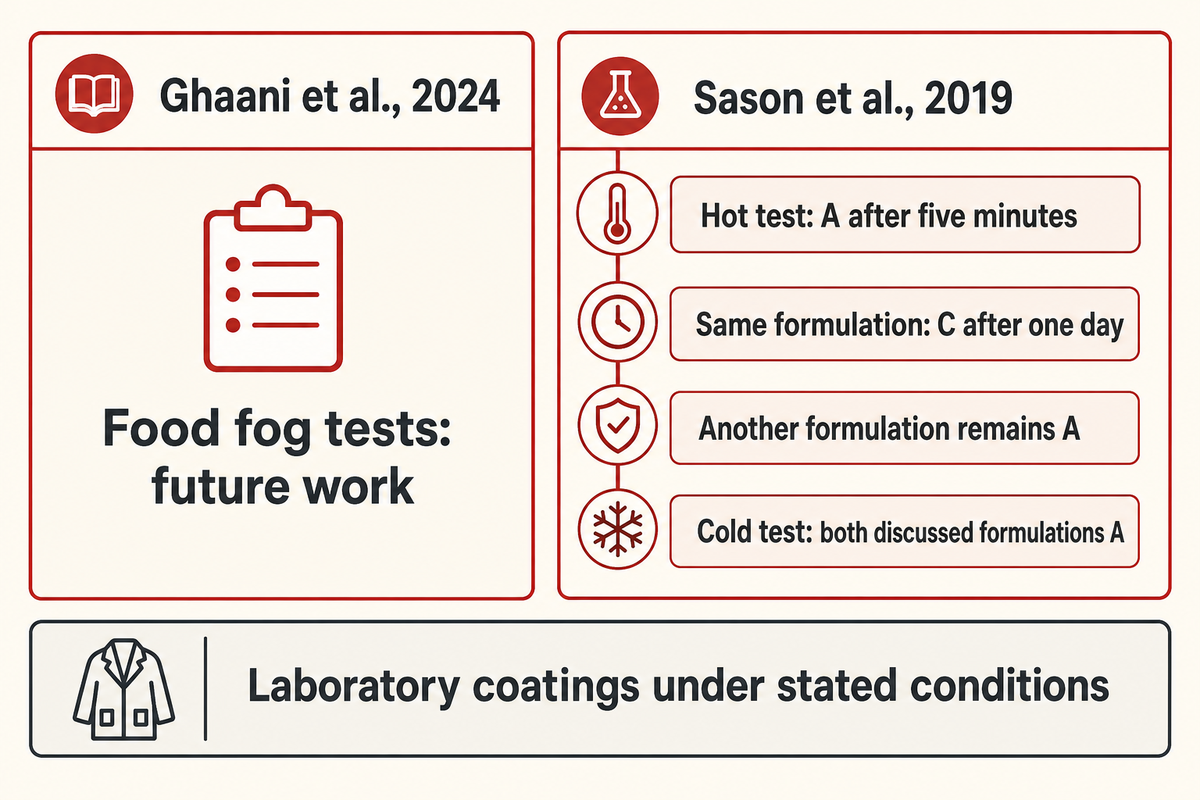
Ghaani et al. published a study of a biopolymer-based pullulan/acrylic anti-fog coating with sealing properties in June 2024, measuring wettability, optical properties and seal strength. Its future work includes fog tests (food and simulated). This makes it a good example for future work and development rather than a specification for fresh food packaging.
Durability and observation time need to be weighted equally. Sason et al.’s 2019 PET-coating study reported one formulation that ranked A after five minutes in its hot-fog test but C after a day; another remained A. Both remained A in the cold test. The comparison is relative to those laboratory coatings and conditions, and demonstrates why an initial image is not sufficient for making purchasing decisions.
For the sustainable packaging proposals, consider the film and treatment in their entirety and not the origin of one ingredient. A label such as “functional coating” should prompt a clear product specification and not result in an automatic food safe or environmental claim.
Frequently Asked Questions
Does anti-fog food packaging actually work?
Yes, a suitable treatment can improve wet visibility.
Yes. Anti-fog treatment helps condensed water spread over the viewing surface to improve visibility rather than bead into many small droplets. The useful result is a readable filled pack through the intended cold food display period. Compare the treatment on the correct surface, after normal storage and handling, with an untreated control exposed to the same food and temperature sequence.
Which anti-fog food packaging material is best?
Choose the complete construction for the food and display route.
Use a food-compatible clear PET or PP container as a format shortlist for chilled hinged packs, then compare its exact treatment in the filled assembly. A resin name alone doesn’t identify the coating or internal additive. For sealed trays, include the lidding film and seal layer in the choice, because closing and opening performance remain part of the job.
Can I test anti-fog performance with a small sample?
Yes, matched samples are useful for initial screening.
Yes. A small side-by-side trial can screen candidate constructions and expose missing conditions before a larger purchase. Include untreated controls and identified samples. Keep the food portion, starting temperature, observation times and camera setup matched, then repeat the normal handling sequence. Treat production-lot consistency as a separate sampling task rather than calculating a factory rejection rate from a few packs.
Does a clear lid prove longer shelf life?
No. Visibility and food storage life are different outcomes.
No. A clear lid describes appearance. Shelf life also involves the food, barrier properties, closure, storage conditions and relevant quality endpoints. Keep the existing food-storage instructions unless a food-specific evaluation supports a change.
Can anti-fog film be heat sealed?
Yes, compatible constructions can combine sealing and anti-fog functions.
Yes, some anti-fog film constructions are heat sealable. The film, tray and seal layer must work together at the intended machine settings. The 2024 BOPP study evaluated sealing separately from dry haze and wettability; Avient also describes anti-fog and easy-peel film systems. For a tray-lidding project, retain the required seal integrity and opening behavior after the proposed treatment, instead of selecting a film solely because its wet surface looks clear.
Can I apply a household anti-fog spray to food packaging?
Use packaging supplied for the intended food-contact application.
Use a supplier-specified packaging construction for its intended food-contact use. Household glass or eyewear treatments aren’t substitutes for a food packaging film, coated sheet or finished container supplied for that application.
Specify Your Chilled Display Pack
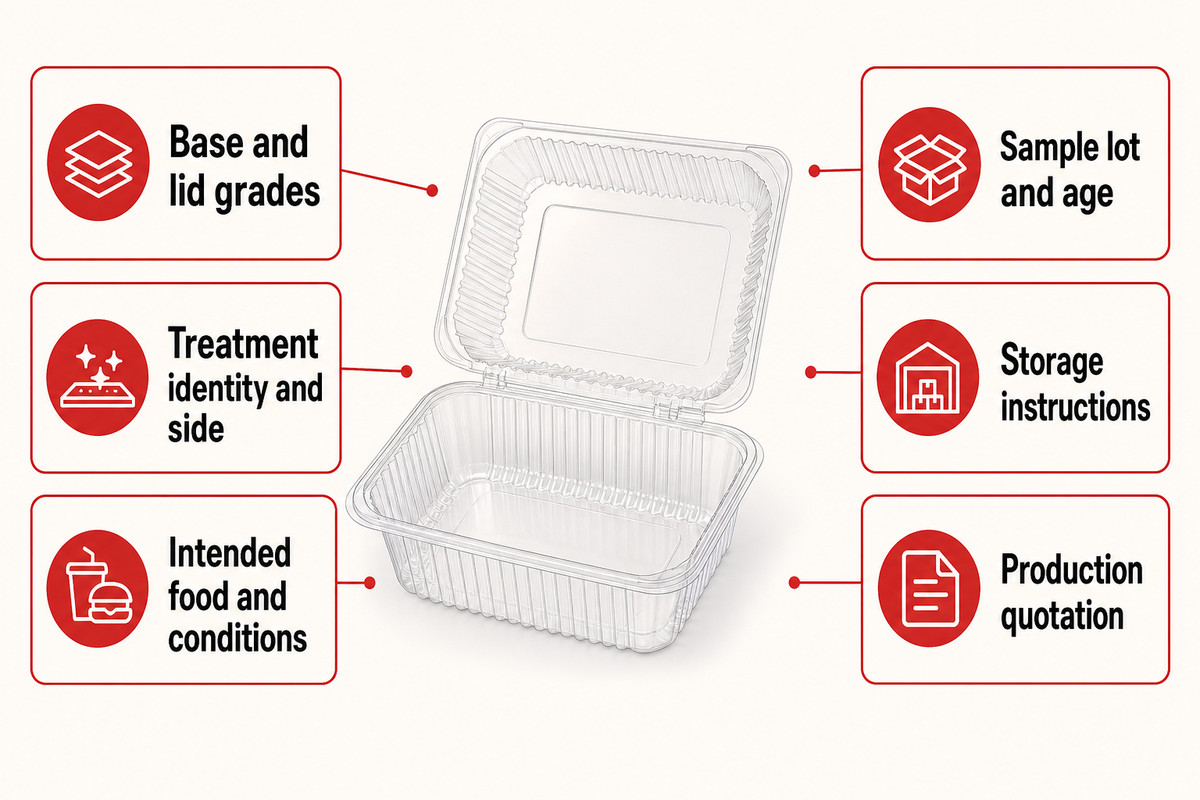
Send Wanhui food, the portion size, base and lid format, filling and display temperatures, required viewing time and order quantity. Use the hinged lid containers range to ascertain the pack format, then request matching samples and the construction details for comparison.
What should a bulk-order sample report include?
A sample order report for a bulk order should provide the pack and lot, the material and treatment route, the surface treated, the sample age, food load, measured temperatures, observational time and raw photographs, closure and handling outcomes and wet visibility. The acceptance decision is tied to the same construction that appears on the quote.
Keep the supplier request in one place: ask for the base and lid grades, treatment identity and side, relevant food-contact documentation for the intended food and conditions, sample-lot details, storage instructions and production quotation. The FDA’s component guidance addresses substance identity, specifications and conditions of use. Where a food-contact notification is the supporting basis, identity of manufacturer also is addressed.
Key takeaway
Choose the pack that stays readable through the selling window, closes correctly and matches the same construction on the order.
As stated in the Wanhui company introduction, they have stock formats and custom packaging services for the food industry. Begin discussions with your filled-pack requirements.
Discuss your chilled display packaging with the Wanhui team. Share the food, pack format and display route so the sample request and quotation describe the same job.
Editorial basis: CYH prepared this guide from literature reviews, supplier technical documents and packaging industry reports. The examples of comparison and calculation are buyer tools. No Wanhui laboratory or customer performance data are presented.
References & Sources
- Development of a Biopolymer-Based Anti-Fog Coating with Sealing Properties for Applications in the Food Packaging Sector Ghaani et al., Polymers, 2024.
- ASTM D1003-21: Haze and Luminous Transmittance of Transparent Plastics ASTM International, public scope.
- ASTM D1003-21 document history American National Standards Institute.
- Antifog composition for polyolefin packaging films US6046254A, historical patent publication.
- Preparation and characterization of polyethylene antifogging film and its application in lettuce packaging Zhu et al., Food Control, 2022; author abstract indexed by FAO AGRIS.
- How temperature ranges affect packaging Ryan Atkinson, Supermarket Perimeter, 2018.
- Engineering of Durable Antifog Thin Coatings on Plastic Films by UV-Curing of Proteinoid Prepolymers with PEG-Diacrylate Monomers Sason et al., ACS Omega, 2019.
- Determining the Regulatory Status of Components of a Food Contact Material U.S. Food and Drug Administration.