Get in touch with Wanhui Company


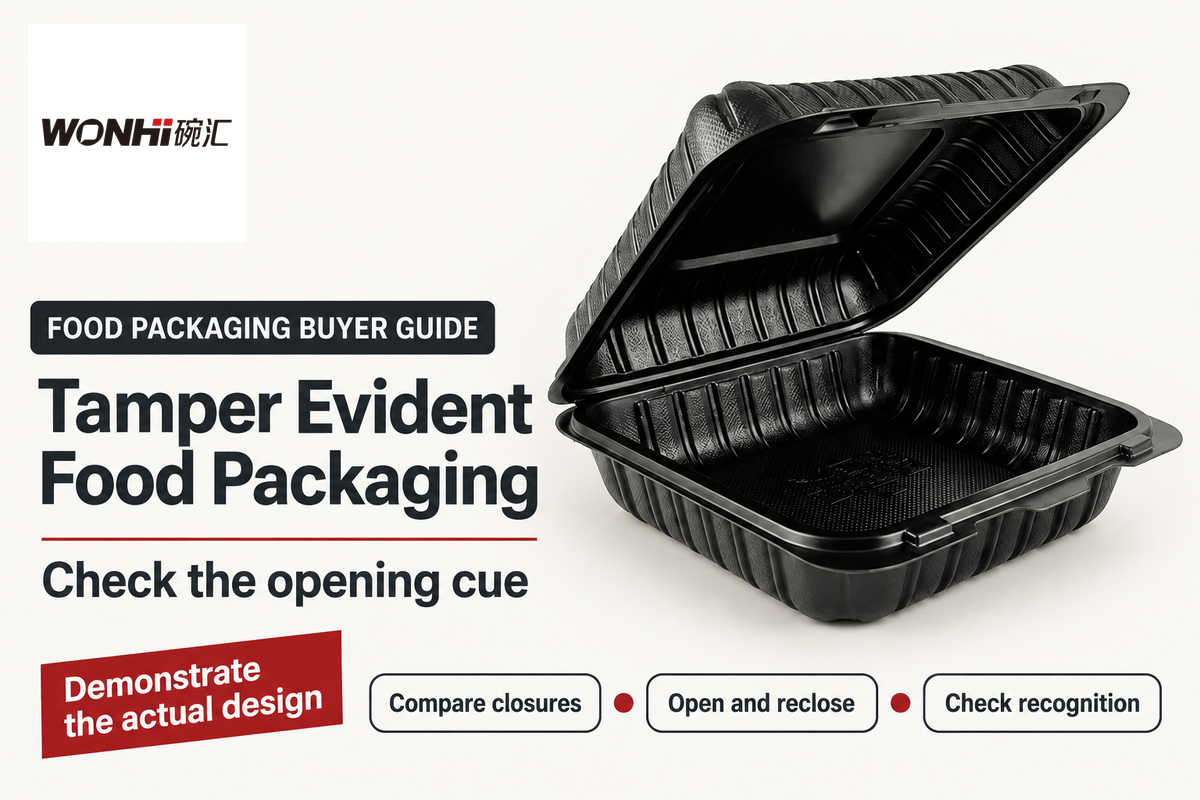
Tamper evident food packaging makes a noticeable change to the closure that has been opened or tampered with. This feature is evaluated by the change it leaves, the function it performs on the closed pack, and whether the customer recognizes that change. Not all lids, when shut, restore the original closure indication.
Updated October 2026
Quick Specs
- Closure options: integral opening feature, security label or tape, shrink band, sealed film.
- Specify separately: food-contact suitability, leakage performance, opening effort and visible evidence.
- Sample comparison: unopened, first-opened and reclosed states, followed by a recipient recognition check.
What tamper evident food packaging actually shows
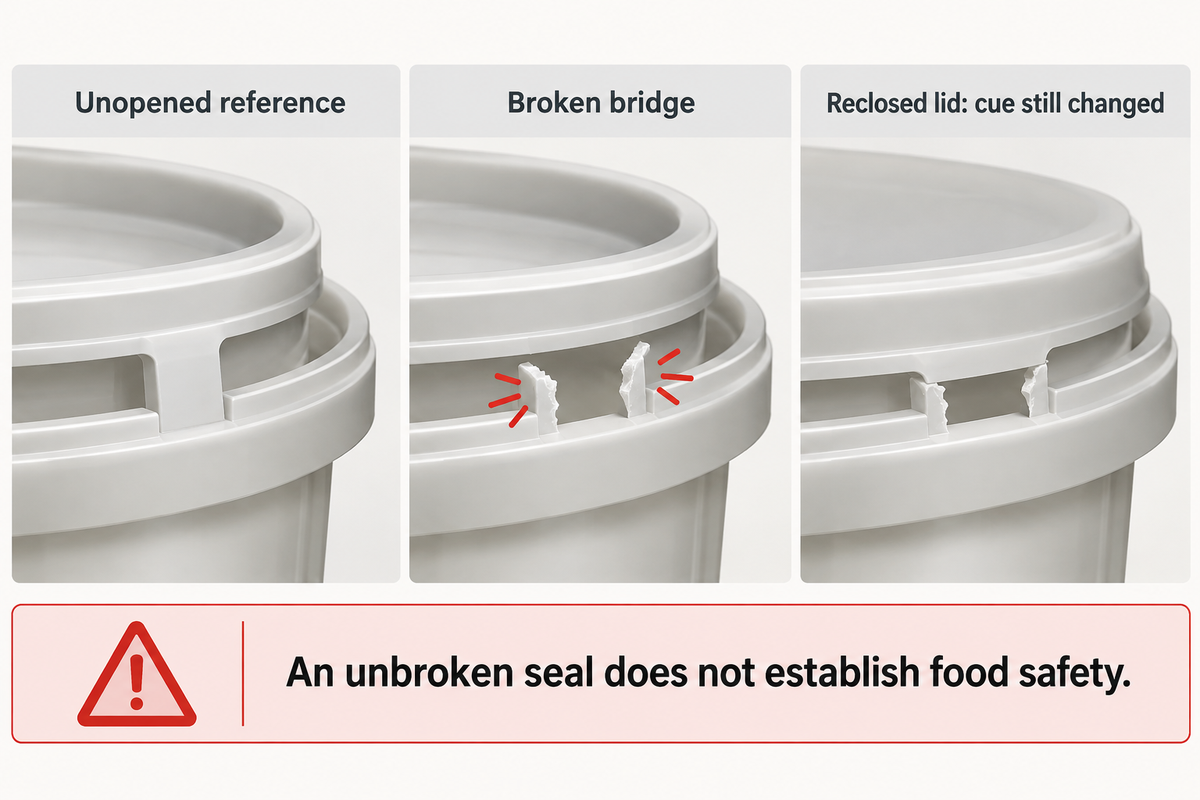
A user of an opening indicator is directed to look for a change: a broken bridge, torn label, moved flag or membrane that has been breached. This change can be the basis for rejecting a suspect pack. An unbroken seal doesn’t establish freshness or food safety.
What is tamper-evident packaging?
Tamper-evident packaging has a feature whose condition changes visibly when the closure is opened or tampered with. The recipient evaluates the pack in comparison to an unopened pack. The correct question is to specify what should be present and what should look different after opening. A generic promise of product safety doesn’t answer these questions.
The consumer guidance from the FDA on food tampering suggests examining packaging and seals. Place the opening cue in a position where the recipient can find it. Explain the safety features beside the brand logo; a “secure” badge does not describe what needs to be changed.
What do you mean by tamper-resistant packaging?
Tamper-resistant packaging makes access harder. Tamper evidence is a change left by access. A design may achieve both; however, pulling harder on a lid doesn’t prove an opening will leave a change. Have the supplier demonstrate each claim on the same proposed model.
Food packaging industry terminology varies in different documentation and regulatory contexts. Consider “tamper proof” and “tamper proof packaging” as claims to clarify, not affirmations that interference isn’t possible. A standard hinged lid container needs to have its specific opening feature validated prior to stating that it’s tamper evident.
Four closure structures for food containers
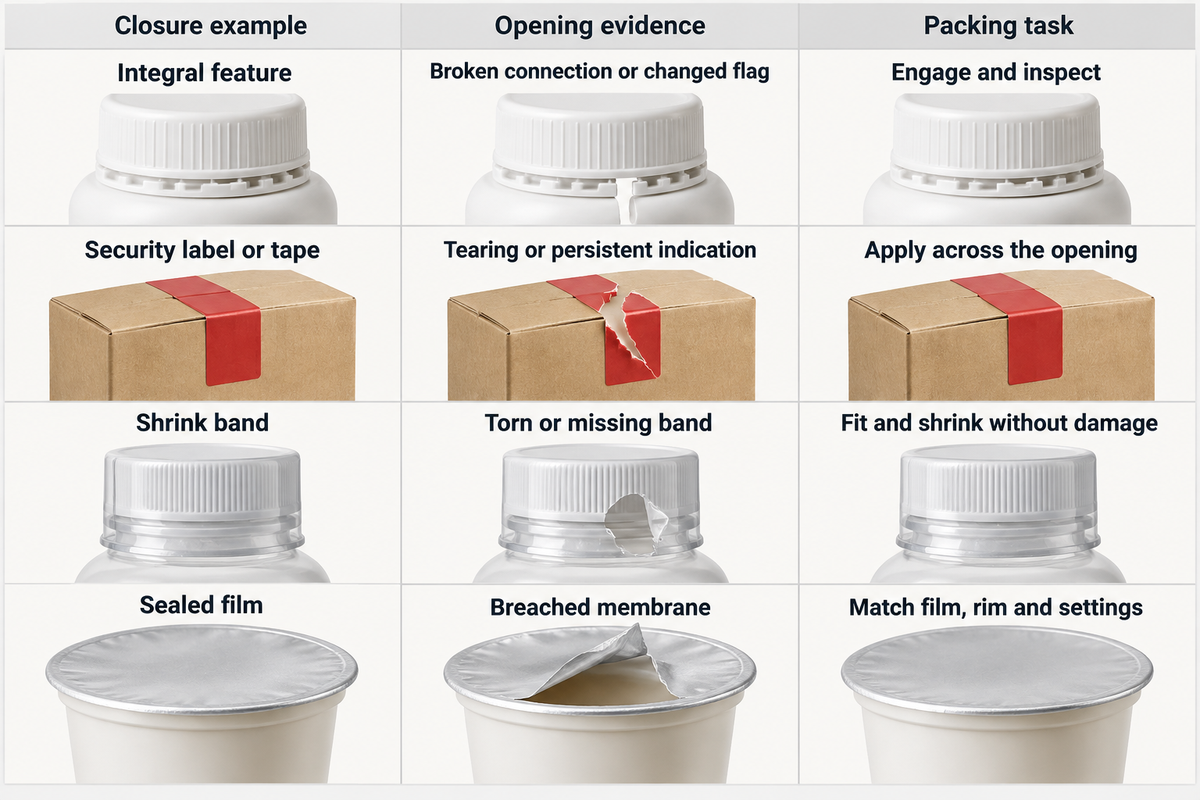
The four closure groups below differ in what the evidence looks like and what the packing operation is required to do. Start with the opening path. That feature should be engaged during packing and should be visibly different when that path is used. A decorative sticker, placed next to the opening, serves a different purpose.
What are the different types of tamper-evident food packaging?
Possible solutions may include the use of a molded opening feature, tamper evident labels or tapes, a shrink band across a closure and a film seal attached to a suitable rim. Each may be appropriate for particular food products and a given filling system. Select the structure first and compare prices, because a label application station and a film sealing station create different operating needs.
| Structure | Expected evidence | Packing task to compare |
|---|---|---|
| Integral tab, strip or flag | Broken connection, removed strip or changed flag position | Fully engage the intended closure; inspect the feature |
| Security label or tape | Tearing, delamination or a persistent indication specified for that label | Apply across the opening on a compatible surface |
| Shrink band | Torn or missing band spanning the closure | Fit and shrink the band without damaging the pack |
| Sealed film | Breached membrane or changed seal condition after opening | Match film, rim and validated sealing settings |
Novolex’s TamperFlag uses a mechanism where a flag rises and stays raised after opening, as described in a 2024 Packaging Strategies report on Novolex’s TamperFlag. This shows that an integrated design need not result in a loose tear strip.
Integral feature
- Advantage: the indication is built into the chosen pack.
- Tradeoff: changing it can mean changing the container model.
- Check: closure engagement and the post-opening appearance.
Applied label
- Advantage: the indication is added as a separate component.
- Tradeoff: adhesion and application become operating tasks.
- Check: label condition on the actual filled surface.
Which closure suits the food, surface and packing line?
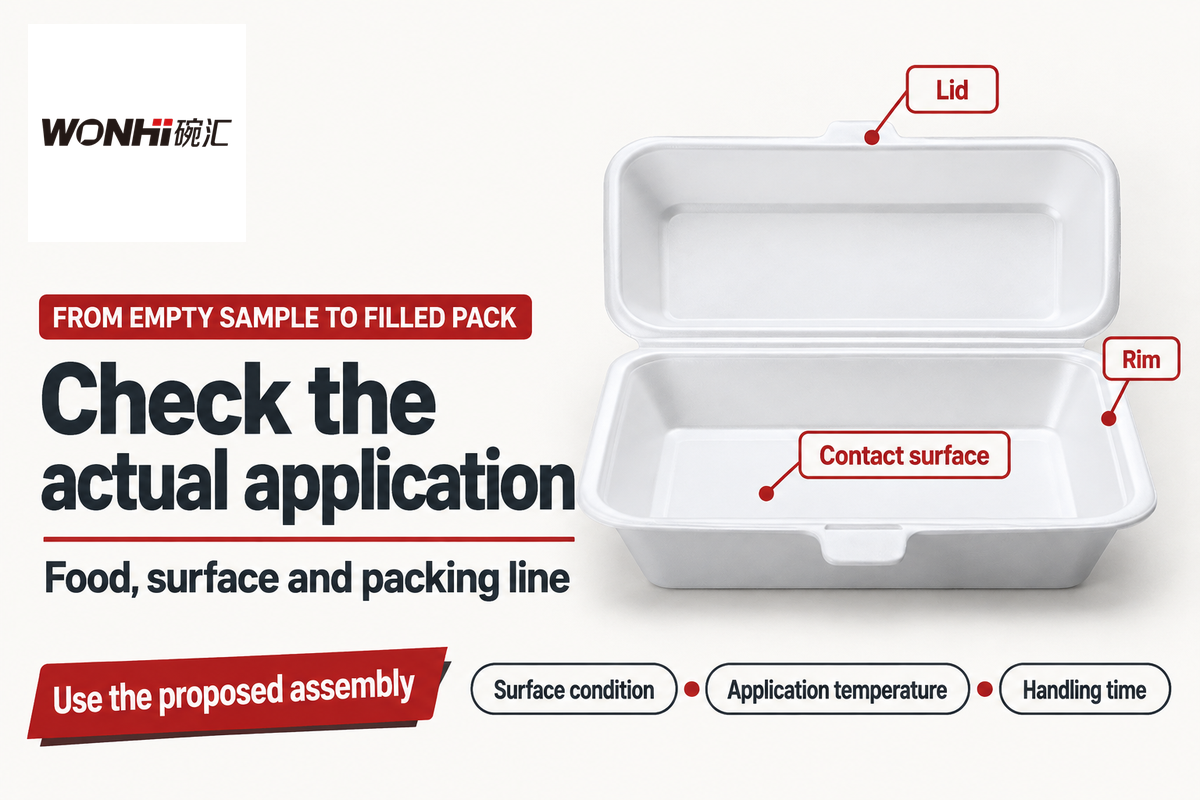
A suitable closure engages the filled pack, is compatible with the application surface, and retains a visible opening cue through shipping and delivery. Consider the food and the pack material, the surface on which it’s to be applied, and the temperature. Assess the filled assembly against the expected delivery conditions. A closed and empty sample is different from the filled pack.
Imagine a deli comparing a label for chilled salad against the same label on a dry counter sample. The counter sample can be appealing while the production surface can be wet with condensation. In this case, keep the proposed label, and repeat the application on other packs taken from the real filling sequence. Note the surface condition, application temperature and the time before handling. If the edge lifts, work with the label supplier on the material and the application conditions. Don’t increase adhesive strength by assumption. The salad packaging guide covers the lid fit. The opening indicator adds a separate check.
For film-sealed food trays, note the film code, tray code, sealing temperature in °C or °F, dwell time in seconds and the machine’s pressure setting with its unit. Keep the supplier’s working range attached to that combination. A stronger bond can also alter the customer’s opening experience.
A bakery snack box, a sandwich pack and a beverage cup present different surfaces and access points. The FDA’s food-contact component guidance also makes intended use part of the assessment. Confirm where a label or adhesive may contact food; a security-label datasheet alone does not answer that question. For a separate sauce cup, compare portion cup sizes and matching lids before adding the opening feature.
Opening force and first-opening evidence measure different things
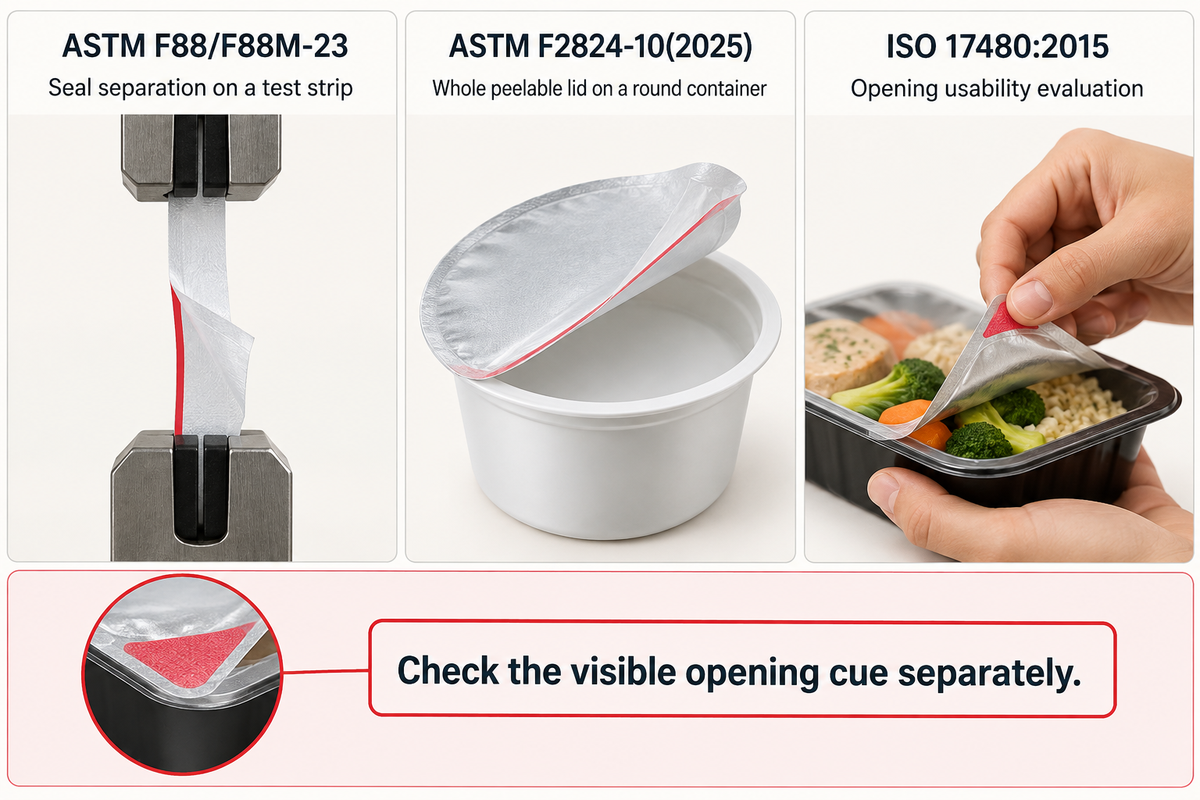
Evidence of a closure being opened (visible evidence) and the effort required to open the closure (opening effort) must be observed separately. A closure may be difficult to open and may leave an ambiguous cue. On the other hand, a closure may open easily and leave a clearly broken feature. Observe intended users opening the closure without guiding them through a hidden step.
| Method | Publicly stated scope | Buyer use |
|---|---|---|
| ASTM F88/F88M-23 | Seal separation on a test strip | Compare seal strength under a consistent specimen method |
| ASTM F2824-10(2025) | Entire flexible peelable lid on a rigid or semi-rigid round container | Evaluate continuous and maximum lid separation forces |
| ISO 17480:2015 | Accessible opening design; instrument-based and user-based evaluation | Plan opening usability evaluation |
Use ASTM F88/F88M-23 for a local seal specimen and ASTM F2824-10(2025) for whole-lid separation within its defined round-container scope. A local seal specimen is different from a user opening a whole package.
Engineering Note
F2824 specifies a 45° pull angle and permits other documented, validated angles. Record the angle with the result; don’t compare unlike setups as if they were equivalent. Its whole-lid method isn’t automatically a test for a molded breakaway tab.
For a takeout meal, evaluate grip, the opening sequence, spillage and effort. ISO 17480:2015 includes user-based evaluation. Check separately whether the opening cue remains visible.
Use the First-Opening Check on samples
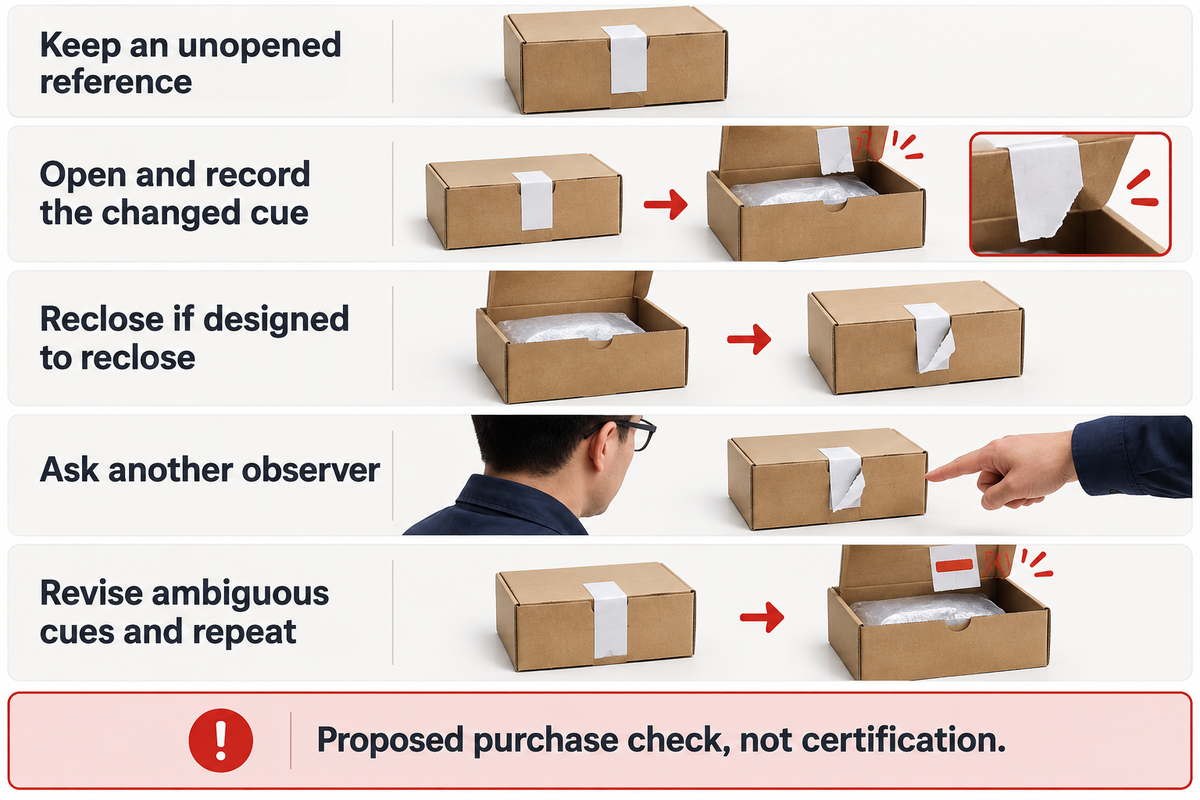
The First-Opening Check examines tamper evident features in the expected unopened condition and after opening and re-closing, then checks if a different person identifies the difference. It’s used to eliminate ambiguous candidates prior to a larger trial. The following check is a proposed purchase check; it isn’t a standardized certification or a surrogate for food contact and performance tests.
“Compare a suspect container with others on the shelf.”
- Keep a reference. Photograph a correctly filled and closed sample, including the opening cue.
- Open as instructed. Photograph the changed feature and record effort or spillage separately.
- Reclose if designed to reclose. Check which evidence remains visible beside the unopened reference.
- Ask another observer. Without identifying the opened sample, ask which pack has changed, where, and what they would do.
- Act on ambiguity. If observers miss the cue, revise its visibility or instructions and repeat before approving that design.
Identify the models and component numbers, the food or test fill, the conditions of use, the observation times, pictures, the number of observers, and the number of incorrect classifications. Quality personnel can compare conditions across candidates; customer service personnel can use the approved photos to illustrate the cue. Choose sample numbers and acceptance limits based on the real risks and uses before testing.
An example is a reclosable deli container whose label tears as intended, but the torn end folds under the lid. The packer records a visible tear while holding it; the recipient looking from above sees what appears to be an intact closure. Record “tear present, missed from normal viewing position”, and retain both pics. Change the indicator position if needed. Don’t approve just because a tear exists. The same check separates a reclosed lid from a restored opening indication. For details on hinge construction and available container shapes, see the hinged lid container designs guide.
Participants could recognize whether devices had been triggered, yet didn’t always check the devices in a given product, according to the historical qualitative 2009 study by Pascall and colleagues.
What a broken seal means for receiving and complaints
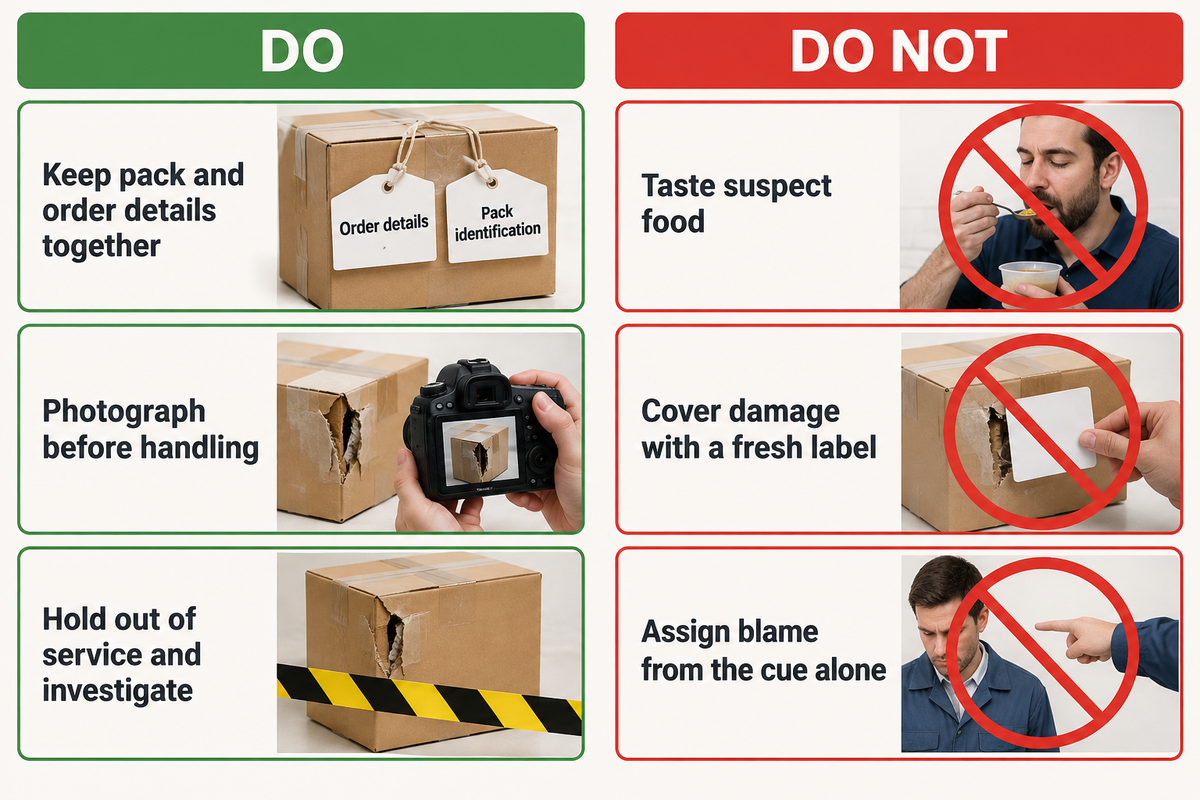
A damaged indicator isn’t evidence of who caused the damage, and doesn’t identify its cause. Generally, preserve the condition of the product, identify the lot or order, and compare it with the approved unopened reference. Don’t reclose the pack and treat the contents as cleared for consumption. Hold the pack out of service while the issue is investigated.
According to the FDA’s voluntary retail food-security guidance, check incoming product and returns for tampering and/or compromised tamper-evident packaging, and reject suspect food. A delivery workflow should name the person who makes that determination.
Do
- Keep the pack and order identification together.
- Photograph the damage before further handling.
- Follow the site’s rejection and escalation procedure.
Don’t
- Taste suspect food to decide whether it is safe.
- Cover the damage with a fresh label.
- Assign blame from a broken feature alone.
This procedure refers to the checking and packing procedures mentioned in the ghost kitchen packaging guide for delivery operators. Recording the nature of the complaint helps distinguish the observed complaint from the suspected cause.
How do food-contact scope and tamper evidence differ?
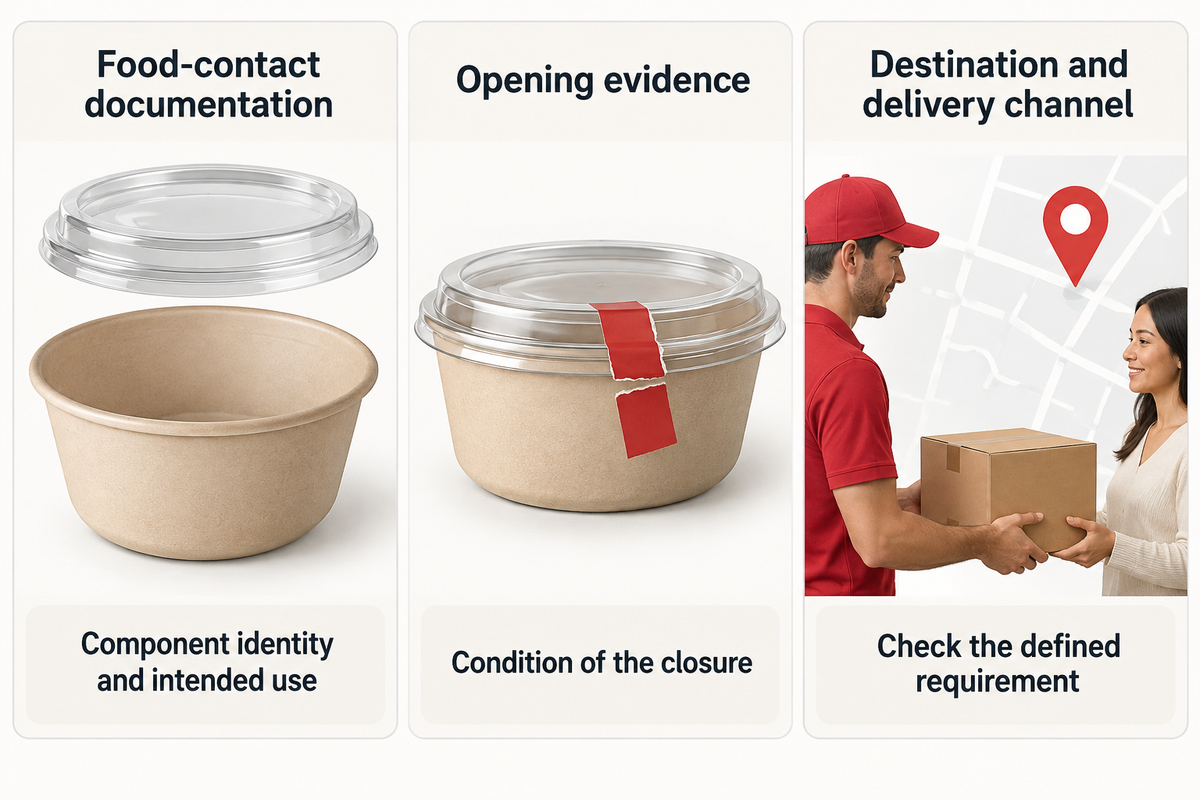
Different questions are addressed by food contact documentation and opening evidence. Documentation is concerned with the identity and specification of the component; an opening check concerns the condition of the component. Give both. Also give the destination and the delivery channel, because a requirement can apply in a specific delivery setting.
The FDA explains that food-contact components must meet the identity, specifications and use limitations of their applicable authorization. Effective food-contact notifications can be manufacturer-specific. Ask for documentation tied to the offered construction and use; the food packaging migration testing guide explains how to compare a report with the proposed pack.
21 CFR 211.132 covers specified over-the-counter human drug products. It shouldn’t be presented as a universal rule for food containers with lids.
For a food-specific example, San Diego County’s inspection guidance cites California Health and Safety Code §113982 for tamper-evident closure of ready-to-eat food transported through a third-party food delivery platform. Its AB 3336 implementation notice assigns the closure task to the food facility before the deliverer takes possession. That defined setting shouldn’t be expanded into an all-food, nationwide requirement.
Send suppliers a closure-specific approval brief
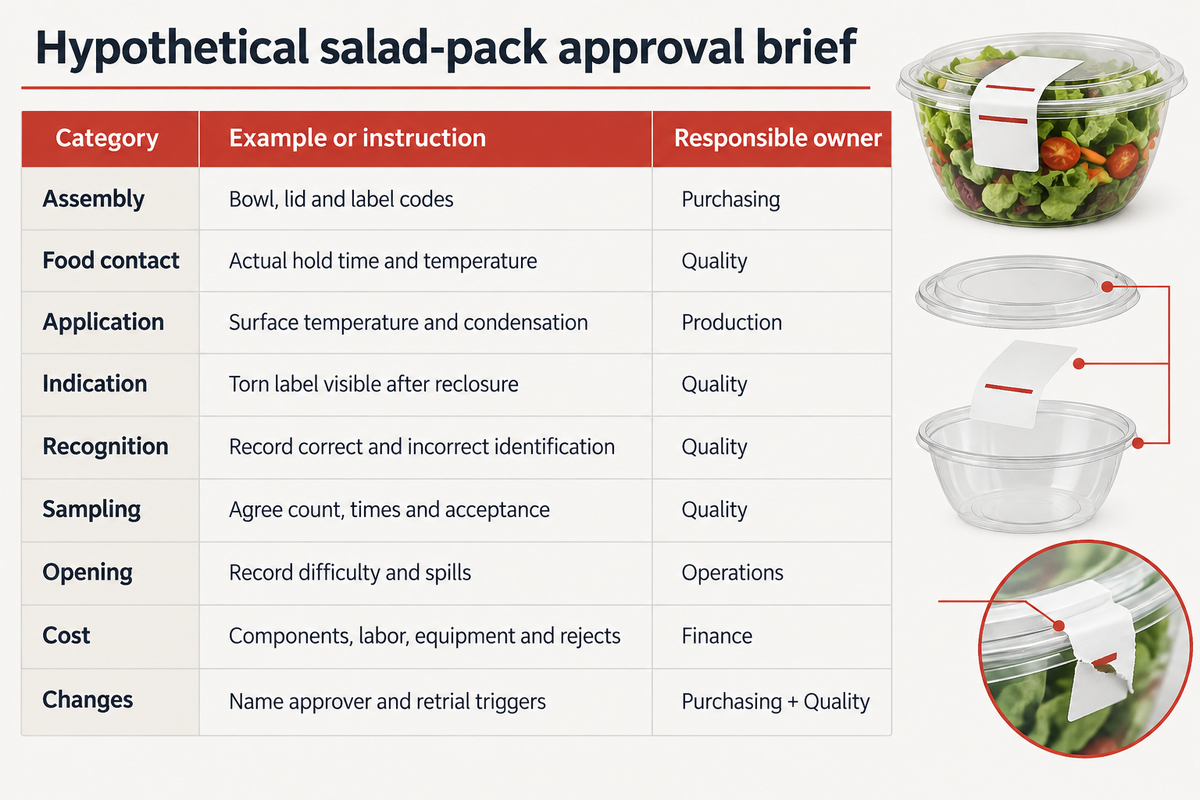
A useful supplier brief states the complete assembly, the operating conditions and the result the buyer expects to observe. Place those fields adjacent to the quote to ensure the same comparison is being made by the purchasing, production and quality assurance personnel. Maintain food contact documentation separated from sample photos and performance results.
Copy the fields below into a custom food packaging inquiry. The examples describe a hypothetical chilled salad and not a Wanhui example. Replace the examples with your product and measured conditions and ask for approval.
| Decision category | Example entry | Decision owner and response |
|---|---|---|
| Complete assembly | Salad bowl, matching lid and opening label; request individual item codes | Purchasing: compare quotes for the same components |
| Food and contact conditions | Chilled salad with separate dressing; specify actual hold time and temperature | Quality: match supporting documents to intended use |
| Application conditions | Apply after filling; measure surface temperature and record condensation | Production: confirm a workable application sequence |
| Expected indication | Torn label remains visible after the lid is reclosed | Quality: compare photos and recipient recognition |
| Recipient recognition | Observe from the usual receiving position without announcing which sample was opened | Quality: record correct and incorrect identifications separately |
| Trial sampling | Agree sample count, observation times and acceptance criteria before the trial | Quality: select a plan for the product and operating risk |
| Opening and leakage | Record opening difficulty and spills separately from indicator condition | Operations: approve performance for the meal route |
| Cost basis | Include closure components, application labor, equipment and rejects | Finance: compare total packed-order cost |
| Acceptance and changes | Name the approver; identify changes that require another trial | Purchasing and quality: retain the approved sample revision |
Suppose purchasing is offered the plain bowl and a security label at a lower unit price, while the production folks would prefer an integrated feature. The label quote is still incomplete, as the team has to account for application labor, consumables, and rejected packs. The integrated option also requires a trial, as an unknown closing action may affect the packing sequence. Have production time the same representative order mix, and have quality record misapplied or incompletely closed packs. Finance can then evaluate completed orders on an equal basis. Neither a lower component price nor fewer loose parts alone settles which solution fits the line.
The FDA’s recommendation to assign food-security responsibilities supports having named receivers and escalation owners. The approval fields above are a purchasing tool; establish acceptance criteria with the respective product and production owners.
Frequently asked questions
Is tamper-evident packaging required for food?
Yes, in some defined settings, including applicable California third-party-platform food deliveries.
California’s third-party-platform delivery setting is one specific example described in the county guidance cited above. Identify where the food will be sold and who handles it before selecting the closure. The federal provision commonly cited as 21 CFR 211.132 concerns specified nonprescription drugs; citing it alone doesn’t establish what an ordinary food pack must use. Keep the applicable requirement with the purchasing specification.
What is food tampering?
Food tampering involves deliberate interference with food or its packaging.
A disturbed indicator can alert a recipient to a problem, but it can’t identify the person responsible or establish the cause. Accidental damage and an incorrectly applied feature also need investigation. Don’t taste food from a suspect pack to test it. Preserve the packaging and order details, contact the seller or responsible food business, and follow the relevant reporting procedure.
Is there a cost associated with tamper-evident packaging?
Compare the cost of the completed pack, including the closure and its application.
Compare completed-pack quotes for take-out service at the same order volume, including labor, inspection and rejects from a representative trial. A separate label, tamper-evident tapes or a shrink band can add materials and handling. An integral feature can change the container price and closing task. Film sealing can require equipment and setup. Keep the quoted assembly and application method attached to the price.
What size food container do I need?
Choose a food container that holds the food items with usable headspace and enough lid clearance to close fully.
Nominal capacity alone doesn’t show whether toppings, a sandwich or a sauce cup will obstruct closing. Trial the actual portion, then verify that the opening feature engages without crushing the food or bowing the lid.
Can a tamper-evident container be reclosed?
Some designs reclose, while retaining a visible indication of the first opening.
Reclosure and restoration of the original indication are different functions. Compare the reclosed sample with an unopened reference. Confirm that the customer can still identify the changed feature and that any claimed leakage performance applies after reclosure.
Discuss the pack and closure together
Send Wanhui your food type, portion, filling conditions and delivery route, together with the opening indication you want the recipient to see. Include the supplier brief when requesting samples.
About this closure guide
Assess the proposed assembly for its intended use: the visible opening cue, application conditions and the recipient’s ability to recognize a change. Wanhui supplies foodservice packaging, and this guide addresses those closure questions in container inquiries. Its sample method and approval brief are purchasing aids assembled from the cited public guidance.
References & Sources
- Food Tampering: An Extra Ounce of Caution, FDA.
- Food Security Preventive Measures Guidance for Retail Food Stores and Food Service Establishments, FDA; voluntary guidance.
- Determining the Regulatory Status of Components of a Food Contact Material, FDA.
- ASTM F88/F88M-23, public scope and significance.
- ASTM F2824-10(2025), public scope and significance.
- ISO 17480:2015, Packaging: Accessible design: Ease of opening, public abstract.
- Consumer focus-group research on tamper-evident packaging, Pascall and colleagues, 2009; historical qualitative study.
- Novolex launches TamperFlag rigid containers, Packaging Strategies, 2024; supplier product announcement.
- 21 CFR 211.132, current eCFR.
- Food in good condition, safe and unadulterated: inspection requirements, San Diego County.
- AB 3336 food-delivery implementation notice, San Diego County, March 2021.