Get in touch with Wanhui Company


Updated October 2026
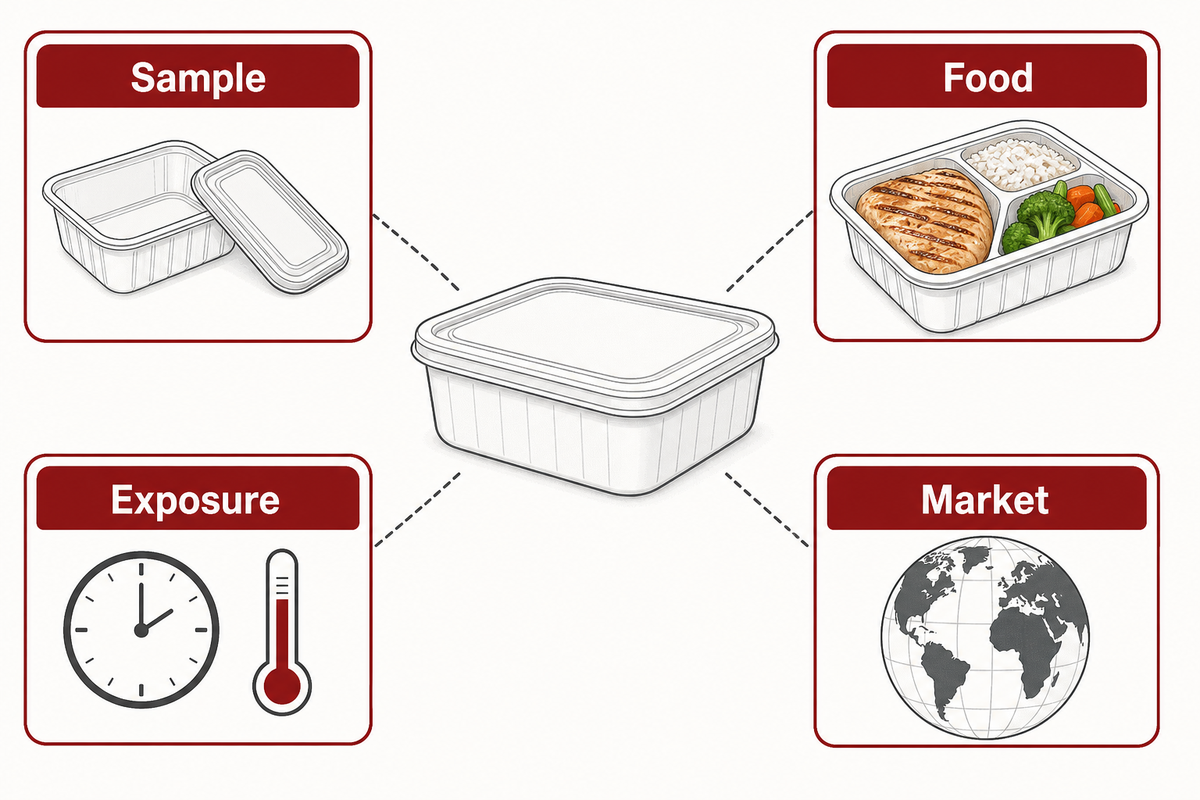
Food packaging migration testing determines migration of substances transferred from a package under defined test conditions. A report of interest represents the package you buy, the food it holds, the environment it faces and the market it serves. A pass of another test or a report for a different use can’t justify your purchase decision.
Before approving an order, seven things must be checked: identity and construction of the sample, the market basis, the food or simulant, time and temperature, analytes and methods, and the interpretation of the results. The two aids below turn those checks into a review of a document. They’re editorial tools built from public guidance and don’t represent test protocols, evidence or test results of any Wanhui product.
What a migration test report tells a packaging buyer
A migration report is a statement by a laboratory on what they examined and found under stated conditions. It supports and helps define a food-contact assessment; it doesn’t approve every package from the supplier. When evaluating the report, read the sample description and test scope, if any, before the conclusion, because the correctness of the result doesn’t guarantee it’s relevant to the sample.
Migration testing for food packaging is a chemical transfer assessment from food contact materials into food and is part of packaging testing. Food sanitation practices are separate and require additional consideration. A chemical assessment report doesn’t define or evaluate every aspect pertaining to packaging and food.
What is a migration test report for packaging material?
This document correlates a specific sample to test conditions, analytical methods and measured results. Its value to a customer is traceability. You should be able to connect the tested packaging material to the ordered specification and understand what restrictions were evaluated. A cover page certificate by itself is usually not detailed enough to make this relationship.
Request the complete report, relevant supplier declaration and supporting justification. As per the regulatory status guidance provided by Food and Drug Administration, the legal justification must cover the substance and the conditions of use. A food contact notification is also dependent on the identified manufacturer. A test report alone doesn’t meet the requirements for the U.S. basis.
The priority should be to resolve a missing sample specification before debating a pass/fail number. The sample specification is a document procurement can obtain; the responsible technical reviewer decides whether the evidence supports release. Keeping these responsibilities separate prevents asking a purchasing team to make an unsupported food safety judgment.
Match the tested food contact material to your order
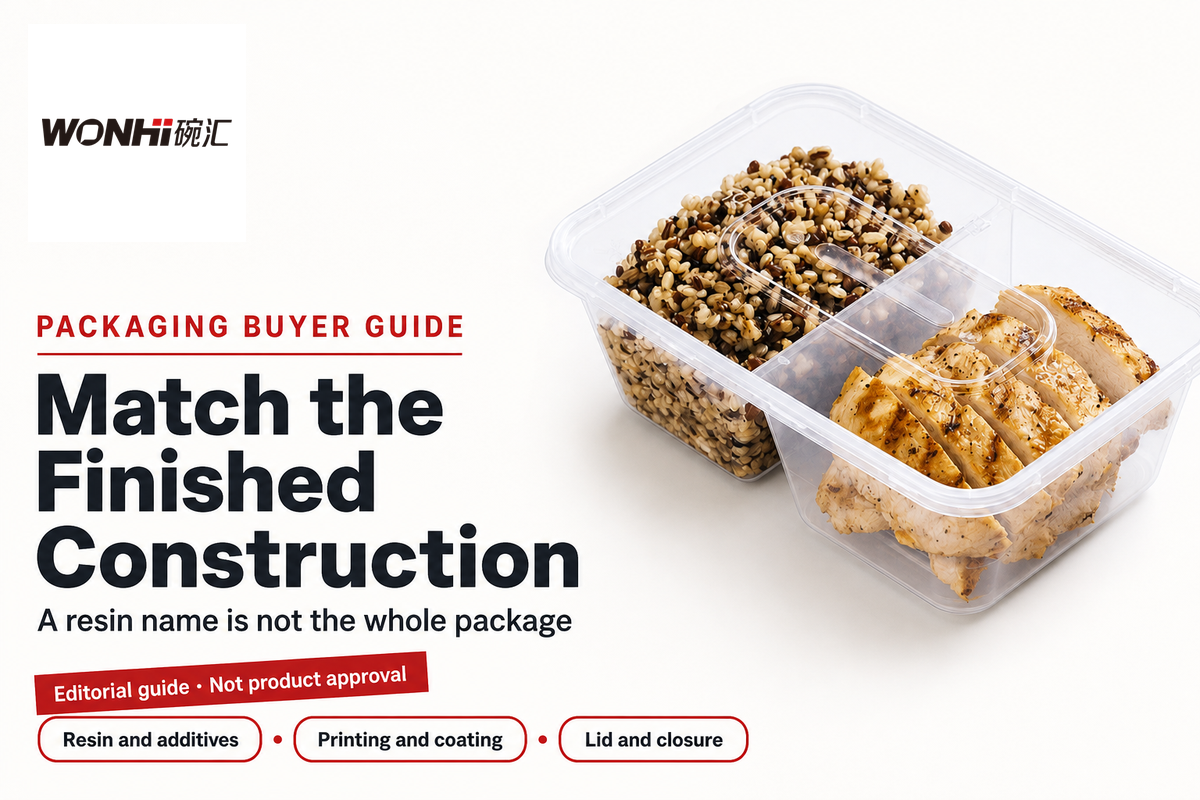
Match the finished construction, not just the polymer name. Assessing which substances need consideration depends on the grade of the resin and other factors such as additives, color, thickness, coatings, printing, closures and other variations. A test report may represent a product family. The supplier/laboratory should explain why the sample covers the packaging products in the order.
Describe the various substances used in food contact layers if the supporting documents allow. Identify food packaging materials consistently across the drawing, declaration and report. Ask to have any confidential formulation details directed to the technical reviewer.
If raw materials are suitable for food packaging is migration testing necessary?
Raw material evidence isn’t conclusive for determining if a converted package is suitable for its intended use. Consider what manufacturing adds or changes to the package and if the existing evidence supports the finished use. Further testing may not always be necessary, and the question may sometimes be answered through justified calculations, supporting documents, or representative testing. Not all stock keeping units (SKU) require a separate test.
The FDA’s chemistry guidance for food-contact submissions mentions test specimens, intended uses, and migration estimates. It is submission guidance and is non-binding. It is not a universal purchase protocol. Ask raw material suppliers and the converter to represent what their documents actually show.
Illustrative scenario: A buyer finds a polypropylene resin document for a black hinged meal box for hot and oily meals. The order also states that a printed sleeve and different lid are to be included with the box. The resin name matches, but the buyer still lacks the finished article’s pigment information and an explanation of lid coverage. The buyer pauses technical approval, is putting together a construction list, and sends it to the supplier. The buyer’s quality assurance asks which components could contribute substances, and if a representative test has been done to cover those components. The answer to the question may be through supporting documentation or assessment, and the resin document alone may not address the question. No test results, or temperature, are implied in this example.
For printed and custom food packaging, freeze the artwork and construction revision used for assessment. Treat MFPP container constructions as specification matches, not as a material name that proves compliance.
4-Way Report-to-Use Match
Definition: Compare the report and purchase across sample, food, exposure and market; resolve a missing match before accepting the evidence.
| Dimension | Compare with the order | If the match is missing | Owner and next action |
|---|---|---|---|
| Sample | Article code and drawing revision | Traceability is unresolved | Procurement requests a specimen-to-order link |
| Sample | Resin, additive and pigment specification | Composition coverage is unclear | Quality assurance asks the supplier for supporting detail |
| Sample | Coating, ink, adhesive and lid | Finished construction may differ | Technical reviewer checks component coverage |
| Food | Actual food types and relevant simulants | The tested medium may not represent use | Laboratory explains the selection |
| Food | Contact area and food quantity | The reporting basis may differ | Laboratory confirms the applicable ratio |
| Exposure | Filling, storage and transport profile | Time or temperature coverage is unclear | Operations supplies the complete use profile |
| Exposure | Reheating and any repeated use | A later use step may be omitted | Technical reviewer requests the coverage rationale |
| Market | Applicable legal basis and version | A pass may answer another market’s question | Quality assurance confirms the destination requirements |
| Market | Quoted assessment and report deliverables | Prices may cover different work | Finance compares equivalent scopes with procurement |
Compare overall migration, specific migration and NIAS
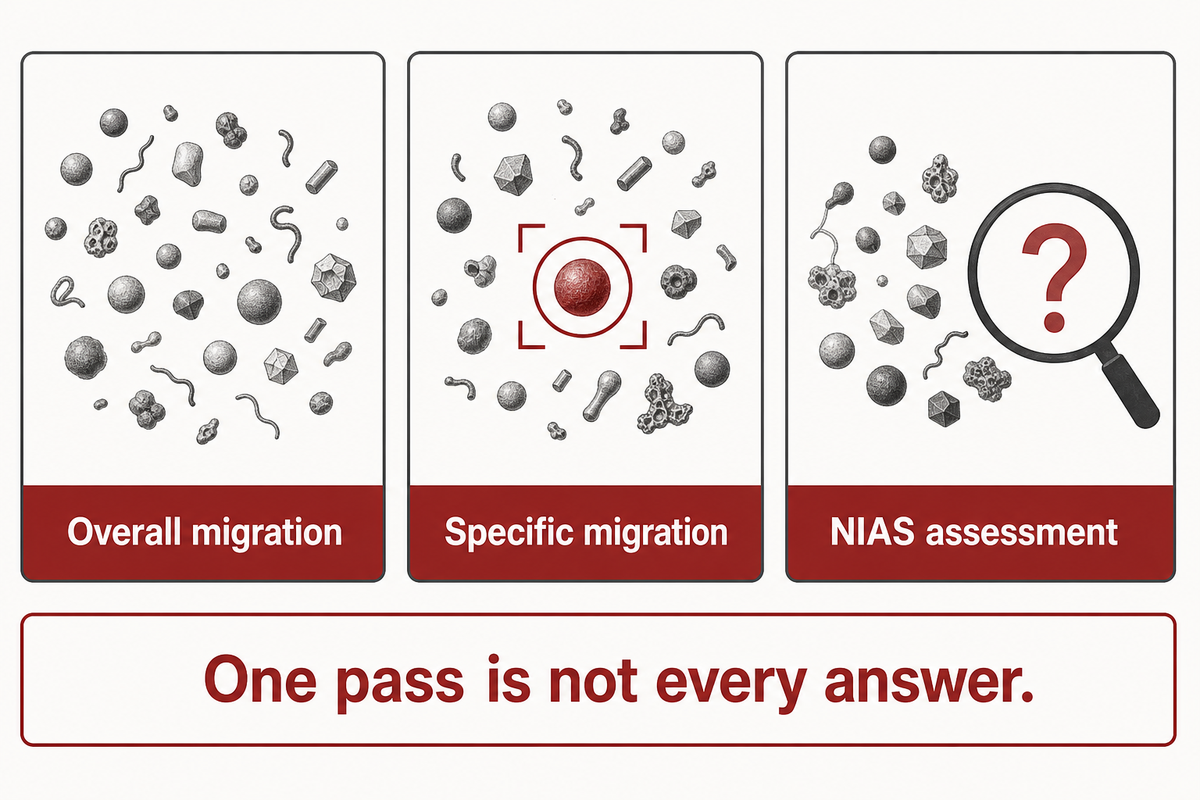
Overall migration and specific migration answer different questions. Overall migration testing measures aggregate transfer under its method; specific testing addresses named substances. Neither automatically replaces an assessment of non-intentionally added substances, known as NIAS. Establish the material and legal framework before deciding which evidence demonstrates the safety of food packaging.
| Assessment | Question answered | What a pass does not establish |
|---|---|---|
| Overall migration | How much nonvolatile material is released under the applicable method? | Compliance with every substance-specific restriction |
| Specific migration tests | Does a named substance meet its applicable migration restriction? | Absence of every unmeasured substance |
| NIAS assessment | What unintended substances and associated health risks require evaluation? | Absolute absence of unknown compounds from one screening run |
For plastic materials in EU Regulation 10/2011, Article 12 stipulates a general overall migration limit of 10 mg/dm². Its specified infant and young child food applications instead use 60 mg/kg food simulant. These are scoped legal provisions, not interchangeable units or limits for every range of materials.
Overall migration is sometimes called total migration because the test measures the total amount of nonvolatile material released. That terminology shouldn’t obfuscate the difference from specific migration limits, which are generally expressed in Article 11 in milligrams per kilogram of food. If a phthalate is relevant to the formulation, a generic overall pass can’t be substituted for assessment of its restriction. Article 19 also addresses risk assessment for relevant substances outside the listed-authorisation route.
The US and EU systems aren’t the same. The US Food and Drug Administration assesses food contact substance uses through applicable legal pathways, including relevant food additive regulations. The European Food Safety Authority has a scientific assessment role. It must not be confused with a laboratory issuing a report. For plastic packaging, consider which migration controls pertain to the specific situation.
Check food simulants, temperature and contact time
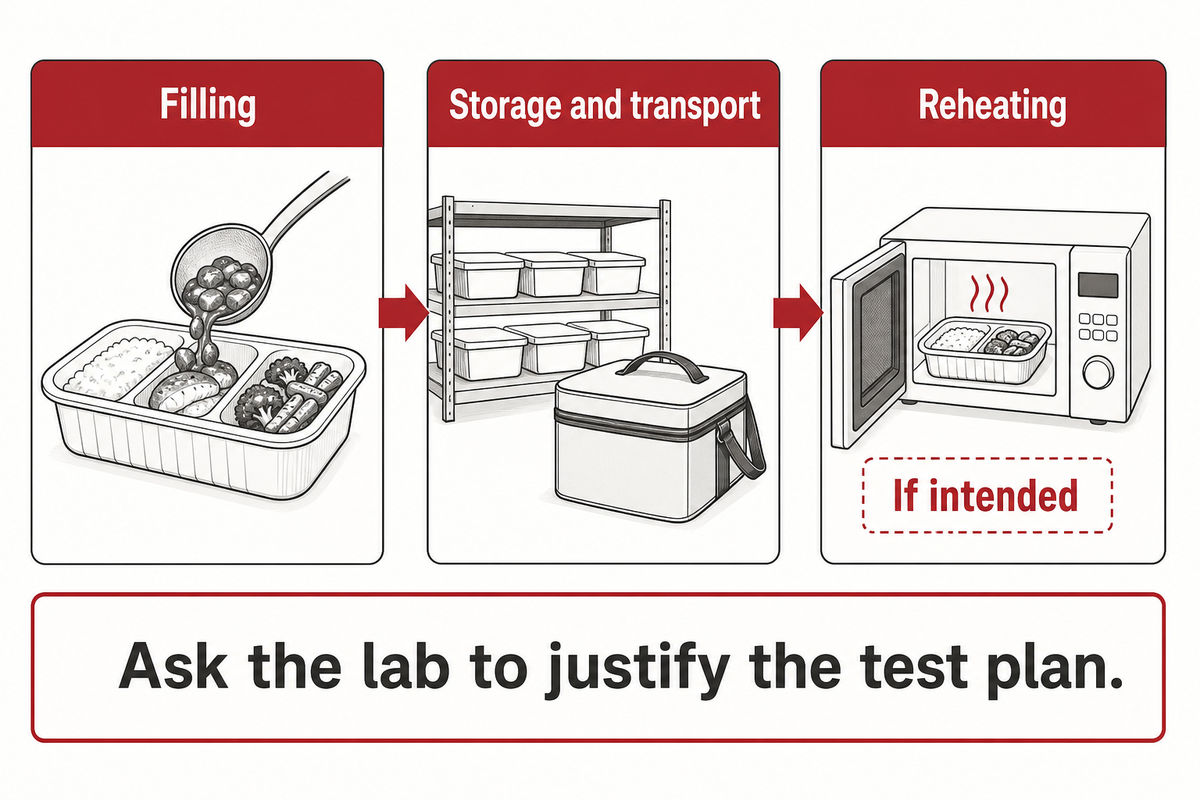
Test conditions should reflect the intended food and exposure through the relevant method, or a justified assessment. Food simulants can stand for pertinent food characteristics. A water-based test cannot automatically cover every fatty meal, and a hotter test cannot automatically compensate for a shorter contact time or a different material.
Document handling, cooling, storage, transportation and reheating separately. Different types of food and their contact conditions may change the assessment. For a meal-prep container range, confirm the intended refrigerated and reheating uses by item. For delivery kitchen packaging consider the operating conditions between filling and consumption.
Illustrative scenario: An operator proposes filling a container at 80 °C, delivering it for 45 minutes and allowing customers to reheat the meal. These are hypothetical operating conditions and not recommended test conditions. The laboratory receives the entire profile including the food’s fat, acidity and other constituents, and checks if the specimen and method cover the proposal. The purchasing team doesn’t request “80 °C for 45 minutes” as the test. If reheating was absent from the earlier brief, quality assurance asks whether the existing evidence represents that extra exposure before allowing a reheating claim. The same is true if a customer changes from a dry snack to an oily sauce.
FDA guidance and the EU regulation’s Annex V provide context-specific approaches for estimating migration from packaging into food. Tell the laboratory what is practiced and ask the laboratory to describe the food simulant, exposure and contact-area basis in the test plan. Group different food types only with an explained basis. A list of actual food products is more constructive than claiming the container is designed to handle all packaging applications.
Read migration limits, units and detection statements
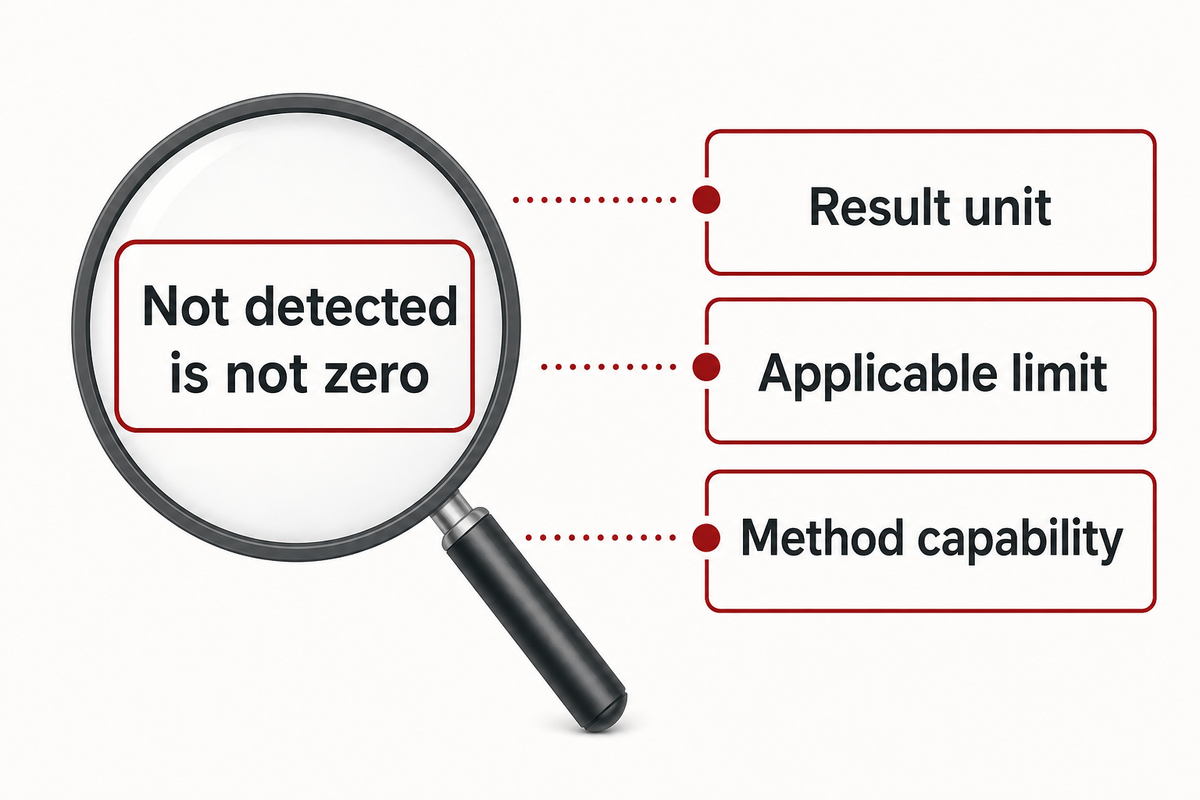
Read each result with its unit, applicable limit, and measurement capability. “Not detected” is not the number zero. A result in mg/dm² cannot be compared directly with a limit in mg/kg without the appropriate basis. Ask the laboratory to justify its conclusion when there’s no basis given for the comparison of the result to the limit.
“The limit of quantitation (LOQ) and selectivity of the methods should be indicated”
The quoted guidance also discusses detection capability, accuracy and precision. A reporting limit informs you of what the method is capable of; it isn’t necessarily the substance’s legal migration limit. For a value expressed per kg of food, check the contact ratio, and relevant conventions. Don’t assume a conversion from the container’s nominal capacity alone. For each substance that migrates, ask whether migration was reported as a measured quantity, or as a value which is below the method’s capability.
ASK for the analyte, measured value or detection statement, unit, reporting limit, test conditions and decision rule. The laboratory’s explanations of uncertainty are often very useful, especially if your result is near a limit. Request the laboratory’s stated conformity conclusion. Migration test results address chemical transfer from material to food; leak resistance and other performance testing answer separate questions.
Choose a laboratory with the right testing scope
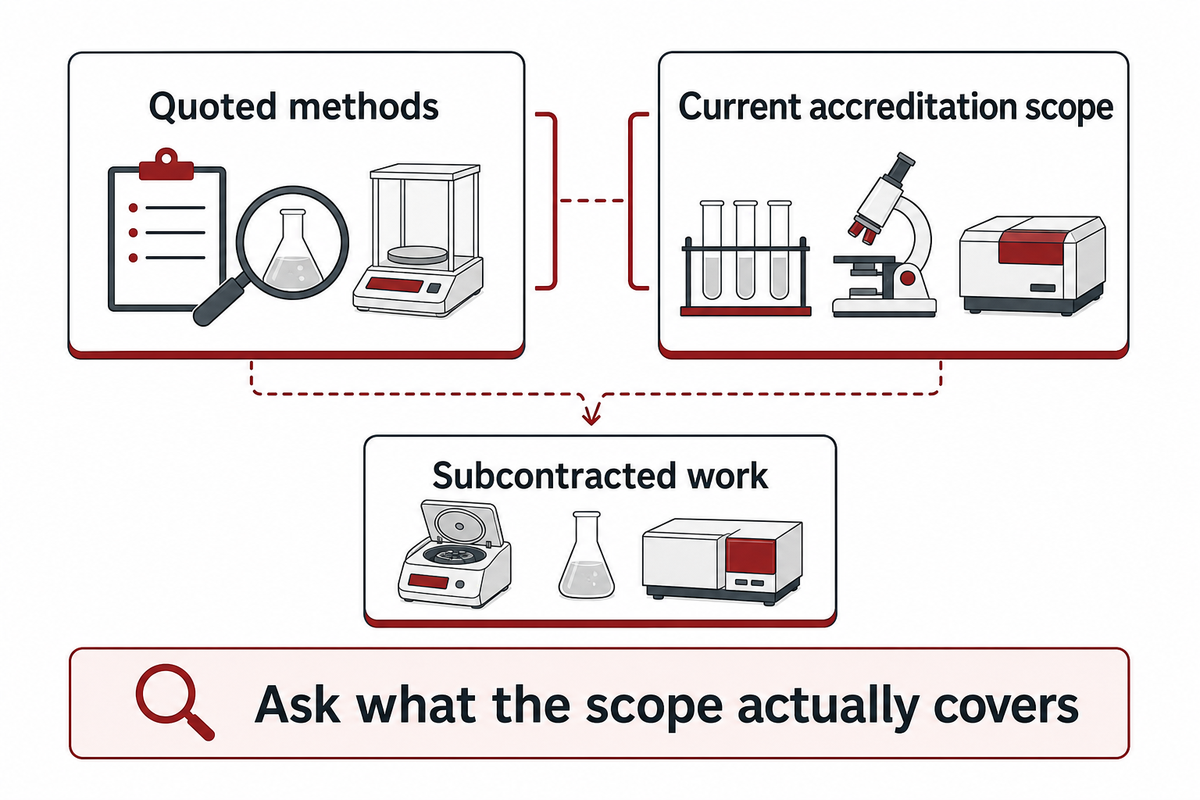
Check if the work you’re buying is included in the laboratory’s current accreditation scope. Not everything a laboratory does is assessed and accredited. Ask what methods are assessed, what work is subcontracted and what conclusions are given outside the accredited scope before accepting the quote.
According to International Laboratory Accreditation Cooperation, accreditation is an independent assessment of competence and impartiality for specified activities. An individual accredited laboratory may work under a flexible scope. That calls for an explanation, not a demand for every single temperature to appear on the certificate.
Have the laboratory map the methods used in their quotation to their accreditation scope and show their accreditation body’s public record. Quality assurance should confirm if the deliverable is analytical data, a regulatory assessment, or both. Testing is essential when it is the required means of demonstrating a restriction, but a prestigious laboratory name cannot repair an incomplete brief. Ask how the work proposed addresses your food contact regulations.
Request a quote that covers the finished package
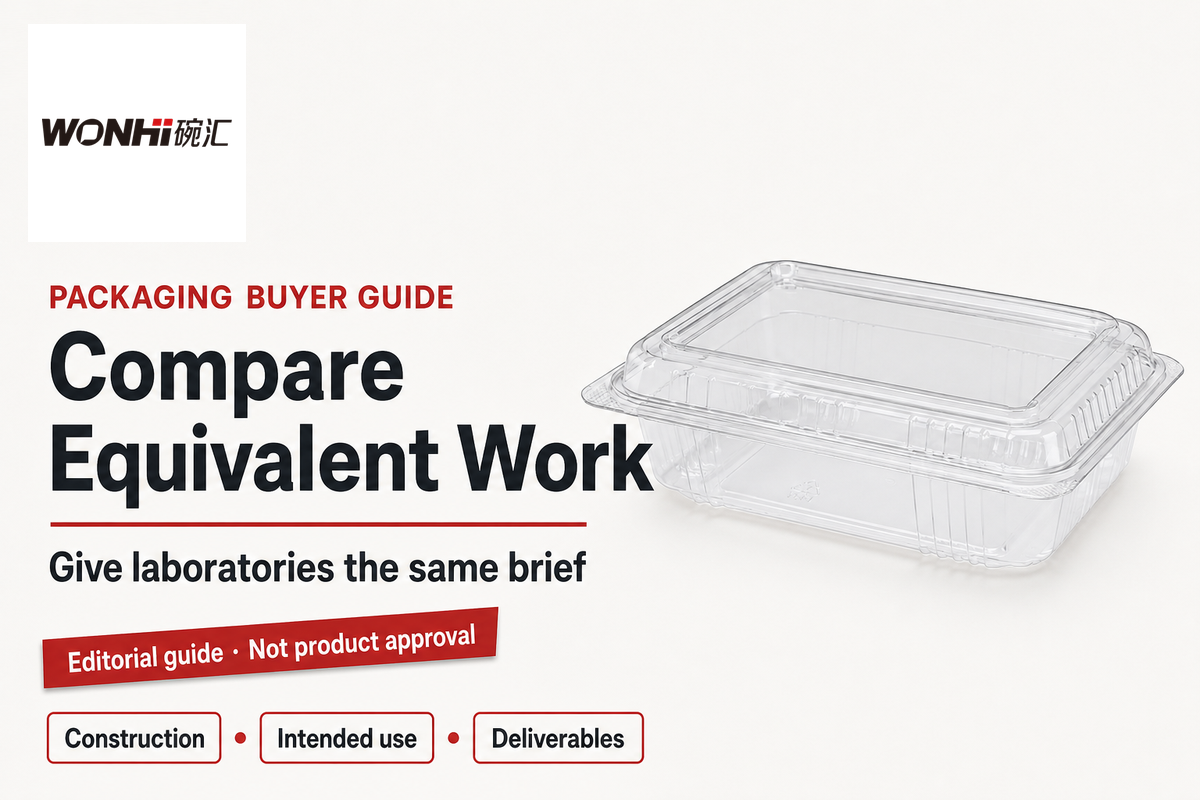
A useful quote begins with a description of the package and intended use. Provide the same briefing to laboratories to enable the identification of disparate prices to disparate work. Sample preparation, analytes, food simulants, exposure conditions, reporting and interpretation all belong in this comparison. No single online price represents every migration program.
RFQ checklist — copy these into your quote request:
| Parameter | Recommended range | Why it matters | How to verify |
|---|---|---|---|
| Finished construction | All relevant layers and components | Defines the sample to assess | Attach the versioned specification |
| Food types | Every intended category | Informs simulant selection | Supply actual menu or product examples |
| Exposure profile | Actual minimum and maximum °C; duration in minutes, hours or days | Defines intended contact | Operations signs off the use brief |
| Sales market | Every intended destination | Determines the legal questions | List requirements with the technical reviewer |
| Sample quantity and timing | Laboratory-defined for the agreed plan | Affects preparation and scheduling | Obtain written shipping instructions |
| Deliverables | Methods, results, limits and agreed interpretation | Makes quotations comparable | Check each quoted inclusion and exclusion |
Illustrative scenario: Finance receives two quotes for the same takeaway package. One quote limits the analytical panel; the other quotes an initial document review and a broader set of substances. Neither total can be considered better value until the scopes are aligned. Procurement provides both laboratories the same construction and use brief and requests methods, interpretation and exclusions in writing. Quality assurance determines evidence need. Finance compares the scopes aligned by equivalent work and price of the follow-up work. This approach doesn’t assume the higher quote is correct; it makes the comparison explainable.
When considering food container manufacturing options, ask the packaging manufacturer which documents already exist and which order specification they cover. This can avoid needlessly duplicating work and assuming that the existing migration test reports are adequate.
Decide what changes need fresh evidence
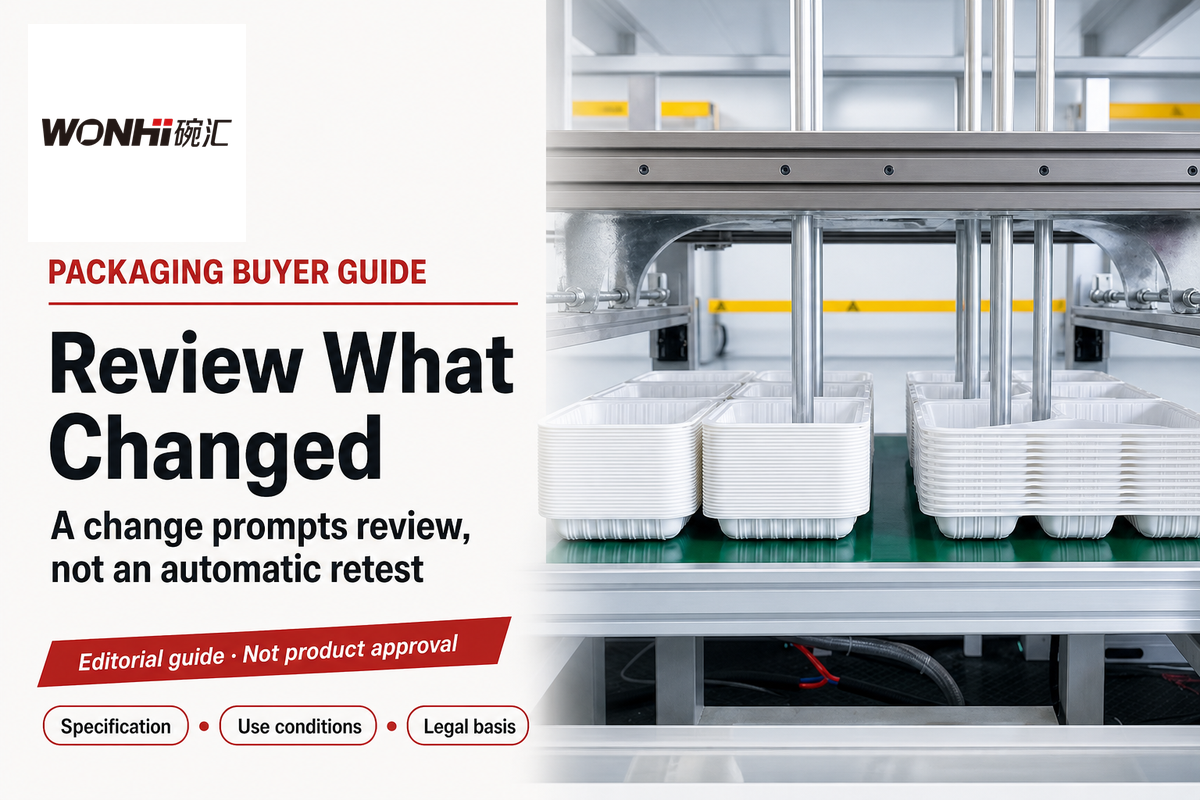
Consider the effect changes may have on the evidence before automatically ordering another test. Composition, processing, contact conditions and the markets to which the product is eventually delivered can impact the assessment. Reordering an unchanged product and ordering a new ink system are different decisions. Record the name of the person who assessed the change, the justification for accepting, extending or replacing the evidence.
Scope Change Log
Definition: Record each change in specification or use and the possible impact on evidence, the name of the person who assessed the change and the decision to purchase.
| Change | Evidence question | Owner | Purchasing disposition |
|---|---|---|---|
| Unchanged reorder | Do specification, use and legal basis still match? | Quality assurance | Record acceptance when coverage is confirmed |
| New resin source | Are composition and authorisation still represented? | Supplier and technical reviewer | Obtain updated support before approval |
| Different pigment or additive | Are relevant substances and levels covered? | Supplier | Request the formulation assessment |
| New printing ink | Could transfer or set-off change? | Converter and laboratory | Review the finished construction |
| Changed coating or adhesive | Does the earlier assessment include it? | Technical reviewer | Define any additional evidence |
| Different lid | Are its material and exposure represented? | Procurement and quality assurance | Match the lid specification |
| Hotter or longer contact | Does the previous use envelope cover it? | Operations and laboratory | Resolve the expanded use first |
| New fatty or acidic food | Is the simulant selection still justified? | Laboratory | Review conditions before acceptance |
| New market or legal change | Are the relevant restrictions addressed? | Regulatory reviewer and finance | Scope and fund any additional work |
EU Regulation 10/2011 ties renewal of the declaration of compliance to specified substantial changes affecting migration or new scientific data. The EU good manufacturing practice regulation also addresses supporting documentation and printing-ink transfer, including set-off during stacking or winding. A non-food side print isn’t always irrelevant.
When not to order another identical test
A frequent purchasing mistake is to repeat the last test without identifying the unresolved question. If the unresolved issue is an unidentified specimen, a test on an unidentified specimen repeats the gap. If the use has changed, repeating the same contact conditions doesn’t necessarily cover the changed use. If a missing item is a US authorization, an extra EU overall migration test doesn’t provide it. Ask the responsible reviewer to name the missing evidence and the impact.
Don’t let cost pressure reverse that logic. Existing results may support a justified assessment, but “we tested something similar” isn’t a written rationale. Outline the connection between materials used and the production version, and intended contact. Once that connection is documented, decide on the appropriateness of a document revision, calculation, targeted analysis, or broader program. Document the decision, prior to issuing a laboratory purchase order. The intention is to purchase evidence that answers the open question, as opposed to purchasing a new date on the existing incomplete and inconsistent package of evidence.
Do
Ask which change affects the evidence and obtain a documented technical decision.
Don’t
Invent a universal annual expiry or assume every change requires the same test panel.
Industry outlook: what is changing in food contact compliance
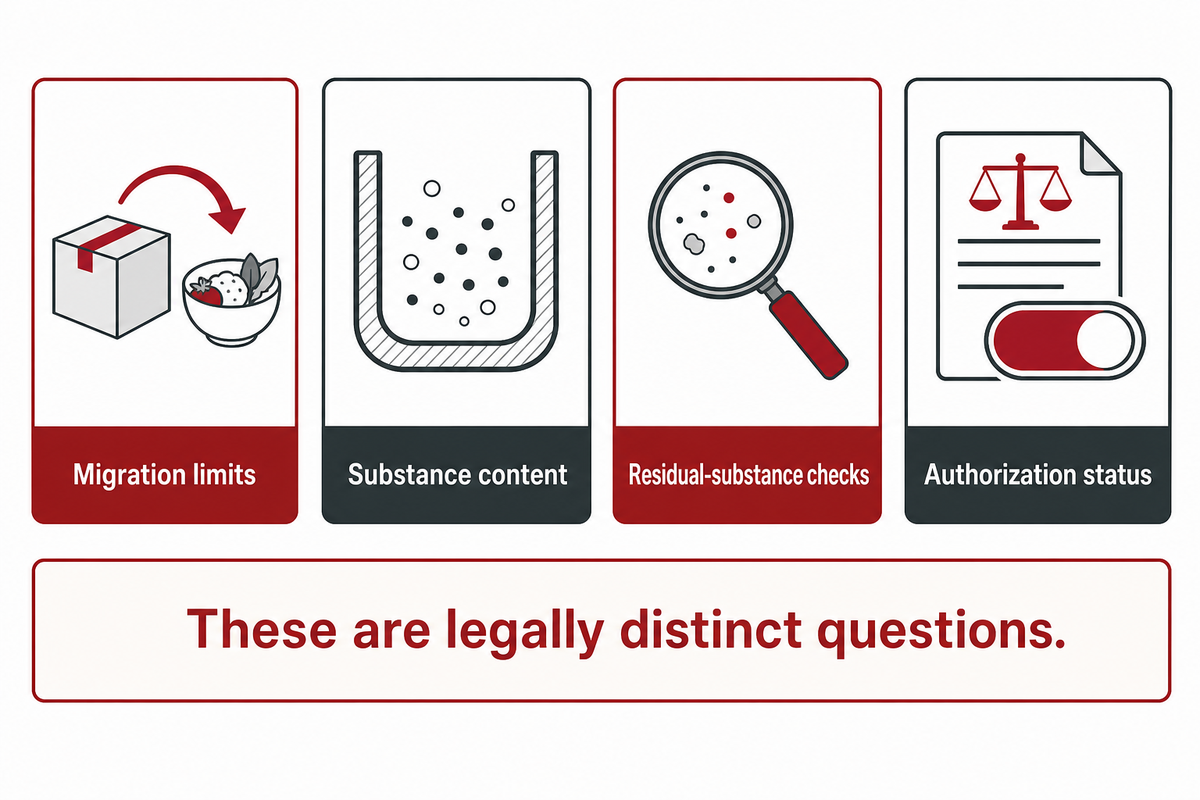
Current review must differentiate between migration limits, restrictions on substance content, residual-substance checks and whether an authorization is still effective. These are legally distinct questions. A migration pass might answer only one of them. As of October 2026, there are a number of changes within the EU and the US that are relevant to making a packaging purchasing decision.
Regulation 2025/351 has amended the EU plastic food-contact requirements and includes transitional provisions. Its Article 4 allows certain articles complying with the earlier rules and first placed on the market before 16 September 2026 to remain on the market until the stock is exhausted. That provision does not mean all older reports expired on that date. Establish which applies to the product.
For food contact packaging, Regulation 2025/40, Article 5, imposes specified PFAS content restrictions from 12 August 2026. Restrictions on content in packaging and migration into food are to be assessed separately. Elsewhere, Regulation 2026/250 stipulates extraction methods for verification of the absence of certain residual bisphenols in accordance with the provision it amends. A migration result should not be presented as an interchangeable residual-content result.
In the United States, FDA announced that authorisations for 35 specified PFAS-related food contact notifications for grease-proofing paper and paperboard would cease to be effective on 6 January 2025. This was a defined set of authorisations, not a statement about every PFAS use or every container.
Ask the supplier’s technical reviewer to state the current legal basis and any applicable transition. This is especially useful when old templates are reused for recycled material, coatings or a new destination market. For plastic products and other food contact articles, retain the applicable version with the purchase record. Packaging regulations and food safety standards should be assessed within their actual scope. The examples provided aren’t a complete chemical compliance review or assessment about Wanhui Products.
Frequently asked questions about migration testing
The other questions are typically about legal scope and cost, and how to proceed when there isn’t enough evidence. The answers to these questions can assist you when completing the brief you send your supplier or laboratory. Final acceptance should be based on the applicable requirements for your article, food and destination market, rather than a “pass/fail” determination based on an internet forum.
Is food packaging migration testing required in USA?
It depends on the applicable legal basis and what evidence is needed for the intended use.
A United States buyer should ask which FDA regulation, effective notification or other permitted basis supports the package, then check the relevant restrictions. Some uses require particular supporting data; others may be supported through existing evidence. An EU migration pass alone does not answer those questions or establish FDA approval of the finished container. Check the relevant provisions of the Code of Federal Regulations or other cited basis with the responsible reviewer.
Does anybody know the costs involved migration testing?
Ask for a scope-specific laboratory quotation; there is no useful universal price.
Tell the laboratory the target market, full material structure, food types and contact conditions. Compare the included analytes, sample preparation, reporting limits and interpretation before comparing totals. Sample quantities, turnaround and any follow-up assessment should be agreed before shipment. If one quotation excludes a requested part of the assessment, identify that difference explicitly so finance can compare equivalent work.
Migration tests: which materials are involved?
The assessment concerns relevant components of the finished article, with material-specific rules.
The substrate, coatings, inks, adhesives and closures may all need consideration if they can contribute substances under intended use. Plastic-specific requirements shouldn’t be copied across every paper, fiber or metal article. Ask which finished components the evidence represents and which requirements the laboratory has applied. Materials intended to come into contact with food must comply with the applicable rules for that material and use.
Why food packaging migration testing failed?
Identify the failed criterion and investigate its cause before changing the test.
Ask the laboratory to explain the result, uncertainty and specimen conditions. Review the material or process with the supplier. A different method or exposure must still be justified for the intended use; it shouldn’t be selected merely to produce a pass.
How often should a packaging migration report be reviewed?
Review according to applicable requirements and relevant changes, not an invented universal expiry.
Check the market, customer and quality-system requirements, then confirm that the article and intended use remain represented. A new resin source, ink, lid or exposure warrants a different review from an unchanged reorder. A report date alone neither proves that the evidence remains sufficient nor proves that the whole test program must be repeated.
Keep a versioned record of the material specification and the uses covered by the supporting evidence. When either changes, ask the supplier and laboratory what the earlier results still support. Record why existing evidence is accepted and what further work, if any, is needed. Also check whether the relevant authorisation or declaration requires updating. A documented review can explain why no new test was commissioned, or why a targeted addition was chosen instead of repeating the entire program. Assign that decision to a responsible technical reviewer.
Key takeaway
Match all four dimensions of the evidence: sample, food, exposure and market. Resolve a missing match before accepting a migration pass for your order.
Got a Wanhui order? (Send the package and use specification) including the food, contact profile, destination, and requested construction. Request documentation that meets that specification and describe any other laboratory assessment prior to approving production.
References & Sources
- Determining the Regulatory Status of Components of a Food Contact Material U.S. Food and Drug Administration
- Guidance for Industry: Preparation of Premarket Submissions for Food Contact Substances (Chemistry Recommendations) U.S. Food and Drug Administration
- Commission Regulation (EU) No 10/2011, consolidated text European Union
- About ILAC International Laboratory Accreditation Cooperation
- Commission Regulation (EC) No 2023/2006, consolidated text European Union
- Commission Regulation (EU) 2025/351 European Union
- Regulation (EU) 2025/40 on packaging and packaging waste European Union
- Commission Regulation (EU) 2026/250 European Union
- FDA Determines Authorization for 35 Food Contact Notifications Related to PFAS are No Longer Effective U.S. Food and Drug Administration