Get in touch with Wanhui Company


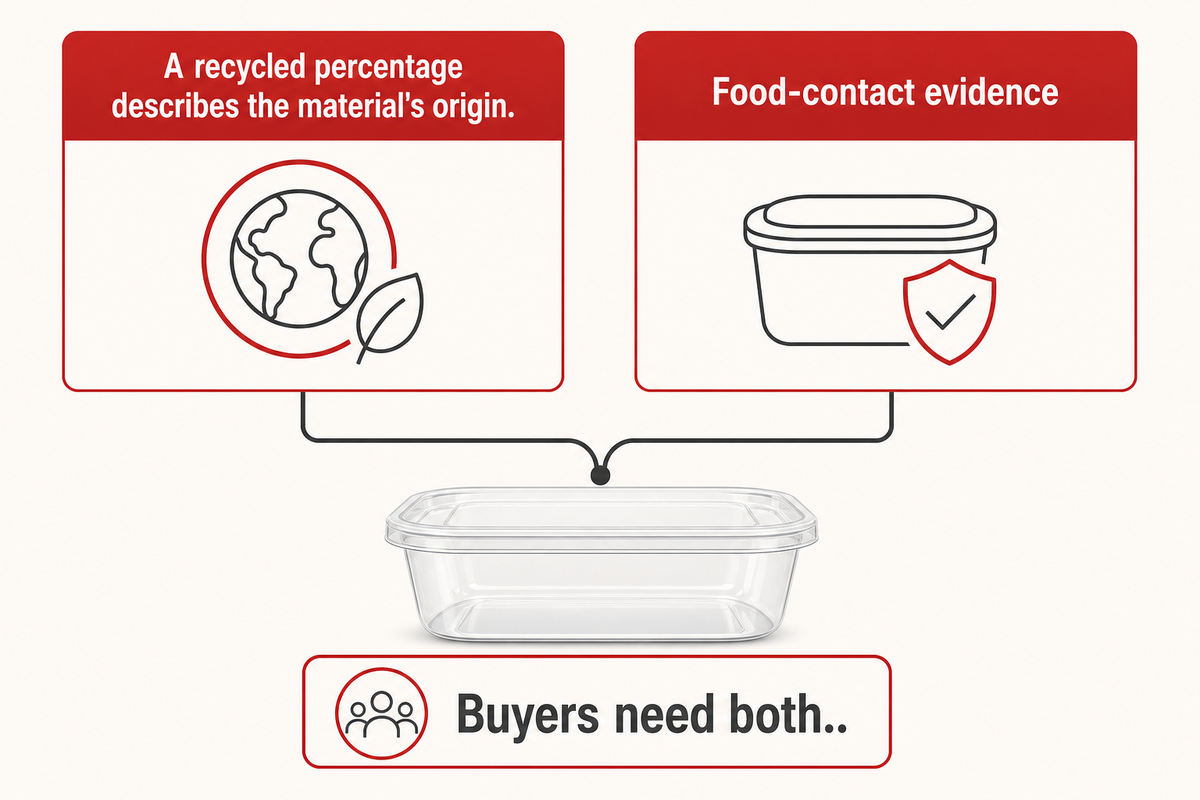
PET vs rPET is a comparison of material sourcing and packaging suitability. PET means polyethylene terephthalate; rPET stands for recycled polyethylene terephthalate. A recycled percentage describes the material’s origin. Food-contact evidence addresses whether a given process and finished pack are suitable for the proposed food, temperature and contact time. Buyers need both.
For a clear salad bowl, deli container or chilled meal tray, the useful question is specific: does this product meet the agreed recycled content claim and the actual filling, storage and serving conditions? Two containers can look the same, but differ in sourcing and compliance.
This guide separates the material comparison from the document trail and covers component weights, application changes and cost per accepted pack. Regulatory references were checked in October 2026; the United States and European Union have different requirements.
Quick comparison
Virgin PET uses virgin feedstock. rPET uses recovered PET through a defined recycling route. Neither label alone establishes a finished container’s heat resistance, food-contact scope or local recyclability. A tray’s percentage can also differ from the percentage of a tray-and-lid set.
Differences between PET and rPET food packaging
The significant difference between PET and rPET is the source history of the material rather than a new polymer name. Packaging selection still depends on grade, construction and intended use. When assessing virgin or recycled source material, consider crystallinity, layers and additives, and the complete container and closure system.
What’s the difference between PET and rPET?
PET is the polymer polyethylene terephthalate and rPET is recycled PET, a resin made from recovered material. A pack simply described as PET may contain virgin material, recycled material or a combination of both. The letters rPET don’t define the recycled percentage, the recovery source, recycling process, or authorize contact with food.
Virgin PET production begins with a chemical feedstock, and includes terephthalic acid and ethylene glycol. Mechanical recycling makes prepared PET available for further use. Other recycling technologies decompose the material and rebuild polymer. Recycling routes differ from virgin PET production, and sourcing is the starting point for describing these routes.
A used PET bottle is input to another product following suitable collection, sorting and processing. Plastic bottle recycling is applicable to bottles and food packaging, but each application requires supporting evidence. This doesn’t mean that every flake or every bottle of used plastic or batch of recycled material is suitable for food packaging. Sourcing control and the evaluated recycling route remain part of the decision.
One of the key differences between PET grades is their specified application. PET resin for one process doesn’t necessarily establish a substitute for virgin material in the other process. The quality of rPET also requires a defined acceptance basis, meaning rPET quality doesn’t automatically mean that a value has been established for purity and appearance and that it meets the requirements of the function of the package. A proposed use of plastic should also identify the grade and article, instead of relying on general statements that make rPET suitable for everything.
Two-Evidence Material Approval Path
Match the recycled-content claim and the food-contact evidence separately, then bring them together for the specific product and intended use.
The following classification is a guide for purchasers. Rows overlap: a food contact article can contain mechanically recycled post-consumer PET. Each row presents a different question.
| Material or construction description | What the description tells you | What still needs matching |
|---|---|---|
| Virgin PET | Virgin material source | Grade, additives and finished-pack intended use |
| Mechanically recycled bottle-derived PET | A stated recovery source and processing route | Input controls, decontamination scope and actual grade |
| Mechanically recycled tray-derived PET | Recovered tray input is claimed | Assessed input stream, process and output application |
| Virgin PET/rPET blend | Both sources may contribute material | Eligible recycled mass and finished-product denominator |
| Virgin-skin/recycled-core sheet | Layers have different compositions | Layer weights, core percentage and whole-tray calculation |
| Pre-consumer recovered PET | Recovery occurred before consumer use | Waste-stream diversion and claim eligibility; normal process scrap is different |
| Tertiary-recycled PCR-PET | A specific chemical recycling route is asserted | Route identity and applicable requirements; FDA’s narrow letter exception |
| Colored or modified PET grade | Appearance or formulation differs | Additives, visual acceptance and local recovery compatibility |
| Tray with separate lid or sealing film | The sale includes multiple components | Each component’s material, recycled claim and food-contact role |
This prevents specifications from becoming ambiguous, such as in the case of a request to quote “food-grade recycled PET.” The quality assurance team can evaluate the appropriate specification; operations can review the pack they’ll fill and close. Neither should be required to make assumptions about what the name of the material guarantees.
Recycled content: verify the percentage and its denominator
A percentage of recycled content requires an eligible numerator, a defined denominator and an accounting method. For physically blended packaging, calculate qualifying recycled material mass divided by the mass of the finished product. Maintain a clear distinction among the core layer, a whole tray, and a tray with lid, even when all refer to the same order.
Start with material that qualifies for the claim
A “pre-consumer” recovery states that the material was originally diverted from the waste stream during the production process. The US Federal Trade Commission’s recycled-content marketing guidance, section 260.13(b), states that pre-consumer material would need to be substantiated to be diverted from the waste stream. Example 1, of the recycled-content marketing guidance, states that normal original-process spills and scraps that the industry reuses within that process wouldn’t qualify for a recycled-content claim.
This is relevant when a sheet supplier reports recovery of edge trim. An account showing material was returned to production doesn’t, in and of itself, resolve whether that material supports the environmental claim in question. The guidance deals with marketing claims; it’s a separate question whether the material supports the food contact claim. Recovery after consumer use is described by postconsumer PET; substantiation of the claim still is required.
SCS Global Services’ certification program describes both direct controlled blending and mass-balance allocation. Its general percentage calculation uses the mass of recycled material divided by the mass of the finished product. A physically blended amount and an allocated amount must be clearly identified; eligibility thresholds for a certification scheme don’t represent the actual recycled content of a product.
Calculate the tray and lid separately
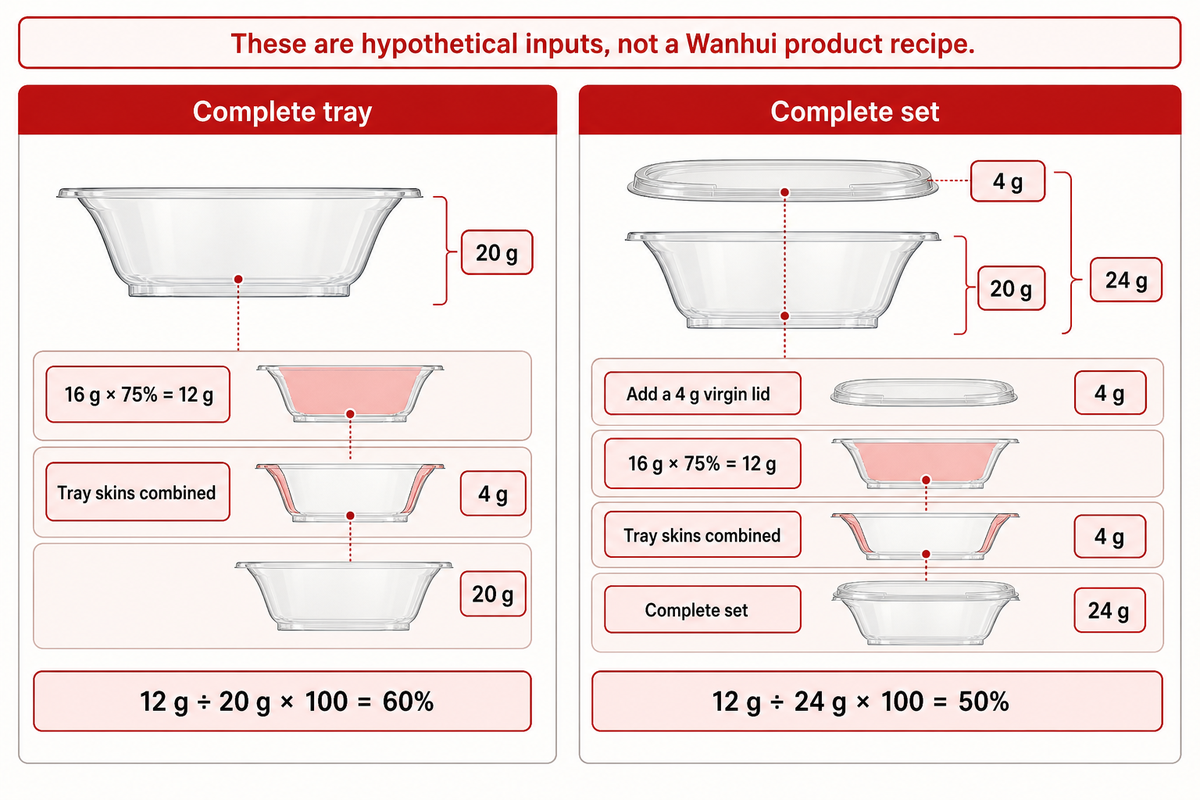
Example: Assume a 20 g tray has a 16 g core containing 75% qualifying recycled PET and 4 g of virgin skins. The core contributes 16 g × 75% = 12 g of recycled material. The tray therefore contains 12 g ÷ 20 g × 100 = 60% recycled content by mass. Add a 4 g virgin lid, and the complete 24 g set contains 12 g ÷ 24 g × 100 = 50%. These are hypothetical inputs, not a Wanhui product recipe. Procurement can order a 60% tray while marketing describes a 50% complete set, provided both claims use the correct scope and substantiation. Calling the entire set “75% recycled” would carry the core percentage into the wrong denominator.
| Component | Total mass | Recycled fraction within component | Recycled mass |
|---|---|---|---|
| Tray core | 16 g | 75% | 12 g |
| Tray skins combined | 4 g | 0% | 0 g |
| Complete tray | 20 g | 60% | 12 g |
| Separate lid | 4 g | 0% | 0 g |
| Complete set | 24 g | 50% | 12 g |
A published case study justifies the distinction. Packaging Europe reported a Tesco, Hilton Foods and Kp minced-beef packaging pilot that included a 100% recovered rPET tray, along with barrier lidding film, containing 30% post-consumer recycled content. The component claims don’t establish a percentage for the combined pack without their respective weights.
When a claim is allocated, the scheme’s calculation and chain of custody should be retained, and this physical mass worksheet shouldn’t be used to prove allocation. A unit of sale could be relevant. A bowl-only purchase and a bowl-plus-lid purchase of content in plastic packaging would create a different product boundary.
A hypothetical 20 g tray contains 60% recycled material, while a 24 g tray-and-lid set contains 50%. The set percentage depends on component masses and recycled fractions; a change of lid weight or source can affect the set percent even if the tray recipe stays the same.
Describing a bowl as made of recycled PET doesn’t define its percentage. The amount of PET recovered for the claimed product should be bound to the same product boundary. Use of recycled content in plastic products should be documented through material records and claim wording should state the percent.
US food-contact evidence: match the process to the use
The US food-contact evaluation of recycled plastic is use- and process-specific. FDA describes case-by-case informal advice about whether a recycling process can produce plastic of suitable purity. The advice needs to be read with its source and use controls, and it does not mean that every finished rPET container is considered food-contact.
Is 100% recycled PET safe?
A 100% recycled PET claim doesn’t show food safety. Food safety and contact suitability depend on multiple things including the recycling route, purity and intended use of the material. A high recycled percentage material can be considered suitable, but the percentage doesn’t replace the evidence required.
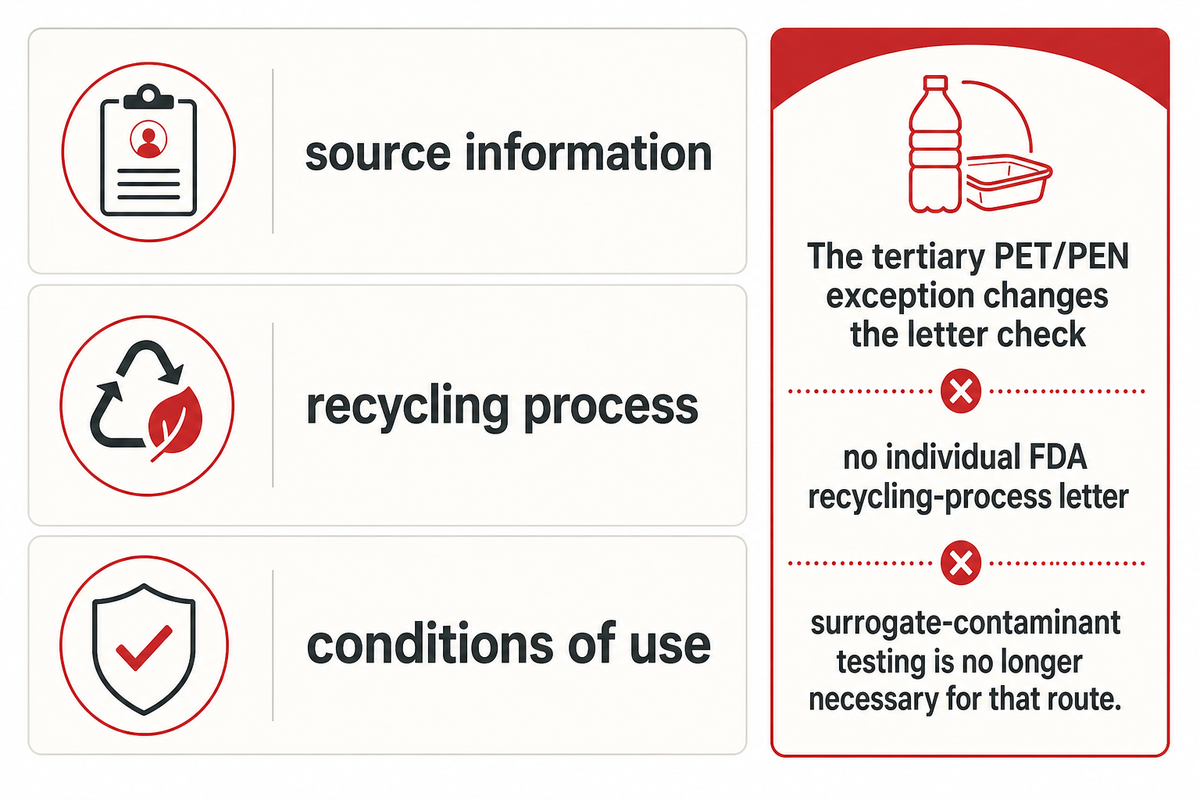
FDA’s recycled-plastics guidance page states they need source information, an explanation of the recycling process, evidence of contaminant removal, and proposed conditions of use. Conditions of use include the type of food, the temperature and duration of contact, and whether the use is single or repeated. Read a process opinion within the limitations of these conditions.
“FDA considers each proposed use of recycled plastic on a case-by-case basis”
The tertiary PET/PEN exception changes the letter check
The same FDA page states that the agency no longer evaluates tertiary recycling processes for PCR-PET or PCR-PEN, or issues individual opinion letters for those processes, because it has determined those processes produce material of suitable purity. It also says surrogate-contaminant testing is no longer necessary for that route.
Consequently, “no individual FDA recycling-process letter” is not a sound universal rejection rule. The exception is specific to the tertiary PET/PEN route described by FDA. It does not make PET and PEN interchangeable, establish a supplier’s recycling method or remove other applicable requirements for the finished material and its use.
FDA’s chemistry considerations guidance also has defined limits. It addresses potential chemical contamination from recycling; structural integrity and microbial contamination are out of scope for this guidance. Therefore, a chemistry document will not address whether a lid is kept closed throughout the distribution.
Separate a use category from a container rating
The official FDA food-types and conditions-of-use tables distinguish refrigerated storage without heating, frozen storage without heating and ready-prepared foods reheated in their container. The tables also distinguish hot-fill categories above and below 150°F. That threshold classifies uses; it is not a published heat-resistance rating for any particular PET tray.
For cold-filled salads, a document limited to the cold-use conditions may be adequate to support that application. Adding customer instructions to heat the bowl changes the proposed use. A purchaser can’t extend a refrigerated-use statement to reheating merely because the supplier offers the same container size.
Finished pack evidence and route specific evidence address different questions. FDA’s 150°F hot-fill split is a use classification, while a specific container’s operating limit needs product evidence. Record food, contact time, storage conditions and serving instructions together to support recognition of the proposed use.
EU food-contact evidence: check the regulatory chain
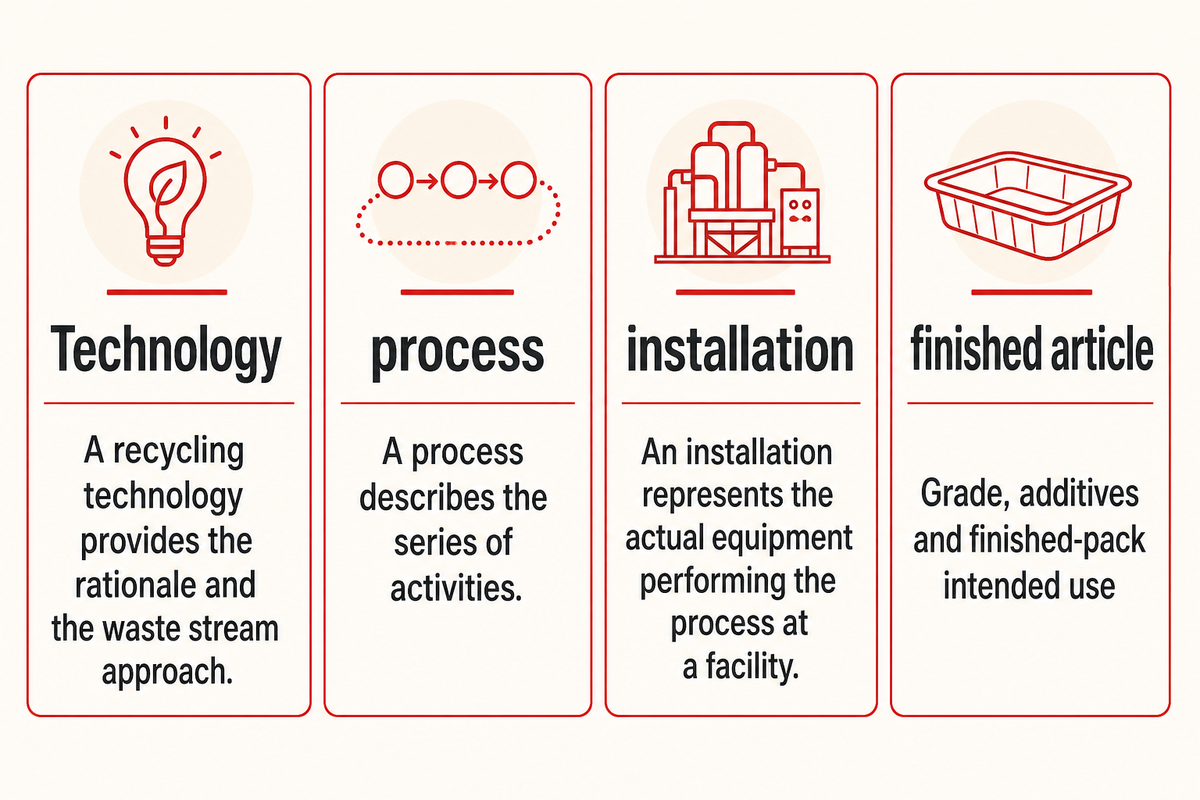
The EU assessment integrates the general requirements for food contact of plastic with the requirements of recycled plastic and recycling, as well as different levels of technology, process and installations. A register entry, the EFSA scientific assessment, and the authorization of the Commission have different roles; none should be replaced with the others because the supplier names rPET.
The European Commission’s recycled plastics explanation describes Regulation (EU) No 10/2011 and (EU) 2022/1616. The composition, applicable migration limits and risk assessment remain pertinent. Recycling adds contamination and decontamination measures which can’t be resolved with the PET polymer name.
Technology, process, installation and finished article
A recycling technology provides the rationale and the waste stream approach. A process describes the series of activities. An installation represents the actual equipment performing the process at a facility. The fact that mechanical PET recycling is a suitable technology, doesn’t prove that an unnamed facility, or every output grade, falls within the required scope.
The Commission differentiates operator, facility, installation and authorization identifiers, i.e. RON, RFN, RIN and RAN. These identifiers should retain their meanings. An identifier related to an upstream recycler shouldn’t be equivalent to evidence naming a downstream converter’s finished tray and its formulation, including its intended food contact status.
The assessed input matters too
EFSA’s 2024 guidance on post-consumer mechanical PET recycling, section 5.1.1.3, provides information on pre-processed input specification. It specifies a maximum 5% of non-food contact PET input under that technology, and requests information on dimensions of flakes, other polymers, adhesive and other relevant impurities. The characteristics of the input material must be covered by the challenge test.
According to the same guidance’s Table 1, the final products and articles resulting from the described mechanical recycling technology aren’t to be used in microwave and conventional ovens; other process-related output specifications may apply. This restriction belongs to the scope of the concerned technology. It should neither be hidden behind the label ‘food-grade rPET’ nor be a vague statement about other recycling technologies.
This connects sourcing to the production order: a process evaluation relies on both the input and operating boundaries, not just the existence of clean looking rPET flakes. A switch in recovery source may trigger an applicability assessment, even if the delivered resin is still within the general description of polymer.
Read the 2025 amendment’s transition precisely
Regulation (EU) 2025/351, Article 4, allows plastic materials and articles, complying with pre-amendment rules and first placed on the market before 16 September 2026, to remain on the market until the stocks are exhausted. It defines a transition of a certain stock, rather than a permanent authorization to manufacture non-compliant finished articles.
Article 4(2) concerns certain intermediate products and substances that comply with the pre-amendment version of Regulation (EU) No 10/2011 and don’t meet the amended requirements and are first placed on the market after 16 December 2025. The declaration concerned must state that the substance or product does not comply with this Regulation and can only be used to manufacture plastic materials and articles to be placed on the market before 16 September 2026. Therefore, it’s necessary to carry out a separate check on both the intermediate and finished products.
An EU order file should link the assessed input and route to the installation and the finished article. The 5 % non-food input restriction (stated above) is specifically for the mechanical recycling technology, and isn’t a maximum recycled content restriction for a tray. Bear that difference in mind when evaluating a supplier percentage claim versus that in regulatory documentation.
Application checks before a PET-to-rPET substitution
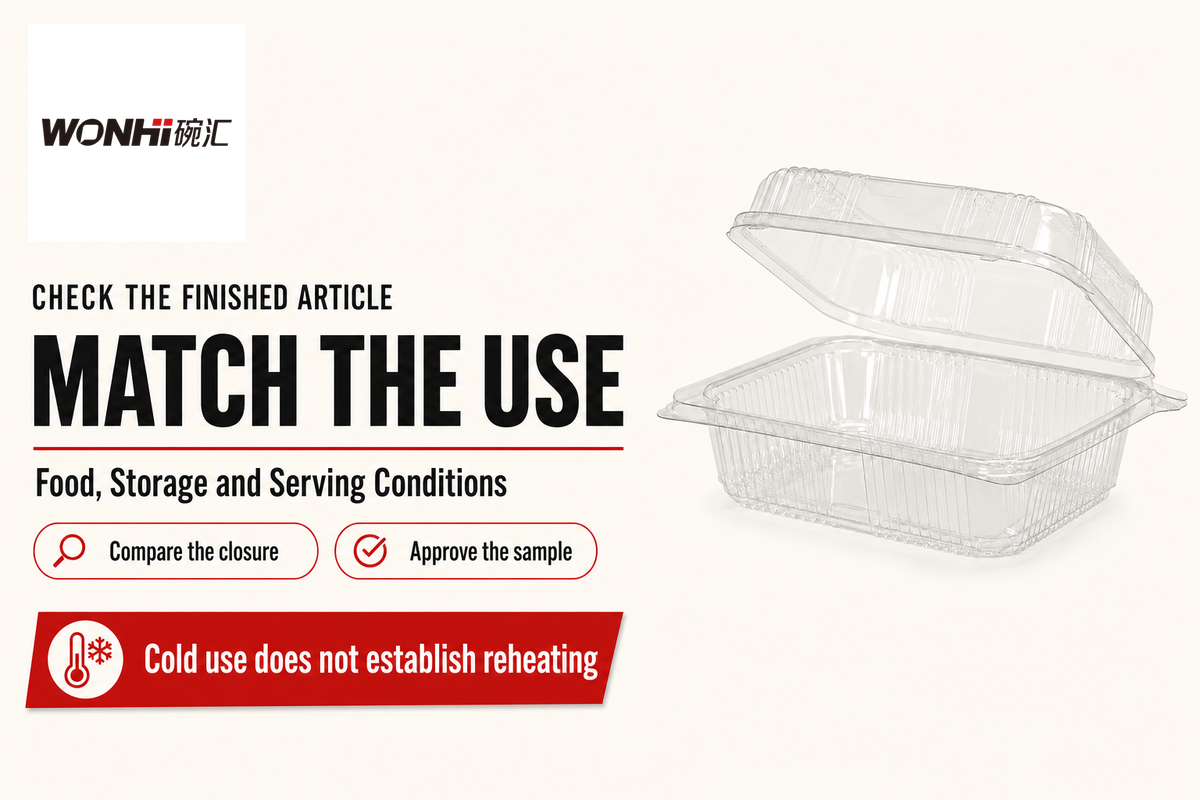
A switch from PET to rPET should preserve the agreed-upon package function and remain within the applicable food contact evidence. Compare the actual trays, lids and films under the intended filling, storage and service conditions. Appearance and percentage of material can’t establish sealing performance and distribution resistance or justify a change in a heat treatment.
Is recycled PET as strong as virgin PET?
There’s no single strength ranking for all recycled PET and virgin PET containers. Consider the grade, processing history, and the distribution of the wall thickness and geometry. Evaluate the finished article against the acceptability criteria agreed to by the parties rather than treating a recycled percentage as a mechanical strength specification.
The Association of Plastic Recyclers’ PET-A-01 protocol separates bottles, sheets, strapping and fiber pathways. Its procedure for rPET-to-sheet is a comparative recycling evaluation. It isn’t a finished food tray acceptance standard or food contact authorization, and its strapping parameters shouldn’t be specified as food tray specifications.
Comparison of the performance of recycled PET with an existing pack requires the same functional acceptance criteria. Properly processed rPET still needs an application match. A description such as high-quality rPET is of use only if the agreed specification states what quality means for the article supplied.
Cold storage and reheating are different scenarios
For example, a food service buyer wishes to replace a clear cold filled salad bowl with a similar bowl containing recycled PET. The proposed bowl may fit the filling line and close with the existing lid. The sales team then adds a “reheat in bowl” instruction for a new meal range. This changes the intended use, even if the volume and appearance stay the same. Quality review now has a heating condition to address; a cold storage document can’t establish this extension. For the EU post-consumer mechanical PET recycling route described above, the exclusion of microwave and conventional oven use is directly applicable. The choice is either to retain a cold use instruction or to use a separate supported material and packaging for the heated use.
A representative sample of the product provides the basis to evaluate dimensions, closure condition, leakage potential, acceptance criteria for handling, stacking and appearance. The acceptance plan must be based upon the actual product and distribution system. Not every drop height, dwell time or temperature range is applicable to every PET container.
If the evidence supports equivalence of material, construction and use boundaries, an equivalence review can identify what carries over and what has changed. If, during the review, a relevant gap is identified and additional evidence is needed, additional targeted testing is appropriate. It isn’t necessarily the case that every change requires a new laboratory program.
For format scoping, Wanhui’s published PET bowl sizes in the meal-prep range include a 300–1,750 ml family with 120, 150 and 180 mm calibers. Its clear PET hinged containers illustrate a different closure format. Those product-family details help define a sample request; the quotation must identify the particular material and use specification.
Even with PET, a 150 mm bowl and a 180 mm bowl are different purchase specifications based on caliber, lid pairing and intended food-contact conditions. A successful closure check evaluates a physical characteristic and doesn’t extend the pack’s documented heating scope.
Quote comparison: cost per 1,000 accepted packs
Compare PET packaging quotes on the same complete-pack specification and cost boundary, then normalize by accepted usable packs. Prices per shipped unit can vary, and a lower unit price may not indicate a better price, e.g. if lids, freight or rejects differ. This method uses order-specific values, and doesn’t assume that rPET is always cheaper or more expensive than virgin PET.
The American Society for Quality’s cost-of-quality framework distinguishes prevention and appraisal costs from internal and external failure costs. Inspection and scrap costs associated with the purchase of packaging may alter the comparison. The ASQ provides the cost categories, and doesn’t provide a price equation or implied reject equation for PET.
Align acceptance definition, delivery basis, printing and lid inclusion with container weight and order quantity. Then use the following formula: Cost per 1,000 accepted packs = comparable batch cost / accepted packs count × 1,000. Relevant additional costs should be included once; don’t charge rejected material a second time if its purchase cost is contained in the batch cost.
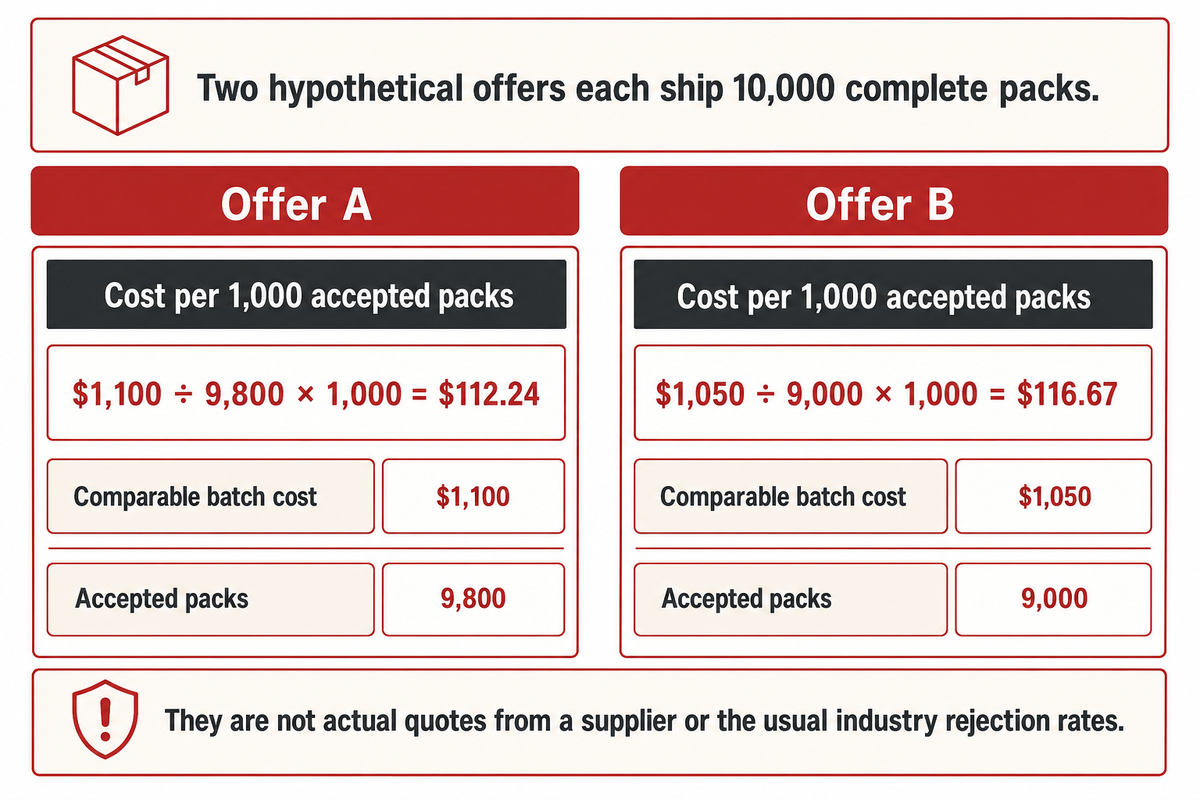
Example: Two hypothetical offers each ship 10,000 complete packs. Offer A has a comparable total batch cost of $1,100 and 9,800 accepted packs: $1,100 ÷ 9,800 × 1,000 = $112.24 per 1,000 accepted packs. Offer B costs $1,050 with 9,000 accepted packs: $1,050 ÷ 9,000 × 1,000 = $116.67. In this case, Offer B has a lower batch invoice and a higher accepted-pack cost. They are not actual quotes from a supplier or the usual industry rejection rates. If inspection or rework costs differ, add the relevant amounts to the corresponding numerator before comparing. If rejected packs are recouped or given credit, take that into account for both offers in a consistent manner.
| Measure | Offer A | Offer B |
|---|---|---|
| Packs shipped | 10,000 | 10,000 |
| Comparable batch cost | $1,100 | $1,050 |
| Accepted packs | 9,800 | 9,000 |
| Cost per 1,000 accepted packs | $112.24 | $116.67 |
Finance gains a comparable denominator. Quality retains responsibility for the acceptance definition. Neither team should rely on a modeled reject count to support a case for supplier’s performance. Replacing assumptions with documented samples or a production trial leads to a similar and more reliable case for the next order.
Available rPET and virgin PET offers may quote different terms and conditions. A quote for a supply of rPET flakes or pellets is a resin purchase, while a quoted supply of closed packs means that the quote includes conversion and closure. Keep both outside comparisons of new PET containers until they have the same cost boundaries. PET prices at the resin level don’t set the delivered price of a closed pack.
The $50 cheaper shipment costs $4.43 more per 1,000 accepted packs. Therefore, a request for a lower unit price must be submitted with the same pack specification and acceptance basis. Changes to the source, part weight or closure call for recalculation, rather than generalizations about rPET costs.
Supplier approval: connect documents to production samples
Supplier approval requires the documents, samples and purchase order to identify the same material and application. Link the claimed recycled content to its calculation basis, and link food contact evidence to the relevant process and finished pack. A named certificate without matching scope leaves the operational decision unfinished.
Source-to-Use Document Match
A document match links the source of the material, recycled claim, assessed process, finished product, and intended use to one identifiable order.
Use the table as a shared handoff between procurement, quality, operations and finance. The filled examples are based on the hypothetical mass worksheet above; they aren’t universal product requirements. The intent is to clarify requirements before a shipment is made, not collect miscellaneous documents after purchase.
| Field | Record to connect | Decision it supports |
|---|---|---|
| Finished-product identity | SKU, drawing revision, tray/bowl and closure identifiers | Documents and samples concern the ordered article |
| Target market | US or EU destination and applicable route | The evidence addresses the intended jurisdiction |
| Recovery source | Post-consumer or eligible pre-consumer input and supplier chain | The recycled-content numerator is substantiated |
| Claim percentage | Example: 60% tray or 50% complete set, clearly labelled | Marketing and purchasing use the same claim |
| Mass/accounting basis | Example: 20 g tray plus 4 g lid; physical blending or allocation method | The denominator and accounting system remain identifiable |
| Process and installation scope | Relevant assessment, process, facility and installation records | Actual sourcing falls within the assessed route |
| Food-contact use | Food type, contact duration, temperature and single/repeated use | The proposed application fits the evidence |
| Pack-system acceptance | Matched closure, handling criteria and representative production sample | Operations receives the agreed functional pack |
| Lot and change control | Material lot, production lot, document revision and agreed change notice | Approval remains connected to delivered batches |
When a request is made for a recycled content, identify scope, method of accounting, evidence supporting food contact, and a production representative sample. Agree which party supplies each upstream document and how identity is given to the converter’s order file. Agree on notification for changes in recovery source, formulation, construction or closure.
For rPET and PET comparison, keep the same food-contact brief. That allows the buyer to use rPET with confidence in a defined decision rather than a broad material label. Using PET for the existing pack gives a starting specification, not proof that every replacement is equivalent.
A historical IFSQN buyer discussion about rPET migration testing illustrates a practical issue. The buyer had declarations, but wanted to understand the applicability when changing the material. It’s a 2009-2010 discussion and isn’t current regulatory advice. The procurement lesson is that having a declaration and having it cover the proposed use case are two different things.
Wanhui’s company background and published product families provide a starting point for supplier discussions. Discussions pertain to specific recycled percentages, process verification and the final intended-use specification. These should be reflected in the quotation and ordering documents.
The worked example keeps both the 60% tray claim and the 50% complete set claim. Quality can review food contact and procurement can amend the commercial description. Operations receives the correct tray and lid, as identified, and not a visual substitute of different history, as could happen in practice.
What’s changing for recycled plastic procurement?
Procurement requires both a dated evidence file and a material specification. EU changes affect document timing and register availability, and the boundaries for recycled content claims still require definition. It’s important to keep future sourcing goals separate from today’s food contact decision and from whether the local collection system accepts the finished pack.
As confirmed in October 2026, the Commission’s recycling-register information page states that its registration and update system have been offline since the 11th of September 2026 for an upgrade. The public register is frozen and the replacement is expected at the end of October, with no exact date stated. A frozen record is a currency limitation, not evidence, by itself that a supplier is non-compliant.
The Commission’s packaging regulation overview also describes a clear increase in recycled content targets towards 2030 and 2040. Product category, exemptions and calculation rules matter; a target reported for beverage bottles shouldn’t be assumed to be a requirement for every food tray.
The initiatives published so far indicate another sourcing direction. Packaging Europe’s Faerch chilled-ready-meal tray report described a plan for a minimum 40% kerbside tray-derived rPET content from January 2025. The supplier announcement talks about its named CPET product and sourcing strategy and doesn’t set any target or establish a carbon saving for Wanhui packaging.
Support for a material-recovery strategy is provided by using rPET, but the impact of rPET depends on recycling technologies, transport, energy, the weight of the product and end-of-life conditions. A lower carbon footprint than virgin PET has to be evaluated with matching boundaries. Recycled content is separate from recyclability: local recycling programs and recycling facilities have to accept the final form.
The recovery of PET waste is one part of the plastic waste management. Reprocessing PET into useful plastic products also needs a destination market for that output. Water bottles and containers may access other recovery systems; a circular economy claim should explain the material flow and finished application it covers. A claim that rPET reduces demand for virgin material needs a defined substitution basis, rather than assuming that every pack displaces the same mass.
When wider material flows are taken into account, review other eco-friendly food packaging options along with the suggested food and service conditions. A plant-based option and an rPET option raise different material and evidence questions. The purchasing specification should clarify which outcome the business is purchasing.
Key takeaway
A 60% recycled tray can form a 50% recycled tray-and-lid set. Match the claim’s component boundary and the food-contact use before comparing price.
Turn that into a complete brief: product form, target market, filling and storage conditions, instructions for use, closure and recycled content claim. With these, the supplier can recommend a particular pack and evidence.
- Define the application Record the food, filling, storage, serving and closure conditions.
- Match the evidence Connect the content claim and applicable food-contact scope to the exact article.
- Approve the sample and order Use agreed acceptance criteria and preserve lot and revision identities.
Frequently asked questions
Is PP the same as PET?
No. PP is polypropylene; PET is polyethylene terephthalate. They’re different polymers.
Read more
Choosing between them requires a grade- and application-specific comparison. A PP container and a PET container can have different constructions, closures and intended heating conditions. Neither resin name replaces the finished-pack specification. For food service, start with filling, storage and serving conditions, then compare the proposed products and their supporting food-contact evidence.
Is rPET recyclable?
Recycled PET can be recyclable, but collection and recycling depend on the finished product and the local system.
Read more
Recycled content describes where material came from, while recyclability concerns what can happen after use. Tray geometry, color, labels, adhesives, layers and the receiving recycling stream can affect acceptance. A bottle collection program does not automatically accept every PET food tray. Use the actual local guidance for the complete packaging format, including its closure.
What are the downsides of PET plastic?
PET packaging needs application-specific heat limits and a suitable collection route; its material name alone doesn’t resolve either.
Read more
A container selected for cold food may be unsuitable for an added reheating step. The complete pack can also combine a tray, film and label with different recovery implications. With recycled material, source variability and document scope add procurement work. These issues should be assessed against a particular grade and pack rather than treated as identical defects in all PET products.
What other industries use rPET?
Recycled PET is used beyond food containers, including bottle, sheet, strapping and fiber applications.
Read more
APR’s PET evaluation protocol treats these pathways separately. Evidence supporting one pathway does not automatically establish a finished article’s suitability in another, especially when food-contact conditions are involved.
Is rPET food packaging always cheaper than virgin PET?
No. A material label can’t establish the final delivered or accepted-pack cost.
Read more
Compare current quotations for the same container weight, closure, quantity, delivery basis and evidence scope. Include relevant inspection, scrap and return costs consistently. Resin prices and availability can change, while a published process model may use assumptions unlike your order. The accepted-pack calculation above helps compare offers without assuming a fixed rPET discount or premium.
Is PET plastic compostable?
PET and rPET shouldn’t be treated as compostable merely because a package is marketed as environmentally friendly.
Read more
A recycled-content claim concerns recovered input. A compostability claim requires its own applicable evidence and disposal conditions; it cannot be inferred from PET recycling or a broad sustainability label.
What rPET products are good for takeout?
An rPET bowl, tray or container can be considered when its specific construction and evidence cover the intended food-service use.
Read more
Cold salads, chilled prepared foods and reheated meals involve different conditions. Define the food, contact time, temperature, closure and serving instruction before selecting the article. In particular, do not extend cold-use evidence to microwave or oven use, and retain the route-specific EU mechanical PET restriction discussed above. Evaluate the production sample against the agreed handling and closure criteria.
References & Sources
The sources linked above provide support to the specific scopes discussed. FDA and Commission pages explain their respective frameworks; EFSA guidance concerns post-consumer mechanical PET. SCS describes its own certification scheme, APR provides a recycling-evaluation protocol, and ASQ supplies cost categories. The named commercial pilots are attributed news articles rather than performance of Wanhui products.
- 16 CFR 260.13: Recycled Content Claims US Federal Trade Commission.
- Tesco recovered-rPET food tray pilot report Packaging Europe; supplier-news example.
- Recycled Plastics in Food Packaging US Food and Drug Administration.
- Use of Recycled Plastics in Food Packaging: Chemistry Considerations US Food and Drug Administration.
- Food Types and Conditions of Use US Food and Drug Administration.
- Plastic Recycling European Commission.
- 2024 Scientific Guidance for Post-Consumer Mechanical PET Recycling EFSA Panel on Food Contact Materials, Enzymes and Processing Aids; DOI 10.2903/j.efsa.2024.8879.
- Regulation (EU) 2025/351, Article 4 European Union; transitional measures.
- PET-A-01 Evaluation Protocol Association of Plastic Recyclers.
- Cost of Quality American Society for Quality.
- Packaging and Packaging Waste Regulation European Commission.
- Faerch chilled-ready-meal tray sourcing report Packaging Europe; supplier-news example.
Discuss a defined PET or rPET packaging specification
Share the pack format, destination market, food, filling and serving conditions, closure, quantity and proposed recycled-content claim.