
Get in touch with Wanhui Company


Updated June 2026 · A Wonhi buyer’s guide
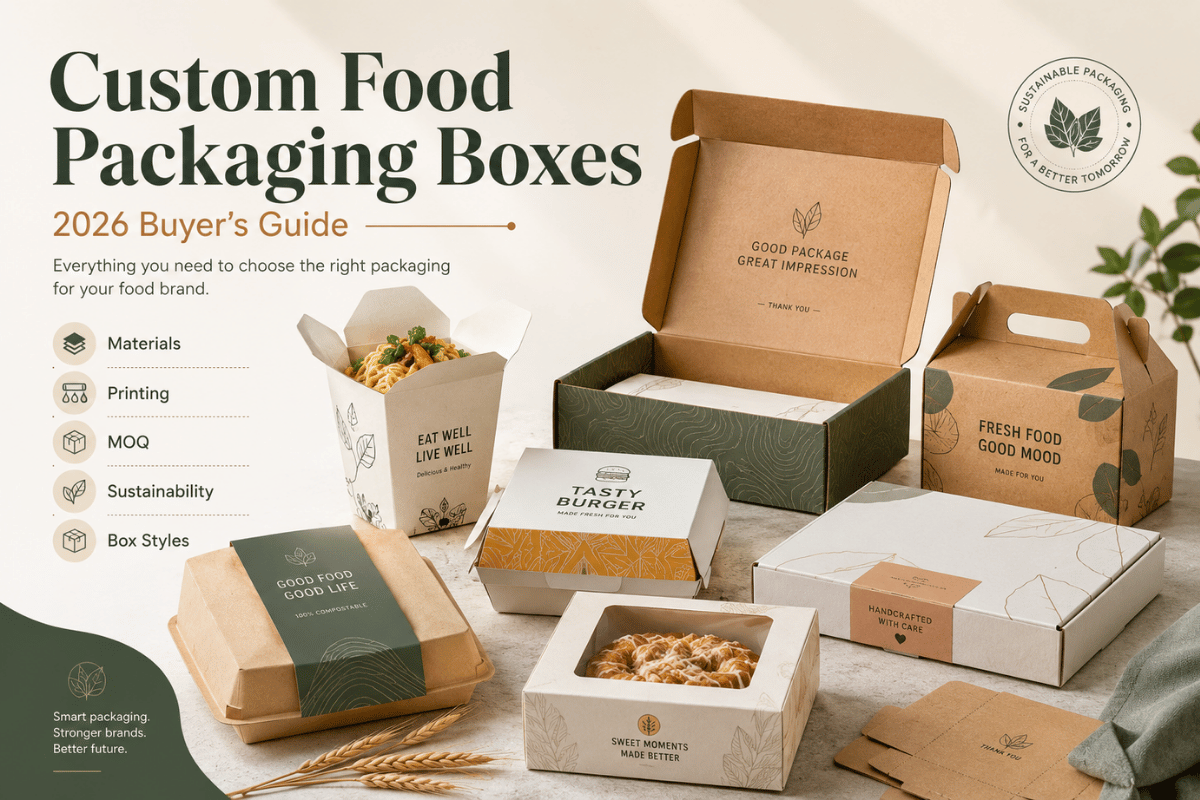
custom food packaging boxes are food-grade containers constructed to the client’s precise specifications for size, material (paperboard, corrugated, plastic, or molded fiber), and print (logo, color, copy). A brand uses these custom containers to ship anything from pizza to bakery items, takeout to high-end retail food in a package that both safeguards the product and conveys branding. When selecting a container, the key is a multi-tasking balance of the food type, the packaging material, and the print technology. This buyer’s guide demystifies each component, breaks down the true costs, and details the 2026 regulations dictating what’s currently acceptable to sell.
Quick Specs: Custom Food Packaging Boxes
| Common boards | SBS, CUK kraft, E/B-flute corrugate |
| Plastic options | PP, PET, MFPP (food containers) |
| Grease barrier | PE-coat, PLA-lined, fluorine-free coating |
| Print methods | Flexo, litho-lam, digital printing, IML |
| Typical MOQ | Digital 100–300 · offset 500–5,000 |
| Lead time | 5–10 days stock mold · 35–50 days custom mold |
| Food-safe basis | FDA 21 CFR 177/176 · ISO 22000 |
When You Need Custom Food Packaging (and When Stock Is Enough)
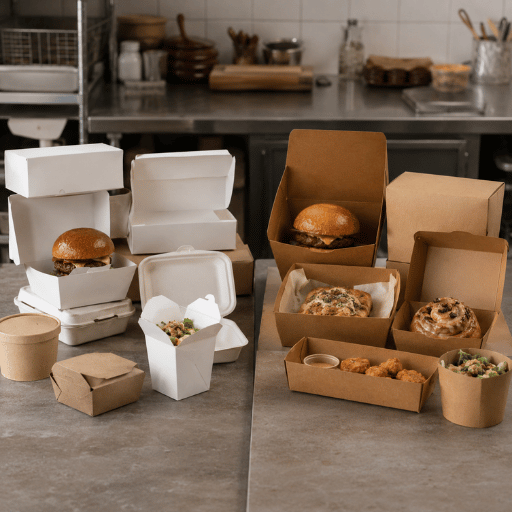
Simple, stock containers suffice when the packaging’s primary role is utilitarian. You move to custom food packaging once the box begins to act as a brand contact point, or it no longer fits the item effectively. A simple, three-tiered approach is useful: If your monthly orders exceed a few thousand units, if how your product is unboxed strongly shapes customer perception, or if off-the-shelf dimensions are inherently wasteful, the initial expense of customization is well-justified. Below these thresholds, a customized stock size or a custom sticker on plain packaging will typically be the more cost-effective choice. A custom box still has to clear the same FDA food-contact rules (21 CFR 177) as any stock box, customization changes the look, not the food-safety bar.
The term “customization” within the world of custom food boxes covers two distinct levels: structural (unique size, shape, or mold tailored for the product) and decorative (custom logo, colors, and copy). These elements can be applied independently; many brands begin by custom printing existing folding cartons prior to investing in bespoke molds. Distinguishing between these levels helps to ensure accurate quotes and expedited project time lines.
This custom methodology apply universally across a brand’s diverse food and beverage packaging lines, including but not limited to boxes. Customized beverage packaging, printed coffee cups, cardboard food trays, custom mailer boxes for consumer packaged goods (CPG) and subscription services, and even a custom tin for premium gifts can all be unified under a single brand identity-offering a complete packaging solution for cafes, ghost kitchens, and food trucks. Custom beverage packaging adheres to the same material and printing standards discussed here.
💡 Pro Tip
Opting for print customization on an existing box size minimizes the minimum order quantities and maintains initial lead times around 5-10 days. Defer customization of molds to instances where stock sizing results in substantial material waste or inadequately protects the food contents.
Box Formats: Matching the Box to the Food
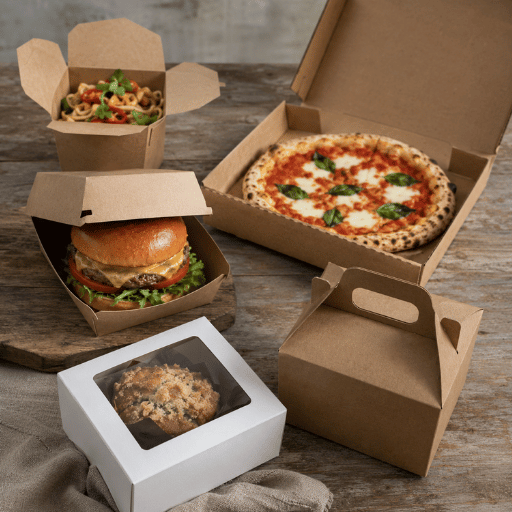
To quickly narrow down your options, focus first on the food item, rather than the packaging. Foods that are greasy or hot require packaging with barrier properties and thermal resistance; dry goods and baked items necessitate a sturdy structure and a print-ready surface; foods that are wet demand a sealable plastic container. Consult the Box Format Food-Type Matrix below to map prevalent food items to typical container types and materials that most brands use, enabling you to pre-select potential candidates before even requesting custom food packaging boxes. Whatever the format, grease resistance is engineered into the board with a barrier coating, not inherent to the paper (see USPTO 10,704,200).
| Food | Format | Material + barrier |
|---|---|---|
| Pizza | Corrugated pizza boxes | E/B-flute kraft, grease-resistant liner |
| Burgers / fries | Burger boxes, fry cartons | SBS or kraft, PFAS-free grease coat |
| Sandwiches / wraps | Folding carton, custom sandwich wedge | CUK kraft, vented |
| Bakery / pastry | Bakery boxes, pastry boxes, window cartons | SBS, clear window film |
| Cake | Tall cake boxes | Rigid SBS or corrugate |
| Cookies / macarons | Donut boxes, macaron boxes, gift boxes | SBS, insert tray |
| Hot wet entrees | Hinged takeout boxes / food containers | MFPP / PP (hot-fill) |
| Salads / cold deli | Clear bowls, deli food containers | PET (cold only) |
| Catering / bulk | Catering boxes, large takeout boxes | Corrugate, kraft |
| Frozen / retail CPG | Folding carton, customized cereal box style | CUK kraft, freezer-grade |
Recommendations on box formatting based on food type, derived from data on material temperature and grease resistance (see References).
Observe the clear distinction: paperboard and corrugated cardboard are the prevalent materials for dry goods, baked items, and ambient products, whereas plastic food containers become dominant for foods that are hot, wet, or require a securely sealed lid. This fundamental divide – dry and rigid versus hot and sealed – guides the majority of your packaging choices.
Choosing Material and Board: The Grease-and-Heat Fit Test
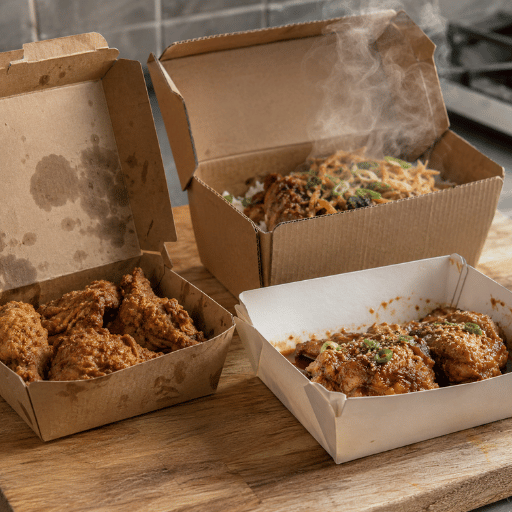
This is the MOST expensive misconception that permeates custom food packaging: that “kraft paper is grease-resistant.” It isn’t. Normal Kraft and SBS will get soaked through if exposed to oil, grease-resistant comes from a barrier coating applied to the board, not the paper itself. We can see patents Granted for barrier-coating technology: see USPTO 10,704,200 as an example.
The Grease-and-Heat Fit Test reduces it to two questions. How greasy and hot is the food, and does it have to remain sealed? Then apply your options to the following grid:
The Grease-and-Heat Fit Test (decision steps)
- Dry / baked, ambient uncoated SBS or kraft food packaging, optional window for bakery
- Greasy and warm, not wet SBS or kraft coated with a PFAS-free grease barrier (KIT 5-8 on the 1-12 scale)
- Hot and wet – requires lid PP or MFPP food containers, PP is the standard hot-fill and microwave-safe foodservice resin, so it holds hot food without warping.
- Cold and wet, clarity is king PET bowls, however, PET softens well below boiling, so save it for cold and ambient foods only. Never use for hot foods.
- Sustainability-led →bagasse or molded fiber with a fluorine-free coating, or PLA-lined board.
📐 Engineering Note
KIT grease test (rating from 1 to 12) Typical packaging boxes food coatings require level 5 to 8 KIT. Trying to achieve a KIT 12 for takeout orders is costly and doesn’t provide much extra value. Make sure that whatever bar you consider, it is fluorine free (effective January 1st, 2025, 35 agents for food coating are now considered as “not authorized for food contact” by the FDA, so claims of ‘grease-proof’ means using a PE, PLA, or water-based barrier layer to grease-proof the food packaging.) A barrier coating typically adds about 5–15% to board cost.
Given the highly varying boards you won’t want to make a mat for a custom printed food packaging project without a few good advantages-and-limitations passages to read first.
✔Paperboard & corrugate
- Best print face for branded packaging
- Recyclable, biodegradable options (kraft food packaging)
- Needs a coating for grease or moisture
⚠Plastic (PP / PET / MFPP)
- Hot-fill, leak-proof, microwave-safe (PP)
- In-mold labeling embeds the graphic
- Weaker recyclability messaging than fiber
Material choice isn’t limited to boxes. For lighter items, custom paper, paper bags, and plastic bags round out a foodservice line, while rigid box packaging and product packaging protect retail goods. The same cardboard food stock used for boxes for food can be cut to many packaging types, so one supplier cover most formats.
Custom Printing and Branding: The Print-Method Trade-off Table
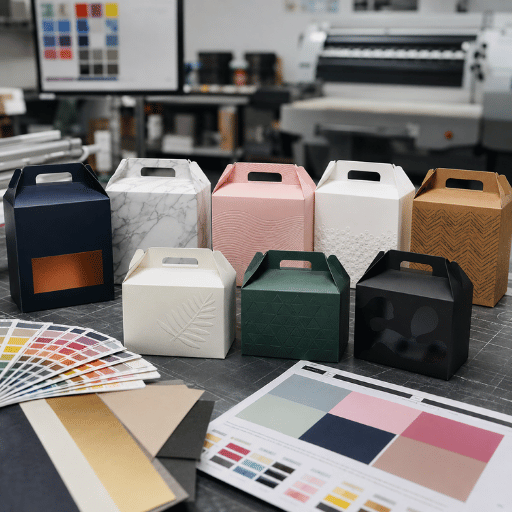
Print method is not about looks, your run size and color needs decide it. Digital printing wins short runs and photographic color; flexography wins high-volume kraft; offset litho-lamination delivers the sharpest color on corrugated cartons; and in-mold labeling (IML) embeds the graphic permanently into plastic containers. The Print-Method Trade-off Table below shows where each method fits, so your custom food boxes with logo get the right process the first time. On throughput, a digital line runs roughly 800–1,500 boxes per hour with near-instant changeovers, while high-end flexo presses reach up to 800 m/min, one reason flexo only pays off at high volume. Printing inks are regulated food-contact components in their own right (FDA 21 CFR 178), so specify low-migration inks for boxes that touch food directly.
| Method | Best run size | Strength | Watch-out |
|---|---|---|---|
| Digital printing | 100–2,000 | Low MOQ, variable data, fast changeover | Higher unit cost at volume |
| Flexography | 10,000–100,000 | Cheap at scale on corrugate/kraft | Weak fine detail; plate cost $400–1,200 |
| Offset / litho-lam | Thousands+ | Sharpest color, true PMS match | Most expensive setup; longer changeover |
| In-mold labeling (IML) | Molded plastic runs | Graphic fused to container, no peel | Plastic only; mold required |
Run-size, plate-cost ranges are for offset print from package sources (see References).
How are custom boxes printed, and what artwork do you need?
No matter how you’ll print them, box producers need 3 inputs to produce your custom printed: a dieline – this is your actual box cut and fold in vector on it; print artwork – vector logo and brand color (PMS spot color preferable); the coating – whether it’s matte, glossy or soft touch. Just have that clear to you. They’ll bring you the art and send back the right proof. Low quality artwork sent on wrong dieline = printing it twice. Most of your custom food packaging’s printers will have their own designers that will draw free of charge the dieline and help get the print ready art to be send.
Food-Safe Inks Are Often overlooked when Buying Boxes You didn’t know you were buying two food contact materials in one – the packaging itself and the printing ink that makes it look pretty! That said when packaging directly contacts food be sure to ask your converter about low migration food safe printing inks whether they use digital, flexo graphic, or IML printing. In molding (IML) a thin printed film, usually 15-40 µm, is “melted” into the container structure. Its benefit: the graphics can’t rub, scratch, or scuff off. Whatever the method, allow about 7–10 days for prepress and a printed proof before the production run.
Food Safety and Compliance: FDA, PFAS, and Labeling
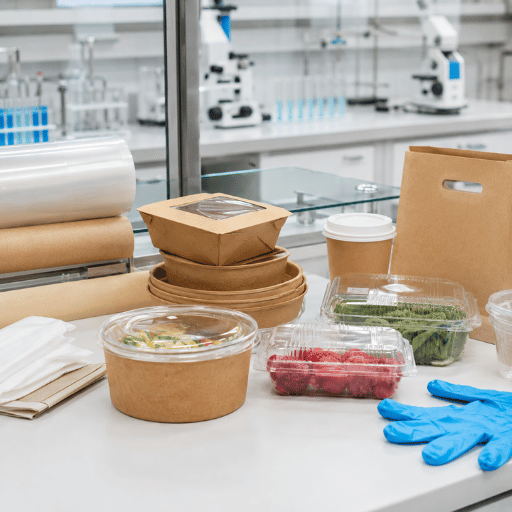
The phrase “Food Safe” is not a single attribute. U.S. regulations classify plastic food contact articles separately from paper/paperboard and carry differing standards ( FDA 21 CFR Part 177 and 176, respectively).
In addition to this federal regulation, many states now ban PFAS in food packaging outright, which can override otherwise-compliant materials.
- Food grade materials certificate, identifying compliance with the FDA 21 CFR Part 177 (plastic or paper 176) standards
- A grease resistant barrier which must be fluorine-free – only accept a PFAS-free declaration in writing, not a verbal assurance or vague term such as “eco-friendly”
- Compostable claims should conform to the FTC’s Green Guides 16 CFR 260 – not just a word such as “biodegradable,” but with support from an ASTM D6400 / ASTM D6868 compliant facility and BPI certification.
- A blank area reserved for any mandated ingredient or nutrition panel.
- A food safety management system is in operation at the packaging manufacturing plant (a ISO 22000 certified facility, or equivalent).
⚠️ Important
A blanket claim of “compostable” or “recyclable” risks an FTC inquiry.
FTC Green Guides require that the term be accompanied by an appropriate clarification unless industrial composting facilities are readily available to a significant majority of consumers, and a recyclable designation implies that at least 60% of residential recycling programs accept that specific packaging material. (BPI certification of materials require less than 100 parts per million total organic fluorine.)
How to Order: The 5-Spec Box Brief, MOQ, and Real Cost
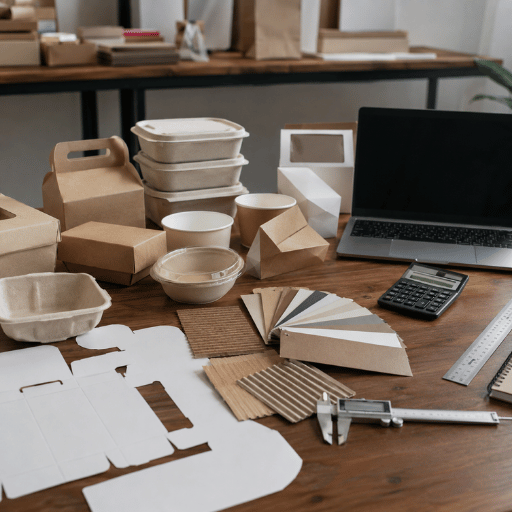
Most sales quotes fall apart for the simple reason the buying specification is so fuzzy the supplier quotes multiple – and incomparable – products. Lock these five issues before you ever ask a supplier to quote. The 5-Spec Box Brief makes sure all five bids you get reflect equivalent products.
The 5-Spec Box Brief
- Food and the typical environment in which it’s stored. (e.g. dry / greasy / wet-heat / cold / frozen).
- Grease level and any barrier requirement
- Format + interior dimensions (or a sample to match)
- Print method + colors (PMS or CMYK)
- MOQ tier + target reorder cadence
The actual dollars and cents on the final custom food packaging come down to this 9-Factor Cost Driver Matrix when comparing Wholesale Box Pricing.
| Driver | Typical range | Effect |
|---|---|---|
| Unit price (custom box) | $1.00–6.50 / unit | Falls fast with volume |
| Cutting die / tooling | $150–2,500 | One-time; amortized over run |
| Printing plates | $400–1,200 | Scales with color count |
| Setup fee | $200–1,000+ | +$1.00/box at 500; +$0.05 at 10,000 |
| Digital MOQ | 100–300 | Lowest entry, no plates |
| Offset MOQ | 500–5,000 | Needs plates; cheaper at scale |
| New custom mold | 35–50 day lead | Longest lead; stock molds ship 5–10 days |
| Coating / finish | +5–20% | Grease barrier, matte/soft-touch |
| Reprints / rejects | Hidden | Bad artwork = paying twice |
Market estimates of prevailing price ranges for typical quantities (see References); consult live quotes to finalize pricing.
This is often the most difficult concept for buyers to grasp: typically the box with the lowest per-unit cost, if based on a compromised specification (low art quality leading to reprint cost, unallocated tooling, high waste rates) is the more expensive box overall, once every associated cost is factored in. Look at total landed cost.
Neither the formula is uniform. Transport-package cost, per the ASTM D6198 method is per-project cost in function of materials, labor, and distribution – and food and takeout container prices vary alongside material costs, per US Bureau of Labor Statistics producer-price data. Treat all Published price Ranges as starting point, and back-check against your spec live quote.
“Buyers fixate on the per-unit line and forget the mold and plates. On a 500-piece run a $500 setup adds a dollar to every box; on 10,000 it disappears. We tell first-time buyers to price the whole job, then walk the MOQ tier up until the unit cost flattens.”
Wonhi production planning team
We worked out all the math on full landed cost, amortization of mold, and multiple unit quantity price-we put this logic to work, and run that math on our custom food packaging manufacturer page for any buyer. Wonhi, our source factory is fully integrated-86 production lines (20 thermoforming, 6 sheet extrusion, and 60 injection molding)-producing over a million units a day, enabling minimum MOQs and low unit costs at volume versus a print broker source.
What to ask for in your custom quote. Spell out your full packaging needs up front: Wonhi supplies wholesale food packaging boxes, custom bakery boxes, custom printed boxes, custom food containers, and food packaging boxes with logo, with low minimum order options on most packaging styles and volume breaks on bulk orders. As a source factory we keep food packaging supplies and custom food packaging supplies in-house, so your packaging options span paper and plastic from one place, request a sample, then order custom food once the proof is approved. Whether you call them custom printed food boxes, custom printed food packaging boxes, customized boxes, or customized food cartons, the packaging process is the same: get custom artwork approved, then print. Strong food packaging designs are designed custom to your brand, and quality custom food packaging and popular custom food packaging styles alike start from your logo.
2026 Outlook: Foam Bans, PFAS Rules, and Branded Delivery
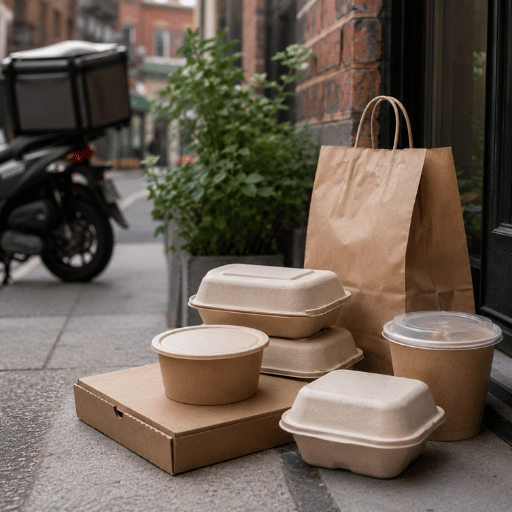
More than an emerging design trend, the big 2026 change is regulation, and it imposes fixed deadlines on buyers. California’s SB 54 restricted EPS foodware, and producers’ failure to meet the January 1, 2025 recycling threshold made its sale prohibited; SB 54 will eventually also cover coated paper and other covered foodware. State PFAS food-packaging rules are already in force in Washington (since 2023), Maine’s lands in 2026, and more states including Illinois are phasing in PFAS or EPS limits on rolling 2025–2026 dates, check your own state before restocking. Federally, a January 2025 FDA notice retired 35 PFAS grease-proofing agents used on paper and paperboard specifically, not every PFAS food-contact use.
For you, what this means is that if you’re still using EPS, now’s the time to re-spec. A new generation of grease-free options-water-based coatings, molded paper pulp, EnShield SBS-is ready. Annual growth of about 4.6% in the custom packaging market and compostable penetration up from 4.8 to 6.1 percent is noteworthy, but won’t be as decisive as legislation driving a swift change away from EPS and from PFAS, while also responding to rising demand for sustainable packaging and eco-friendly packaging, especially takeout packaging for food delivery brands, in a market increasingly driven by branded, custom printed packaging.
💡 Action for 2026
Audit your current boxes for foam and PFAS exposure this quarter, then pilot a fluorine-free swap before your state’s date. For sustainable lines, see our eco-friendly food packaging range and compostable clamshell containers.
Frequently Asked Questions
How much do custom food packaging boxes cost?
View Answer
Custom food boxes typically run about $1.00 to $6.50 per unit in 2026, with the price falling sharply as volume rises. On top of the unit price you pay one-time tooling ($150–2,500), printing plates ($400–1,200 by color count), and a setup fee ($200–1,000+). That setup adds roughly $1.00 per box at 500 units but only about $0.05 per box at 10,000 — which is why MOQ drives the real cost more than the sticker price.
What is the minimum order (MOQ) and turnaround time?
View Answer
Digital printing accepts a low minimum order of about 100–300 units, while offset needs 500–5,000 to justify plates. Turnaround depends on tooling: stock molds and existing dielines ship in roughly 5–10 days, but a new custom mold pushes the lead time to about 35–50 days. If speed matters, start on a stock size with digital printing and add a custom mold on the reorder once volume is proven.
Are eco-friendly or compostable materials available for custom food boxes?
View Answer
Yes. Kraft food packaging, bagasse, molded fiber, and PLA-lined board all support eco-friendly and biodegradable custom food packaging. Here the catch is the claim: under the FTC Green Guides a compostable claim must be qualified and backed by ASTM D6400/D6868 and BPI certification (under 100 ppm total organic fluorine), not the loose word “biodegradable.” Insist on the certificate, and make sure the grease barrier is fluorine-free so the eco claim holds up.
Can custom food boxes keep bakery and perishable items fresh?
View Answer
Yes — with the right structure. Vented bakery boxes release steam so pastry stays crisp and food fresh, while sealed plastic food containers hold freshness and help you deliver food in good condition. The right food packaging options protect texture in transit.
Can I design my own box, or do you offer design support?
View Answer
Both. Send print-ready vector art on the supplier’s dieline, or use the free design support most factories provide to create custom artwork from your logo.
Why is custom food packaging better than plain packaging?
View Answer
Plain boxes carry food; custom food packaging carries food and brand recognition at the same time. A branded box turns every delivery into a marketing impression, lets you size the box to the product so it protects better, and signals quality at the moment a customer first sees the order — which plain packaging cannot do.
About This Guide
This guide draws on 20 years of Wonhi experience manufacturing custom food packaging across thermoforming, sheet extrusion, and injection molding, plus current FDA, FTC, and state regulatory sources listed below. The cost and lead-time figures reflect our own MOQ ranges and production data as a source factory. Reviewed by the Wonhi technical team.
References & Sources
- 21 CFR Part 177, Indirect Food Additives: PolymersU.S. eCFR
- 16 CFR Part 260, FTC Green GuidesU.S. eCFR
- EPS Foam Food Service Ware Ban (SB 54)California Attorney General
- US Patent 10,704,200, Oil and grease resistant paperboardUSPTO
- 2025 State Regulatory & Waste UpdatesFood Packaging Forum
- PFAS Food Packaging Regulations, State by StatePackaging Digest
- ASTM D6198, Standard Guide for Transport Packaging DesignASTM International
- Producer Price Index: Food & Carryout Corrugated BoxesU.S. Bureau of Labor Statistics / FRED