Get in touch with Wanhui Company



Updated June 2026 Reviewed by the Wanhui technical team.
Custom takeout boxes are branded, food-grade to-go containers made to your own size, material, and print specification – sold as paper, plastic, or molded fiber, in formats that range from the classic Chinese pail to a hinged clamshell. Matched to the food, a box stays intact in transit and turns a delivery bag into a brand impression; the wrong one leaks, soaks through, or smears your logo. This guide walks a restaurant or food brand through the decisions that actually matter: format, material, food safety, printing, cost, and the foam and PFAS rules now reshaping what you’re allowed to buy.
Quick Specs: Custom Takeout Box Basics
| Common materials | Kraft/SBS paperboard, PP, PET, molded fiber (bagasse), PLA-lined fiber |
| Heat tolerance (typical) | PP ~120°C / 248°F · bagasse ~100°C / 212°F · uncoated kraft lowest |
| Print MOQ | Digital 25–100 units · flexo/offset 5,000+ units |
| Typical unit cost | ~$0.59–$1.10 per box at 1,000–3,000 units (printed paperboard) |
| Compliance to check | FDA 21 CFR food-contact · state EPS-foam bans · state PFAS limits |
What Counts as a “Custom Takeout Box”?
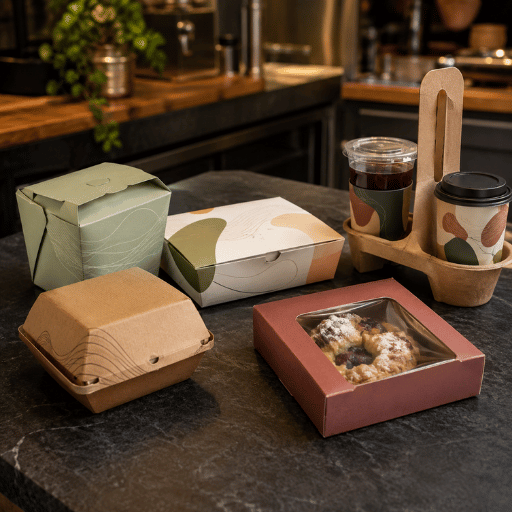
A custom takeout box (also spelled take-out box) is any food-contact container produced to your brand’s specification rather than bought blank off a shelf. “Custom” can mean a printed logo, a specific size, a chosen material, or a bespoke die – and most restaurants combine several.
Before you pick a material or a printer, decide on a format family, because format dictates which materials and closures are even available. The table below maps the six formats that cover the vast majority of takeout orders. Restaurants usually order them alongside the rest of their food packaging – deli containers, soup containers, food cups, coffee cups, paper bags, and clamshell containers – so it helps to plan custom takeout boxes as one packaging solution rather than a one-off.
| Format | Best for | Typical size | Default material |
|---|---|---|---|
| Chinese pail (tuck-top) | Noodles, rice, saucy entrées | 16–64 oz | Poly-lined kraft |
| Hinged clamshell | Burgers, full meals, salads | 6×6 to 9×9 in | Bagasse or PP |
| Tuck-top mailer box | Pizza slices, pastries, bakery | 7–12 in | Corrugated or SBS kraft |
| Fry scoop / open box | Fries, wings, nuggets | 4–32 oz | Grease-resistant paperboard |
| Sushi / bento tray + lid | Cold, plated presentation | 6×4 to 9×6 in | PET or molded fiber + clear lid |
| Bowl + lid | Poke, grain bowls, soup | 16–48 oz | PP or PLA-lined fiber |
What size takeout box do I need?
Size by the portion, not the dish name. A good rule – call it the 80% Fill Rule – is to fill a container to about 80% capacity: under-filling lets food slide and the lid pop, over-filling crushes garnish and forces sauce past the seal.
In practice that means stocking sizes in roughly 8 oz / 12 oz / 26 oz / 38 oz steps so each portion lands near that 80% mark. Most operators stock two or three sizes per format – for example a 26 oz and 38 oz bowl – rather than one “universal” box, because a half-empty 48 oz bowl arrives looking like a smaller portion than it’s. Match capacity to your three highest-volume menu items first, then add edge cases. Even a small range of sizes covers most menus, from cold food cups to large take out containers for catering businesses and food delivery, and from a cafe to meal prep kits and special events.
Choosing the Right Material: Paper, Plastic, and Molded Fiber
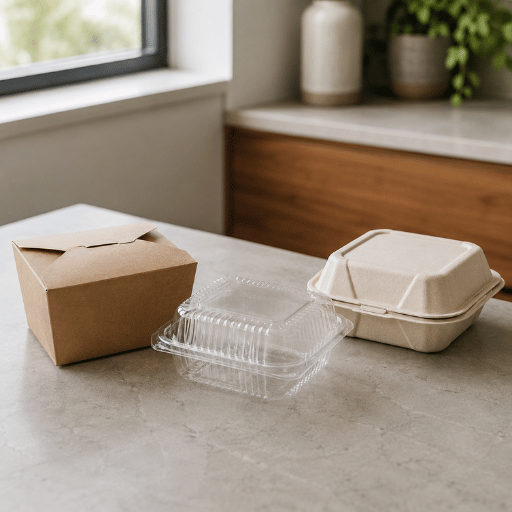
Material is the decision that most often go wrong, because buyers pick on price or appearance instead of how the food behaves. Use a simple rule we call the Grease-and-Heat Material Test – a 3-Axis Material Rule: rate your dish on three axes – grease load, serving temperature, and dwell time (how long food sits in the box before it’s eaten) – and let the highest-stress axis pick the material. A dry pastry eaten in ten minutes can go in printed kraft; a 200F curry that rides 40 minutes in a delivery bag needs molded fiber or PP, not paper.
Here’s why each axis matters. Heat sets the limit: polypropylene (PP) takes up to roughly 120°C (248°F), bagasse and molded fiber hold their form close to 100°C (212°F), and untreated kraft comes in lowest. Grease attacks the fiber: a peer-reviewed study of molded pulp found oil held firm in both chilled and hot use, while uncoated paperboard wicks oil unless it carries a barrier. Dwell time is the sneaky one: what holds up for 10 minutes can fail by 40, and once a box loses either of the first two limits the food can end up on your customer’s hands. Rate the dish, then work down the matrix below. On the paper side, custom paper stock runs from brown kraft to white and kraft and heavier corrugated cardboard; bagasse is the same sugarcane fiber sold as molded fiber. Kraft paper take-out boxes remain the workhorse for dry and warm items.
| Material class | Max temp | Grease / leak | Microwave | End of life |
|---|---|---|---|---|
| Kraft / SBS paperboard | Low–med (~70°C) | Needs coating | No (uncoated) | Recyclable / compostable |
| Greaseproof / glassine paper | ~80°C | Good (coated) | No | Recyclable if uncoated |
| Corrugated board | ~70°C | Needs liner | No | Recyclable |
| Polypropylene (PP) | ~120°C / 248°F | Excellent | Yes | Recyclable #5 |
| PET | ~60°C (cold) | Excellent | No | Recyclable #1 |
| EPS foam (polystyrene) | ~90°C | Good | No | Banned in 12+ states |
| Aluminum foil | >200°C (ovenable) | Excellent | No | Recyclable (if clean) |
| Molded fiber / bagasse | ~100°C / 212°F | Good (oil-resistant) | Yes (short) | Commercially compostable |
| PLA-lined fiber | ~85°C | Good | No | Commercially compostable |
Figures represent approximate temperatures; verify against your supplier. Molded fiber performs well in general, but still needs appropriate linings to be truly oil and water proof, especially in longer use cases.
📐 Engineering Note
As a source factory running 20 thermoforming lines, 6 sheet-extrusion lines, and 60 injection lines (about 30 tonnes of sheet a day), we see one pattern over and over: the cheap box that passes on the counter fails in the bag, collapsing once it’s filled with hot food. For hot, saucy dishes we spec a heavier wall and a leak-proof seal rather than the thinnest gauge that holds shape empty. If your dish runs above 80°C and travels more than 20 minutes, test the box full and closed for 30 minutes before you commit to a print run.
Food Safety and Performance: Grease, Heat, Leaks, and PFAS

“The box that looks fine empty on the counter is not the one that survives 40 minutes in a delivery bag. We spec the wall and the seal for the worst dish on the menu, not the average one, and we always test it full and closed before a print run.”
— Wanhui technical team, foodservice packaging manufacturing
Any takeout box that touches food has to be made from food-grade materials. In the US, paper and paperboard food-contact surfaces fall under FDA 21 CFR 176.170, which lists what is allowed to touch aqueous and fatty foods; other countries keep their own equivalents. “Food-safe” is a regulated standard, not a slogan, and a credible supplier can name the spec their stock meets. It is also broader than PFAS alone: how much any chemistry migrates into food depends on heat, fat, acidity, contact time, and the coatings, adhesives, inks, and recycled fibers in the box – which is why a hot, greasy dish held 40 minutes is a much harder test than a cold sandwich.
⚠️ The grease-proof myth
Uncoated kraft isn’t grease-proof on its own – a coating has to be applied if oil is going to sit on it – and for years the cheapest barrier was a PFAS treatment. That’s going away: in February 2024, US manufacturers ended sales of PFAS grease-proofing agents for paper food packaging. Other chemistries, such as silicone or engineered films that set under heat, are used instead. So a “greaseproof” guarantee only means something when it names how the resistance was achieved.
Past grease, three other checks are all that distinguish a box protecting your brand from one which wrecks it. Leak proofness: two-thirds of people want leak and spill proof packaging over all others. A secure seal or tamper-evident closure therefore earns its keep. Heat and reheat: only make sure a box is microwave safe when your vendor says so – a plastic lid that’s deformed by 60 °C doesn’t make it after a reheat. Venting: fried food placed inside a sealed box sweats – crisp product needs venting.
Custom Printing and Branding That Survives the Kitchen
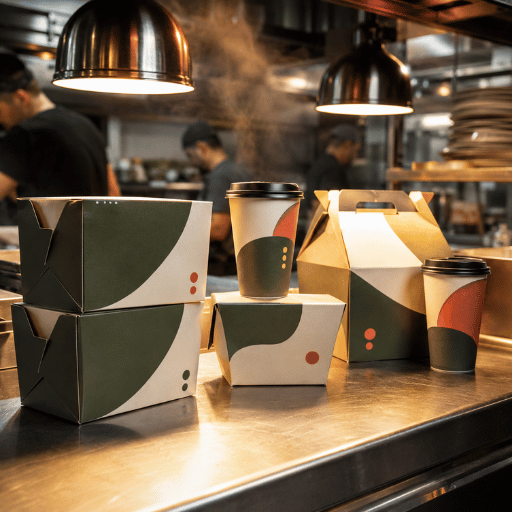
Printing is what turns an anonymous container into a custom takeout box, and the method you pick is driven mostly by volume. Whether you’re branding custom printed takeout boxes, pizza boxes for a pizzeria, or boxes for a catering line, three options cover the field: digital, flexographic (flexo), and offset. All put your brand on the box; they differ in setup cost, minimum run, and how many colors they handle cleanly.
| Method | Best run size | Setup / plates | Colors |
|---|---|---|---|
| Digital | 25–5,000 | No plates | Full-color, photos |
| Flexo | 5,000+ | Plate per color (~$50–$200 each) | 1–6 spot colors |
| Offset | 10,000+ | Plates + make-ready | Highest detail |
Two practical rules keep print quality from failing in the field. First, use food-safe inks and coatings – water- or soy-based – and keep heavy ink coverage off the inside near the food, since the food-contact surface is regulated under FDA 21 CFR. Second, design for contrast over detail: bright art only works if it doesn’t smear when it meets grease or condensation, so a bold one- or two-color mark on brown kraft or a white box read better after a 30-minute ride than a photo-real print that scuffs. Keep your logo on the lid or a flat side panel, not on a fold that creases. Treat the box as a blank canvas for memorable packaging: full-color custom restaurant packaging lifts food presentation, and a customizable die lets you tailor customized food boxes to each SKU. It is easy to create custom takeout containers and custom printed food packaging as sustainable packaging and custom packaging under one eco-friendly custom brand.
What Drives the Cost of Custom Takeout Boxes

Quotes for what looks like the “same” box vary widely because four levers move the price independently. We call this the 4-Lever Cost Framework – the Four Cost Levers of a Custom Box Run – and once you know them you can predict a quote instead of guessing at it. These figures assume a 350 gsm board at roughly 0.4-0.6 mm wall; heavier stock shifts every number up.
The Four Cost Levers of a Custom Box Run
- Tooling / mold (one-time): a custom die runs roughly $150-$300 for a folding carton; a bespoke thermoforming or injection mold costs more up front but divides out over millions of units.
- MOQ and run length: unit cost drops steeply with volume. A 1,000-unit two-color paperboard box lands near $0.82 each; the same box at 3,000 units falls to about $0.59.
- Material and gauge: heavier board, food-grade resin (regulated under FDA 21 CFR Part 177), and barrier coatings each add cost per unit.
- Print colors and coverage: every spot color is another plate, and full-bleed coverage uses more ink than a single-color mark.
These levers collide at the MOQ break point: flexo bears plate cost but the lowest price per unit over about 5,000-10,000 boxes, while digital skips plates and wins under that. A common break-even sits around 3,000-5,000 units per design. Working directly with a source factory and cutting out the middleman affects two levers at once. The combination of in-house mold development and greater than one million units/day capacity pushes the tooling floor below reseller cost as volume increases, and simultaneously, any MOQ requirements. If you run multiple SKUs, a shared die across sizes can spread that tooling lever. Ask suppliers about wholesale pricing, real MOQs, fast turnaround, and responsibly sourced board so you compare like for like.
Sustainability and Foam & PFAS Ban Compliance

Eco-friendly packaging is now more than just a choice in how you position your takeout boxes; in many states, what material you use is simply not a choice, it’s the law. There are two “waves” of regulations that affect how you pack food:bans on expanded polystyrene (EPS) foodware and regulation of intentionally added PFAS substances in food packaging. If your product is sold in any of the affected states, it’s a matter of when-not whether-you need to change your material.
| State | Rule | Status |
|---|---|---|
| California | EPS foodware ban (SB 54) | In effect Jan 1, 2025 |
| Washington | Foam foodware ban | In effect Jun 1, 2024 |
| New York | PFAS in food packaging | In effect since Dec 31, 2022 |
| Maine | PFAS in plant-fiber packaging | Sell/offer date May 25, 2026 |
Twelve or more states have banned some forms of EPS food packaging, while PFAS requirements vary by state, so be sure you understand what’s needed for the markets you serve.
“Compostable” and “recyclable” are regulated claims. In order to make an ASTM D6400 ( or ASTM D6868 ) (for coated paper products, which includes a “total fluorine” limitation that is designed to eliminate the addition of PFAS) claim, a compostable product must be independently certified. Per the FTC Green Guides, an unsubstantiated“compostable”claim requires proof. A genuine compostable claim means the product is certified and carries the BPI mark, and that it will break down in an industrial compost facility, not a backyard pile. But even an ASTM D6868-certified box can end up in landfill if your community has no facility that accepts these containers for composting, and a coated paperboard box that makes a great Chinese food pail is treated as contamination by paper recyclers that process much of the recycled material stream. State both whether the item is certified, as well as whether the material will actually end up getting composted in your community. For a deeper material walk-through, see our guide to compostable clamshell containers. Whatever you pick, keep it food-safe and, where you can, sustainably and responsibly made; recyclable and eco friendly options now match foam on performance.
How to Order Custom Takeout Boxes: A Step-by-Step Workflow

Ordering custom takeout boxes is a five-step workflow, and running it in order heads off the two costly errors: printing the wrong material, or finding a leak only after a full run of 20,000 boxes is already stacked in your warehouse. Settle the spec before you ever cut a die, and each step below builds on the last.
- ✔1. Define format and volume. From your top menu items, pick a format family and the two or three sizes that fit them, and estimate monthly volume per SKU.
- ✔2. Pick the material using the Grease-and-Heat Material Test, plus any state foam/PFAS requirement for the markets you serve.
- ✔3. Prepare artwork and the dieline. Send vector art and your Pantone or hex colors, and confirm the print method (digital vs flexo) against your volume.
- ✔4. Approve a sample and proof. Get a physical sample, then stress-test it full and closed with your real food before signing off.
- ✔5. Confirm production and QA. Lock MOQ, lead time, and a quality check on seal integrity and print registration before the full run ships.
What to hand a factory upfront save a round of back-and-forth: your dieline or stock size, brand color, food type and its serving temp, target volume, and your deadline. The more Grease-and-Heat inputs you give, the faster a supplier can quote the right material. You can start from our broader custom food packaging options, or go straight to a build for custom takeout boxes.
Industry Outlook: What’s Changing for Takeout Packaging in 2026

What shapes takeout boxes mostly in 2026 isn’t a trend. It’s a regulatory deadline. State foam and PFAS bans are now landing on specified dates and so re-speccing boxes on the fly has become a calendar item, not a “someday”. And that regulation lands atop a structural shift the National Restaurant Association has tracked for years: a large and growing share of meals now leave the building. The box is the restaurant. Across industry surveys, operators increasingly treat packaging as a brand asset rather than an expense line, and many say they would pay more for branded material. Treat those survey figures as directional, not precise – but the direction is hard to miss.
On the supply side, PFAS-free barrier technology continues its rapid maturation and the engineered bio-based coatings and dry-fiber trays commercializing by late 2025-2026 now achieve the grease and moisture standards previously requiring ‘forever chemicals’. For you as the buyer, this means audit existing SKUs today against the states you ship to and approach anything that’s either plain paper or foam as a near-term replacement. Market growth in delivery business keeps demand for brand boxes high. It’s regulation that dictates what you’re allowed to emblazon with your logo though.
Frequently Asked Questions
Q: What materials are custom to-go boxes made from?
View Answer
Most custom takeout boxes use one of five food-grade materials: kraft or SBS paperboard, PP, PET, molded fiber such as bagasse, or PLA-lined fiber. Use paperboard for dry or warm items, PP and molded fiber for hot and saucy dishes, and PET for cold presentation. The right choice depends on grease load, serving temperature, and how long food sits in the box before it is eaten.
Q: Can you put Chinese takeout boxes in the microwave?
View Answer
You can microwave the box only if it is labeled microwave-safe and has no metal handle. Classic Chinese take-out pails often include a thin wire carry-strap that must come off first. Many poly-lined paper boxes and bagasse pails tolerate a short reheat, though a PET lid will warp with heat. When in doubt, move the food to a plate, and confirm the microwave rating for the exact grade you buy.
Q: Are custom takeout boxes recyclable or compostable at home?
View Answer
Depends on the material and your local facilities. PP and PET boxes are recyclable where #1 and #5 plastics are accepted, if free of grease. Certified compostable fibre boxes (ASTM D6400/D6868, BPI mark) need an industrial composter, not a home bin, so check the certification before you claim it.
Q: How long does a custom takeout box order take?
View Answer
Depends on the print process and whether a new die is needed. Digital runs can ship in 2 days to 2 weeks; flexo or custom-die orders take a few weeks once artwork and a sample are approved. Build the sample-and-proof step into your timeline.
Q: What inks are used for food-safe printing?
View Answer
Water-based and soy-based inks are the usual food-safe choices. They sit on the outer surface so they do not touch the food directly, and the food-contact side stays unprinted. Confirm the exact ink system with your printer for any direct-contact use.
Q: Is there a minimum order (MOQ) for custom takeout boxes?
View Answer
Yes, and it tracks the print method. Digital can start as low as 25-100 units, while flexo and offset usually need 5,000+ to cover plate and setup costs. A custom mold raises the floor further but lowers the per-unit price at scale, so MOQ and unit cost trade off against each other – the more you buy, the cheaper each box. For a first order, many factories run a smaller pilot before you commit to full volume.
Q: Why invest in custom takeout boxes instead of plain ones?
View Answer
Because the box now does work the dining room used to. With most food eaten off-premises, packaging is one of your last brand touchpoints, and a good unboxing helps customers order again. It also matches the material to the food so it arrives intact.
Why We Wrote This
Wanhui is a source factory that thermoforms, extrudes, and injection-molds disposable food containers, meal boxes, bowls, and clamshells, for chain restaurants and delivery brands across five continents. The material and cost figures here come from running custom mold development and high-volume production daily, paired with current FDA, CalRecycle, and FTC references. Reviewed by the Wanhui technical team.
Spec your custom takeout boxes with a source factory
Send us the box dimensions, the type of food you’re packaging – hot or cold food, leftover food that has to keep food fresh, plastic containers or paper take-out containers – and your volume, and we’ll match the right packaging needs across your food service and takeout orders, from chinese take out boxes to restaurant boxes.
References & Sources
- 21 CFR 176.170, Components of paper and paperboard in contact with aqueous and fatty foods – U.S. FDA / eCFR
- EPS Foam Food Service Ware Ban (SB 54) – California Office of the Attorney General / CalRecycle
- Green Guides: Environmental Marketing Claims – U.S. Federal Trade Commission
- Commercial Compostability Certification (ASTM D6400 / D6868) – Biodegradable Products Institute
- CNF-Coated PFAS-Free, Grease-Resistant Molded Pulp Containers for Food Packaging – ACS Applied Polymer Materials
- Off-premises dining and packaging research – National Restaurant Association
Related Articles
- Disposable Food Containers: A Buyer’s Guide – materials and formats across the full range
- Compostable To-Go Containers Guide – certifications and disposal reality
- Wholesale Food Containers Guide – MOQ and sourcing at volume
- Disposable Food Containers – source-factory product range