Get in touch with Wanhui Company


Updated August 2026 · A food-container buyer’s guide
In-Mold Labeling vs Sticker Labels: A Food Packaging Buyer’s Guide
In mold labeling vs sticker labels for food packaging is not a simple durability contest. For a buyer, the useful question is where decoration belongs in the production system: inside the mould while the container is formed, or after moulding as a pressure-sensitive label. That choice affects tooling, artwork changes, validation work, label components, and the questions your supplier must answer before a food-container run is approved. For the separately applied sticker route, self-adhesive label stock from Guanma offers a material category to assess against the container surface and use conditions; it should not be treated as an in-mold label specification.
This guide compares the two routes without claiming a universal winner, a transferable per-label price, or automatic food-contact or recyclability status. It is designed for foodservice buyers specifying bowls, trays, meal boxes, and other rigid containers.
Quick decision frame
2 workflows to compare 7 cost drivers to request 8 conversion checks to run 2 separate compliance tracks to review
1. IML and Sticker Labels Solve Different Production Problems
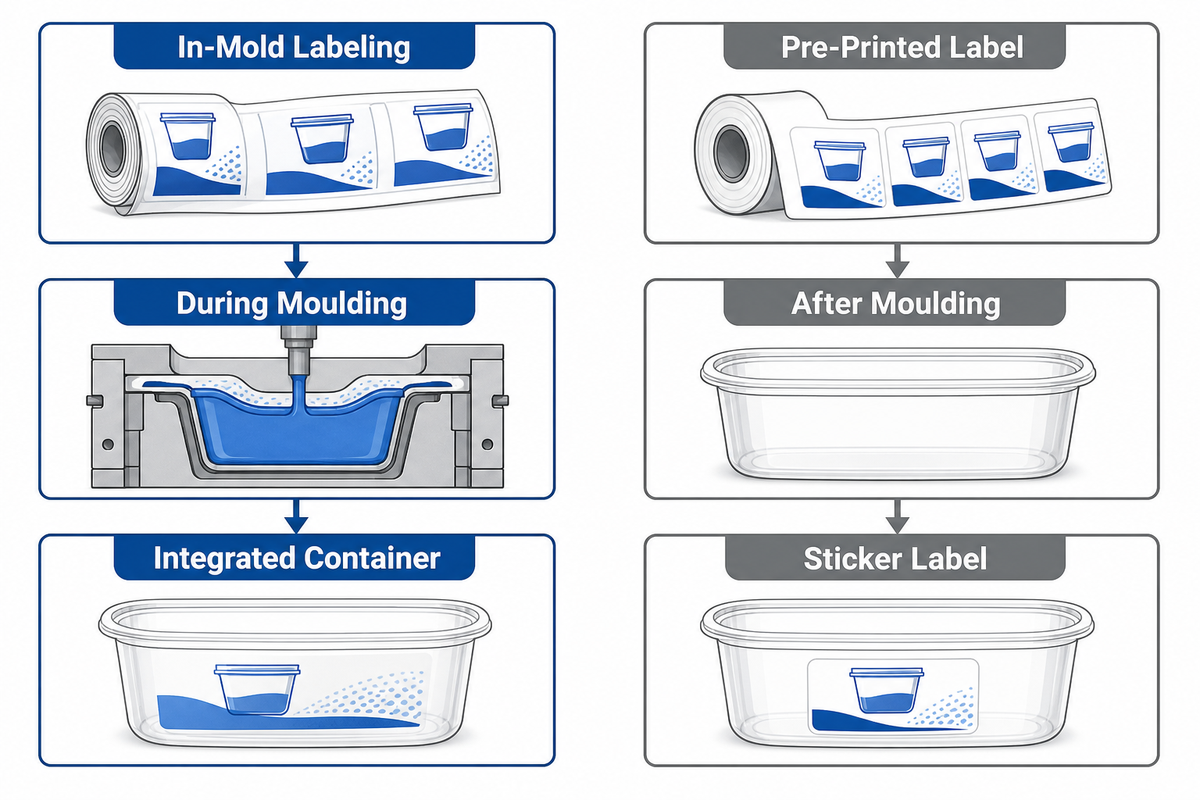
In-mold labeling (IML) is a decoration process. During the moulding cycle, a pre-printed label is positioned in the mould and becomes an integral part of the plastic container. After moulding, a sticker label—usually a pressure-sensitive label in this comparison—is applied to the finished container. More than a “permanent” versus “temporary” choice, the difference is a change in the order of operations.
A Labels & Labeling technical overview of in-mould labels describes the pre-placement and moulding workflow. For in-mold label printing, that means considering the container geometry, mould, resin, label film, holding method, and artwork together—not as a print finish selected at the end of the job.
In mold label printing is reviewed as part of the in mold labeling process, not as a late graphic choice after the container is made.
A sticker route keeps the container and the decoration step more separate. That can be useful when a menu changes, a regional language version is still moving through approval, or a short test run should not lock artwork into a moulding workflow. It can also introduce its own application, inventory, adhesion, and inspection questions. Neither route removes the need to define the actual handling environment.
IML starts before moulding
Best evaluated as a container, label, mould, and production-route decision.
Best evaluated as a container, label, mould, and production-route decision.
Sticker labeling starts after moulding
Best evaluated as a separate label-application and change-control decision.
Best evaluated as a separate label-application and change-control decision.
2. How the Two Labeling Workflows Change Your Line
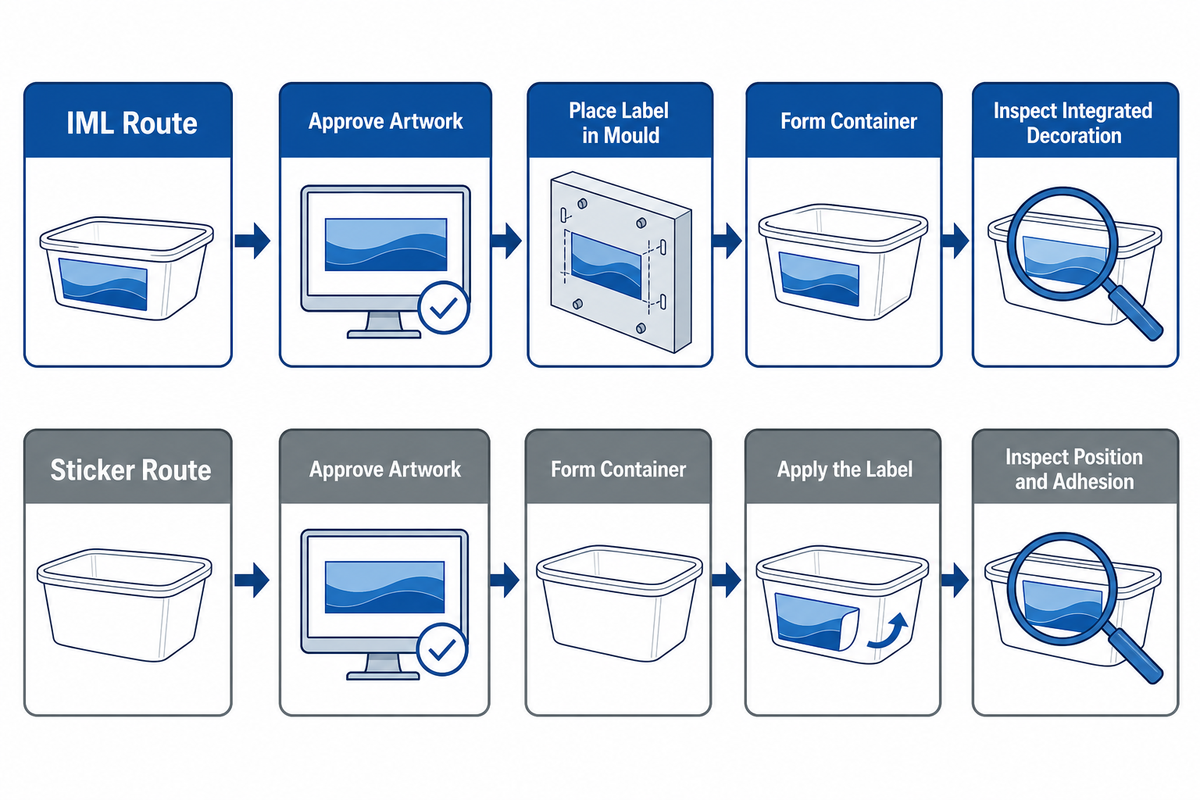
Think of the comparison as two short process maps. Those maps stay deliberately simple because an actual line must be confirmed with the moulder, label converter, and packaging team. For a polypropylene (PP) tray or bowl program that uses injection moulding rather than blow molding, confirm that the moulder can inject the selected resin and that the manufacturing route being quoted is the one being discussed. A U.S. in-mould-label patent record is useful process background, not proof that a buyer’s line will perform the same way.
- IML: approve artwork and label construction; place the label in the mould; retain it during the cycle; form the container; inspect the integrated decoration and part.
- Sticker label: form the container; hold or convey it to a labeling step; apply the label; inspect position, adhesion, readability, and any later scuffing or moisture exposure.
Illustrative example, not a production specification: the Northline Chilled Bowl Trial could record a 125 mm round container with an 86 mm usable label panel before the buyer asks a supplier to quote either route. The point is to make the sample brief measurable; those placeholder values are not a promised fit for another bowl.
In practice, a label issue can occur at a different place in each system. In-Mold Decorating Association terminology identifies curl and delamination, while a peer-reviewed review of IML injection-moulding defects discusses categories including wrinkles, weld lines, sink marks, and bubbles. None of those sources predicts a defect rate for your product. They support planning a sample trial instead of treating an integrated label as a zero-risk finish.
For a sticker route, the key questions shift to applicator fit, label presentation, container surface, adhesive choice, and the time between container production and application. Select the workflow your team can control and verify on the actual container, not the more advanced one printed in a brochure.
3. Food-Packaging Decision Table: When Each Option Fits
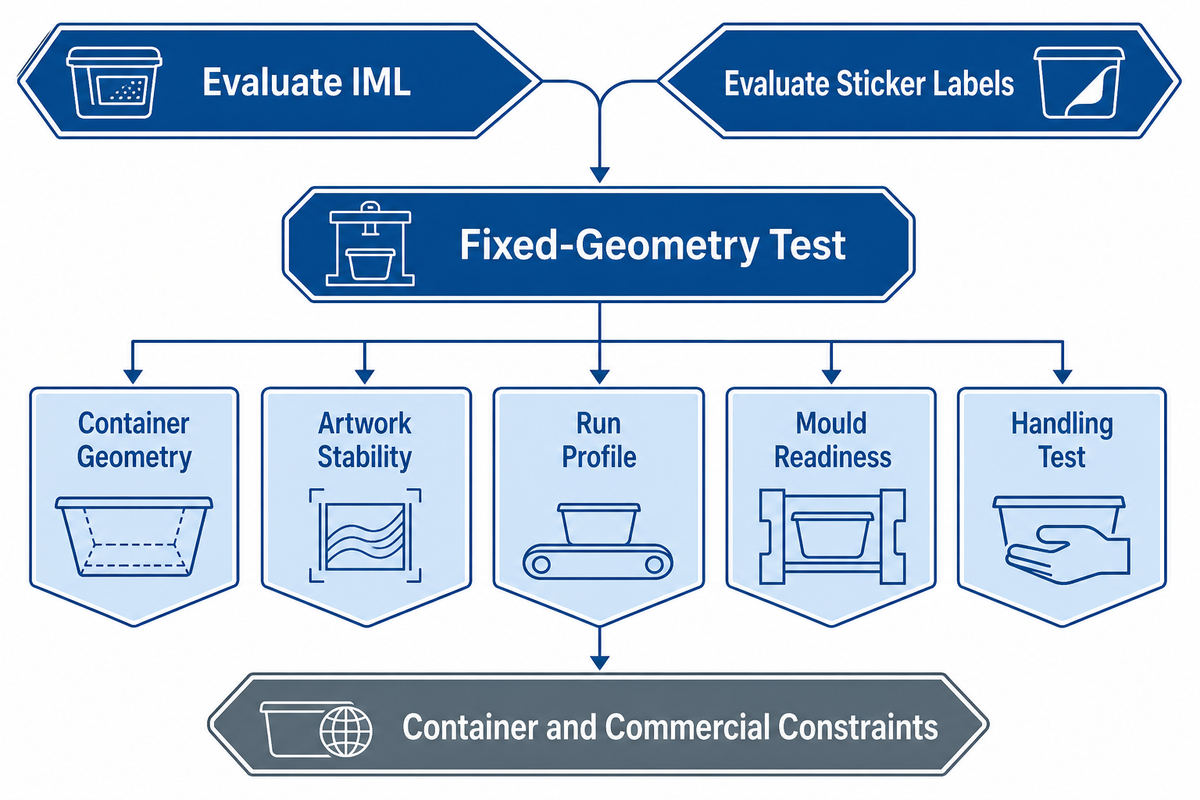
Use the Fixed-Geometry Test to turn a broad IML-versus-sticker conversation into a buying decision. Start with the container and commercial constraints, then decide which route is worth quoting and sampling. For broader format choices, compare these questions with your custom food packaging options before assuming that a label change can solve a container-design problem.
| Decision category | Evaluate IML when… | Evaluate sticker labels when… |
|---|---|---|
| 1. Container geometry | Shape and label area are stable enough for a mould-based trial. | Label area or format may still change after the container is made. |
| 2. Artwork stability | Core artwork is approved for repeated production. | Promotions, languages, or menu graphics change frequently. |
| 3. Run profile | Demand is repeatable enough to justify examining integrated setup. | Run profile is a test, short campaign, or uncertain launch. |
| 4. Mould readiness | The supplier can assess label placement and holding in the intended mould. | A separate labeling station avoids changing the moulding route now. |
| 5. Handling test | Samples can be checked in the real packing, stacking, transport, and cold-chain route. | Adhesion and scuffing can be checked after the actual application step. |
| 6. SKU control | A smaller number of stable designs reduces obsolete pre-printed stock risk. | More SKU versions need independent, late-stage flexibility. |
| 7. Compliance scope | Label film, inks, coatings, and intended use can be reviewed with the container system. | Adhesive and label construction can be reviewed with the application and intended-use conditions. |
| 8. Approval path | A physical moulding trial and cross-functional sign-off are available. | Teams need to approve graphics or label position without a mould conversion. |
| 9. Quote comparison | Quote lines can separate tooling, labels, validation, and expected production assumptions. | Compare label stock, application, inspection, and changeover assumptions separately. |
4. Cost Is a Volume-and-Changeover Question, Not a Per-Label Shortcut
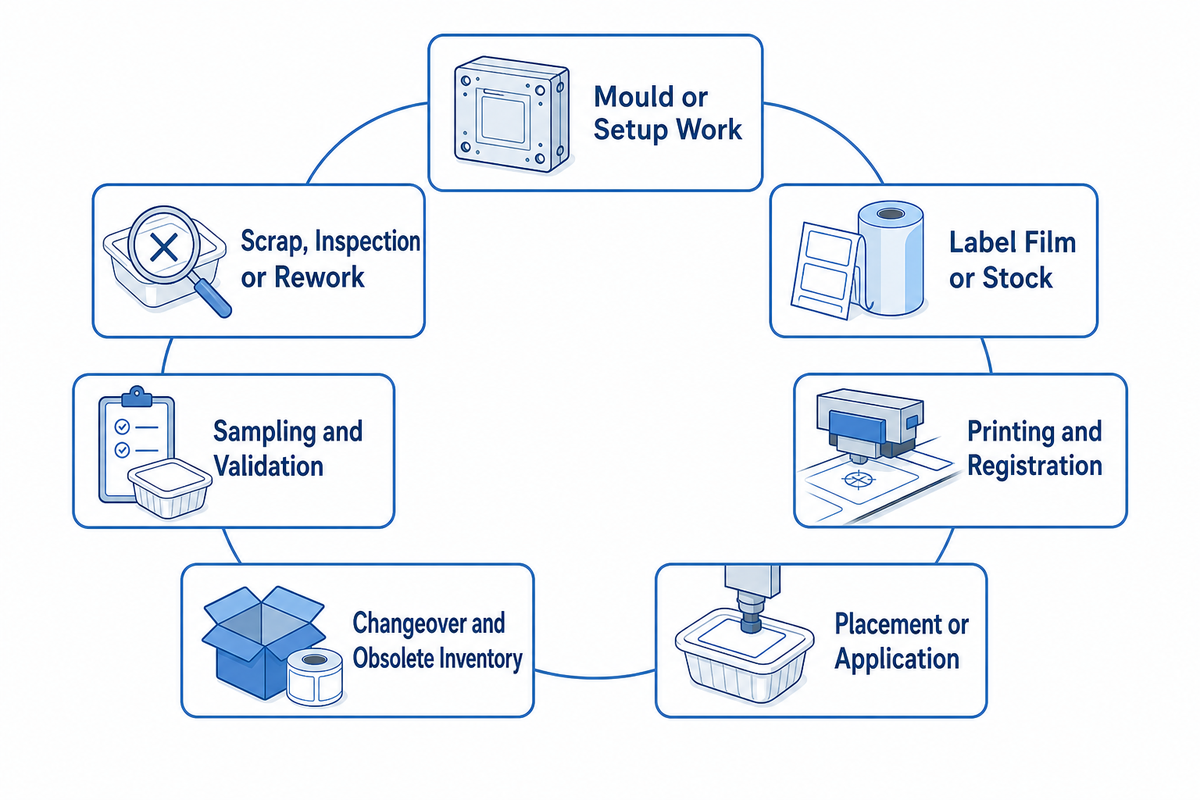
Commercial sources don’t provide a confirmed, transferable price for “an IML label” versus “a sticker label” on a food container. Any number that doesn’t include container geometry, label material, artwork, tooling, line setup, order profile, and destination specifications would appear precise yet be misleading.
Use the Seven-Cost-Driver Labeling Comparison in each RFQ instead. Ask suppliers to cite assumptions for: (1) mould or setup work, (2) label film or stock, (3) printing and artwork registration, (4) placement or application operation, (5) changeover and obsolete inventory handling, (6) sampling and validation, and (7) scrap, inspection, or rework processes.
Keep any regulatory or documentation work as a separately stated cost driver: the applicable conditions for pressure-sensitive adhesive label surfaces do not create a transferable per-label price.
This transforms a request for a low-cost label into a comparable system quote. It also avoids a low visible label price being subsidized by effort elsewhere in the process. Keep the result conditional: a stable, repeatable program may make a different cost structure worth while; a fast-changing program may prioritize label change ability after moulding. Neither answer replaces a supplier-specific quotation.
Buyer takeaway: ask for assumptions, not a generic price-per-label promise. Quotes that cannot name their seven cost drivers are difficult to compare fairly.
5. Durability, Moisture and Cold-Chain Handling
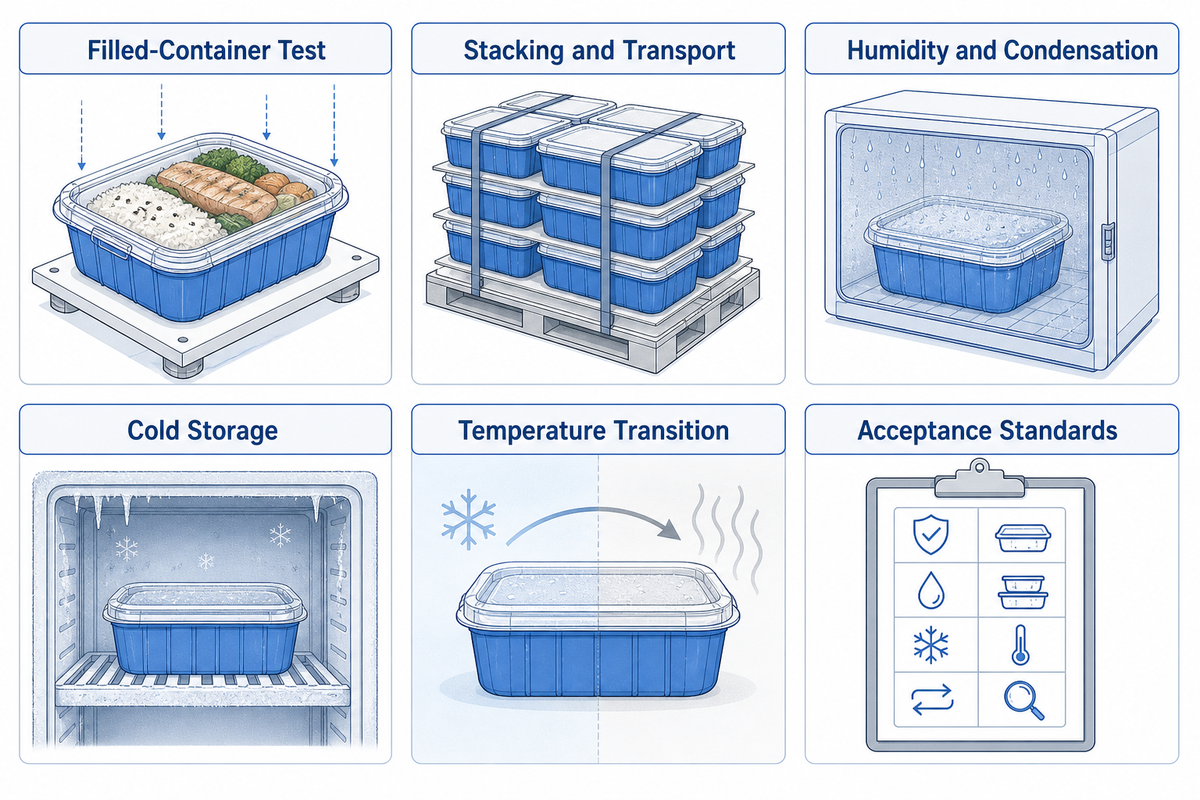
“Durable” should be a defined test schedule, not a statement printed beside a container image. During actual handling, a label process can face filling, nesting, packing, stacking, condensation, chilled storage, delivery bags, abrasion, and consumer handling. Each scenario can matter differently for the container, the label surface, its cosmetic appearance, the ink system, and the application or moulding operation.
Technical references and association terms are helpful here because they clearly show potential failure modes: curl, delamination, wrinkles, washout, part defects, or misplacement issues should be considered during testing. They don’t enable a buyer to project a guaranteed result from another container shape or line.
Evidence note: documented IML defect categories are a reason to specify a trial and approval plan, rather than promise a result before the container and process have been tested.
- Run a filled-container test with the intended food, lid, and packing route.
- Evaluate label placement and appearance after stacking and simulated transportation.
- Assess humidity, condensation, cold storage, and any planned temperature transition.
- Document what was tested, the acceptance standards, and the approver.
Illustrative example, not a production specification: for the same Northline Chilled Bowl Trial, the record might state a 4 °C chilled hold and a 24-hour observation window, then name the actual handling sequence. Those placeholder values only show how to make a trial record auditable; the buyer and supplier must agree the real conditions.
A related meal prep container guide can help teams connect the labeling decision to lid fit, stack pressure, and the intended foodservice route. Your own packaging sample must still decide the final choice, rather than a generic claim copied from another application.
6. Material Compatibility, Recycling and Compliance Boundaries
This is where a simple comparison can become unsafe if it blurs different questions. Even an IML container needs a component-by-component review. An external sticker label can still require review of its construction and intended-use conditions. Separate the following two tracks.
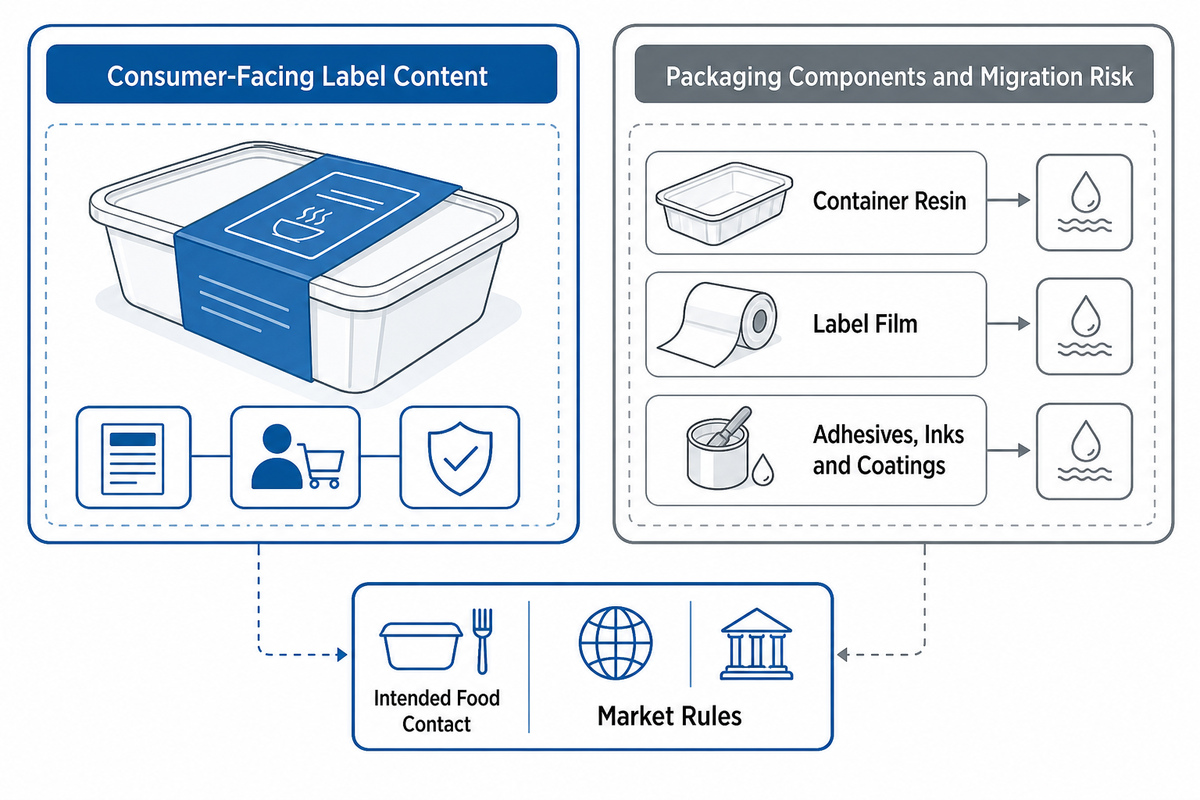
2-Track Compliance Rule for Food-Packaging Decoration
Track 1 — Consumer-facing food-label content: confirm the label information required for the product and destination market. The FDA Food Labeling Guide is a U.S. starting point, not an approval for every product or market.
Track 2 — Packaging-component and migration risk: review the container resin, label film, adhesives, inks, coatings, substrate, stacking/set-off conditions, intended food contact, and applicable market rules. FDA explains that food-contact substances can include packaging components, adhesives, and colorants. In the United States, 21 CFR 175.125 sets prescribed conditions where pressure-sensitive adhesives are used as food-contact label surfaces. That does not mean every sticker label contacts food; it shows why configuration and intended use matter.
Recycling claims need the same restraint. Even a compatible resin family does not prove that an individual package qualifies for an unqualified recyclable claim. The U.S. recyclable-claims guidance ties unqualified claims to established collection and processing access, among other conditions. Treat the container, decoration components, and receiving stream as one system—and have the market-specific claim reviewed before it appears on packaging.
7. Design Flexibility and SKU Changeovers
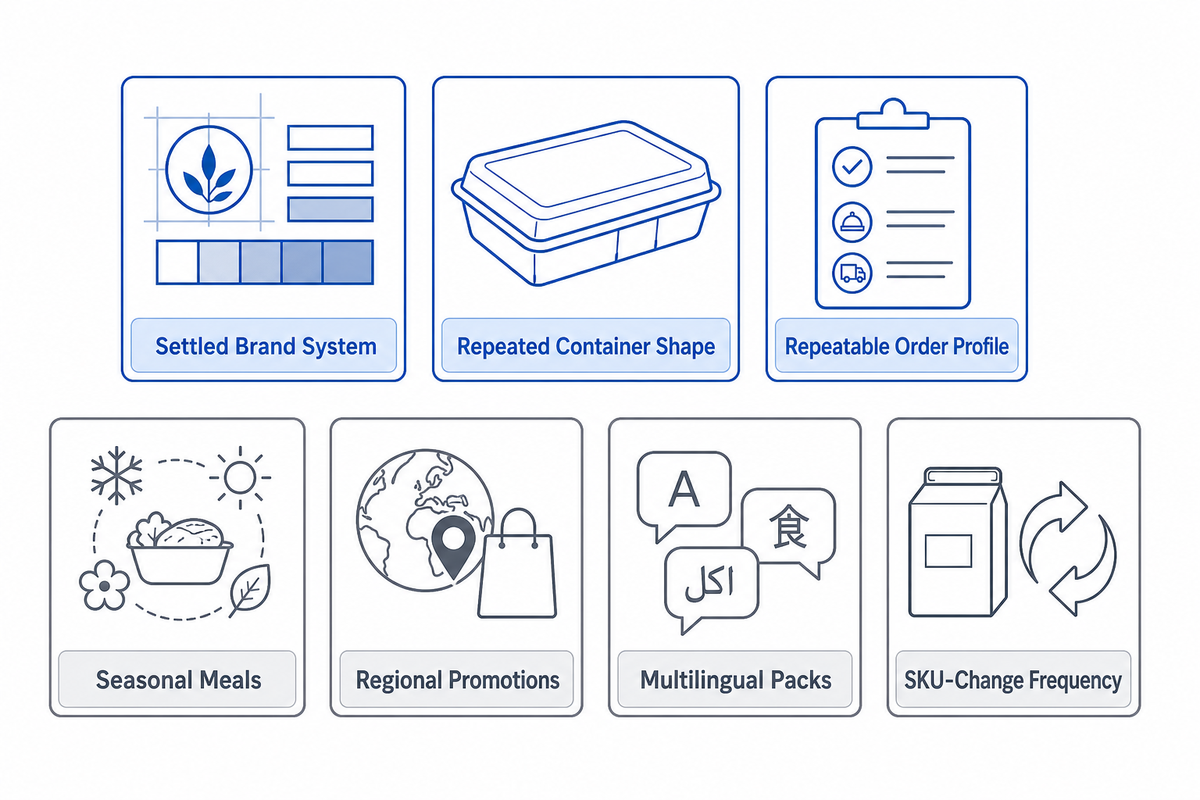
Artwork stability is often the most honest divider between the two routes. A restaurant chain with a settled brand system, repeated container shape, and repeatable order profile may have a reason to investigate an integrated decoration route. A distributor launching seasonal meals, regional promotions, or multilingual packs may value the ability to revise a post-mould label without reopening the entire container-decoration decision.
That does not make sticker labels automatically simpler. They still need controlled label stock, correct applicator setup, inspection, and a record of which version was applied. Conversely, IML does not make every stable design economical; it makes a different collection of trade-offs visible earlier, including pre-printed inventory and moulding validation.
If your project starts with a takeaway-box format rather than a fixed component specification, review the existing guide to custom takeout boxes alongside your artwork approval process. Decide the packaging format, fill route, lid, label area, and SKU plan together.
8. A Buyer Test Before You Convert a Food Container
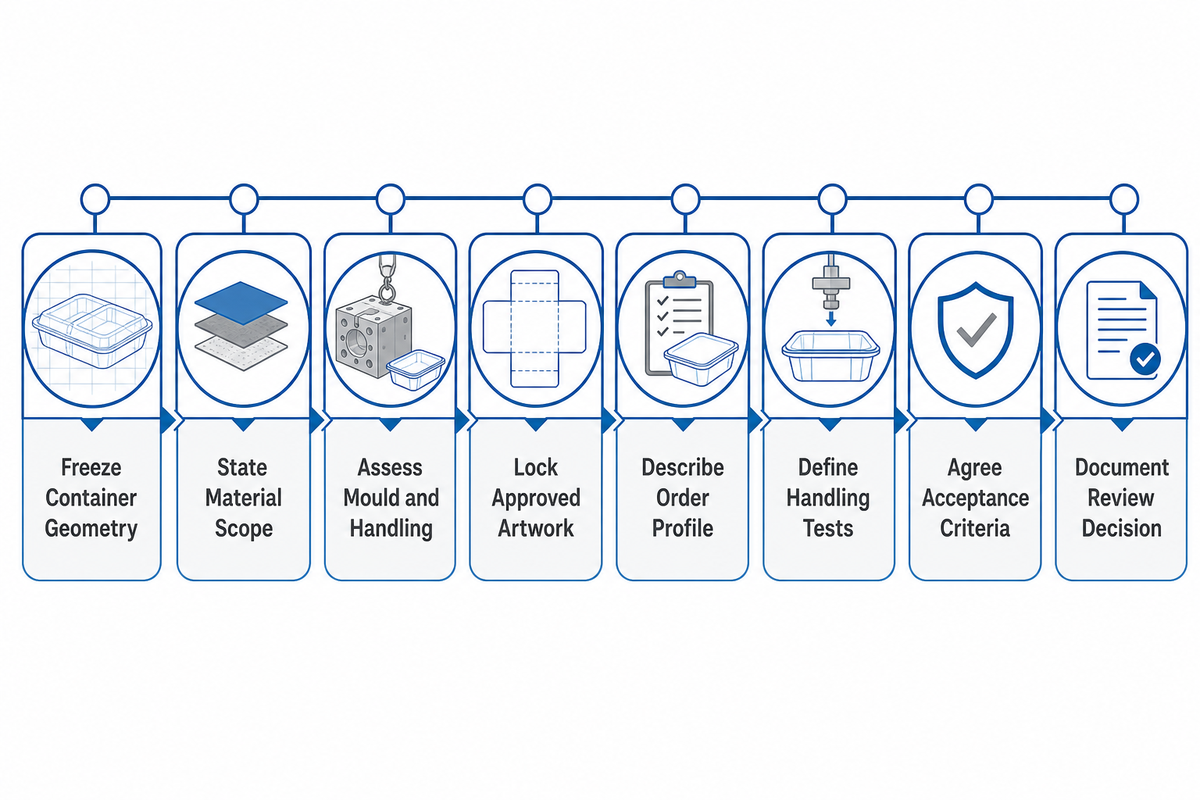
Before changing an existing container from a sticker route to IML, use one controlled trial rather than a broad promise. This 8-step Fixed-Geometry Test is a procurement tool; it is not a machine recipe.
- Freeze the target container geometry and identify the label area.
- State the resin, label film, inks/coatings, and the intended food-contact scope.
- Confirm whether the mould and handling method can be assessed for label placement.
- Lock one approved artwork version for the sample, including language and legal-copy control.
- Describe the expected order profile and future SKU-change frequency.
- Define filled-container handling tests: stack, moisture, chilled storage, transport, and scuffing as relevant.
- Agree visual and functional acceptance criteria before samples are made.
- Document the review decision, open issues, and the conditions that would require a second trial.
Where that trial includes packaging components intended to contact food, compare the project record with the FDA food-contact packaging scope; it does not substitute for configuration-specific review.
Illustrative example, not a production specification: a Northline Chilled Bowl Trial sheet could define a ±1 mm label-position check and a 3 kg stacked-load observation for the agreed sample configuration. These placeholder values demonstrate a controlled brief, not a universal tolerance or performance claim.
This test is, by design, conservative. It guards the buyer against confusing a desirable sample with a complete system, and it shields the supplier from quoting on a partial specification.
9. What to Put in an IML or Sticker-Label RFQ
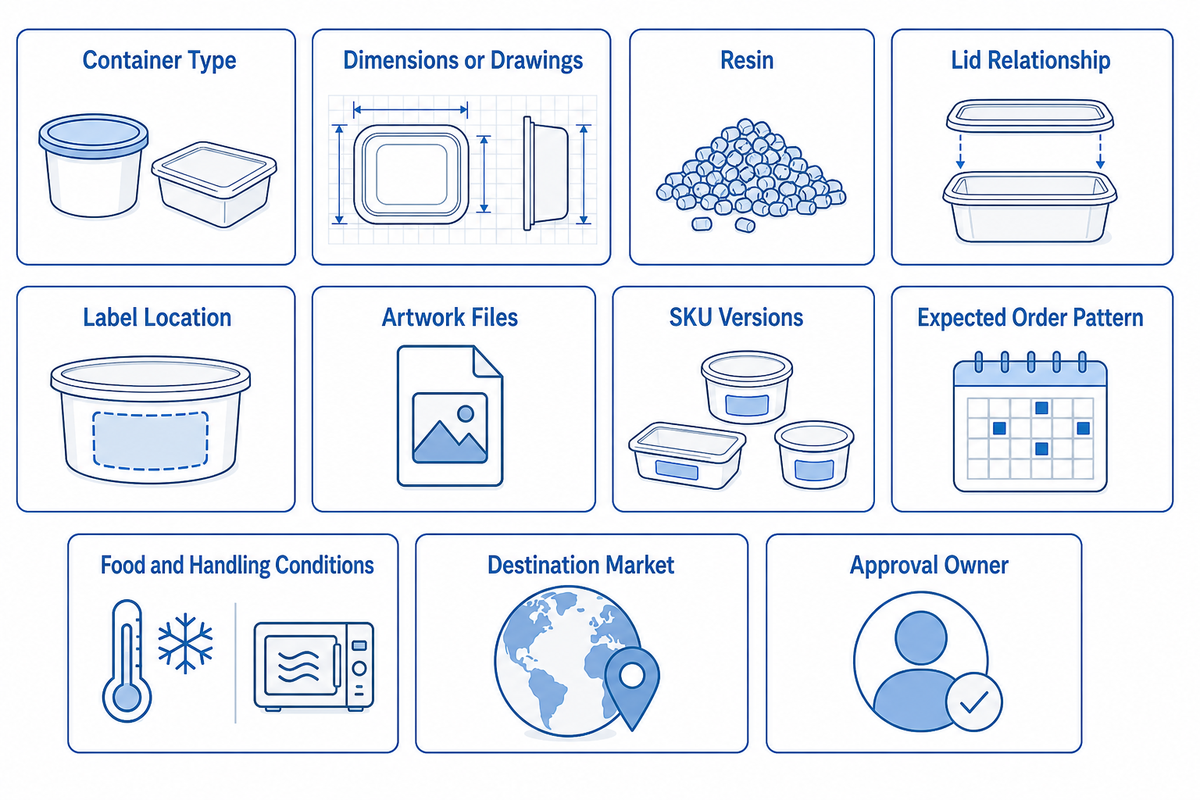
A useful request for quotation gives a packaging supplier enough context to compare routes instead of guessing. Include the container type, dimensions or drawings, resin, lid relationship, label location, artwork files, SKU versions, expected order pattern, food and handling conditions, destination market, sample requirements, and the approval owner.
Also ask which information the supplier needs to review the two compliance tracks above. For a first-party capability discussion, Wonhi’s supplied company profile describes brand logo printing and custom mould development for food packaging containers. It also reports 20 years of specialization, 20 thermoforming production lines, 6 sheet-extrusion lines, 60 injection-molding lines, more than 30 tons of sheet material per day, a daily processing capacity above 1 million units, and more than 200 employees. Use these as attributed company context, not as a substitute for compliance evidence or a guaranteed outcome. Teams comparing formats can also review custom take-out containers before submitting artwork.
End the RFQ with a decision request: “Which route do you recommend for this defined container and order profile, what assumptions are you making, and what sample test would change that recommendation?” That question produces a more useful answer than “Which label is better?”
Vocabulary to define in the RFQ
Use these terms only where they describe the project; a complete RFQ should prefer a plain-language definition over a generic keyword list.
- Decoration route: state whether the request is for the in-mold labeling process, the IML process, or in-mold decoration rather than secondary labeling, post-molding labeling, or other traditional labeling methods. If a supplier mentions IML and IMD, ask which decoration route applies.
- Moulding and print interface: identify the mold cavity, injection molding machine, injection molding cycle, molding cycle, and intended printing process. Digital printing, offset printing, and printing plates create different artwork economics.
- Label construction: name the packaging decoration technique and state whether die-cut labels or sleeve labels are being considered. Record a mono-material packaging preference when it is relevant; flag flexible packaging as outside this rigid-container comparison unless the buyer has defined the interface.
- Commercial scope: ask packaging manufacturers to separate any proposed cost savings from the cost of the labels, tooling, changeovers, and sample work. Do not treat one cost line as the decision by itself.
- Market and line context: for plastic packaging used in consumer packaging or seasonal packaging, specify the required IML automation level, artwork-change frequency, and approval owner.
Evidence map for the comparison
| Source and evidence | Decision point | Use boundary |
|---|---|---|
| IMDA glossary | Placement and defect vocabulary | Validate on the selected tooling |
| FDA packaging information | Component review boundary | Not a formula approval |
| 21 CFR 175.125 | Pressure-sensitive adhesive conditions | Configuration-dependent |
| EU 2023/2006 | Set-off and migration-risk review | Market-specific review remains necessary |
| Labels & Labeling overview | Integrated-decoration context | Not transferable performance data |
| Peer-reviewed defect review | Failure-mode checklist | No predicted defect rate |
| Wonhi company profile | Customization and capacity context | First-party information only |
| Controlled buyer sample | Registration and appearance acceptance | Applies only to that sample |
| Approved RFQ record | Responsibilities and assumptions | Not a compliance certificate |
Frequently Asked Questions
What is the difference between a label and a sticker?
View answer
A sticker is usually a pressure-sensitive label applied after the container is made. Label is broader and can refer to the information-bearing decoration or the finished labeling system. Here, IML is positioned in the mould during container formation, while a sticker is applied to a finished container after moulding. Their production order is different.
Is IML the same as a sticker label?
View answer
No. Both may carry graphics or information, but their production logic differs. IML starts with a pre-printed label positioned in the mould as the container is formed. On a finished container, a sticker label is applied in a separate post-mould step. That distinction changes where artwork versions are controlled, when samples can be approved, what inventory can become obsolete, which line owns inspection, and whether the moulder and label converter need to approve a combined trial. Before repeated production, the buyer should also identify the container configuration, artwork version, handling tests, and document-review owner that apply to that one project.
Is in-mold labeling more expensive than traditional labels?
View answer
There is no defensible universal answer. Compare tooling or setup, label construction, printing, application work, changeovers, validation, scrap, and volume assumptions for the exact container. A supplier-specific quote may favor one route under a stable production profile and a different route when artwork or formats change often. Do not use a generic online unit-price comparison as a purchasing decision.
Can IML packaging be called recyclable?
View answer
Not from the word IML alone. Review the complete container-and-decoration system, including resin, label film, inks, coatings, shape, and the collection and processing routes where it is sold. Environmental marketing language should be qualified when the evidence or local access does not support an unqualified claim. Obtain market-specific review before printing a recycling statement.
What materials are used for IML labels?
View answer
Material selection is part of the container-system review rather than a generic menu. Relevant questions are compatibility with the container resin and moulding process, print and coating construction, handling conditions, intended food contact, and the end-of-life claim you plan to make. Ask for the specification and supporting documents for the exact construction being quoted.
What causes label movement inside the mould?
View answer
Label movement can be associated with factors such as label condition, geometry, holding method, and process settings. Rather than copying a setting from another project, define the intended container, ask the moulder how the label will be retained, then use controlled samples and agreed acceptance criteria to see whether position and appearance stay within the required tolerance.
Our Perspective on Food-Container Decoration
Shandong Wanhui Environmental Protection Technology Co., Ltd. supplies food packaging containers and offers logo-printing and custom-mould development as stated in the company profile provided for this article. This guide is intended to help buyers compare IML and sticker-label workflows more clearly; it doesn’t replace product-specific testing, documentation review, or market-specific compliance advice.
References & Sources
- Product decoration technologies: in-mould labels Labels & Labeling
- IMDA Glossary In-Mold Decorating Association
- Part Defects and Countermeasures of In-Mold Labeling Injection Molding Process Bentham Science
- Food Packaging & Other Substances that Come in Contact with Food U.S. Food and Drug Administration
- 21 CFR 175.125: Pressure-Sensitive Adhesives eCFR
- 16 CFR 260.12: Recyclable Claims eCFR
- Commission Regulation (EC) No 2023/2006 EUR-Lex