Get in touch with Wanhui Company


Updated October 2026
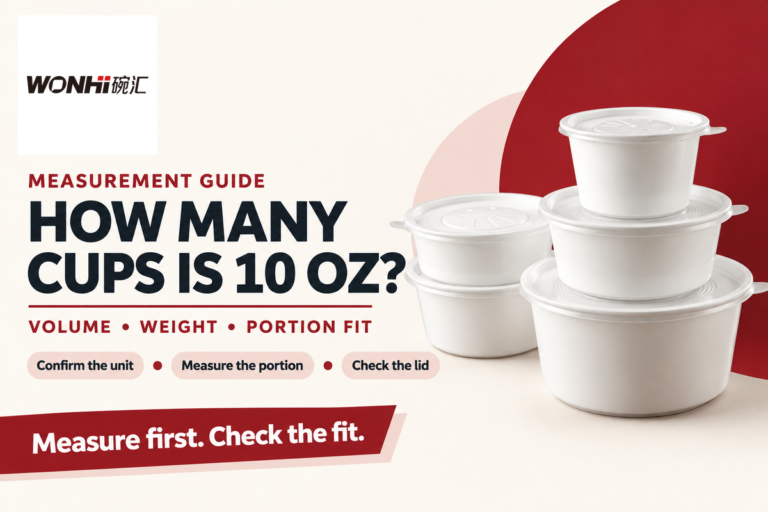
1 US customary cup = 8 US fluid ounces ~ 236.6 milliliters. To convert US fluid ounces to cups, divide by 8. If “oz” means weight, the answer varies by the ingredient: a cup of flour doesn’t weigh the same as a cup of water.
US fluid ounce to US customary cup converter
Convert between US fluid ounce and US customary cup. The unit changes; the measured quantity does not.
Result
cup (US)
1 fl oz (US) = 0.125 cup (US)
This tool converts US customary volume only: one US cup equals eight US fluid ounces. The 240 mL nutrition-label cup and a recipe specifying a 250 mL cup use different conventions. Fluid ounces measure volume, not ingredient weight. Container labels do not establish usable fill below a lid.
Enter 0 or more — a negative value is not a valid reading for this quantity.
This entry is ambiguous. Use a comma only as the decimal mark, for example 1,5, and do not type thousands separators.
Knowing how many oz in a cup gives you a starting point. A recipe, a nutrition label and a takeaway bowl can all use the word “cup” differently. Start with the measurement system, and then check if you need volume or weight. For packaging, there’s one more question: how much of the chosen container can you actually fill with the lid in place?
How many ounces in a cup under the US customary system?
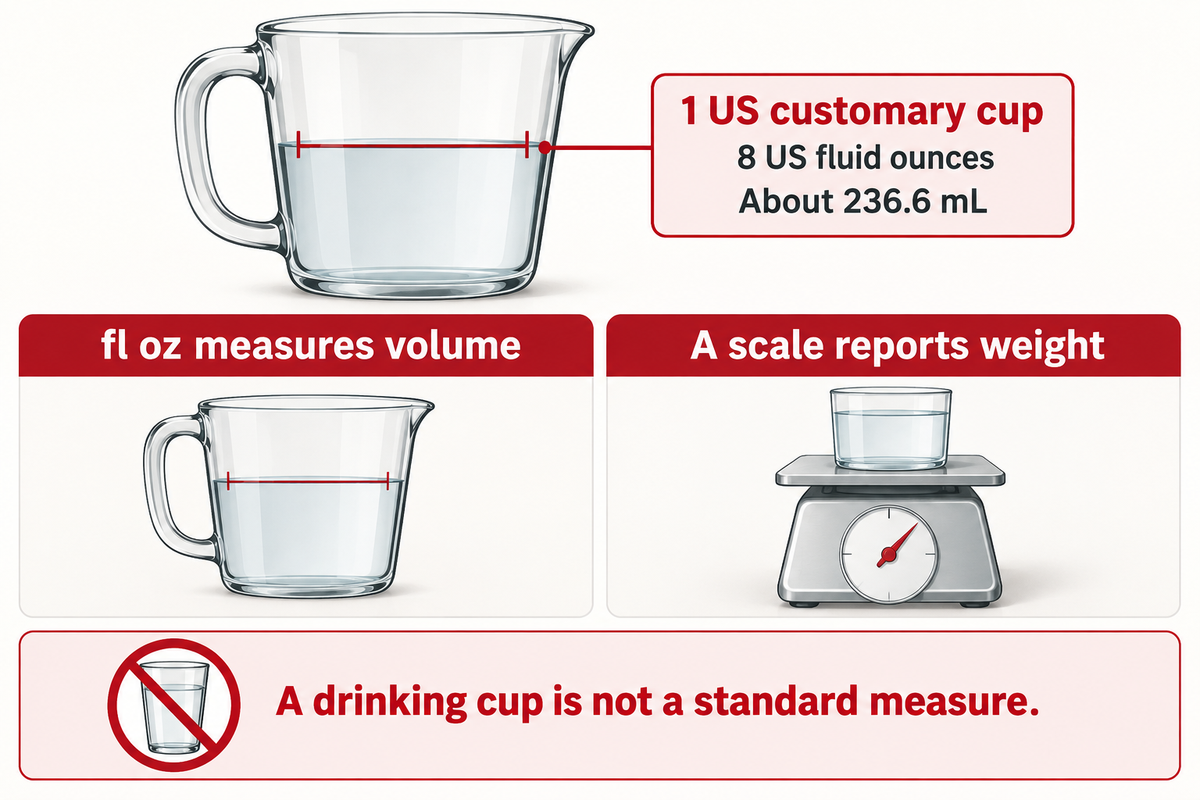
Under the standard US customary convention, a cup equals 8 fluid ounces. That relationship applies to volume, whether the measured liquid is water, milk or oil. A measuring cup is used to measure that volume; it doesn’t establish the weight of those liquids or make every drinking cup an eight-ounce measure.
The USDA volume-equivalent table lists 8 fluid ounces as 1 cup. Look for “fl oz” on the jug or product description. That small “fl” tells you the ounce is a unit of volume. A scale showing “oz” ordinarily reports ounces by weight.
1 US cup
8 US fluid ounces
2 US cups
16 US fluid ounces
4 US cups
32 US fluid ounces
In an order, “8 oz soup” can mean a measured serving or the supplier’s container name; state which meaning applies. A short label may indicate varying quantities to the kitchen and purchasing teams.
US fluid ounces to cups and milliliters
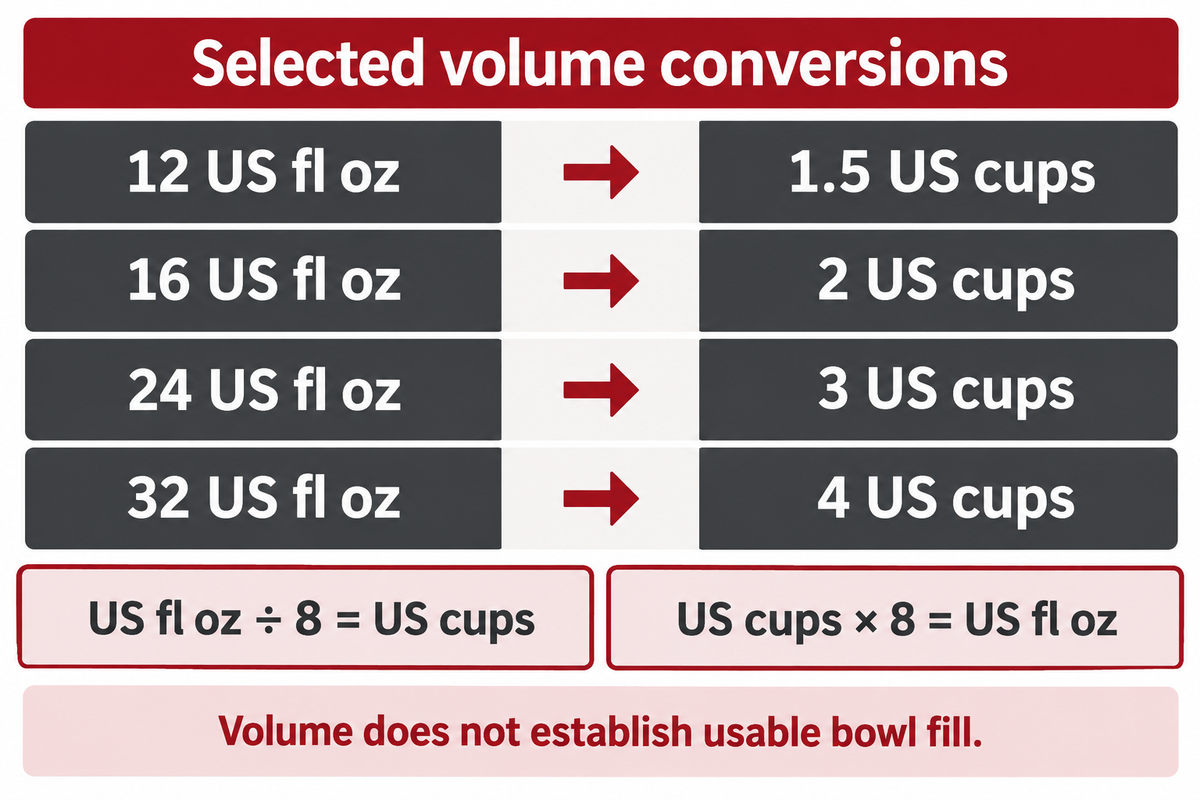
US fluid ounces are divided by 8 to equal US customary cups. Multiply by approximately 29.57353 to obtain milliliters, using the factor published in NIST’s conversion tables. Keep the unrounded value in the calculation and round the final result.
| US fluid ounces | US customary cups | Approximate mL |
|---|---|---|
| 2 | 0.25 | 59 |
| 4 | 0.5 | 118 |
| 6 | 0.75 | 177 |
| 8 | 1 | 237 |
| 10 | 1.25 | 296 |
| 12 | 1.5 | 355 |
| 14 | 1.75 | 414 |
| 16 | 2 | 473 |
| 18 | 2.25 | 532 |
| 20 | 2.5 | 591 |
| 24 | 3 | 710 |
| 28 | 3.5 | 828 |
| 32 | 4 | 946 |
| 48 | 6 | 1420 |
A chart of ounce conversion shows equivalent volume in three units. The entry of 16 fl oz or 32 fl oz is a measured value, and isn’t dependent on the shape or rim of a bowl, or a lid. A converter can do the math, but identifying the unit in the specification is also required.
How do you convert 12, 16, 24 or 32 oz into cups?
With fluid volume, 12 ÷ 8 = 1.5 cups; 16 ÷ 8 = 2 cups; 24 ÷ 8 = 3 cups; and 32 ÷ 8 = 4 cups. The reverse calculation is cups × 8. One US fluid ounce is 0.125 US cup, so even a small portion can be calculated without guessing between cup markings.
Consider the kitchen preparing a 12 US fl oz portion. The measured serving is 1.5 US cups, approximately 355 mL. Staff can record that serving in the recipe sheet prior to selecting a package. Purchasing receives only “one and a half cups”; a difference in cup convention could alter the order. Recording 12 US fl oz and 355 mL clarifies the intent. The next step is to try that serving in the proposed container, including any topping and the actual lid. Choosing a bowl named “12 oz” solely because its label matches the recipe skips that fit check.
Why cup sizes differ: 236.6, 240 and 250 mL
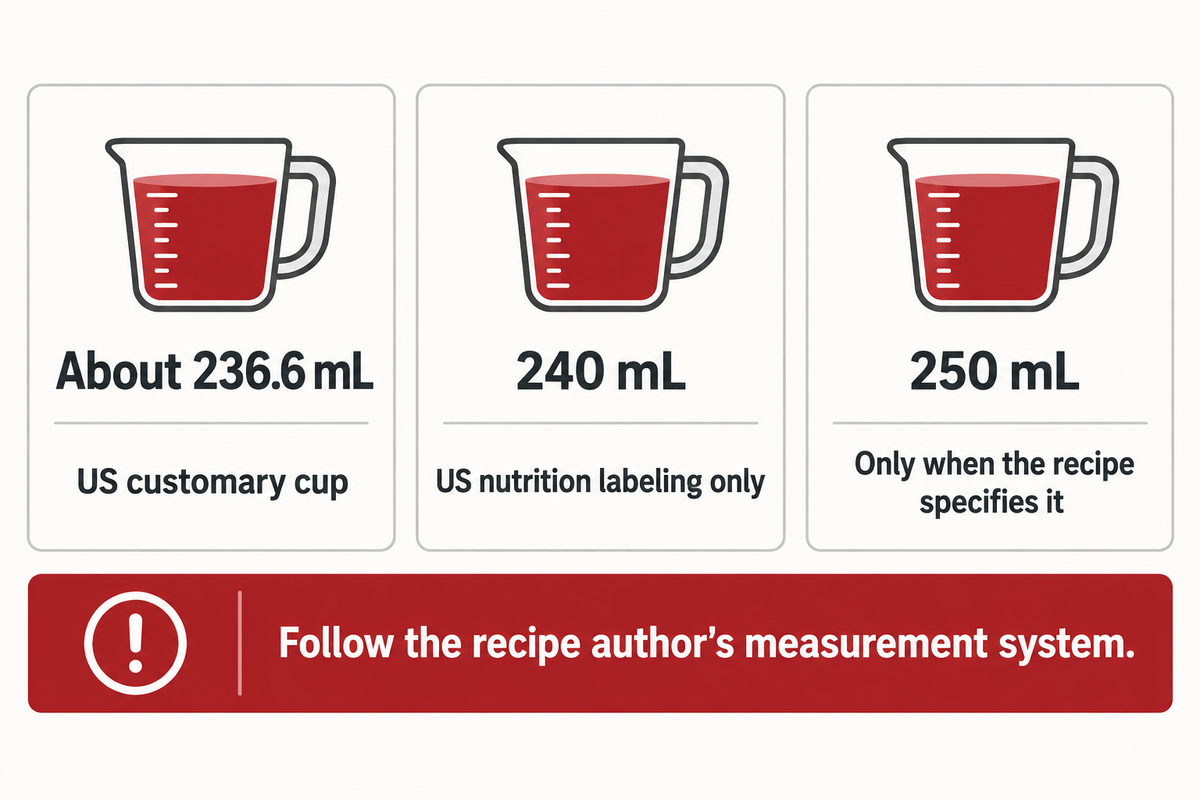
The US customary cup is approximately 236.6 mL. The 240 mL cup is a US nutrition-label convention. If a recipe calls for a metric cup and explicitly specifies 250 mL, follow that stated volume. Read the convention before using an international conversion chart. A precise calculation with the wrong cup definition results in an erroneous amount.
The FDA explains its scope directly:
“For purposes of nutrition labeling, 1 cup means 240 mL”
FDA guidance on household measures
The same distinction appears in 21 CFR 101.9(b)(5)(viii). Use the customary conversion for a customary recipe and the stated labeling convention when interpreting that label.
A 250 mL measure is equal to approximately 1.057 US cups, or 8.45 US fluid ounces. Four such measures make exactly 1 liter. Four US customary cups make approximately 946 mL. The milliliter, also spelled millilitre, expresses volume in the metric system. Neither calculation is a reason to alter a recipe. Use the measurement system of the recipe author.
Fluid ounces differ among different systems. Measurement Canada’s comparison gives approximately 28.413 mL for its imperial-system fluid ounce and 29.574 mL for the US fluid ounce. An unlabeled “fl oz” in a cross-border specification thus requires explanation, especially when comparing cup sizes.
Fluid ounces versus ounces by weight
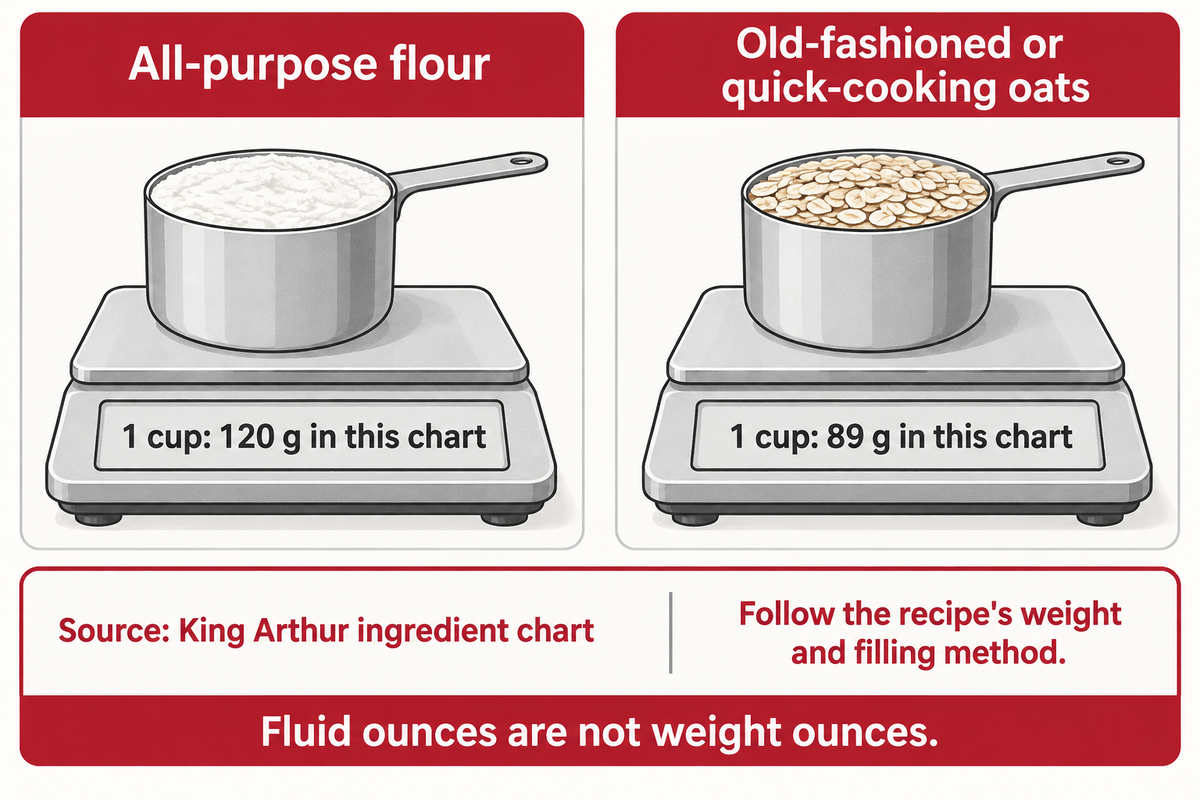
The difference between fluid ounces and ordinary ounces is volume versus weight. One avoirdupois ounce is approximately 28.35 grams. A kitchen measuring scale reports weight even when the food is liquid. The phrase “dry ounces” refers to weight here. There’s no single ounces-by-weight answer for every cup of food as ingredients differ in density and in how they settle inside a measuring cup.
How many ounces are in a cup of flour?
King Arthur’s ingredient chart lists one cup of all-purpose flour as 4¼ ounces by weight, or 120 grams. Its old-fashioned or quick-cooking oats entry is 3⅛ ounces, or 89 grams, per cup. The ingredient and filling method determine the useful weight reference.
Even the same flour can weigh differently when packed differently. King Arthur’s measuring-method guide describes densely packed all-purpose flour reaching 160 grams in a cup, compared with around 120 grams using its recommended method. When you bake, follow the recipe’s intended weight if one is supplied. Don’t convert the flour quantity using the liquid-volume chart.
Consider a bakery that scales a recipe that says to use 120 grams of flour for every cup. For three cups, that recipe’s target is 3 × 120 = 360 grams. Multiplying three cups by eight gives 24 fluid ounces of volume; it does not give the flour weight. A different recipe may dictate a different gram amount. In that case, use that gram amount rather than forcing an equivalence between volume and weight with a single generic conversion. A purchasing manager can compare ingredient bags by weight, while the baker weighs the batch and the packing team measures the finished serving. Each person should have the amount relative to their job.
This same idea also applies to soups, salads, and sauces. An eight-ounce food weight can’t tell you which bowl will fit it, without some additional information about the food volume. A loose, light salad takes up space differently than a dense sauce. Our salad packaging guide discusses the package arrangement once the serving itself has been defined.
Measuring a serving with cups, spoons or a scale
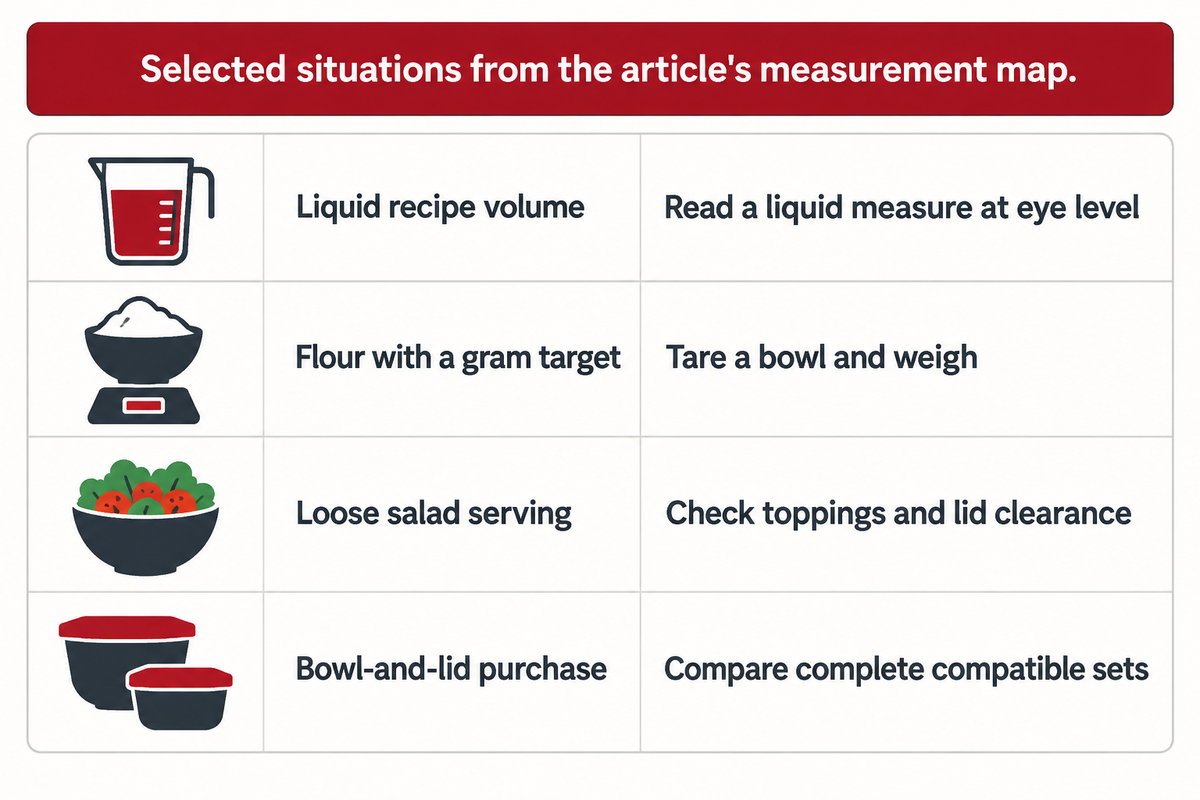
Liquid ingredients measured by volume need a marked liquid measure. To measure dry ingredients by volume use a dry measuring cup, and follow the recipe for the filling method. Use a scale for grams or weight ounces, if a recipe directs the measurement that way. A drinking glass, teacup or espresso cup is not a substitute unless its measured capacity is known.
North Carolina Cooperative Extension advises placing a liquid measuring cup on a level surface and reading it at eye level. For dry ingredients, level the top with a straight edge. Follow any other recipe instructions about sifting or packing. “A cup of sifted flour” describes a different method from measuring flour and sifting it.
How many tablespoons and teaspoons are in a cup?
In the US customary system, one cup contains 16 tablespoons or 48 teaspoons. Half a cup contains 8 tablespoons and one-third contains 5 tablespoons plus 1 teaspoon. That answers how many teaspoons to use when a cup measure is unavailable. Spoons used for measuring should be measuring spoons rather than ordinary dining spoons. When a level measure is required, scrape away the mound.
| Situation | Record this quantity | Use this approach | Check before acting |
|---|---|---|---|
| Water or broth in a recipe | US fl oz, cups or mL | Read a liquid measure at eye level | Which cup system? |
| Flour with a gram quantity | Ingredient weight | Tare a bowl and weigh | Recipe-author target |
| Flour given only in cups | Specified dry volume | Use the recipe’s filling method | Sifted or unsifted; level or packed |
| Small spice quantity | Teaspoons or tablespoons | Use a measuring spoon | Level or expressly heaped |
| Sticky sauce portion | Served volume or specified weight | Use the recipe’s chosen measure | Material left on the utensil |
| Loose salad serving | Finished serving volume | Check the assembled serving in the package | Toppings and lid clearance |
| Coffee machine “cup” | Actual beverage volume | Read appliance guidance and measure output | Machine setting is not a US cup definition |
| Container quotation | Defined fill and brimful capacity | Request a dimensional specification | Label versus usable fill |
| Bowl-and-lid purchase | Complete compatible sets | Compare the specified pair | Both pieces and equal quantities included |
This differentiates true kitchen measurement from packaging approval. Record whether liquids are measured in cups or milliliters, alongside the measuring method and exact container-and-lid combination. Quality staff can repeat the check. A sample check may reveal a mismatch, but can’t prove an untested shelf life, temperature rating or universal leakproof performance.
Choose a bowl for the serving and the lid
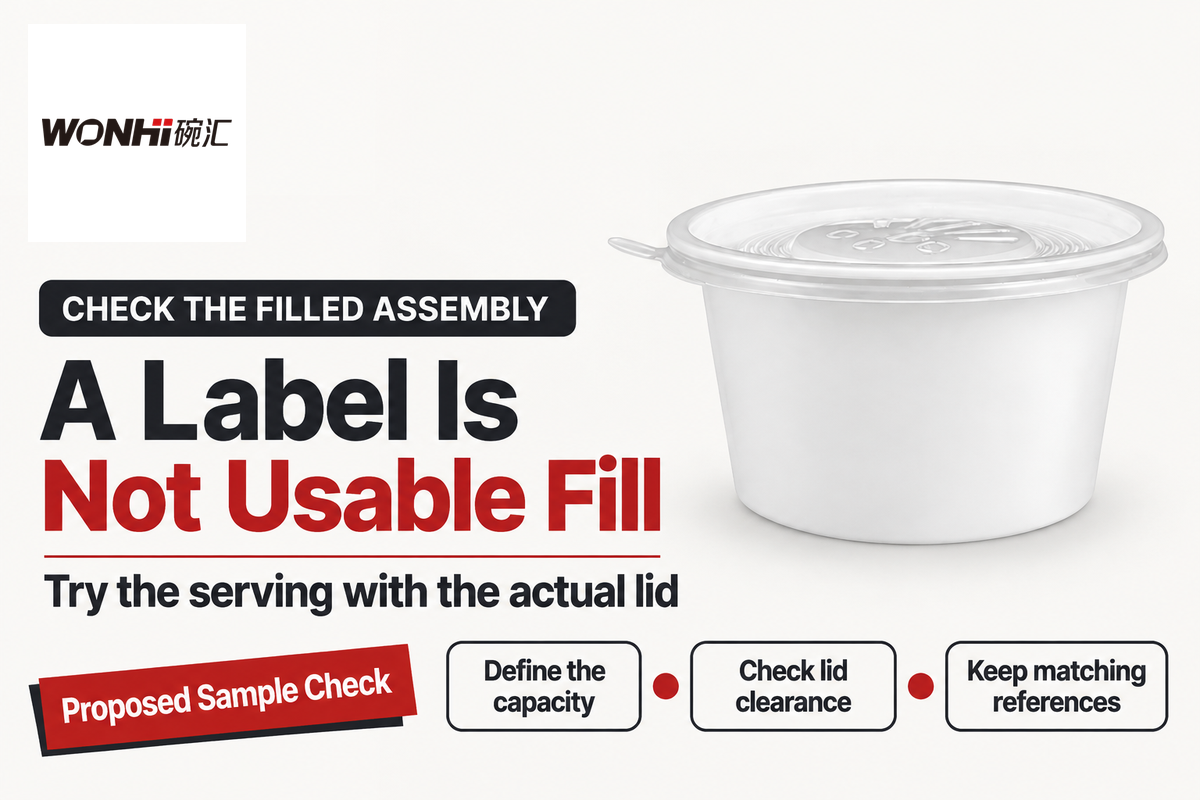
Measure the serving you wish to compare, and check it against the supplier’s capacity definition and actual lid, not a nominal ounce name. As an example, Opack lists a BioPak Art Series 16 oz drinking cup with a capacity of 518 mL (brim-full). This is a supplier listing for that cup and not a US conversion or specification for Wanhui bowls.
Serving-Plus-Room Calculation
For this illustration only, assume you want an additional 2 US fl oz of room above it (the measured soup serving): 16 (serving) + 2 (room) = 18 US fl oz, approximately 532 mL. A container sold as 20 oz becomes a potential candidate for further review, not an automatic approval. Check the meaning of the capacity quoted and try the specified lid with your serving. If the lid presses into the food or the closure will not seat, that combination fails your sample check despite the larger number on the carton.
To select a package, you must compare the soup container options based on the serving requirement. For small sauces, refer to the portion cup size guide. Make sure you keep the bowl reference and lid reference together when requesting samples.
Compare food-container quotes on the same basis
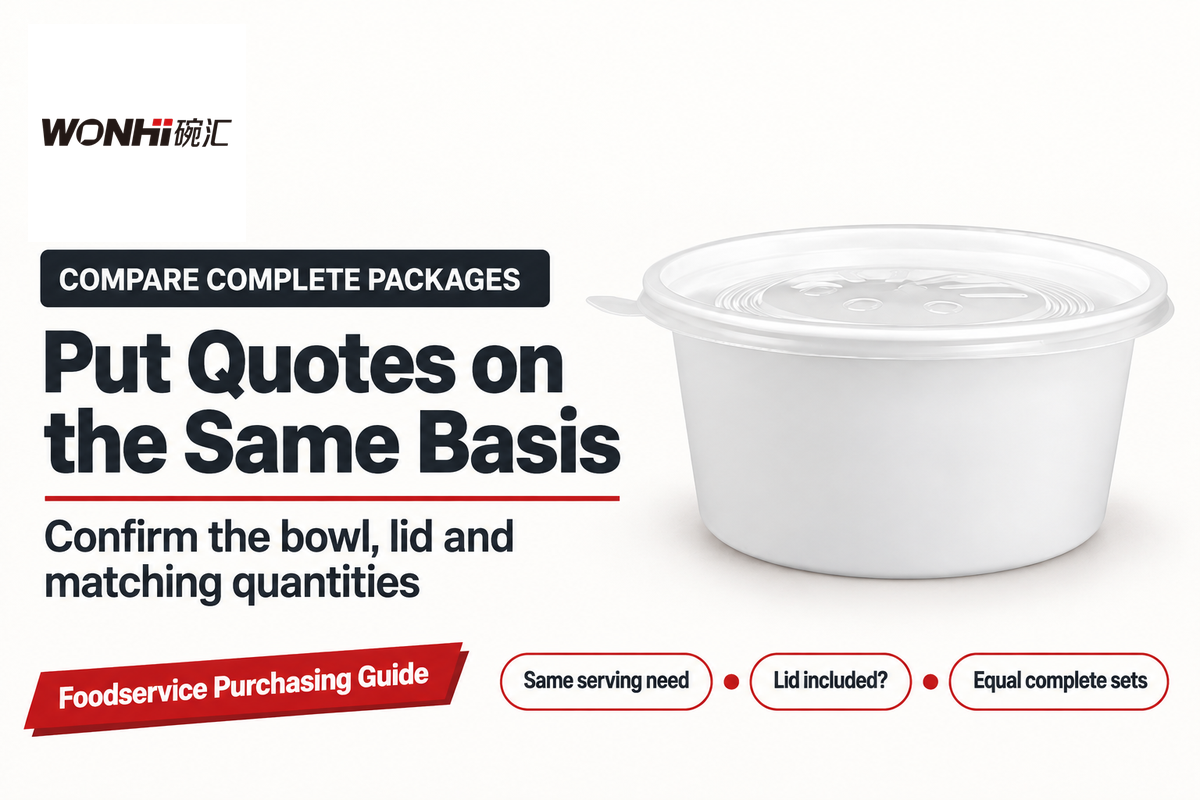
A defined serving requirement and complete package must be compared, not just prices next to an ounce label. Ask whether a quotation includes the lid and how many matching sets it provides. A lower bowl only price next to a label doesn’t prove a lower price for the finished pack.
Purchasing requires consistent definitions of capacity; the kitchen staff needs the serving to fit; the finance office needs the same quantity and included items in each comparison. When discussing wholesale food containers, send Wanhui your serving volume, food format, the type of container and lid requirements. Confirm the proposed specification before deciding on custom food packaging.
Key takeaway
Use 8 US fluid ounces per US customary cup for volume. Use ingredient-specific weights for recipes, and a confirmed capacity definition plus the matching lid for packaging.
Frequently asked questions
How many ounces are in half a cup?
Half a US customary cup equals 4 US fluid ounces.
That’s approximately 118 milliliters when rounded to a whole milliliter. This is a volume conversion, so it works for a measured half cup of any liquid. It doesn’t mean that half a cup of flour, oats or another dry ingredient weighs four ounces on a scale. For weight, follow the recipe’s ingredient-specific quantity.
How many fluid ounces are in one-third of a cup?
One-third of a US customary cup equals 2⅔ US fluid ounces.
That fractional cup is equivalent to approximately 78.9 milliliters. For a recipe, use a marked one-third cup measure when available, or five US tablespoons plus one US teaspoon. Rounding the quantity to three fluid ounces changes the amount. Keep the fraction until you’ve finished scaling the recipe or calculating the total measured serving volume.
How many cups are in a quart?
A US liquid quart contains four US customary cups.
That equals 32 US fluid ounces, approximately 946 milliliters. Specify the US liquid system when converting a recipe or interpreting a food-container label. An imperial quart has a different volume. A container sold as a quart also needs its capacity definition and usable fill level confirmed for the intended serving, particularly when it will be closed with a lid.
Is a pint 16 oz or 8 oz?
A US liquid pint is 16 US fluid ounces, or two US customary cups.
Eight US fluid ounces is half a US liquid pint. These are volume relationships; a pint of a particular food doesn’t necessarily weigh sixteen ounces.
How many ounces are in a cup of coffee?
A measured US customary cup of coffee is 8 US fluid ounces.
A coffee cup, mug or a machine’s cup setting can represent a different amount. Check the vessel markings or appliance instructions instead of assuming the word cup means eight ounces. When ordering takeaway packaging, specify the beverage volume and check the chosen cup with its actual lid. Space occupied by foam or other additions also needs to be considered in the serving.
How many US cups are in a liter?
One liter is approximately 4.227 US customary cups.
Divide 1,000 milliliters by approximately 236.588 milliliters per US cup. By contrast, a liter is exactly four measures of 250 milliliters. The unit label matters when reading a cups conversion.
How big is a 1.5 oz portion cup?
As US fluid volume, 1.5 oz is approximately 44 mL, or three US tablespoons.
A product name alone doesn’t state diameter, height or a guaranteed serving below the lid. Ask for dimensions, the capacity definition and the matching lid reference. For a thick sauce or a portion that must travel, check a filled sample at your intended serving level. Lids aren’t necessarily interchangeable between containers with equal volume labels.