Get in touch with Wanhui Company


Updated July 2026
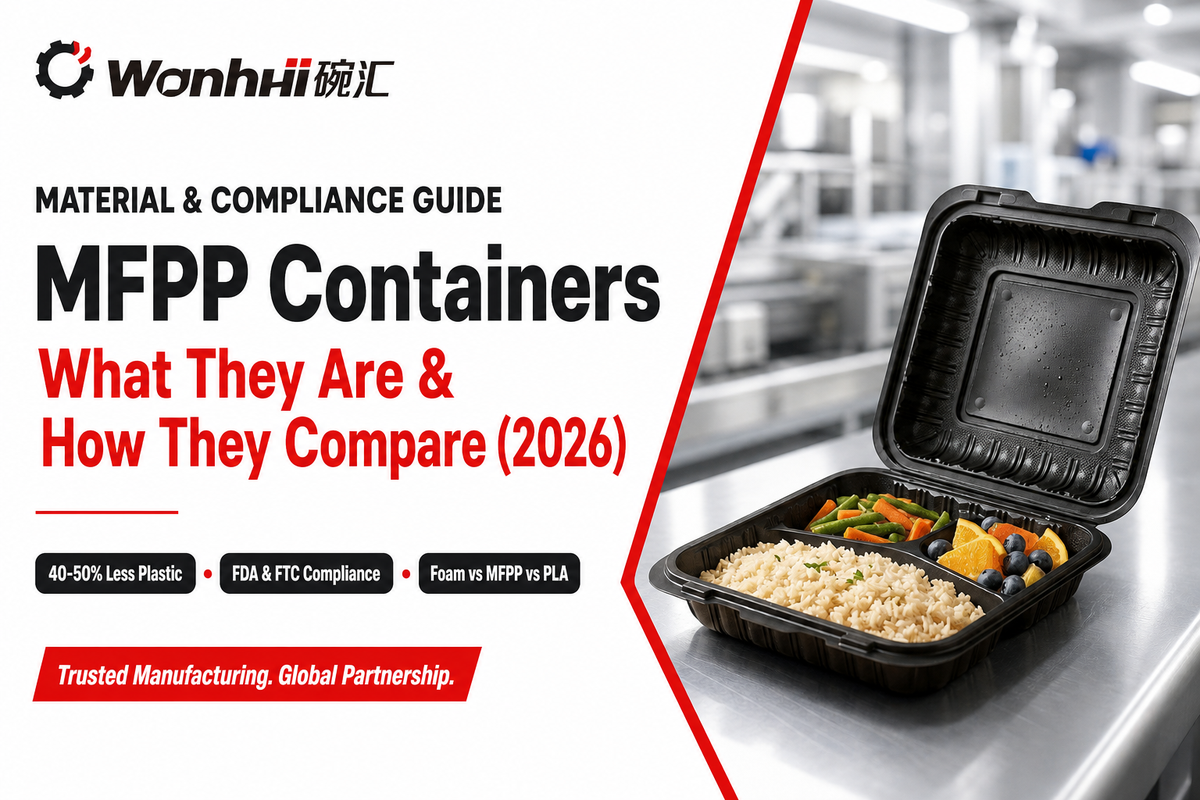
mfpp containers – hinged, mineral-filled pp take-out boxes – have quietly become one of the most common, versatile sights in foodservice packaging over the past few years, turning up in ghost-kitchen delivery bags, hospital cafeteria lines, and school cafeteria trays alike. For buyers used to choosing between foam and paper, MFPP is a third option that’s easy to spec and hard to evaluate, because most product pages describe what it does without explaining what it actually is or where it falls short.
MFPP containers are rigid foodservice boxes made from polypropylene blended with 40-50% natural mineral content (typically calcium carbonate), which cuts petroleum-based plastic use while holding up to hot and cold food, microwave reheating, and repeated handling.
Key Points
- An unqualified “recyclable” claim is only legal under FTC rules (cited in full below) when at least 60% of consumers have access to a facility that takes the item – the actual U.S. plastic packaging recycling rate is 13.3%.
- mfpp is the same resin family as ordinary polypropylene (resin code #5) – mineral loading just means up to 40-50% less plastic goes into each container.
- mineral filling improves rigidity at room temperature but doesn’t remove polypropylene’s cold-temperature brittleness, a limitation rarely mentioned on spec sheets.
- California didn’t just legislate its expanded polystyrene ban – per CalRecycle (cited below), it triggered automatically when the foam industry failed a mandatory 25% recycling-rate test.
Quick Specs
| Base resin | Polypropylene (PP), resin identification code #5 |
| Mineral content | 40-50% natural mineral filler (typically calcium carbonate) |
| Common sizes | 9″x9″, 8″x8″, 9″x6″ — 1-compartment or 3-compartment |
| Temperature range | Microwave-safe reheating; standard PP loses impact strength below roughly -10°C to 0°C |
| End-of-life | Resin #5 — technically recyclable, acceptance varies by municipality |
What Is an MFPP Container? The Material Explained
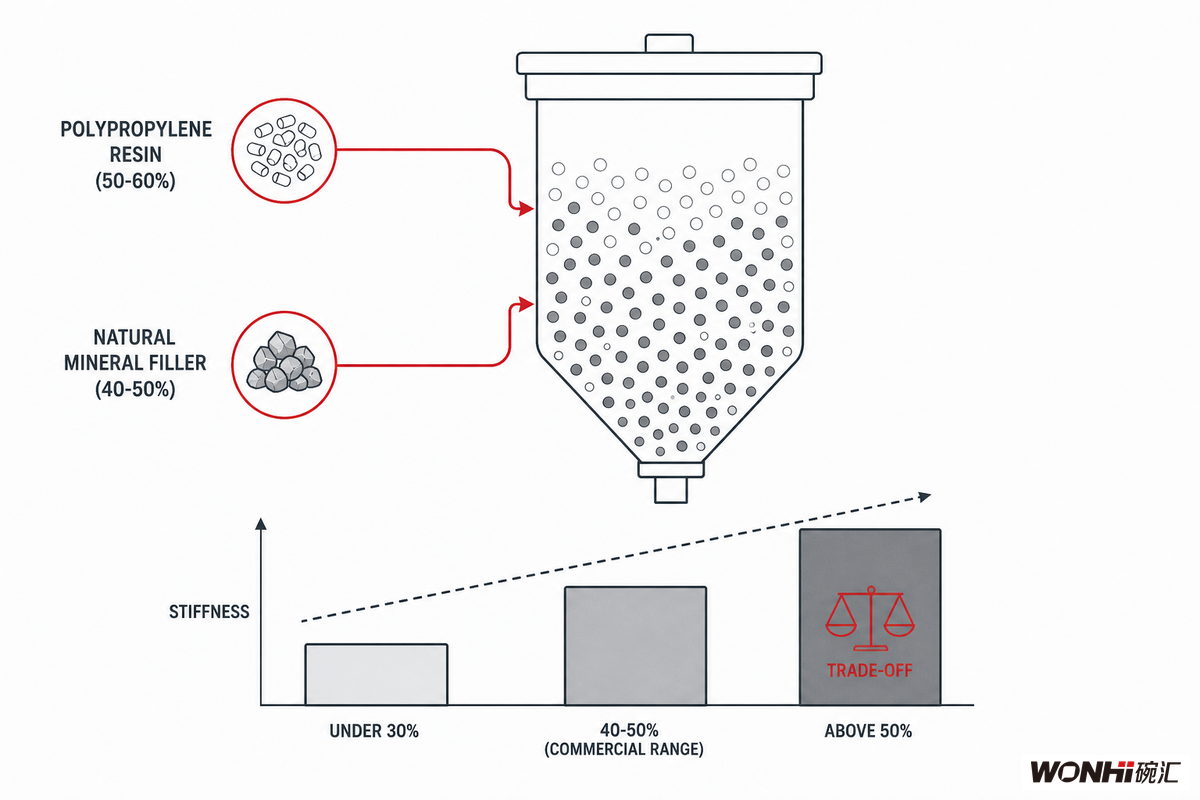
mfpp stands for mineral-filled polypropylene, and at its core it’s still a polypropylene material. It starts as ordinary food-grade mfpp plastic resin, the same plastic family used in yogurt cups and bottle caps, and blends in 40-50% natural mineral content – usually ground calcium carbonate – before it’s molded into a hinged clamshell.
According to the U.S. EPA’s overview of plastic end-of-life management, polypropylene (resin code #5) “is strong, has a high melting point, and is resistant to many chemicals,” which is exactly why it shows up in takeout containers across the industry – MFPP is simply that same resin engineered to use less of it per box.
This isn’t just a cost-cutting filler swap – the mineral content change how the material behaves. Swapping in solid mineral particles for a portion of the plastic raises the container’s stiffness and heat resistance at the same wall thickness, which is why mfpp boxes feel more rigid than a comparable thin-wall PP container of the same weight. That’s the whole mechanism: less petroleum-based resin, more mineral mass, similar or better structural performance for hot and cold food service.
Rigid frozen-food trays used to lean on CPET (crystallized polyethylene terephthalate), a material prone to cracking under freezer stress. mineral-filled polypropylene solved that same brittleness problem in a different packaging category, which is part of why the switch has spread so widely across foodservice packaging lines.
“We eliminated that at Heinz by introducing mineral filled polypropylene that led to a reduction in 45% of the carbon footprint. And of course, it doesn’t break, because, as you know, in frozen trays, CPET cracks. This one doesn’t crack.”
Okoroafor was talking about the frozen-tray packaging, not clamshells taken to-go, but the same material story applies to the use of mfpp to spread through hinged-container lines: mineral-filled polypropylene is a resin that fixes cracking and brittleness, the two big things that drove manufacturers off the old rigid plastics, while also simultaneously driving down the resin cost.
📐 Engineering Note
The standard, commercial version of mfpp hinged container comes in at 40-50% mineral content by weight. Less than roughly 30% and the material behaves almost exactly like any standard PP; higher than 50% and you begin trading away impact resistance in favor of stiffness, so suppliers generally won’t go above this for containers that will be shipped, stacked, or dropped.
The MFPP Material-Reduction Ledger
| Mineral Content | Plastic Reduction vs. Standard PP | Relative Stiffness | Impact Resistance Trade-Off |
|---|---|---|---|
| Under 30% | Minimal — behaves close to standard PP | Near-baseline | None |
| 40-50% (commercial range) | Roughly 40-50% less virgin resin per container | Noticeably higher | Modest, generally acceptable for foodservice handling |
| Above 50% | Higher reduction, rarely offered commercially | Highest | Meaningful — suppliers avoid this range for shipped/stacked containers |
Is MFPP Food-Safe? Regulatory Standing and Compliance
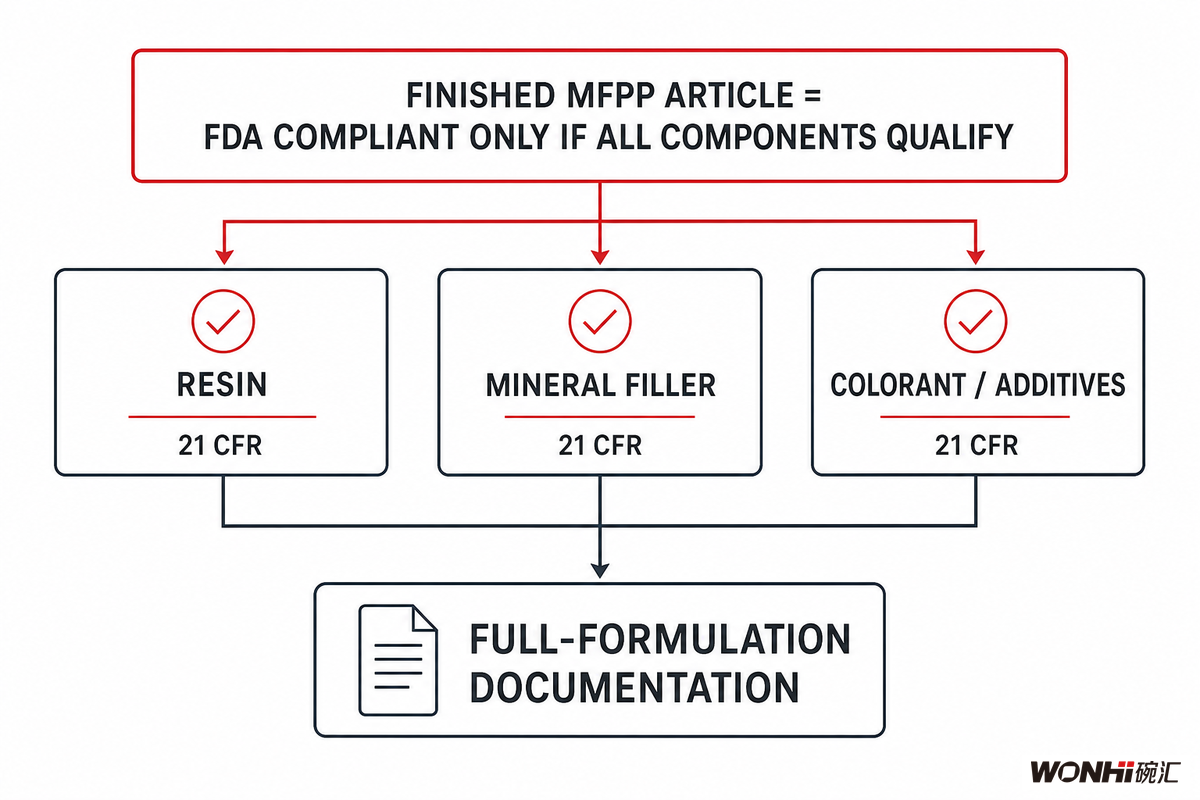
Polypropylene is one substance the FDA has affirmatively evaluated for food contact use; polypropylene is on the Inventory of Food Contact Substances as being authorized under 21 CFR parts 175-178 for its specified intended use and conditions. That general classification leaves a real compliance gap for buyers who stop at the resin citation, because the FDA’s guidance on determining the regulatory status of food-contact material components requires every component of an article in contact with food — the plastic itself, mineral filler, processing aids, colorant — to independently qualify as a permitted substance, not just the base resin. The risk is not hypothetical: a retail or foodservice customer running its own supplier audit will ask for that full-formulation paperwork, and “polypropylene is FDA approved” is not an answer that holds up. A knowledgeable, certified supplier keeps full-formula records on file for exactly this reason, rather than relying on the resin listing alone.
Can MFPP Containers Go in the Microwave?
Yes. One of the main reasons that mfpp’s higher heat resistance compared to thin-wall PP is often why it’s selected for hot food and for reheating. As with any plastic, venting or leaving uncovered, as indicated by the manufacturer, should be a part of the use. It should also not be used at higher temperatures than it’s rated for or with high-fat food, as it will quickly surpass the material’s limit.
Additionally, compared to foam and traditional PP, mfpp has stronger resilience against the BPA and PFAS concerns that has driven many consumers away from previous generations of packaging. High-quality MFPP product lines are manufactured without BPA or PFAS, but anyone purchasing from overseas should obtain a recent Certificate of Compliance relevant to the intended market.
MFPP vs. Foam, Compostable Clamshells & Standard PP
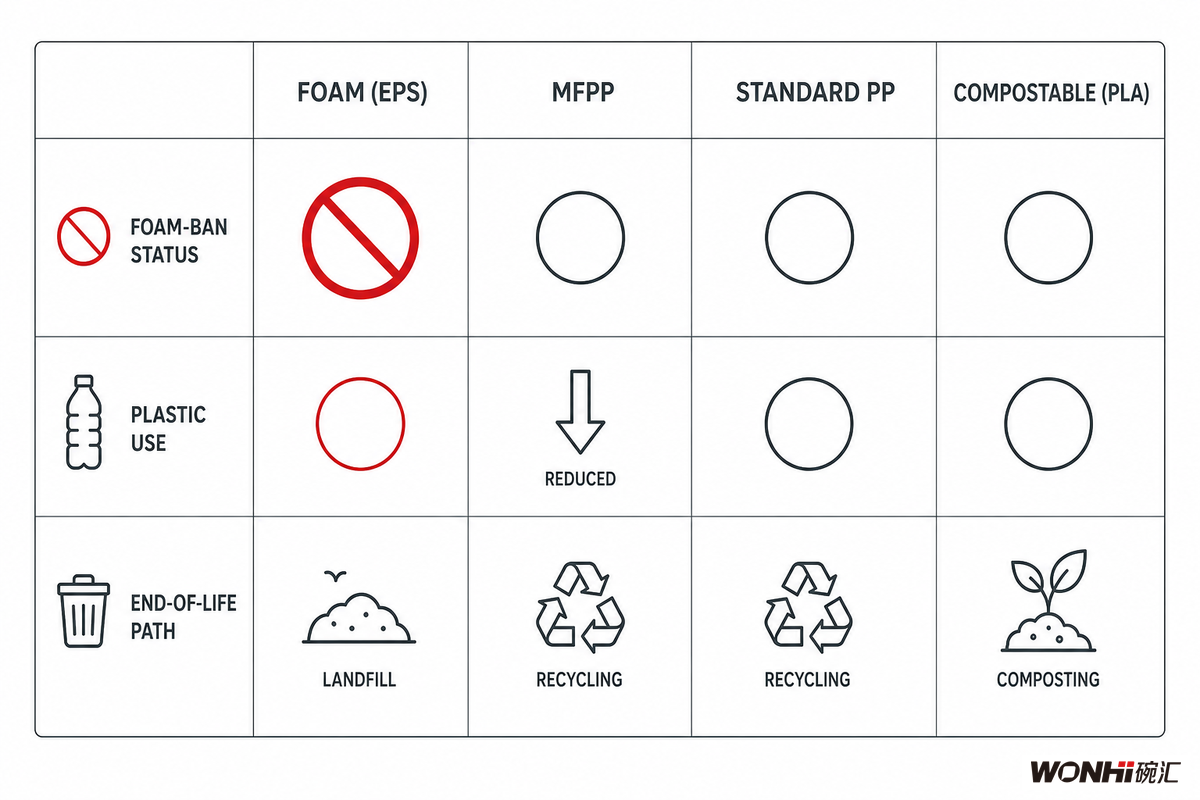
There’s a sweet spot for mfpp in relation to the three other prevalent foodservice materials, and landing on the wrong material usually comes back to you as an expense issue, compliance letter, or complaint — the same trade-offs covered in New York State’s own reference guide to foam foodservice alternatives. Foam, the least expensive, is also now banned or restricted in numerous states for foodservice applications. Compostable clamshells (bagasse, PLA) offer sustainability credentials, but these benefits only come to fruition if and where the requisite industrial composting facilities actually exist, a concern we cover in depth in our guide to eco-friendly food packaging routes. unfilled or standard plastic hinged containers work functionally, but consume more virgin plastic per unit to accomplish what a MFPP can do more economically.
But where it can still be sold, state-by-state rules are changing quickly – read our full guide to foam container bans for the latest information. What sets mfpp apart in this shift is that it make sense even without compost-friendly infrastructure: it’s a plastic replacement, not an infrastructure bet.
| Material | Regulatory status (2026) | End-of-life reality | Relative unit cost |
|---|---|---|---|
| Foam (EPS) | Banned/restricted in DC, MD, VT, ME, NY, NJ, CO, WA, OR, CA and expanding | Rarely recycled; near-zero real diversion | Lowest |
| MFPP | Not foam-restricted; resin #5 | Technically recyclable, acceptance varies (see below) | Low-mid |
| Standard PP | Not foam-restricted; resin #5 | Same as MFPP, more virgin plastic used | Mid |
| Compostable (PLA/bagasse) | Meets EPR compostability targets where infrastructure exists | Requires industrial composting access — absent in most U.S. counties | Highest |
The Container-Swap Decision Grid
| If your priority is… | Choose… | Because |
|---|---|---|
| Lowest cost, foam still legal in your state | Foam | Cheapest per unit, but check your state ban timeline first |
| Foam-banned market, no composting mandate | MFPP | Compliant swap without needing composting access |
| Brand-level compostability commitment, composting access confirmed locally | PLA/bagasse | Delivers on the compostable claim only where facilities exist |
| Frozen/cold-chain use | Standard PP or MFPP with cold-rated formulation | Mineral filling doesn’t fix PP’s low-temperature brittleness — confirm the grade |
Format Categories: Compartments & Hinge Types
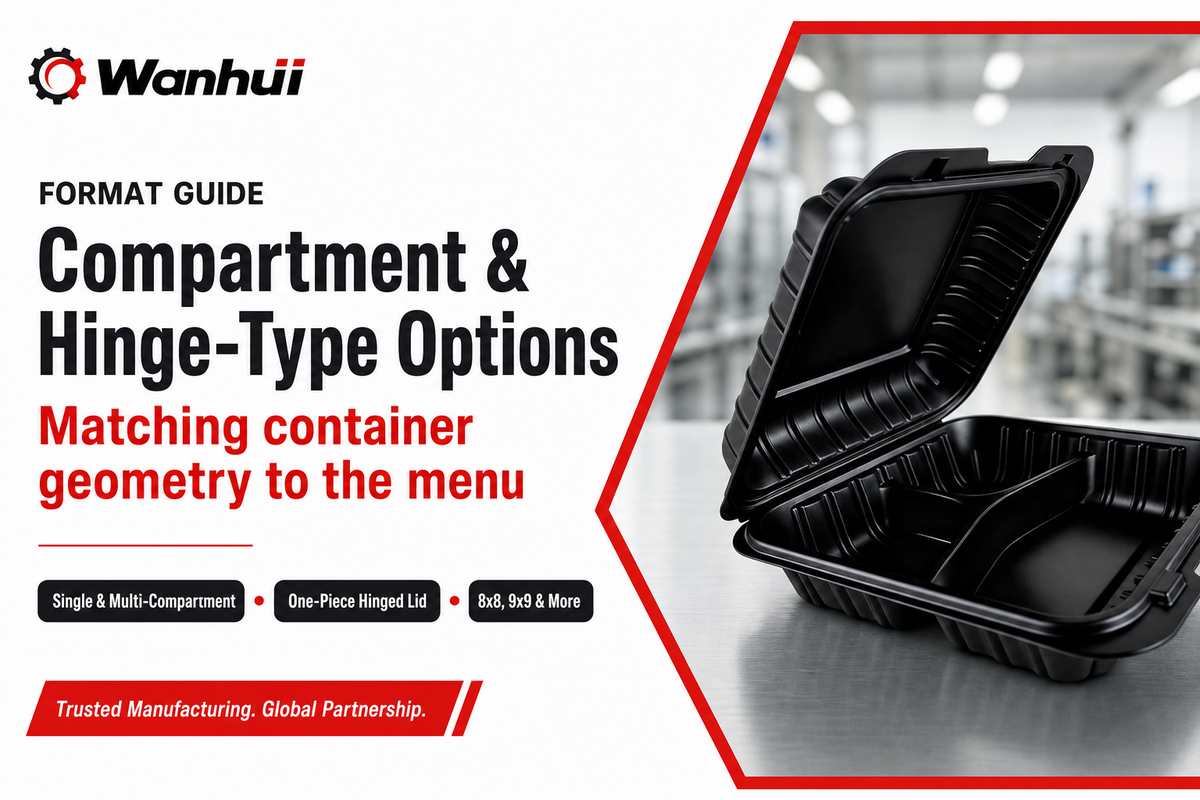
mfpp hinged lid containers come in a few categories, rather than one standard shape.
1-compartment hinged containers are great for entrees, salads, and sandwiches. Two or 3-compartment hinged options separate food, sauces and proteins to survive delivery journeys of 20 minutes or more. hinges range from integral living closures to durable, secure corner- and snap-lock types that won’t pop open in transport.
| Format Type | Dimensions | Compartments | Best For |
|---|---|---|---|
| Compact single | 6″ x 6″ | 1 | Sides, small salads, condiments |
| Standard single | 8″ x 8″ | 1 | Sandwiches, wraps, single-protein entrees |
| Large single | 9″ x 9″ | 1 | Full entrees, family-style portions |
| Rectangular single | 9″ x 6″ | 1 | Hot dogs, sub sandwiches, elongated cuts |
| Standard double | 8″ x 8″ | 2 | Entree kept separate from one side |
| Standard triple | 8″ x 8″ | 3 | Entree plus two sides |
| Large triple | 9″ x 9″ | 3 | Full meals needing sauce and side separation |
| Round bowl format | 7″ round | 1 | Salads, soups, poke bowls |
| Vented single | 9″ x 9″ (vented) | 1 | Steamed or fried items needing moisture to escape |
container sizes, compartment configurations, and lock types differ based on the manufacturer’s tooling. To determine the most effective match, browse the full MFPP container size and pricing chart-instead of attempting to match a product from broad categories-because case quantities, specific measurements and minimum order quantity (MOQ) pricing information is granular enough to make comparisons with current purchase volume useful — buyers sourcing MFPP containers wholesale should compare that chart directly against their own case-volume math.
Where MFPP Fits: Foodservice Applications
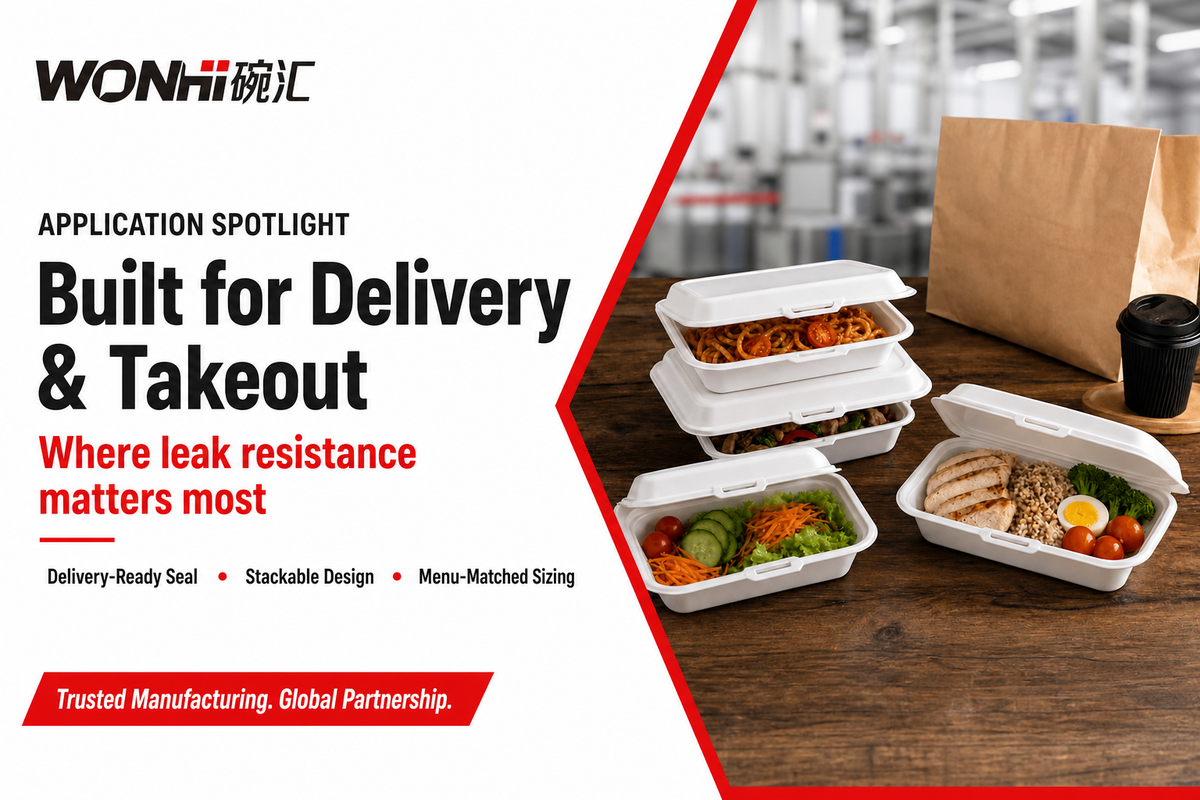
Two decades of running foodservice packaging lines have shown demand for mfpp formats breaks down into three purchaser types: large chains needing consistency across outlets; delivery-centric businesses prioritizing spill-proofing over presentation; and institutions — hospitals and schools sourcing under USDA child nutrition program procurement requirements — needing containers that won’t crack in mass tray handling or microwave reheating.
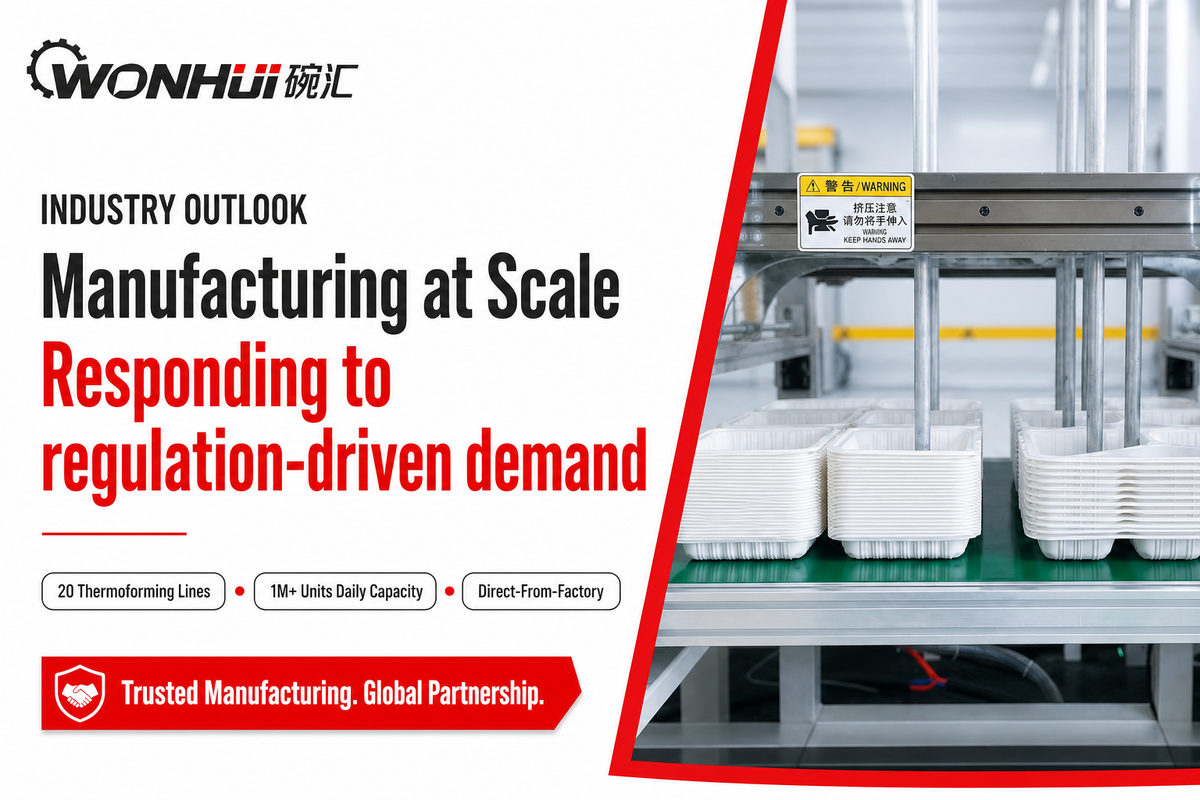
We’ve 20 years of in-house experience running 20 thermoforming and 60 injection molding lines processing more than 30 tons of material daily; our own manufacturing team requires precise, certified temperature and pressure control at the injection gate, because mineral-filled resin fractures at the gate more readily than standard PP if that control slips — which is exactly why not all converters have the capability of successfully running MFPP lines.
While restaurant chains often pack one or two sizes across their entire menus to simplify ordering, delivery companies are most interested in three-compartment styles with added protection, and institutions tend to favor food storage durability and the ability to withstand reheating without damage over aesthetic qualities. Matching the container configuration with your purchasing profile beforehand can prevent the common mistake of ordering an over-engineered multi-compartment product for an entree menu item or using an understated clamshell container when a tamper-evident seal is required.
Is MFPP Recyclable? The End-of-Life Reality
mfpp bears resin identification number 5 (polypropylene); and in all honesty, the answer as to whether this indicates recyclability is a bit complicated-not in every location, and not automatically. As the U.S. EPA’s own recycling guidance notes, “The resin number is in a triangle that appears quite similar to the recycling symbol, but it doesn’t mean that your local recycling facility will accept it.” The U.S.
Plastics Pact 2023-24 Impact Report estimates that only 13.3 percent of plastic packaging material in the United States was actually recycled.
The gap also extends beyond customer trust to the legal arena. According to the FTC’s Green Guides (16 CFR 260.12), an unqualified ‘recyclable’ claim is appropriate only when facilities are accessible to ‘a substantial majority of consumers’ (at least 60 percent of whom have access to them). If that figure drop below 60 percent, ‘any component significantly limits the ability to recycle the item, any recyclable claim would be deceptive,’ the guidance states plainly. Since national plastic packaging recycling currently stands at 13.3 percent – nowhere near 60 percent – an unqualified ‘recyclable’ label on mfpp packaging is a real regulatory risk.
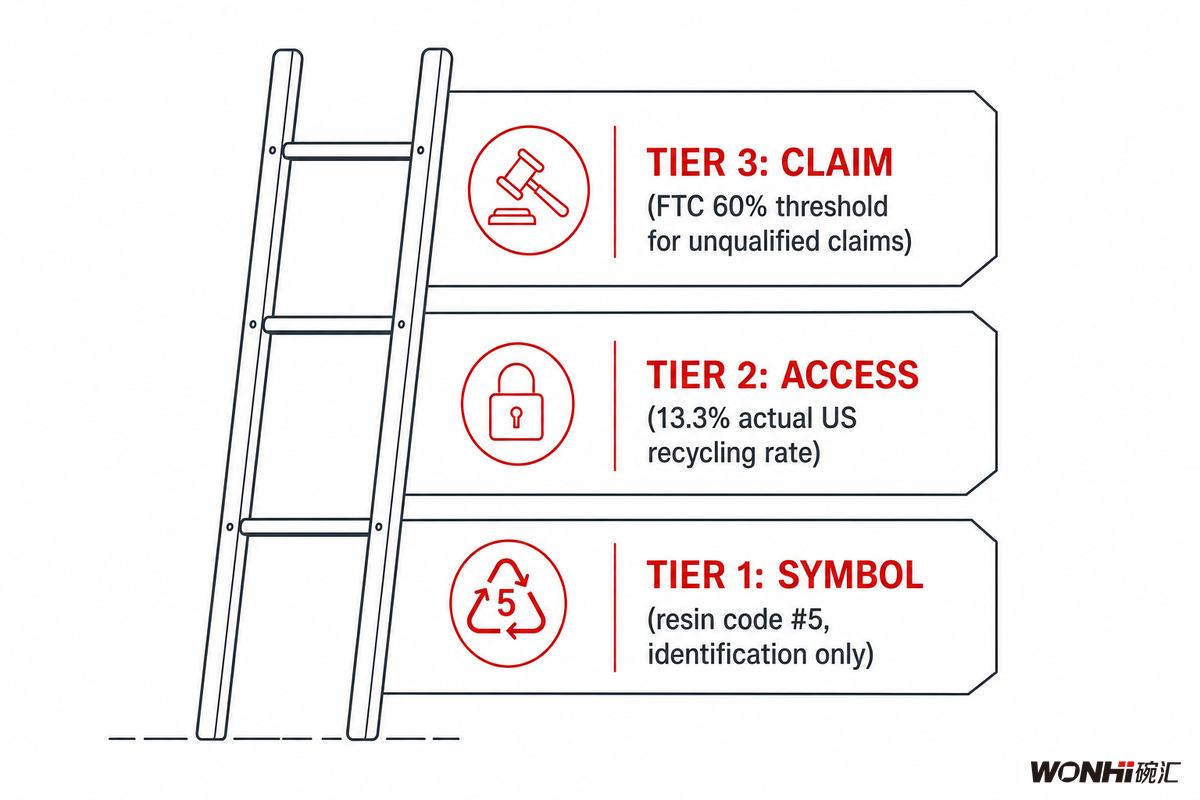
The 3-Tier Recyclability Reality Check
- Symbol tier: the resin-code triangle identifies plastic type but ‘doesn’t necessarily mean’ it will be accepted by facilities, according to the EPA.
- Access tier: Actual U.S. plastic packaging recycling rate is only 13.3 percent overall; most U.S. communities don’t collect #5 containers curbside.
- Claim tier: An unqualified ‘recyclable’ claim on a package could be deceptive; compliant labeling would require qualifying phrases such as ‘check locally’ or ‘recyclable where facilities exist’ since access rates are well below the FTC’s 60 percent threshold.
It’s not just mfpp – the ‘say-do gap’ exists across U.S. plastic packaging recycling overall: Only about 32 percent of material is ultimately recycled despite far greater public trust in the system, per a 2025 Waste Dive analysis of EPA data. A Bay Area resident posted on Reddit, “I switched to glass for home use, but still feel a little twinge of futility when I throw plastic marked 3-7 into the bin” because they weren’t sure it would be processed. In practice, that same risk applies to any foodservice buyer who prints a simple, unqualified ‘recyclable’ claim on their own packaging products.
Microwave & Thermal Performance: What to Expect
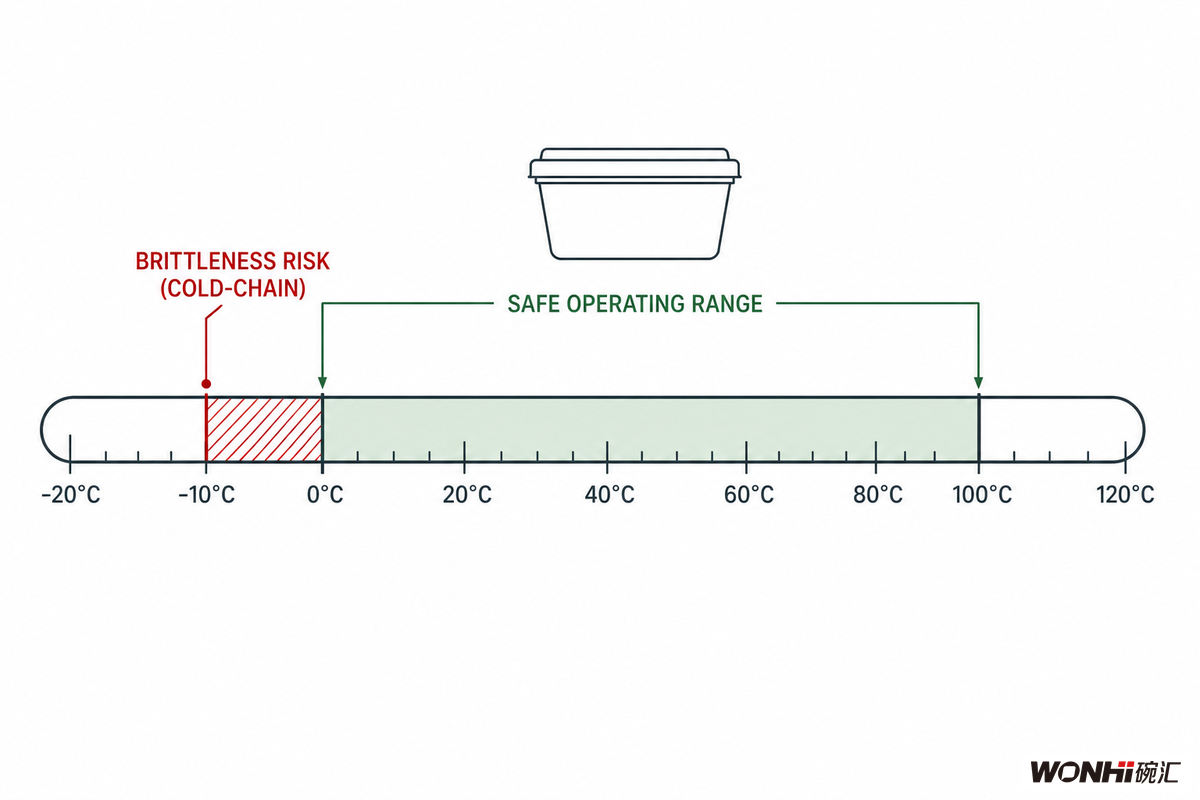
mfpp outperforms thin-wall standard PP in heat resistance, making it a favored material for hot food, meal-prep items, and reheating a leftover order the next day. Filling the material with mineral improves its heat deflection temperature to withstand hot and acidic food while maintaining its shape, compared to unfilled plastic of equal thickness. What mfpp doesn’t do, however, is resolve standard PP’s behavior in the cold.
⚠️ Important
Polypropylene typically becomes more brittle and less impact-resistant below a glass transition temperature of approximately -10C to 0C (as documented by materials educators on ChemEd X and by MIT’s engineering explainer on cold-temperature plastics, which names polypropylene specifically) — the same low-temperature impact behavior that ASTM D256 notched Izod testing is designed to quantify for plastics generally. Although the mineral filling enhances rigidity at cooking and ambient temperatures, that same stiffness can crack or wear through faster in cold-chain conditions — unheated trucks or freezers prior to use — so this hidden gap should be clarified with suppliers before it becomes a claims risk.
Durability & Functional Performance
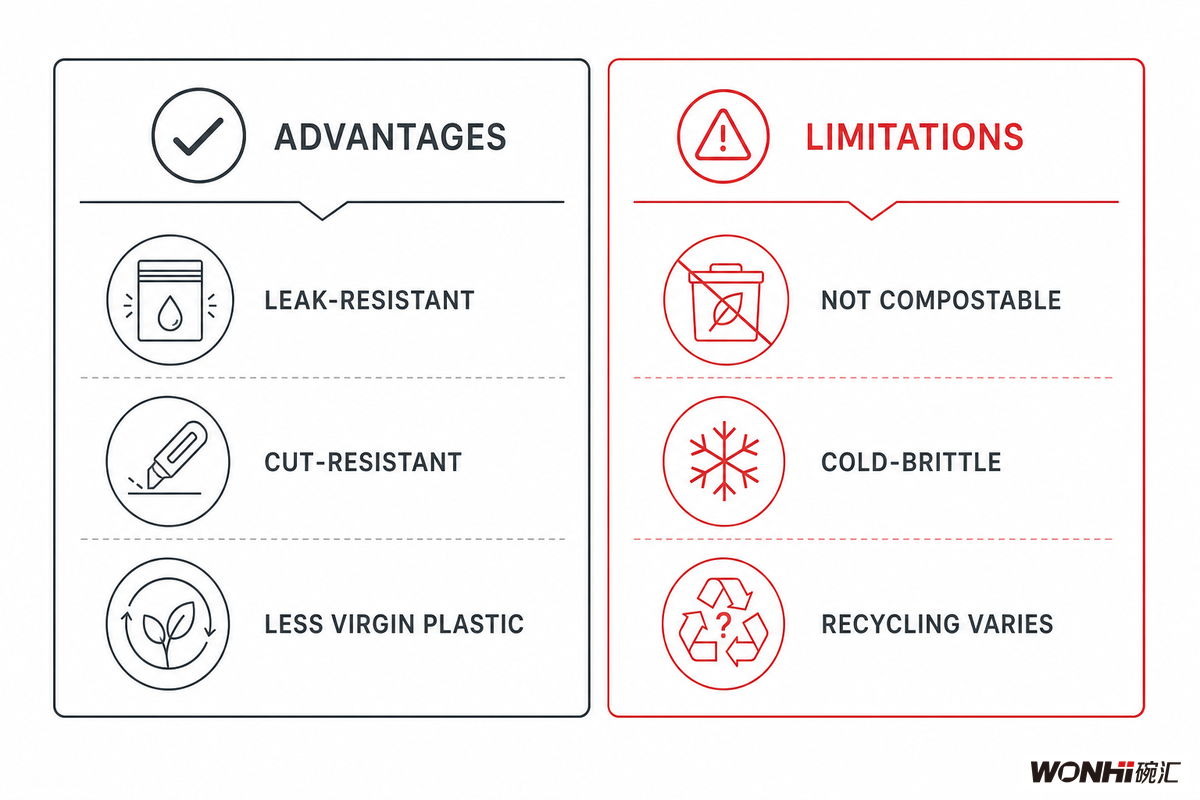
mfpp’s primary benefits – leak resistance, cut resistance, and a tight hinge/lock closure at a smaller footprint – hold true, and they map onto the same puncture- and leak-resistance criteria university food-packaging integrity testing protocols use to evaluate rigid and semi-rigid containers. Where buyers can be caught out is when considering the full range of use cases – like those involving cold-chain handling discussed above, or the tendency to assume that “sturdier” necessarily implies “suitable for every situation.”
✔ Advantages
- Leak-resistant snap/corner-lock closures for hot and cold food
- Cut-resistant and puncture-resistant compared to foam
- Microwave-safe for reheating
- Reduces virgin plastic use by 40-50% compared to standard PP of similar performance
⚠ Limitations
- Not a compostable material – end-of-life is dependent on recyclability, not compostability
- Cold-temperature brittleness not solved by mineral filling
- Recycling acceptance varies significantly by municipality
- Not a replacement for genuine compostability if the brand commitment is there
A very common misunderstanding we’re clarifying here’s that switching from foam to any rigid plastic, like mfpp, is often viewed as an inherent sustainability upgrade. It’s a compliance upgrade – MFPP isn’t foam and isn’t banned by state regulation – but it’s still a petroleum-based plastic with all the same recycling caveats discussed above. For buyers who want to be able to say “compostable” or “biodegradable,” that requires a move to compostable alternatives, discussed below.
Industry Outlook: Where Mineral-Filled Packaging Is Headed
So what’s driving demand for a supposedly greener, convenient mfpp option? Not consumer sentiment. A widening and growing set of regulatory triggers is progressively taking foam off the table and adding real compliance risk for buyers slow to switch. Virginia’s statewide ban on polystyrene foodservice extends to all food vendors starting July 1, 2026 (closing a loophole for small businesses), according to Packaging Dive’s 2026 state packaging law roundup. In New York, the state’s foam ban applies to cold-storage containers beginning Jan. 1, 2026, according to the NY DEC’s official foam-free program page.
California is also adding a more indirect compliance pathway we’ll need to monitor: producers of expanded polystyrene foodservice in the state are required under SB 54 to achieve a 25% recycling rate by January 1, 2025. Per CalRecycle’s own program page, “This requirement hasn’t been met. Accordingly, producers are prohibited from selling, offering for sale, distributing, or importing EPS food service ware…in or into California.” That’s a de facto ban driven by recycling rates rather than legislation-but with broader 2032 requirements under SB 54 calling for recyclable or compostable packaging, this approach to managing underperforming materials might soon extend beyond foam.
So for 2026-2027 packaging budget discussions, view foam ban compliance less as a state-by-state blacklist and more as a performance metric driven by recyclability data, and evaluate mfpp (and other alternative materials) on what they do, not what they’re called.
For context only: The global market for polypropylene disposable food containers was an estimated $18.6 billion in 2025, with estimates projecting further growth into 2035, per market intelligence reports. This market figure is provided as background, not as a substitute for the above regulatory information.
Frequently Asked Questions
Q: What is an MFPP container?
View Answer
A mfpp container is a foodservice box made with a polypropylene resin blended with 40-50% of a naturally sourced filler, typically calcium carbonate, which is called mineral in industry parlance. Adding mineral reduces the need for virgin plastic per box and increases rigidity and heat resistance, leading to MFPP’s popularity for microwavable take out containers used in delivery and meal-prep packaging applications.
Q: Is PP plastic safe for food?
View Answer
Yes – Polypropylene is approved for use with food for direct contact, per FDA regulations under 21 CFR parts 175-178. That’s for the base resin alone. A fully compliant mfpp finished product also needs the mineral filler, colorant and processing aids that are used in the specific product to meet food contact substance status individually, which is why reliable suppliers document the entire formulation and not just the resin.
Q: What does PP mean on plastic containers?
View Answer
PP stands for Polypropylene. It is one of seven plastic resin identification codes used for sorting plastics for recycling. In the familiar triangle symbol on the underside of your product, it’s marked as #5, and it’s the base resin family for mfpp, yogurt cups, bottle caps, and many rigid foodservice hinged containers. The number simply identifies the plastic – it doesn’t automatically qualify the product for your curbside recycling program.
Q: Is MFPP recyclable?
View Answer
Yes – technically it is, as it is resin #5, but many municipalities still do not accept it for curbside collection. Overall plastic packaging recycling rates nationally are 13.3%. Best to check with your local municipality first.
Q: Can MFPP containers go in the dishwasher?
View Answer
No. mfpp is single-use packaging. Hand-wash for a one-time reuse if you must, but skip the dishwasher — repeated heat and detergent will warp the hinge.
Q: What’s the difference between MFPP and foam containers?
View Answer
Foam, also known as Expanded Polystyrene (EPS), is less expensive but has been banned or restricted for foodservice in a growing number of states. Several states including New York and Virginia have or are expanding restrictions against foam for 2026. mfpp is a rigid plastic that is not currently affected by these foam restrictions and it can perform comparably for a small additional cost – with its own recyclability concerns.
About This Analysis
This guide draws on FDA and EPA regulatory documentation, FTC Green Guide labeling rules, and 20 years of production data from Shandong Wanhui Environmental Protection Technology Co., Ltd…’s own thermoforming and injection molding lines. We manufacture MFPP, eco-friendly, and foam-hinged container lines side by side, which is why we’ve tried to give the recyclability and regulatory caveats the same weight as the performance benefits, you’ll make a better packaging decision with both.
Reviewed by the Shandong Wanhui Environmental Protection Technology Co., Ltd. technical team.
References & Sources
- Inventory of Food Contact Substances Listed in 21 CFR — U.S. Food and Drug Administration
- Determining the Regulatory Status of Components of a Food Contact Material — U.S. Food and Drug Administration
- How Do I Recycle Common Recyclables — U.S. Environmental Protection Agency
- Sustainable End-of-Life Management of Plastics — U.S. Environmental Protection Agency
- 16 CFR 260.12, Recyclable Claims (Green Guides) — Federal Trade Commission
- 2023-24 Impact Report — U.S. Plastics Pact
- SB 54: Plastic Pollution Prevention and Packaging Producer Responsibility Act — CalRecycle, State of California
- Go Foam Free — New York State Department of Environmental Conservation
- Packaging Laws Taking Effect in 2026 — Packaging Dive
- By the Numbers: How America Recycles in 2025 — Waste Dive
- McCormick’s Sustainability Chief Has a Dream for Packaging Circularity — Packaging Digest
- ASTM D256: Notched Izod Impact Strength of Plastics — ASTM International (via ZwickRoell)
- Examination of Flexible and Semirigid Food Containers for Integrity — University of Wisconsin Food Research Institute
- Why Do Plastics Get Brittle When They Get Cold? — MIT School of Engineering
- Alternatives to Single-Use Expanded Polystyrene Foam Food Service Products — New York State Department of Environmental Conservation
- Procurement Toolkit for Child Nutrition Programs — USDA Food and Nutrition Service
Related Articles
- Foam Hinged Containers, the 2026 state ban map and switch guide
- Eco-Friendly Food Boxes, the 4-route framework for compostable, recyclable, reusable, and source-reduced packaging
- Wholesale Food Containers, bulk sourcing scorecard for foodservice buyers
- MFPP Container Sizes, Specs & Wholesale Pricing