Get in touch with Wanhui Company


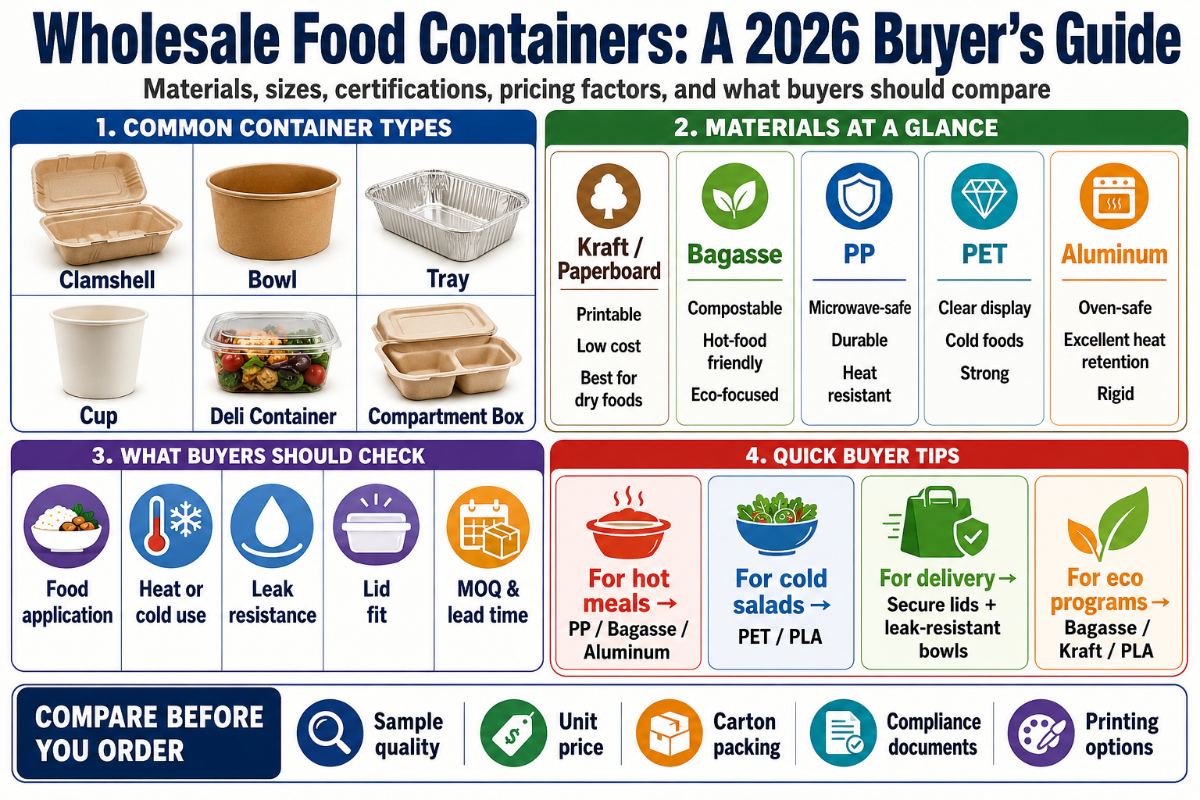
An example practical guide for volumetric sourcing of restaurants, delis, food trucks, caterers, and delivery brands.
Purchasing wholesale food containers may seem easy, but it can prove otherwise when your first pallet arrives and the lids won’t close, when soup leaks are at 200°F, or when a state inspector flags your foam clamshells. This guide shows how to pick the appropriate material, formats and size, food-grade compliance verification, reading sustainability claims, and how to run a bulk purchase including the 2026 regulations which change what you can buy. If you want to order first and research later, view our wholesale food containers catalog; If you want to be able to make an informed decision, continue reading.
Quick Specs: Wholesale Food Containers at a Glance
| Common materials | PP (#5), PET (#1), PS foam (#6), bagasse/molded fiber, kraft paper, aluminum, PLA |
| Common sizes | Deli cups 8 / 16 / 32 oz; clamshells 1–3 compartment; trays, bowls, soup cups |
| Microwave-safe option | Polypropylene (PP) — tolerates ~250°F (121°C); PET and foam are not |
| Food-grade reference | FDA 21 CFR 177 (PP §177.1520, PET §177.1630) |
| Typical wholesale MOQ | Stock items: 1–5 cases; custom-printed/custom-mold: higher, tooling-dependent |
| 2026 watch-outs | State EPS foam bans, state + federal PFAS limits, EPR programs |
Wholesale Food Containers at a Glance: Categories & Buyer Priorities
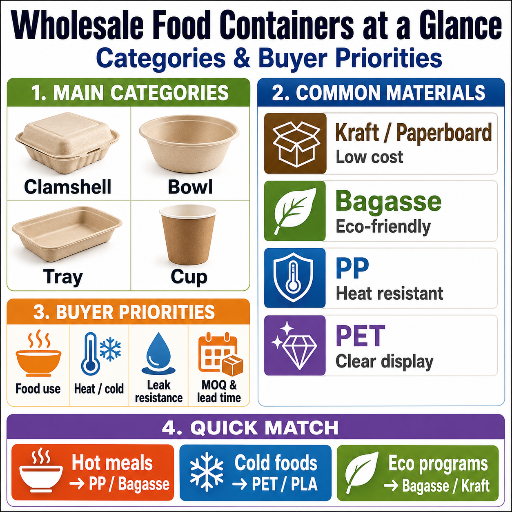
“wholesale food containers” is a generic term that covers all disposable containers that a foodservice operation procures in bulk to hold, transport, or retail prepared food – deli cups, hinged clamshells, take-out containers, to-go boxes, trays, bowls, soup cups, and catering boxes. They are a single-use substitute for reusable, dishwasher-cycled foodware, and are selected for their convenience and cleanliness during high-volume service. This category includes numerous materials and wide-ranging sizes, which is precisely where bulk purchasers become entangled: what works for one environment, such as the salad bar, may not work for another, such as a hot curry line.
Over hundreds of bulk orders, there are four things that determine the success of a container program: material (does it survive the temperature, grease, and acid of the food?), format and size (does it fit the dish and the shelf?), food-safety compliance (is it FDA food-contact compliant under 21 CFR Part 177 and legal in your state?), and total cost (not just price per piece, but also leaks, returns, and disposal). Below, each priority is covered in detail, along with how to execute the purchase itself.
💡 Key takeaway
When looking at the four priorities, it should be seen as a sequence and not a menu. Material constrains format, format constrains size, and all compliance can override everything. price is the last filter, not the first.
Container Materials Compared: PP, PET, PS Foam, Bagasse, Kraft & Aluminum
Material is the first decision as it sets the physical limits of everything else that follows. Before making your comparison, set your focus: a container is only “food-grade” for the conditions to which it is authorized and engineered. A food-contact polymer is under the jurisdiction of the U.S. FDA food service, and the regulations for it can be found here 21 CFR Part 177 and polypropylene is here §177.1520 and PET is under §177.1630. These are compositional standards and the approval and authorization are tied to specific use conditions. For example, PET is a material that is fundamentally cold-side: foodservice uses it practically in a temperature range of 120°F (49°C). So, having “FDA approved” on a spec sheet doesn’t mean much without use conditions provided.
The most useful way to choose is to map the food’s condition — not its name — to a material. Hot, oily, acidic, frozen, and microwave-reheated foods each stress packaging in different ways.
| Food condition | Best-fit material | Avoid | Why |
|---|---|---|---|
| Hot food, microwave reheat | Polypropylene (PP) | PET, PS foam | PP holds ~250°F (121°C); it is the only common disposable plastic rated for microwave reheating |
| Cold / clear display (salads, cut fruit) | PET (rPET) | PP for clarity | PET stays glass-clear and rigid cold but warps above ~120–140°F (49–60°C) |
| Hot soup / saucy, leak-prone | PP round + snap lid, or lined paper soup cup | Unlined paper, PET | PE-coated paper liners soften at hot-fill temperatures — field reports cite leaks near boiling (~95°C/203°F) |
| Greasy / fried | Kraft with grease-resistant lining, bagasse | Plain paperboard | Grease wicks through unlined fiber; bagasse resists oil without plastic film |
| Oven / reheat at venue | Bagasse (molded fiber), aluminum | All plastics, PLA | Bagasse tolerates high heat; aluminum runs ~-20°F to 400°F (but not microwave) |
| Frozen / freezer storage | PP, aluminum, bagasse | Brittle PET in deep freeze | PP and fiber stay tough cold; PET can crack under impact when very cold |
| Acidic (tomato, citrus, vinaigrette) | PP, lined fiber | Bare aluminum | Acid reacts with uncoated aluminum; PP is chemically stable |
| Compostable program required | Certified bagasse / PLA-lined fiber | “Biodegradable” plastic | Only certified compostables (see H2-6) are defensible; “biodegradable” is largely unregulated |
| Long-haul delivery, stacking | PP with locking lid | Foam, thin PET | Snap-fit rims that mechanically lock survive bag tumble; vented lids release steam |
📐 Engineering Note
PP has a temperature tolerance to about 250°F (121°C), and a melt point of 320°F (160°C); the practical limit of is around 120°F (49°C) according to the food service references, not microwave-safe (21 CFR 177.1630 defines composition, not a temperature rating); PS foam softens at about 75°C (167°F); PLA deforms above 40-60°C and will slump in a hot car; bagasse withstands oven and microwave heat. If you are unsure for a hot-fill line, use PP and confirm with a sample run at your actual serving temperature.
For a side-by-side comparison of the three resins most buyers consider, our PP vs PET vs bagasse material selector customizes these guide lines to your specific menu.
The 6 Foodservice Container Families (and Which Foods They Fit)
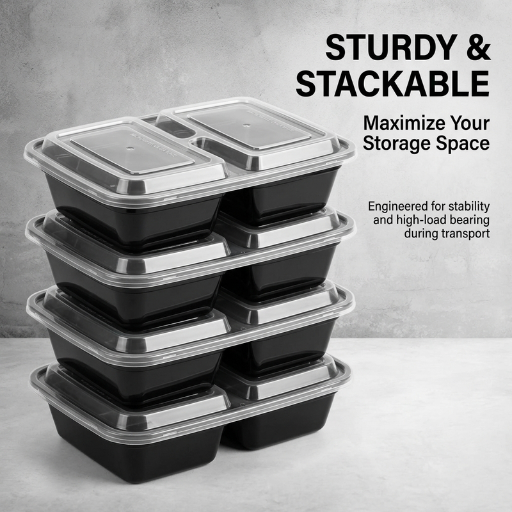
After the materials are set, the shape of the container design is based on the dish. Most of the disposable food containers are classified into six families. This family and food pairing mitigates the two most frequent issues: smashed presentation and spillage during transport.
| Family | Best for | Typical materials | Size span |
|---|---|---|---|
| Deli cups (round, with lid) | Soups, sauces, sides, prepped ingredients | PP, PET | 8, 16, 32 oz |
| Hinged clamshells | Entrees, burgers, sandwiches, salads | PP, bagasse, PS foam (where legal) | 1–3 compartment |
| To-go & Chinese-style boxes | Noodles, rice, mixed hot dishes | Kraft paperboard, PP | 16–64 oz |
| Trays & platters | Catering, meat/produce, bakery | Molded fiber, PET, aluminum | Small to full-size |
| Bowls & soup cups | Grain bowls, soups, salads | PP, lined paper, bagasse | 12–48 oz |
| Catering & multi-portion boxes | Group orders, meal kits | Kraft, corrugate | Half/full pan |
Standardization typically occurs on 2-3 families for manageability of SKUs and reorders. A delivery-heavy kitchen may run PP clamshells for entrees, PP deli cups for sides and sauces, and lined paper bowls for soups, then use specialty formats such as bento boxes and disposable soup containers as the menu requires.
Container Sizing Guide: Matching oz Capacity to Portions
Silently costly sizing mistakes can be extremely expansive. If containers are too small, they crush leak and food. Too large, and then you are paying for materials and freight and making portions look skimpy. Deli-cup standard sizes are the backbone of most programs.
What are the standard deli container sizes?
Most of the disposable foodservice industry runs a near-universal deli-cup ladder: 8 oz, 16 oz, and 32 oz, with 12 oz and 24 oz cups as common in-betweens. Its big advantage is that one lid diameter fits over several different cup heights. That means for the 8, 16, and 32 oz you can share a single lid SKU, which both cuts your lid inventory and reduces the “wrong lid” errors that slow a packing line. Make sure the cup matches the portion: dressings and sides go in 8 oz, single soups and grain sides go in 16 oz, while family soups and bulk prep are in 32 oz.
| Capacity | Best-fit use | Notes |
|---|---|---|
| 8 oz | Dressings, dips, sauces, small sides | Highest count per case; shares lid with 12/16 oz |
| 16 oz | Single soup, grain side, salad | The workhorse size for most menus |
| 24 oz | Entree salad, large side, smoothie | Bridges 16 and 32 oz |
| 32 oz | Family soup, bulk prep, poke bowl | Check freezer/shelf depth before standardizing |
Prior to securing a size matrix, verify the numbers against your case packs and shelf depth using a container size and product-line selector so that the cartons will fit in your storage.
Food-Grade & Food Safety: What to Verify Before You Buy
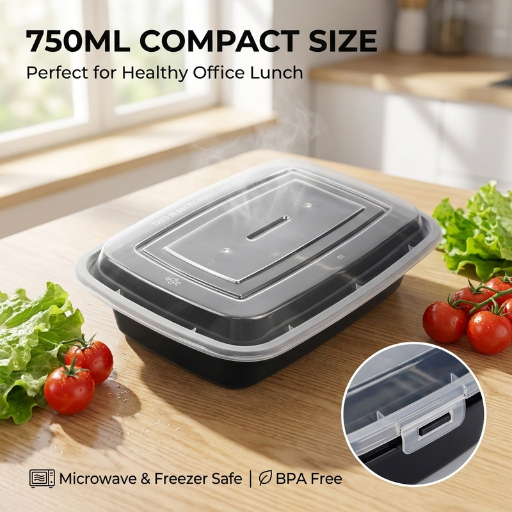
You should verify, not assume, “Food-grade” claims, especially for larger orders. The FDA’s 21 CFR Parts 174–178 allows the use of certain materials for food contact applications, but the specific material, the type of food, and the temperature of use are all factors that determine compliance. Just stating something is “FDA-approved” is not the same as providing documentation for compliance for your application.
What’s the difference between PP and PET containers?
The two plastics you’ll compare the most will be PP (polypropylene, resin code #5) and PET (polyethylene terephthalate, #1). PP is opaque-to-translucent, flexible, and heat tolerant— the only common disposable plastic rated for microwave reheating (to ~250°F/121°C). PET is rigid, glass-clear, and suitable for cold display, but warps at low heat, with foodservice references citing a practical limit around 120°F (49°C) making it cold-side and not a reheat material. The easiest rule: if the customer will microwave it, ship microwavable PP; if it’s a premium-looking cold item, ship PET. PP is also the more durable choice for food prep and repeated handling, while display clarity makes PET prized.
Before the bulk PO is issued, request the following four documents from your supplier, and conduct your own review:
- ✔ An FDA food-contact statement mentioning the specific 21 CFR section for the particular resin (e.g., §177.1520 for PP).
- Use-condition limits: the temperature and food type range the material is rated for ⎯ not just “microwave safe” on the lid.
- ✔ Recycled-content status: Generally, post-consumer recycled (PCR) resin for food contact is subject to case-by-case review by the FDA with process-specific clearances — A virgin-resin CFR citation does not cover a recycled batch.
- A PFAS-free declaration for any fiber or coated product (this is becoming a hard legal requirement in several states — see the 2026 outlook).
Forum chefs continually caution that the ‘microwave-safe’ stamp simply means the container won’t melt — it does not ensure zero migration. Recent tests show PP and PS containers shed microplastic particles in large quantities when microwaved, so many kitchens move food to a plate for reheating regardless of the stamp. For containers, a verified food-grade plastic container manufacturer should have no issues proving this.
Sustainable Options: Compostable vs Biodegradable vs Recyclable
Sustainability is where customers get most confused — and where vague assertions pose genuine legal risk. The three terms are not synonymous.
| Claim | What it should mean | How to verify | Catch |
|---|---|---|---|
| Compostable | Breaks down in a commercial composter into CO₂, water, biomass | BPI certification to ASTM D6400 (plastics), D6868 (coated), or D8410 (fiber) | Needs access to industrial composting; rarely home-compostable |
| Biodegradable | (Loosely) breaks down eventually | No universal standard | Largely unregulated — treat as a red flag without a cert |
| Recyclable | Accepted and reprocessed in local streams | Resin code + local program acceptance | Food residue and small parts often disqualify in practice |
Certified compostables have real standards: to be BPI certified, an item must reach about 90% disintegration within 84 days and meet PFAS restrictions (in force since 2020). For consumers, the easy yardstick is this – if it’s not certified to an ASTM standard, the “eco” claim is indefensible.
Are compostable containers actually better?
Not automatically — and this is the counterintuitive part most buyers miss. A compostable container only delivers its environmental benefit if it actually reaches a facility that accepts it. Without that access, two problems appear. First, a compostable item tossed in recycling is a contaminant: one compostable cup can cause an entire bale of recyclable plastic that is otherwise valuable to be sent to the landfill. Second, in a landfill’s oxygen-starved environment, compostables break down uncleanly — they create methane, which the UN Environment Programme describes as over 80 times more potent than CO₂ over a 20-year period. In that situation, a compostable fork can be a bigger climate burden than a conventional plastic one.
“Compostable packaging only delivers its environmental benefit when it actually reaches a composting facility that accepts it — without that access, it behaves like a contaminant in recycling or a methane source in landfill.”
There is also a marketing-law layer buyers forget: US FTC Green Guides (16 CFR Part 260) require competent, reliable evidence for environmental claims such as “compostable” or “recyclable” on your packaging must be substantiated, not just asserted. An ASTM/BPI certificate confirms one entity’s technical claim, but that is not a sufficient condition to satisfy all marketing-substantiation requirements. Bottom line: use certified materials and substantiate your on-pack claims. Our compostability certification decoder illustrates which certifications are relevant to the materials, while the more eco-friendly food packaging certified range shows the options.
How to Buy Wholesale: MOQs, Price Tiers, Custom Printing & Importing
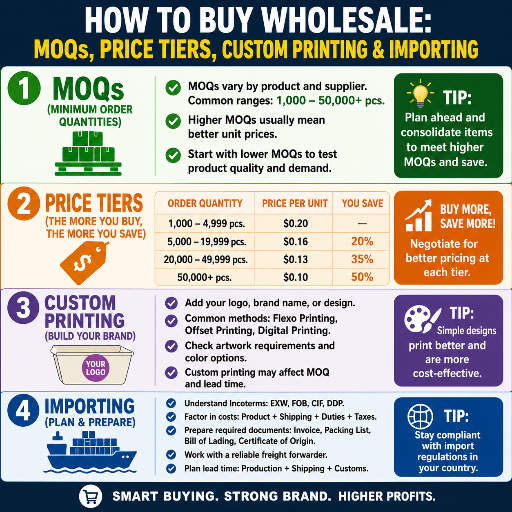
Buying is a skill in its own right. Bulk buyers’ most common mistake is focusing on unit cost alone — low-quality containers lead to leaks, plus refund, disposal, or compliance costs that can far exceed any savings. Try using a structured scorecard (not a price list).
The Bulk Container Sourcing Scorecard
- Food-grade documentation: can they provide a 21 CFR citation, use-conditions and PFAS-free declaration upon request?
- MOQ fit — do the minimum orders align with your burn rate, or will you end up storing a year’s worth of inventory?
- Pricing at your actual volume – provide a quote for the tier you’re actually purchasing, not the headline price.
- Lead time and reliability — production + freight; request an actual timeframe, not the best case scenario.
- Custom capability — Are they able to print your logo and cut custom molds, and what is the tooling payback?
- Compliance coverage — do their materials address the bans that apply in your sales states (and export markets)?
On MOQ and customization, the economics split into two paths. Stock items ship in low minimums (often a few cases), cover a wide range of selection and fast shipping, and suit testing and smaller operations. Custom-printed or custom-mold programs have higher minimums because logo and label plates plus tooling carry fixed setup costs — but they reduce the unit cost at higher quantity and put your brand on every order. Operating 20 thermoforming lines, 6 sheet-extrusion lines, and 60 injection-molding lines with a total capacity of more than 1 million units per day, we have found that buyers tend to underestimate testing before making a large custom run; ordering samples of your actual menu items will prevent the most expensive mistakes. Assess options using our wholesale food container supplier tools, or explore custom food packaging options for branded runs.
⚠️ Importing watch-out
If you import aluminum containers, trays, or lids, consider trade remedies: Since 2025, the U.S. has had anti-dumping and countervailing duty orders against certain disposable aluminum containers from China. These duties will be added to your unit price and freight, so check the landed cost — not just the FOB quote — before settling on imported aluminum.
Matching a Container Program to Your Operation
The right container mix will depend on how the food exits your kitchen. A few operational profiles:
Ghost kitchens or delivery brand depend on the integrity of transit. Our top priority as of now will be with PP clamshells with locking, vented lids, and PP deli cups for every sauce. Any sauce that escapes the cup in the bag will lead to a refund and a one-star review. Keep standard two clam shell sizes and one lid system to keep the line fast.
A food truck depends on quickness and a small storage footprint. Nesting deli cups and a single clamshell that covers most of the menu defeats a wide SKU assortment; cubic storage is the limiting factor, so case dimensions are as important as price. Stock-and-go meal prep containers link here often serve double duty for truck service.
A canteen in a hospital or school deals with issues like heat retention, allergen segregation, and procurement compliance. Their compartment trays keep different items separated, PP allows for reheating, and certified materials meet the purchasing requirements of institutions, where compliance/documentation is prioritized over the lowest price.
Operation → Container Program (quick map)
| Delivery / ghost kitchen | PP locking clamshells + PP sauce cups; vented lids |
| Food truck | Nesting deli cups + one versatile clamshell; mind case cube |
| Catering | Half/full-pan trays + kraft catering boxes |
| Hospital / school canteen | PP compartment trays; certified materials + full docs |
2026 Outlook: Foam Bans, PFAS Rules & the Shift to Fiber
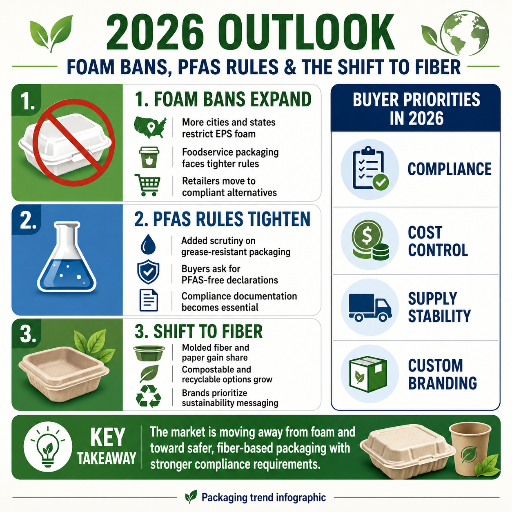
Regulations will be the most rapidly changing aspect concerning your business, and 2026 will be a pivotal year. If you plan to make any purchases in 2026, you should consider compliance as part of your sourcing specifications, rather than an afterthought.
Polystyrene (foam) bans are spreading. States with EPS foodservice bans now include California, New York, New Jersey, Maine, Maryland, Vermont, Washington, Rhode Island, and Delaware. New York banned EPS foodservice containers in 2022, and according to NYSDEC , starting January 1, 2026, this will also apply to cold-storage EPS (coolers, ice chests). Virginia’s EPS foodservice ban will be implemented by 2025–2026, based on which vendor type, so check what the current effective date is for your operation instead of assuming there will be a single deadline.
Limits on PFAS now apply to fiber. Maine’s PFAS rule on plant-fiber food packaging comes into effect on May 25, 2026 (excluding manufacturers with less than $1 billion in revenue) and California’s AB 1200 has prohibited PFAS (or ≥100 ppm total organic fluorine) in plant-fiber food packaging since 2023 and New Jersey’s broader food-packaging PFAS ban will be in effect in 2028, and in 2025 Illinois will have expanded their PFAS Reduction Act (Public Act 104-0231) to include food packaging, with other provisions, and compliance deadlines that will be effective in the coming years. Due to the varying dates and scope by state, it is advisable to confirm rather than assume the effective date for each of your sales states. The FDA has stated that PFAS grease-proofing agents will no longer be sold in the U.S. market as of 2024, with the relevant authorizations expiring in early 2025, indicating that even unbanned states are seeing PFAS designed out.
The shift to fiber is structural, not seasonal. The U.S. disposable food packaging market is projected to grow from roughly $14.9 billion (2024) toward $23 billion by 2030 (about 7.5% CAGR), and quick-service chains are replacing plastic clamshells with molded fiber and paperboard. The enabling technology is PFAS-free water-based barrier coatings — using clay, calcium carbonate, starch, chitosan, or bio-polyester dispersions — which, as Food Engineering reports, now give fiber the grease and moisture resistance hot takeout needs. Action for 2026 buyers: if you sell into multiple states or export, default new programs to certified, PFAS-free fiber or PP and keep a documented compliance trail; the foam-ban compliance finder maps which of your states already restrict foam.
The Foam-to-Fiber Switch Cost Curve
Changing from foam to certified fiber typically increases unit costs in the short term, but it decreases once you price compliance risk (fines, forced repurchases if a ban occurs), brand value, and the consistent decrease in the price of fiber as volume increases. Operators that switch before their state’s deadline bypass the premium from panic buying that occurs when everyone switches at the same time.
Frequently Asked Questions
Are wholesale food containers microwave and freezer safe?
View Answer
It depends on the resin. Polypropylene (PP, #5) is both microwave-safe (to about 250°F/121°C) and freezer-safe, which is why it’s the default for reheatable meals. PET (#1) is freezer-tolerant for cold items but not microwave-safe — it warps and can degrade above roughly 120–140°F. Always confirm the specific product is rated for both, and look for a printed microwave-safe symbol on PP items.
Are takeout containers leak-proof?
View Answer
Only by design. True leak resistance comes from a snap-fit lid that mechanically locks to the container rim, not from thicker material. For soups and saucy dishes, choose round PP deli cups with snap lids or lined paper soup cups; avoid unlined paperboard, whose PE liner can fail near 95°C (203°F). For delivery, vented lids also help by releasing steam pressure that would otherwise force liquid out.
What is the typical MOQ for wholesale food containers?
View Answer
For stock (un-printed) items, minimums are often as low as a few cases, which makes them ideal for testing. Custom-printed or custom-mold programs carry higher minimums because logo plates and tooling have fixed setup costs that only amortize over larger volumes. Ask each supplier for the MOQ at the exact SKU and print level you need, and request samples before committing to a large custom run.
Do lids come included or are they sold separately?
View Answer
Usually separately. Most deli cups, bowls, and trays sell bodies and lids in separate cases — so confirm you’re ordering both.
Are foam (Styrofoam) takeout containers banned?
View Answer
In a growing number of U.S. states, yes. Expanded polystyrene (EPS) foodservice containers are banned in states including California, New York, New Jersey, Maine, Maryland, Vermont, Washington, Rhode Island, and Delaware, and more are phasing in restrictions through 2025–2026. Because the rules and effective dates differ by state — and sometimes by city — check your specific sales jurisdictions before reordering foam, and have a fiber or PP alternative qualified so a ban doesn’t strand your inventory.
Can you put Chinese takeout boxes in the microwave?
View Answer
Not if they have a metal handle or any foil lining — remove those first. Plain paperboard boxes can briefly warm food but aren’t built for sustained heat; transfer to a microwave-safe PP container or a plate for reheating.
How long does bulk container delivery and lead time take?
View Answer
Stock items ship fastest — often within days domestically. Custom-printed orders add time for proofing and print setup, and custom molds add tooling lead time on top. For imported orders, build in ocean freight and customs clearance. Always ask for the realistic production-plus-freight window rather than the best-case number, and order a buffer of stock to cover the gap on your first custom run.
Looking for food-grade containers in bulk — plain or custom-printed with your logo?
About This Guide
This guide was prepared and reviewed by the packaging team at Wonhi (Shandong Wanhui Environmental Protection Technology Co., Ltd.), a 20-year manufacturer of disposable meal boxes, bowls, and foodservice containers exporting to Europe, the Americas, the Middle East, Asia-Pacific, and South America. We drew on the public sources below for material temperature ranges, FDA citations, certification standards, and 2026 regulatory dates; check state effective dates for your jurisdictions before purchasing, as they change frequently.
References & Sources
- 21 CFR Part 177 — Indirect Food Additives: Polymers — U.S. Electronic Code of Federal Regulations
- 21 CFR 177.1520 — Olefin polymers (polypropylene) — U.S. Food & Drug Administration
- Recycled Plastics in Food Packaging — U.S. Food & Drug Administration
- Commercial Compostability Certification (ASTM D6400/D6868/D8410) — Biodegradable Products Institute
- Green Guides, 16 CFR Part 260 — U.S. Federal Trade Commission
- Expanded Polystyrene Foam Ban — New York State Department of Environmental Conservation
- Packaging laws taking effect in 2026 — Packaging Dive
- Sustainable Barrier Coatings Replace PFAS — Food Engineering
- Facts About Methane — UN Environment Programme
Related Resources
- Disposable food containers — complete product range over meal boxes, bowls and trays
- Compostable clamshell containers — hinged format options with certification in fiber
- Custom takeout boxes — branded, logo-printed packaging
- 3-compartment containers — meal and canteen portion separations
- Wholesale food containers — bulk catalog and quote request