Get in touch with Wanhui Company


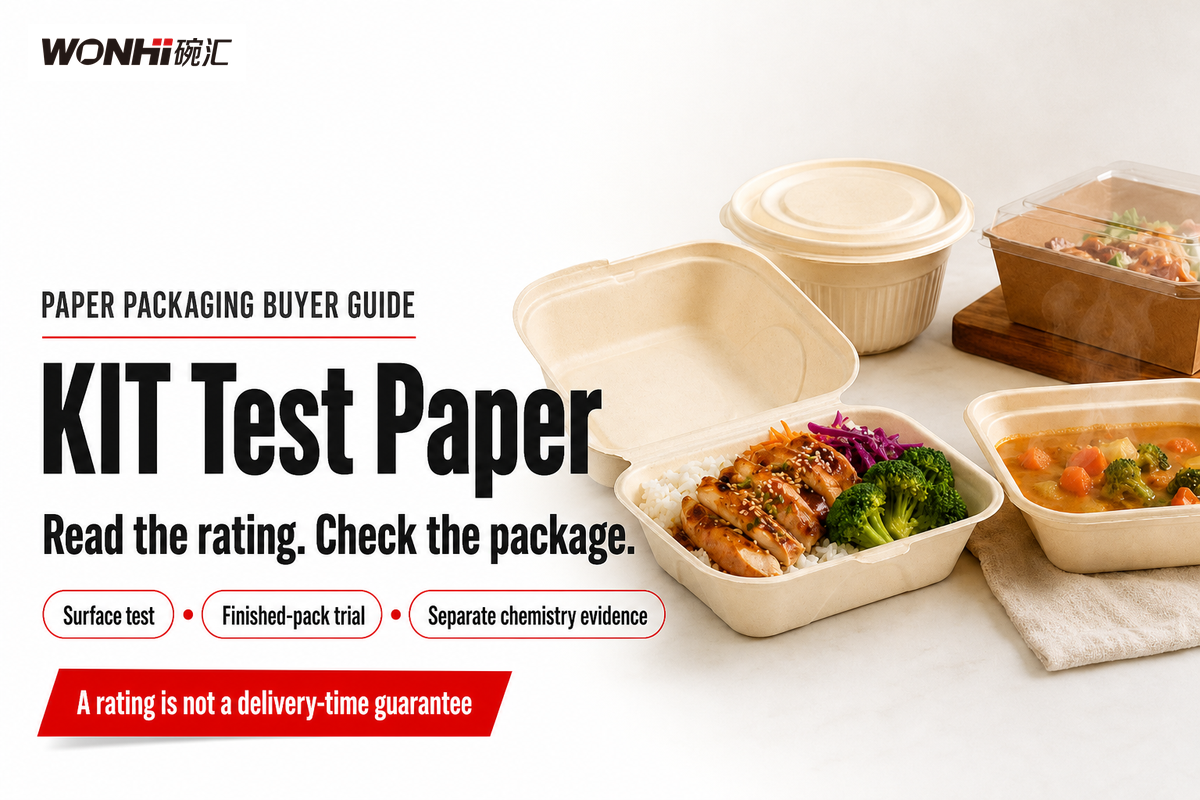
KIT test paper is evaluated with a numbered series of test liquids to rank surface repellency. Buyers use the test result to compare food packaging paper using the same method. A folded food package needs a separate performance check, while water absorption and chemical composition require different evidence.
In brief
- Read the highest passing reagent, the method and the tested material together.
- Keep flat-paper results separate from observations on a filled, folded container.
- Use the failure map to choose the next comparison and the quote card to define laboratory work.
KIT result at a glance
- Scale: 1 to 12, as described by Applied Paper Technology and Measurlabs.
- Endpoint: highest numbered reagent that leaves no failure or stain.
- Exposure example: Measurlabs describes a 15-second drop test.
- Method fit: TAPPI prescribes evaluation when applying T559 to nonfluorochemical or film-like barriers.
KIT test paper: what the rating measures
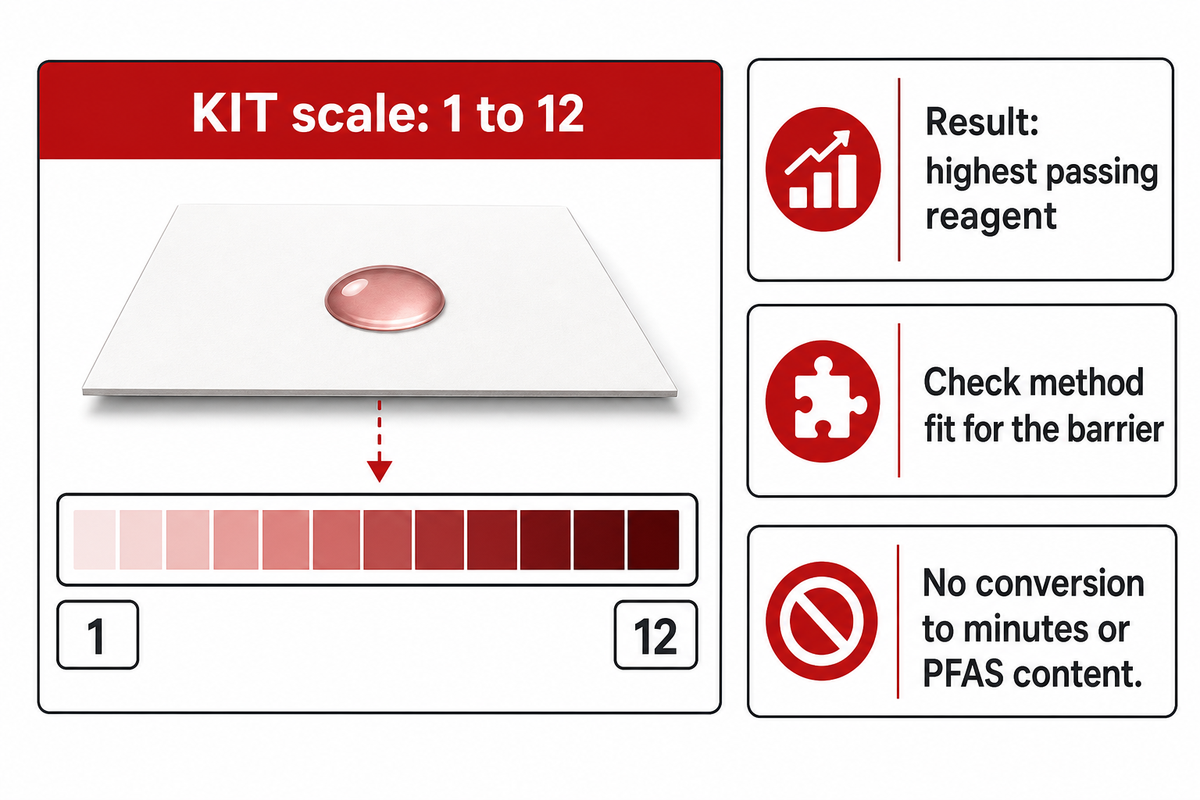
The KIT test uses a numbered series of liquids to assess surface repellency in the paper and paperboard. TAPPI T 559 describes its original application to fluorochemical sizing treatments. For a different barrier system, the laboratory first has to establish if that test method provides a meaningful result.
A treatment can change how a surface interacts with a liquid. A continuous coating can resist penetration through another mechanism. Both constructions can resist grease; however, they may show a different response to the same reagent series. Comparison starts with the identity of the coating, not the printed grade.
“the use of this test for papers with film-like barriers or those treated with nonfluorochemical agents would have to be evaluated.”
A commonly used name for the method is the 3M KIT test. Measurlabs defines a mixture series consisting of castor oil and solvents including toluene. The laboratory’s test kit provides the numbered liquid series. Standardized reagent tests belong in a laboratory. A buyer’s observation of a filled lunch box answers a different question and should be labeled an application test.
What is kit value in paper?
Kit value is the number of the highest test liquid that the paper surface withstands under the stated test conditions. Applied Paper Technology describes the series from 1 (least aggressive reagent) to 12 (most aggressive). The number ranks the result; it isn’t a percentage of oil blocked.
Therefore, the reported value should be referenced to a material description and named test method. “KIT 8” on a sales sheet leaves the tested face and construction unclear. A coating applied on only one side, or a change in the formulation of the barrier, can make an apparently matching specification a different purchasing decision.
Measurlabs describes a 15-second exposure before the liquid is wiped away and the surface is inspected for staining. A food package may remain in contact with a fatty meal for much longer. The short reagent challenge and the meal’s hold period should be in separate lines of the specification.
KIT ratings: read the result before setting a specification
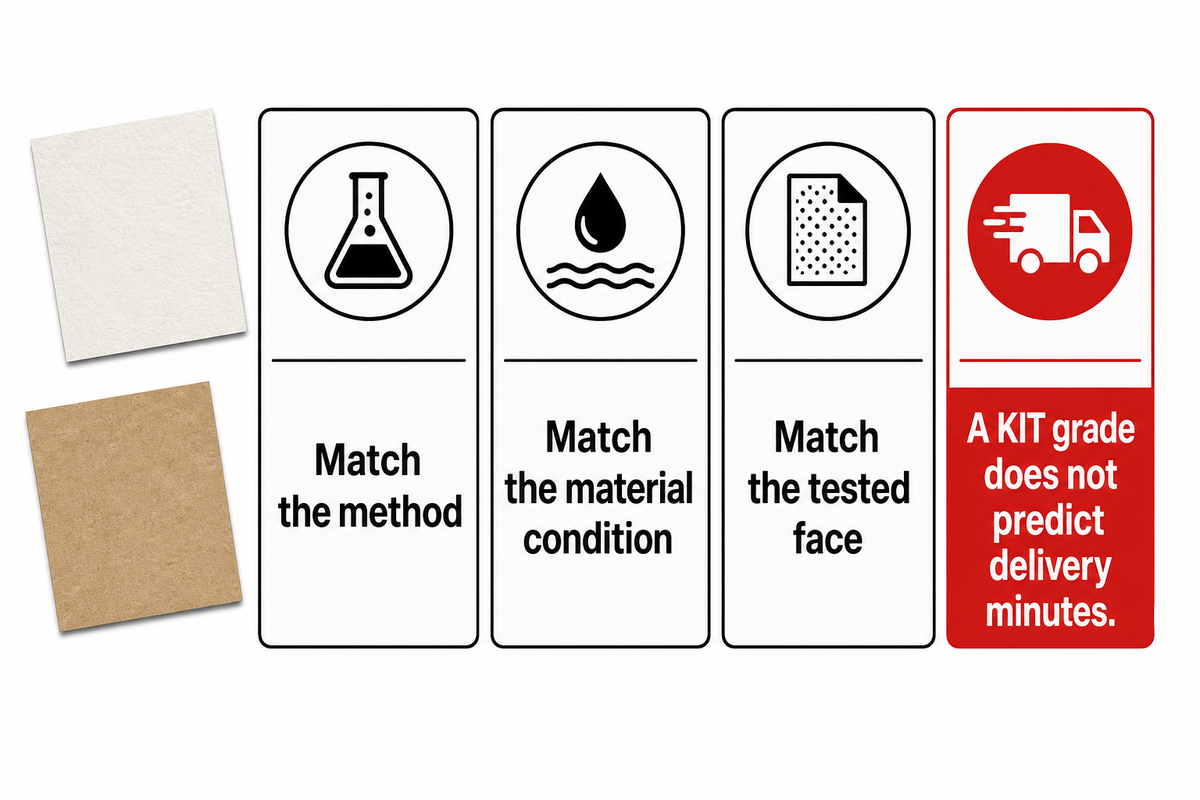
A higher number indicates resistance to a more aggressive reagent in the KIT series; ratings should be compared when the method, material condition and tested face are in alignment. Set the acceptance grade against the intended packaging application, rather than converting the difference between two grades to an extra delivery allowance.
At Applied Paper Technology, the reported rating is the highest numbered reagent that doesn’t stain the sample. This makes the endpoint more useful than a loose claim of “excellent resistance to oil.” Procurement can compare a stated result with an agreed requirement; an adjective leaves the requirement undefined.
Example: A buyer gets two reports for comparable sandwich wraps. One sample shows a test to KIT 6 and the other to KIT 8. As per the agreed-upon method, the specified minimum requirement is KIT 8, and therefore the second sample meets the requirement, and the first sample doesn’t. The buyer then sees that the higher rated sample was tested on its coated face, while the first report doesn’t mention a tested face. Prior to replacing the material, the lab addresses that difference. Neither result supplies a calculation for a 30-minute delivery route. The application trial still uses the selected wrap, the sandwich and the handling conditions that the customer will encounter.
The important difference is between ranking and prediction. A high kit rating can help control a specified material. The grade alone gives no conversion factor from laboratory performance to minutes of containment. Unexpectedly high values require the same identity check as unexpectedly low values.
When two reports differ, start with the construction and procedure before assigning the difference to supplier quality. Different paper grades may use different coatings. Thus, an uncoated kraft paper shouldn’t silently substitute for a coated sample. A change in test method may also account for a change in failure mechanism being observed.
For a 30 minute route, a purchasing requirement can pair an agreed KIT acceptance result with an application endpoint evaluated after 30 minutes. The route trial defines the duration. Keeping these criteria separate lets quality staff investigate a failed meal trial without automatically raising the required KIT grade.
KIT test vs Cobb and PFAS evidence
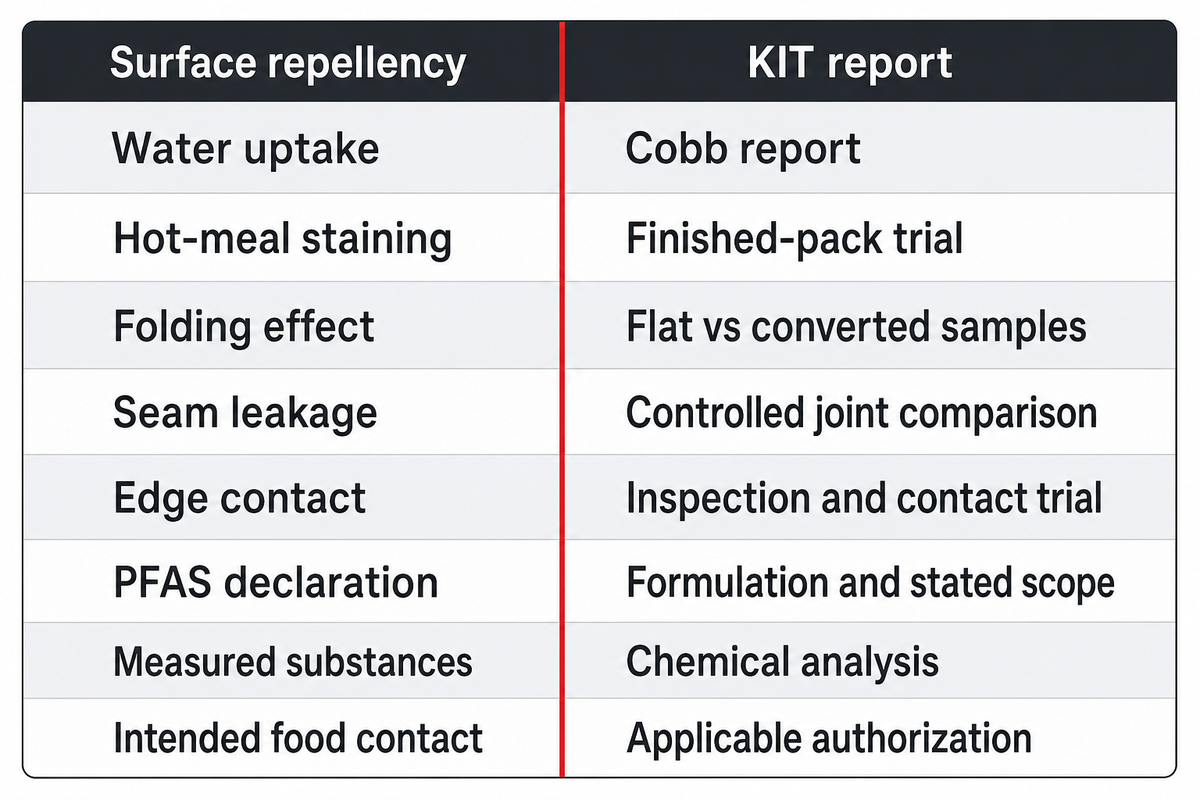
KIT governs grease performance against reagents; Cobb governs water absorption over a defined time period. Chemical analysis and food-contact documentation address composition and permitted use. Choose the evidence that answers the buying question, then keep its method and scope attached when comparing suppliers or approving a replacement material.
As stated in the SGS-IPS description of TAPPI T 441, the test determines the level of water absorption of sized paper, paperboards and corrugated fiberboards. There are various exposure periods provided in the service description. Therefore, a Cobb value without its test time is incomplete for comparison, the same way a grease result without its method leaves an important element blank.
| Buying question | Evidence to use | Detail that changes the decision |
|---|---|---|
| How does this surface resist the KIT liquid series? | KIT laboratory report | Highest passing grade, method and tested face |
| How much water does the board absorb? | Cobb report | Exposure time and water uptake, with the report’s units |
| Will a hot, oily meal mark the outside? | Finished-package application trial | Food, fill temperature, hold period and stain endpoint |
| Does folding change the barrier? | Matched flat and converted samples | Same stock and coating, different converting condition |
| Where does a seam leak begin? | Location records and controlled seam comparison | Orientation, joining condition and first visible stain |
| Does an exposed edge contact the food? | Finished-pack inspection and contact trial | Edge exposure and whether the stain spreads from it |
| What does a PFAS declaration cover? | Supplier formulation declaration | Claim wording, product identity and stated scope |
| What substances were measured? | Chemical analysis report | Analytes, reporting limits and sample identity |
| Is the material suitable for the intended food contact? | Applicable authorization and supporting documentation | Substance identity, supplier linkage and use conditions |
OGR (oil and grease resistance), usually shortened to OGR, concerns a packaging function. A chemical declaration concerns the composition of the material. A good result for one shouldn’t be used to justify an empty column in the other. This separation is especially useful when an unfamiliar coating arrives with a familiar grade.
For evaluating the permeability of packaging to moisture and/or gas, see the separate guide to evaluating packaging permeability data. Food contact assessment has its own sampling and use conditions; the migration-testing guide for packaging buyers addresses this adjacent task.
SGS-IPS lists 120 seconds for its short paper Cobb test and 30 minutes for its combined-board option, with other periods available by request. These are examples of laboratory services. Whenever a procurement function compares water absorption data, the exposure time should be included with the result.
Grease resistance in hot-food packaging trials
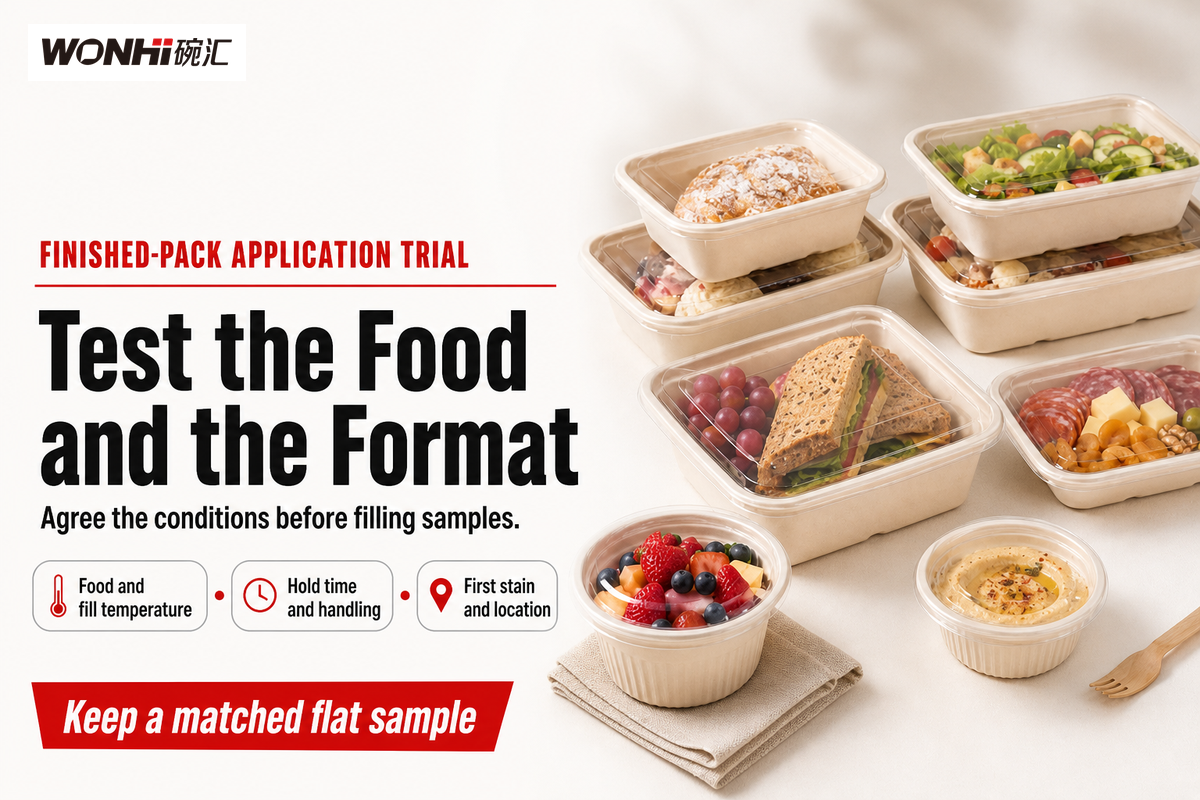
Evaluate the completed food package with food and handling conditions it will face. Record fill temperature and contact time and inspect the outside and supporting surface at the intervals agreed. Use this trial to judge the application and retain the flat-paper test as a separate material control measurement.
Lev and co-authors’ 2023 review of coated packaging materials describes barrier damage during creasing, folding and forming. A flat sheet reaches the customer after those operations. That’s the basis for a material comparison and container trial as complementary parts of qualification.
Example: Let’s consider a take-away operator who compares two folded boxes containing the same greasy rice meal. The trial plan records a 65 °C fill temperature and observations after 15, 30 and 45 minutes; these are the operator’s chosen conditions for this example. The operator elected those conditions. The boxes have clean outer walls at the start. Later, one develops a stain beside a bottom fold while its wall remains dry. The location clue is close to the fold. Quality staff retain the box, photograph the fold and compare a second formed sample with a flat stock from the same lot. Production checks the converting condition, while procurement keeps the material identity fixed during the comparison.
Observe the customer’s handling. A pastry resting on a liner and a high-fat meal pressed against a wall expose different areas. Contact, stacking, tilting and transportation can move the contact zone. The observation schedule should capture the handover point as well as the time spent waiting to be dispatched.
Define the customer experience required at handover: clean packaging and no grease transferred to the receiving surface. Set the trial’s failure criteria before filling the samples: an outside grease mark, a drop escaping a seam, or a stain transferred to a clean support. In this case, the blotter must remain consistent between the samples, or the visibility of the grease may change.
Keep the comparison manageable. When a trial changes the coating, the box design, and the meal all together, what’s being compared is difficult to determine. Keep the other variables constant and focus on the variable being investigated. Label retained samples before they are separated from their outer packaging, and keep the observation sheet with the photographs. A description of an observation such as “first stain, lower left, no mark on upper right wall” is more informative than a general comment. It may be possible for production to repeat the forming conditions, while quality can select material from the same lot for the tests.
For the 45 minute example, the useful record is the first affected position and observation time, not just “failed.” That detail serves as an observation for planning the next run. The same concept applies to packaging checks for bakery products without universally assigning KIT grades to all pastries.
Grease leakage at folds, seams and cut edges
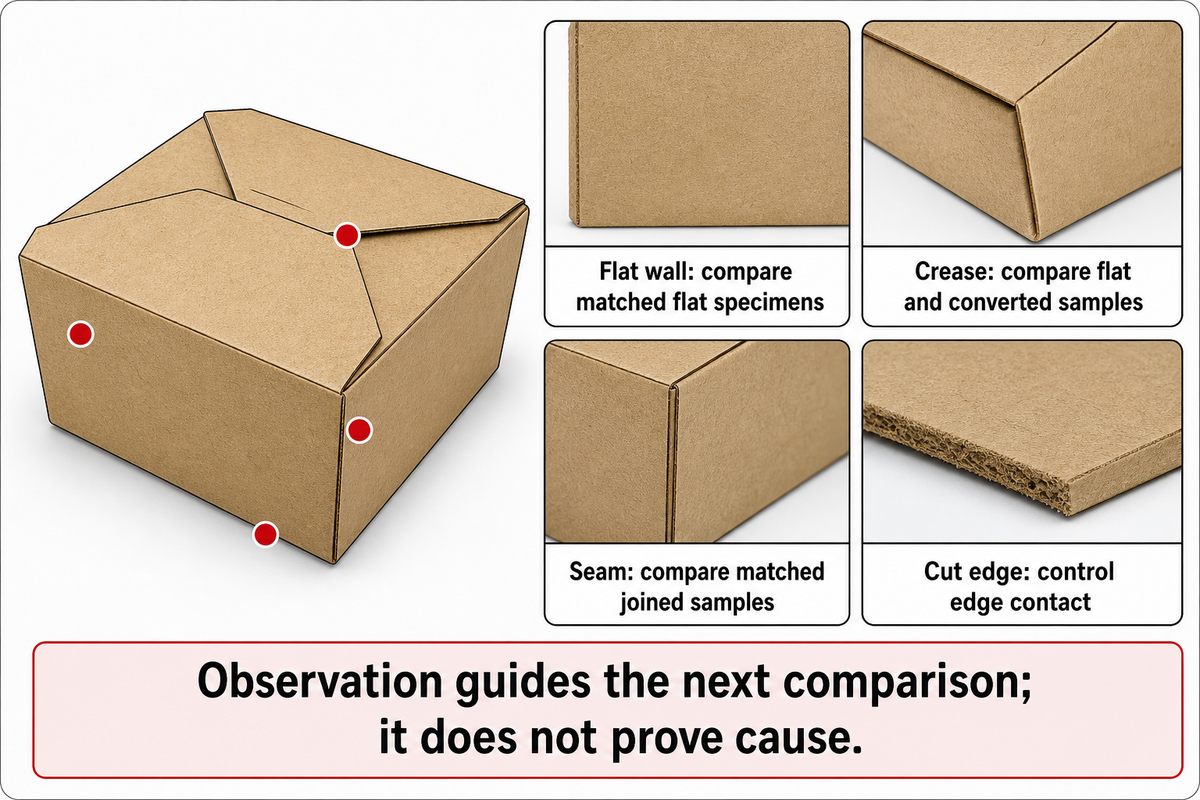
Find the first obvious stain before modifying paper. Separate observations on the flat wall, crease, seam and cut edge and compare the affected area to a matched sample. This keeps the next investigation focused on the package feature involved instead of treating every leak as weak surface resistance.
4-Zone Grease Failure Map
Use this worksheet in conjunction with the buyer during a trial. The zones point to where to look and what to compare. The cause is identified with follow-up work. Keep photographs, samples and labels to discuss the same sample location with the lab, converter and the buyer. Retaining samples is important.
| Zone | Record | Next comparison | Owner |
|---|---|---|---|
| Flat wall | Stain position, contact face, temperature and first observation time | Matched flat specimens with the same coating and lot; compare the tested face with the food-contact face | Quality and laboratory |
| Crease or formed corner | Whether the mark follows a fold, damaged spot or stretched region | Flat versus converted samples from the same stock; inspect the local converting condition | Production and quality |
| Seam or joint | First leakage point, joint orientation and food contact with the joint | Matched joined samples; review joining geometry and process with the converter | Production |
| Cut edge | Exposed edge position and direction of stain spread | Same construction with controlled edge contact; distinguish edge wetting from a wall stain | Quality and packaging development |
A crease mark is a good place to start an investigation. It does not identify the cause by itself. Damage to the coating, contact geometry and the pathway of the oil can all combine to produce the crease mark. Similarly, a seam observation should lead to a controlled joint comparison before the team blames either the adhesive or the paper.
Marianelli and others’ 2022 TAPPI Journal abstract describes an adapted KIT test and an oil breakthrough test for waterborne barrier coatings. Their work provides a basis for deciding on the best test to perform, based on the performance question. It’s an excellent discussion aid for an R&D tester when the surface test results don’t correlate to the filled-pack results.
Do higher GSM papers stop grease leaks?
No. A higher GSM describes more mass per unit area, not a guaranteed increase in grease resistance. Coating construction and the method of package formation are still considerations. A heavier board may require the same level of investigation into its food contact surface as a lighter board.
For a comparison of 250 g/m² and 300 g/m² boards, keep the coating identity and package design visible in the trial record. Otherwise, differences may be caused by other factors such as a different treatment or converting conditions. Use the design which meets the requirements of the whole application including physical strength.
A narrow crease stain and a broad wall stain should be tracked separately during a 30-minute observation. Recording them separately preserves a useful distinction for the next comparison. A general “leakage” label discards location information needed to investigate the package, and therefore impedes production from carrying out its investigation.
Paper testing laboratory: request a comparable quote
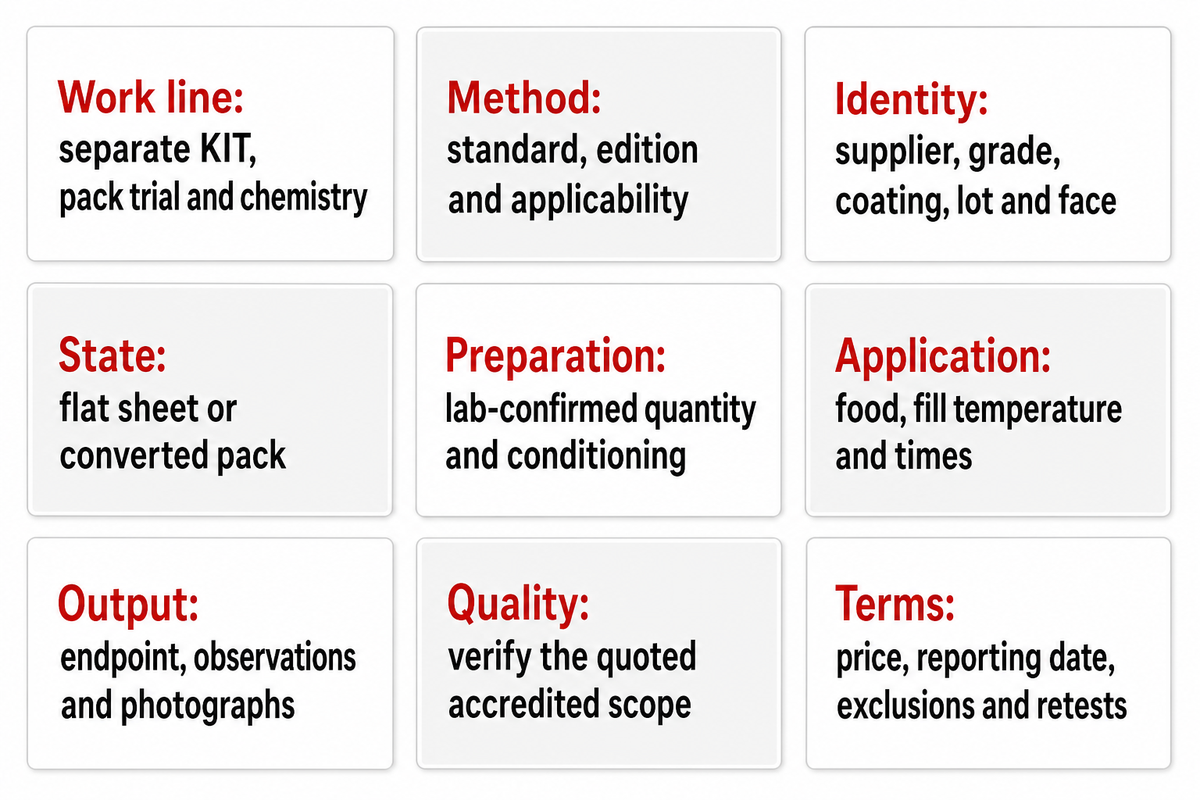
Specify separate scope lines for a KIT test, finished-container trial and any chemical work. Provide the material identity and planned use to the laboratory, and agree terms for preparation, reporting and acceptance. The quotation is comparable when both third-party laboratories are pricing the same specimens and the same test.
Measurlabs’ KIT service lists 10 A4 sheets and a typical three-week turnaround after samples arrive. Quotes from other laboratories may vary for logistics. For sample quantity, turnaround and accreditation scope, consider these as named fields in the request and don’t presume a testing service page is a binding quotation.
The test method is identified in the industry standards. The quotation defines the work the laboratory will perform for the order. Separate specimen preparation and testing and reporting when comparing the scope. A low headline price may cover a flat sheet, and the other quote may cover converted samples and photographed specimens. Identify the difference and place it with the total before choosing a laboratory. Retest charges also matter if an unclear sample label or unsuitable specimen requires another shipment. This comparison is for scope and not to order every test possible.
Lab Quote Scope Card
These fields should be included in the request. Quality controls the acceptance question; procurement obtains scope and price; the laboratory confirms the test method and specimens.
| Field | What to send or request | Decision it supports |
|---|---|---|
| Work line | Flat-paper KIT, modified finished-pack trial, or separate chemistry assessment | Compare like-for-like services |
| Method | Standard and edition; laboratory’s applicability assessment for the barrier | Use a suitable method |
| Sample identity | Supplier, grade, coating reference, lot and tested face | Link results to the order |
| Specimen state | Flat sheet or converted container; joining and crease locations where relevant | Separate material and forming effects |
| Quantity and preparation | Lab-confirmed sample count, dimensions, conditioning and replicates | Ship usable samples |
| Application conditions | For a modified trial: food, fill temperature in °C and observation times in minutes | Represent the intended use |
| Endpoint and output | Highest passing KIT result or separately agreed trial endpoint; observations and photographs | Interpret the result consistently |
| Quality scope | Verify whether the quoted method is within the laboratory’s stated accredited scope | Match assurance to the work |
| Commercial terms | Price, sample-receipt date, reporting time, exclusions and retest charges | Avoid an incomplete cost comparison |
How should Kit Level be written into an RFQ or specification sheet?
Add the agreed results of KIT acceptance testing along with the method, material identity and tested face. Place finished-package trial conditions on a separate line. This gives the supplier a defined laboratory requirement while keeping the food-contact application visible to the people selecting and approving the construction.
A useful specification also identifies who approves a method change and how results are reported. “KIT 8 minimum” can be an agreed example of a material criterion; it shouldn’t silently become the acceptance rule for all burgers, fried chicken or wrapping papers. The level is determined by the qualified application of the buyer.
For the laboratory that requests 10 A4 sheets, dispatching only one small formed tray could delay the work. Agree upon the sampling format before any cutting or shipping. A matched set of flat stock and converted packages can support several work lines, but the laboratory needs to define the quantity for each.
Supplier approval: match reports to production packaging
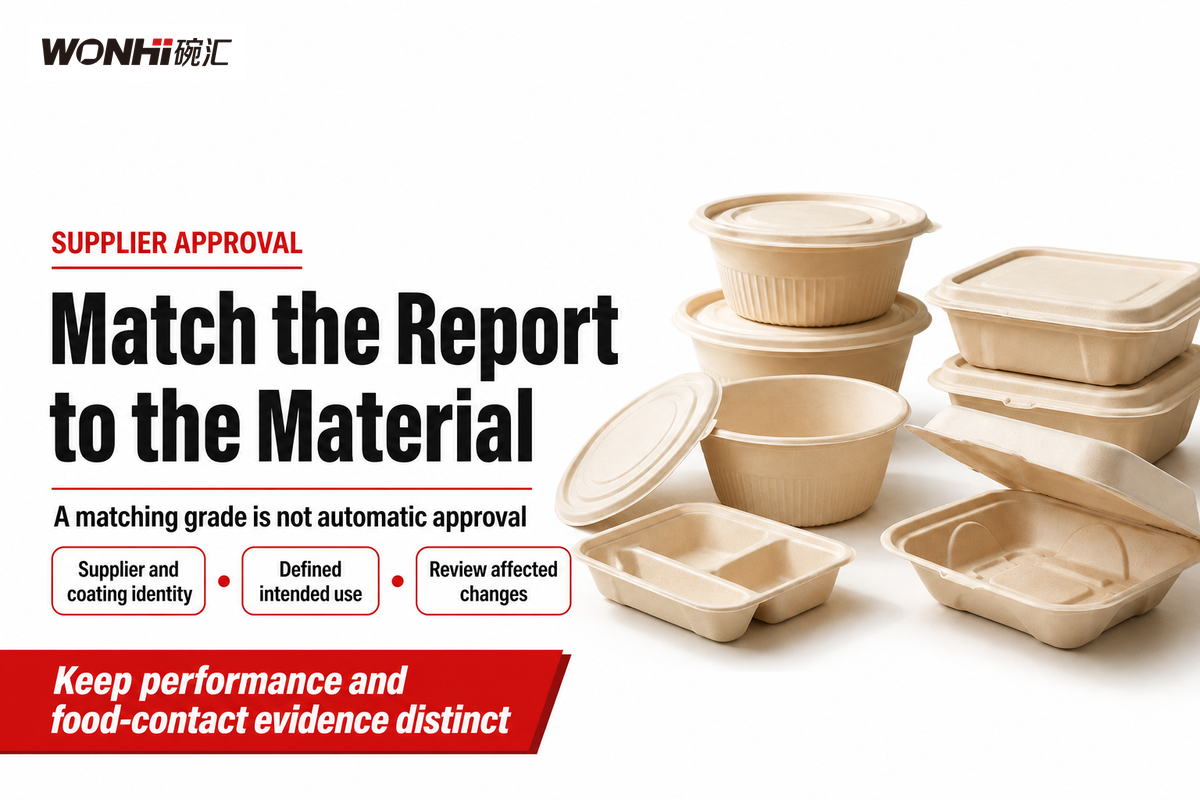
A defined construction is approved for a defined use, with evidence packages that connect the supplied material to the required specification. Performance acceptance should be kept distinct from food contact compliance. If the material or intended use changes, review the affected requirement before carrying the previous approval forward to the new order.
The FDA’s food contact regulatory status explanation describes various pathways to market. Where an Effective Food Contact Notification is the basis, it applies to the specific manufacturer, substance and conditions of use. A distributor’s paperwork needs that supply-chain link; a similar material name alone is insufficient.
Example: A procurement lead receives a replacement board with the same nominal thickness and KIT result as the approved stock. The coating reference has changed and the old report has named a different material supplier. The lead holds the delivery for the affected application, and quality reviews the construction details. The converter provides the new coating reference, the applicable food-contact basis and supporting performance information. A finished-pack trial is performed only where the change is affecting the qualified use. The team captures which requirements are reviewed and the reason for accepting the evidence. Procurement can release the order once the requirements for the defined use are met. An unchanged grade or a new certificate alone isn’t automatic approval.
Do
- Link the supplied grade to its applicable evidence.
- Record which material changes trigger review.
- Retain the agreed application and acceptance conditions.
Don’t
- Transfer an authorization between unrelated suppliers by assumption.
- Approve a new coating solely because its grade matches.
- Require every material to have the same authorization route.
The buyer’s approval workflow should allow a proportionate response. Missing identity calls for clarification; a changed coating calls for review of the affected performance and use conditions. Relevant evidence may be available, and testing each individual production package isn’t an automatic requirement.
For a project involving custom food-packaging construction, keep the agreed design revision with the sample record. Procurement can then review the change with quality and production. This is more helpful than asking a manufacturer to improve “grease resistance performance” without identifying the problem observed.
PFAS-free greaseproof paper: what is changing
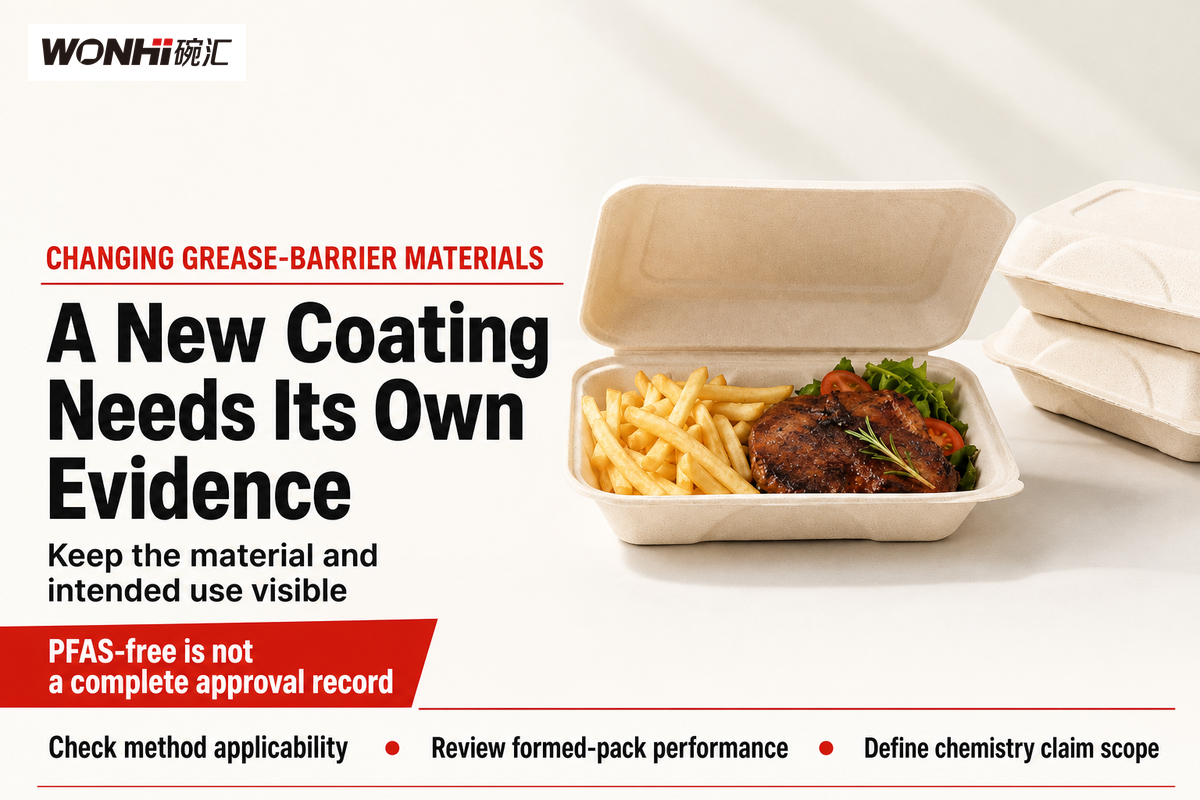
With changes in grease-barrier chemistry, coating identity and test applicability are more important in purchase requirements. The FDA’s older action on PFAS grease proofers gives a federal reference point. A replacement material still requires performance evaluation and substantiation related to the food contact and the destination market.
The FDA’s January 2025 notice identifies 35 food-contact notifications for PFAS-related greaseproofing substances that became no longer effective on January 6, 2025, following abandonment of those uses. Its phase-out overview also records the February 2024 announcement that these greaseproofing substances were no longer being sold into the US paper-food-packaging market.
This federal action is only a portion of the purchasing situation; it isn’t a complete destination market checklist. The better approach is to describe the material in question and assess the use in question. The phrase “PFAS-free” from a supplier, an analytical report and a food contact authorization should each warrant their own scope.
Changing to a waterborne barrier also changes the technical conversation. The coating could rely on a different framework from historical fluorochemical treatments. Keep the agreed surface tests where applicable and evaluate converted-package behavior when the construction varies. “sustainable” describes a goal. The functional specification needs defined end points.
Key takeaway
A KIT result is one material measurement. Pair it with an application-specific package trial and the appropriate chemistry and food-contact documentation before approving a changed construction.
For a request, state the food type and package format and indicate the first location where a grease mark appears. The Wonhi paper food packing range defines the product starting point. The agreed material and trial define the next step.
Frequently Asked Questions
How can you test the quality of paper?
Test paper against the properties needed for its intended use, including grease resistance, water absorption and physical strength where relevant.
Start with the application and turn each requirement into a separate measurement. A food wrap and a folded takeaway box face different handling conditions. Use a suitable laboratory method for the material property, then evaluate the finished format under the agreed real-world service conditions. Record the grade, coating, lot and tested face so a result remains useful when the next order arrives.
Can you still buy grease proof paper?
Yes. Greaseproof paper remains a packaging category, but the chosen grade must suit the food and intended conditions.
Buy by a defined construction and application rather than the product name alone. Surface treatment, coating and conversion can affect how a grade performs. For US food contact, obtain documentation for the applicable material and use. A supplier changing its grease-barrier formulation should identify that change so the buyer can review the relevant performance and documentation before substitution.
What is greaseproof paper for cooking?
Greaseproof paper limits grease penetration, while suitability for a cooking process must come from the specific product’s intended-use instructions.
Do not treat greaseproof and baking paper as interchangeable purchasing specifications. The cooking method introduces conditions beyond an oil-resistance grade, including the product’s permitted temperature and contact use. Select a grade explicitly intended for the process. For wrapping a pastry after cooking, define the contact and handling requirement separately from any oven-use requirement attached to a baking product.
Is KIT testing relevant to coated film barriers?
KIT testing can be considered for coated barriers after the laboratory evaluates its applicability to that material.
TAPPI describes this evaluation for film-like and nonfluorochemical barriers. Keep the coating identity in the test request. A method suited to one surface treatment may need different interpretation when the barrier works through a continuous film.
What KIT level should I use for fried chicken versus pastries?
Select the KIT requirement through qualification of the chosen packaging construction and food application, rather than a universal menu-to-grade table.
Fried chicken can expose a box to hot oil and sustained contact; a pastry may touch a liner in a smaller area. Define the food, handling and acceptable exterior condition, then compare suitable material candidates. A qualified application gives the grade a purchasing purpose. The food name by itself leaves coating, geometry and hold conditions unresolved. Use the accepted construction and its trial conditions as the reference when discussing a replacement with the supplier.
How do hold time and heat affect the required KIT level?
Hold time and temperature belong in the food trial; KIT grades have no fixed conversion into minutes of hot-food containment.
Record both variables when comparing packs. A longer route or a changed fill temperature can justify reviewing the application even when the supplier’s surface-test grade stays the same.
What should I do if the paper passes but the container leaks?
Retain the leaking container, locate the first stain and compare that zone with matched flat and converted samples.
Use the wall, crease, seam and cut-edge entries in the failure map to organize the observation. Record the contact conditions before changing the grade. Quality and production can then isolate a useful comparison, such as a forming change with material held constant. The next laboratory request should address that question instead of repeating an undirected surface test. Keep an unused sample from the same lot for comparison and preserve the failed pack’s orientation in photographs. If the stain starts at a joint, send the laboratory or converter a marked image of that joint rather than relying on a written description of the whole box.
Bring the application into the packaging enquiry. State the food type, format and fill conditions, the expected storage and handling time, together with any test report. Contact Wonhi with your packaging requirements to discuss the product and sample brief.
References & Sources
- TAPPI T 559 cm-22: public method scope
- Applied Paper Technology: grease resistance and KIT rating
- Measurlabs: KIT laboratory-service description
- SGS-IPS: TAPPI T 441 Cobb test
- Lev et al., 2023: converting and barrier properties review
- Marianelli et al., 2022: OGR methods for waterborne barriers, public abstract
- FDA: 35 PFAS-related food-contact notifications, January 2025
- FDA: greaseproofer market phase-out overview
- FDA: regulatory status of food-contact components