Get in touch with Wanhui Company


Updated July 2026. Reviewed by the Wanhui packaging team.
3 compartment containers are single-shell foodservice trays with three interior wells that keep a hot entrée separated from two sides or a dessert, and for US off-premise foodservice they’re the format operators reach for whenever sauce-bleed, portioning, and presentation all matter at once. This guide is written for the buyer, not the browser: which material actually survives your reheat cycle, how many compartments your menu really needs, why sauce migrates between wells, and how to keep your next bulk order legal under the foam and PFAS rules now rolling across the states.
The short answer: A 3-compartment container is a one-piece hinged or snap-lid foodservice tray with three interior wells that hold a complete meal — typically one large entrée well plus two smaller side wells. For hot delivery, spec polypropylene (PP) or mineral-filled PP (MFPP) with a vented, perimeter-locking lid; reserve clear PET for cold service, and treat “compostable” as a certified spec, not a label.
Quick Specs: 3-Compartment Foodservice Containers
| Common footprints | 8×8 in and 9×9 in hinged (square); 9×6 in rectangular |
| Typical well split | ~850 ml entrée + 350 ml + 350 ml sides |
| Hot-food material | PP (#5) / mineral-filled PP (MFPP) |
| Cold-service material | Clear PET (#1) |
| Microwave rating (PP/MFPP) | Short-burst reheat to ~120°C / 250°F |
| Case packs | 100–150 sets/case typical |
What a 3-Compartment Container Actually Is (and When the Format Wins)
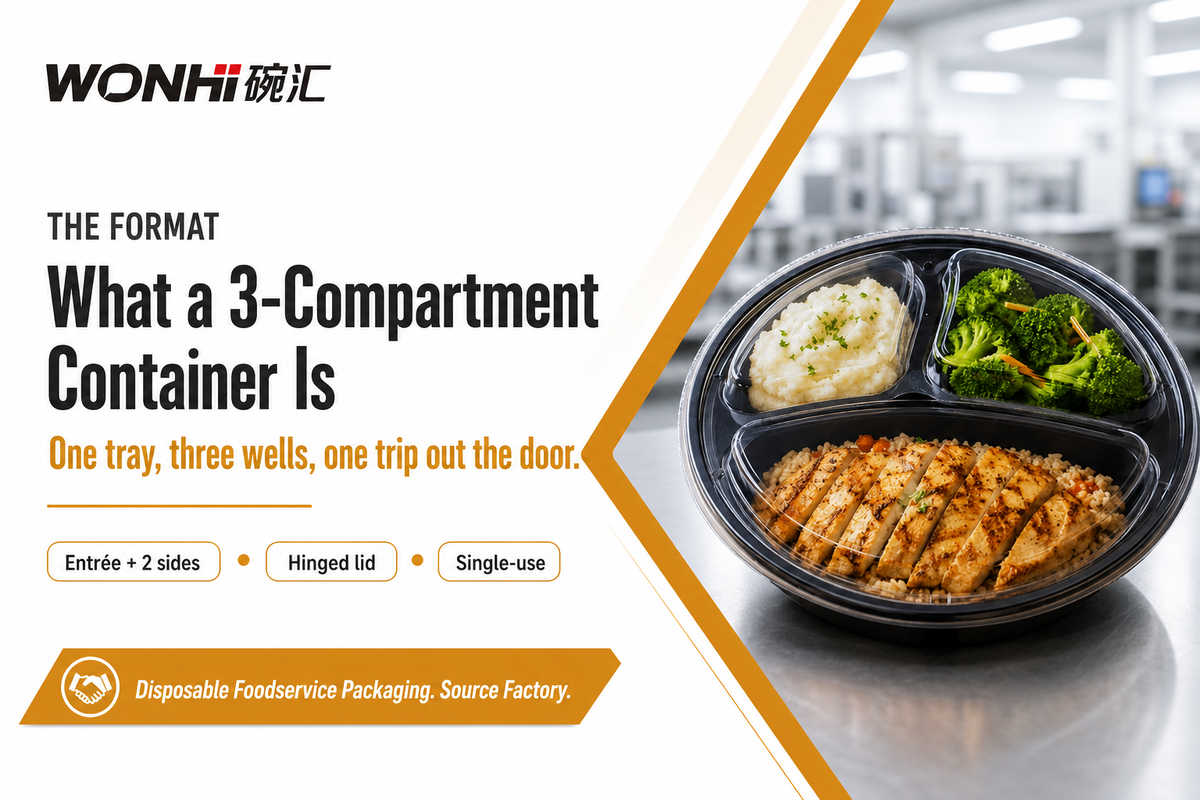
A 3-compartment container is a single hinged or snap-lid tray with three sealed interior wells sized for a full meal – one hot entre kept apart from two cold or saucy sides. Those resins are food-contact-grade under the FDA rule for olefin polymers (21 CFR 177.1520), which is the safety basis for PP and PET foodservice trays, not a temperature rating.
This format wins when your menu has a natural three-part structure and sauce migration hurts the customer’s first impression – combo meals, school and cafeteria lunch service, meal-prep delivery, and catering plates. It replaces the “one cup per item plus its own lid” habit with a single SKU, which cuts pick-pack labor and shrinks the number of line items on your storeroom shelf.
It loses when the menu is a single high-volume item: dividers eat usable volume, so a burrito bowl or a wing order is usually better in a 1- or 2-compartment meal prep container. Practitioners who test these trays note the same thing repeatedly: buyers over-spec the compartment count and then complain they’re “just losing space.” Wanhui codes the format directly into its SKU numbers – an 883 reads as “8-inch, 3-compartment” and a 993 as “9-inch, 3-compartment,” the same logic wholesale catalogs use. In practice, a taqueria running 400 delivery orders a day moved its wet entrées into disposable 3 compartment containers and cut mixed-leak complaints sharply. That’s the concrete win 3 compartment food containers deliver on a saucy menu, and why operators pay for 3 compartment containers with lids that actually seal rather than the cheapest 3 compartment to go containers you can shop off the shelf. That same divided format also shows up as consumer lunch boxes and food storage sets, but a foodservice plastic food container is engineered for a hotter, faster single-use cycle than a home leftovers box.
💡 Key takeaway: Choose 3 compartments when the menu is entrée-plus-two, not by default — the divider is only an advantage when the food actually needs separating.
How Many Compartments Do You Actually Need? The Compartment-Count-to-Menu Matrix
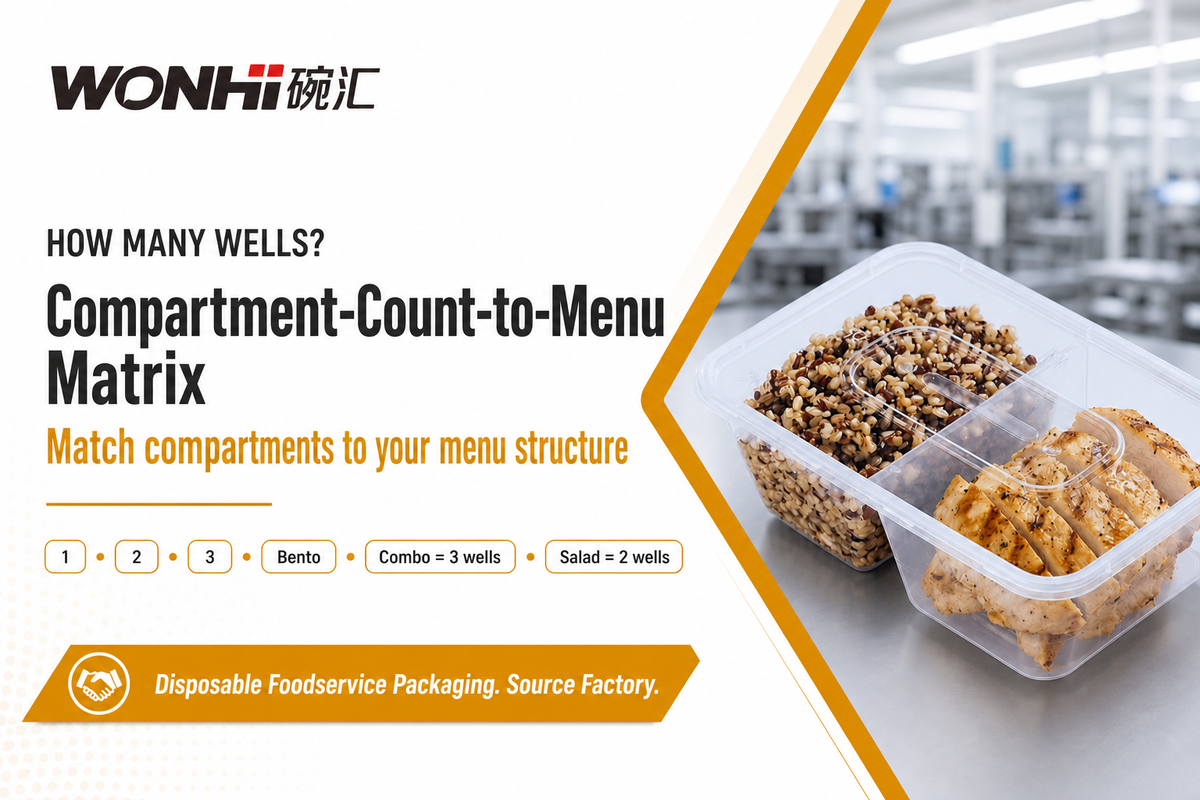
The Compartment-Count-to-Menu Matrix maps menu structure to compartment count so you spec by the food, not by whatever your last distributor happened to stock. Match the count to the number of items that must stay physically apart; everything else is wasted tooling and lost volume.
| Menu structure | Count | Why |
|---|---|---|
| Soup, single-protein bowl, dessert | 1 | One food, no separation needed; dividers only cost volume |
| Rice + protein, salad + dressing | 2 | One wet/one dry pairing; often ships with a per-well seal |
| Combo meal: entrée + 2 sides | 3 | The classic fit — one SKU replaces three cups + lids |
| School / cafeteria tray meal | 3 | Portion-controlled components, reheatable on the line |
| Meal-prep delivery (macro-tracked) | 3 | Protein / carb / veg split reads as portion control |
| Bento-style plated meal | 3–4 | Visual variety; see the bento box format guide |
| Tasting / sampler platter | 5+ | Many small portions; specialty tooling |
| High-volume single item (wings, fries, burrito bowl) | 1 | Dividers block the volume the food needs |
Well-split and SKU logic drawn from Wanhui production-line specs; menu-fit patterns cross-checked against foodservice buyer discussions.
💡 Key takeaway: Standardizing on 3-compartment for an entrée-plus-two menu collapses three cup-and-lid SKUs into one, which is where the real procurement saving lives — fewer line items, single-pallet shipping, simpler kitchen stations.
Material Selection: PP, MFPP, PET, Bagasse, and Foam Compared
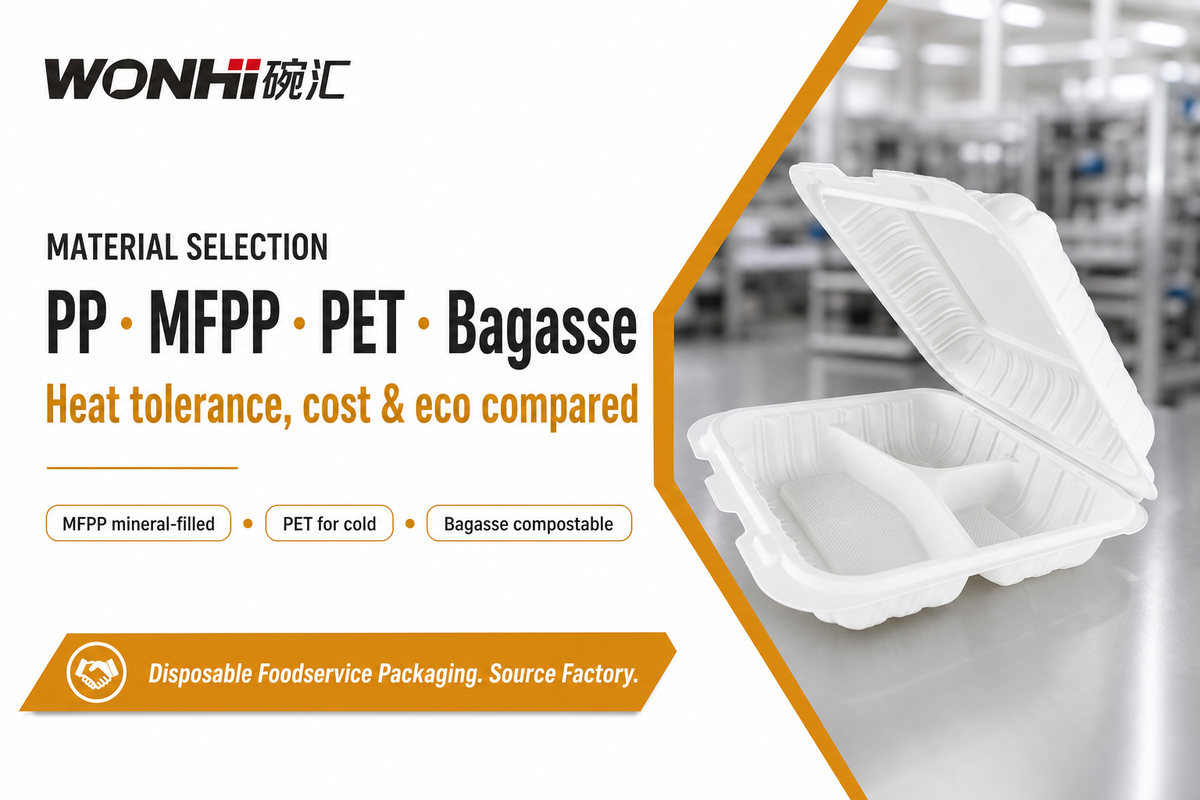
Material decides everything downstream – heat tolerance, microwave safety, clarity, recyclability, and whether the container is even legal in your state.
Get it wrong and the box either melts on the reheat or fail a municipal foam rule. Here’s how the five foodservice families actually compare.
| Material | Service temp | Microwave | Best for |
|---|---|---|---|
| Polypropylene (PP #5) | Continuous ~80–100°C; short-burst ~120°C/250°F | Yes (vent lid) | Hot takeout, rice bowls, delivery |
| Mineral-filled PP (MFPP) | ~110°C/230°F, stiffer | Yes | Premium hinged, foam replacement |
| PET (#1) | Softens ~70–75°C (amorphous) | No | Cold salads, sushi, deli, display |
| Bagasse (molded fiber) | Handles hot food well (~200°C+) | Yes | Compost-mandated venues (if certified) |
| EPS foam | ~70°C; softens fast | No | Being legislated out (see compliance) |
PP service temperatures per MatWeb polypropylene data; PET softening from glass-transition measurement. FDA 21 CFR 177.1520 governs food-contact safety, not temperature.
Two handy notes that spec sheets hide. First, PP costs about 1/3 to 1/5 as much per unit volume as PET, on a per-weight basis and also in terms of dollar-cost per gram of resin – this is why virtually all US kitchen fare at temperature relies on PP. Second, mineral-filled PP substitutes 30-40% inert filler for polymer, adding the stiffness that protects a hinged lid and a divider, the reason foam-replacement lines lean on MFPP hinged containers rather than unfilled PP.
Material choice shows up in complaint rates, not spec sheets. A burrito-bowl ghost kitchen running thin foam clamshells fought constant warped-lid and queso-spill callbacks until it switched to black PP with perimeter-locking lids; complaints dropped sharply for a packaging-cost increase of about $0.15 per order. Operators repeat the lesson bluntly: buy the right material for the heat, not the cheapest box on the shelf.
“We tested fourteen MFPP filler ratios across the 883 and 993 lines before settling on the current formulation, it is the only blend that holds shape after 90-second microwave reheating without warping the 3-compartment dividers.”
Will It Survive the Microwave? The Foodservice Reheat-Temperature Ladder
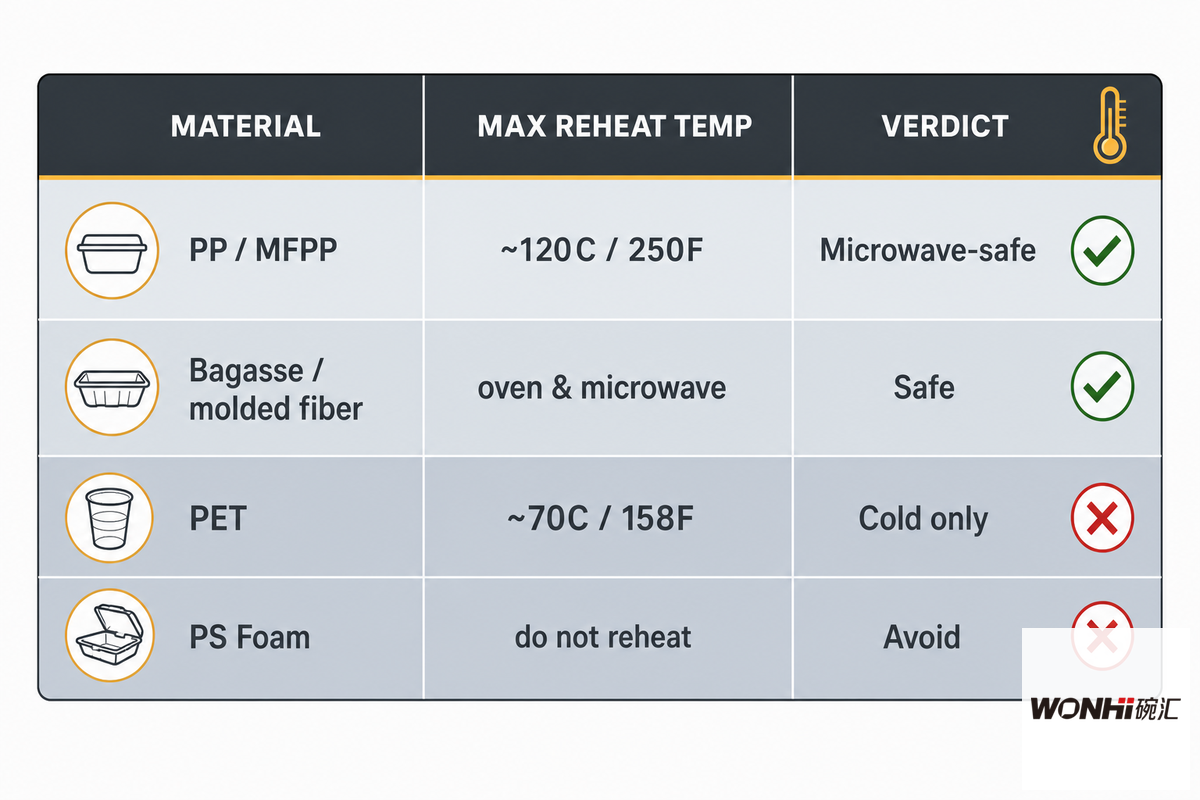
Are 3-compartment containers microwave safe?
PP and mineral-filled PP 3-compartment containers work well with short microwave-safe reheats, up to around 120C/250F; clear, unfilled PET isn’t, because it starts to soften near 70-75C, below the temperature of just-plated soup or rice. When selecting an item for reheating, just keep the Foodservice Reheat-Temperature Ladder in mind: match the material rating to the actual peak temperature of your food, then leave a buffer.
- ✔~200°C+ bagasse molded fiber and dual-oven CPET trays: steam-table and convection service.
- ✔~110–120°C / 230–250°F PP and MFPP: hot soup, rice bowls, microwave reheat. This is where takeout lives.
- ✔~70–75°C PET ceiling: cold and ambient only; warps under hot fill, never microwave.
- ✔~60–70°C EPS foam floor: softens fast and is being banned outright.
📐 Worked example: A rice-and-curry bowl plated at ~95°C sits above PET’s ~70°C softening point but comfortably under PP’s ~120°C short-burst rating. So you spec black PP or MFPP, not clear PET — the clarity is worth nothing once the tray deforms and the customer photographs a slumped lid.
Operators confirm failure via customer feedback, as customers call to report thin plastic visibly warping under hot food (immediately signaling potential leeching risk) or to tell them that their meal-preppers won’t put their plastic lids in the microwave (which distorts them), and instead hand-wash them. PP also takes the freeze-to-microwave swing that meal-prep delivery demand, staying pliable in the freezer and safe under a reheat. Material rating is only half of safe reheating, though: USDA food-safety guidance also calls for venting, stirring or rotating for even heating, a standing time, and reheating leftovers to 165°F/74°C. If in-container reheat matters to your menu, put the microwave-safe SKUs on your PP/MFPP lines and label them clearly.
Why Sauce Bleeds Between Compartments: The Cross-Compartment Bleed Rule
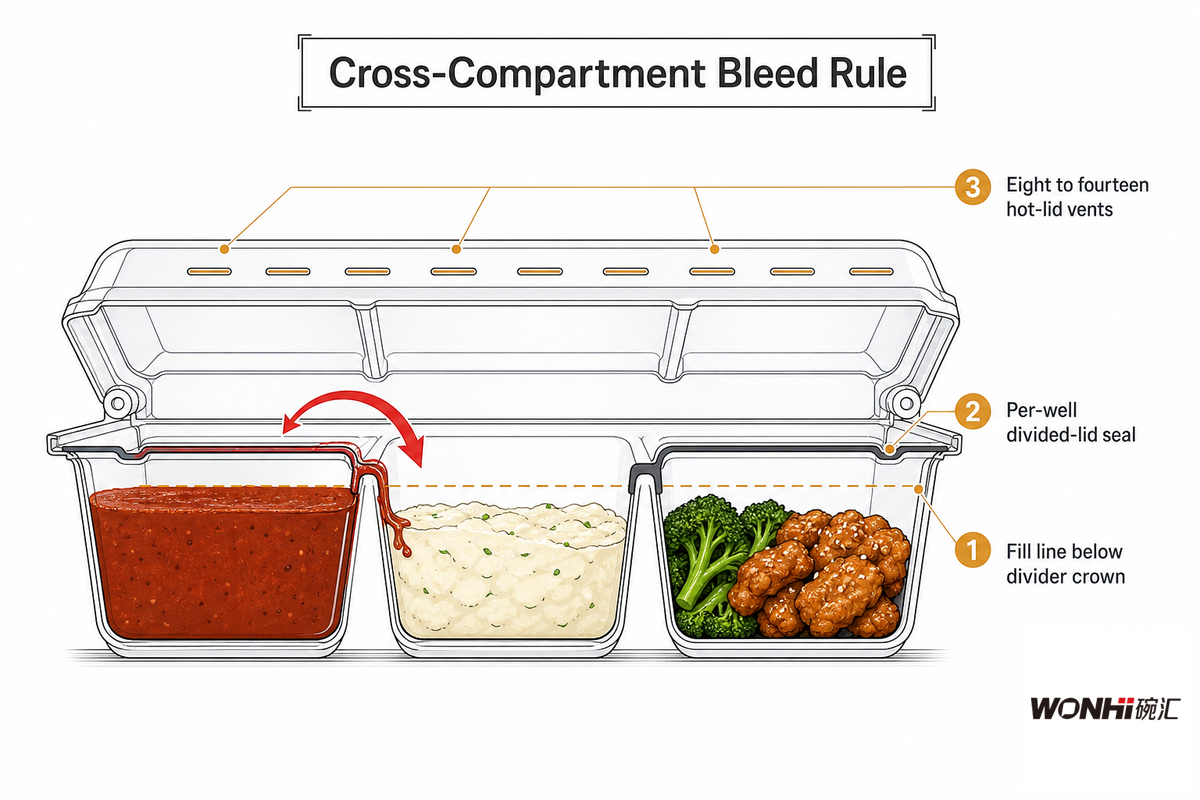
Cross-compartment bleed – dressing or sauce migrating from one well into the next – is the top complaint on divided containers, and it’s a lid-seal problem far more than a divider-height one. Most 3-compartment SKUs ship a lid that seals the outer box but not each interior well, so a tilt in the delivery bag lets liquid run over the dividers.
As one meal-prepper put it, “the lid doesn’t seal the compartments from each other, so my hummus leaked out over everything else.”
The Cross-compartment Bleed Rule: Fill to below the divider height, use a divided lid that seals the interior wells independently, and vent lids on hot-food items.
📐 Engineering Note: Over-sealing a hot container makes leaks worse, not better. Trapped steam builds vapor pressure that pops single-tab friction locks — lids engineered for cold grab-and-go — once thermal expansion hits. Venting is the general fix: USDA food-safety guidance is to loosen or vent the lid so steam can escape rather than build pressure. One food-container patent (Anchor Packaging, US20100320210A1) discloses 8 to 14 top-surface vents as its tested optimum, placed on the lid top rather than the sides to avoid a dead-air effect — a useful engineering reference point, not a universal performance threshold. For hot, fried, or rice dishes a vented lid is the more leak-proof choice; reserve non-vented perimeter locks for soups and sauces.
If the shipment is right, we can focus on another half that’s manufacturing consistency. Cheap divided PP often comes with misshapen lids that won’t close straight out of the box- one buyer had ten containers and “not a one closes.” On Wanhui’s 993 line the entre well is 38 mm deep and side wells are 32 mm, with 0.55-0.65 mm wall gauged on the line so the divider remains durable and maintains its shape through a reheat rather than relaxing into the neighboring well.
Sizing by Operation Type: The Operation-Type Spec Selector
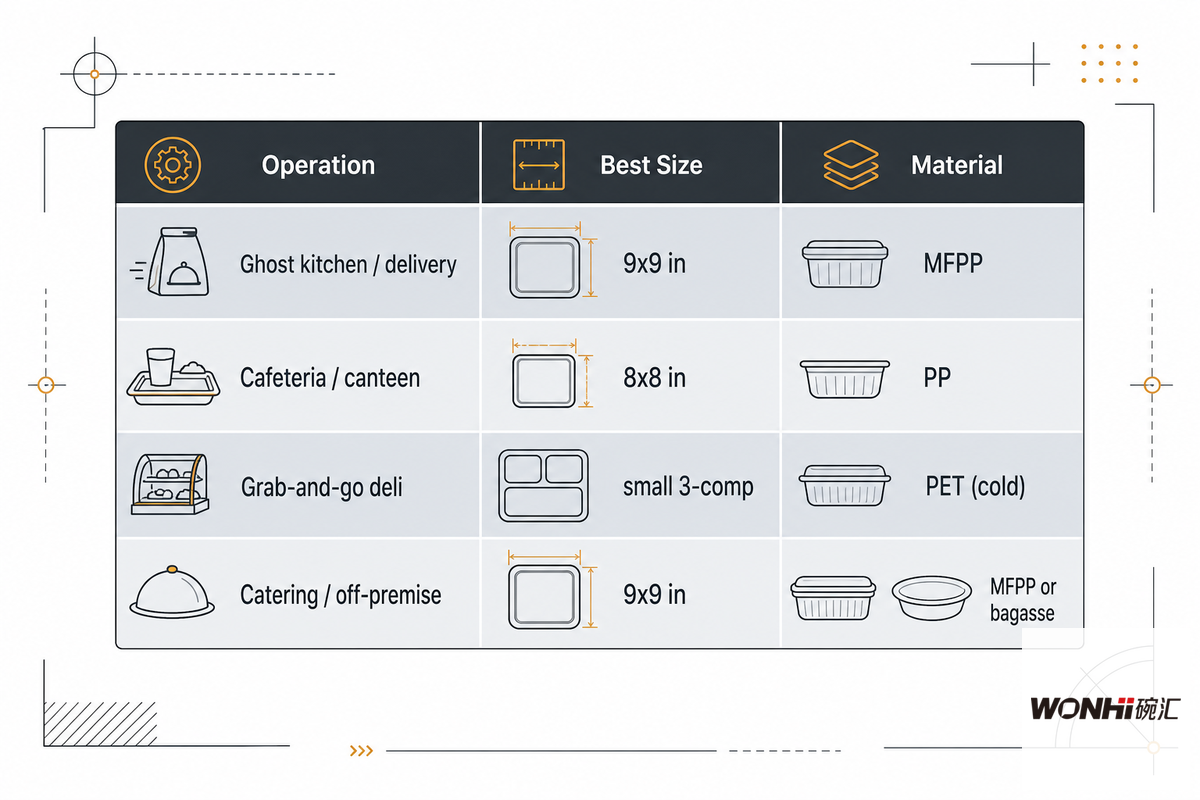
The Operation-Type Spec Selector reads the other way from the material table- begin with what you run, and it gives you the count, material, footprint and the one compliance flag you can’t skip. It’s designed for the five off-premise operations that buy 3-compartment trays in volume.
| Operation | Material | Footprint | Watch for |
|---|---|---|---|
| Ghost kitchen (hot delivery) | Black PP / MFPP | 9×9 in | Vented perimeter-lock lid; survives 30–60 min bag time |
| School / hospital canteen | MFPP | 8×8 in | Reheat-on-line rating; portion consistency |
| Catering / events | MFPP or bagasse | 9×9 in | Stack height; venue compost mandate |
| Meal-prep delivery | PP (freezer-safe) | 8×8 in | Freezer + microwave dual duty; tamper seal |
| Retail grab-and-go | Clear PET | 9×6 in | Cold-chain only; clarity sells the food |
Footprints reflect Wanhui 3-compartment common tooling; match capacity with the compartment material decider.
Whether operators call them takeout containers or 3-compartment meal prep containers with lids, the divided format is built to make portioning easy across a shift. Practical details still matter too: a spacious yet lightweight tray that stacks tight, is easy to clean if it sees a reuse cycle, and helps staff measure portions consistently is what keeps a busy line convenient.
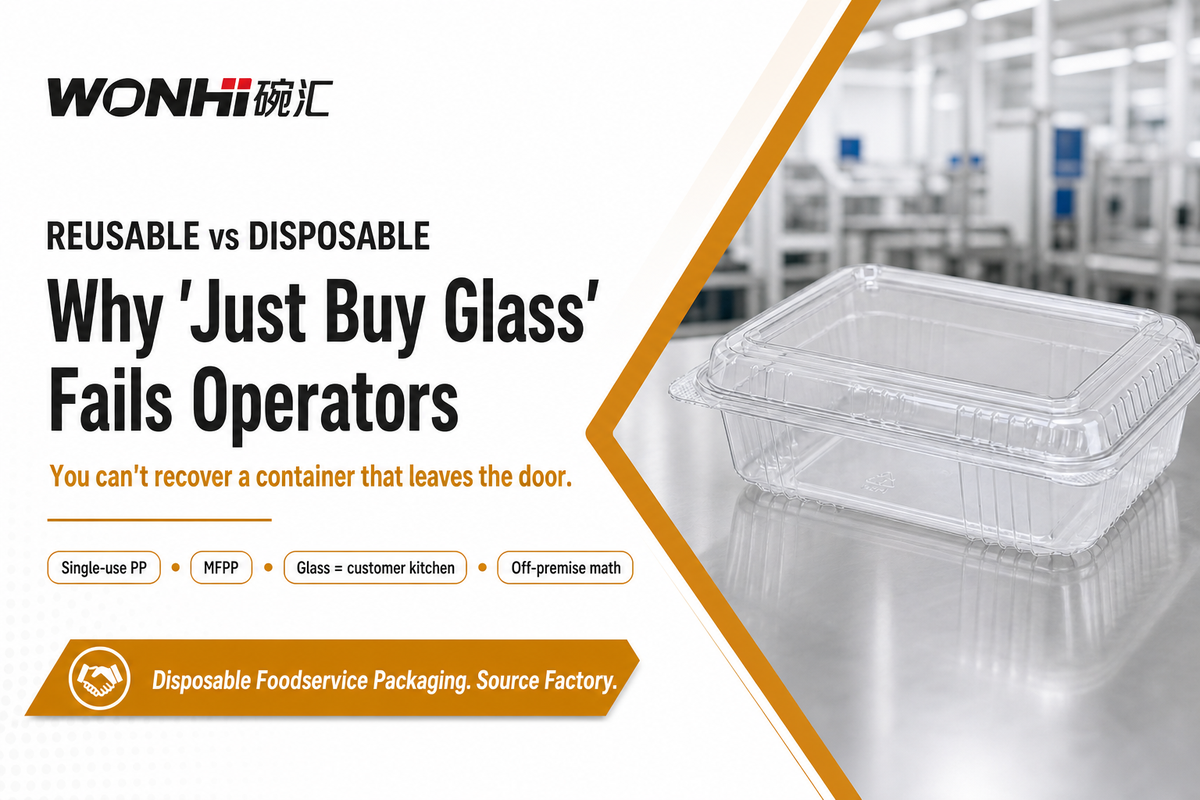
Reusable vs Disposable (and Why “Just Buy Glass” Isn’t the Answer for Operators)
What is the healthiest container to store food in?
For direct food contact, the safest disposable choice is BPA-free, food-grade polypropylene (PP #5) for hot food or PET for cold, both cleared under FDA 21 CFR 177.1520; food-grade PP is inherently BPA-free because it is polymerized from propylene and contains no bisphenol-A.
Glass and stainless work well for personal reuse, but they answer a different question than a foodservice operator’s. A restaurant passing food out the door can’t recover a reusable container, so single-use PP/MFPP that reheats and maintains a seal is the practical “healthy” option; glass and steel belong in the customer’s kitchen, not the delivery bag.
✔ Disposable PP/MFPP wins when
- Food leaves your premises and won’t come back
- Throughput is high and labor to wash is scarce
- You need microwave-safe, freezer-safe, stackable at low unit cost
⚠ Reusable glass/steel wins when
- A closed-loop or dine-in program recovers the container
- The end user is a consumer meal-prepping at home
- Long-term reheat with zero warping matters more than unit cost
Home meal-preppers reaching for reusable meal prep containers or 3 compartment glass containers are solving a different problem; those stackable sets keep food organized in the fridge across a week, while a foodservice tray optimizes for one trip out the door. We make disposable foodservice containers, not glass or steel, so we’ll tell you frankly: if your operation can function in a real reuse loop, a glass set may be better for that segment of volume. For everything that leaves the door, spec disposable by use-case and stop paying a premium for a feature the channel can’t use.
Compliance & Supplier Vetting: Foam Bans, PFAS, and FDA Food-Contact
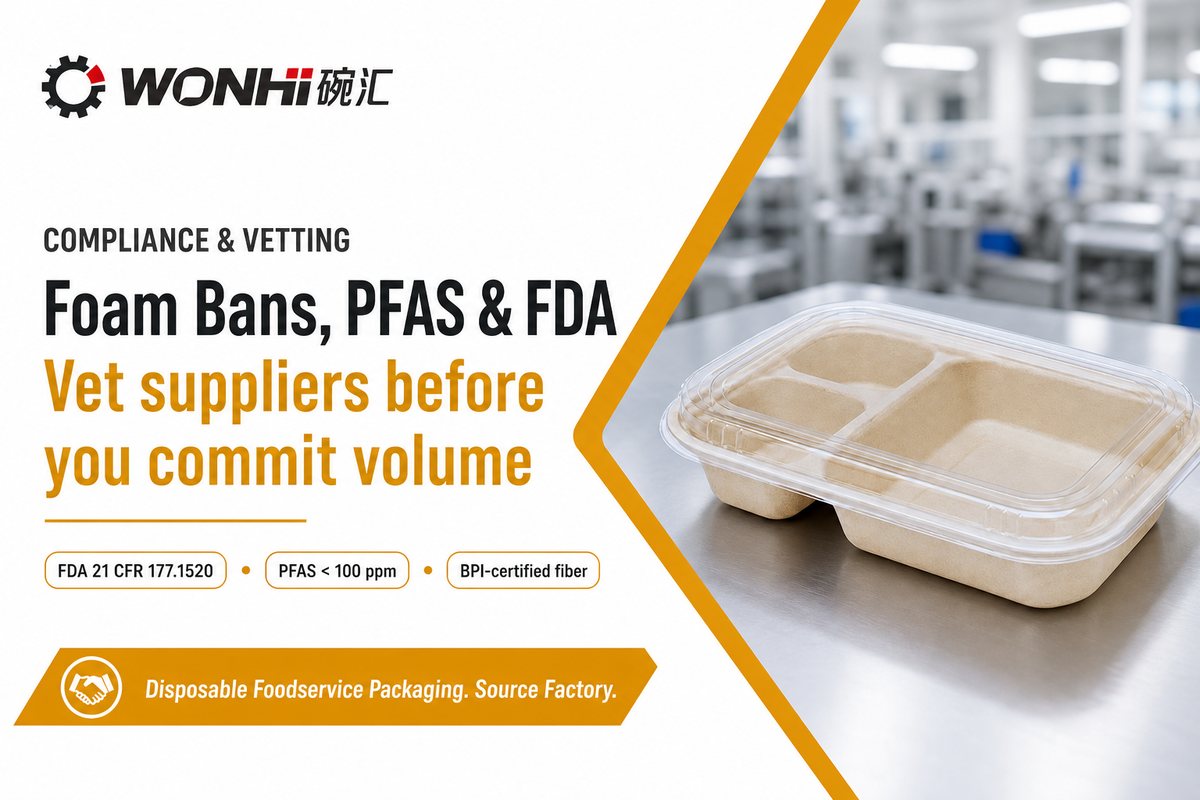
This is the section that the product pages omit, and where a faulty order become a legal issue. Three factors determine whether your 3-compartment container is safe to buy: the foam regulations in your state, the PFAS status of anything “compostable,” and the food-contact documentation your supplier can actually provide.
Foam bans are now a purchasing constraint
Expanded-polystyrene (EPS) foam foodservice ware is legislated out across an increasing number of states – Maine first in 2019, followed by NJ, NY, MD, OR, WA, VT, CO, RI and DE. California is the sharpest case: underSB 54, EPS foodservice ware had to prove a 25% recycling rate by 1 Jan 2025. It failed that standard, so sale, import, and distribution into California is now prohibited, and the Attorney General’s advisory cites penalties up to $50,000 per day, per violation. The regulated “producer” can reach beyond the manufacturer to some importers and distributors, though CalRecycle notes small-business exemptions and the sell-through of legally acquired stock, so sourcing compliant PP, MFPP, PET, or bagasse rather than foam is now part of vetting itself. Confirm your own standing rather than assume it. SB 543 (OR) also became effective this same month.
“Compostable” is not the same as PFAS-free
Plant-fiber and bagasse packaging historically held some of the highest PFAS “forever chemical” concentrations of any food packaging since there’s no natural grease barrier, so manufacturers coated it to create one. Labels mean nothing, certifications do. Seek BPI Certification, since 1 Jan 2020, this requires max 100ppm total organic fluorine and a signed statement certifying that no intentionally added fluorinated chemicals have been used. Also look for underlying ASTM D6400 / D6868 standards for compostability. Many independently tested packaging marketed as compostable exceed the 100ppm fluorine mark; demand a lab report, not a logo.
⚠️ Supplier vetting checklist: ask for (1) an FDA 21 CFR 177.1520 material declaration, (2) a Declaration of Compliance shipped with the order, (3) independent migration-test reports, and for eco lines, (4) current BPI certification with the fluorine test result. Sourcing veterans put it bluntly: “food safe in China isn’t always food safe” — demand batch-specific documentation rather than a generic “food grade” claim. Wanhui ships a Declaration of Compliance and migration test reports with every order from its auditable plant in Linyi, Shandong.
Buying in Bulk: Distributor Markup vs Factory-Direct
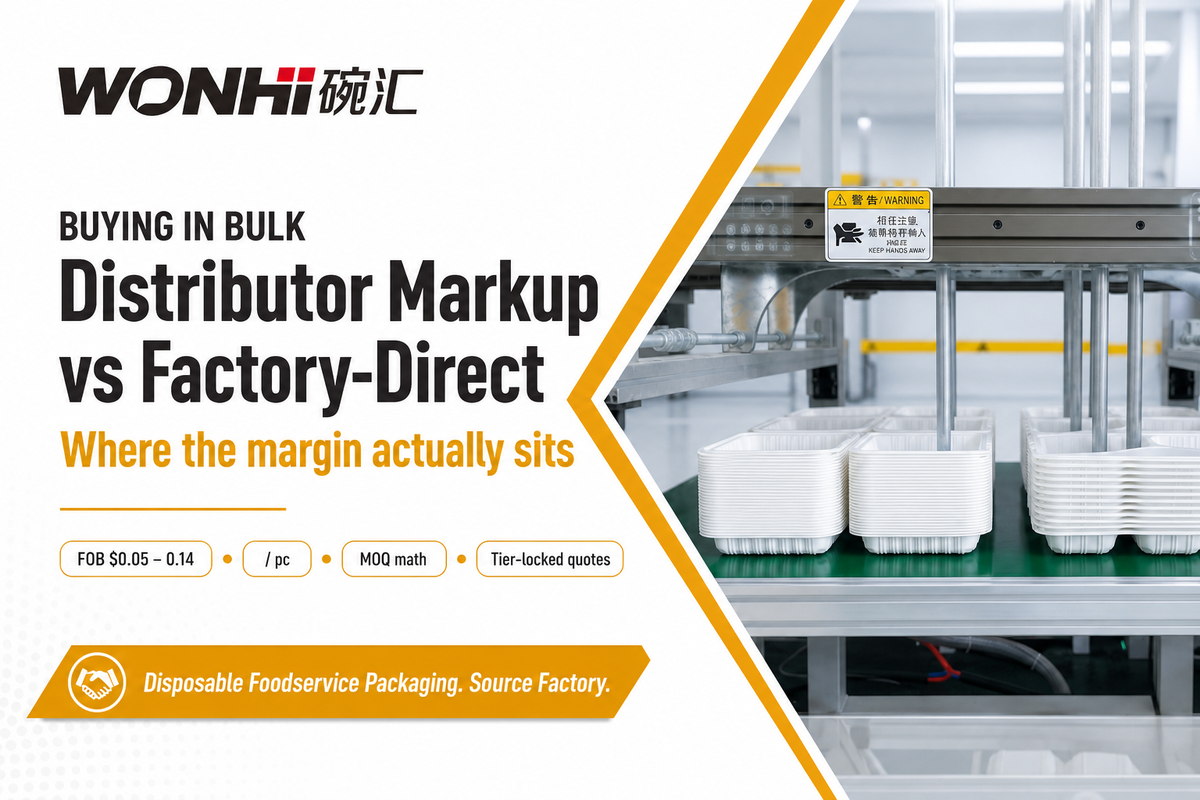
The true cost challenge isn’t sticker price but how many layers of margin sit between the mold and your stockroom. Hinged 3-compartment trays run roughly $0.05-$0.14 per piece ex-factory FOB, while comparable 9×9 trays at US distributors are commonly cited at $0.18-$0.59 per piece depending on size and material. That three-to-ten-times spread is distributor margin, freight, and warehousing, not a difference in the container.
That’s not to say that direct sourcing is automatically a money-saver. It trades the distributor margin for ocean freight, import duty and a minimum purchase order, so unless you’re a major buyer, the numbers don’t flip in favor of going direct until you hit a volume threshold. Key drivers of your landed price:
What moves your landed cost
- Material familyinjection PP is the baseline; bagasse and in-mold labeling add cost.
- Volume tierper-piece price and freight-per-unit both fall sharply with case count.
- Customizationlogo printing adds a one-time setup; a custom mold adds tooling and a 4–6 week lead.
- Destinationocean freight and the import duty stack, quoted line by line so nothing hides in a bundled “delivered price.”
It’s already true today: many operators price 3 compartment food containers wholesale across the major distributors – Restaurant Depot, Sysco, US Foods, Webstaurant – whether for a chain rollout or a single case of 3 compartment meal prep containers, and some even seek China-direct sourcing to strip out the manufacturer-to-distributor margin. Beware that the price premium for avoiding direct shipping will always be on “the other” end – verification – not price. If you consolidate volume to clear an MOQ, factory-direct on wholesale food containers can beat distributor stock; below that line, a distributor may be simpler. Ask any supplier for a tier-locked, itemized quote before you switch.
What’s Changing in 2026: Foam Bans, PFAS Rules, and Format Consolidation
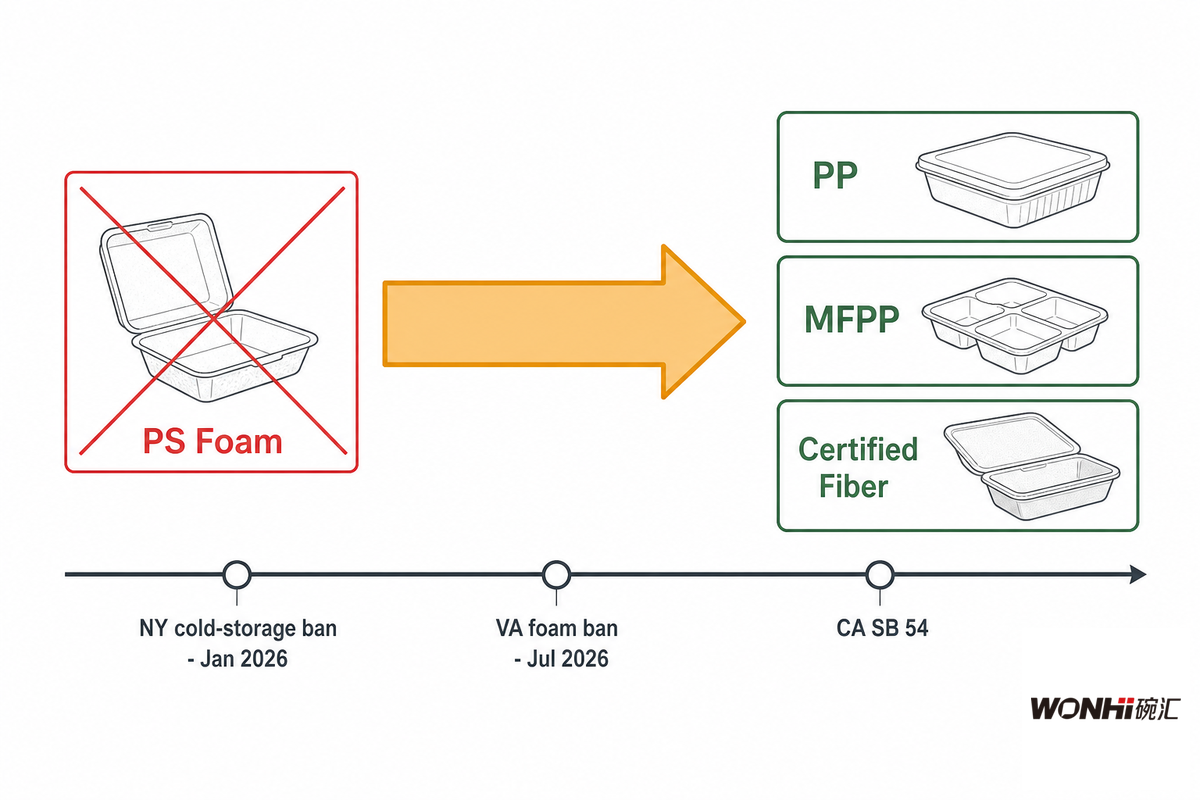
Don’t “plan” for 2026 orders by looking at a market growth chart – your purchasing decisions for the coming year will be dictated by regulations, not by expanding off-premise dining. Polystyrene bans are proliferating: since 2025 at least nine states have moved to ban expanded polystyrene, Virginia bans foam across all food vendors on July 1, 2026, and New York extended its ban to cold-storage containers on January 1, 2026.
The federal “Farewell to Foam Act” was reintroduced the same year, and it all amounts to a necessary, unavoidable pivot away from foam toward PP, MFPP, and certified fiber alternatives.
PFAS chemicals present the second front: More than 350 PFAS-related bills moved through the legislative pipeline across 39 states in 2025, and California’s AB 1201 (in effect June 30, 2027) will redefine what’s accepted as truly “compostable” – forcing suppliers to classify any “compostable” product as organic input, thereby effectively prohibiting a broad range of plastic alternatives. Adding to the pressure, the USDA voted in 2026 against the inclusion of synthetic compostable-plastic feedstocks in federally approved compost standards. Add in extended producer responsibility fees that are now implemented in seven states, and these harder-to-recycle formats actually become more expensive – not less – to handle.
For unprepared buyers, the risk is real. One Virginia operator publicly projected roughly $115,000 more per year on to-go packaging alone after switching off foam, a single operator’s own estimate, but a concrete illustration of the cost shock a late switch invites. For your 2026 purchasing, now is the time to secure compliance in the form of PP/MFPP for hot applications and certified fiber where local composting infrastructure exists to support its responsible end-of-life, and where local organics collection does accept it, composting meaningfully cuts landfill methane, so the fiber choice earns its premium there. Rather than be caught out, secure the compliant material now and plan your order around regulatory milestones, not a forecast for market growth.
Frequently Asked Questions
Q: What size is a 3-compartment container?
View Answer
Dominant foodservice sizes are 8×8-inch and 9×9-inch square hinged trays, plus a 9×6-inch rectangular option. A typical 9×9 splits into about an 850 ml entrée well and two 350 ml side wells, roughly a 32–48 oz total capacity. Compartment depth commonly runs near 38 mm for the entrée well and 30–32 mm for the sides. Smaller lunch-box formats drop to about 6×6 inches for single sides or snack portions, while catering calibers scale up to 250 mm. Because the interior layout is fixed by the mold and differs by SKU, confirm the exact well dimensions — not just the outer footprint — against your portion sizes before committing to a case.
Q: Are 3-compartment containers dishwasher-safe and reusable?
View Answer
PP and MFPP containers only withstand a few cycles through commercial dishwashers before losing their seal, so can be re-used a time or two but were never intended to be more than disposable foodservice. PET can not be used in a dishwasher at all, while PLA and paperboard should only be used one time. If multi-use is really the objective, glass should be the material; foodservice PP was designed for flow-through rather than infinity use.
Q: Why do some 3-compartment containers arrive with equal-size wells when the photo showed one big and two small?
View Answer
Compartment layout is fixed by the mold cavity and varies by SKU; some 3-compartment tools are one-large-plus-two-small, others are three equal wells. Catalog photos are not a reliable guide, and buyers regularly report receiving an equal-well tray after ordering from an image that implied an unequal split. Verify the compartment-dimension table on the spec sheet, and request a physical sample, before you standardize a case order.
Q: Where can I buy 3-compartment containers in bulk?
View Answer
You may buy from your broadline distributor, or direct from factory if your volume exceeds the minimum quantity then insist on an itemized tier locked price to evaluate the total landed cost.
Q: Is foam (Styrofoam) still legal for 3-compartment takeout?
View Answer
Not in a growing number of jurisdictions. EPS foodservice foam is banned or restricted in a dozen-plus states — including California (a de facto ban under SB 54), New York, Maine, Maryland, New Jersey, Oregon, and Washington, and, from July 1, 2026, all of Virginia. Rigid PP, MFPP, PET, and bagasse are not foam and remain legal, which is why compliant operators switch to those materials. Always confirm your local rule before ordering.
Q: What is a 3-compartment Tupperware?
View Answer
“Tupperware” is a consumer reusable brand; in foodservice the equivalent is a disposable 3-compartment PP or MFPP tray with a divided lid. The function is the same — separate an entrée from two sides — but foodservice buys single-use, food-grade PP by the case rather than a reusable household set.
Why We Wrote This
Wanhui runs 86 in-house lines producing PP, MFPP, PET, and bagasse foodservice containers, including 3-compartment 883 and 993 trays. The specs, well depths, and material behavior in this guide come from our own production-line records and the FDA, EPA, CalRecycle, BPI, and patent sources cited above, not from a catalog. Reviewed by the Wanhui packaging team.
References & Sources
- 21 CFR 177.1520, Olefin polymers (food-contact)U.S. Electronic Code of Federal Regulations
- Composting & wasted food dataU.S. Environmental Protection Agency
- Quantifying Methane Emissions from Landfilled Food WasteU.S. EPA (2023)
- SB 54 Packaging EPR / EPS provisionsCalRecycle
- SB 54 Foam Ban Enforcement AdvisoryCalifornia Office of the Attorney General
- Polystyrene foam ban (SB 543)Oregon DEQ
- Fluorinated chemicals / 100 ppm total fluorine standardBiodegradable Products Institute
- ASTM D6400 / D6868 compostable productsUS Composting Council
- Food container having improved ventilation (US20100320210A1)Anchor Packaging, patent literature
- New composting access data (2025)Sustainable Packaging Coalition
- Cooking Safely in the Microwave OvenUSDA Food Safety and Inspection Service