Get in touch with Wanhui Company


10 US fluid ounces equals 1.25 US cups, or 1¼ cups. If you mean 10 ounces by weight, the answer depends on the ingredient. For example, flour, sugar, and chocolate chips, among others, don’t occupy the same volume in a cup at the same weight.
“How many cups is 10 oz?” has one main ambiguity: is the recipe referring to oz by weight or fl oz? In this conversion guide, we cover those measurements, give the 300 mL example, and explain how to check a container for a measured portion.
- For US liquid volume, divide the total fluid ounces by 8.
- For an ingredient weighed in ounces, use a kitchen scale or its recipe-specific conversion.
- For a container, check the stated capacity and the actual lid fit.
How many cups is 10 oz? The US liquid answer
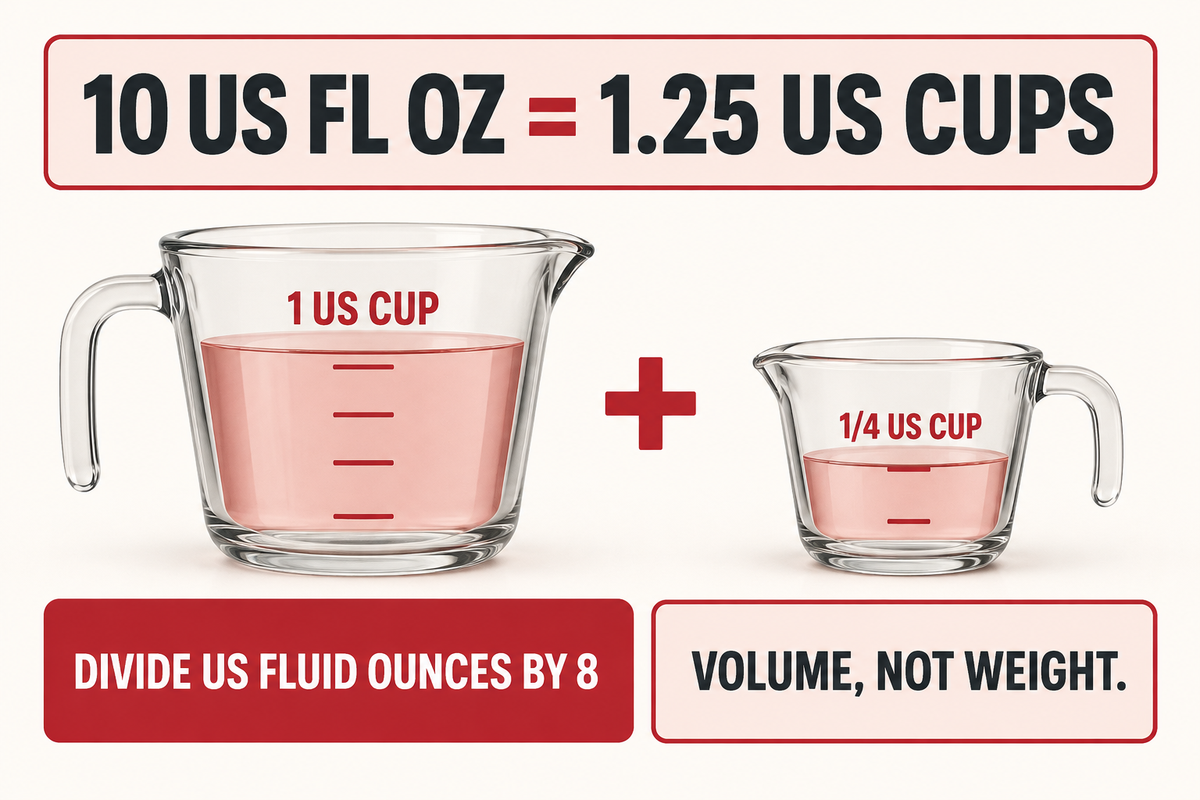
10 US fluid ounces is 1¼ US cups. In US customary units, 1 cup equals 8 fluid ounces, so the conversion is 10/8 = 1.25. A volume measurement shows how much space a liquid occupies rather than how much it weighs.
The NIST household measurement table gives relationships between cup and fluid-ounce units. Apply the ratios in the following way to convert fluid ounces, keeping the units shown:
| US fluid ounces | US cups | US tablespoons |
|---|---|---|
| 2 fl oz | ¼ cup | 4 tbsp |
| 4 fl oz | ½ cup | 8 tbsp |
| 6 fl oz | ¾ cup | 12 tbsp |
| 8 fl oz | 1 cup | 16 tbsp |
| 10 fl oz | 1¼ cups | 20 tbsp |
| 12 fl oz | 1½ cups | 24 tbsp |
| 16 fl oz | 2 cups | 32 tbsp |
| 20 fl oz | 2½ cups | 40 tbsp |
| 24 fl oz | 3 cups | 48 tbsp |
To figure how many ounces are in a cup, use fluid ounces for this volume conversion; every cup in this chart is a measuring unit and not a drinking glass. To convert cups to ounces of liquid, multiply US cups by 8.
Fluid ounces and ounces by weight
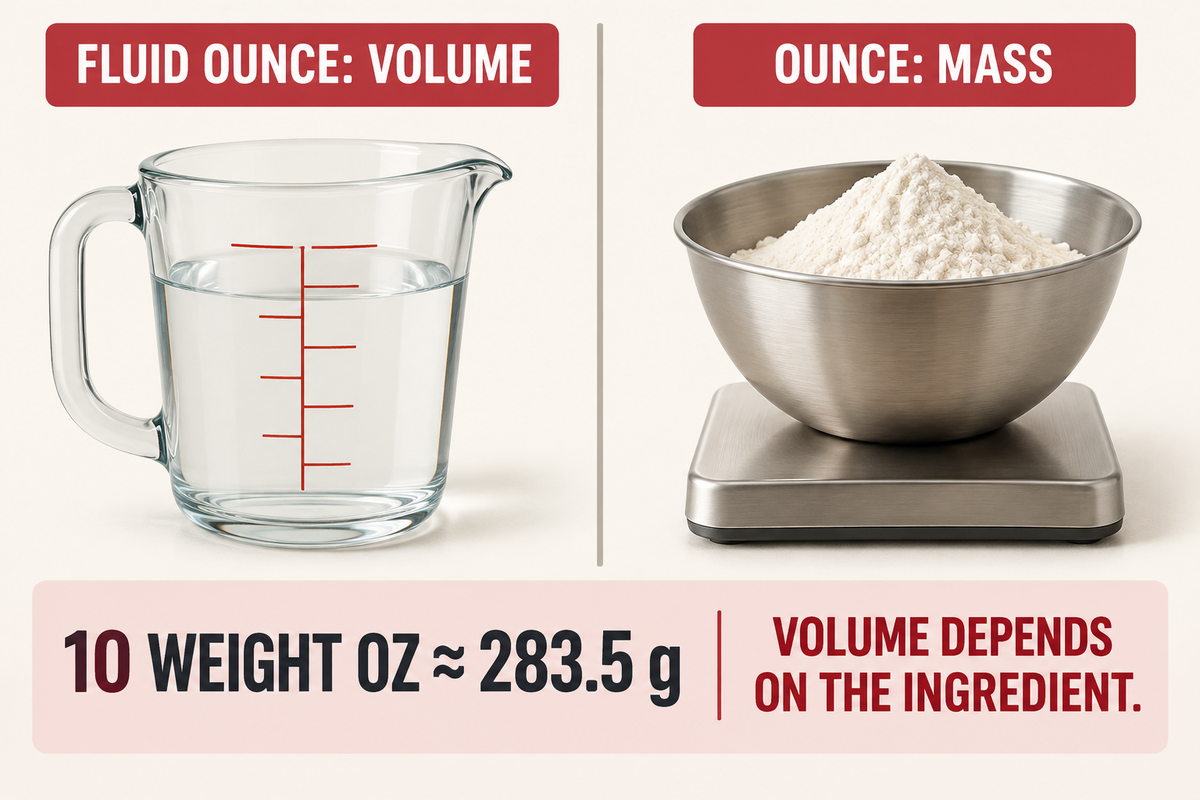
One fluid ounce measures volume. One ounce, on the other hand, measures mass. Ten avoirdupois ounces is about 283.5 grams, regardless of whether the ingredient is flour, cheese or milk. Its volume changes with the ingredient. Using the number of ounces shown on a scale as if it were a liquid measuring-cup reading gives the wrong conversion.
“A common error is to mistake fluid ounces for ounces by weight.”
Dry measuring cups and liquid measuring cups are used to measure volume. Use a dry measuring cup to measure ingredients that can be levelled across the rim; use a clear jug to measure liquids at the marked line. Similarly, fluid ingredients can also be weighed if the recipe requires it.
If a scale shows 16 ounces, it gives a weight measurement. To measure the volume instead, you need the ingredient’s density or a vessel with an appropriate marked line. A cup of water and a cup of oil occupy the same volume, but have different weights. The weight of an item can’t be read from its apparent size.
How many dry cups are in 10 ounces?
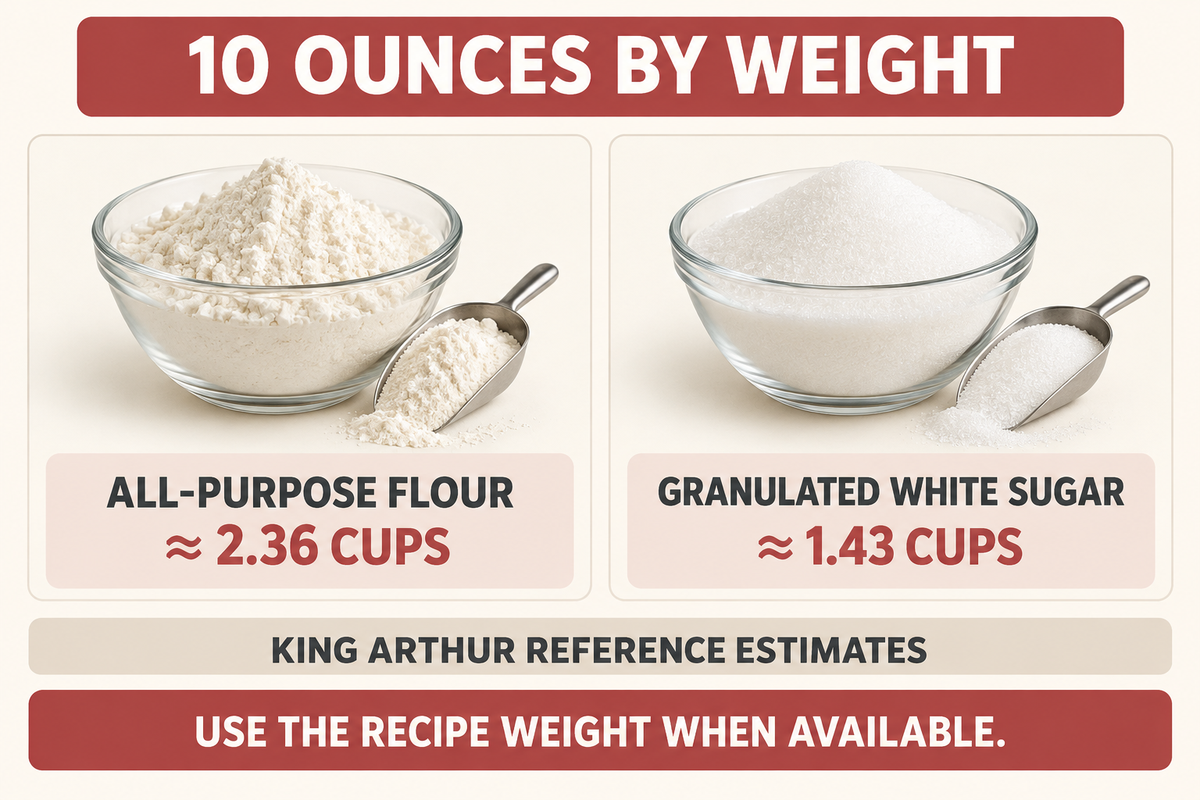
Using King Arthur Baking’s reference weights, 10 ounces of all-purpose flour is approximately 2.36 cups, while 10 ounces of granulated white sugar is approximately 1.43 cups. These are approximate values based on named gram-per-cup values, since the weight of a cup depends on the ingredient. For cooking and baking, use the weight provided by the recipe if it’s available.
The King Arthur ingredient weight chart is referenced below. To convert ounces to cups, convert the 10 weight ounces to approximately 283.5 grams and divide this by the amount listed for grams per cup. Don’t mix the rounded ounce column and gram column in the same calculation.
| Ingredient and condition | Reference grams per cup | 10 weight oz, approximately |
|---|---|---|
| All-purpose flour | 120 g | 2.36 cups |
| Granulated white sugar | 198 g | 1.43 cups |
| Brown sugar, packed | 213 g | 1.33 cups |
| Confectioners’ sugar, unsifted | 113 g | 2.51 cups |
| Chocolate chips | 170 g | 1.67 cups |
| Mini chocolate chips | 177 g | 1.60 cups |
| Oats, old-fashioned or quick-cooking | 89 g | 3.19 cups |
| Unsweetened cocoa | 84 g, derived from 42 g per ½ cup | 3.38 cups |
| Butter | 226 g, derived from 113 g per ½ cup | 1.25 cups |
Worked Example: converting 10 ounces of flour requires 283.5 divided by 120 which is equal to 2.3625 cups, rounded to 2.36 cups. For precise measurements, weigh the flour; scooping and settling affect the amount you collect when you measure dry ingredients by volume.
For ingredients like flour, Texas A&M’s measuring guidance advises fluffing, spooning into the cup, and leveling the top. Pack brown sugar when a recipe calls for packed sugar. “Dry ounces” is still ounces by weight; it isn’t a separate, universal cup conversion.
How many cups is 10 oz of cheese?
Weigh 10 ounces of cheese for the specified amount; there is no single cup equivalent because cheese type and preparation affect the volume. When translating the weight to cups, a cheese-specific reference must be used.
The same is true for other ingredients that are hard to measure evenly, such as large chocolate chunks.
10 oz vs 300 mL: US and metric cup measurements
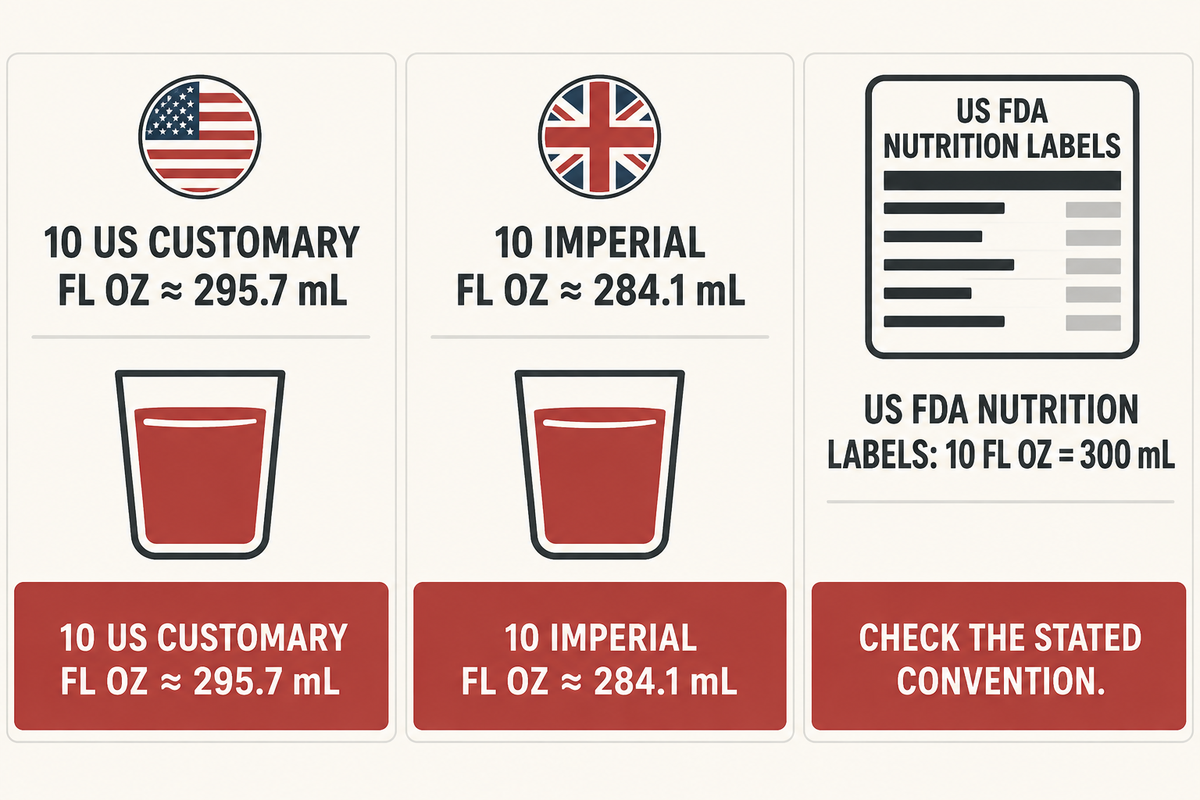
Ten US customary fluid ounces is about 295.7 milliliters, so 300 mL is slightly more: about 1.27 US cups. If your cup is marked 250 mL, 300 mL will fill about 1.2 of those cups. Before choosing a denominator, check the measurement used on the tool or in the recipe.
According to the NIST conversion-Factor Table, one US fluid ounce is about 29.57353 mL, and a US cup is about 236.5882 mL. In this case, we multiply by the first factor to convert ounces to milliliters, using US fluid ounces as the input. The metric system expresses the resulting volume in mL; it does not make every cup the same size.
Both the US customary and Imperial systems of measurement use their own types of fluid ounces. NIST states that an Imperial fluid ounce is about 28.41306 mL, and thus, 10 Imperial fluid ounces is approximately 284.1 mL. The country alone doesn’t determine the size of a cup: follow its stated unit of measurement.
Nutrition-label exception: FDA guidance for US nutrition labelling uses 240 mL per cup and 30 mL per fluid ounce. Under that convention, 10 fl oz corresponds to 300 mL.
Measuring cups and tablespoons: how to measure 10 fl oz
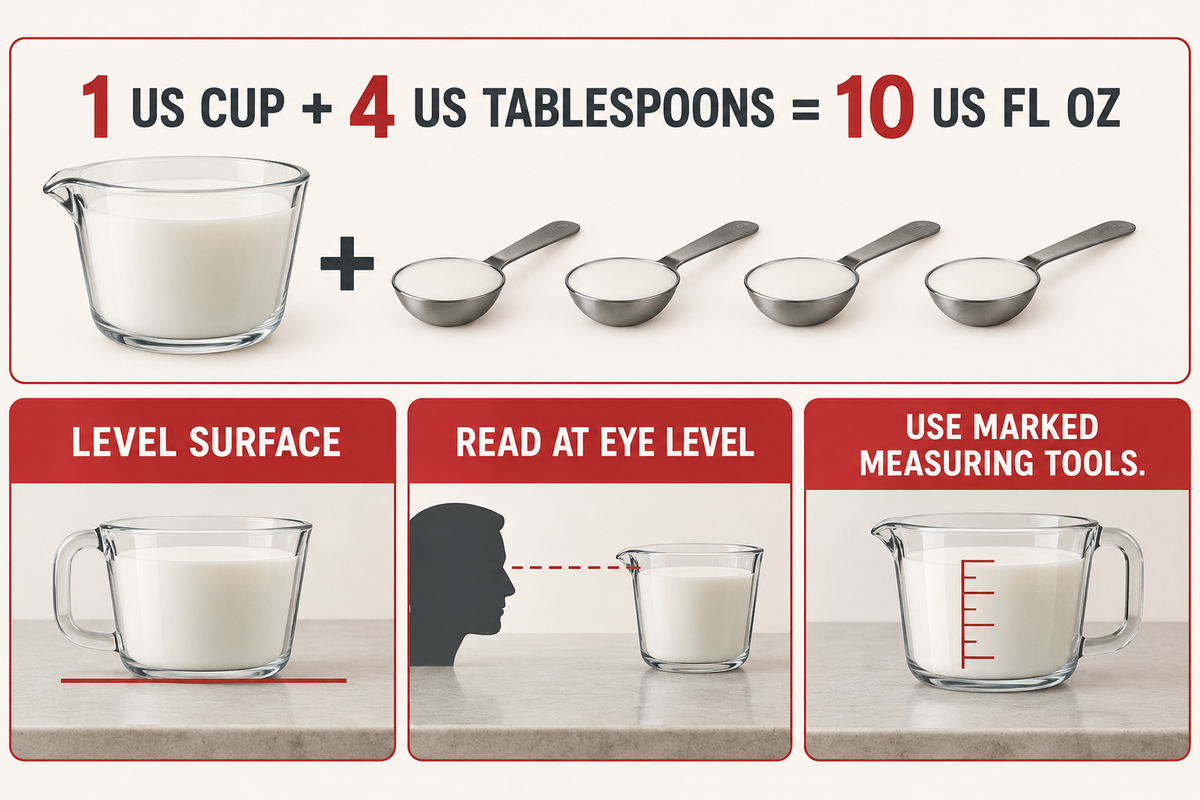
One full US cup plus four US tablespoons equals 10 US fluid ounces. See the NIST household measurement table for these US-unit ratios. Four tablespoons is a quarter cup, and since one tablespoon is 1/16th of a cup, a quarter cup is measured by four tablespoons. Use standard measuring spoons and a marked liquid measuring cup when measuring ounces and cups of liquid; ordinary eating spoons and drinking cups have no assured capacity.
How do I measure 10 ounces of liquid?
For 10 US fluid ounces, place a liquid measuring cup on a level surface and pour to its 10 fl oz line, reading at eye level; for 10 ounces by weight, tare a container on a scale and weigh the liquid.
A one-cup measure can also be filled once, followed by a quarter-cup measure. Read the intended mark rather than the jug’s rim. For small amounts of ingredients, one US tablespoon is equivalent to three US teaspoons.
For a recipe calling for 10 fluid ounces of milk, choose the volume method. The scale method would be used for a recipe with 10 ounces of milk by weight. Choosing fluid ounces or ounces by weight is more critical than whether the ingredient is pourable.
Choosing a container for a 10 fl oz portion
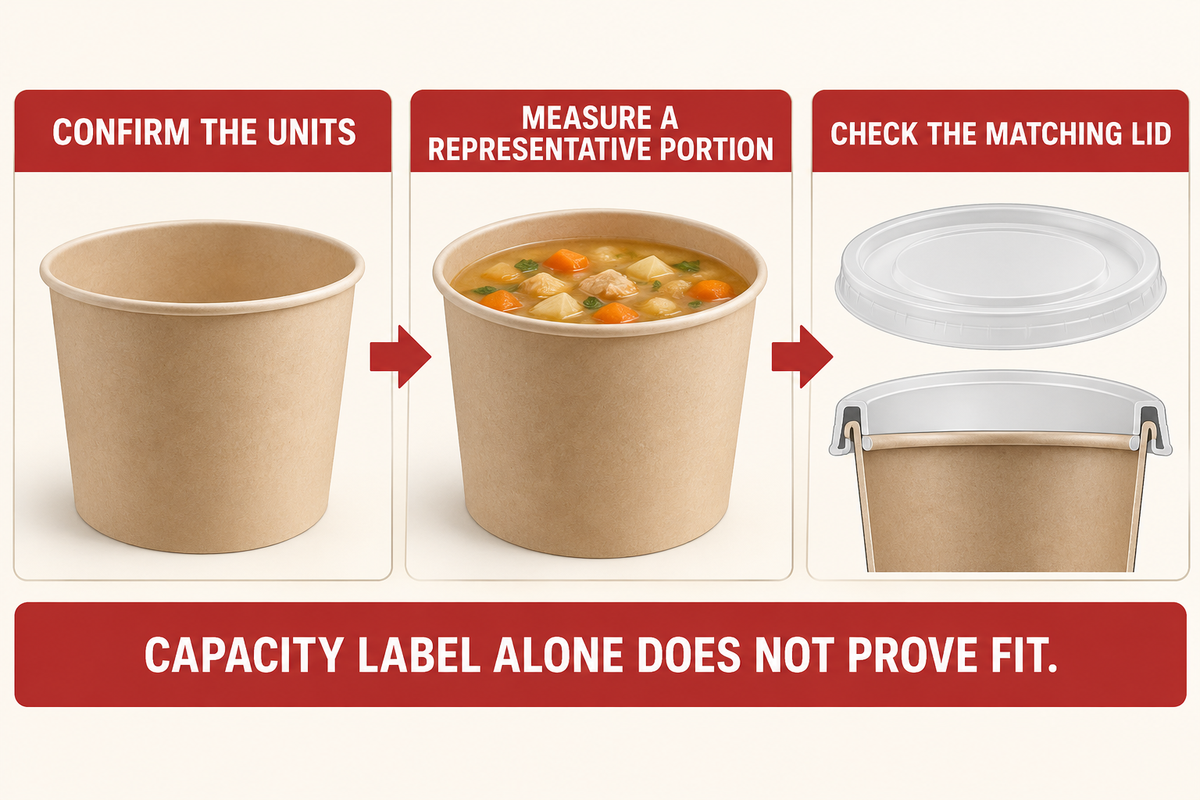
A container marked “10 oz” may state a nominal design volume or a brimful volume, so identify which capacity it states before using it for a 10 fl oz portion.
Cetie’s advice on glass packaging differentiates “brim-full” capacity from “nominal design” capacity and states that closures occupying space inside a container reduce headspace. Compare actual samples from the food container range against your portion. For smaller sauce servings, compare portion cup sizes and matching lids.
The 3-Step Unit, Fill and Lid Fit Check
Conduct a preliminary check on the sample against the actual food it will contain and the matching lid under the intended service conditions. Record each sample’s portion and lid fit so you can compare the results before ordering.
- Confirm the units. Record whether the portion is 10 US fl oz, 300 mL or 10 oz by weight, and ask how the supplier defines capacity.
- Measure the portion. Fill the sample with the specified amount and record the food, sample model and conditions; repeat the check consistently.
- Fit the intended lid. Check whether the food interferes with seating the lid or occupies the space needed by its underside.
Assumed-input example: suppose a sample’s measured brimful capacity is 12 US fl oz. Subtracting a 10 US fl oz portion leaves a theoretical 2 fl oz volume difference. That isn’t a measured gap height, a guaranteed lid clearance or a universal recommendation to buy 12 oz containers. The lid and food shape still have to fit.
For a smooth liquid, check the measured fill level. For chunky soup, use a representative portion containing both liquid and solids. For a food sold by weight, weigh the portion first, then check its actual occupied space. Remember, package names that include “10 oz.” don’t always mean that the food is sold by weight.
Initial fit also doesn’t prove suitability after a temperature change. University of Georgia guidance notes that most foods need expansion space when frozen, with exceptions. Follow the food’s instructions and the container’s intended use rather than applying one clearance to every product.
What to ask before ordering cups and containers
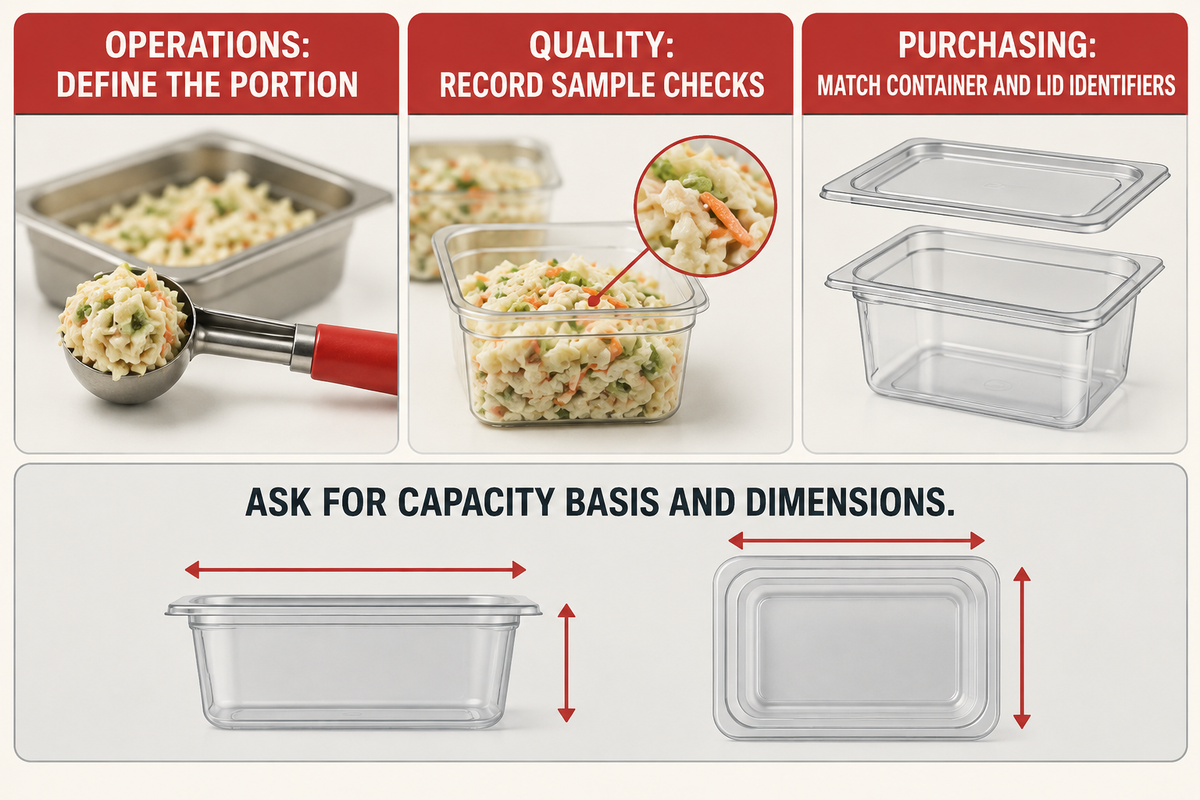
You should complete a portion requirement form and give it to the supplier before discussing a bulk order. A volume conversion cannot choose the material, dimensions or lid for you. Operations should define the portion; quality staff should record the sample checks; purchasing should confirm the same container and lid identifiers appear on the quotation.
Example request: “We serve 10 US fl oz of chunky soup. Identify the capacity basis and dimensions of the proposed samples as well as a lid that matches these samples. We’ll check the measured portion and the lid seating under our actual service conditions before deciding on the size.”
Refer to the wholesale food container guide for ordering questions. Inquire about delivery schedule, sample availability and required quantity separately. They can’t be determined from cup measurements.
What changing portion formats mean for cup selection
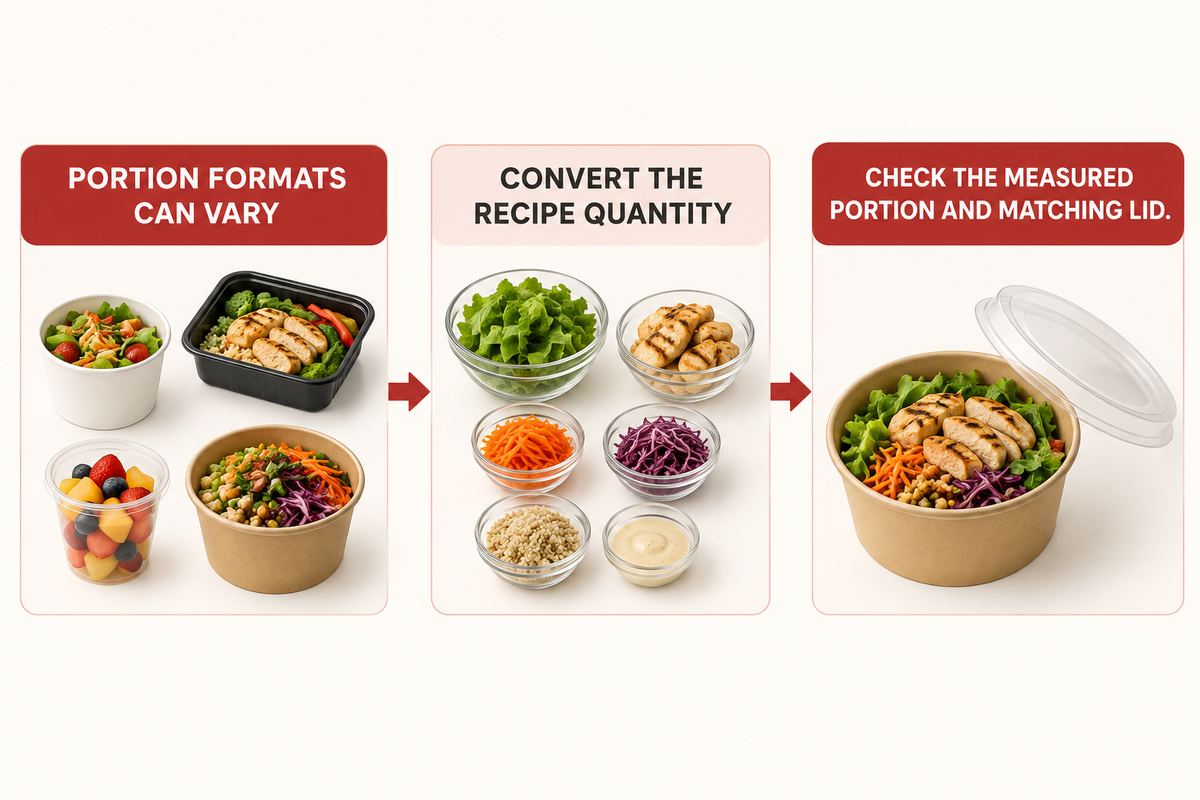
The conversion stays the same, while portions can vary. A January 2026 ReFED summary of Datassential research discusses customer interest in the customization of restaurant portion sizes.
If you decide to offer smaller soup or snack items on your menu, make sure to check fit and service with the cup you need, and not with respect to current market trends. You may need to convert its recipe quantity, but that is only the first step. For food service, take the next step with a measured portion and a matching lid. Contact Wanhui to provide information regarding your portion and container in order to obtain samples for your checks.
FAQ
Is 2 cups 10 oz?
Two US cups equal 16 US fluid ounces, so they hold more than 10 fluid ounces. To measure 10 fluid ounces, use one full US cup plus one quarter cup. This comparison describes liquid volume. If the ounces on your recipe or package refer to weight, you need an ingredient-specific conversion instead.
Is 10 fl oz half a cup?
Ten US fluid ounces is one and a quarter US cups, not half a cup. Half a US cup contains four US fluid ounces. Check that your measuring jug uses US units before reading the markings, because an Imperial fluid ounce and a 250 mL metric cup belong to different measurement systems.
Is 10 oz the same as 1 1/4 cup?
Yes, when the amount means 10 US fluid ounces and the cup is a US customary measuring cup. Eight fluid ounces make one cup, and another two make the quarter cup. Ten ounces by weight is a different measurement, so flour, sugar, cheese and other foods require their own weight-to-volume reference.
How many cups is 10 oz of water?
Ten US fluid ounces of water equals 1.25 US cups. If “10 oz” describes water weighed on a scale, use a weight-to-volume calculation instead; don’t treat a weight ounce as exactly one US fluid ounce.
How many cups is 10 oz of chocolate chips?
Using King Arthur’s reference of 170 grams per cup, 10 ounces by weight is about 1.67 cups of chocolate chips. The calculation is approximately 283.5 divided by 170. This estimate depends on the chip type: the same chart lists mini chips at a different weight per cup. For a recipe asking for 10 ounces, weighing the chips avoids rounding the cup estimate and avoids changing the amount when you substitute differently sized chips.
How big is a 10 oz cup?
A 10 US fl oz capacity is about 295.7 mL, but it doesn’t specify height or diameter. Cups with different shapes can have the same volume. Check the supplier’s dimensions and whether the capacity is nominal or brimful.
Can I use a 300 mL container for a 10 fl oz portion?
Don’t choose a 300 mL container on volume alone. A 10 US customary fl oz portion is about 295.7 mL, leaving only about 4.3 mL below a genuinely 300 mL brimful capacity. That arithmetic alone doesn’t show whether the lid seats properly or the food needs additional room. If the stated 300 mL is a working capacity instead, the situation differs. Ask for the capacity definition and test a representative portion before choosing.
Put the conversion to work
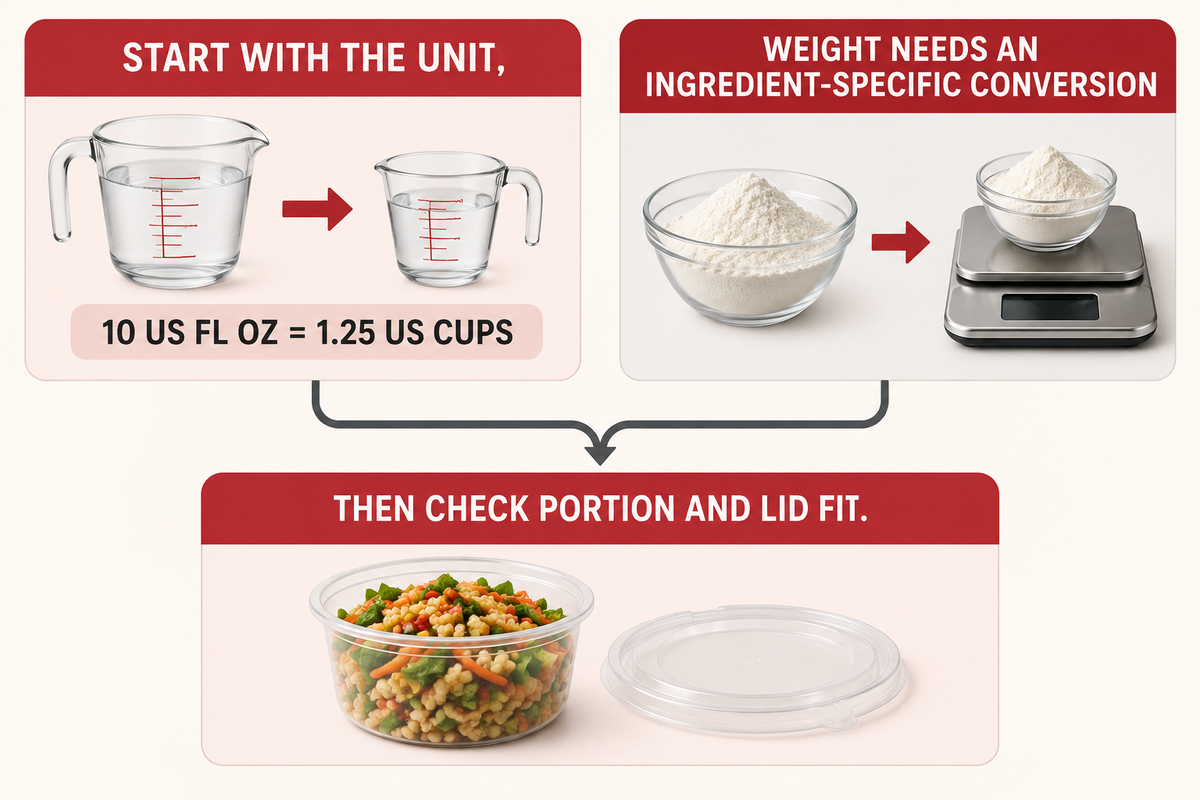
Start with the unit: 10 US fl oz is equivalent to 1¼ US cups, and 10 weight ounces requires an ingredient specific conversion. For foodservice, take the next step with a measured portion and matching lid. Send Wanhui your portion and container requirements to discuss suitable samples for your own checks.
Key takeaway
10 US fluid ounces equals 1.25 US cups; a container’s capacity label still needs a separate portion-and-lid fit check.
Related reading
References & Sources
- Metric Household, National Institute of Standards and Technology.
- Scaling Up Your Food Process, Oklahoma State University.
- Are You Measuring Ingredients Correctly?, Texas A&M AgriLife Extension.
- Appendix B.8 Conversion Factors, National Institute of Standards and Technology.
- Metric Equivalents of Household Measures, US Food and Drug Administration.
- Packaging Questions to Experts, Cetie.
- Packaging and Labeling Foods, University of Georgia.
- Research on Customizable Restaurant Portions, ReFED.
About this guide: Prepared by Wanhui using public measurement references and the ingredient chart identified above.